
TL;DR · 30-second read
The Short Version
- Argan builds power plants for other companies. Demand for electricity to run artificial-intelligence computing has made that a very good business.
- In the three months to July 31, Argan earned $53.3 million on sales of $384 million — the most in its history, and roughly 60% more revenue than a year earlier.
- But the value of work it has signed but not yet done fell to about $2.5 billion from $2.9 billion in January. It is finishing jobs faster than it is winning new ones.
- It also bought ValCor, a small Connecticut company that installs and repairs data cabling.
Argan, Inc. (NYSE: AGX) reported record results for its fiscal second quarter ended July 31, 2026, in a press release filed with the Securities and Exchange Commission as an exhibit to an 8-K on September 2. Consolidated revenue rose 61.5% year over year to $384.0 million and net income reached $53.3 million, or $3.76 per diluted share, against $35.3 million and $2.50 a year earlier. Adjusted EBITDA — earnings before interest, taxes, depreciation, amortisation and certain one-off items — was $70.0 million. The Power segment, which builds gas-fired and renewable generation, grew revenue 53% to $301 million at a 22% gross margin. Cash, cash equivalents and investments totalled $1.03 billion, with no debt, and consolidated project backlog stood at approximately $2.5 billion, down from about $2.9 billion at January 31, 2026.
Within the quarter Argan closed its acquisition of ValCor Communications, a Connecticut-based provider of installation and repair services for information, communication and data networks, which the company said broadens its Teledata segment’s reach into defense, aerospace and technology clients in the region. Simply Wall St, covering the quarter, framed the deal as part of an effort to reduce dependence on large gas projects and noted a wide spread among the fair-value estimates it tracks for the stock; those are third-party model outputs, not company forecasts.
Executive Summary
The headline numbers are unambiguous: this was the best quarter Argan has reported. Revenue grew across all three segments, gross margin expanded to 19.3% from 18.6%, and selling, general and administrative costs fell to 4.5% of revenue from 6.0% — classic operating leverage, where fixed overhead is spread across a much larger revenue base. Other income of $10.1 million, mostly investment income on the cash pile, added further to the bottom line.
The reason this matters beyond Argan’s shareholder register is what it says about the plumbing of the artificial-intelligence build-out. Argan is an EPC contractor — engineering, procurement and construction, meaning it designs a plant, buys the equipment and builds it, usually for a fixed price. Its core market is gas-fired power generation in the United States, Ireland and the United Kingdom. Data centers need firm, always-on electricity, and gas turbines remain the fastest large-scale way to supply it. A contractor that builds those plants has become, in effect, a leveraged proxy for data center power demand.
Leverage runs both ways. Backlog — the value of signed work not yet performed — declined roughly $400 million over six months while the company recognised $674.9 million of revenue. Argan is converting its order book into earnings at an impressive rate; the open question is how quickly it is refilling it, and whether the ValCor acquisition, a small telecommunications tuck-in, meaningfully changes a revenue mix still dominated by a handful of very large power projects.
How a Gas-Plant Builder Became an AI Trade
For most of the past decade, building combined-cycle gas plants in the United States was a shrinking business. Utilities were retiring coal, adding wind and solar, and forecasting flat electricity demand. That forecast broke. Data centers — particularly those built for AI training and inference, which draw power continuously rather than in daytime peaks — have pushed load growth back into utility planning models, and gas turbines are one of the few technologies that can deliver large blocks of firm capacity on a schedule developers can underwrite.
Argan’s second quarter shows what that looks like inside a contractor’s income statement. Power segment revenue of $301 million, up 53% year over year, came from what the company described as the continued ramp-up of construction on several contracts that have not yet reached peak activity — meaning the revenue curve on those jobs is still climbing. Gross margin in that segment reached 22%, well above the consolidated 19.3%, which the company attributed to project and contract mix and execution quality.
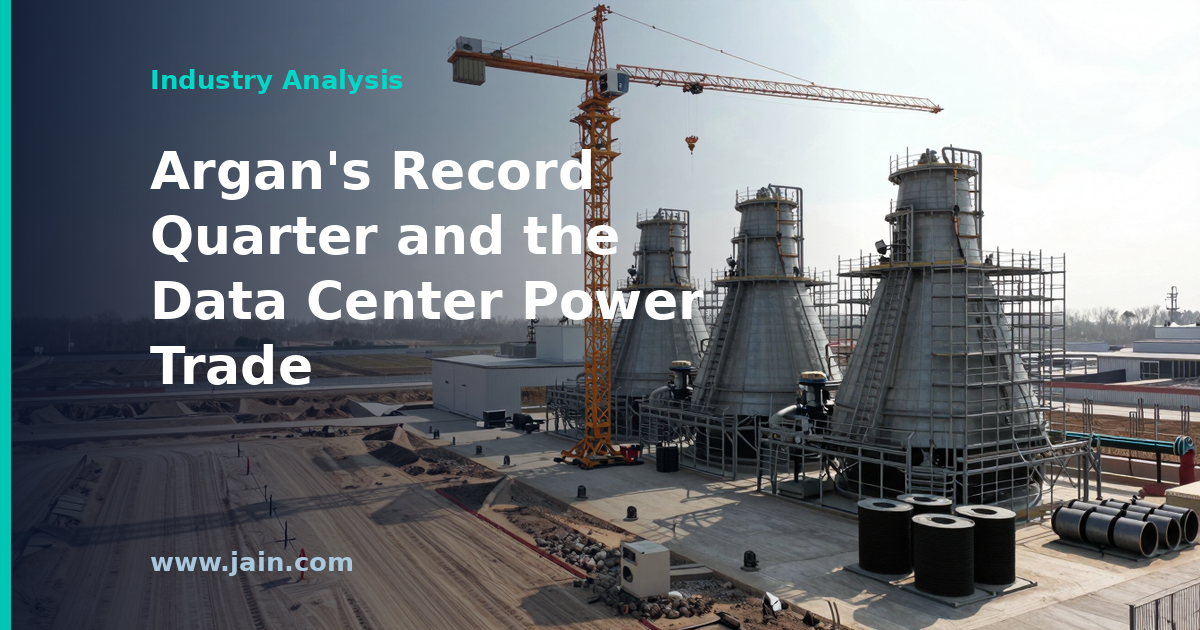
The more direct data center exposure is in the Industrial segment, where Argan said its new fabrication facility is on track for completion next quarter and will support demand for fabricating vessels for data centers. That is a smaller business than Power, but it is the clearest statement in the release that management is building capacity specifically against data center demand rather than simply benefiting from it indirectly.
The Backlog Is the Number That Actually Forecasts
Revenue tells you what a contractor did last quarter. Backlog tells you what it can do next. Argan reported consolidated backlog of approximately $2.5 billion at July 31, versus approximately $2.9 billion at January 31. Over that same six months the company recognised $674.9 million of revenue. As a rough inference — backlog also moves on scope changes, cancellations, currency and the point at which a contract is deemed awarded — new work booked in the first half appears to have run well below work performed.
That is not a crisis, and it is not unusual. EPC bookings are lumpy by nature: a single large gas plant award can add a billion dollars in one quarter and nothing for the two quarters either side. A book-to-bill ratio below one for six months in this industry is noise until it is a trend. But it is the metric that determines whether fiscal 2028 looks like fiscal 2027, and it is moving in the opposite direction from the earnings headlines.
It also complicates the simplest version of the AI-power story. If demand for gas-fired capacity were translating into signed contracts as fast as commentary suggests, the backlog of a well-capitalised, debt-free contractor with a strong execution record would be expanding. Post-quarter, Argan reported final completion on the last of its Midwest Solar and Battery Projects — good news for margin recognition, and one more block of work that has now left the book.
A Billion in Cash, and What It Can Realistically Buy
Argan ended the quarter with $1.03 billion in cash, cash equivalents and investments, up from $895.0 million in January, and no debt. That balance is genuinely unusual for a mid-cap contractor and is doing real work in the P&L: $10.1 million of other income, chiefly investment income, flowed almost entirely to pre-tax profit. It is also a reminder that a portion of reported earnings is rate-sensitive rather than operational.
The headline cash figure should be read alongside the company’s own net liquidity measure of $440.4 million, up only modestly from $421.0 million in January. The gap reflects the reality of EPC accounting: much of a contractor’s cash is customer money received ahead of work performed, and it is spoken for. Deployable capital is therefore materially smaller than $1.03 billion — a distinction that matters when assessing how much acquisition firepower is really available.
Against that, ValCor is a modest transaction. It is a Connecticut installer and repairer of information, communication and data networks, folded into Argan’s smallest segment, and it extends geographic reach and client mix rather than transforming the revenue base. Framing it as a hedge against gas exposure sets a bar the deal is not sized to clear. It is a sensible tuck-in, and diversification of this kind is built through a sequence of such deals, not one.
Concentration Risk, Stated Plainly
The structural risk in Argan’s model is not hidden — the company’s own numbers make it visible. A backlog weighted toward a small number of very large power projects means results depend on the schedule and margin outcome of a handful of jobs. Fixed-price EPC contracts place cost overruns, labour availability and equipment delivery delays on the contractor. Turbine lead times are an industry-wide constraint that no builder controls.
There is a mix risk as well. Argan noted that the consolidated gross margin gain was partially offset by decreased performance on certain projects in the Industrial and Teledata segments — a useful reminder that the diversification story and the margin story can pull against each other. Smaller, more numerous contracts smooth revenue but do not automatically carry Power’s 22% margins.
For buyers of power capacity — data center developers, utilities, independent power producers — the read-across is more encouraging. A contractor with no debt, expanding fabrication capacity and demonstrated ability to ramp multiple projects simultaneously is a lower-counterparty-risk partner than the sector average, which matters when a project’s completion date is tied to a customer’s compute deployment schedule. The scarce resource in this market is not capital; it is execution capacity and equipment slots.
Background
Argan, Inc. is an Arlington, Virginia-based holding company whose subsidiaries provide engineering, procurement, construction, commissioning, maintenance, project development and technical consulting services to the power generation market in the United States, the Republic of Ireland and the United Kingdom. Its largest subsidiary business builds utility-scale generation — historically combined-cycle natural gas plants, more recently including solar and battery storage projects. Alongside power, it runs an industrial fabrication and field services arm and a telecommunications infrastructure business known as Teledata. Argan’s fiscal year ends January 31, so the quarter ended July 31, 2026 is its fiscal 2027 second quarter.
The market context has changed sharply. After years in which flat US electricity demand made new large-scale generation hard to justify, load growth driven by data centers, electrification and manufacturing reshoring has revived orders for firm capacity. Gas turbines can supply large, continuously available blocks of power on timelines that data center developers can plan around, which has put specialist EPC contractors — a small group with the balance sheets and bonding capacity to take on billion-dollar fixed-price jobs — in an unusually strong bargaining position. That advantage is real but cyclical: it depends on continued gas plant awards, and on contractors executing those jobs at the margins they bid. Source: How Investors Are Reacting To Argan (AGX) Record Earnings And ValCor Deal Reshaping Its Risk Mix — Simply Wall St’s commentary on Argan’s second-quarter results and the ValCor Communications acquisition. Primary sources: Argan, Inc. Reports Second Quarter Fiscal 2027 Results (Exhibit 99.1 to Form 8-K, September 2, 2026); Argan, Inc. Form 8-K filed September 2, 2026; Argan, Inc. Form 10-Q for the quarter ended July 31, 2026.Sources