Tag: APLD

  • $4M in Boyce, $350K in Oliver County: AI Campus Community Payments Have No Standard Rate

    $4M in Boyce, $350K in Oliver County: AI Campus Community Payments Have No Standard Rate

    TL;DR · 30-second read

    The Short Version

    Applied Digital, a company that builds huge computer centers for artificial intelligence, has agreed to a $4 million deal to benefit the town of Boyce, Louisiana.

    That is more than eleven times the $350,000 in grants it recently promised a rural North Dakota county that hosts another of its sites.

    The takeaway: there is no going rate for what a town gets when one of these projects arrives. It comes down to each local deal, and those deals are now part of what it costs to build.

    KALB reported that Applied Digital (Nasdaq: APLD) has agreed to a $4 million community benefit deal for Boyce, Louisiana. Applied Digital develops and operates large data centers built for artificial intelligence and other high-performance computing workloads.

    The deal follows the company’s October 7 fiscal first-quarter earnings release, which disclosed $350,000 in grants across five organizations in Oliver County, North Dakota, home to its Polaris Forge 3 campus. The same release reported quarterly revenue of $341.9 million, up 322% year over year, and 250 MW of live capacity at its Polaris Forge 1 campus.

    Executive Summary

    Applied Digital’s $4 million commitment to Boyce is small next to the billions in leases and debt behind its AI campuses, but it is a concrete, priced obligation to a host community. Set beside the $350,000 the company committed to Oliver County organizations through its Applied Digital Cares program, it shows the same developer’s local commitments ranging by more than elevenfold, and taking different forms, from one site to the next.

    For local officials, that means there is no fixed benchmark to anchor a negotiation. For investors and lenders, it means community commitments behave like land and power costs: site-specific, negotiated, and worth modeling explicitly rather than assuming away. The Louisiana commitment also points to Applied Digital activity beyond the North Dakota campuses that have defined the company so far.

    $4 Million Versus $350,000: No Going Rate for Host Towns

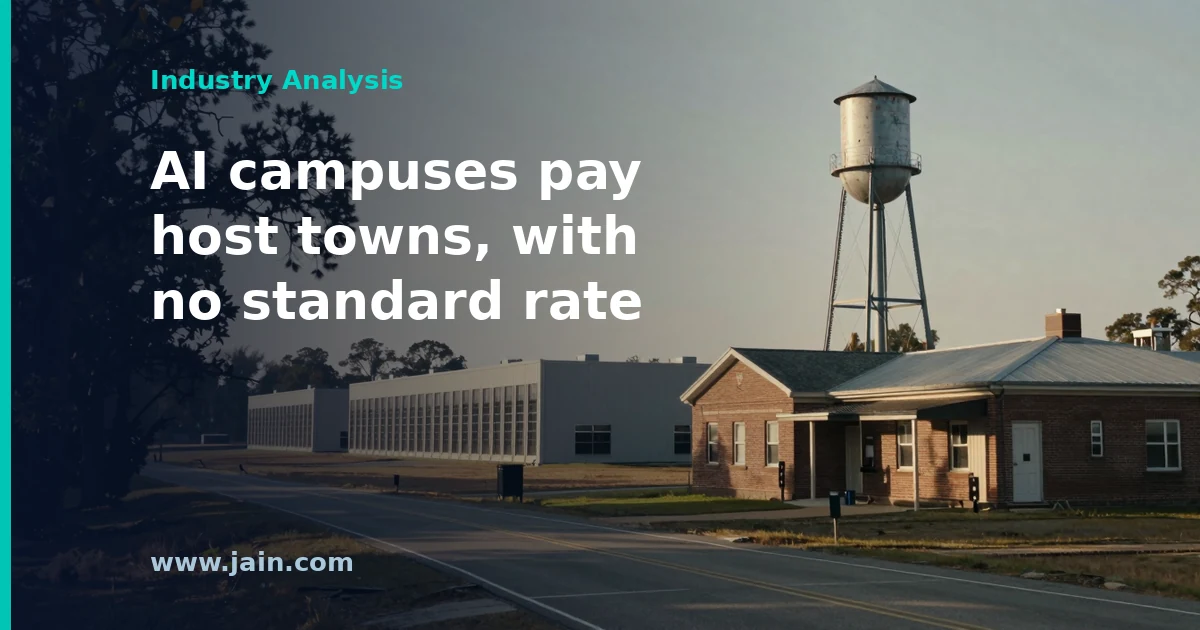
    Applied Digital’s two most recently disclosed community commitments differ by more than a factor of eleven. Alongside the $4 million Boyce deal, the company’s October 7 earnings release said that through Applied Digital Cares it committed $350,000 in grants across five organizations in Oliver County, North Dakota, supporting first responders, schools and community facilities.

    The form differs as much as the amount. A community benefit agreement is generally a negotiated, contract-style commitment from a developer to a host community, often made alongside local approvals or incentives. Grants from a corporate giving program are discretionary. One developer using two different instruments, at two very different price points, within weeks of each other, is strong evidence that this cost is set place by place rather than by formula. The company also highlighted that Polaris Forge 1 was named Project of the Year by the Mid-America Economic Development Council, with community investment among the cited reasons, a sign that Applied Digital treats local standing as something to build and report.

    The comparison is between headline commitments, not rates. Applied Digital has not disclosed the megawatt scale of its plans at Boyce, the payment period, or whether the Oliver County grants are the first of several, so a per-megawatt figure cannot be calculated. That is exactly the problem for anyone trying to budget: a cost that varies this widely cannot be extrapolated from one site to the next.

    Why Paying for Local Certainty Pencils Out

    Against the company’s capital stack, $4 million is small. In the quarter ended August 31, Applied Digital closed $1.59 billion of 7.000% senior secured notes to fund a 150 MW building at Polaris Forge 1; the Boyce commitment equals roughly 0.25% of that single raise.

    The more useful comparison is the cost of delay. The 210 MW, 15-year Delta Forge 2 lease the company signed with its hyperscaler customer (one of the giant cloud and AI companies) represents about $5.2 billion of base-term revenue, an average of roughly $29 million a month. A one-month slip in a contract of that size would defer about seven times the entire Boyce commitment. When zoning, permits, road access and utility work all run through local bodies, a payment that smooths those steps is cheap insurance for a developer whose revenue starts only when capacity is delivered.

    That does not make these costs trivial. Applied Digital reported a $221.0 million net loss attributable to common stockholders for the quarter (an adjusted net loss of $4.1 million) and is funding growth with 7% debt. Each community commitment is modest alone, but it recurs with every new campus, and the company is adding campuses.

    A Footprint Spreading Beyond the Dakotas

    North Dakota remains the center of the business. Polaris Forge 1 reached 250 MW of critical IT load (the power available to run computing equipment) on October 1, and the company expects Polaris Forge 2 in Harwood to bring its North Dakota total to 300 MW by the end of 2026. Management cites the state’s low-cost power, abundant energy, low population density and cool climate.

    The Boyce deal, a Finland agreement for up to roughly 1 GW of potential power capacity, and a power purchase agreement with Base Electron tied to a planned 1,200 MW natural gas plant in North Dakota all extend the company’s reach into new jurisdictions and partnerships. Each new region brings new local counterparties, from parish and county governments to utilities, with their own expectations. The company says its near-term priorities remain centered on its U.S. portfolio; how it prices community commitments as that portfolio spreads will be worth watching.

    Background

    Applied Digital is a Dallas-based designer, developer, owner and operator of large data centers built for AI, machine learning and other accelerated computing, which it calls AI factories. Its core campuses are in North Dakota, including Polaris Forge 1, Polaris Forge 2 in Harwood and Polaris Forge 3 in Oliver County, and it leases capacity under long-term contracts to large cloud customers. Its majority-owned ChronoScale subsidiary, itself a public company, runs the historic cloud services business.

    As AI campuses have grown to hundreds of megawatts, developers have increasingly dealt with host communities over land use, roads, water and power. Commitments such as community benefit agreements and local grants are one way developers address those concerns, and their size and structure are set locally rather than by any common standard.

    Sources

    Source: Applied Digital agrees to $4 million community benefit deal for Boyce (KALB), on Applied Digital’s $4 million community benefit deal for Boyce.

    Primary sources: Applied Digital Form 10-Q for the quarter ended August 31, 2026 (filed October 7, 2026); Applied Digital Form 8-K filed October 7, 2026; Applied Digital Reports Fiscal First Quarter 2027 Results (Exhibit 99.1).

  • Applied Digital’s 1 GW Finland Deal Buys an AI Power Option, Not Yet a Campus

    Applied Digital’s 1 GW Finland Deal Buys an AI Power Option, Not Yet a Campus

    TL;DR · 30-second read

    The Short Version

    Applied Digital, a Dallas company that builds the huge computer warehouses used to run artificial intelligence, has signed a deal for access to a large supply of electricity in Finland. It is the company’s first project outside the United States.

    At full size, the site could use about as much power as one large nuclear reactor produces. But the first electricity is not expected until 2028, and no customer has signed yet.

    The lesson is that in this business, the electricity gets locked up first. The buildings and the paying tenants come later, if they come at all.

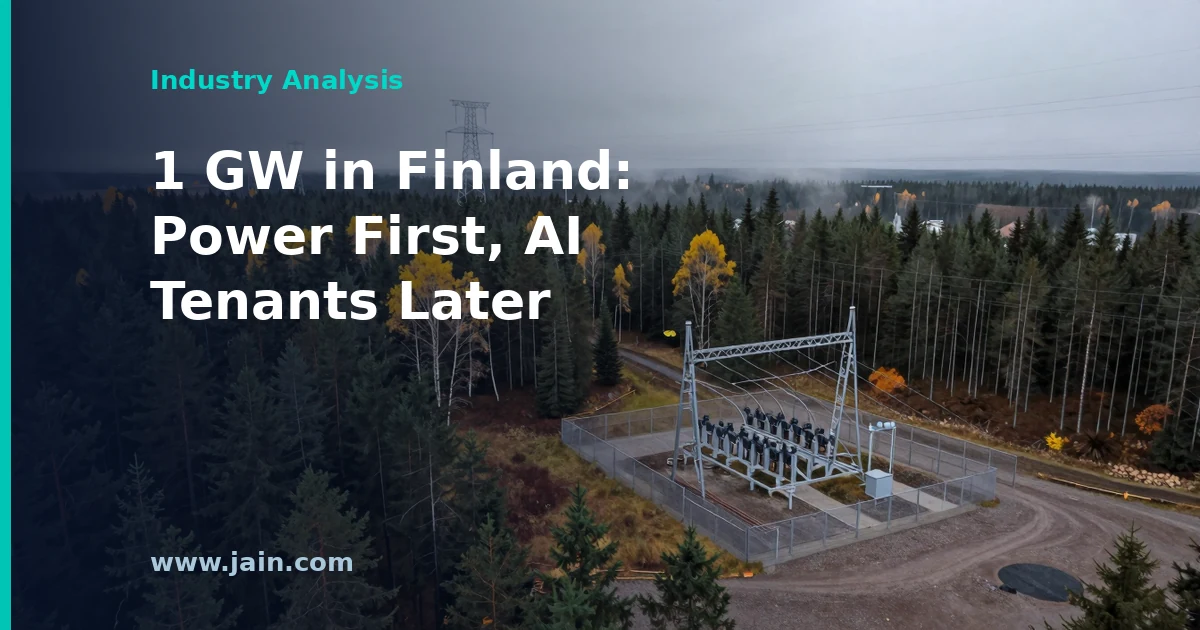
    Applied Digital (Nasdaq: APLD) announced on October 6, 2026 that it has entered into an agreement providing access to up to 1 gigawatt (GW) of potential power capacity in Finland, its first development opportunity outside the United States. The company plans a large-scale “AI Factory” campus that could scale to as much as 1 GW, with initial power availability anticipated beginning in 2028.

    Applied Digital said it has begun marketing the site and is in discussions with leading global hyperscale customers, the largest cloud and AI platform operators. It did not name the site’s location, the counterparty to the agreement, its financial terms or any prospective tenant.

    Executive Summary

    The Finland agreement gives Applied Digital a claim on a very large block of future electricity in a cool-climate market, the input that most constrains how fast AI data centers can be built. The company framed the deal as a measured first step abroad, structured to limit its initial exposure, with further investment contingent on customer demand, commercial milestones and regulatory approvals.

    That framing matters as much as the headline number. “Up to 1 GW of potential” capacity, power from 2028 and an unsigned customer base describe an option rather than a project under construction. The announcement establishes where Applied Digital wants to grow next and how it intends to manage the risk; it does not yet establish how much capacity will actually be built, when, or for whom.

    For industry readers, the deal is a test of whether a US developer’s site-selection model, built around abundant power and cold weather in North Dakota, transfers to the Nordics. For investors, it adds long-dated growth optionality while the company’s own guidance keeps near-term attention on its US pipeline.

    What “Up to 1 GW of Potential” Actually Buys

    Read closely, the release qualifies its headline figure at every step. The agreement provides access to “up to” 1 GW of “potential” power capacity; the campus is one “capable of scaling to as much as” 1 GW; and only “initial” power is anticipated, beginning in 2028. The company says future investment and development decisions will be tied to customer demand, commercial milestones and regulatory and development requirements, and that the deal was structured to limit initial exposure. Each of those statements points the same way: Applied Digital has secured the right to pursue a campus, not a commitment to build one at full scale.

    That is a rational way to buy the scarcest input in AI infrastructure. A gigawatt is roughly the output of one large nuclear reactor, and AI campuses of this size are gated less by land or buildings than by how quickly a large, reliable grid connection can be delivered. Securing power years before a tenant signs lets a developer offer hyperscalers a dated path to capacity, which is the thing those customers are shopping for. The trade-off is that the value of the option depends on terms the company has not disclosed, including what it pays to hold the capacity and what happens if no tenant materialises.

    The people most affected are prospective tenants, who gain another large-scale European option with a stated 2028 start, and shareholders, who should treat the 1 GW as a ceiling on what could be built rather than a measure of what has been contracted.

    Why Finland Fits the North Dakota Playbook

    Chief executive Wes Cummins tied the choice directly to the company’s US model: Finland “stood out because many of the characteristics that have supported our success in North Dakota are also present in the Nordics — a favorable climate, an attractive energy ecosystem, strong connectivity and the ability to develop at meaningful scale.” Each of those factors has an operational meaning. Cold ambient air reduces the energy spent removing heat from dense AI servers; a strong energy ecosystem determines whether large power blocks can be delivered; and fibre connectivity determines whether the site can serve customers beyond its immediate region.

    The release presents this as continuity, not reinvention: securing scalable power and land where AI capacity can be developed “efficiently, responsibly and repeatedly.” That is a reasonable thesis, but it is a claim to be proven. Cummins said as much, describing Finland as the chance “to begin proving that platform can travel.” The company’s own risk disclosures in the release flag what could differ abroad, including sourcing materials and labour internationally and complying with regulations outside the US.

    The 2028 Clock and the Hyperscaler Question

    With initial power not expected until 2028, the commercial work happens now. Applied Digital says it has begun marketing the site and is in discussions with leading global hyperscale customers. Large AI campuses are typically financed around long-term leases with creditworthy tenants, so the timing and size of any signed lease will largely determine whether the Finland project moves from option to construction, and how quickly it scales beyond its first phase.

    The release does not indicate how much of the 1 GW becomes available in 2028 versus later years. That phasing matters: a hyperscaler weighing the site will compare not just the headline ceiling but the megawatts deliverable in each year against competing sites. Until a tenant and a phasing schedule are disclosed, the near-term financial contribution of the Finland site should be treated as zero, consistent with the company’s own emphasis on its US projects.

    Discipline as the Message

    The release spends notable space reassuring investors. Cummins called the deal “a deliberate first step, not a change in our strategy,” and said scale “is not about planting flags in as many markets as possible.” That emphasis is consistent with the risk factors the company lists, which include its ability to raise additional capital for data center construction and to obtain financing for leases. Framing Finland as low-exposure optionality signals that the company does not intend to divert capital from US execution to fund it.

    Whether that framing holds will depend on disclosures still to come: the cost of holding the capacity, any deposits or milestone payments, and how a Finnish build would be financed if a tenant signs.

    Background

    Applied Digital, founded in 2021 and headquartered in Dallas, designs, builds and operates large data centers for high-performance computing, including artificial intelligence, cloud, networking and blockchain workloads. The company markets closed-loop cooling, a system that recirculates coolant rather than continuously consuming water, along with rapid deployment, and describes its build model as an “AI Factory” franchise. Its US development has centred on North Dakota, which the company credits for traits it now seeks in Finland: cold weather, available energy and room to scale. Datacloud named it Best Data Center in the Americas for 2025.

    Across the AI infrastructure market, developers increasingly compete to secure large blocks of electricity years ahead of construction, because access to reliable power at scale has become a principal constraint on how fast AI computing capacity can be added. The Nordics, which the company describes as an emerging European AI market, have drawn growing investment from global technology firms on the strength of their climate, energy and digital networks.

    Sources

    Source: Applied Digital Secures Up to 1 GW of Potential Power Capacity in Finland, Marking First International Development in the Nordics: Applied Digital’s October 6, 2026 announcement of its first development opportunity outside the United States.

  • Applied Digital’s $36B AI Lease Book Is Now a 1.41 GW Delivery Test

    Applied Digital’s $36B AI Lease Book Is Now a 1.41 GW Delivery Test

    TL;DR · 30-second read

    The Short Version

    Applied Digital, a company that builds giant computer warehouses for artificial intelligence, says customers have signed leases worth about $36 billion. Before five new deals this past year, that figure was $7 billion.

    The buildings covered by those leases are designed to draw about as much electricity as roughly a million American homes.

    The catch: in this business, rent generally starts only once a building is finished, powered and handed over. The company now pays its president partly on how much capacity actually gets delivered, not just how much gets signed.

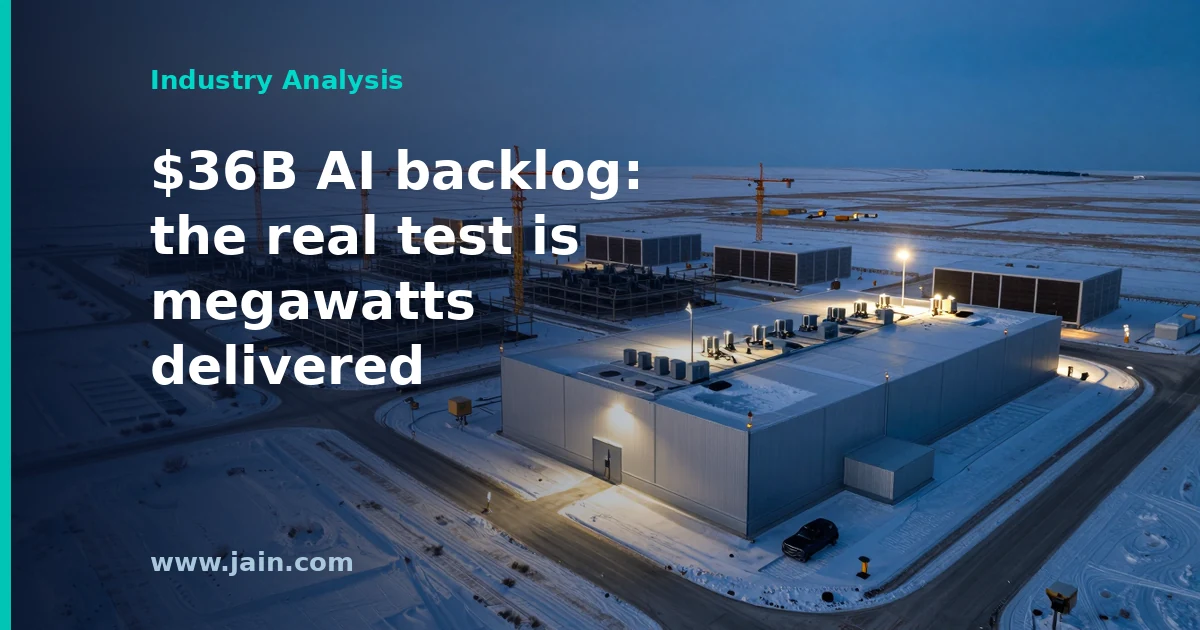
    Applied Digital (Nasdaq: APLD) reported in its definitive proxy statement, filed with the SEC on September 25, 2026, that five leases signed during fiscal 2026 (the year ended May 31, 2026) raised its initial-term contracted revenue from $7 billion to approximately $36 billion, before any customer renewal or expansion options. Stock Titan, summarizing the filing, reported that total contracted critical IT load stands at 1.41 gigawatts (GW).

    The same proxy sets out five-year equity awards for CEO Wes Cummins, President Jason Zhang and CFO Saidal Mohmand, and calls stockholders to a virtual annual meeting on November 4, 2026, to elect six directors, ratify CBIZ CPAs P.C. as auditor, and cast an advisory vote on executive pay.

    Executive Summary

    The headline number is a roughly fivefold jump in contracted revenue in a single fiscal year: from $7 billion to about $36 billion, driven by five leases. That places Applied Digital among the AI data center developers with the largest disclosed lease backlogs, and it is tied to 1.41 GW of critical IT load, meaning the electricity available to the servers themselves, before cooling and building overhead.

    What makes the filing more than a backlog update is how the company has chosen to pay its leadership against it. President Jason Zhang’s performance shares are measured half on contracted revenue and half on ready-for-service delivery, CFO Saidal Mohmand’s on net operating income, and CEO Wes Cummins’s on share-price hurdles the proxy describes as interdependent with the other two. In effect, the board has written into its pay plan that signing leases is only half the job; turning them into energized, revenue-producing capacity is the other half.

    That framing matters because it arrives after only 52.6% of votes supported the company’s 2025 say-on-pay proposal, and because the conversion from contract to delivered megawatt is where AI infrastructure schedules most often slip.

    From $7 Billion to $36 Billion in One Fiscal Year

    The proxy’s figure is initial-term contracted revenue: the total rent customers have committed to pay over the base length of their leases, excluding renewal and expansion options. On that measure, five leases signed between June 2025 and May 2026 added roughly $29 billion. Dividing $36 billion by 1.41 GW gives a blended figure of about $25.5 million of initial-term revenue per contracted megawatt. That is simple arithmetic on two disclosed totals, not an annual rate, because the lease terms are not broken out; a 15-year lease and a 10-year lease at the same headline value imply very different yearly income.

    The excluded options cut both ways. They represent potential upside if tenants renew or expand, but they are not commitments, and the $36 billion should be read as the contracted floor rather than a projection of lifetime value. For industry readers, the useful comparison is not against other developers’ press-release totals but against Applied Digital’s own delivery rate: how quickly 1.41 GW of contracted load becomes billing capacity.

    Contracted Is Not Delivered: Why 1.41 GW Is the Real Test

    In wholesale data center leasing, rent typically begins when a hall or building is declared ready for service (RFS): powered, cooled, commissioned and handed to the tenant. Until then, a signed lease is a promise on both sides, and the developer carries the construction cost, the equipment procurement and the utility interconnection work. A 1.41 GW critical IT load also understates the site-level power requirement, since total facility draw is higher once cooling and electrical losses are added; the proxy lists power usage effectiveness (PUE), the ratio of total facility power to IT power, among its key terms for exactly this reason.

    Applied Digital’s compensation design makes this conversion explicit. Jason Zhang’s performance stock units (PSUs, shares that vest only if targets are hit) are split evenly between contracted revenue and ready-for-service delivery. Saidal Mohmand’s rest on two net operating income hurdles, which can only be cleared once leased capacity is operating and paying. Wes Cummins’s three share-price hurdles are described as interdependent with the success of the other two awards. The board has, in other words, tied the top three executives’ largest equity grants to the same chain: sign, deliver, earn.

    The people most exposed to that chain sit outside the company as well. Tenants are planning AI deployments around RFS dates. Lenders and equity holders are underwriting construction against rent that has not yet started. Utilities, transformer makers and cooling suppliers are the ones who have to deliver the physical inputs on schedule. A backlog this large is a strong demand signal; whether it is a strong earnings signal depends on those delivery dates, which is the measure the company itself has chosen to be judged on.

    A Five-Year Pay Plan After a 52.6% Vote

    The awards to Cummins, Zhang and Mohmand use a five-year performance and vesting horizon, a 25/75 split between time-based restricted stock units (RSUs) and performance-based PSUs, and a two-year holding requirement after PSUs vest. They are intended to be the three executives’ only company equity awards for five years from grant. The Compensation Committee says the structure reflects longer project cycles and that stockholder feedback, following 52.6% support for say-on-pay in 2025, informed its fiscal 2026 decisions. Support at that level is well below the threshold at which proxy advisers commonly expect a board to show it has responded.

    Both sides of the debate have a fair point to test. Supporters of front-loaded, multi-year grants argue they match compensation to multi-year construction timelines and reduce annual grant churn. Skeptics of the design generally ask how demanding the hurdles are, how share-price targets interact with dilution from future capital raises, and whether a single large grant concentrates risk. The November 4 advisory vote will indicate which reading stockholders favor.

    The proxy also notes that on April 29, 2026, the board formed separate committees of directors it identifies as independent to review and approve or ratify related-party transactions with ChronoScale and Base Electron expected to exceed, or potentially exceed, $120,000 in a fiscal year. Establishing dedicated committees is a governance safeguard; the scale and nature of those relationships are what stockholders will want to follow.

    Background

    Applied Digital is a Dallas-based developer and operator of data centers that began by hosting high-power computing for cryptocurrency mining and has since repositioned toward purpose-built campuses for AI and high-performance computing, leased to large compute customers on long-term contracts. Its fiscal year ends May 31.

    The wider AI infrastructure market has shifted toward multi-year, gigawatt-scale leases in which developers secure land and power, build to a tenant’s specification and begin collecting rent once capacity is ready for service. Backlogs have grown quickly across the sector; the pace at which utilities, equipment suppliers and construction crews can turn those contracts into energized capacity has become the practical constraint on how fast they convert into revenue.

    Sources

    Source: Five leases lifted Applied Digital (APLD)’s initial-term contracted revenue beyond $7 billion. – Stock Titan, a summary of Applied Digital’s definitive proxy statement reporting initial-term contracted revenue rising from $7 billion to about $36 billion across 1.41 GW of contracted critical IT load.

    Primary sources: Applied Digital Corp. Definitive Proxy Statement (Form DEF 14A), filed September 25, 2026 — SEC EDGAR.