Tag: AMD Helios

  • Generative Bionics’ 5,000 m² Hub Makes Factory Floor Space an AI Infrastructure Input

    Generative Bionics’ 5,000 m² Hub Makes Factory Floor Space an AI Infrastructure Input

    TL;DR · 30-second read

    The Short Version

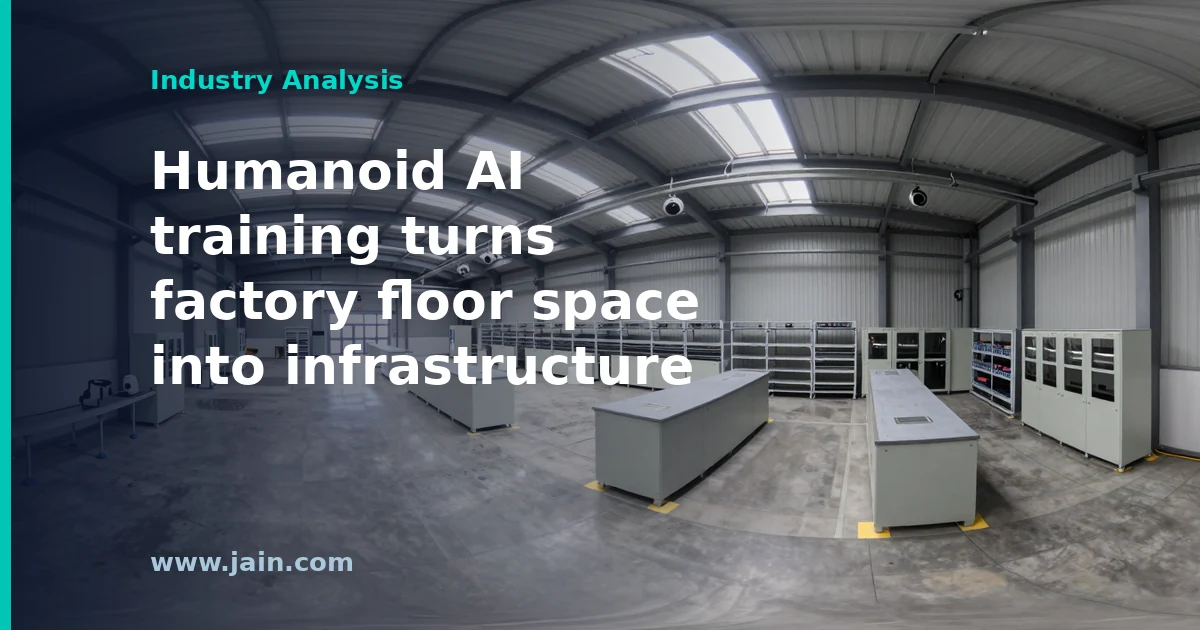
    An Italian company that builds humanoid robots, machines shaped roughly like people, plans a 5,000-square-metre training centre in Italy. That is about two-thirds the size of a football pitch. It is due to open by late 2027.

    Inside, fleets of its robots will do real factory jobs to gather experience. Powerful computers from the chipmaker AMD will then replay those jobs thousands of times in virtual copies. Chatbots learn from the internet, but robots have no such library, so the company is building one.

    Two more sites are planned. The company has not said what they will cost or how much electricity they will use.

    Generative Bionics, an Italian company developing humanoid robots for industrial use, announced on October 21, 2026, at CES Unveiled Milan that it plans to build a three-node Physical AI Data Factory network. The announcement was made in a release distributed via PR Newswire. The first node is a 5,000-square-metre hub in Italy scheduled to be operational in the fourth quarter of 2027. A second site will follow elsewhere in Europe, and a third will serve global markets.

    The network will run on AMD Helios, AMD’s rack-scale AI infrastructure. In the facilities, fleets of the company’s GENE.01 humanoid will perform industrial tasks in reproduced real-world environments. The data they generate will feed digital-twin simulation and model training. Generative Bionics describes the Italian hub as Europe’s largest physical AI training facility for humanoid robots.

    Executive Summary

    The announcement is a plan for a new kind of AI facility. A conventional AI data center turns electricity and chips into trained models using data that already exists. Generative Bionics’ data factory has to manufacture its training data first. Robots perform real tasks on a physical floor, those sessions are cloned into thousands of simulated variants, and the resulting models are sent back to physical robots for validation. The company calls this a real-to-sim-to-real loop.

    This matters for infrastructure because it adds physical space to the AI supply chain. The only scale figure disclosed is 5,000 square metres of floor, which measures the capacity to generate data rather than to compute. AMD’s role covers the whole stack. AMD Ventures invested in the company’s seed round, AMD compute sits inside the GENE.01 robot, and Helios systems are slated to power the factory network. That gives AMD a visible European reference project in physical AI, an area where its competitors are also active.

    The plan is framed around European sovereignty: the data, models and know-how behind industrial humanoids would be generated, trained and validated on the continent. Several things have not been specified, including how much compute the network will run, what power it will draw, what it will cost and which industrial partners will supply the environments. These are the variables that determine whether the 2027 date holds.

    Why Floor Space Becomes Part of the AI Stack

    Generative Bionics bases the project on a data argument. Large language models learn from vast amounts of online text, but humanoid robots have no comparable record of how to act in the physical world. The data they need covers contact, force, motion, proximity, temperature, task constraints and interaction with people. For GENE.01 it also includes vision, motion and signals from the robot’s full-body multimodal skin. None of that can be downloaded. It has to be produced by robots doing work in realistic settings, which here means environments selected with industrial partners and run continuously by robot fleets.

    That is why the headline number is square metres rather than megawatts or GPU counts. In this design, the 5,000-square-metre hub is the main data-generation asset. Its size limits how many environments can be reproduced at once, how many robots can run in them, and how many hours of physical data the pipeline collects. Simulation then multiplies each physical session into thousands of variations in layout, objects, materials, operating conditions and failure modes, which would be impossible to stage physically. Compute amplifies the physical floor’s output but cannot substitute for it, because every simulated variant starts from a real environment and every trained model returns to a real robot for validation.

    Site developers and operators face a facility type that does not fit existing categories. The plan co-locates robotics, AI and data-engineering teams with the infrastructure, and links physical environments, simulation, training and fleet deployment through shared infrastructure across sites. The result needs open industrial floor suited to moving robot fleets, and it needs high-performance compute and storage in the same workflow. A warehouse developer or a data center operator alone would supply only half of that.

    A Compute Build With No Power Figure Attached

    Helios is described as a rack-scale architecture, meaning systems designed and deployed as integrated racks rather than individual servers. Rack-scale AI systems are generally far denser in power and heat than conventional enterprise server racks. Wherever the Helios capacity is housed, it will bring the electrical and cooling requirements that come with that class of hardware. The robotics floor adds its own load, from charging and running fleets to industrial equipment in the reproduced environments.

    Generative Bionics has disclosed floor area and an operational quarter. It has not disclosed rack count, megawatts, cooling approach or whether the compute sits physically inside the Italian hub. For a Q4 2027 target, those details carry real schedule weight. In AI construction, grid connections and delivery slots for high-density equipment often set the timeline more than the building does. The first Helios-specific question for this project is how much capacity it will run and where.

    Sovereignty Turns Into a Siting Requirement

    The sovereignty framing has practical consequences. If the data, models and technical knowledge behind Europe’s industrial humanoids must be generated, trained and validated on the continent, then the factory floor and the compute both have to be in Europe as well. That places this kind of workload among the European AI builds where location is part of the specification, not just a cost decision.

    The investor list fits that framing. The €70 million seed round was led by CDP Venture Capital, with AMD Ventures, Duferco, Eni Next, RoboIT and Tether participating. The network design also qualifies the framing somewhat. Two nodes are European, but the third is meant to serve global markets, and the release does not say where that node will be or how data will move between sites. How a sovereign European pipeline connects to a global node will test how strictly the sovereignty principle applies.

    What AMD Gets, and What the Claims Still Need

    For AMD the arrangement is a full-stack showcase: venture investor, on-robot compute supplier and data-center platform for one customer. Keith Strier, AMD’s senior vice president for global AI markets, presented it as a step for European AI and industrial sovereignty. For Generative Bionics, deep alignment with a single vendor can simplify engineering and secure supply. It also concentrates dependence on that vendor, and the economics of that dependence will depend on terms neither company has published. The release describes the infrastructure partnership as a planned collaboration, and the compute as infrastructure that is expected to provide the required capacity.

    The company’s other claims are presented as goals rather than results so far. CEO Daniele Pucci described the facility as replicating the world physically and digitally so that humanoids can be trained at scale before they enter it. The Europe’s-largest designation is the company’s own description, with no comparison set published. Fleet size, partner environments and validation metrics are not stated. The concept is coherent and the problem it targets is real. Whether it works will become clearer once Generative Bionics publishes those operating details.

    Background

    Generative Bionics is an Italian deep-tech company, led by CEO Daniele Pucci, that develops AI-driven humanoid robots for industrial settings. Its platform, GENE.01, is designed to work safely within existing production processes without dedicated infrastructure. The company raised €70 million in a seed round led by CDP Venture Capital, with AMD Ventures, Duferco, Eni Next, RoboIT and Tether participating.

    Physical AI, meaning AI that controls machines acting in the real world, has become a major focus as developers try to move humanoid robots from lab demonstrations to dependable factory work. The main obstacle is data. Text and images for training language and vision models are abundant online, but robots need large volumes of real-world interaction data that has to be generated deliberately. AMD’s Helios platform is the company’s rack-scale AI system, and it competes for the large training and simulation workloads that physical AI developers are beginning to build.

    Sources

    Source: Generative Bionics construirá la mayor fábrica de datos de IA física de Europa, Generative Bionics’ release announcing its three-node Physical AI Data Factory network and AMD Helios infrastructure partnership, also published in English.

  • AMD-Cerebras 5x Per-Watt Claim Rests on Splitting AI Inference Across Vendors

    AMD-Cerebras 5x Per-Watt Claim Rests on Splitting AI Inference Across Vendors

    TL;DR · 30-second read

    The Short Version

    Two chipmakers, AMD and Cerebras, are teaming up so that a single chatbot answer is produced by both companies’ hardware working together.

    When you ask an artificial intelligence assistant something, the computer does two jobs: it reads your question, then writes the reply word by word. AMD’s machines will do the reading. Cerebras’ dinner-plate-sized chip will do the writing.

    The companies say the pairing could produce up to five times more output for the same electricity. That matters because power is one of the biggest limits on building the giant computer buildings behind these services. It is due later this year.

    AMD and Cerebras Systems announced on July 23, 2026, at AMD’s Advancing AI 2026 event, a technical partnership that combines AMD’s Helios rack-scale systems, built on AMD Instinct GPUs, with the Cerebras Wafer-Scale Engine in a single disaggregated inference workflow. In the companies’ joint announcement, Helios handles prompt processing and large context windows, while the Wafer-Scale Engine handles token generation, the step that streams the answer back to the user.

    The companies say the combined system is expected to deliver up to 5x higher tokens per second per watt. Cerebras plans to deploy Helios systems in its own data centers, with the joint solution expected to be available first through Cerebras Cloud in the second half of 2026.

    Executive Summary

    The announcement pairs two very different kinds of AI hardware inside one request. AMD’s GPU racks take the first, compute-heavy pass over a prompt. Cerebras’ wafer-scale processor then generates the output, a phase limited mainly by how fast data can be pulled from memory. The companies aim the product at the ultra-low-latency segment of inference: coding tools, real-time copilots, live agents and agentic workflows, where response time directly shapes how useful the system is.

    It matters for three reasons. First, the headline efficiency figure is measured per watt, and electricity is increasingly the scarcest input for new AI capacity. Second, it makes disaggregated inference, the practice of running the two phases of a request on separate hardware, a cross-vendor design rather than something done inside one company’s GPU fleet. Third, it turns Cerebras into an AMD customer and operator of AMD systems, with the integration burden sitting in Cerebras’ data centers rather than with end buyers.

    What is not yet established is the performance itself. The 5x figure is an ‘up to’ projection. The product is forward-looking, with availability targeted for the second half of 2026, and neither company has disclosed deployment scale or commercial terms.

    The 5x Claim Rests on the Split, Not on Either Chip

    Every response from a large language model is produced in two phases. Prefill reads the whole prompt in one parallel pass, whether that prompt is a question, a pasted contract or an entire codebase. That work suits hardware built for massive arithmetic throughput. Decode then produces the answer one token, roughly a word fragment, at a time. Each step has to re-read the model’s weights and the stored context of the conversation from memory, so decode speed is capped by memory bandwidth more than by raw compute. The AMD–Cerebras announcement describes exactly this division of labour. Helios processes ‘prompts and large context windows’, while the Wafer-Scale Engine ‘accelerates the memory-bandwidth-intensive token generation.’

    That division is the mechanism behind the headline number. The companies say the two engines together are expected to deliver up to 5x higher tokens per second per watt. They present the gain as a property of the pairing, not of either system alone. A GPU rack running both phases spends much of decode waiting on memory. A wafer-scale system running both phases spends capacity on prefill work that GPUs batch efficiently. Assigning each phase to the hardware whose strength matches that phase’s bottleneck is how a combined system could outperform either one, provided the handoff between the two machines is fast and cheap enough.

    The choice of metric matters for the people who build and power these facilities. Tokens per watt means output per unit of electricity, and grid power, more often than floor space, now caps how much AI capacity an operator can bring online. The words ‘up to’ mark the figure as a best case. Until AMD and Cerebras publish the configuration and baseline behind it, it is a design target rather than a measured operating result.

    One Answer, Two Vendors’ Hardware: What Operators Inherit

    Splitting prefill from decode is not new in itself; large inference providers have separated the phases across different pools of GPUs. The new element here is that every request crosses a vendor boundary. When Helios finishes prefill, the prompt’s working state, known as the key-value cache (the model’s stored record of everything it has just read), has to move to the Cerebras system before the first output token appears. That transfer sits directly on the latency path the product is being sold on, so the network link between the two systems effectively becomes part of the product.

    It also puts two hardware platforms, two software stacks and two support relationships inside one serving pipeline. It means two distinct system designs, likely with different power densities and cooling requirements, sharing the same data hall. Scheduling is harder too, because prefill and decode capacity must be sized against each other: too few Helios racks starve the wafer-scale engines, and too few wafer-scale engines leave GPU output queued.

    The launch model shields buyers from most of that. Cerebras plans to deploy Helios in its own data centers and offer the joint solution first through Cerebras Cloud in the second half of 2026, so customers would consume it as a service rather than integrate it themselves. Cerebras, not the end customer, absorbs the integration risk, along with the capital cost of buying, powering and hosting AMD racks.

    What Each Company Gets Out of It

    For AMD, the partnership extends Helios into the most latency-sensitive end of the inference market without AMD building a dedicated decode chip. Helios stays positioned, in the announcement’s words, as ‘the foundation for high-throughput and balanced inference workloads across the data center.’ It also makes Cerebras a buyer and operator of AMD systems, adding another deployment of Helios in a production cloud.

    For Cerebras, the arrangement concentrates its wafer-scale hardware on the phase where it says it is strongest. Prompt processing, which grows heavier as context windows lengthen and agentic workflows chain many calls together, goes to GPU racks built for throughput. Andrew Feldman framed the benefit as reach: partnering with AMD lets Cerebras ‘bring that performance to even more customers.’ That fits Cerebras’ own risk disclosures in the announcement. It lists dependence on a small number of significant customers, including OpenAI, Group 42 Holding, Mohamed bin Zayed University of Artificial Intelligence and AWS, and the need to secure data center capacity and capital for its cloud offerings. The partnership broadens the product, but it also adds a capital-intensive deployment commitment.

    For the wider market, this is one partnership, not proof of an industry shift. It does put a concrete test in front of buyers: whether heterogeneous inference, which matches different chips to different phases of a single request, delivers enough latency and energy gains to justify the added operational complexity. If Cerebras Cloud demonstrates those gains in production, similar cross-vendor pairings become more likely. If it does not, single-platform stacks keep their simplicity advantage.

    Background

    Cerebras Systems, listed on Nasdaq under the ticker CBRS, builds AI systems around its Wafer-Scale Engine, a processor made from a whole silicon wafer rather than many chips cut from it. The company sells hardware on premises and, increasingly, inference as a cloud service, and it markets itself on speed of token generation. Its disclosures name OpenAI, Group 42 Holding, Mohamed bin Zayed University of Artificial Intelligence and AWS as significant customers.

    AMD is the main GPU alternative to Nvidia in AI data centers through its Instinct accelerator line, and Helios is its rack-scale system, which packages GPUs, processors and networking into a single deployable unit. The partnership reflects a wider industry move toward splitting inference into prefill and decode stages and optimising each separately, an approach previously used mainly within single-vendor GPU clusters.

    Sources

    Source: AMD and Cerebras Announce Industry-Leading Ultra-Low-Latency and High Throughput AI Inference Solution, the joint AMD and Cerebras Systems announcement of July 23, 2026, unveiling a disaggregated inference solution pairing AMD Helios with the Cerebras Wafer-Scale Engine.