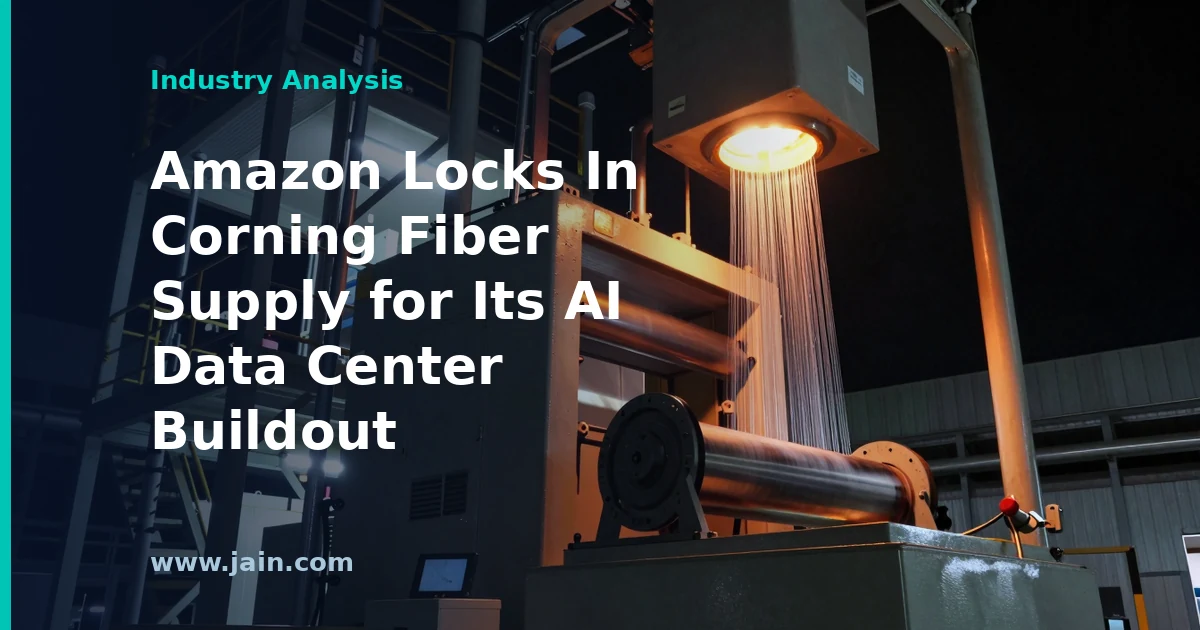
Amazon has signed a multibillion-dollar agreement with Corning to ramp up fiber-optics manufacturing, as first reported by Manufacturing Dive on June 10, 2026. The deal ties one of the world’s largest cloud and AI infrastructure builders to the world’s best-known maker of optical fiber, securing the connectivity layer — the glass strands that carry data between and within data centers — for Amazon’s ongoing AI expansion.
Executive Summary
The announcement is short on public detail but long on signal: Amazon is treating optical fiber the way hyperscalers have learned to treat power, land, and chips — as a scarce input to be locked down years in advance rather than bought on the spot market. A multibillion-dollar commitment to “ramp up” manufacturing suggests this is not a routine purchase order but a demand guarantee large enough to justify new or expanded production capacity on Corning’s side.
For the infrastructure industry, the deal matters in two directions. It confirms that AI data center construction is now pulling hard on the optical supply chain, not just on GPUs and megawatts. And it raises a practical question for every other buyer of fiber — carriers, colocation operators, and enterprises — about what capacity remains available, and at what price, once the largest customers have reserved theirs.
Fiber Is the Quiet Bottleneck of the AI Buildout
Public attention in the AI infrastructure boom goes to chips and electricity, but the third essential ingredient is optical connectivity. Modern AI training clusters link thousands of GPUs (graphics processing units, the chips that do AI computation) into what behaves like a single machine, and the traffic between those chips — so-called east-west traffic inside the data center — dwarfs the traffic going out to users. That traffic moves over optical fiber, and an AI-optimized facility can consume many times the fiber count of a conventional cloud data center, before counting the long-haul routes needed to knit multiple campuses together.
That demand profile changes the economics of fiber. Optical cable production is capital-intensive and slow to scale: drawing glass fiber requires specialized furnaces and facilities that take time to build and qualify. When demand surges faster than capacity, lead times stretch. A hyperscaler planning multi-year, multi-gigawatt campuses cannot afford to discover mid-project that cable is on allocation. Committing billions of dollars up front converts that risk into a contractual guarantee.
The Offtake Playbook Comes to Connectivity
The structure here follows a pattern hyperscalers have already applied elsewhere: long-term offtake agreements — commitments to buy future output — that give a supplier the demand certainty to invest in capacity. Amazon and its peers have signed similar multi-year deals for power generation and chip supply. Extending the playbook to fiber optics tells you the connectivity layer has crossed the threshold from commodity procurement to strategic sourcing.
For Corning, a guaranteed buyer of this size de-risks manufacturing expansion that would be hard to justify on spot demand alone — fiber makers were burned in past cycles when telecom demand collapsed after capacity had been built. For Amazon, the deal buys priority in the queue. The open question, unanswered in the initial reporting, is how much of Corning’s output this commitment effectively reserves, and for how long. Corning has struck capacity-reservation arrangements with other large buyers before, so the cumulative effect of these deals on remaining open-market supply is the number the rest of the industry would most like to see.
What Tighter Fiber Supply Means for Everyone Else
When the largest buyers pre-purchase capacity, smaller buyers face a different market. Regional carriers, colocation and interconnection providers, municipal broadband projects, and enterprises building private networks all draw on the same manufacturing base. If AI-driven hyperscale demand absorbs the industry’s expansion for the next several years, other buyers should plan for longer lead times and firmer pricing — and, like the hyperscalers, may need to move from transactional purchasing toward framework agreements of their own.
There is also a competitive-landscape angle. Corning is the most prominent name in optical fiber, but it is not the only one; other global cable makers may see openings with customers who want supply diversity, and the deal could catalyze capacity investment across the sector. Historically, that is how supply crunches resolve — though the telecom industry also remembers the early-2000s lesson that capacity built for a boom can outlive the boom. Whether AI connectivity demand proves durable enough to absorb an industry-wide ramp is the multibillion-dollar assumption embedded in deals like this one.
Background
Corning invented low-loss optical fiber in 1970 and has manufactured it through every networking cycle since — including the early-2000s telecom bust, when overbuilt fiber capacity took years to absorb, a memory that still shapes how cautiously fiber makers expand. Amazon, through Amazon Web Services, operates one of the world’s largest cloud platforms and has been investing heavily in data center capacity to serve AI workloads.
The two trends converged in the mid-2020s: AI cluster architectures multiplied the fiber content of each new data center just as hyperscale construction accelerated, and large buyers began reserving optical manufacturing capacity through long-term agreements — a market where Corning, as the sector’s most prominent supplier, sits at the center.
Amazon, Google, Meta and Microsoft — the four largest hyperscale cloud and platform operators — are jointly supporting an initiative aimed at advancing sustainable data center technology, according to a report published by trade outlet ESG Dive on May 28, 2026. The move brings direct competitors together on the environmental footprint of the AI-driven data center build-out.
Executive Summary
The four companies behind most of the world’s hyperscale data center capacity are aligning behind a shared effort to accelerate sustainable data center technology. Details in the initial report are limited, but the direction is clear: rather than each company pursuing greener infrastructure alone, the hyperscalers are pooling their influence — and, implicitly, their purchasing power — to pull cleaner technologies into the market faster.
Why it matters: these four companies are the dominant buyers of data center capacity, electricity, chips and cooling equipment worldwide. When they signal jointly that they want a class of technology to exist at scale, vendors, utilities and investors listen. A coordinated demand signal from Amazon, Google, Meta and Microsoft can do what no single procurement contract can — de-risk the early production runs of technologies such as low-carbon building materials, advanced cooling and cleaner backup power. The open question, which the initial reporting does not resolve, is how much money, binding commitment and measurable accountability sit behind the alliance.
Why Fierce Rivals Cooperate on Infrastructure
Amazon, Google, Meta and Microsoft compete intensely for cloud customers, AI workloads and advertising dollars, but they face an identical physical problem: the AI build-out requires enormous amounts of electricity, water, land, concrete, steel and cooling capacity, and public scrutiny of that footprint is rising. Sustainability technology is what economists call a pre-competitive domain — no hyperscaler wins market share because its concrete is lower-carbon, so there is little to lose and much to gain by developing the supply base together.
There is precedent for this pattern in the industry. Hyperscalers have previously collaborated through open hardware efforts and joint clean-energy procurement pledges, where aggregated demand from multiple large buyers gave manufacturers the confidence to invest in new production capacity. A sustainability-technology initiative follows the same logic: the hardest problem for emerging green technologies is rarely the science — it is finding a first buyer large enough to justify scaling up production. Four hyperscalers acting together are the largest first buyer imaginable in this market.
The AI Build-Out Makes This Urgent, Not Optional
The context for the alliance is the unprecedented wave of data center construction driven by AI training and inference — the computing processes behind models like chatbots and image generators, which consume far more power per rack than traditional workloads. All four companies have publicly held climate commitments, and all four have acknowledged in their own sustainability reporting that rapid data center expansion has made those goals harder to reach. Grid connection queues, community pushback on power and water use, and regulatory attention in the US and Europe have turned sustainability from a reporting exercise into a genuine constraint on growth.
Seen that way, this initiative is as much about securing the ability to keep building as it is about emissions. Data centers that use less water, draw less grid power per unit of computing, or can be permitted with lower-carbon materials are easier to site and faster to approve. Sustainable technology, in other words, is becoming a capacity-expansion strategy, not just an environmental one.
Winners, Losers and the Ripple Effects Down-Market
If the initiative translates into real procurement, the clearest winners are vendors of emerging sustainable infrastructure: low-carbon cement and steel producers, advanced cooling firms (including liquid cooling, which removes heat with fluid rather than air and can sharply cut energy use), clean backup-power providers, and grid-technology companies. Utilities and regional grid operators also benefit from any standardization the hyperscalers drive, since it makes large data center loads more predictable.
For the broader data center industry — colocation providers, regional operators and enterprise builders — the effects cut both ways. Technologies that hyperscaler demand pushes down the cost curve eventually become affordable for everyone, just as hyperscale-driven renewable power purchasing matured that market for smaller buyers. But in the near term, four dominant buyers coordinating around preferred technologies could concentrate supply, lengthen lead times, and effectively set de facto standards the rest of the market must follow without having had a seat at the table.
What Would Make This More Than a Press Release
The honest test of any joint sustainability initiative is whether it changes procurement. The initial report, as reflected in the available material, confirms the who and the intent but not the mechanics: no disclosed funding figure, no binding purchase commitments, no named technologies, timelines or measurement framework are visible in the source at hand. That does not make the effort hollow — early-stage coalitions often announce direction before detail — but it means the announcement should be read as a statement of intent whose substance is not yet substantiated.
History offers both encouraging and cautionary examples. Aggregated corporate buying genuinely transformed the renewable energy market over the past decade. Other multi-company pledges have faded once headlines passed. The indicators worth watching are concrete ones: signed offtake agreements (advance commitments to buy a technology’s output), dollar amounts, third-party verification of claimed impacts, and whether the group’s membership and criteria are opened to the wider industry.
Background
Amazon, Google, Meta and Microsoft collectively operate the largest fleet of data centers in the world, underpinning cloud services, social platforms and the current generation of AI systems. Each has spent years pursuing individual sustainability programs — renewable energy purchasing, efficiency engineering and public climate commitments — while the AI era has sharply increased their facilities’ demand for power, water and construction materials.
That tension has made the environmental footprint of data centers a mainstream policy and community issue in the US and Europe, with grid operators, regulators and local governments increasingly shaping where and how quickly new capacity can be built. Joint industry action on the technology supply chain, as reported here, is a logical next step from the collective clean-energy buying models the same companies helped pioneer over the past decade.
Amazon will invest up to a further $25 billion in the AI developer Anthropic as part of an AI infrastructure arrangement, according to CNBC reporting published on 20 April 2026. The figure is an upper bound rather than a committed lump sum, and it follows earlier Amazon investments in Anthropic that were previously reported at roughly $8 billion in total.
The available source is a single news headline and summary. It establishes the parties, the ceiling on the investment and the fact that the money is linked to infrastructure; it does not, on its own, set out the tranche structure, the valuation, the data center locations, the silicon mix or the timeline over which the capital would be deployed.
Executive Summary
The headline number matters less than the shape of the deal. An investment described as part of an “AI infrastructure deal” signals the arrangement that has come to define this cycle: a hyperscaler — an operator of globally distributed, very large-scale data centers, in this case Amazon Web Services — puts capital into a model developer, and the model developer spends heavily on that same operator’s compute. Capital goes out one door and returns as cloud revenue through another.
For Amazon, this is a way to secure an anchor tenant for capacity it is already building, and to give its in-house Trainium accelerators — custom chips designed for training and running AI models — a demanding, high-volume customer. For Anthropic, it is access to capital and to reserved capacity at a moment when the binding constraint on frontier AI is not ideas or engineers but power, land, chips and the multi-year lead times attached to all three.
For everyone downstream — power developers, cooling vendors, network operators, colocation providers — an announcement of this size is a demand signal. It is not, however, a permit, an interconnection agreement or a delivered megawatt, and the reporting available at publication does not convert the ceiling into a schedule.
Capital for Capacity: How the Circle Works
The structure now common across AI infrastructure is straightforward to describe and harder to evaluate. An investor with data centers invests in a customer who needs data centers; the customer commits to spending on the investor’s platform. Economically it resembles vendor financing, a long-established practice in capital-intensive industries — telecom equipment makers lent to carriers who bought their switches; aircraft manufacturers financed airlines. The practice is legitimate and often rational. It also compresses the distance between an investment decision and the revenue it later produces.
That compression is what analysts and auditors watch. When a supplier funds a customer’s purchases, reported demand can partly reflect capital the supplier itself provided, and the quality of that revenue depends on whether the customer would have bought at similar scale anyway. In Anthropic’s case there is a genuine independent business — enterprise API demand, consumer subscriptions, coding and agent products — so the question is one of degree, not of substance. Nothing in the available reporting quantifies that degree, and nobody outside the two companies can settle it from a headline.
The honest reading is that the arrangement is defensible on its face and unverifiable in its detail. “Up to” is doing real work in the sentence. Ceilings of this kind are typically drawn down in tranches against milestones, and the difference between a committed $25 billion and an available $25 billion is the difference between a construction schedule and an option.
Why Amazon Pays to Fill Its Own Data Centers
A data center is a fixed-cost asset that depreciates whether or not anything is running in it. AI accelerators depreciate faster than the buildings that house them, and a rack of idle high-end silicon is one of the more expensive ways to hold an asset. Utilization is therefore the central economic variable, and an anchor tenant with predictable, enormous, long-duration demand is worth paying for — which is much of what an investment like this buys.
There is a silicon dimension as well. Amazon has invested years in Trainium, its own training and inference chips, and the strategic value of custom silicon depends on someone using it at frontier scale. A demanding model developer serves as both a volume customer and a co-designer, surfacing the software and networking gaps that only appear at scale. Every workload that runs on in-house accelerators rather than merchant GPUs also improves the margin structure of the underlying cloud business and reduces exposure to a single external supplier.
The risk sits on the other side of the same coin. Concentrating capital and capacity around one customer means that customer’s trajectory becomes the operator’s trajectory. If frontier model demand grows as expected, purpose-built capacity is an advantage; if demand shifts toward smaller, cheaper models or toward inference patterns that need different hardware, specialized capacity is harder to repurpose than general-purpose cloud. That is a real risk, not an accusation, and it applies to every hyperscaler pursuing this strategy.
The Physical Bill Comes Due Downstream
Capital commitments of this magnitude eventually resolve into physical infrastructure, and the physical layer moves on its own clock. Grid interconnection queues in major markets run years, not quarters. Large transformers and switchgear carry long lead times. High-density AI racks push power and heat well beyond what conventional air cooling handles economically, which is why liquid cooling has moved from a niche to a default in new frontier-scale builds. None of that accelerates because a funding announcement is made.
The winners from a demand signal like this are diffuse: power developers with sites already interconnected, cooling and electrical equipment suppliers with capacity to sell, network operators building the high-bandwidth links that stitch training clusters together, and communities where such projects land. The pressures are equally real — local grid capacity, water use where evaporative cooling is employed, and rising interest from regulators and ratepayer advocates in who pays for network upgrades. These are legitimate questions that deserve specifics, and specifics are exactly what a headline cannot provide.
Reading a Thin Source Honestly
What is substantiated at publication is narrow: two named parties, an upper bound of $25 billion, a characterization as part of an AI infrastructure deal, and a date. That is enough to establish direction and scale. It is not enough to support conclusions about market share, competitive displacement or the fate of rival partnerships, and readers should treat confident claims in either direction with caution until the companies publish terms.
It is worth stating plainly what the announcement does not settle. It does not, by itself, demonstrate that AI compute demand justifies the buildout; nor does it demonstrate the reverse. Large strategic investments are made under uncertainty, and both the enthusiastic and the skeptical readings of this cycle remain open questions that will be answered by utilization data and enterprise adoption over several years, not by a funding ceiling. The most useful posture for buyers, suppliers and investors is to track what follows the announcement — filings, tranche disclosures, site announcements, interconnection agreements — rather than the number in the headline.
Background
Anthropic was founded in 2021 by researchers who previously worked at OpenAI and develops the Claude family of large language models. Amazon began investing in the company in 2023, with earlier commitments previously reported at around $8 billion in total, alongside an arrangement under which Amazon Web Services serves as a primary cloud and training partner. Anthropic has also taken investment from Google, and its models are distributed through multiple cloud platforms.
The wider context is a capital cycle in which the largest cloud operators are spending at unprecedented levels on data centers, accelerators, power procurement and cooling to meet AI workloads. Partnerships pairing a hyperscaler with a frontier model developer — Microsoft with OpenAI, Google and Amazon with Anthropic, and Nvidia’s investments across the sector — have become the organising structure of the industry, blending investment, supply agreements and long-term capacity reservations into single arrangements.