Amazon plans to spend $1 billion on the towns and counties where it builds data centers. Data centers are the giant warehouses of computers that run websites, apps and artificial intelligence tools.
The pledge comes as more neighbors push back against new data centers being built near them.
Why it matters: winning local approval has become something tech companies pay for. If the money gets projects approved faster, other companies will likely copy it. If it doesn’t, the delays stay.
AP News reported that Amazon plans to invest $1 billion in communities that host its data centers, amid growing backlash against data center rollouts. The commitment is aimed at the localities where Amazon builds and operates the facilities behind its cloud and AI computing services.
Executive Summary
Amazon is putting a single, company-level figure on something data center developers have usually handled project by project: the cost of keeping host communities on side. A $1 billion pledge directed at those communities, made explicitly against a backdrop of local opposition, moves community relations from a public-relations task to a budgeted cost of building capacity.
The pledge matters because local decisions, such as zoning, special-use permits and public hearings, increasingly set how fast new data center capacity comes online. That capacity is the physical foundation for AI. Every month a site spends in approvals is a month the computing it would house is not available.
The open question is whether money buys speed. A pledge counts as infrastructure strategy only if it shortens approval timelines or reduces the share of projects stalled by opposition. Otherwise it is goodwill spending.
Local Consent Becomes a Line Item
Building a data center depends on a chain of local approvals: rezoning land, securing special-use or building permits, negotiating tax arrangements and, often, getting through public hearings where residents can object. Each step is a point where opposition can add months or stop a project. For a company building capacity to meet AI demand, that delay has a direct cost: the land, equipment orders and power arrangements sit idle while the approval clock runs.
Developers have long offered site-specific concessions, such as road improvements, local hiring or school funding, negotiated one project at a time. A $1 billion pledge aimed at host communities, announced as a single corporate commitment in response to backlash, changes that. It treats community acceptance as a recurring cost of doing business, budgeted like land, power or construction. That is the core of the shift: Amazon is acknowledging that local consent is now an input to capacity, not an afterthought.
The people affected are the ones on both sides of the approval table. Local officials gain bargaining weight. Utilities and regional planners may see projects move faster or slower depending on how hearings go. Competing developers now negotiate against a visible benchmark.
The Test Is Speed, Not Goodwill
Whether the pledge works depends less on its size than on its design. Money that is written into binding, site-specific agreements, often called community benefit agreements, gives local boards something enforceable to point to when they vote. Discretionary grants announced at the corporate level are easier to dismiss as public relations, especially by residents whose objections concern the facility itself rather than a lack of local funding.
The concerns raised against data centers in many markets include strain on the electric grid and possible effects on household power bills, water use for cooling, noise from equipment, loss of farmland or open space, and tax breaks that reduce local revenue. Funding a park does not answer a question about the grid. The pledge is most likely to speed approvals where the money is matched to the specific objection at each site, for example by offsetting infrastructure costs residents fear they will bear.
The measurable outcomes are concrete: shorter time from site announcement to approval, fewer projects withdrawn or denied, and fewer conditions attached late in the process. Those are the numbers that would show whether this is infrastructure strategy.
A New Baseline for Everyone Else
Every large cloud provider and data center developer goes through the same local processes. If Amazon’s approach visibly shortens approval timelines, competitors have a strong reason to match it. That would raise the starting point in every future negotiation. Large hyperscalers, the biggest cloud companies, can absorb that cost. Smaller developers and colocation operators, which rent data center space to multiple tenants, may find it harder to compete for contested sites.
There are risks on both sides of the argument. For the industry, a large pledge can draw more scrutiny rather than less if residents see it as an attempt to buy approvals rather than resolve concerns. For critics, the pledge is a direct test of their case: if the objections are about real local costs, well-designed community investment should address some of them. If opposition continues regardless, it suggests the concerns lie with the facilities themselves, which no payment fixes. Both readings deserve to be tested against what happens at actual sites.
Background
Amazon, through its Amazon Web Services cloud unit, is one of the world’s largest builders and operators of data centers, the facilities that store data and run software for millions of customers. Demand for computing, particularly for training and running AI models, has driven a wave of large data center construction by the biggest cloud providers, often called hyperscalers.
As these facilities have grown larger and more numerous, they have drawn more attention from the communities around them. Local zoning boards, county commissions and public hearings, once routine steps, have become points where residents can raise objections about power, water, noise and land use. That has made community relations a factor in how quickly new capacity can be delivered.
Amazon is reportedly trying to sell about $8 billion worth of Nvidia computer chips (the specialized processors that power artificial intelligence services) to outside investors.
That is unusual. Big tech companies normally buy these chips and keep them. Selling them would let Amazon free up cash while someone else owns the hardware.
The catch is that these chips can lose value quickly as newer models arrive. Investors who buy in are betting the chips stay useful long enough to pay off. That bet could shape how the artificial intelligence boom gets paid for.
Amazon is seeking to sell roughly $8 billion worth of Nvidia chips to investors, Reuters reported, citing the Financial Times. The chips are graphics processing units (GPUs), the processors that train and run most large AI models. Amazon has not publicly disclosed the structure, the buyers, the pricing or the timing of the transaction, and the effort is described as being sought rather than completed.
Executive Summary
The world’s largest cloud provider is reportedly looking to move a large block of AI hardware it already owns into the hands of outside investors. At $8 billion, this would be one of the largest single transfers of GPU ownership from a hyperscaler (the industry term for the handful of giant cloud operators such as Amazon Web Services, Microsoft Azure and Google Cloud) to financial buyers.
The transaction matters less for what it does to Amazon’s AI capacity, which has not been disclosed, than for what it asks of the buyers. Anyone paying $8 billion for GPUs has to put a price on things the industry has argued about for two years: how fast these chips become obsolete, how reliably they will be rented out, and who is on the hook if they are not. The answer will show whether AI compute can be financed like aircraft or real estate, as an asset owned by one party and used by another, or whether it stays an asset that only the largest technology companies can hold.
Why a Cloud Giant Would Sell Chips It Already Owns
Hyperscalers have historically funded data center buildouts themselves, out of operating cash flow and corporate bonds, and owned the servers inside outright. Selling installed or purchased hardware breaks with that pattern. Amazon has not explained its reasons. Transactions of this kind usually serve one of two purposes. The first is capital recycling: convert hardware into cash that can be redeployed into new data centers, power contracts or newer chips. The second is balance-sheet management: shift ownership, and with it the depreciation (the accounting charge that spreads a purchase’s cost over its useful life), to another party.
Which purpose applies depends on a detail Amazon has not disclosed: whether it keeps using the chips. In a sale-leaseback, a familiar structure in real estate and aviation, the seller hands over ownership and pays rent to keep operating the asset. In an outright sale, the chips leave Amazon’s fleet entirely. The two lead to very different conclusions about Amazon’s own capacity plans, which is why the reported $8 billion figure alone does not show whether Amazon is adding flexibility or reducing exposure.
What an $8 Billion GPU Buyer Actually Has to Underwrite
This is where the transaction becomes a test of GPUs as an investable asset. A building or a jet has decades of useful life and a deep resale market. An AI accelerator has neither. Nvidia releases new chip generations on a short cycle, and each one resets the performance customers expect per dollar and per watt. An investor holding older GPUs is exposed to that curve. The hardware may still work perfectly, but the rent it can command falls as newer chips arrive.
That leaves a buyer two ways to earn a return, and each has a different risk. If Amazon leases the chips back, the investor is mostly underwriting Amazon’s promise to pay. That is a strong credit, and the deal starts to look like corporate lending with GPUs as collateral. If Amazon does not lease them back, the investor is underwriting the chips themselves: their resale value, the cost of hosting and powering them elsewhere, and the strength of demand from other cloud tenants. Pricing that second scenario at $8 billion would be a much bolder bet on GPU residual value, meaning what the hardware is worth after its first few years of use.
Either way, the price investors will pay is information the market has lacked. Little public data exists on what large blocks of used AI accelerators are worth to financial buyers. A completed transaction at this size would give lenders, insurers and equipment financiers a reference point for valuing GPU collateral elsewhere in the industry.
Who Gains if GPUs Become a Financed Asset
If investor appetite proves deep, the most immediate beneficiaries are capital-hungry builders outside Big Tech: specialist GPU cloud providers, often called neoclouds, and data center developers whose growth depends on borrowing against hardware. A market in which a hyperscaler can sell GPUs to investors is also one in which a smaller operator can borrow against them more easily. For hyperscalers, it adds a funding channel at a time when AI capital spending is large enough to draw scrutiny from shareholders.
The risks fall on the other side of the ledger. Moving hardware ownership to investors does not remove the obsolescence risk. It relocates it, possibly into funds and credit vehicles that are less able to absorb a fast drop in chip values than a cloud operator that can redeploy older chips to cheaper workloads. For Nvidia, the transaction involves chips already sold and does not by itself change its revenue. A deeper financing market could still widen the pool of buyers able to afford its next generation. That makes the terms of any completed deal more informative than the headline number.
Background
Amazon Web Services is Amazon’s cloud computing division and one of the largest buyers of AI hardware in the world. It purchases Nvidia GPUs and also designs its own AI chips, including Trainium. Nvidia is the leading supplier of the accelerators used to train and run large AI models, and it releases new chip generations on a short cycle.
Hyperscalers have traditionally financed data centers and servers themselves and owned that hardware outright. As AI spending has grown, outside capital has moved into the sector. Specialist GPU cloud providers routinely borrow against their chips, and investors have debated how quickly AI accelerators lose value. The reported Amazon transaction brings that financing model to the scale of the largest cloud operator.
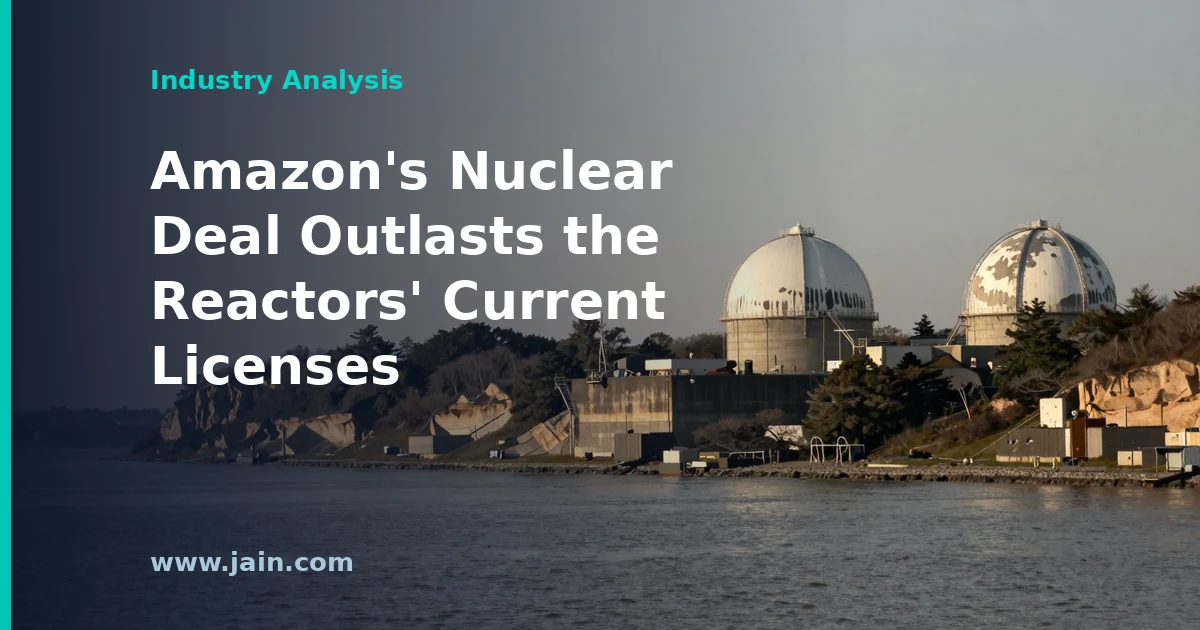
Amazon has signed a 20-year deal to buy about a third of the electricity from Calvert Cliffs, Maryland’s only nuclear power plant, which today produces enough for more than 1.3 million homes. The plant’s owner, Constellation Energy, says the deal unlocks more than $3 billion of investment.
The twist: most of that power already exists. Just over a quarter of Amazon’s share will come from new equipment, due between 2030 and 2032. The plant’s two reactors have federal operating licenses that expire in 2034 and 2036, long before the contract ends. The power also stays on the shared grid rather than being walled off for Amazon.
Constellation Energy and Amazon signed a 20-year agreement on Sept. 30, 2026 under which Amazon will buy 690 megawatts (MW) of output from the Calvert Cliffs Clean Energy Center in Maryland, Mugglehead Investment Magazine reported. The 690 MW includes a planned 190 MW capacity increase at the 1,790 MW station, expected to come online between 2030 and 2032. Constellation says the agreement is expected to enable more than $3 billion in Maryland infrastructure investment.
Amazon said electricity from Calvert Cliffs will continue flowing to the PJM regional grid. The companies also signed a separate retail supply agreement covering Amazon operations across PJM’s 13 states and the District of Columbia. Constellation did not disclose a price per megawatt-hour or a spending schedule for the investment.
Executive Summary
Amazon, one of the hyperscalers (the largest cloud and AI computing operators), has committed to two decades of nuclear power from Maryland’s only nuclear plant. The contract covers 690 MW, roughly a third of the station’s output once a planned 190 MW uprate is complete. Constellation ties the deal to more than $3 billion of state investment, to relicensing the plant for another 20 years, and to potential new clean energy plants at the site.
The deal is less about new megawatts than the headline suggests. About 500 MW of the contract comes from reactors already running, and the new 190 MW will not arrive until 2030 to 2032. The larger consequence is financial: a 20-year revenue stream for a station whose two reactor licenses expire in 2034 and 2036 strengthens the case for keeping all 1,790 MW running into the 2050s. The structure matters too. The plant stays connected to the shared grid instead of being dedicated to an Amazon campus built on site.
What remains open is the economics. There is no disclosed price, start date, investment schedule, or relicensing application date. Constellation has also named no design or budget for the new plants it says the deal will help advance.
Most of the 690 Megawatts Already Exists
A megawatt measures generating capacity. Calvert Cliffs’ current 1,790 MW supplies the equivalent of more than 1.3 million homes and about 80 per cent of Maryland’s clean energy, by Constellation’s count. Amazon’s 690 MW contract includes the planned 190 MW increase, so roughly 500 MW of it is output from reactors that are already operating. The 190 MW is an uprate, meaning engineering changes that let existing reactors produce more power. It is not a newly ordered reactor.
For anyone modeling new electricity supply for data center growth in PJM, the timing is the point. In the near term, the deal assigns existing carbon-free output to a named buyer. The net addition to the grid, about a tenth more capacity at the station, arrives between 2030 and 2032.
Amazon’s earlier PJM nuclear agreement follows a similar pattern. Talen Energy’s June 11, 2025 contract covers 1,920 MW from the existing Susquehanna plant in Pennsylvania, reaching full quantity no later than 2032 and running through 2042. Talen treats any extra output from uprates as a separate possibility. Two contracts with one buyer do not make a market-wide trend. Still, both of Amazon’s disclosed PJM nuclear deals are anchored on reactors that already exist, with new capacity small or optional.
Why the 2034 License Date Is the Bigger Stake
The U.S. Nuclear Regulatory Commission (NRC) lists Unit 1’s operating license as expiring July 31, 2034 and Unit 2’s as expiring Aug. 13, 2036. Both licenses were renewed in 2000. A 20-year contract signed in 2026 runs into the mid-2040s at the earliest. If deliveries begin soon after signing, more than half of the term falls after Unit 1’s current license ends. The contract can be fully performed only if the NRC grants subsequent license renewal. That process extends reactor operation from 60 to 80 years and requires its own safety and environmental reviews.
The arithmetic shows where the stake lies. The uprate adds 190 MW. Operation beyond the mid-2030s depends on relicensing for all 1,790 MW, more than nine times as much capacity. Constellation says the agreement helps provide the revenue certainty needed to relicense the plant for another 20 years. That is the mechanism: long-dated contracted revenue is what justifies the cost of a renewal application and the plant investment that goes with it. “Amazon’s commitment supports the long-term operation of Calvert Cliffs for generations to come,” chief executive Joe Dominguez said.
Several parties depend on that outcome. Amazon needs the plant running to receive its contracted supply. Maryland gets most of its clean electricity from this one station. PJM would lose far more capacity if the plant closed than the uprate adds. A power sale does not renew a license, though, and Constellation has given no date for an application. The deal’s most consequential effect is a stronger financial case for keeping the station open. The regulatory decision is still years away.
A Hyperscaler Pays for Nuclear Without Taking It Off the Grid
Amazon said Calvert Cliffs’ electricity will keep flowing to PJM, the operator of the regional grid serving 13 states and Washington, D.C. That footprint includes Northern Virginia, the world’s largest data center market. The main alternative is co-location, in which a data center is built at the plant and draws power directly, “behind the meter,” before it reaches the grid. Co-location has drawn regulatory scrutiny in PJM over its effect on other customers.
Calvert Cliffs instead uses what the industry calls a grid-side power purchase agreement (PPA), a long-term contract to buy a plant’s output. The plant sends its electricity into the grid, and Amazon’s facilities are served through a separate retail supply agreement. Under a structure like this, the buyer underwrites the plant’s revenue while its output stays available to the regional system. That reduces the friction co-location attracts.
The trade-off is that Amazon’s sites still depend on the grid’s ability to deliver power where its data centers are located. The nuclear contract secures a source of electricity, but it does not settle questions of local grid connections or transmission capacity.
The $3 Billion Figure Still Needs a Schedule
Constellation says the deal will “enable” more than $3 billion of Maryland investment. That figure is not described as Amazon’s direct spending, and no spending timeline was given. It is also unclear how the sum divides among the uprate, relicensing work, and the potential new clean energy plants, for which Constellation named no design, equipment order, budget, or completion date.
Without a price per megawatt-hour, outside observers cannot compare the contract with market power prices or judge how much of the plant’s future revenue it locks in. Constellation’s shares rose after the announcement, which suggests investors value the long-term revenue certainty. Overall, the announcement is concrete on duration, volume, and the uprate window, and thin on economics.
Background
Constellation Energy, spun off from Exelon in 2022, operates the largest fleet of nuclear plants in the United States. Calvert Cliffs, on Maryland’s Chesapeake Bay shore, has two reactors totaling 1,790 MW. The company is also working to restart an 835 MW reactor in Pennsylvania under a separate long-term agreement with Microsoft. That unit received an NRC environmental finding on Sept. 25, 2026.
Since 2024, hyperscalers have turned to existing nuclear plants for around-the-clock, carbon-free power for cloud and AI data centers. Many of these deals sit inside PJM, the grid serving 13 states and Washington, D.C., where data center demand has grown fastest. Amazon’s 1,920 MW contract with Talen Energy’s Susquehanna plant, signed in June 2025, is the closest comparable.
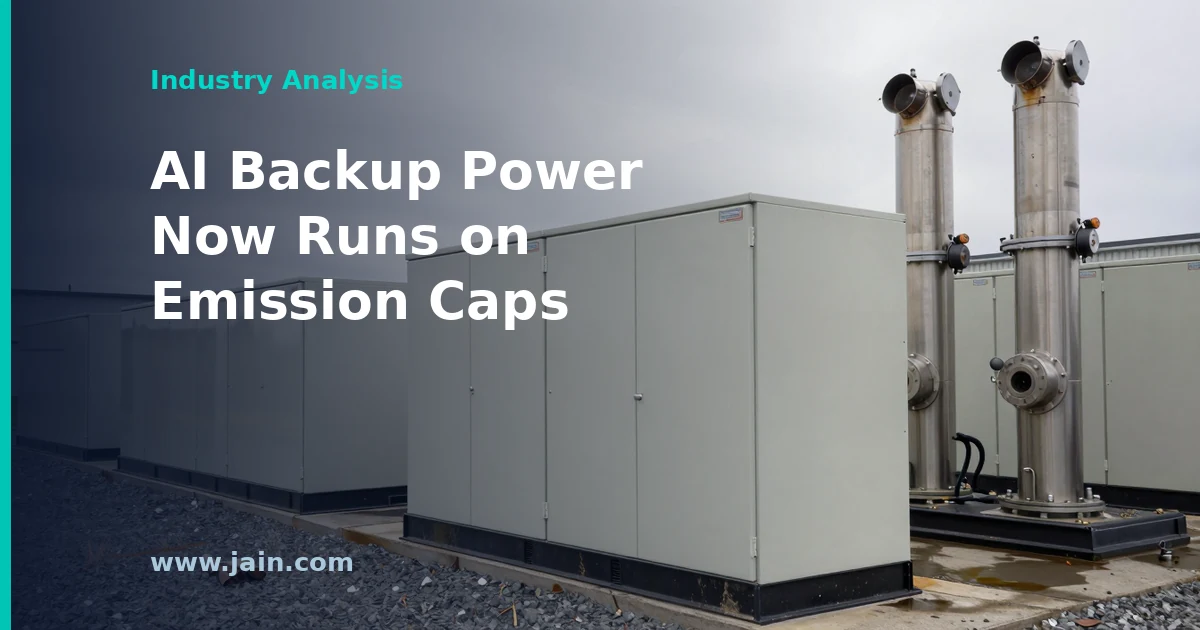
Amazon agreed to buy backup generators from Generac, the company best known for the generators that keep homes running during blackouts. These machines do the same job for the giant computer buildings behind online services, starting up when the regular power fails.
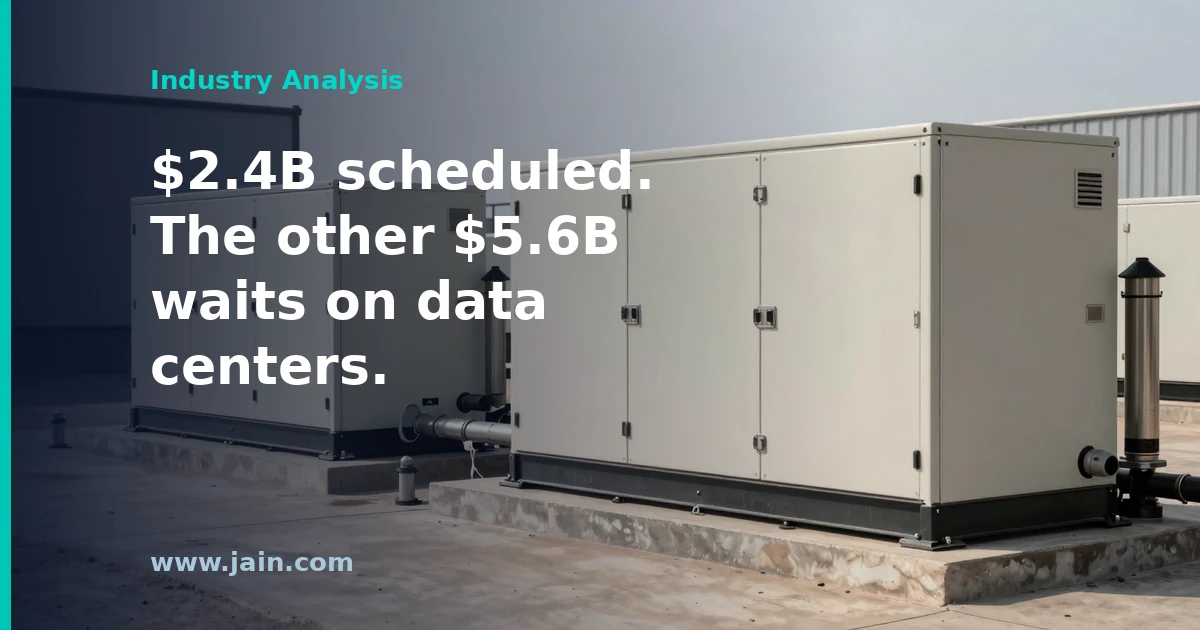
About $2.4 billion worth is expected to be delivered in 2027 and 2028. Amazon also gets the right to buy Generac stock at a fixed price, and that right grows the more generators Amazon buys, up to $8 billion.
The first $2.4 billion has a date on it. The rest only happens if Amazon keeps building.
On September 16, 2026, Generac Holdings (NYSE: GNRC) and Amazon.com signed a long-term supply agreement for backup power generators for Amazon data centers, according to an 8-K Generac filed the same day. Initial deliveries are expected to total $2.4 billion across 2027 and 2028. Alongside the supply deal, Generac issued an Amazon subsidiary a warrant to buy up to 1,693,745 Generac shares at $200.9266 each. Some of those shares vested immediately, and the rest vest as Amazon’s generator payments accumulate, up to a total of $8 billion.
Yahoo Finance reported that Generac shares rallied on the news.
Executive Summary
Generac’s filing makes Amazon a named buyer of data-center backup power, the generators that carry a facility through a grid outage once its batteries run down. It puts two numbers on the relationship. The first is $2.4 billion in expected deliveries over two years. The second is an $8 billion ceiling on the purchases that can unlock Amazon’s equity stake.
Those two figures measure different things. The $2.4 billion is a delivery expectation with dates attached. The $8 billion is the spending level at which Amazon’s warrant fully vests, and the warrant runs until September 2033. Most of the headline figure is therefore contingent: it turns into revenue only if Amazon keeps building data centers that need Generac equipment.
The structure also shows who is paying for what. Generac is giving its customer equity upside in return for volume. For Generac shareholders, that is a trade of some future dilution for a large anchor buyer. For the wider data-center supply chain, it signals that backup generation is now valuable enough to be locked in years ahead with financial ties that go beyond a purchase order.
The $8 Billion Is a Ceiling, Not an Order
The 8-K describes two separate instruments. The long-term supply agreement governs what Amazon buys, and the only scheduled volume it discloses is the $2.4 billion in initial deliveries expected in 2027 and 2028. The warrant governs what Amazon earns, and it vests in tranches “contingent upon aggregate gross payments, net of certain offsets” from Amazon for data-center backup generators, “up to a total of $8 billion.” The $8 billion is the point where the incentive stops growing. It is not a commitment to spend that much.
Scheduled deliveries cover 30% of that ceiling. The remaining $5.6 billion has no timetable in the filing, only an outer boundary: the warrant can be exercised on or before September 16, 2033. Every new hyperscale data center needs its own backup generation, sized to its electrical load. Whether Generac’s revenue approaches the $8 billion mark therefore depends on how many facilities Amazon builds over the next seven years, how large they are, and how much of that generator demand Generac wins against other suppliers.
This matters to three groups. Investors should model $2.4 billion as the disclosed baseline and treat anything above it as dependent on Amazon’s construction pace. Generac’s factory planning has to support a two-year delivery ramp without knowing what comes after 2028. Other generator suppliers now face a buyer that has a financial incentive to direct its volume toward one vendor.
Generac Is Paying for Volume in Equity
A warrant is the right to buy shares later at a fixed price. Here the supplier grants it to the customer. That makes it a volume incentive paid in stock rather than cash. Of the 1,693,745 warrant shares, 307,954 (about 18%) vested at signing, which works as an upfront signing incentive. The other 1,385,791 unlock only as Amazon’s payments grow. Spread evenly across $8 billion, that would be roughly one share for every $5,770 of generator purchases. The filing says only that vesting occurs in “multiple tranches” and does not give the actual schedule.
The economics favor Amazon when Generac’s stock trades above the $200.9266 strike price. Buying all 1,693,745 shares would cost about $340 million at that price. However, Amazon can choose a cashless exercise, receiving the net value in shares without paying cash. Generac has also granted registration rights, which make it easier for Amazon to sell those shares later. The result ties part of Amazon’s return to Generac’s share price, and that price should rise as Amazon buys more generators. Existing Generac shareholders bear the cost through potential dilution. The warrant’s strike price and share count are also subject to anti-dilution adjustments.
A Home-Standby Brand Takes a Hyperscale Test
Generac built its name on home standby generators. Data-center backup is a different business. The units are larger, reliability requirements are strict, and a hyperscaler’s construction schedule does not move because a supplier fell behind. Having Amazon as a named, contracted buyer is the clearest external validation of Generac’s data-center push so far. It also exposes Generac to a direct test: delivering $2.4 billion of equipment within two calendar years, to a customer that can measure its performance precisely.
Amazon’s broader funding shows how much money is flowing into these projects. Two days before the Generac agreement, Amazon’s own 8-K reported that it closed a £4.25 billion sterling bond sale, with coupons ranging from 5.200% on notes due 2029 to 6.650% on notes due 2045. Nothing in that filing links the proceeds to Generac or to data centers in particular. What it does show is a buyer raising capital at a scale where multi-year equipment commitments are routine. For Amazon, a warrant that pays off only if Generac performs is an inexpensive way to secure a supply chain it will need regardless.
Background
Generac Holdings, which trades as GNRC, is best known for home standby generators, the units that switch on automatically when a house loses power. Data-center backup power is a larger, more demanding version of the same product. Each facility needs enough on-site generation to carry its full electrical load through a grid outage, and hyperscale operators such as Amazon buy these systems in volume as they build new campuses.
Warrants tied to a customer’s purchases are an established way for suppliers to secure large buyers. The supplier grants equity upside that grows as the customer spends. Generac’s agreement follows that model, pairing a long-term supply contract with a warrant that vests against Amazon’s generator payments.
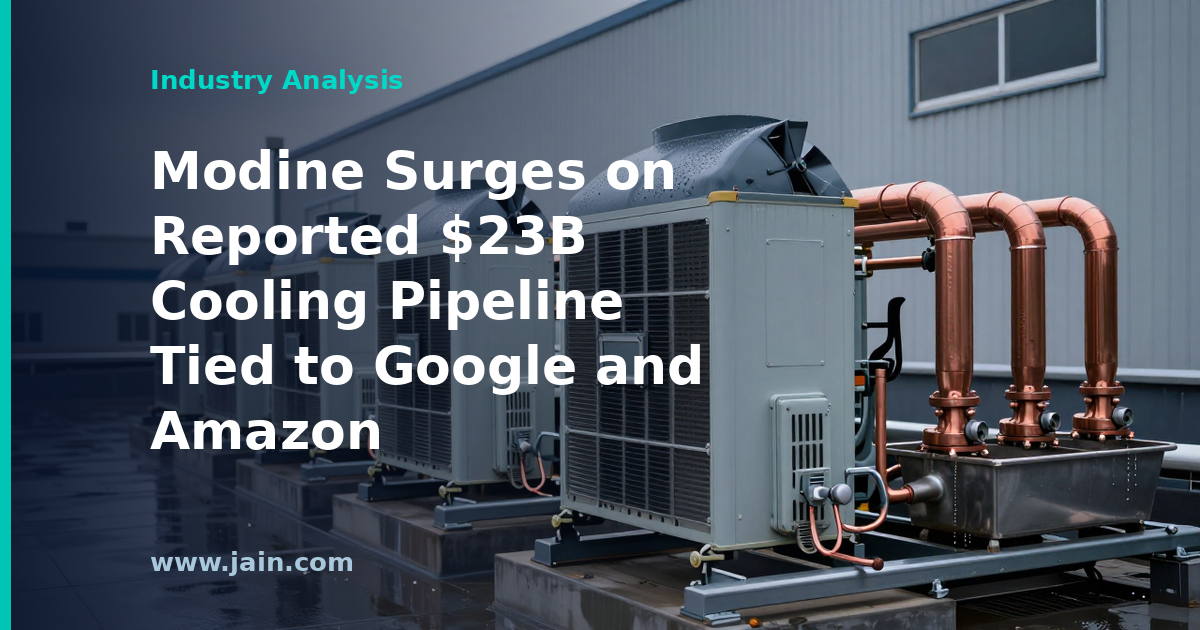
Shares of Modine Manufacturing (NYSE: MOD) jumped after Hunterbrook published a report, based on what it describes as leaked files, claiming the thermal-management company has a roughly $4 billion deal tied to Google and a data center cooling demand pipeline of about $23 billion that also links Amazon as a customer. Multiple financial outlets, including Benzinga, Proactive, and Pluang, relayed the report on August 22, 2026.
Neither Modine, Google, nor Amazon has publicly confirmed the figures, which originate from the report rather than from any company disclosure.
Executive Summary
The claim at the center of the move is simple but large: a report by Hunterbrook, citing leaked documents, names Google and Amazon as customers behind a data center cooling pipeline it sizes at $23 billion, including a reported $4 billion arrangement connected to Google. For a company of Modine’s size — a century-old industrial thermal specialist rather than a hyperscale household name — numbers of that magnitude, if borne out, would represent a step-change in the scale of its data center business.
The market’s reaction is as informative as the claim itself. Investors bid the stock up on an unverified, third-party report — a signal of how hungry the market is for pure-play exposure to data center cooling. As artificial intelligence workloads push server racks toward power densities that air cooling alone cannot handle, the companies that move heat — through chillers, coolant distribution units, and liquid cooling systems — are being repriced as strategic AI infrastructure suppliers rather than cyclical industrial vendors.
What matters now is verification: whether the companies involved confirm, deny, or stay silent, and whether the reported pipeline reflects contracted backlog or aspirational opportunity. Those are very different things for a stock that just moved on the distinction being blurred.
Cooling Is Becoming the Buildout’s Next Bottleneck
For most of the data center industry’s history, cooling was a solved problem: blow enough cold air across the servers and manage the electric bill. AI has broken that model. Modern accelerator racks can draw many times the power of traditional server racks, concentrating heat beyond what air-based systems efficiently remove. The industry’s answer — liquid cooling, where coolant is piped directly to chips or to heat exchangers at the rack — requires specialized equipment, and the supplier base for that equipment is far smaller than the demand now chasing it.
That is the structural story that makes a report like this land so hard. Investors have already repriced power equipment makers, transformer suppliers, and generator manufacturers as AI bottleneck trades. Thermal management is the logical next link in that chain: every megawatt of new AI compute is also a megawatt of heat that must go somewhere. A report naming the two largest cloud builders as anchor customers of a mid-cap cooling specialist fits a narrative the market was already primed to believe.
What the Report Claims Versus What Is Confirmed
It is worth being precise about the evidentiary chain here. The $4 billion and $23 billion figures come from a media report citing leaked files — not from a Modine securities filing, an earnings call, or a customer announcement. Hyperscalers rarely confirm their suppliers, and suppliers are often contractually barred from naming hyperscaler customers, so silence from Google and Amazon would be unremarkable either way. As of the coverage cited, none of the three companies had substantiated the numbers.
The word “pipeline” also deserves scrutiny. In industrial sales, a pipeline is typically the total value of opportunities being pursued — not signed contracts, not backlog, and not revenue. If the $23 billion figure describes potential demand Modine is quoting against, the economic reality could differ substantially from what a headline reader might assume. The reports available do not make that distinction clear, and the distinction is worth billions.
The Messenger Matters: Reading a Hunterbrook Report
The source of the claim adds its own analytical wrinkle. Hunterbrook operates an unusual model in financial media: a newsroom paired with an affiliated investment fund that can trade on its reporting before publication. In this case the report is bullish — a departure from the short-seller-style exposés such outlets are better known for — but the incentive question cuts the same way in both directions. Readers and investors should ask of any market-moving report: who benefits from the move, and was the evidence strong enough to justify it?
None of that makes the reporting wrong. Leaked documents can be accurate, and Hunterbrook’s work has moved markets before precisely because it is often substantive. But the fair standard is symmetrical: the same skepticism this publication would apply to an unverified vendor press release applies to an unverified media report, however sophisticated the outlet. Until Modine addresses the figures directly — in a filing, an earnings call, or a formal statement — the $23 billion number is a claim, not a fact.
Concentration Risk Hides Inside the Opportunity
Suppose the report is directionally right. Even then, the economics carry a caveat familiar to anyone who supplies hyperscalers: customer concentration. A supplier whose growth story rests on two buyers — however creditworthy — inherits their capital-expenditure cycles, their pricing leverage, and their willingness to dual-source or bring capabilities in-house. Hyperscalers have a long record of commoditizing their supply chains once a technology matures, from servers to networking gear.
The competitive field is also crowding fast. Established HVAC and infrastructure giants, specialist liquid cooling firms, and well-funded startups are all racing into the same thermal market. A large pipeline today says little about margins three years from now if the bidding field triples. For buyers of cooling equipment, that competition is good news — more capacity and better pricing. For any single supplier’s shareholders, it is the risk that tempers the headline number.
Background
Modine Manufacturing, founded in 1916 and headquartered in Racine, Wisconsin, spent most of its history as a heat-transfer specialist serving automotive and industrial markets. In recent years it has pivoted deliberately toward higher-growth thermal businesses, with data center cooling — including chillers and precision cooling systems — becoming a centerpiece of its climate solutions segment. That repositioning has coincided with the AI-driven data center boom, which has turned formerly unglamorous supply categories like power distribution and heat rejection into some of the market’s most closely watched bottleneck trades.
Hunterbrook, the report’s source, represents a newer breed of financial media: an investigative newsroom paired with an affiliated fund that can trade on its findings. Its reports have moved stocks in both directions before, which is why a bullish claim about Modine’s customer pipeline traveled so quickly through financial media despite lacking company confirmation.
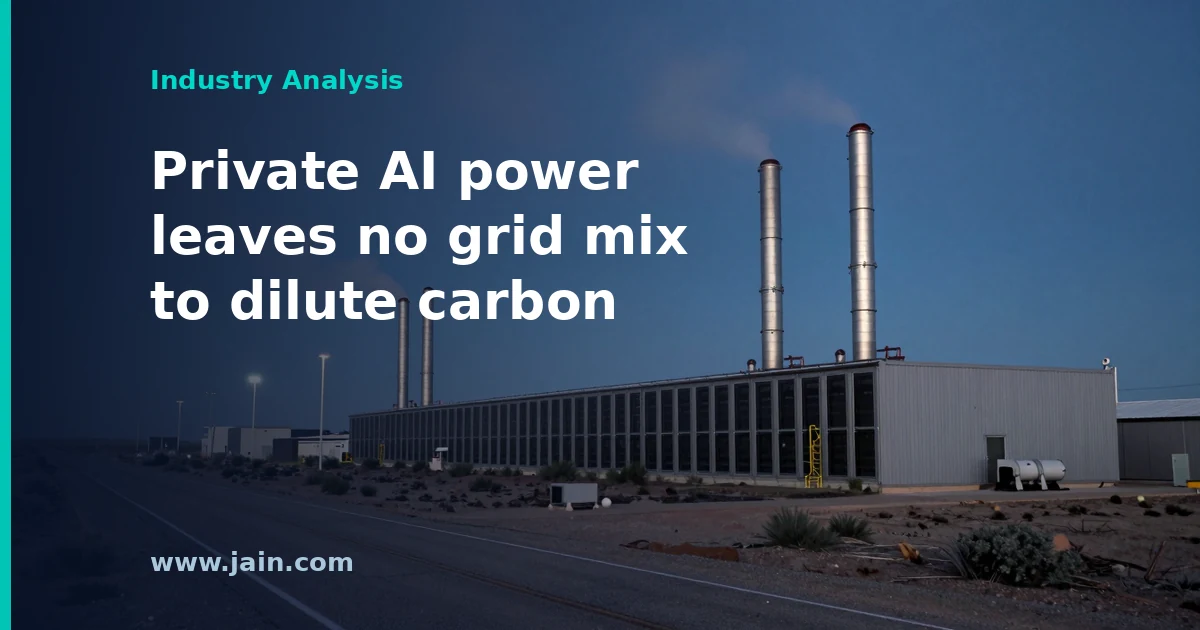
Amazon is building its own natural gas power plant in west Texas to run a giant artificial intelligence computer center on the same site.
Its permit allows up to 33 million tons a year of carbon dioxide, the main gas warming the planet. That is more than any other power plant in the country.
Plugging into the public grid mixes in wind, solar and nuclear power. A private gas plant does not, so every ton traces back to one project, while Amazon still promises to cancel out its carbon pollution by 2040.
Amazon is building a natural gas power plant in Pecos County, Texas, to supply a new AI data center on the same site, according to a New York Times report on August 8 that Tom’s Hardware covered the following day. Project permits describe a plant of up to 7.65 gigawatts (GW) running 35 gas turbines, authorized to release up to 33 million tons of carbon dioxide a year. That is more than any other power plant in the United States.
Amazon co-founded The Climate Pledge in 2019 and committed to net-zero carbon emissions across its global operations by 2040. Amazon spokeswoman Margaret Callahan said “the world looks different now than when we co-founded the climate pledge,” but that “our commitment hasn’t changed.”
Executive Summary
The Pecos County project is a clear example of “behind-the-meter” generation at hyperscale. Behind-the-meter means power is produced on site for a single user instead of being drawn from the public grid. Hyperscalers are the handful of companies that run cloud platforms at global scale. At 7.65 GW, this is a utility-sized power station built to serve one data center campus.
The scale matters, and so does the structure. A grid-connected data center’s footprint is an allocated share of a regional mix that includes gas, wind, solar and nuclear, and the operator can lower its reported figure with clean-energy contracts. A dedicated gas plant has one fuel and one customer. Every ton it emits traces to the AI campus it serves, and at the permitted ceiling those tons would make it the country’s largest single point source of power-sector CO2.
For Amazon, the plant sits in direct tension with a public 2040 net-zero goal. The company says the goal is intact but has not described how the two will be reconciled. For the wider industry, the permit is a preview of the emissions ledger that comes with choosing speed-to-power over grid interconnection.
No Grid Mix, No Dilution: Why Bring-Your-Own Power Changes the Carbon Math
A data center plugged into the public grid consumes electrons from a shared pool. Its reported electricity emissions are calculated from that regional mix, and under common greenhouse-gas accounting practice a buyer can point to renewable-energy contracts to lower the figure it reports. Two things soften the number: the grid’s own blend of generation sources, and the contracts layered on top.
A dedicated gas plant removes both. The 35 turbines permitted in Pecos County burn a single fuel for a single customer, so the permitted 33 million tons a year maps directly onto one AI campus. There is no wind farm or nuclear unit in the blend to average it down. If Amazon owns or controls the plant, standard accounting treats those tons as the company’s direct emissions, which are the hardest category to offset with purchased certificates. Even under a third-party ownership model, the link between the smokestack and the server hall is unambiguous.
That is why the number stands out. The permit is a ceiling, and actual emissions will depend on how many turbines are built and how hard they run. At the permitted level, though, one company’s AI buildout would exceed every other power plant in the country. Everyone weighing on-site generation is affected: Amazon’s own 2040 accounting, the more than 700 members of The Climate Pledge that Amazon co-founded, and every other hyperscaler now pricing the trade-off between waiting for the grid and building its own power.
Speed to Power Is Choosing the Fuel
The shift to on-site generation is driven mainly by time. Connecting a large new load to the grid can take years of studies and upgrades, and communities have grown wary of data centers pushing up local electricity bills. Building power on site sidesteps both problems. Gas has become the leading choice because turbines scale quickly and fuel is available. Nuclear agreements such as Microsoft’s Three Mile Island deal and large renewable portfolios are also being pursued, but they generally take longer to deliver at gigawatt scale.
Policy points in the same direction. The Trump administration has backed gas-fired data center projects and promoted oil, natural gas and coal over renewables, which lowers the regulatory friction for fossil-fueled generation at data center sites. Pecos County sits in the Permian Basin region, and that proximity to gas production strengthens the logistics case.
The economics change too. By building a 7.65 GW plant, Amazon effectively becomes a major power producer, which means taking on turbine procurement, fuel supply, plant operations and fuel-price exposure that grid customers leave to utilities. Turbine manufacturers and gas suppliers gain a large anchor customer. The operator gains control over its timeline, and in exchange it owns the emissions outright.
Testing the Claim That the Commitment Hasn’t Changed
Amazon’s position is that its 2040 net-zero goal stands even as the landscape shifts. The claim deserves a fair test. The company’s emissions have risen each year for the past several years, a trend analysts attribute to data center construction for AI. Microsoft has made a similar case about its 2030 goal amid its own carbon-intensive expansion. Neither company has abandoned its target, and ambitious targets set in advance of a technology shift are not inherently disingenuous.
The tension is structural, though. Gas plants are typically built to operate for decades, which would carry a facility of this size well past 2040. For a net-zero commitment to hold, something has to bridge the gap. That could be carbon capture, a later fuel switch, running the turbines far below their permitted ceiling as grid or clean supply arrives, or large-scale offsets. None of these has been described for this site. Until one is, the commitment is a statement of intent that the Pecos County permit does not yet support.
Background
Amazon operates more data centers than any other company worldwide and is building several new AI-focused campuses around the world. In 2019 it co-founded The Climate Pledge, committing to net-zero carbon emissions across its operations by 2040. Its emissions have nonetheless risen each year for the past several years as data center construction accelerated.
Across the industry, hyperscalers and data center operators are increasingly building dedicated on-site power instead of waiting for grid connections, driven by long interconnection timelines and local concern over rising electricity bills. Some are pursuing nuclear and renewable deals, but natural gas has become the leading choice because it can be scaled and brought online quickly.
Amazon is building a huge complex of computer buildings, the kind that run online services and artificial intelligence, on an old steel mill site outside Philadelphia.
Pennsylvania plans to let Amazon add 280 natural gas engines that switch on if the power goes out. That is on top of 76 diesel engines already there.
The catch is that Amazon agreed to a strict yearly pollution limit, so those engines can only run so much. For buildings like these, keeping the lights on is now decided partly by pollution permits and packed town meetings, not just the power company.
WHYY reported on July 15, 2026 that Pennsylvania’s Department of Environmental Protection (DEP) plans to approve 280 natural gas-fired generators and three diesel-fired generators to supply backup power at Amazon’s data center complex under construction in Falls Township, Bucks County. Amazon has already installed 76 diesel generators at the 250-acre site, the former U.S. Steel mill now called the Keystone Trade Center. The generators would run when the site’s electricity supply from the utility PECO is interrupted.
DEP officials presented the plan at a tense public meeting on July 14 at Pennsbury East High School. Under the pending application, Amazon agreed to keep annual emissions of nitrogen oxides and volatile organic compounds under 25 tons. The air quality plan approval opens for 30 days of public comment once it appears in the Pennsylvania Bulletin, which DEP expected on July 18.
Executive Summary
Amazon’s Falls Township campus, with up to 10 new buildings plus 1 million square feet of retrofitted warehouse space and more than half built, is set to carry 359 backup generators in total if DEP approves the new units. Amazon says the complex will host cloud computing infrastructure and “advance AI innovation.” It is part of a $20 billion investment Amazon has pledged in Pennsylvania.
The figure that matters most is the 25-ton emissions ceiling, not the generator count. By fitting emissions controls on its larger generators and limiting fuel use, Amazon qualifies the site as a “synthetic minor” source. That means it accepts enforceable limits to stay below the threshold for heavier regulatory treatment. In effect, the campus’s backup power becomes an annual emissions budget written into an air permit.
This moves the reliability question for large AI-oriented campuses out of the utility’s engineering studies and into state air permitting, public comment periods and community meetings. It also sits beside a separate, unresolved debate over who pays as data center demand grows on the regional grid.
A 25-Ton Cap Turns Backup Power Into a Budget
The headline number is 280 gas generators, but the number that governs how they can be used is 25. Under its pending application, Amazon agreed to keep combined annual emissions of nitrogen oxides and volatile organic compounds under 25 tons per year. Both pollutants can form ground-level ozone and worsen asthma. To stay under the limit, Amazon will install emissions control systems on its larger generators and limit fuel usage. Staying under 25 tons qualifies the campus as a “synthetic minor” source: a facility whose equipment could in principle emit more, but which accepts binding limits to remain below the level that triggers the more demanding permitting that applies to major sources.
A fuel-use limit works in practice as a limit on running time. Data center backup generators typically run for routine testing and maintenance, and for real outages. The permit turns that into a fixed annual allowance shared across the whole fleet. In a year with a reliable grid, most of the allowance goes to testing. A long outage or repeated grid emergencies would draw it down faster. Reliability planning for this campus therefore has a regulatory ceiling written into the air permit, alongside the electrical design.
That affects the people who plan, build and permit these sites. Developers sizing backup fleets for large campuses have to design against local emission thresholds as well as uptime targets. The approving authority for that design is a state air regulator operating in public: a packed auditorium meeting, a 30-day comment window, and a petition critics say has drawn more than 4,000 signatures. Pennsylvania’s Permit Fast Track Program sped up earlier permits for this project. The backup power decision still runs through public comment.
Hundreds of Engines Behind a Grid-Connected Campus
The campus is designed to run on grid power from PECO. The generators exist for the moments that supply fails. Even so, the fleet is large. Seventy-six diesel units are already installed, and 283 more are proposed, for 359 in total. That scale reflects what hyperscale operators expect from a site this size. A hyperscale campus is a very large, standardized facility built by a major cloud provider, and customers of cloud and AI services expect it to keep running through a utility outage.
The new units are mostly gas-fired rather than diesel. Amazon has not publicly explained the choice. In general, gas units draw fuel from a pipeline rather than on-site tanks and produce less soot than diesel. They still emit nitrogen oxides, which is why the emissions controls and the tonnage cap matter. Amazon has not disclosed the combined generating capacity of the fleet, so it is not possible to say how much of the campus load the generators could carry, or for how long.
The Grid Cost Question the Transmission Agreement Does Not Settle
PECO’s Glen Murphy said the utility found the project will not raise the distribution rates PECO customers pay. He said the project’s second phase will require infrastructure upgrades, but a “take-or-pay” transmission security agreement with Amazon protects residents from those costs. Under a take-or-pay arrangement, the customer commits to pay whether or not it uses the capacity. Murphy called the project a likely net benefit to customers that could “bring down rates a bit.”
Those agreements do not cover a different cost: the price of electricity supply itself, which rises with demand on the regional grid. PECO is part of PJM, the grid operator serving Pennsylvania, New Jersey and other states. New Jersey Assemblyman Balvir Singh argued that added demand will push up bidding and prices across that shared grid. The two claims are not contradictory. One concerns the wires that connect the campus; the other concerns the market for the power flowing over them. Neither side offered a figure for the supply-cost effect.
Weighing the Claims on Both Sides
Amazon’s Becky Ford said the company’s Pennsylvania data centers use water for cooling around 6% of the year on average, relying mostly on outside air. An engineer working for the Morrisville Municipal Authority said the project will draw Delaware River water rather than drinking water, in an amount requested to equal about 70 homes’ use. These are useful figures, but an annual average says little about hot-weather peaks, and a requested amount is not metered use. Ford also said the nearest homes are about 5,000 feet away and will hear no noise from the complex. That answers the residential question, not the one resident John Baldassano raised: whether generators running during an emergency would disrupt workers at industrial sites closer by.
DEP’s Jillian Gallagher said projected emissions are similar to those of hospitals, universities and snack food manufacturers in the state. Resident Seema Kazmi countered that the area is already pollution-stressed. A per-facility threshold does not by itself address cumulative burden, which is her concern. Her point about emissions from grid power supplying the site also falls outside the scope of this air permit. Better data is coming. The state budget signed July 12 requires large data centers to report their energy and water use annually to DEP. Proposals to tie tax incentives to new clean generation, and to pause data center development, did not pass.
Background
Amazon’s Falls Township campus sits on the Keystone Trade Center, a former U.S. Steel mill site along the Delaware River in Bucks County, north of Philadelphia. It is one of two Pennsylvania data center projects in Amazon’s pledged $20 billion state investment. The other is in Salem Township beside the Susquehanna nuclear plant. The local utility, PECO, operates within PJM, the regional grid and wholesale power market that spans Pennsylvania, New Jersey and neighboring states.
Large data centers keep fleets of on-site generators so servers stay running through grid outages. In Pennsylvania these generators require air quality approval from DEP. Pennsylvania has courted data center investment through fast-track permitting and tax abatements, while debate continues over grid costs, water use and local pollution.
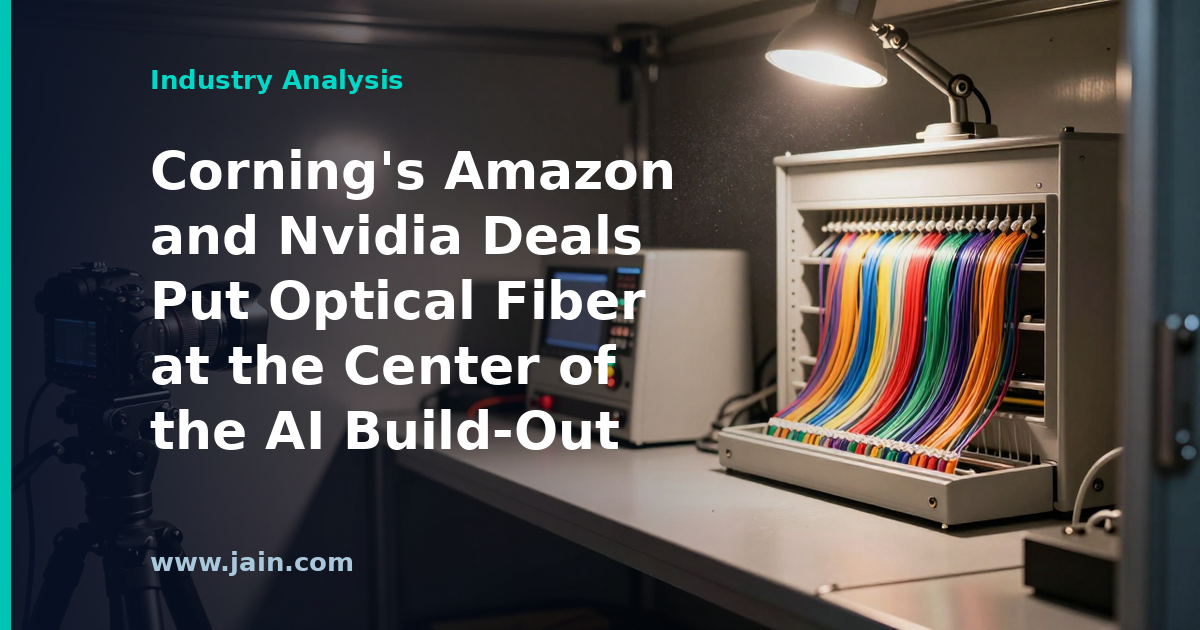
Corning Incorporated (NYSE: GLW), the U.S. glass and optical-fiber maker, has landed a supply deal with Amazon and a tie-up with Nvidia to support AI-driven fiber expansion, according to a Yahoo Finance report dated July 11, 2026. The report identifies the two partners and the AI-infrastructure context but discloses no financial terms, volumes, or timelines.
Executive Summary
According to the report, Corning has secured two of the most consequential names in AI infrastructure as partners: Amazon, the largest cloud provider through AWS, and Nvidia, whose GPUs power the bulk of AI training clusters. The pairing matters because it spans both ends of the optical market — a hyperscale buyer locking in fiber supply for data-center construction, and a chipmaker whose networking roadmap increasingly depends on optics engineered into the systems themselves.
The deeper signal is about scarcity. For three years the AI build-out narrative has centered on GPUs, then power, then land and cooling. Deals like these suggest the industry is now moving down the stack to connectivity: the millions of fiber strands that stitch tens of thousands of accelerators into a single usable computer. When buyers of Amazon’s and Nvidia’s scale contract directly with a fiber manufacturer, it typically means they no longer trust the spot market to deliver.
Fiber Is the Layer the AI Boom Forgot to Price In
An AI data center is, in networking terms, unlike anything the cloud era built. Traditional cloud facilities connect servers that mostly work independently; AI training clusters must make thousands of GPUs behave like one machine, which requires every accelerator to talk to every other at extreme speed. That drives fiber consumption per megawatt to multiples of what conventional data centers use — dense mesh fabrics of optical links inside the building, plus long-haul routes connecting campuses into distributed training networks.
Corning has been positioning for this shift for some time. In 2024 it struck a widely reported agreement with Lumen Technologies that reserved roughly 10% of its global fiber capacity to interconnect AI data centers — an early sign that fiber, a product long treated as a commodity, was becoming something buyers reserve years ahead. A reported Amazon deal would extend that pattern from carriers to the hyperscalers themselves.
What Amazon and Nvidia Each Want — and Why It’s Not the Same Thing
Amazon’s interest is straightforward supply security. AWS has committed to one of the largest capital programs in corporate history, building AI campuses that each require enormous quantities of fiber-optic cable, connectors, and pre-terminated assemblies. Contracting directly with the manufacturer hedges against the lead-time blowouts that hit transformers and switchgear, and can lock in pricing before competitors absorb capacity.
Nvidia’s angle is architectural. As GPU clusters scale, the copper links traditionally used for short connections run out of reach and power budget, pushing the industry toward optics integrated ever closer to the chip — including co-packaged optics, where the optical components sit in the same package as the switch silicon. Nvidia has publicly built a silicon-photonics ecosystem around its networking platforms, and Corning has previously been named among its optics partners. A deepened tie-up would suggest fiber makers are moving up the value chain, from selling cable to co-engineering the optical guts of AI systems.
Winners, Losers, and What the Report Actually Establishes
If the deals are as described, Corning gains something rare for a components maker: demand visibility anchored to the two most creditworthy names in AI. Other fiber and connectivity suppliers — Prysmian, CommScope, Fujikura, Sumitomo — face a market where marquee demand is being locked up bilaterally, which can lift the whole sector’s pricing but also concentrates the best volumes with the leader. Buyers without such agreements, including telecom carriers and enterprises mid-way through their own fiber projects, may face longer lead times if AI demand absorbs available capacity.
That said, the source material here is thin: a headline confirming that deals exist, not what they contain. No dollar values, durations, capacity commitments, or product scope are disclosed. Supply agreements in this industry range from binding take-or-pay contracts to loose framework arrangements that generate headlines but little guaranteed revenue. Until terms emerge — in an SEC filing, an earnings call, or a detailed release — the prudent reading is directional: fiber is now strategic enough that Amazon and Nvidia negotiate for it directly, and that fact alone is meaningful.
Background
Corning invented the first commercially viable low-loss optical fiber in 1970 and has remained one of the world’s largest fiber producers through every connectivity cycle since — the dot-com fiber glut, fiber-to-the-home, and the cloud data-center era. Its optical communications segment sells fiber, cable, and pre-connectorized hardware to carriers and, increasingly, to hyperscale data-center operators.
The AI era reframed that business. Beginning around 2024, Corning began striking capacity-reservation agreements tied explicitly to AI data-center interconnection, including its Lumen Technologies deal, and was named among the partners in Nvidia’s silicon-photonics ecosystem. The reported Amazon and Nvidia deals of July 2026 continue that trajectory: fiber shifting from commodity purchase to strategically contracted supply.
Amazon has launched a $25 billion bond sale to help fund its artificial-intelligence infrastructure buildout, according to a report published by SiliconANGLE on July 6, 2026. The offering ranks among the largest corporate debt raises of the year and is aimed squarely at the data centers, chips, and power capacity behind Amazon’s AI ambitions.
Executive Summary
The announcement itself is simple: Amazon is borrowing $25 billion in the investment-grade bond market, and the stated purpose is AI infrastructure. What makes it significant is what it says about scale. Bond sales of this size were once reserved for blockbuster acquisitions; here, the “acquisition” is compute — data center campuses, accelerator chips, networking, and the electricity to run them.
It also confirms a structural shift in how the AI buildout is financed. The largest cloud providers, long famous for funding expansion out of their own operating cash flow, are increasingly turning to debt markets because annual capital spending has grown beyond what even their formidable cash generation comfortably covers. When the world’s biggest companies must borrow tens of billions to keep pace, AI infrastructure stops being just a technology story and becomes a fixed-income story — one that credit investors, utilities, and data center operators all have a stake in.
From Cash Machine to Serial Borrower
For most of the cloud era, hyperscalers — the handful of companies operating cloud platforms at global scale, such as Amazon, Microsoft, and Google — were net generators of cash. Capital expenditure was enormous but sat inside operating cash flow, so bond issuance was occasional and opportunistic. The AI cycle broke that pattern. Late 2025 saw a wave of jumbo hyperscaler bond deals, including a roughly $15 billion Amazon offering — its first major issuance in years — and even larger raises by peers. A $25 billion follow-on just months later suggests this is not a one-off top-up but a financing model: recurring, large-scale debt issuance to fund a multi-year infrastructure program.
That model is rational. Debt is well suited to long-lived physical assets — buildings, substations, cooling plants — and investment-grade borrowers of Amazon’s standing can raise it cheaply relative to the returns they project on AI services. The open question is duration matching: much of AI capex is not thirty-year buildings but accelerator chips (specialized AI processors) that may be economically competitive for only a handful of years. Borrowing long against assets that depreciate fast is a bet that AI revenue arrives on schedule.
Big Enough to Move the Bond Market
A $25 billion deal is not just large for Amazon; it is large for the market it lands in. Offerings at this scale absorb a meaningful share of investment-grade demand in the weeks they price, influence credit spreads (the extra yield investors demand over government bonds) for other issuers, and increase the weight of technology names in bond indexes that pension funds and insurers track. In effect, AI infrastructure is becoming an asset class within corporate credit — a bundle of quasi-utility bonds backed by the cash flows of cloud computing.
That has two second-order effects. First, it gives fixed-income investors — a far larger pool of capital than equity or venture markets — direct exposure to the AI buildout, which deepens the funding available for it. Second, it concentrates risk: if AI demand disappoints, the losses would no longer be confined to stock prices but would show up in credit portfolios that are meant to be the conservative part of institutional balance sheets. Nothing in this offering suggests distress — Amazon remains among the strongest credits in the market — but scale itself changes the risk picture.
Where the $25 Billion Actually Goes
“AI infrastructure” is shorthand for a long supply chain. Bond proceeds at this scale ultimately flow to chipmakers, to construction firms building data center shells, to electrical and cooling equipment vendors, to fiber and networking suppliers, and to utilities contracting new generation and transmission. For the data center industry, sustained debt-funded hyperscaler capex is demand visibility: it signals that orders for land, power, and capacity should continue well beyond the current fiscal year.
It also sharpens the competitive divide. Operators and regions that can deliver powered land — sites with grid connections, water or alternative cooling, and permits already in hand — are positioned to capture this spending. Those that cannot will watch it flow elsewhere. And because the hyperscalers can borrow at scale that colocation providers and smaller developers cannot match, cheap debt access itself becomes a competitive moat in the infrastructure race.
The Sustainability Question
The measured way to read this deal is as a confidence signal with a caveat. Amazon borrowing $25 billion says its leadership expects AI demand to justify the capacity — companies do not typically lever up to build assets they expect to idle. The caveat is that the entire industry is making a correlated version of the same bet, financed increasingly with borrowed money. If AI monetization compounds as projected, these bonds will look like textbook infrastructure finance. If it stalls, the sector will be servicing debt on capacity that arrived ahead of revenue.
History offers both comfort and warning. The fiber overbuild of the late 1990s was also debt-financed infrastructure ahead of demand; the capacity was eventually used, but not before wiping out many of its financiers. The difference this time is balance-sheet quality: the borrowers are among the most profitable companies ever to exist, with diversified revenue outside AI. That is a genuine buffer — but it is a buffer, not a guarantee.
Background
Amazon operates Amazon Web Services (AWS), the world’s largest cloud computing platform and the profit engine that has historically funded the company’s expansion. For most of the cloud era, Amazon and its hyperscale peers paid for data center growth out of operating cash flow, issuing bonds only occasionally. The generative-AI boom that accelerated from 2023 onward changed the math: annual capital budgets across the largest cloud providers climbed into the tens and then hundreds of billions of dollars, driven by AI chips, new data center campuses, and power procurement.
By late 2025 that spending had spilled into the bond market, with several of the largest technology companies — Amazon among them — launching some of the biggest corporate debt offerings on record to fund AI infrastructure. The $25 billion sale reported in July 2026 continues that shift, cementing debt markets as a core funding channel for the AI buildout rather than an occasional supplement.
Amazon says the buildings that run its websites, apps and artificial intelligence services use about one-seventh the water of a typical facility of their kind.
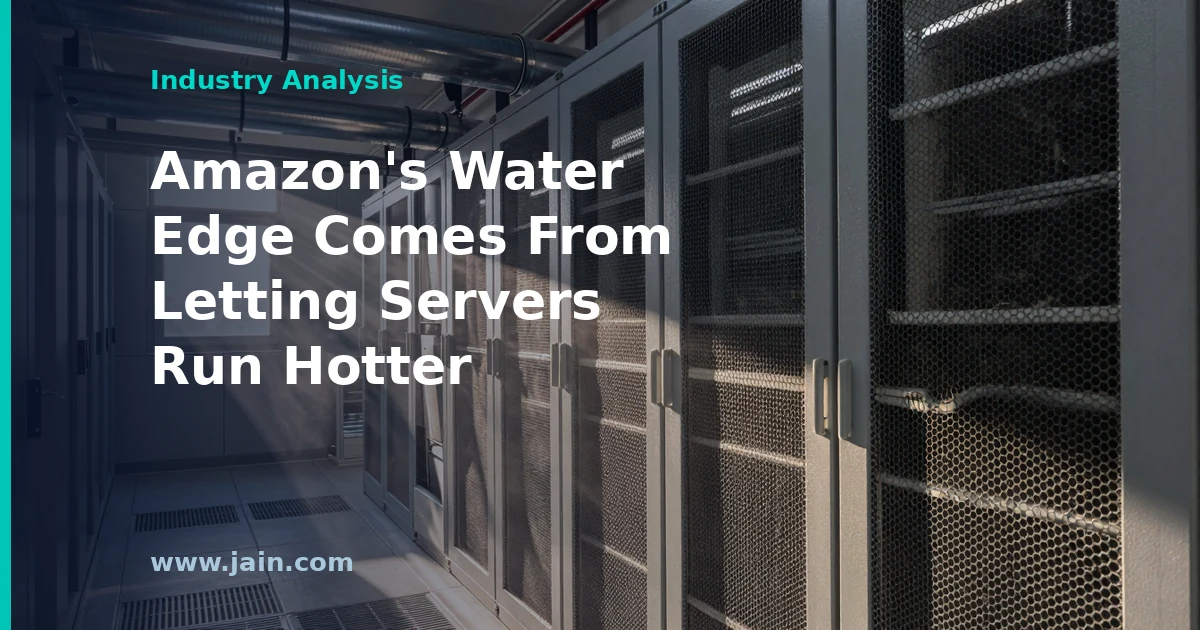
The main trick is letting the computers run warmer. Outside air cools the buildings about 90% of the time. Water is used only when it is hotter than about 85 degrees Fahrenheit outside.
This matters because these buildings are multiplying, and their neighbors want to know how much local water they take. The open question is whether the newest artificial intelligence chips, which Amazon says needed a new kind of liquid cooling, will let that approach last.
Amazon said in a June 11, 2026 post on its About Amazon site that its global data center operations used 0.12 liters of water per kilowatt-hour (L/kWh) in 2025. The company puts that at more than seven times better than an industry average of 0.84 L/kWh and says it is a 52% improvement since 2021. It withdrew about 2.5 billion gallons of water across its global data center footprint in 2025.
Amazon credits two things for the result. The first is free-air cooling, which it uses about 90% of the time. The second is higher server temperature limits, so that evaporative cooling runs only when outside air is above roughly 85°F. The company also said it is 75% of the way to its 2030 water-positive goal and that it runs 26 facilities on 100% reclaimed water, with 130 more contracted.
Executive Summary
Amazon has published a headline water-efficiency figure for its data centers: 0.12 liters of water for every kilowatt-hour of energy in 2025. It set that against an industry average of 0.84. The company explains how it got there. It relies on outside air for most cooling, uses evaporative cooling only in the hottest hours, and has spent several years raising the temperatures its servers are allowed to run at. It says this cut water use without raising hardware failure rates.
The figure matters because water has become one of the main local questions asked of new data center campuses. Amazon’s explanation also shows that water efficiency is a set of engineering trade-offs, not a fixed property of a building. The company chose to use some water on hot days rather than run chillers, which it says need 25% to 35% more electricity at the moments the grid is most stressed.
Two things are harder to assess. One is the comparison itself: Amazon did not publish how the 0.84 average was built or on what basis each peer’s figure is measured. The other is the future. Amazon says denser AI chips already required a custom liquid cooling system, so the air-first approach behind the 7x figure now has to hold up as AI capacity grows.
The Water Number Is Really a Temperature Number
Amazon’s 0.12 liters per kilowatt-hour did not come from a new water technology. It came from deciding how rarely to use water at all. About 90% of the time, Amazon says, its data centers use free-air cooling. Outside air is drawn past the servers and pushed back out, with no water involved. Water comes into play only through evaporative cooling. In that process, hot air passes through a water-soaked medium and cools by five to 10 degrees as the water evaporates. Amazon now switches that on only when outside air exceeds roughly 85°F.
That threshold is the lever. Every degree of heat the servers can tolerate removes hours from the evaporative season, so raising operating temperatures cuts water use directly. Amazon’s own evidence is specific:
Two identical data centers on the same campus, one running hotter, differed by about 50% in water use.
Northern Virginia, its largest region by IT load (the power drawn by the computing equipment itself), cut water use 42% year over year while demand grew.
Thousands of hours of campus data showed no increase in failure rates at the higher temperatures.
Those results fit the 52% efficiency improvement Amazon reports since 2021.
The same logic is why this is a test for AI-era cooling. The approach depends on air being able to carry heat away from the servers. Amazon itself says denser, more powerful AI chips required a completely custom liquid cooling system. It has not said how much of its fleet now runs that way, whether those systems rely on evaporative water on hot days, or how a growing share of AI capacity will move the 0.12 figure. The air-first playbook behind the 7x gap was proven on the fleet Amazon has run since 2021. Whether it carries over to high-density AI halls is the next data point to watch.
Water or Watts: The Trade Behind the Ratio
Amazon is explicit that a low water number is partly a choice about electricity. The alternative it names is chillers, which work like giant air conditioners and, by Amazon’s figures, typically need 25% to 35% more electricity. The timing of that extra load is the problem. It arrives in the hottest hours, when household air conditioning is already straining the grid. Amazon concluded it is better to spend some water on those days than to add power demand at the peak.
That is a defensible engineering position, and it cuts against a simple reading of water metrics. An operator could report a lower water ratio by running chillers, which shifts the burden onto the grid and, depending on how that electricity is generated, onto water used off site. Conversely, a site that uses more water may be sparing a stressed grid. For utilities and local planners, the useful question is how much water and how much power a campus uses together at the peak hour, not either one in isolation.
Amazon did not quantify the grid side of its trade. It has not said how much peak demand evaporative cooling avoids across its fleet, or how many hours a year its sites in hot regions exceed 85°F. Without those figures, the argument rests on the chiller penalty range alone.
Why 0.12 and 0.84 Are Hard to Line Up
Liters per kilowatt-hour is the industry’s standard water-efficiency ratio, often called water usage effectiveness. It divides the water used for cooling by the energy consumed by the IT equipment. Amazon describes it as water per unit of compute, but the denominator is energy, not work done. A fleet running more efficient chips gets more computing out of each kilowatt-hour, and the metric does not capture that in either direction.
The 7x claim depends entirely on the 0.84 industry average. Amazon’s chart cites sustainability reports and blogs from Microsoft, Google and Meta alongside its own report. The company did not publish how 0.84 was derived: which operators it covers, how they were weighted, or whether each figure measures water withdrawn (taken from a source) or water consumed (evaporated and not returned). Large operators do not all report water the same way, so a like-for-like reading requires knowing which basis each number uses.
Scope matters too. Amazon’s absolute figure, about 2.5 billion gallons in 2025, is a withdrawal number for its global data center footprint. The 2% year-over-year decline it cites applies only to sites it owns and operates directly. The company did not say whether the 0.12 ratio is based on withdrawal or consumption, or whether leased facilities are included. None of that makes the claim wrong. It does mean the 7x multiple is Amazon’s own calculation rather than a figure a reader can reproduce from peers’ reports.
Replenishment and Reclaimed Water Carry the Local Story
Efficiency is only half of Amazon’s water case. The company has committed to being water positive by 2030, meaning it returns more water to communities than its data center operations use. It says it is 75% of the way there, returning 3 gallons for every 4 used in 2025. It has announced more than 50 projects that are expected to return over 5.8 billion gallons a year once fully implemented, which is more than twice its 2025 withdrawals. Examples include:
storing Columbia River winter flows in an aquifer in Hermiston, Oregon;
a runoff pipeline in Pina del Ebro, Spain;
watershed restoration near Guadalajara, Mexico.
Replenishment is an accounting balance. Its value to a given town depends on whether the returned water lands in the same basin the data center draws from. Reclaimed water addresses the local question more directly, because it replaces drinking water with treated wastewater at the site itself. Amazon says 26 facilities already run on 100% reclaimed water, more than any other cloud provider, and 130 more are contracted. It has also funded infrastructure and helped with permitting for programs in Mississippi, Hong Kong and Indonesia. If those 130 facilities come online, reclaimed supply may matter as much to neighbors as the headline efficiency ratio.
Background
Amazon operates one of the world’s largest data center fleets, mostly to run Amazon Web Services (AWS), its cloud computing business. Data centers convert nearly all the electricity they use into heat, and removing that heat is where most of their water goes. The industry commonly measures water efficiency as liters of water per kilowatt-hour of IT energy, a ratio known as water usage effectiveness, or WUE.
Amazon has committed to being water positive by 2030 and has expanded its use of reclaimed water from wastewater treatment plants. Amazon says data centers account for less than 0.5% of global industrial water use. Still, where a campus draws its water matters to the surrounding community, and Amazon says its water team is particularly focused on water-scarce areas.