Tag: Air Permits

  • Everyone Is Watching the $1.07M Fine. The AI Power Risk Is the 45-Day Clock.

    Everyone Is Watching the $1.07M Fine. The AI Power Risk Is the 45-Day Clock.

    TL;DR · 30-second read

    The Short Version

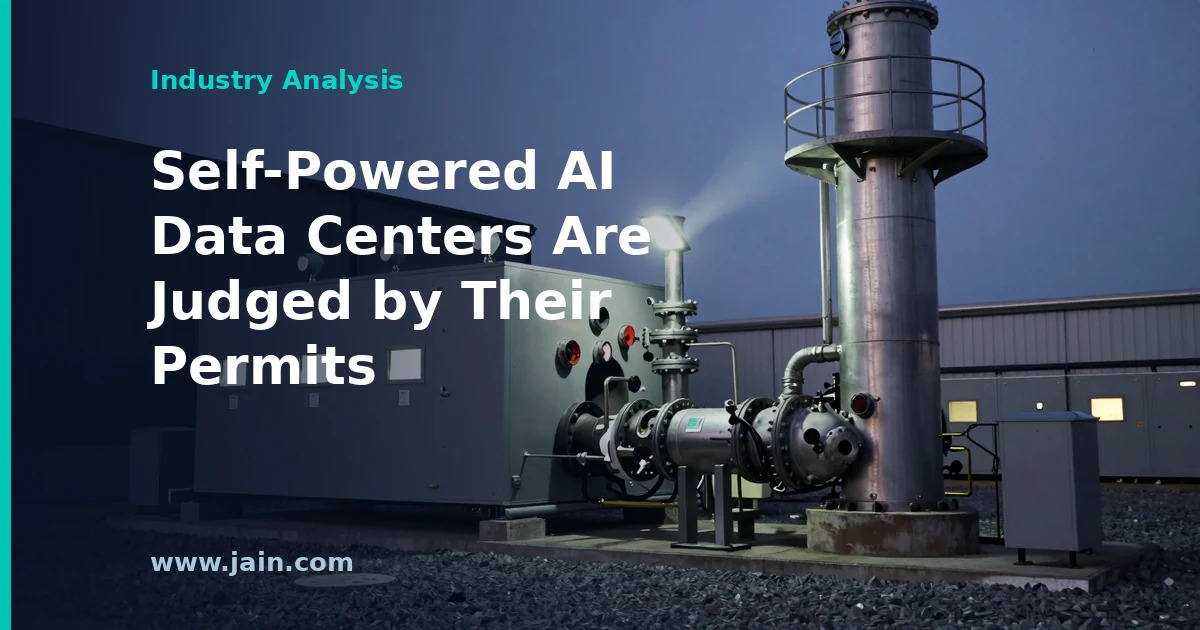
    New Jersey fined the builder of an artificial intelligence data center in the town of Vineland a record $1.07 million for running 62 portable power generators without pollution permits.

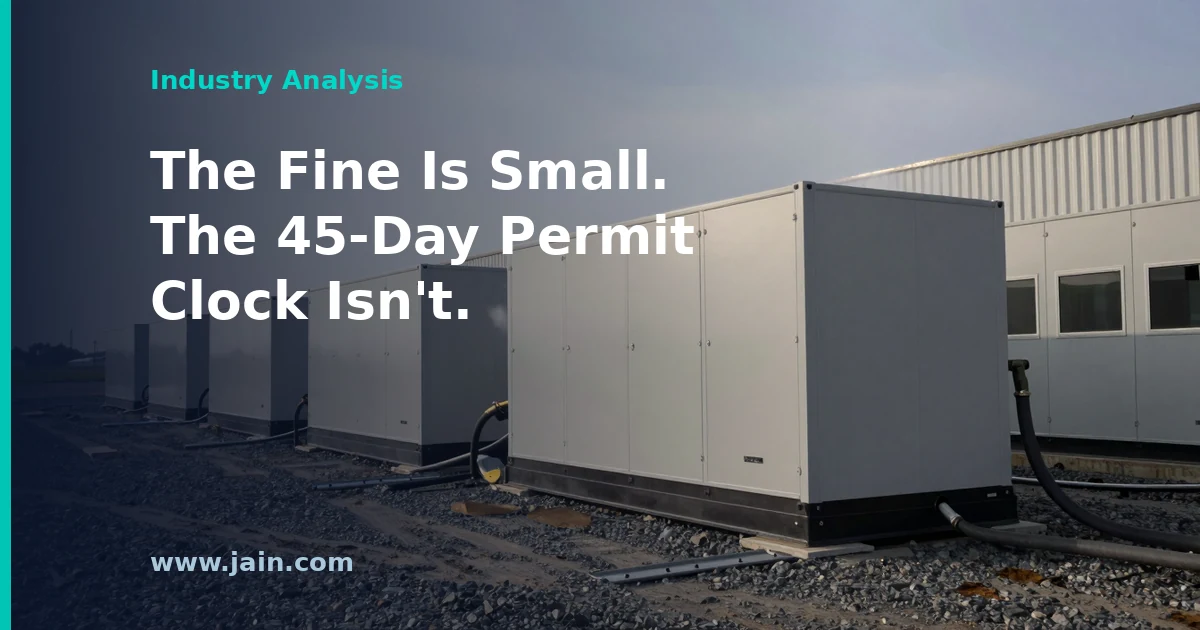
    Split across the generators, that is about $17,000 each. Neighbors called it pocket change. The real threat is a deadline: get the permits within 45 days or switch the generators off.

    The site supplies computing power for a $33 billion deal involving Microsoft, so losing its power source would be a far bigger problem than the fine.

    New Jersey has fined DataOne a record $1.07 million for running 62 unpermitted portable generators at its AI data center construction site in Vineland. The state also ordered the company to obtain air permits within 45 days or stop using the units. Tom’s Hardware reported the action on September 25, 2026, citing The New York Times. State inspectors found the generators powering the facility in late July. DataOne supplies computing capacity to Nebius, which Microsoft signed to a $33 billion deal.

    Residents have raised several other complaints:

    • the construction, without a permit, of a 1.5-million-gallon liquefied natural gas (LNG) tank;
    • night-time noise reaching homes within half a mile;
    • little public consultation before the project began.

    DataOne disputed the fine. It said it will apply for air permits for the temporary generators and is moving from portable turbines to fuel cells.

    Executive Summary

    The penalty is modest against the scale of the project. Spread across 62 generators, it comes to roughly $17,300 per unit, a point residents made bluntly. The 45-day order is what carries operational weight. Generators that were powering the site must be permitted by state regulators in that window or switched off. That puts a regulatory decision, not a construction milestone, on the critical path for a facility tied to one of the larger AI capacity contracts in the market.

    The case matters beyond Vineland. On-site generation, often called bridge power, lets developers bring their own electricity instead of waiting for a utility connection, and it is an increasingly common way to get AI capacity online quickly. New Jersey’s action and the earlier dispute over unpermitted turbines at SpaceXAI’s Colossus 2 site in Memphis point to the same limit: the workaround only moves as fast as the air-permit process allows.

    Why the 45-Day Clock Outweighs the $1.07 Million

    Divide $1.07 million by 62 generators and the penalty works out to about $17,300 per unit. Next to a $33 billion capacity contract, that is a rounding error. Residents said so directly. Longtime Vineland resident Steve Brown called it “a drop in the bucket,” and Tiffany Leone-Vespa argued the fine should have applied to each generator. As a financial deterrent, a penalty of this size does little to change the calculation behind what Brown described as a “don’t ask for permission, just ask for forgiveness later” approach.

    The shutdown order is a different kind of lever. New Jersey told DataOne to meet its permitting requirements and to stop running the generators if permits are not granted within 45 days. Inspectors found those units powering the facility. If the permits do not come through, DataOne has to replace that power on a schedule set by regulators rather than by its own construction plan. The replacement could be utility supply, the fuel cells it says it is adopting, or other permitted equipment. For a company whose product is computing capacity, a power gap is a delivery problem, not an accounting line.

    That exposure runs down a contract chain. DataOne supplies Nebius, and Nebius supplies Microsoft. The company has said it will apply for the permits. Whether regulators can review and grant them inside the window is the operative question, and it matters far more to the project’s timeline than the size of the fine.

    Bring-Your-Own Power Comes With a Permit Attached

    AI developers are bringing their own power because utility connections for very large new loads can take years, while trailer-mounted turbines and generators can be delivered and running in weeks. When a data center is built to rent out expensive AI processors, every month without power is lost revenue.

    The trade-off is that fuel-burning equipment emits pollutants such as nitrogen oxides, along with noise. That is why states require air permits, which are licenses that set emission limits, operating hours and monitoring for combustion equipment. At 62 units, a temporary generator fleet starts to resemble a small power plant, and it draws the scrutiny that comes with one. Noise complaints from homes within half a mile show the effects are felt locally, not just on paper.

    Memphis offers the closest comparison. SpaceXAI’s unpermitted turbines at Colossus 2 led to a lawsuit, and the Department of Justice asked the court to dismiss it on the grounds that the site “supports mission-critical operations.” The company ultimately agreed to remove the unpermitted turbines. It said the process would take more than a year as replacement plants totaling 1.2 gigawatts come online. Both cases end with temporary generation giving way to permanent, permitted supply. What differs is who sets the pace: more than a year in Memphis, 45 days in Vineland.

    Fuel Cells, an LNG Tank and the Replacement Question

    DataOne’s stated fix is to move from portable turbines to fuel cells. Fuel cells generate electricity through a chemical reaction rather than combustion. They are generally quieter and emit fewer local pollutants, so they address both of the neighbors’ main complaints. They still need fuel, most commonly natural gas, and they would have to match the output the 62 units were providing. DataOne has not said how much capacity it plans to install, who will supply it, or when it will be running.

    The 1.5-million-gallon LNG tank is a separate exposure. Liquefied natural gas is gas cooled until it becomes a liquid so it can be stored in bulk, and on-site storage at that scale is one way to fuel generation where pipeline supply is limited. DataOne has not explained what the tank is for. Residents say it was built without a permit, which could make its status a second regulatory question alongside the generators.

    Community Consent Is Now Part of the Power Plan

    According to residents, they learned a data center was going up in their neighborhood only after Microsoft announced its deal with Nebius. They raised concerns at a February town hall, citing satellite imagery that showed “some type of unit” on site. Inspectors had found no generators during a December visit, then found 62 in late July. When the units first arrived remains unclear, and so does how long they ran before enforcement.

    Both sides deserve a fair reading. DataOne’s commitment to seek permits and move to cleaner equipment points in the direction regulators want. Residents’ argument that a flat fine is too small for a well-capitalized operator is a legitimate question about how penalties are designed, including whether they should scale per unit. For developers, the lesson is practical. Permitting and early community engagement cost time up front, but enforcement mid-construction imposes a deadline the developer does not control.

    Background

    Nebius is an AI cloud company, sometimes called a neocloud, that rents out computing capacity built on graphics processors, the chips used to train and run AI models. It is headquartered in Amsterdam, listed on Nasdaq, and emerged in 2024 from the restructuring of Yandex’s international business. Its $33 billion deal with Microsoft makes it a major capacity supplier to one of the largest buyers of AI computing. DataOne is the developer contracted to provide computing capacity for that arrangement at Vineland, in southern New Jersey.

    AI data centers draw far more electricity than traditional facilities, and utility connections for large new loads can take years. Many developers now use on-site generation such as gas turbines, engines or fuel cells as bridge power until grid supply is ready. Under the federal Clean Air Act framework, states require air permits for fuel-burning equipment above certain size thresholds. Operating without one exposes a site to fines and orders to shut the equipment down.

    Sources

    Source: New Jersey hits Microsoft-linked AI data center with record fine for 62 unpermitted power generators, issues 45-day shutdown deadline — site tied to $33 billion deal also built illegal 1.5M-gallon fuel tank: Tom’s Hardware on New Jersey’s $1.07 million fine and 45-day permit deadline for DataOne’s Vineland AI data center.

  • Vantage’s 95-Ton NOx Permit Shows AI Self-Power Is Judged by Ceiling, Not Output

    Vantage’s 95-Ton NOx Permit Shows AI Self-Power Is Judged by Ceiling, Not Output

    TL;DR · 30-second read

    The Short Version

    A data center in Virginia makes its own electricity with eight gas-burning turbines, each about the size of a bus, close to people’s homes.

    A Harvard researcher estimated its air pollution could cause tens of millions of dollars a year in health harm. Virginia’s environmental regulator moved quickly to challenge that estimate, even though one of its own experts said judging health effects was outside his training.

    Why it matters: more of the buildings that run artificial intelligence want their own power plants, and fights like this one will decide where they can be built.

    Politico reported on July 25 that internal emails, obtained through a public records request, show Virginia’s Department of Environmental Quality (DEQ) organized a rebuttal to a health analysis of Vantage Data Centers’ self-powered facility in Sterling, Loudoun County, before that analysis was published. DEQ Director Michael Rolband forwarded the Piedmont Environmental Council’s report to seven air-permitting staff within five minutes of receiving it in early March. He asked for “a defensible critique that will stand the test of public and critical review.”

    The Piedmont-commissioned study estimated that soot from the facility’s eight natural gas turbines could cause $53 million to $99 million a year in health costs, and 3.4 to 6.5 premature deaths, if the site emitted the maximum its permit allows. DEQ’s own report, released in late April, said actual emissions were 28 to 69 percent of permitted levels. The agency has said its staff “did not collaborate with PEC, Vantage or any other external participants” in its assessment.

    Executive Summary

    This dispute centers on the only data center in Virginia that generates its own electricity. Its on-site power system combines eight bus-sized natural gas turbines with dozens of backup diesel generators, and it sits in a residential area. DEQ’s 2023 permits allow up to 95 tons a year of nitrogen oxides (gases that help form smog) and more than 56 tons of soot, meaning fine particles that lodge in the lungs. Both pollutants are linked to asthma and heart attacks. Those limits are typical for a minor pollution source. The dispute arose because of where the facility sits, not because of how large the limits are.

    It matters beyond one building because self-generation is becoming the industry’s answer to grid congestion. Dominion Energy disclosed in February that it receives about 10 new connection requests a month from large-load customers. It also disclosed that dozens of projects requesting a combined 70 gigawatts are waiting to connect, three times the utility’s all-time peak load. Vantage itself described its turbines to DEQ as “a temporary solution given the current power constraints of the grid.”

    The episode shows how the health case against on-site generation gets built. Critics model the legal ceiling in the permit, not the meter reading. Even when actual emissions come in well below that ceiling, the permit keeps the higher figure in play.

    The Permit Ceiling Is the Number That Gets Modeled

    Michael Cork, a biostatistics research fellow at Harvard’s T.H. Chan School of Public Health, did not have Vantage’s operating data when Piedmont hired him. He used the only public figures available, which were the permitted maximums. That produced the headline range of $53 million to $99 million in annual health costs. Vantage objected that this was a “worst case scenario,” and DEQ’s report made the same point: measured emissions of soot, volatile organic compounds and nitrogen oxides ran at 28 to 69 percent of what the permit allows.

    The correction lowered the estimate but did not end the argument. Cork reran his model with DEQ’s actual-emissions figures and arrived at $33 million to $63 million a year and two to four premature deaths. He also noted that nothing in the permit prevents the facility from increasing output back toward its ceiling. That is the mechanism the headline refers to. A permit is a legal right to emit, so outside analysts can reasonably treat it as the facility’s potential footprint, whatever the current meter shows.

    This matters for developers planning on-site generation. Operators often seek permit headroom so they can run harder when the grid is strained or when load grows. That headroom has operational value. It is also, in effect, a published number that critics can model. A project that wants its real-world performance to count in public debate may need to make that performance binding, through enforceable limits closer to expected output or regular public reporting of actual emissions, rather than relying on a regulator to vouch for it after the fact.

    Why Self-Power Keeps Spreading Anyway

    The economics pushing data centers toward their own power plants are not easing. A 70-gigawatt connection backlog at a single utility means many projects face long waits for grid power. On-site gas turbines offer a way to start operating sooner. They also answer the political charge that data centers raise household electricity bills. The federal government has encouraged the model too: President Donald Trump promoted a wave of power plants for new data centers at a White House meeting with technology companies in early March.

    The Vantage case shows the trade-off. Self-generation moves the power question off the utility’s books and onto the local air-permit docket. The cost stops appearing in rate cases and starts appearing in health-damage estimates for the neighborhood downwind. The more facilities follow this path, the more often permitting agencies will be asked to rule on disputes that go beyond their traditional remit.

    A Regulator’s Rebuttal Is Not a Health Finding

    The emails show disagreement inside DEQ about how far the agency should go. Michael Kiss, a manager in the Office of Air Quality Assessments, wrote that the magnitude of impacts was “relatively low” and not surprising. He also said he had “absolutely no comments on the health study” because “we aren’t qualified to do that review.” Robert Burnley, who led DEQ from 2002 to 2006, said the conventional defense of a permit is narrower: that the emissions do not cause a violation of air quality standards.

    Several claims in DEQ’s final report are open to challenge on their own terms. The report said health impacts were “unlikely” because Loudoun County soot levels are below EPA standards. Health experts, including former EPA air quality official Michael Koerber, said soot can harm health even at EPA-approved levels, and the World Health Organization’s guideline is nearly half the EPA figure. The report also cited 2023 state health data, collected before Vantage began operating, to describe Loudoun as one of Virginia’s healthiest localities. That data says little about the facility’s effect.

    For the industry, the lesson is practical rather than partisan. The Data Center Coalition circulated DEQ’s report to reporters and lawmakers as evidence that the Piedmont analysis was wrong. A rebuttal whose health reasoning is contested gives less protection than it appears to. The most useful thing DEQ published was arguably the actual-emissions data. It narrowed the dispute to a real number, even though that number still produced a substantial estimate.

    Siting Near Homes Is Where the Costs Land

    DEQ’s permits for Vantage are in line with other minor-source permits in the state. The concern stems from the facility’s location in a residential area. Neighbors report constant noise as well as air pollution. Vantage says it has taken steps to reduce the noise. Health-cost models of the kind Cork used scale with the number of people in a plume’s path, so the same turbines sited away from housing would generate a very different estimate.

    Virginia has more than 600 data centers, and many future self-powered sites will compete for land in areas that are already developed. Where generation sits relative to homes is likely to be as consequential for permitting risk as how many tons it is allowed to emit.

    Background

    Northern Virginia, and Loudoun County in particular, hosts the world’s largest concentration of data centers, and Virginia is home to more than 600 of them. Dominion Energy, the region’s largest utility, has struggled to keep pace with demand. Large projects now wait in a queue that is far larger than anything the utility has ever served. In response, developers have begun planning facilities that generate their own electricity on site, usually with natural gas turbines.

    Vantage Data Centers’ Sterling facility came before that trend. DEQ issued its air permits in 2023. The Piedmont Environmental Council, a Virginia conservation group, has been active on data center land-use and environmental impacts. The Data Center Coalition is the industry’s trade group.

    Sources

    Source: Emails show how Virginia regulators downplayed data center health concerns — Politico’s report on internal DEQ emails concerning Vantage’s self-powered Loudoun County data center.

  • Amazon’s 280 Gas Generators Show AI Backup Power Now Runs on Air-Permit Limits

    Amazon’s 280 Gas Generators Show AI Backup Power Now Runs on Air-Permit Limits

    TL;DR · 30-second read

    The Short Version

    Amazon is building a huge complex of computer buildings, the kind that run online services and artificial intelligence, on an old steel mill site outside Philadelphia.

    Pennsylvania plans to let Amazon add 280 natural gas engines that switch on if the power goes out. That is on top of 76 diesel engines already there.

    The catch is that Amazon agreed to a strict yearly pollution limit, so those engines can only run so much. For buildings like these, keeping the lights on is now decided partly by pollution permits and packed town meetings, not just the power company.

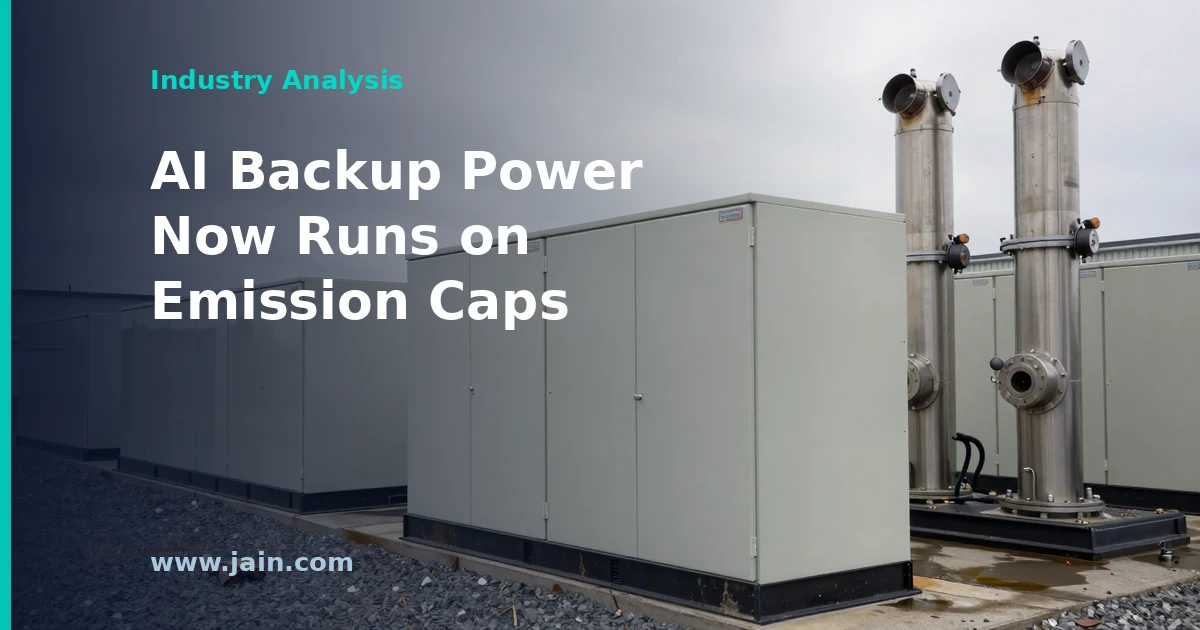
    WHYY reported on July 15, 2026 that Pennsylvania’s Department of Environmental Protection (DEP) plans to approve 280 natural gas-fired generators and three diesel-fired generators to supply backup power at Amazon’s data center complex under construction in Falls Township, Bucks County. Amazon has already installed 76 diesel generators at the 250-acre site, the former U.S. Steel mill now called the Keystone Trade Center. The generators would run when the site’s electricity supply from the utility PECO is interrupted.

    DEP officials presented the plan at a tense public meeting on July 14 at Pennsbury East High School. Under the pending application, Amazon agreed to keep annual emissions of nitrogen oxides and volatile organic compounds under 25 tons. The air quality plan approval opens for 30 days of public comment once it appears in the Pennsylvania Bulletin, which DEP expected on July 18.

    Executive Summary

    Amazon’s Falls Township campus, with up to 10 new buildings plus 1 million square feet of retrofitted warehouse space and more than half built, is set to carry 359 backup generators in total if DEP approves the new units. Amazon says the complex will host cloud computing infrastructure and “advance AI innovation.” It is part of a $20 billion investment Amazon has pledged in Pennsylvania.

    The figure that matters most is the 25-ton emissions ceiling, not the generator count. By fitting emissions controls on its larger generators and limiting fuel use, Amazon qualifies the site as a “synthetic minor” source. That means it accepts enforceable limits to stay below the threshold for heavier regulatory treatment. In effect, the campus’s backup power becomes an annual emissions budget written into an air permit.

    This moves the reliability question for large AI-oriented campuses out of the utility’s engineering studies and into state air permitting, public comment periods and community meetings. It also sits beside a separate, unresolved debate over who pays as data center demand grows on the regional grid.

    A 25-Ton Cap Turns Backup Power Into a Budget

    The headline number is 280 gas generators, but the number that governs how they can be used is 25. Under its pending application, Amazon agreed to keep combined annual emissions of nitrogen oxides and volatile organic compounds under 25 tons per year. Both pollutants can form ground-level ozone and worsen asthma. To stay under the limit, Amazon will install emissions control systems on its larger generators and limit fuel usage. Staying under 25 tons qualifies the campus as a “synthetic minor” source: a facility whose equipment could in principle emit more, but which accepts binding limits to remain below the level that triggers the more demanding permitting that applies to major sources.

    A fuel-use limit works in practice as a limit on running time. Data center backup generators typically run for routine testing and maintenance, and for real outages. The permit turns that into a fixed annual allowance shared across the whole fleet. In a year with a reliable grid, most of the allowance goes to testing. A long outage or repeated grid emergencies would draw it down faster. Reliability planning for this campus therefore has a regulatory ceiling written into the air permit, alongside the electrical design.

    That affects the people who plan, build and permit these sites. Developers sizing backup fleets for large campuses have to design against local emission thresholds as well as uptime targets. The approving authority for that design is a state air regulator operating in public: a packed auditorium meeting, a 30-day comment window, and a petition critics say has drawn more than 4,000 signatures. Pennsylvania’s Permit Fast Track Program sped up earlier permits for this project. The backup power decision still runs through public comment.

    Hundreds of Engines Behind a Grid-Connected Campus

    The campus is designed to run on grid power from PECO. The generators exist for the moments that supply fails. Even so, the fleet is large. Seventy-six diesel units are already installed, and 283 more are proposed, for 359 in total. That scale reflects what hyperscale operators expect from a site this size. A hyperscale campus is a very large, standardized facility built by a major cloud provider, and customers of cloud and AI services expect it to keep running through a utility outage.

    The new units are mostly gas-fired rather than diesel. Amazon has not publicly explained the choice. In general, gas units draw fuel from a pipeline rather than on-site tanks and produce less soot than diesel. They still emit nitrogen oxides, which is why the emissions controls and the tonnage cap matter. Amazon has not disclosed the combined generating capacity of the fleet, so it is not possible to say how much of the campus load the generators could carry, or for how long.

    The Grid Cost Question the Transmission Agreement Does Not Settle

    PECO’s Glen Murphy said the utility found the project will not raise the distribution rates PECO customers pay. He said the project’s second phase will require infrastructure upgrades, but a “take-or-pay” transmission security agreement with Amazon protects residents from those costs. Under a take-or-pay arrangement, the customer commits to pay whether or not it uses the capacity. Murphy called the project a likely net benefit to customers that could “bring down rates a bit.”

    Those agreements do not cover a different cost: the price of electricity supply itself, which rises with demand on the regional grid. PECO is part of PJM, the grid operator serving Pennsylvania, New Jersey and other states. New Jersey Assemblyman Balvir Singh argued that added demand will push up bidding and prices across that shared grid. The two claims are not contradictory. One concerns the wires that connect the campus; the other concerns the market for the power flowing over them. Neither side offered a figure for the supply-cost effect.

    Weighing the Claims on Both Sides

    Amazon’s Becky Ford said the company’s Pennsylvania data centers use water for cooling around 6% of the year on average, relying mostly on outside air. An engineer working for the Morrisville Municipal Authority said the project will draw Delaware River water rather than drinking water, in an amount requested to equal about 70 homes’ use. These are useful figures, but an annual average says little about hot-weather peaks, and a requested amount is not metered use. Ford also said the nearest homes are about 5,000 feet away and will hear no noise from the complex. That answers the residential question, not the one resident John Baldassano raised: whether generators running during an emergency would disrupt workers at industrial sites closer by.

    DEP’s Jillian Gallagher said projected emissions are similar to those of hospitals, universities and snack food manufacturers in the state. Resident Seema Kazmi countered that the area is already pollution-stressed. A per-facility threshold does not by itself address cumulative burden, which is her concern. Her point about emissions from grid power supplying the site also falls outside the scope of this air permit. Better data is coming. The state budget signed July 12 requires large data centers to report their energy and water use annually to DEP. Proposals to tie tax incentives to new clean generation, and to pause data center development, did not pass.

    Background

    Amazon’s Falls Township campus sits on the Keystone Trade Center, a former U.S. Steel mill site along the Delaware River in Bucks County, north of Philadelphia. It is one of two Pennsylvania data center projects in Amazon’s pledged $20 billion state investment. The other is in Salem Township beside the Susquehanna nuclear plant. The local utility, PECO, operates within PJM, the regional grid and wholesale power market that spans Pennsylvania, New Jersey and neighboring states.

    Large data centers keep fleets of on-site generators so servers stay running through grid outages. In Pennsylvania these generators require air quality approval from DEP. Pennsylvania has courted data center investment through fast-track permitting and tax abatements, while debate continues over grid costs, water use and local pollution.

    Sources

    Source: Amazon to install hundreds of gas-fired generators at Bucks County data center site (WHYY), reporting on Pennsylvania DEP’s planned air permit approval and the July 14, 2026 public meeting in Falls Township.