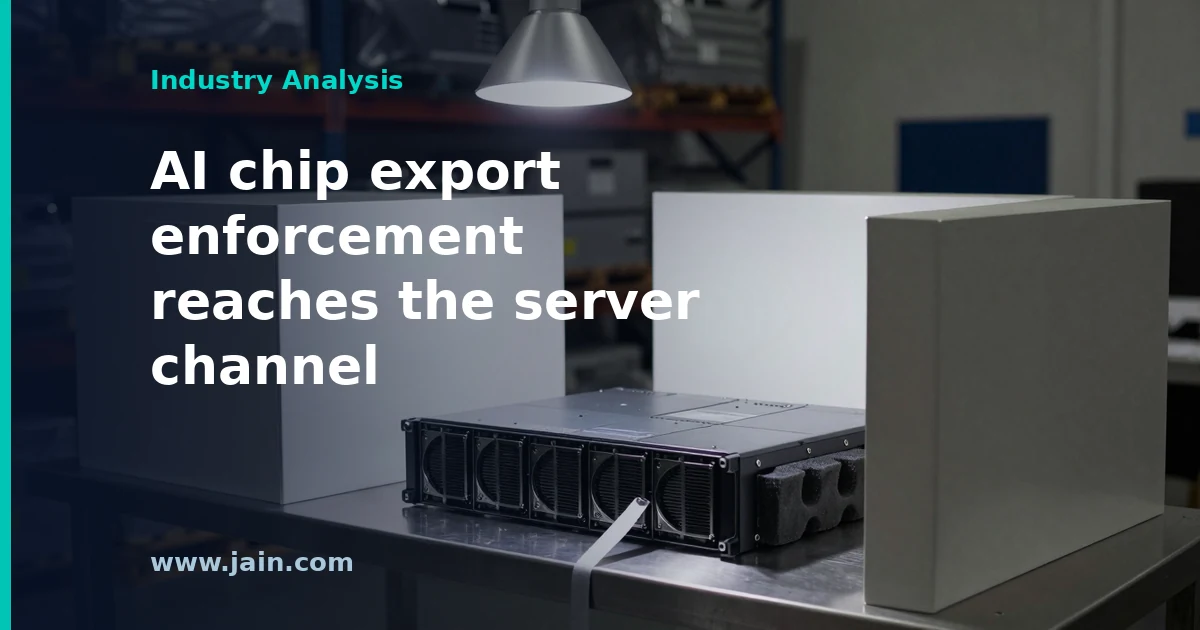
A contractor who worked with Super Micro, an American company that builds the powerful computers used to run artificial intelligence, has admitted in court to helping send those machines to China illegally. The scheme was valued at $2.5 billion.
The computers held chips from Nvidia, whose chips power much of today’s AI. US rules bar selling those advanced chips to China without government permission.
Why it matters: the case targets the people between the chipmaker and the final buyer, not the chipmaker itself. Enforcement is reaching further down the supply chain.
A contractor tied to Super Micro Computer has pleaded guilty in a scheme to divert AI servers containing Nvidia chips to China, Reuters reported. Coverage puts the scheme’s value at $2.5 billion and describes the contractor as a co-defendant of a Super Micro co-founder.
The plea comes in the same week Super Micro disclosed board changes in an 8-K filed October 8. That filing does not mention the export case.
Executive Summary
A guilty plea in a $2.5 billion AI server diversion scheme is among the clearest signals yet of where US export-control enforcement on AI hardware is landing. The equipment at issue was not loose chips but complete servers built around Nvidia GPUs (graphics processing units, the processors that do most AI computation). The person admitting guilt is a contractor, not an employee of the chipmaker.
That matters because it shifts the compliance burden. Export restrictions on advanced AI chips follow the chip into whatever system it is installed in. That makes everyone who builds, resells or ships those systems a potential point of failure, and of liability. For server makers, distributors and the data center operators who buy from them, the case is a reminder that end-user screening is part of the product, not paperwork around it.
The plea establishes guilt only for the person who entered it. Anything alleged against other defendants remains an allegation, and no charges against Super Micro as a company have been reported.
Where a GPU Becomes a Server, Control Gets Harder
Advanced AI chips leave Nvidia in large, traceable allocations to a relatively small set of server makers and cloud buyers. Once a GPU is installed in a server, it becomes one component inside a finished system. That system can then pass through distributors, contractors and resellers before reaching its final operator. US export rules still apply to the chip inside the box, but the chipmaker’s line of sight usually ends at its direct customer.
That gap is the mechanism this case exposes. The diverted goods were Super Micro AI servers with Nvidia chips inside, and the guilty party is a contractor in the server maker’s orbit. At a reported $2.5 billion, the scheme shows how much hardware value can move through the integration and resale layer, the stage after the chip is sold but before the system is plugged in. Controls written around the chip are only as strong as the checks at that downstream stage.
Those affected are the companies that sit between foundry and data hall: server builders, value-added resellers, logistics contractors, and the compliance teams that sign off on who the end user really is. Nvidia’s chips were in the boxes, but Nvidia is not reported to be a defendant and has made no material SEC filing on the matter. The enforcement weight in this case sits downstream.
What the Channel Now Has to Prove
For server makers and their partners, export compliance means knowing the end user and the end use, not just the immediate buyer. A diversion scheme works by putting a permissible-looking customer between the seller and a prohibited destination. A plea at the contractor level gives every company in that chain reason to scrutinize intermediaries, shipping patterns and resale terms more closely.
The economic effect is friction. Legitimate buyers of AI servers, from enterprise IT departments to colocation tenants, may face more documentation about where systems will be deployed and who will operate them. For integrators competing on speed of delivery during a GPU supply crunch, slower deal reviews carry a real cost. The case makes clear that the alternative cost is higher.
What Is and Isn’t Established About Super Micro
Super Micro is one of the largest builders of Nvidia-based AI servers, so any case involving its products draws attention to the company. The facts on the record are narrower than the headlines. A contractor has admitted guilt. A co-founder is described as a co-defendant, which is an allegation, not a finding. No charges against the company have been reported.
Super Micro’s most recent disclosure is an 8-K covering the appointment of former Intel IT chief technology officer Shesha Krishnapura as an independent director and the retirement of director Judy Lin. The filing states that Lin’s departure was not the result of any disagreement with the company, and it does not reference the case. Reading a connection into the timing would go beyond what either the plea or the filing supports.
Background
Since 2022 the United States has restricted exports of advanced AI chips and the systems built around them to China, through rules administered by the Commerce Department’s Bureau of Industry and Security and tightened in later rounds. Nvidia, the dominant supplier of AI accelerators, sells its GPUs largely through server makers and large cloud buyers, which turn them into finished systems.
Super Micro Computer, based in San Jose, California, is one of the biggest of those server makers and a major builder of Nvidia-based AI systems for data centers. Its fiscal year ended June 30, 2026. In early October it announced a board change, adding former Intel IT chief technology officer Shesha Krishnapura and accepting the retirement of director Judy Lin.
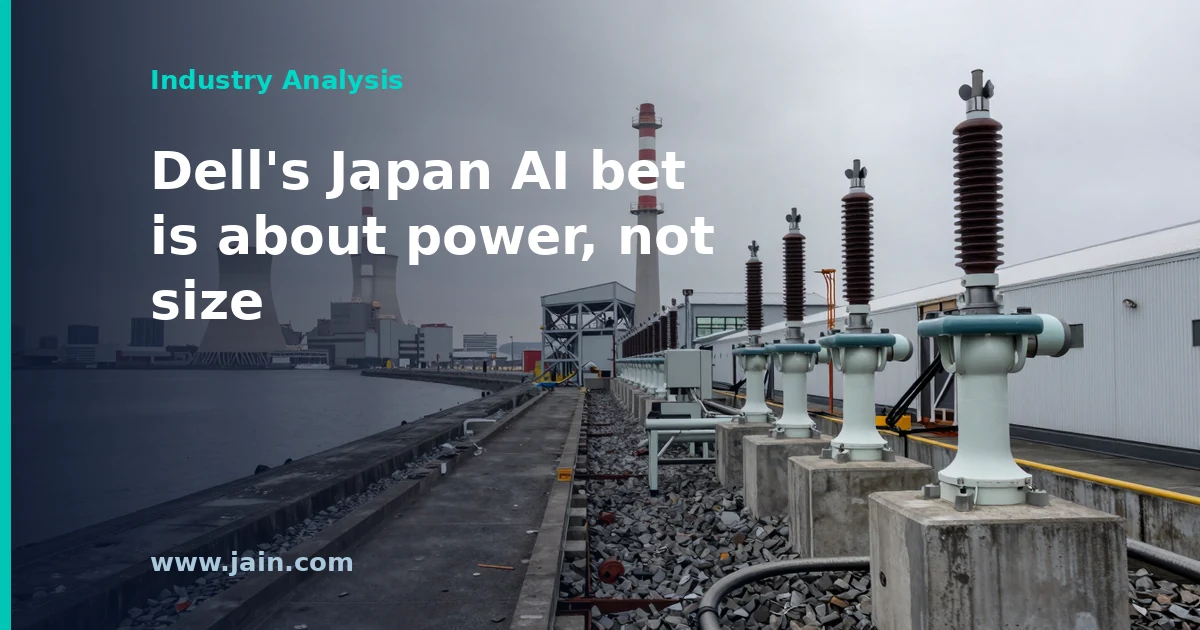
Dell, the American company known for laptops and for the powerful computers that run artificial intelligence, has joined a project to build an artificial intelligence computing center in Japan. Its partners include JERA, Japan’s biggest electricity producer, and a company called RHAELM.
The project is designed around one problem: securing a steady supply of electricity, which these computers use in huge amounts. It is due to open in 2028.
One oddity: the price tag was given as both 15 billion yen and about 15 billion dollars. In fact, 15 billion yen is less than 1% of 15 billion dollars.
Simply Wall St reported on October 2, 2026 that Dell Technologies (NYSE: DELL) has joined an AI data center project in Japan involving JERA, the country’s largest power generator, and a company named RHAELM. The project is designed around securing reliable electricity for power-intensive AI computing. The site is planned to open in 2028 and reach full operation in 2029.
The project’s size was given as ¥15 billion and also described as roughly $15 billion. Those two figures are far apart: ¥15 billion converts to less than one percent of $15 billion.
Executive Summary
Dell has become a named participant in a Japanese AI data center project whose defining feature is its power partner. JERA generates more of Japan’s electricity than any other company. The project is explicitly built around solving the problem that limits AI buildouts in many markets: getting enough dependable power to the building.
For Dell, the deal is significant less for its dollar value, which has been stated two incompatible ways, than for what it signals about strategy. The analysis accompanying the announcement cites more than US$130 billion in AI server orders and a US$95 billion backlog. A backlog is orders booked but not yet delivered. That backlog turns into revenue only when there are powered, cooled buildings ready to receive the servers. A partnership anchored by a utility-scale generator is one way to secure those destinations.
What the announcement does not establish is equally important. It does not define Dell’s role, the facility’s power capacity, its customers or how it is financed. Without those details, the deal is best read as a strategic marker rather than a quantified commitment.
Why Power Access Outweighs the Price Tag
The useful way to read this deal starts with Dell’s order book, not the project’s headline value. According to the analysis published alongside the news, Dell’s AI growth case depends on converting more than US$130 billion of AI server orders and a US$95 billion backlog into delivered systems. AI servers are racks of graphics processors (GPUs) and supporting hardware. They are installed in data centers that must supply far more electricity per square meter than conventional facilities. Orders cannot ship into a building that does not yet have power, so every delay in grid connections or generation pushes revenue recognition further out.
Measured against a US$95 billion backlog, a single project worth either ¥15 billion or $15 billion is not what moves Dell’s results. The mechanism that matters is the partner list. Joining a project co-led by Japan’s largest generator gives Dell a line of sight to a site whose electricity supply is part of the design from the start, rather than something to be negotiated after construction. That reduces one source of what the analysis calls execution friction: the gap between building hardware and having somewhere to switch it on.
The parties affected are concrete. Dell gains a reference project where compute and power are planned together. JERA gains a large, steady electricity customer of the kind utilities increasingly court. Any eventual tenants gain a facility where power availability is less of an open question. None of those benefits depend on whether the project is worth $100 million or $15 billion.
A Size Figure That Needs Reconciling
The project was described as ¥15 billion and as roughly $15 billion. At any exchange rate the yen has traded at in decades, those figures differ by more than a factor of one hundred. That is the difference between a modest specialized facility and a campus large enough to rank among the bigger AI builds anywhere.
This matters for anyone trying to size the opportunity. A $15 billion project would imply a very large server and infrastructure order flowing through partners like Dell over the 2028–2029 ramp. A ¥15 billion project would be a meaningful but contained deployment. Until the participants state the figure in a consistent currency, capacity and revenue estimates built on either number rest on an unresolved premise.
The 2028–2029 Clock and Dell’s Margin Question
The site is planned to open in 2028 and reach full operation in 2029. For AI infrastructure, that is a long horizon: server generations turn over roughly yearly, so the hardware eventually installed may differ substantially from what is shipping today. A long lead time cuts both ways for Dell. It provides visibility into future demand, but it also means the project contributes little near-term revenue against the current backlog.
The accompanying analysis also notes a structural risk the deal does not change: AI GPU servers carry mid-single-digit operating margins for Dell, well below what its traditional storage and services businesses earn. The suggestion that Dell could bundle compute, storage and power reliability into a single offering for hyperscale clients (the largest cloud operators) is one route to better economics. It remains an interpretation, however; neither a bundled product nor a named hyperscale customer has been disclosed. Whether this project improves Dell’s margin mix depends on how much higher-margin storage, networking and services it ultimately includes.
Does Japan’s Timeline Now Run Through Dell?
It is tempting to conclude that the project’s schedule now depends on Dell’s rack deliveries. The facts do not yet support that. The announcement does not say whether Dell is the primary server supplier, one of several vendors, an equity participant or a systems integrator. In practice, the critical path for a power-first data center usually runs through generation, grid connection and construction well before servers arrive. The partner most likely to set the pace here is the one supplying electricity. If Dell’s role is later confirmed as lead hardware supplier, its delivery performance would become a factor in the 2029 ramp. For now, that link is a question, not a finding.
Background
Dell Technologies, based in Round Rock, Texas, sells PCs, servers, storage and IT services worldwide. Over the past few years its server business has been reshaped by demand for AI systems built around high-end GPUs. That demand has produced a large order backlog but at thinner margins than Dell’s traditional enterprise hardware.
JERA was created by two of Japan’s major utilities, TEPCO and Chubu Electric, to combine their fuel procurement and thermal power generation, and it is now the country’s largest power producer. Across many markets, AI data center developers increasingly treat electricity supply as the first problem to solve rather than the last. That shift explains why generators and utilities are appearing as named partners in projects that once would have been led solely by real estate developers and hardware vendors.
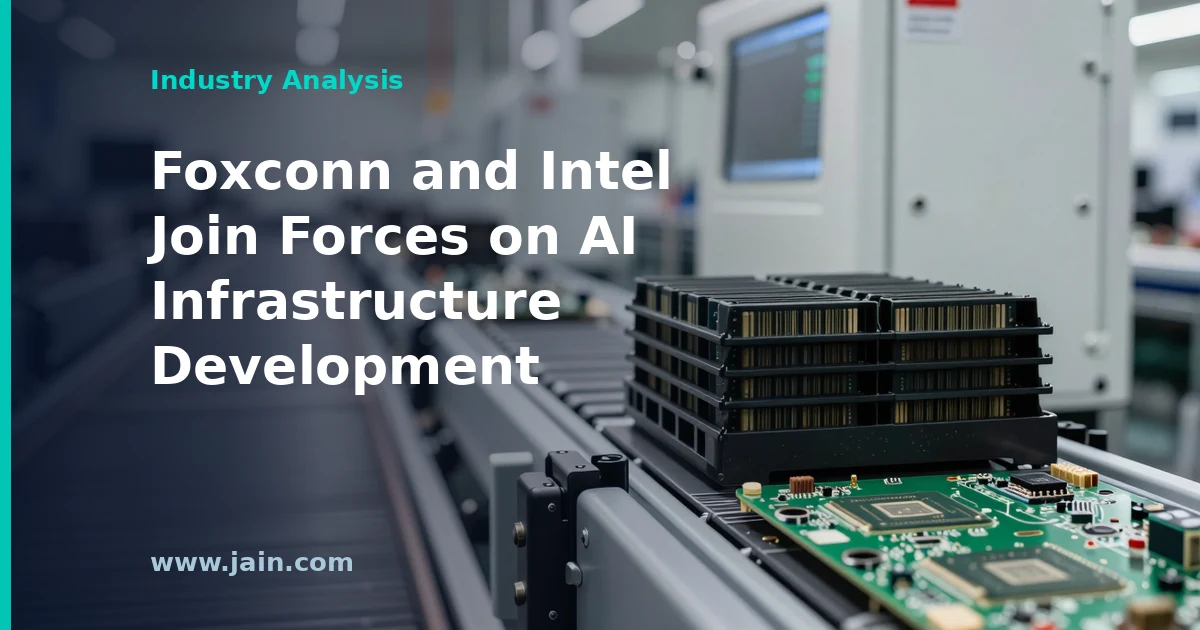
Foxconn and Intel are partnering to develop AI infrastructure, according to a report by The Wall Street Journal published June 5, 2026. The tie-up brings together the world’s largest contract electronics manufacturer — already a dominant assembler of AI servers — and one of America’s most storied chipmakers, which has been fighting to regain relevance in the AI computing market.
The initial report is light on specifics: no financial terms, product roadmap, or timeline has been disclosed publicly at this stage.
Executive Summary
The reported alliance matters because of who the two parties are. Foxconn (formally Hon Hai Precision Industry) has quietly become one of the most important companies in the AI boom — not by designing chips, but by building the servers and racks that house them for the world’s largest cloud and AI companies. Intel, meanwhile, designs and manufactures processors and has been investing heavily to rebuild its manufacturing arm and win a meaningful share of AI-related computing workloads.
A Foxconn–Intel pairing on AI infrastructure — the physical layer of the AI economy: servers, racks, cooling, power distribution, and the data center systems that tie them together — would formalize a manufacturing-meets-silicon axis at exactly the moment hyperscalers and enterprises are racing to add AI capacity.
That said, the substance of the announcement is not yet public. Until the companies detail what they are actually building together, and for whom, the significance of the deal rests on its strategic logic rather than on disclosed commitments.
Manufacturing Muscle Meets Silicon Ambition
The logic of the pairing is straightforward. Foxconn brings scale manufacturing: it assembles servers, integrates full racks, and increasingly delivers complete data center systems rather than individual boxes. Intel brings silicon: CPUs that still anchor a large share of the world’s servers, AI accelerator efforts, networking components, and a foundry business that manufactures chips for others. Each has something the other lacks — Foxconn does not design leading processors, and Intel does not build data centers at Foxconn’s volume.
For Intel, a deep manufacturing partner could help it package its silicon into complete, deployable AI systems — the form factor in which customers increasingly buy compute. For Foxconn, a second major silicon partner diversifies a business that has grown heavily around one dominant AI chip supplier’s ecosystem. Reducing single-vendor concentration is prudent for a contract manufacturer whose fortunes swing with its customers’ product cycles.
The Economics of the AI Buildout
AI data center spending has become one of the largest capital deployment waves in technology history, with hyperscale cloud providers, AI labs, and sovereign projects all competing for servers, power, and cooling capacity. In that environment, the bottleneck is often not chip design but delivery: getting integrated, tested, power-dense racks onto data center floors quickly. That is precisely the layer where a manufacturing-silicon alliance competes.
The competitive backdrop is equally important. The AI systems market today is led overwhelmingly by one chip designer’s platforms, with rival silicon vendors and their manufacturing partners fighting for the remainder. An Intel–Foxconn combination does not change that math by itself, but it creates another credible route for buyers who want alternatives — and buyers, from cloud providers to enterprises, generally welcome supplier competition because it improves pricing and availability.
What Success Would Require
Strategic logic is necessary but not sufficient. For this alliance to matter commercially, Intel’s AI silicon must win sockets — meaning customers must choose to deploy it — and Foxconn must be able to build around it at competitive cost and speed. Both companies have work to do: Intel has publicly acknowledged in recent years that it trails in AI accelerators, and Foxconn must balance any new alliance against relationships with existing customers who may view it as competitive.
It is also worth being clear-eyed about what a single-source report supports. The WSJ headline establishes that a partnership exists or is being formed; it does not establish its size, exclusivity, or ambition. Partnerships in this industry range from joint product development with committed capital to loose co-marketing arrangements, and the difference determines whether this is a strategic shift or a press-release-grade alignment. Readers should withhold judgment until terms are disclosed.
Background
Foxconn and Intel represent two different eras of technology manufacturing that the AI boom has pushed together. Foxconn rose over four decades from a Taiwanese components maker into the world’s largest electronics contract manufacturer, and in the 2020s pivoted aggressively into AI servers as demand from cloud and AI companies exploded. Intel dominated computing’s CPU era but lost ground in the shift to AI accelerators, prompting a multi-year turnaround effort centered on advanced manufacturing, foundry services for other chip designers, and renewed AI silicon ambitions.
The backdrop is an AI data center buildout of historic scale, in which hyperscalers and enterprises are spending heavily on compute capacity and the industry’s constraint has shifted from chip design toward manufacturing, integration, power, and delivery speed — precisely the territory where a Foxconn–Intel alliance would operate.
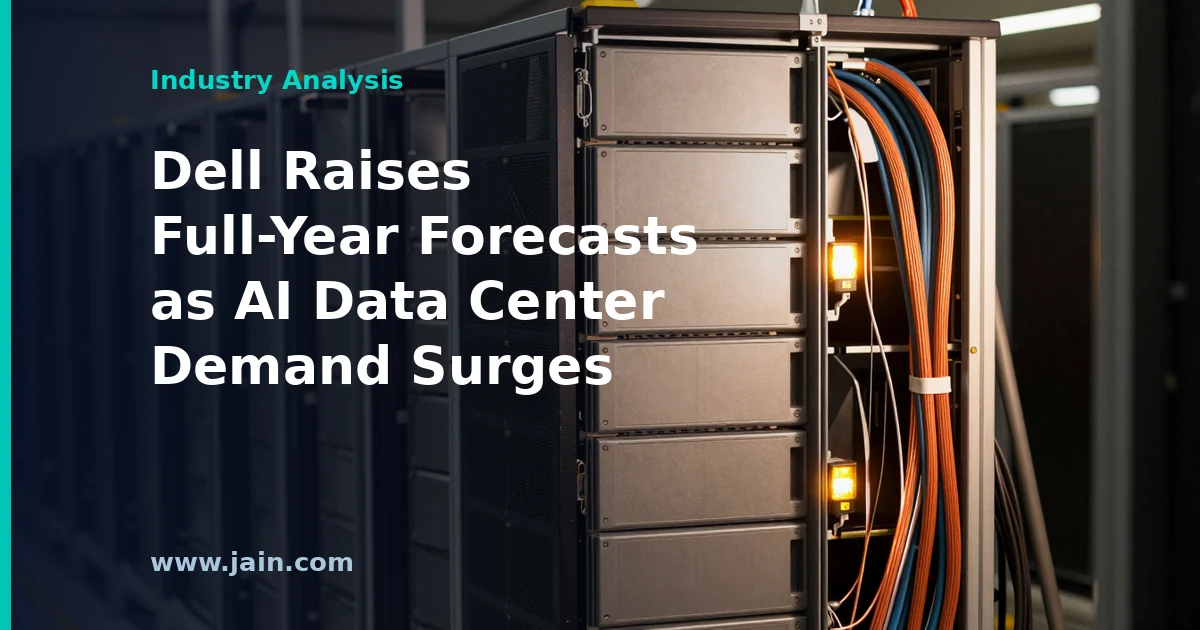
Dell Technologies raised its full-year financial forecasts, citing surging demand for servers driven by the ongoing AI data center buildout, according to a Reuters report published May 27, 2026. The company’s shares rose sharply on the news.
The report frames the guidance increase as a direct consequence of accelerating infrastructure spending by organizations racing to deploy AI computing capacity — making Dell’s outlook one of the clearest demand signals yet from the hardware layer of the AI supply chain.
Executive Summary
According to Reuters, Dell lifted its forecasts for the full fiscal year on the strength of AI-driven server demand, and the market responded with a significant share-price rally. A guidance raise — a company telling investors it now expects better results than it previously projected — is a stronger signal than a single good quarter, because it implies management sees the demand trend continuing rather than peaking.
Why it matters: Dell is one of the largest suppliers of the physical machines that AI runs on. When a vendor of its scale raises its outlook because of data center buildouts, it suggests that the capital spending wave from cloud providers, AI specialists, and large enterprises is still translating into real hardware orders — not just announcements. For everyone downstream of that spending — data center operators, power and cooling providers, connectivity firms — Dell’s forecast is a leading indicator of workloads and capacity demand still to come.
The headline-level report reviewed here does not include the specific revised revenue or profit figures, so the magnitude of the raise, and the margin picture behind it, remain to be read from Dell’s own investor disclosures.
Why Dell’s Guidance Is a Supply-Chain Bellwether
AI infrastructure spending is often measured in press releases — announced campuses, pledged gigawatts, multi-year commitments. Server revenue is different: it is recognized when physical machines ship, which makes it one of the more honest gauges of how much of the announced buildout is actually being executed. Dell sits at that conversion point. Its AI-optimized servers — dense systems built around GPUs, the graphics-derived accelerator chips that dominate AI training and inference — are what turn a chipmaker’s roadmap and a developer’s ambitions into installed capacity.
A raised full-year forecast therefore says something beyond Dell itself: purchase orders for AI hardware were strong enough, and visible enough, for management to commit to a higher number publicly. That is meaningful at a moment when parts of the market have debated whether AI capital spending is durable or a bubble. It does not settle that debate — guidance reflects the order book, not the eventual return on the buyers’ investments — but it indicates the spending had not slowed as of late May 2026.
The Economics Behind the Boom
The AI server business is famously a high-revenue, hard-margin trade. A large share of each system’s cost is the accelerator silicon, which the server maker buys from chip suppliers and passes through — so revenue can grow spectacularly while gross margin percentages compress. Industry analysts have repeatedly flagged this dynamic across the server sector. The headline report does not say how Dell’s raised forecast splits between revenue and profitability, and that distinction is exactly what sophisticated readers should look for in the underlying filings: a raise driven by profitable AI systems and attached storage, networking, and services is a different story than one driven by low-margin pass-through volume.
Dell’s structural advantages in this fight are its global supply chain, enterprise sales relationships, financing arm, and deployment services — capabilities that matter more as AI systems get denser, hotter, and harder to integrate. Liquid cooling, rack-scale delivery, and on-site services are where hardware vendors can defend margin against commodity pressure.
Winners and Losers Down the Stack
Strong AI server demand radiates outward. Chip suppliers benefit first and most directly. Data center operators benefit next: every GPU server Dell ships needs space, power, and cooling, and the newest generations demand far more of each per rack than traditional enterprise gear — sustaining demand for high-density colocation and purpose-built AI facilities. Power and cooling infrastructure vendors, and the connectivity providers linking these facilities, ride the same wave.
The competitive picture among server makers is less comfortable. Dell competes with Supermicro, HPE, Lenovo, and the original design manufacturers (ODMs) that build directly for hyperscale cloud companies. A demand environment strong enough to lift Dell’s full-year outlook likely lifts rivals too, but share shifts between them depend on allocation of scarce accelerator supply, cooling engineering, and delivery speed. For traditional enterprise IT budgets, there is also a quieter tension: dollars flowing to AI systems can crowd out spending on conventional servers and PCs, a mix shift worth watching in Dell’s segment detail.
The Durability Question
The risk case is concentration and cyclicality. AI server demand is driven by a relatively small set of very large buyers — hyperscale clouds, well-funded AI companies, and GPU-cloud specialists. If any of those buyers pause, digest capacity, or hit financing constraints, hardware orders can swing quickly, and guidance can be cut as fast as it was raised. Server makers also carry inventory and backlog timing risk across accelerator product transitions, when buyers may delay orders to wait for next-generation chips.
None of that is a prediction of trouble; it is the standard risk frame for reading any AI hardware guidance raise. The signal from this announcement is genuinely positive for the infrastructure economy. The discipline is remembering that a forecast is a forward-looking statement about a fast-moving market, not a contracted outcome.
Background
Dell Technologies, headquartered in Round Rock, Texas, is one of the world’s largest makers of servers, storage systems, and PCs. Its Infrastructure Solutions Group supplies the data center hardware at the center of this story, and over the past several years the company has become a leading integrator of GPU-dense AI systems, competing with Supermicro, HPE, Lenovo, and hyperscale-focused ODMs. Its scale in supply chain, enterprise sales, financing, and deployment services is central to its position in the AI server market.
The announcement lands amid a historic capital-spending wave: cloud providers, AI developers, and enterprises have been racing to build and equip AI data centers, straining supplies of accelerator chips, power, and cooling. Server-vendor guidance has become a closely watched proxy for whether that buildout is translating into real, shipped infrastructure — which is why a Dell forecast raise draws attention well beyond its own shareholders.
Foxconn, the Taiwanese contract-manufacturing giant that assembles a large share of the world’s consumer electronics and AI servers, has been named as the victim of a cyberattack attributed to the Nitrogen ransomware group, according to a May 2026 report in Cyber Magazine. Foxconn — formally Hon Hai Precision Industry — is the world’s largest electronics manufacturer, which makes any successful intrusion into its environment a supply-chain story as much as a security story.
Public details of the incident remain limited: the report centers on Nitrogen’s claim of responsibility, and at the time of writing the scope of the breach, the systems affected, and any operational impact have not been independently detailed.
Executive Summary
The reported breach pairs a familiar attacker playbook with an unusually consequential target. Nitrogen is a ransomware operation that security researchers have tracked in recent years, associated with intrusion campaigns that begin quietly — often through deceptive downloads or compromised access — and end in encryption, data theft, or both. Foxconn, its claimed victim, sits at the center of global electronics production, from smartphones to the GPU-dense server racks powering the AI buildout.
Why it matters: ransomware against a manufacturer of this scale is not just an IT incident. Contract manufacturers run on thin margins, tight production schedules, and deep integration with customers’ logistics systems. Even a contained breach raises questions about production continuity, the exposure of customer and design data, and the resilience of a supply chain that much of the technology industry — including the AI infrastructure sector — depends on.
Equally important is what has not been established. A ransomware group’s claim is an allegation until the victim confirms it or evidence is verified. The available reporting does not yet document what data was taken, whether production was disrupted, or what Foxconn’s response has been. Readers should hold both facts in mind: the target is enormously significant, and the publicly verified details are thin.
Why Manufacturers Keep Ending Up on Ransom Notes
Manufacturing has consistently ranked among the most-attacked sectors in ransomware incident data, and the economics explain why. A factory that stops producing loses money by the hour, and restarting complex assembly lines is far harder than rebooting an office network. That gives attackers leverage: the cost of downtime can dwarf the ransom demand, creating pressure to pay quickly. Manufacturers also run a mix of modern IT and older operational technology (OT) — the industrial control systems that run production equipment — which is often difficult to patch and was rarely designed with hostile networks in mind.
Contract manufacturers like Foxconn add a further layer of attractiveness. They hold not just their own data but their customers’ — product designs, component specifications, order volumes, and logistics details for some of the world’s most valuable brands. For a double-extortion group, which steals data before encrypting systems and threatens to publish it, that customer data is the real prize: it multiplies the number of parties with something to lose.
The AI Server Supply Chain Raises the Stakes
Foxconn’s role has evolved well beyond consumer electronics. The company has become a major assembler of AI servers — the GPU-packed systems that cloud providers and enterprises are racing to deploy. That business runs hot: demand outstrips supply, delivery schedules are tight, and every week of slippage ripples through data center construction timelines and cloud capacity plans downstream.
This is the context that makes the Nitrogen claim resonate beyond Foxconn itself. The AI infrastructure boom has concentrated enormous economic value in a relatively small number of manufacturing and logistics chokepoints. An attacker does not need to breach a chipmaker or a hyperscaler to touch the AI economy; compromising an assembler, a component supplier, or a logistics system can be enough. For data center operators and cloud buyers, the incident is a reminder that supply-chain risk assessments should extend to the cybersecurity posture of manufacturing partners, not just their production capacity.
Foxconn Has Been Here Before
This is not the first time Foxconn has appeared in a ransomware headline. In 2020, attackers using DoppelPaymer ransomware hit a Foxconn facility in Ciudad Juárez, Mexico, and in 2022 the LockBit group claimed an attack on its Tijuana operations. Neither incident, by public accounts, caused lasting global disruption — a point that cuts both ways. It suggests a company of Foxconn’s scale can absorb and contain regional incidents, but repeated targeting also shows that a manufacturer with hundreds of facilities and a vast workforce presents an attack surface that is effectively impossible to make airtight.
The pattern also illustrates how ransomware groups treat prior victims: a company that has been breached before is often probed again, by different crews, on the theory that complexity breeds recurring gaps. For defenders, the lesson is that incident response cannot end at recovery — each event is intelligence about where the perimeter is soft.
Reading Ransomware Claims with Discipline
A note of caution belongs in any analysis of this incident: ransomware groups have strong incentives to exaggerate. Naming a famous victim generates publicity, pressures the target, and burnishes the group’s reputation with affiliates. There have been past cases across the industry where claimed breaches proved smaller than advertised — stolen data from a subsidiary or supplier presented as a crown-jewels haul, or old data recycled as new.
That does not mean the claim is false; it means the burden of proof matters. The questions that determine this incident’s real severity — what was accessed, whether production systems were touched, and what data if any was exfiltrated — can only be answered by Foxconn’s own disclosure or by verified evidence. Until then, the sober reading is that a credible threat group has claimed a very high-value target, and the claim warrants attention without embellishment.
Background
Foxconn, the trade name of Taiwan’s Hon Hai Precision Industry, grew from a components maker founded in 1974 into the world’s largest electronics contract manufacturer, employing hundreds of thousands of workers across facilities in Asia, the Americas, and Europe. It is best known as Apple’s principal iPhone assembler, but its customer list spans much of the global electronics industry, and in recent years it has become a major manufacturer of AI servers — the GPU-dense systems at the heart of the data center buildout.
The company’s scale has made it a recurring ransomware target: a DoppelPaymer attack struck its Ciudad Juárez, Mexico facility in 2020, and LockBit claimed an attack on its Tijuana operations in 2022. The Nitrogen group named in the current incident is a more recent entrant among extortion crews tracked by security researchers, and its claim against Foxconn — if borne out — would rank among its most prominent targets to date.