
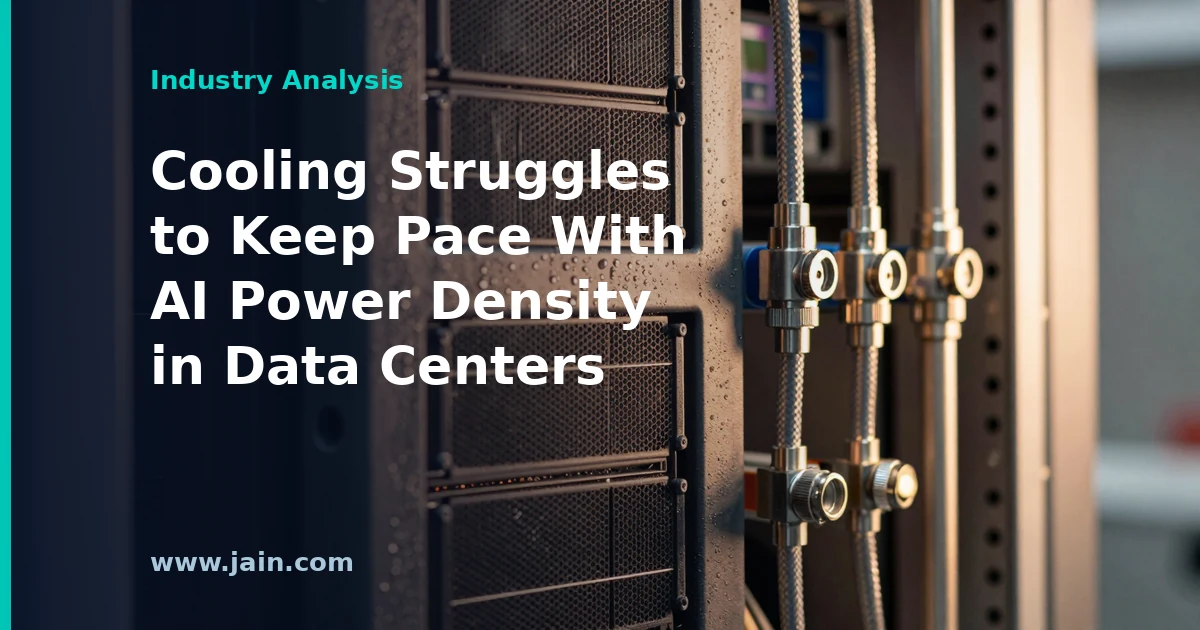
Trade publication Data Center Knowledge reported on May 1, 2026 that cooling capability is failing to keep pace with the power density of AI computing hardware in data centers. The report frames a problem now visible across the industry: racks packed with AI accelerators draw far more power — and therefore shed far more heat — than the air-cooled infrastructure most facilities were built around, turning thermal management into a gating factor for AI capacity.
Executive Summary
The core claim is simple but consequential: the heat produced by AI hardware is rising faster than the industry’s ability to remove it. Every watt a server consumes becomes heat that must be carried away, and conventional data centers were engineered for racks drawing modest single-digit to low-double-digit kilowatts. Dense AI training clusters concentrate an order of magnitude more power in the same floor space, pushing air-based cooling — fans, raised floors, and computer-room air handlers — toward its physical limits.
Why it matters: if cooling cannot keep up, it does not matter how many GPUs a company can buy or how much grid power a site can secure. Thermal capacity becomes the binding constraint on AI deployment schedules. That reality is forcing a generational transition toward liquid cooling — circulating coolant directly to chips or immersing hardware in fluid — and it is reshaping how facilities are designed, financed, and leased.
Heat Is the Hard Ceiling, Not Power or Chips
The AI buildout has been narrated mostly as a race for GPUs and grid connections, but this report points at the quieter bottleneck between them: getting heat out of the building. Air cooling works by moving enormous volumes of chilled air past hot components, and its effectiveness falls off sharply as power concentrates. Past a certain rack density, no arrangement of fans and airflow containment can remove heat as fast as modern accelerators generate it. Liquid, which carries heat far more efficiently than air, becomes a physical necessity rather than an optimization.
That distinction matters for planning. Power shortages can sometimes be solved with money and patience — new substations, on-site generation. Thermal limits are baked into a building’s design: pipe runs, floor loading, chilled-water plant capacity, and the space between racks. A facility designed for air cooling cannot simply be told to run hotter.
The Retrofit Problem: Old Buildings, New Physics
The industry’s installed base is the crux of the struggle the report describes. Most operating data centers were designed years before dense AI clusters existed. Retrofitting them for direct-to-chip liquid cooling means adding coolant distribution units, leak detection, new piping, and often structural work — all while existing tenants keep running. That is slow, expensive, and disruptive, which is why much of the highest-density AI capacity is going into purpose-built greenfield facilities instead.
The economic consequence is a widening split in the market. Modern, liquid-ready capacity commands premium pricing and pre-leases quickly, while older air-cooled facilities risk sliding toward commodity workloads. For operators, the question is no longer whether to invest in liquid cooling but how much of the existing portfolio is worth converting versus running out its useful life on conventional enterprise and cloud workloads.
Winners, Losers, and the Supply Chain in Between
A constraint this fundamental redistributes value. Suppliers of liquid-cooling hardware — cold plates, coolant distribution units, immersion systems, heat exchangers — and the engineering firms that integrate them stand to benefit from a multi-year upgrade cycle. Chipmakers are increasingly designing accelerators that assume liquid cooling, which pulls the whole ecosystem along. Operators with liquid-ready designs and available power gain leverage in lease negotiations with AI tenants who have few alternatives.
The losers are less obvious but real: enterprises and smaller cloud providers holding long leases in facilities that cannot economically support high-density deployments, and AI projects whose timelines quietly slip because the cooling plant — not the chips — is the long-lead item. For buyers of AI capacity, thermal specifications are becoming as important a diligence item as price per kilowatt.
Background
For most of the industry’s history, data centers were cooled by air: chilled air pushed through raised floors and aisles past servers drawing a few kilowatts per rack. That model scaled comfortably through the enterprise and cloud eras. The AI boom broke the pattern — training clusters built on power-hungry accelerators concentrate an order of magnitude more power per rack, and the industry has responded with a generational shift toward liquid cooling, a technique long used in supercomputing but new at commercial scale.
By early 2026, the constraint conversation around AI infrastructure had expanded from chip supply to grid power and, increasingly, to thermal capacity — the subject of this report. Cooling now sits alongside power procurement as a first-order determinant of where and how fast AI capacity gets built.
Source: Cooling Struggles to Keep Pace With AI Power Density — Data Center Knowledge trade-press report, published May 1, 2026, on thermal management lagging AI hardware density in data centers.