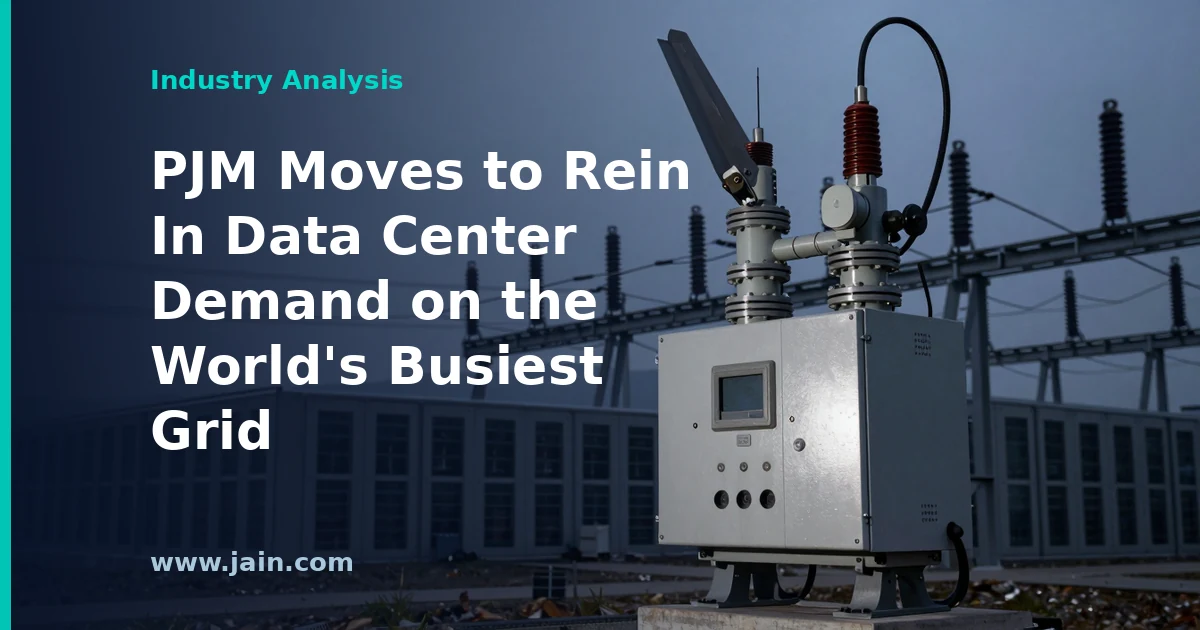
PJM Interconnection — the regional grid operator serving 13 states and the District of Columbia, including Northern Virginia’s “Data Center Alley,” the densest concentration of data centers on Earth — is taking steps to rein in data center electricity demand, according to reporting from public broadcaster WHRO published April 20, 2026. The move signals that the operator of the world’s most data-center-heavy grid no longer treats hyperscale load growth as something to be absorbed without conditions.
Executive Summary
The significance here is less any single rule than the direction of travel. PJM is the largest wholesale electricity market operator in the United States, coordinating power for roughly 65 million people, and its territory hosts the global capital of the data center industry. For most of the past decade, the operating assumption in that territory was that if you could buy land and fiber, the grid would eventually follow. A grid operator moving to constrain or condition data center demand inverts that assumption.
For the infrastructure industry, this matters in two ways. First, it converts power from a procurement line item into a gating factor: projects in PJM territory may increasingly be shaped by what the grid operator will allow, and on what timeline, rather than purely by developer ambition. Second, it sets a precedent. PJM’s rules and market designs are watched — and often copied — by other regional operators facing their own waves of AI-driven load requests. What PJM does about data centers rarely stays in PJM.
The Grid Operator Blinks First
A regional transmission organization (RTO) like PJM does not generate power or build data centers; it runs the wholesale market and keeps supply and demand in balance across its footprint. Its core legal obligation is reliability. When such an operator starts “taking steps to rein in” a category of demand, it is effectively saying that the pace of load requests has begun to strain its ability to guarantee that balance. That is a notable admission from the operator whose territory — anchored by Loudoun County, Virginia — handles more data center load than any comparable grid in the world.
The economic backdrop makes the move legible. PJM’s recent capacity auctions — the mechanism through which it pays power plants to be available in future years — have cleared at sharply higher prices, with data center growth widely cited as a principal driver. Those costs flow through to every ratepayer in the footprint, not just the data centers causing the growth. Political and regulatory pressure to distinguish between speculative interconnection requests and real projects, and to make large loads bear more of the costs they create, has been building accordingly.
From Land-and-Fiber to Power-First Siting
If the grid operator for the world’s largest data center market is imposing limits, the site selection calculus changes for everyone downstream. Developers who counted on Northern Virginia’s unmatched fiber density and cloud ecosystem now have to weigh whether a grid connection will arrive on a bankable schedule. That logic has already been pushing projects toward secondary markets — and toward on-site or contracted generation that reduces dependence on the shared grid. Constraints in PJM accelerate both trends.
There is also a sorting effect within the industry. Well-capitalized hyperscalers and established operators can absorb longer timelines, post larger financial commitments, and negotiate directly with utilities and generators. Thinly financed projects that were effectively options on future power — reserving grid capacity they might never use — are the natural target of any tightening. To the extent PJM’s steps separate firm demand from speculative demand, the result could be a healthier queue, even if headline growth numbers shrink.
Reliability, Ratepayers, and the Politics of AI Load
The uncomfortable center of this story is cost allocation. Electricity markets were not designed for single customers that show up requesting the load of a mid-sized city. When capacity prices rise to meet that demand, households and small businesses share the bill, and state regulators and legislators hear about it. A grid operator that visibly disciplines data center demand is, among other things, managing its own political legitimacy across 13 states with very different attitudes toward hosting the AI build-out.
For the data center industry, the fair response is not to dismiss the concern but to engage on mechanism design: rules that require demonstrated financial commitment, that pay large loads for flexibility (curtailing during grid stress), and that let them bring their own generation can protect reliability without rationing growth. The risk, from the industry’s side, is blunt instruments — caps or moratoria that stall real projects along with speculative ones. Which kind of instrument PJM has chosen is the central question the reporting raises.
Background
PJM Interconnection grew out of one of the world’s oldest power pools, dating to 1927, and today runs the largest wholesale electricity market in the United States. Its footprint includes Northern Virginia, where cheap land, dense fiber routes, and proximity to federal and internet-exchange infrastructure made Loudoun County the global capital of the data center industry over the past two decades. That concentration was long a point of regional pride and tax revenue; the AI boom has turned it into a grid-planning challenge, as power demand in the region — flat for years — began climbing steeply on the back of hyperscale computing.
By 2026 the tension was visible on ratepayer bills and in regulatory dockets: PJM’s capacity auction prices had risen sharply with data center growth cited as a key driver, and policymakers across its 13-state footprint were debating who should pay for the infrastructure the AI build-out requires. PJM’s move to rein in data center demand is the market operator’s entry into that debate.
Amazon will invest up to a further $25 billion in the AI developer Anthropic as part of an AI infrastructure arrangement, according to CNBC reporting published on 20 April 2026. The figure is an upper bound rather than a committed lump sum, and it follows earlier Amazon investments in Anthropic that were previously reported at roughly $8 billion in total.
The available source is a single news headline and summary. It establishes the parties, the ceiling on the investment and the fact that the money is linked to infrastructure; it does not, on its own, set out the tranche structure, the valuation, the data center locations, the silicon mix or the timeline over which the capital would be deployed.
Executive Summary
The headline number matters less than the shape of the deal. An investment described as part of an “AI infrastructure deal” signals the arrangement that has come to define this cycle: a hyperscaler — an operator of globally distributed, very large-scale data centers, in this case Amazon Web Services — puts capital into a model developer, and the model developer spends heavily on that same operator’s compute. Capital goes out one door and returns as cloud revenue through another.
For Amazon, this is a way to secure an anchor tenant for capacity it is already building, and to give its in-house Trainium accelerators — custom chips designed for training and running AI models — a demanding, high-volume customer. For Anthropic, it is access to capital and to reserved capacity at a moment when the binding constraint on frontier AI is not ideas or engineers but power, land, chips and the multi-year lead times attached to all three.
For everyone downstream — power developers, cooling vendors, network operators, colocation providers — an announcement of this size is a demand signal. It is not, however, a permit, an interconnection agreement or a delivered megawatt, and the reporting available at publication does not convert the ceiling into a schedule.
Capital for Capacity: How the Circle Works
The structure now common across AI infrastructure is straightforward to describe and harder to evaluate. An investor with data centers invests in a customer who needs data centers; the customer commits to spending on the investor’s platform. Economically it resembles vendor financing, a long-established practice in capital-intensive industries — telecom equipment makers lent to carriers who bought their switches; aircraft manufacturers financed airlines. The practice is legitimate and often rational. It also compresses the distance between an investment decision and the revenue it later produces.
That compression is what analysts and auditors watch. When a supplier funds a customer’s purchases, reported demand can partly reflect capital the supplier itself provided, and the quality of that revenue depends on whether the customer would have bought at similar scale anyway. In Anthropic’s case there is a genuine independent business — enterprise API demand, consumer subscriptions, coding and agent products — so the question is one of degree, not of substance. Nothing in the available reporting quantifies that degree, and nobody outside the two companies can settle it from a headline.
The honest reading is that the arrangement is defensible on its face and unverifiable in its detail. “Up to” is doing real work in the sentence. Ceilings of this kind are typically drawn down in tranches against milestones, and the difference between a committed $25 billion and an available $25 billion is the difference between a construction schedule and an option.
Why Amazon Pays to Fill Its Own Data Centers
A data center is a fixed-cost asset that depreciates whether or not anything is running in it. AI accelerators depreciate faster than the buildings that house them, and a rack of idle high-end silicon is one of the more expensive ways to hold an asset. Utilization is therefore the central economic variable, and an anchor tenant with predictable, enormous, long-duration demand is worth paying for — which is much of what an investment like this buys.
There is a silicon dimension as well. Amazon has invested years in Trainium, its own training and inference chips, and the strategic value of custom silicon depends on someone using it at frontier scale. A demanding model developer serves as both a volume customer and a co-designer, surfacing the software and networking gaps that only appear at scale. Every workload that runs on in-house accelerators rather than merchant GPUs also improves the margin structure of the underlying cloud business and reduces exposure to a single external supplier.
The risk sits on the other side of the same coin. Concentrating capital and capacity around one customer means that customer’s trajectory becomes the operator’s trajectory. If frontier model demand grows as expected, purpose-built capacity is an advantage; if demand shifts toward smaller, cheaper models or toward inference patterns that need different hardware, specialized capacity is harder to repurpose than general-purpose cloud. That is a real risk, not an accusation, and it applies to every hyperscaler pursuing this strategy.
The Physical Bill Comes Due Downstream
Capital commitments of this magnitude eventually resolve into physical infrastructure, and the physical layer moves on its own clock. Grid interconnection queues in major markets run years, not quarters. Large transformers and switchgear carry long lead times. High-density AI racks push power and heat well beyond what conventional air cooling handles economically, which is why liquid cooling has moved from a niche to a default in new frontier-scale builds. None of that accelerates because a funding announcement is made.
The winners from a demand signal like this are diffuse: power developers with sites already interconnected, cooling and electrical equipment suppliers with capacity to sell, network operators building the high-bandwidth links that stitch training clusters together, and communities where such projects land. The pressures are equally real — local grid capacity, water use where evaporative cooling is employed, and rising interest from regulators and ratepayer advocates in who pays for network upgrades. These are legitimate questions that deserve specifics, and specifics are exactly what a headline cannot provide.
Reading a Thin Source Honestly
What is substantiated at publication is narrow: two named parties, an upper bound of $25 billion, a characterization as part of an AI infrastructure deal, and a date. That is enough to establish direction and scale. It is not enough to support conclusions about market share, competitive displacement or the fate of rival partnerships, and readers should treat confident claims in either direction with caution until the companies publish terms.
It is worth stating plainly what the announcement does not settle. It does not, by itself, demonstrate that AI compute demand justifies the buildout; nor does it demonstrate the reverse. Large strategic investments are made under uncertainty, and both the enthusiastic and the skeptical readings of this cycle remain open questions that will be answered by utilization data and enterprise adoption over several years, not by a funding ceiling. The most useful posture for buyers, suppliers and investors is to track what follows the announcement — filings, tranche disclosures, site announcements, interconnection agreements — rather than the number in the headline.
Background
Anthropic was founded in 2021 by researchers who previously worked at OpenAI and develops the Claude family of large language models. Amazon began investing in the company in 2023, with earlier commitments previously reported at around $8 billion in total, alongside an arrangement under which Amazon Web Services serves as a primary cloud and training partner. Anthropic has also taken investment from Google, and its models are distributed through multiple cloud platforms.
The wider context is a capital cycle in which the largest cloud operators are spending at unprecedented levels on data centers, accelerators, power procurement and cooling to meet AI workloads. Partnerships pairing a hyperscaler with a frontier model developer — Microsoft with OpenAI, Google and Amazon with Anthropic, and Nvidia’s investments across the sector — have become the organising structure of the industry, blending investment, supply agreements and long-term capacity reservations into single arrangements.
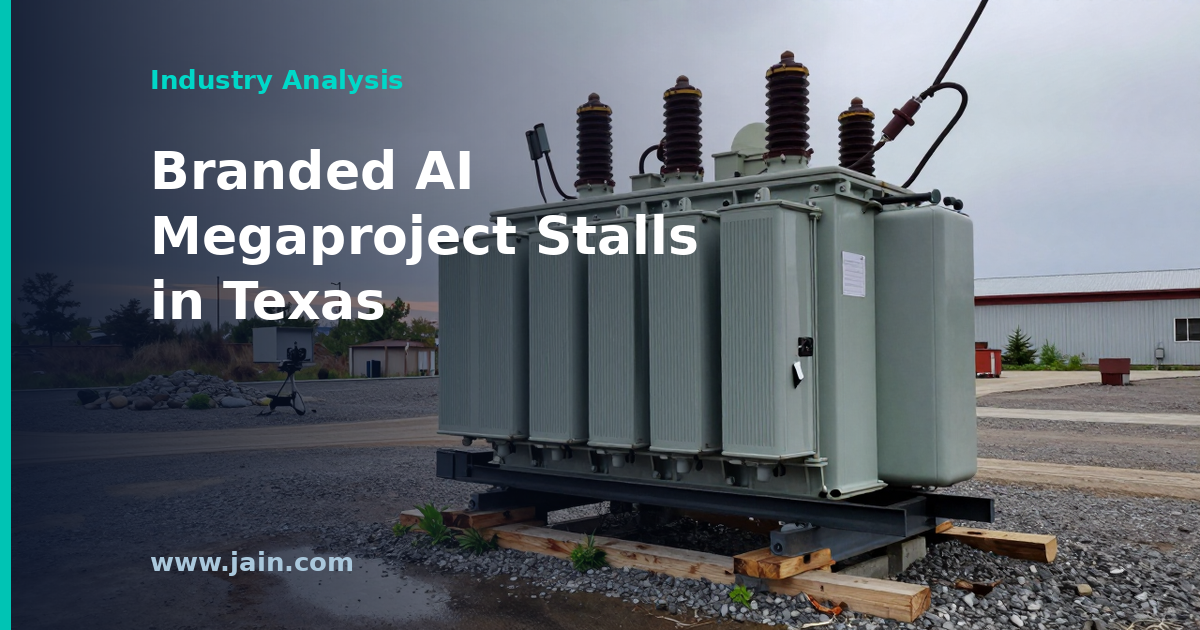
An AI data center megaproject carrying the Trump brand has stalled, and its chief executive has left the company, according to an Axios report published on April 20, 2026. The report is the first public signal that the venture, promoted as a large-scale AI computing campus, is not proceeding on its announced path.
The available source is a headline-level wire item. It establishes two things: the project has stalled, and the CEO has departed. It does not, in the material available to us, set out the project’s contracted capacity, financing status, customer commitments, or the reason for the leadership change.
Executive Summary
The announcement of a large AI campus and the delivery of one are separated by a chain of dependencies that rarely appears in a press release: firm power, an interconnection agreement with the grid operator, long-lead electrical and generation equipment, an anchor customer willing to sign a decade-long lease, and a capital stack willing to fund construction before that customer moves in. A stall at this stage usually means one link in that chain did not close.
Why it matters beyond one project: since 2024, the AI buildout has been announced in gigawatts rather than megawatts, and much of that pipeline is speculative. A gigawatt is roughly the output of a large power plant, enough for a mid-sized city. Projects at that scale are not real estate transactions; they are power transactions with buildings attached. Each publicly stalled project gives lenders, utilities and enterprise buyers a data point on how much of the announced pipeline converts to poured concrete.
The political branding adds a distinct variable. A licensed name raises a project’s visibility and can widen its investor pool, but it does not shorten an interconnection queue, secure a turbine order, or substitute for a creditworthy tenant. This case tests whether that distinction is priced correctly.
Announcements Are Cheap; Interconnection Is Not
The binding constraint on large AI campuses today is electricity, not land or capital appetite. To draw hundreds of megawatts from a grid, a developer must enter the operator’s large-load interconnection process, fund system-impact studies, and often pay for transmission upgrades that take years to build. In Texas, the ERCOT market is attractive precisely because it is fast and deregulated by U.S. standards, but the surge of large-load requests has made a queue position an asset in itself, and grid operators have grown more demanding about which requests are financially backed rather than exploratory.
Behind-the-meter generation, the common workaround, has its own timetable. Large gas turbines and grid-scale transformers are ordered years in advance from a small number of manufacturers, and a developer without a slot in that order book cannot buy one at any price on short notice. A project that announced first and secured equipment later is exposed to exactly this gap.
The practical lesson for readers evaluating any megaproject: treat an announced capacity figure as an aspiration until it is paired with a signed interconnection agreement, an energy supply contract, or a filed transmission study. Those documents are frequently public. Rendering images are not evidence.
Who Signs the Lease Decides Whether the Steel Goes Up
The economics of a hyperscale campus rest on offtake — a long-term commitment from a creditworthy tenant to pay for capacity whether or not it uses it. That contract is what construction lenders underwrite. Without it, a developer is asking capital markets to fund a multi-billion-dollar facility on the assumption that demand will arrive, which is a materially more expensive proposition and, in tighter credit conditions, sometimes an impossible one.
This is where independent developers face a structural disadvantage against the largest cloud and AI operators. A hyperscaler building for itself is its own anchor tenant, funds construction from operating cash flow, and can absorb a delay. A newly formed venture must persuade someone else’s balance sheet first. When a project of this type stalls, the most common explanation is not that AI demand evaporated, but that the demand went to counterparties who could deliver capacity on a credible schedule.
Both readings deserve scrutiny. If the venture’s backers argue this is a temporary financing pause, the fair question is which specific milestone slipped and what the revised date is. If critics argue the project was never viable, the fair question is what evidence beyond the stall itself supports that — announced projects are routinely restructured, resited or resumed under new sponsors, and a stall is not a liquidation.
A Brand Is Not a Balance Sheet
Name licensing is a conventional real estate structure: a developer pays for the right to use a recognizable brand, which can lift marketing reach and investor attention. What it does not transfer is operational capability or credit. In digital infrastructure, buyers procure on uptime history, power availability, network density and financial durability over a fifteen-year lease. Brand recognition ranks low on that list, and a politically salient brand can cut both ways with multinational customers who prefer their infrastructure vendors to be uncontroversial.
The CEO departure compounds this. In early-stage infrastructure ventures, the executive team is often the substance of the enterprise — the relationships with utilities, equipment vendors, and prospective tenants sit with named individuals rather than with institutional processes. Losing a chief executive before financial close therefore carries more weight than the same event at an operating company. Nothing in the available source explains the circumstances of the departure, and it would be unfair to the individual to assume any.
For the wider market, the healthiest outcome of episodes like this is better disclosure discipline. Operators, utilities and municipalities all benefit when announcements distinguish between land under option, capacity under study, and capacity under contract. Those are three very different things that are currently reported in the same units.
Background
Since 2024, the buildout of computing capacity for artificial intelligence has become the largest wave of industrial construction in the technology sector, with announced projects routinely measured in gigawatts of electrical load rather than square feet. The scale changed the nature of the business: developers now compete primarily for grid capacity, generation equipment and construction credit, and only secondarily for land. Texas became a focal point because of its independent power market, generation mix and speed of permitting relative to other U.S. states.
That environment produced a wide gap between announced and delivered capacity, and a corresponding pattern of ventures formed to capture attention and capital ahead of securing the underlying power and customers. Independent developers without a captive tenant face the hardest version of this problem, because they must persuade an external counterparty to commit before lenders will fund construction. Reports of stalled projects and leadership changes in that cohort are a recurring feature of the cycle rather than an anomaly, and each one offers a measurable test of which announcements were backed by contracts.