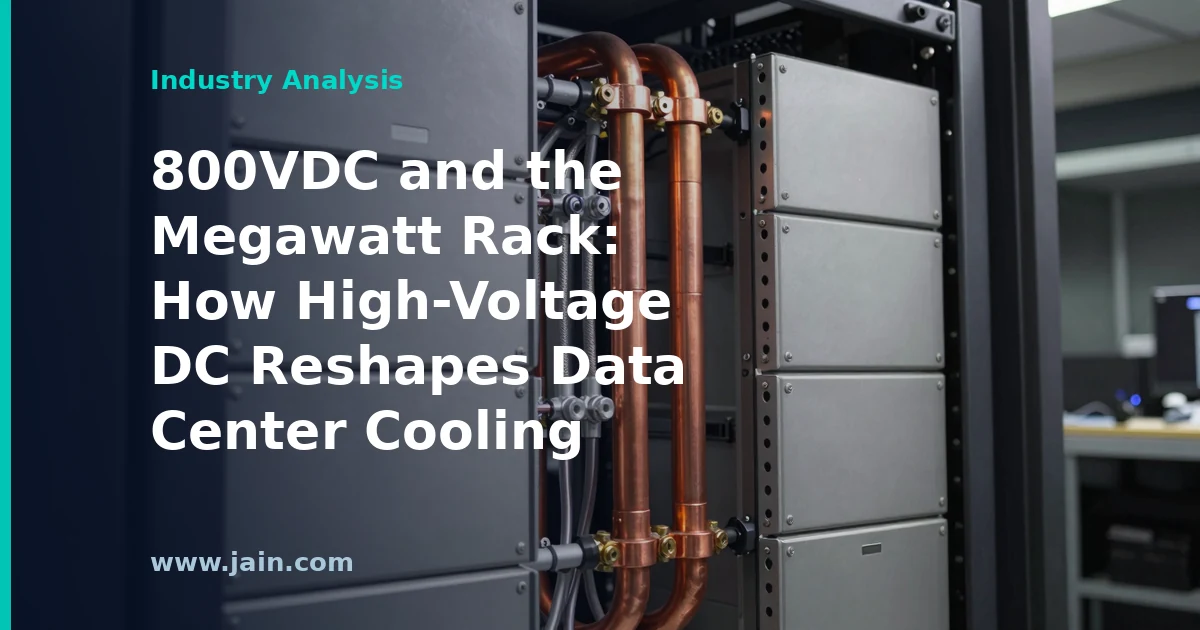
Data Center Dynamics has published an analysis of 800-volt direct current (800VDC) power distribution and its knock-on effects for data center cooling, examining the infrastructure evolution and operational impact of the architecture now being proposed for next-generation AI racks. The piece lands as the industry debates how facilities designed around alternating current (AC) and 54-volt in-rack distribution adapt to rack power densities approaching a megawatt.
Executive Summary
The subject is a plumbing-and-wiring story with strategic stakes: as AI accelerator racks climb toward megawatt-class power draws, the conventional approach — converting utility AC power through multiple stages down to low-voltage DC inside the rack — runs into hard physical limits on copper, conversion losses, and space. Moving distribution to 800VDC, an approach publicly championed by NVIDIA and partners across the power-electronics ecosystem for its next-generation rack designs, promises fewer conversion stages, dramatically thinner conductors, and higher end-to-end efficiency.
The DCD analysis focuses on the less-discussed second-order effect: what this does to cooling. Every watt saved in power conversion is a watt of heat that never has to be removed, but the racks 800VDC enables are so dense that liquid cooling becomes a prerequisite rather than an option. Power architecture and thermal architecture, historically designed by separate teams against separate budgets, are converging into a single engineering problem — and operators, colocation providers, and equipment vendors will all feel the shift.
Why a Power Story Is Really a Cooling Story
In a data center, electricity and heat are two views of the same quantity: essentially all power delivered to IT equipment leaves as heat that the cooling plant must reject. Every stage of power conversion — utility voltage to distribution voltage, AC to DC, high DC to the roughly one volt a chip core actually uses — wastes a slice of energy as heat, often inside the white space where cooling is most expensive. Collapsing conversion stages with 800VDC distribution reduces that parasitic load. But the same architecture exists to feed racks far denser than air can handle: at hundreds of kilowatts per rack and beyond, direct-to-chip liquid cooling with cold plates, coolant distribution units (CDUs), and facility water loops stops being an exotic option and becomes the baseline design.
That coupling changes how facilities get engineered. Busbar routing, cold-plate manifolds, leak detection, and serviceability now compete for the same rack volume. The DCD piece’s framing — implications, infrastructure evolution, operational impact — reflects a real shift in the industry conversation from “can we power it” to “can we power and cool it as one integrated system.”
What Actually Changes Between 54 Volts and 800
Today’s high-density AI racks typically distribute power internally at around 54 volts DC over copper busbars. Power scales with voltage times current, so at fixed voltage, a megawatt rack demands enormous current — and current is what sizes conductors, connectors, and their resistive losses. Raising distribution to 800VDC cuts the current for the same power by an order of magnitude, which is why the approach shrinks copper requirements and frees rack space for compute and cooling hardware. It also moves bulky AC-to-DC conversion equipment out of the rack into dedicated infrastructure, a further gift of space and a relocation of its heat.
For the thermal engineer, the ripple effects are concrete: less conversion loss inside the rack, but far more total heat per rack; new hot components (DC converters, solid-state protection devices) in new places; and coolant loops that must be designed around high-voltage conductors with appropriate creepage, isolation, and leak-response assumptions. None of this is unsolvable — electric vehicles and utility-scale solar have normalized high-voltage DC engineering — but it is genuinely new practice for most data center operations teams.
The Operational Bill: Skills, Safety, and Serviceability
The quiet cost of the transition is human. Data center technicians are trained on AC systems and low-voltage DC; 800VDC introduces different arc-flash behavior, different lockout and protection practices, and different failure modes, now interleaved with pressurized liquid-cooling loops in the same enclosure. Procedures for a coolant leak near an energized 800V busbar have to be written, trained, and drilled before the first rack lands. Vendors will point to sealed, engineered systems; operators will reasonably ask who is qualified to service them and on what schedule.
There is also a monitoring and commissioning dimension. When power and cooling are co-designed, so must be their telemetry: a CDU fault and a DC bus fault can each cascade into the other’s domain within seconds at megawatt densities. Operators evaluating 800VDC-era equipment should scrutinize integration of electrical and thermal controls as closely as the headline efficiency figures.
Winners, Losers, and the Retrofit Question
The clearest beneficiaries are power-electronics and liquid-cooling suppliers, which gain a generational replacement cycle, and hyperscale builders designing greenfield AI factories where the whole electrical-thermal stack can be specified at once. The harder position belongs to operators of existing facilities: buildings engineered around air cooling, AC distribution, and 10–30 kW racks cannot simply be re-declared 800VDC-ready. Some will retrofit power and cooling in tandem; others will find their most valuable asset is grid connection and land rather than the building itself.
For colocation providers and enterprise buyers, the pragmatic takeaway is sequencing. 800VDC is a roadmap item tied to next-generation rack platforms, not a description of most 2026 deployments — but cooling and electrical decisions made today have 15-to-20-year design lives. Facilities being planned now should at minimum preserve optionality: structural allowances for liquid loops, space for DC plant, and staff development that anticipates high-voltage practice.
Background
Data center power delivery has evolved in steps: from AC distribution to the server, to rack-level busbars at 12 and then 54 volts DC, each change driven by rising density. The AI buildout broke the curve — accelerator racks jumped from tens of kilowatts to hundreds, with roadmaps pointing toward a megawatt per cabinet, forcing the industry to revisit both how power reaches silicon and how heat leaves it. In 2025, NVIDIA and a wide ecosystem of power and cooling partners publicly outlined 800VDC distribution for next-generation rack platforms, borrowing high-voltage DC practice from electric vehicles and utility-scale solar.
Data Center Dynamics, the trade publication behind the source analysis, has tracked the parallel rise of liquid cooling from niche to necessity. The convergence of those two threads — high-voltage power and liquid thermal management as one co-designed system — is the backdrop for this piece and for facility design decisions now being made with multi-decade consequences.
Bitcoin mining companies are collectively investing billions of dollars to convert and expand their facilities for artificial-intelligence and high-performance computing (HPC) workloads, according to an April 2026 report carried by TradingView. The striking figure in the headline: the sector’s AI-related capital expenditure is outpacing the revenue those AI operations currently generate by roughly 15-to-1.
The report frames the pivot as an industry-wide phenomenon spanning the class of publicly traded miners that includes names such as TeraWulf (WULF) and Riot Platforms (RIOT), which have been repositioning energized data-center sites originally built for cryptocurrency mining toward GPU-based compute.
Executive Summary
The announcement is less a single company’s news than a sector-level snapshot: bitcoin miners, squeezed by the economics of their core business, are betting their balance sheets on becoming AI infrastructure providers. Capital expenditure — the money spent building data halls, buying cooling and electrical equipment, and preparing sites for GPU tenants — is running at roughly fifteen times the revenue the AI segments are bringing in today.
That ratio matters because it quantifies the leap of faith underway. Data-center construction is a spend-first, earn-later business, so a wide gap between investment and current revenue is normal early in a buildout. But a 15-to-1 gap sustained across an entire sector of companies that historically financed themselves through volatile bitcoin proceeds raises a sharper question: can these firms carry the spending long enough for contracted AI revenue to arrive?
For the broader digital-infrastructure market, the answer will shape who supplies the next wave of AI capacity — and who ends up selling distressed sites to better-capitalized players.
Why Miners Are Racing Into AI
The pivot is rooted in assets, not sentiment. Bitcoin miners own something the AI boom desperately needs: large, already-energized sites with grid interconnections, substations, and industrial-scale power contracts in place. Securing new utility power for a data center can take years; miners already have it. Converting a mining site to HPC use lets them monetize that scarce head start.
At the same time, the core mining business has become structurally harder. Bitcoin’s periodic “halving” events cut the block rewards miners earn for the same work, and competition keeps pushing up the computing power required to win those rewards. AI hosting offers what mining never could: multi-year contracts with creditworthy tenants and revenue that does not swing with a cryptocurrency price. The strategic logic is sound. The question the 15-to-1 figure raises is whether the execution is affordable.
Reading the 15-to-1 Gap
A capex-to-revenue ratio of 15-to-1 is not automatically alarming — it is partly a timing artifact. AI data centers follow a J-curve: enormous upfront spending on construction, electrical gear, and cooling, followed by revenue that only begins once tenants move in and ramps over the life of a lease. Early in a buildout, the ratio is always lopsided. Traditional data-center developers run the same math, but usually with pre-leased capacity and cheap, secured financing behind it.
What makes the miners’ version riskier is who is doing the spending. These are companies whose historical cash flows came from an asset with extreme price volatility, whose cost of capital is higher than that of investment-grade data-center REITs (real estate investment trusts), and several of which are converting sites on the promise of future tenancy rather than fully contracted demand. A 15-to-1 gap backed by signed long-term leases is a construction schedule; the same gap backed by expected demand is a wager. The report, as summarized, does not break down how much of the sector’s spend falls in each category — and that distinction is the whole ballgame.
The Financing Strain Behind the Buildout
Billions in capex must be funded from somewhere, and miners have essentially four levers: cash from mining operations, selling bitcoin holdings, issuing new shares, or taking on debt — including convertible notes, which are loans that can turn into stock. Each carries a cost. Equity issuance dilutes existing shareholders; debt adds fixed obligations to businesses with historically variable income; selling bitcoin reduces the treasury cushion that has often reassured investors during downturns.
The sector precedent that makes this real rather than theoretical: miners have gone through bankruptcy restructurings before when leverage met a downturn, and the survivors’ pivot to AI hosting was in part a search for steadier ground. If AI revenue ramps on schedule, today’s spending converts into long-lived contracted cash flows and the ratio compresses rapidly. If tenant demand arrives slower than construction bills, the same companies face refinancing at whatever terms the market offers a capital-hungry, pre-revenue AI landlord. That asymmetry — not the pivot itself — is the strain worth watching.
Winners, Losers, and the Capacity Question
If the buildout succeeds, the clearest winners are AI tenants — hyperscalers and GPU-cloud operators — who gain powered capacity years faster than greenfield development could deliver it, plus the equipment vendors and contractors paid regardless of outcome. Miners that convert successfully effectively transform into data-center companies and may earn the valuation multiples that go with steadier revenue.
The losers in a stumble scenario are concentrated: shareholders absorbing dilution, and lenders to projects that miss their lease-up targets. But even failure has a second-order winner — established data-center operators and infrastructure funds, who would be natural buyers of energized sites at a discount. In that sense, the capacity being built is likely to serve the AI market either way; what the 15-to-1 gap really determines is who owns it when it does.
Background
Bitcoin miners are industrial-scale data-center operators that historically earned revenue by running specialized computers to secure the bitcoin network in exchange for newly issued coins. The business is capital-intensive and hostage to bitcoin’s price and to protocol-driven halvings that periodically cut rewards. After a bruising downturn cycle that pushed several operators into restructuring, the AI boom presented the sector with an unexpected second act: the power capacity and energized sites miners had assembled became strategically valuable to AI companies facing multi-year waits for new grid connections.
Beginning in the mid-2020s, a wave of publicly traded miners — including TeraWulf and Riot Platforms among the larger names — announced conversions of mining capacity to GPU-based high-performance computing, in some cases anchored by long-term hosting agreements with AI cloud providers. The April 2026 report examined here is a snapshot of how far that spending has run ahead of the revenue it is meant to create.
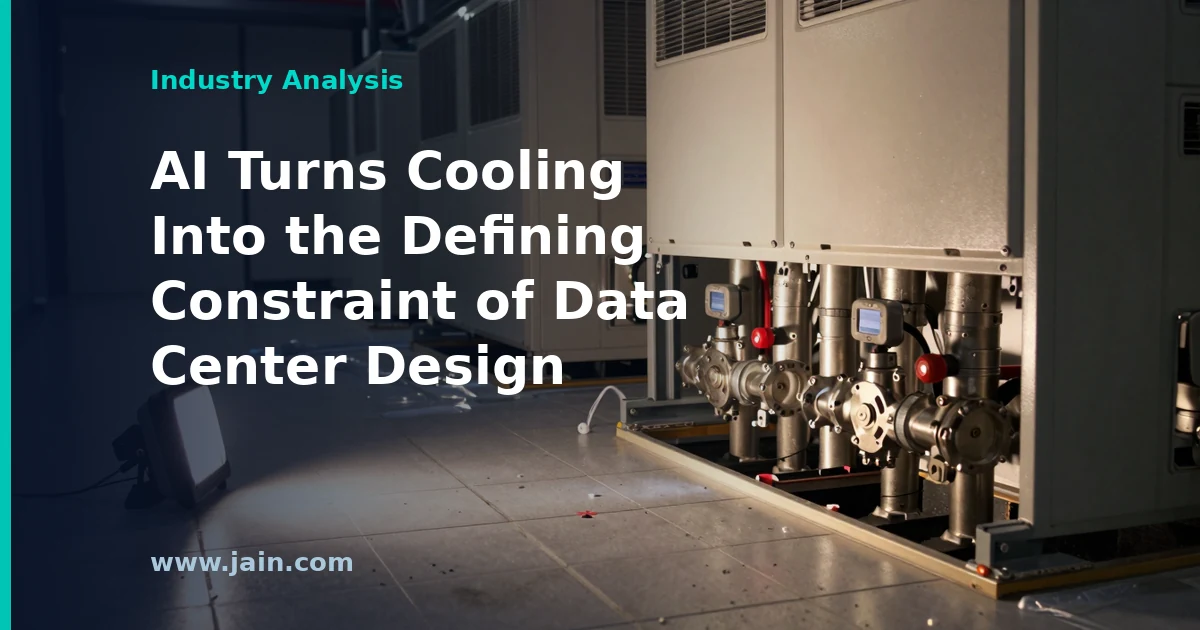
Data Center Knowledge reported on April 23, 2026 that cooling has moved to the forefront of data center design challenges, driven by the power density of AI computing. The trade publication’s framing captures a shift the industry has been living through: thermal management, once a back-of-house engineering detail, now shapes where facilities are built, how they are architected, and how quickly they can serve AI demand.
Executive Summary
The report’s core argument is structural rather than incremental: artificial intelligence has changed the physics of the data hall. Traditional enterprise servers could be cooled with chilled air pushed through raised floors and contained aisles. AI training and inference clusters concentrate far more electrical power — and therefore far more heat — into each rack than air can economically remove, forcing designers to treat heat rejection as a first-order constraint alongside power availability and land.
Why it matters: when cooling becomes the binding constraint, it stops being a line item and starts being a strategy. Choices between air, direct-to-chip liquid cooling (circulating coolant through cold plates mounted on processors), rear-door heat exchangers, and immersion systems now determine a facility’s compatibility with next-generation chips, its water and energy footprint, and its retrofit economics. Operators, colocation providers, and their customers are all repricing those decisions in real time.
When Air Runs Out of Headroom
Air cooling served the industry for decades because server heat loads were modest and evenly distributed. AI accelerators break that model: they pack extraordinary computation — and heat — into small silicon footprints, and operators deploy them in dense clusters to keep chip-to-chip communication fast. Past a certain density, moving enough air through a rack becomes physically impractical and economically punishing, because fan energy and airflow engineering costs rise steeply while cooling effectiveness plateaus.
Liquid is the natural successor because water and engineered coolants carry heat far more efficiently than air. But switching thermal mediums is not a component swap. It changes piping, floor loading, leak detection, maintenance procedures, and the skills a facilities team needs. That is why the trade press now describes cooling as a design challenge rather than an operations task: the decision has to be made before concrete is poured, and it constrains everything after.
The Retrofit Divide: Winners and Losers
The shift creates a two-tier market. New builds designed liquid-ready from day one can court the highest-value AI tenants. Older facilities — the majority of the world’s installed base — face a harder calculus: retrofitting liquid cooling into a live building is disruptive and expensive, but declining to retrofit risks ceding AI workloads entirely and competing for a shrinking pool of conventional enterprise demand.
The beneficiaries are visible across the supply chain: cooling equipment manufacturers, mechanical engineering firms, and colocation providers with modern, high-density-capable inventory. The squeezed parties are operators of legacy stock and, potentially, customers who signed long leases in facilities that cannot follow the density curve. For buyers of data center capacity, a facility’s thermal architecture is becoming as important a diligence question as its power contract.
Cooling as a Sustainability and Siting Question
Cooling choices also carry environmental and community consequences. Evaporative systems trade energy efficiency for water consumption — a sensitive issue in drought-prone regions where many data center clusters sit. Closed-loop liquid systems can reduce water draw and, in some designs, make waste heat recoverable for district heating or industrial reuse. As municipalities scrutinize data center growth, thermal design is increasingly part of the permitting and public-acceptance conversation, not just the engineering one.
That elevates cooling from a cost center to a siting variable. A design that minimizes water use or enables heat reuse can be the difference between a fast permit and a contested one — a dynamic worth watching as AI capacity expansion collides with local resource politics.
Background
For most of the industry’s history, data center design was governed by power and space, with cooling treated as a solved problem: chilled air, raised floors, and hot-aisle containment handled the modest, evenly distributed heat of enterprise servers. The AI buildout that accelerated after 2022 broke that assumption. Training and serving large models requires dense clusters of power-hungry accelerator chips, and each hardware generation has pushed per-rack heat loads further beyond what air-based systems were designed to handle.
The result has been a rapid industry pivot toward liquid-based thermal architectures — direct-to-chip cold plates, rear-door heat exchangers, and immersion systems — and a re-sorting of the market between facilities that can host high-density AI workloads and those that cannot. Trade coverage like this Data Center Knowledge report reflects a consensus that has hardened across operators, chipmakers, and engineers: cooling is no longer downstream of design; it is design.
Microsoft has announced an A$25 billion investment in Australia spanning AI infrastructure, security, and skills — a commitment the company frames as a deepening of its decades-long presence in the country. At roughly US$16 billion depending on exchange rates, it ranks among the largest single-country AI infrastructure commitments any hyperscaler has announced to date.
The announcement, published April 22, 2026 via Microsoft’s official news channel, packages three workstreams under one headline figure: physical AI and cloud infrastructure, cybersecurity capability, and workforce skilling. Detailed breakdowns of how the money divides across those three pillars were not included in the material reviewed here.
Executive Summary
The announcement matters for scale and for what it says about the direction of hyperscaler capital. A$25 billion is a step-change from Microsoft’s previous headline commitment to Australia — the A$5 billion infrastructure and skilling package announced in October 2023 — and it lands in the middle of a global race in which cloud providers are striking country-level ‘sovereign AI’ arrangements that bundle data centers, security cooperation, and training programs into a single political and commercial package.
For Australia, the pledge signals continued confidence that the country will be a regional AI hub despite well-documented constraints on power availability and construction capacity. For the broader industry, it reinforces a pattern: AI infrastructure spending is increasingly announced as multi-year, multi-billion-dollar national commitments rather than individual facility builds — a format that makes headlines easy and verification hard. The substance will be in the details that follow: sites, megawatts, timelines, and how much of the figure represents genuinely new spending.
From A$5 Billion to A$25 Billion in Under Three Years
Microsoft’s October 2023 Australian commitment — A$5 billion over two years for hyperscale data center expansion, a cyber partnership with the Australian Signals Directorate, and skilling programs — was, at the time, described as the company’s largest investment in its 40-year history in the country. An A$25 billion figure roughly quintuples that headline number, and the tripartite structure (infrastructure, security, skills) mirrors the 2023 template closely. That continuity suggests this is an expansion of an existing playbook rather than a new strategic direction.
The escalation tracks the industry-wide surge in AI capital expenditure. Hyperscalers have collectively guided toward hundreds of billions of dollars in annual capex, and country-level announcements of this size have appeared across the US, UK, Japan, India, and the Gulf states. Australia’s inclusion at the A$25 billion tier moves it firmly into the first rank of national AI buildout destinations — a meaningful shift for a market of roughly 27 million people.
Why Australia: The Sovereign AI Logic
‘Sovereign AI’ — the idea that nations need AI compute, models, and data handled within their own borders and legal jurisdiction — has become the organizing frame for hyperscaler expansion outside the United States. Australia is a natural candidate: a Five Eyes intelligence ally, a stable regulatory environment, strong government cloud adoption, and a geography that makes it a serving point for the broader Asia-Pacific region. Bundling a security component into the package speaks directly to that sovereignty narrative, positioning Microsoft not merely as a vendor but as a national-capability partner.
The economics cut both ways, however. Australia has among the higher data center construction and energy costs in the Asia-Pacific, its east-coast grid is in the middle of a complex energy transition, and skilled construction and electrical labor is in short supply — the same constraints that have slowed AI buildouts elsewhere. A commitment of this size implies substantial new power demand, and how that demand is met will shape both the project’s timeline and its public reception.
Security and Skills: The Softer Two-Thirds of the Triad
Infrastructure dollars are relatively easy to audit — buildings and servers either exist or they don’t. Security and skills commitments are harder to measure, and the material reviewed here does not quantify either. Microsoft’s prior Australian security work centered on threat-intelligence sharing with the Australian Signals Directorate under the MACS (Microsoft-Australian Signals Directorate Cyber Shield) initiative; a continuation or expansion of that model would be the natural reading, but that is inference, not disclosure.
Skills programs serve a dual function in announcements like this: they address a genuine constraint — every market building AI infrastructure faces shortages of data center technicians, electricians, and cloud engineers — and they broaden the political constituency for the investment beyond the suburbs that host the facilities. The test, as with all skilling pledges, is whether the programs produce certified, employed workers at measurable scale, something that historically has been reported unevenly across the industry.
Reading a Headline Number Honestly
Multi-year country commitments deserve scrutiny on three questions, and they apply here as they would to any vendor’s announcement. First, over what period is the A$25 billion spread? A figure spent over four years is a very different signal from one spread over ten. Second, how much is incremental versus a re-badging of spending already planned or announced — including the 2023 A$5 billion program? Third, what counts toward the total: land, construction, and hardware clearly do, but security operations and training programs are operating expenses of a different character, and blending them inflates comparability with pure infrastructure figures.
None of this makes the commitment less real — Microsoft has a track record of delivering data center capacity in Australia, where it has operated cloud regions since 2014. It simply means the number is a ceiling on ambition, not a receipt. Investors, policymakers, and competitors will get the true picture from planning applications, grid connection requests, and construction awards over the coming quarters, not from the announcement itself.
Background
Microsoft is one of the world’s three dominant cloud providers and has operated in Australia since the 1980s, opening its first Australian Azure cloud regions in 2014 and serving government workloads through dedicated Canberra-based capacity. In October 2023 the company announced what was then its largest Australian investment — A$5 billion over two years for hyperscale data center expansion, a cyber-defense partnership with the Australian Signals Directorate, and digital skilling programs — a template this new announcement appears to extend at five times the headline scale.
The announcement arrives amid an unprecedented global surge in AI infrastructure spending, with hyperscalers collectively committing hundreds of billions of dollars annually to data centers, chips, and power. Country-level ‘sovereign AI’ packages — combining compute, security cooperation, and workforce development — have become the standard vehicle for that expansion outside the United States, and Australia’s combination of political stability, alliance relationships, and regional position makes it a recurring destination.
Google has unveiled a new generation of custom chips designed to handle both AI training — the compute-intensive process of building large models — and inference, the day-to-day work of running them, according to CNBC coverage published April 21, 2026. The announcement is the latest move in Google’s decade-long effort to reduce its dependence on Nvidia, whose graphics processing units (GPUs) dominate the market for AI accelerators.
Executive Summary
The announcement, as reported, positions Google’s newest silicon as a dual-purpose platform: one chip family aimed at both building frontier AI models and serving them to users at scale. That framing matters. Training has historically drawn the headlines, but inference — every chatbot reply, every AI-generated search answer — is where the industry’s recurring costs now accumulate, and where cloud providers have the strongest incentive to control their own hardware economics.
It is worth being direct about what is and is not substantiated here. The coverage available at publication is headline-level: it confirms that new chips exist and that they target both workloads, but it does not, in the material we reviewed, disclose performance figures, availability dates, pricing, or named customers. Our analysis therefore focuses on the well-documented market context this announcement lands in, rather than on claims the source does not support.
What is beyond dispute is the strategic direction. Google has designed its own Tensor Processing Units (TPUs) since the mid-2010s, and each new generation tightens the competitive pressure on Nvidia — not by selling chips against it, but by giving one of the world’s largest AI operators, and its cloud customers, a credible alternative.
The Custom-Silicon Race Enters a New Phase
Every major cloud provider now designs its own AI accelerators. Google was earliest with its TPU line, Amazon Web Services followed with Trainium and Inferentia, and Microsoft has developed its Maia chips. The motivation is the same across all three: Nvidia’s GPUs are extraordinarily capable but also expensive, supply-constrained, and sold on Nvidia’s terms. For companies spending tens of billions of dollars a year on AI infrastructure, even a modest cost or efficiency advantage from in-house silicon compounds into enormous savings.
A new TPU generation covering both training and inference signals that Google intends to compete across the full AI lifecycle, not just in niches. That is a meaningful escalation. Custom chips that only serve inference concede the most prestigious workloads — frontier model training — to Nvidia. A chip family credibly pitched at both erodes that concession.
Why Pairing Training and Inference Matters
Training a large model is a massive one-time (or periodic) expense; inference is a cost that scales with every user, every query, every day. As AI products move from demos to mass deployment, industry attention has shifted toward the price of serving models — often measured in cost per token, the basic unit of AI text processing. Hardware optimized for inference can trade raw flexibility for efficiency, lowering that recurring bill.
Announcing one platform for both workloads also simplifies the operational picture inside data centers. Operators can, in principle, shift capacity between training and serving as demand fluctuates, rather than maintaining separate fleets. Whether Google’s new chips actually deliver that flexibility is exactly the kind of claim that requires benchmarks the coverage does not yet provide.
The Economics of Not Selling Chips
Google’s challenge to Nvidia is structurally unusual: Google has historically not sold TPUs as merchant silicon. Instead, it rents access to them through Google Cloud and uses them to run its own services. The competitive effect is indirect but real — every workload that runs on a TPU is a workload Nvidia doesn’t monetize, and every credible TPU generation strengthens Google’s negotiating position when it does buy Nvidia hardware, which it continues to do at scale.
The harder question is software. Nvidia’s dominance rests as much on CUDA — its mature, widely adopted programming ecosystem — as on its chips. Developers, frameworks, and years of accumulated code default to Nvidia. Google’s counter has been to optimize its own software stack for TPUs, which works well inside Google and for cloud customers willing to adapt, but keeps the broader market’s center of gravity with Nvidia. A new chip alone does not change that; sustained software investment might.
What It Means for the Infrastructure Layer
For data center operators and the wider infrastructure industry, chip diversity is broadly good news. A market with multiple viable accelerators eases the supply bottlenecks that have delayed AI buildouts, and competition on efficiency directly shapes facility design — modern AI accelerators drive rack power densities that increasingly demand liquid cooling and substantial electrical upgrades.
For enterprise AI buyers, the practical takeaway is optionality. Cloud customers evaluating where to train or serve models now have a genuine multi-vendor landscape to price against, even if switching costs remain significant. The winners in that dynamic are large-scale buyers; the risk sits with anyone betting that any single vendor’s roadmap — Nvidia’s included — will define the market indefinitely.
Background
Google was the first hyperscaler to design its own AI accelerator, deploying Tensor Processing Units internally in the mid-2010s and offering them to cloud customers later that decade. The program began as a way to run Google’s own AI services more efficiently and has since become a strategic pillar of Google Cloud’s pitch to AI developers. Nvidia, meanwhile, transformed from a graphics-chip company into the dominant supplier of AI compute, with its GPUs powering the vast majority of large-model training worldwide and its market value soaring on AI demand.
That dominance made Nvidia’s largest customers — Google, Amazon, Microsoft, and Meta among them — also its most motivated potential competitors. Each now invests heavily in custom silicon, not necessarily to sell chips, but to control the cost and supply of the infrastructure their AI ambitions depend on. This announcement is the latest chapter in that structural tension.
CoreWeave, the GPU-focused cloud provider, and Google Cloud have announced a partnership covering AI training and inference workloads, according to an April 21, 2026 report by CIO Dive. The tie-up pairs one of the world’s three largest hyperscale cloud platforms with the most prominent of the so-called “neoclouds” — specialist providers that rent out large fleets of Nvidia GPUs for artificial-intelligence computing.
Executive Summary
The reported arrangement positions CoreWeave as a capacity partner to Google Cloud for AI training (the compute-intensive process of building machine-learning models) and inference (running those models to answer user requests). For a hyperscaler with its own global data-center footprint and custom TPU silicon to lean on an outside GPU specialist is a notable signal: demand for AI compute is outrunning even the largest builders’ ability to bring capacity online.
It matters for a second reason. CoreWeave has been a watchlist name since its March 2025 IPO — admired for its growth, questioned for its debt-financed expansion and customer concentration. Landing Google Cloud as a partner is the kind of validation that speaks directly to those questions, because it adds a marquee counterparty and suggests the GPU-rental model works at hyperscale, not just for AI labs. That said, the report available at publication is brief: no dollar value, duration, or capacity figures were disclosed, so the deal’s true weight cannot yet be assessed.
When Hyperscalers Rent Instead of Build
Google operates one of the largest data-center estates on earth and designs its own AI accelerators, the TPU line. That it would still contract with an outside GPU landlord says less about Google’s engineering and more about the physics of the moment: data centers take years to permit, power, and build, while AI demand compounds quarterly. Renting ready capacity from CoreWeave converts a construction problem into a procurement problem — faster, more flexible, and off Google’s capital-expenditure line.
There is precedent. Microsoft has been CoreWeave’s largest customer, effectively subcontracting part of its AI buildout, and OpenAI signed a multibillion-dollar capacity contract with CoreWeave in 2025. If Google is now sourcing capacity the same way, the pattern hardens into an industry structure: hyperscalers as demand aggregators, neoclouds as overflow capacity, and the grid and supply chain as the real constraint. The headline’s pairing of “training” and “inference” is worth noting too — inference is the recurring, revenue-linked workload, and contracts that include it tend to be stickier than one-off training rentals.
Validation for a Watchlist Stock
CoreWeave’s story invites scrutiny. The company began life in 2017 as a cryptocurrency-mining operation, pivoted to GPU cloud services, and grew at extraordinary speed on the strength of Nvidia hardware access and heavy borrowing secured against its chips and contracts. Skeptics have focused on two risks: customer concentration — a large share of revenue from a handful of counterparties — and the treadmill of financing new GPU generations before the old ones are paid off.
A Google Cloud relationship addresses the first risk directly by diversifying the customer base with a counterparty of unimpeachable credit quality. It also functions as technical due diligence by proxy: hyperscalers audit partners’ facilities, networking, and operations before routing customer workloads to them. What it does not do — absent disclosed terms — is tell investors how much revenue is involved, for how long, or on what margin. A validation signal is not the same as a valuation input, and the two should not be conflated until numbers appear.
What It Means for the Rest of the Market
For enterprise buyers, hyperscaler–neocloud deals cut both ways. In the near term they can ease GPU waiting lists, since capacity reaches customers through whichever storefront has it. Over time, though, consolidation of neocloud capacity under hyperscaler contracts could reduce the independent spot supply that gave smaller AI companies negotiating leverage. Competing neoclouds — Lambda, Crusoe, Nebius, and others — now face a clearer bar: land an anchor hyperscaler or lab contract, or compete on price in the remaining open market.
For the infrastructure sector jain.com covers, the through-line is unchanged: every one of these agreements ultimately resolves into megawatts, cooling, fiber, and land. Whoever the logo on the contract, the binding constraints are power interconnection queues and data-center construction timelines — which is why capacity already built, like CoreWeave’s, commands a premium at all.
Background
CoreWeave was founded in 2017 and originally mined cryptocurrency before repurposing its GPU expertise into a cloud business aimed at AI workloads. Backed in part by Nvidia and fueled by debt raised against its hardware and contracts, it grew into the flagship of the neocloud category and completed a closely watched Nasdaq IPO in March 2025. Its rise tracked the broader AI infrastructure boom, in which demand for GPU compute from model developers and hyperscalers persistently exceeded the industry’s ability to build powered data-center capacity.
Google Cloud is the third-largest hyperscale cloud platform, behind Amazon Web Services and Microsoft Azure, and is distinctive for fielding its own custom AI accelerators (TPUs) alongside Nvidia GPUs. Hyperscaler–neocloud capacity deals emerged as a defining feature of the AI buildout, with Microsoft’s use of CoreWeave the template this reported Google partnership now appears to follow.
The Midcontinent Independent System Operator (MISO) — the grid operator coordinating electricity across a footprint spanning 15 U.S. states and the Canadian province of Manitoba — expects electric load to jump roughly 35% by 2035, according to an April 2026 report from Utility Dive. The primary driver named in the forecast is data center growth.
A 35% increase over roughly a decade represents a dramatic break from the era of essentially flat U.S. electricity demand that prevailed from the late 2000s through the early 2020s, and it puts one of the largest grid operators in North America on record quantifying the scale of the AI-and-cloud buildout.
Executive Summary
MISO’s forecast is a planning document, not a press release from a company selling something — which makes it one of the more consequential data points in the ongoing debate over how much electricity the data center boom will actually consume. Regional transmission organizations (RTOs) like MISO exist to keep supply and demand balanced in real time and to plan the wires and generation needed years ahead. When an RTO raises its ten-year demand outlook by more than a third, that number flows directly into transmission planning, capacity auctions, and the resource plans of dozens of utilities.
The significance is twofold. First, it validates what individual utilities across the Midwest and Gulf South have been reporting piecemeal: hyperscale data center projects are arriving in interconnection queues at a pace with no modern precedent. Second, it sets up a decade of hard trade-offs. Meeting 35% growth requires new generation, new transmission, and new large-load interconnection rules — all on timelines that historically run slower than the two-to-three-year construction schedule of a data center campus.
For the infrastructure industry, the headline number is both an opportunity signal and a warning: the grid is now the binding constraint on digital infrastructure growth, and the regions that solve power delivery fastest will win the next wave of siting decisions.
The End of Flat Demand Is Now Official Planning Doctrine
For roughly fifteen years, U.S. grid planners could assume that efficiency gains — LED lighting, better HVAC, industrial offshoring — would offset economic growth, keeping total electricity demand nearly flat. That assumption underpinned everything from utility rate cases to power plant retirement schedules. A 35% load-growth forecast from MISO formally retires it for one of the largest grid footprints in North America.
What makes an RTO forecast different from a consultant’s projection is accountability: MISO must plan transmission and resource adequacy against this number. If the forecast is right and the buildout lags, the result is capacity shortfalls and price spikes. If the forecast is wrong and infrastructure is overbuilt, ratepayers carry stranded costs. Either error is expensive, which is why the assumptions behind the number — how much announced data center load actually materializes — deserve as much scrutiny as the number itself.
Data Centers as the Marginal Buyer of Power
A data center is, from the grid’s perspective, an unusual customer: it demands large blocks of power (often hundreds of megawatts per campus), runs at high utilization around the clock, and wants to connect years faster than traditional industrial load. When such customers become the dominant source of demand growth, they effectively set the terms of grid expansion — and grid operators, utilities, and regulators are still working out who pays for the upgrades those connections require.
The economics cut in several directions. Utilities in MISO territory gain a growth story they have not had in a generation, which supports investment in wires and generation. Existing ratepayers face the risk of subsidizing infrastructure built for loads that may not fully arrive — a concern regulators in several states are already addressing through special large-load tariffs and financial-commitment requirements. Data center developers, meanwhile, face the reality that power availability, not land or fiber, now determines where and when they can build.
Winners, Losers, and the Speed Mismatch
The core tension in a 35%-by-2035 scenario is timing. Gas turbines face multi-year order backlogs, new nuclear operates on decade-plus horizons, and large transmission projects routinely take seven to ten years from planning to energization. Data center campuses go from groundbreaking to load in two or three. That mismatch favors whoever can bridge it: developers with early interconnection positions, utilities with spare capacity or fast-track large-load processes, suppliers of grid equipment, and operators pursuing on-site or co-located generation.
It also raises competitive stakes between regions. MISO’s footprint — stretching from the upper Midwest to the Gulf Coast — competes with PJM, ERCOT, and the Southeast for hyperscale siting. A credible, well-executed plan to serve 35% more load is itself an economic-development asset; a forecast without matching buildout is a queue of frustrated customers who will site elsewhere.
Forecast Versus Reality: The Phantom Load Question
Every load forecast in the current environment must grapple with duplicate and speculative requests. Developers commonly file interconnection requests in multiple jurisdictions for the same project, and some announced campuses will never be built. Grid operators know this and apply screening assumptions, but the industry has little historical data on what fraction of AI-era announced load converts to actual consumption. The honest read of any 35% figure is that it is a planning scenario with meaningful uncertainty in both directions — actual growth could undershoot if projects evaporate, or overshoot if AI demand keeps compounding.
That uncertainty is not a reason to dismiss the forecast; it is a reason to watch how MISO and its member utilities structure commitments. Mechanisms that require large customers to put capital at risk — minimum-take contracts, collateral requirements, contribution to network upgrades — are the market’s way of separating real load from phantom load, and their adoption across the footprint will be a better indicator of true demand than any single projection.
Background
MISO was founded in 1998 and became the first FERC-approved regional transmission organization in the United States in 2001. It coordinates generation and high-voltage transmission across a footprint stretching from the upper Midwest down through the Gulf South, serving tens of millions of people through its member utilities. Like other RTOs, it does not own power plants or lines; it operates markets and plans the system that its members build.
The forecast arrives amid a broader U.S. re-acceleration of electricity demand after more than a decade of stagnation, driven by AI and cloud data center construction, manufacturing reshoring, and electrification. Grid operators across the country have been revising load outlooks upward repeatedly since the early 2020s, and interconnection queues for both large loads and new generation have swelled to historic levels — making forecasts like this one central to the industry debate over how much of the announced boom is real.
Publicly traded bitcoin mining companies have reduced their collective hashrate — the computational power they dedicate to mining bitcoin — by 13.4%, according to an April 21, 2026 report from Bitbo, a bitcoin data and analytics outlet. The report frames the decline not as distress but as a strategic shift: AI revenue is “taking over” as these companies redirect their power capacity and facilities toward artificial-intelligence computing workloads.
Executive Summary
The headline number is striking because hashrate has historically been the metric public miners competed on. Growing it signaled health; shrinking it signaled trouble. A double-digit collective cut across the public-miner cohort, presented alongside rising AI revenue, suggests the industry’s scoreboard is changing: megawatts under contract to AI customers now matter more to these companies than exahashes pointed at the bitcoin network.
Why it matters: public miners control something AI companies desperately need — large, energized data center sites with utility-scale power already connected. If miners are voluntarily retiring or redirecting 13.4% of their mining compute, that is among the clearest quantitative signals yet that the economics of AI hosting are outcompeting bitcoin mining for the same electrons. The caveat: the source is a single headline figure, and the report as circulated does not detail which companies cut how much, over what window, or how much AI revenue is actually flowing.
The Scoreboard Is Changing From Exahashes to Megawatts
For most of the public mining sector’s history, hashrate growth was the core investor pitch — more machines, more chances to win bitcoin block rewards. A 13.4% collective cut would once have read as capitulation. In 2026 it reads differently: mining rigs are single-purpose machines, but the infrastructure around them — high-capacity grid interconnections, substations, cooling, and permitted industrial sites — is exactly what AI data center developers spend years trying to assemble. Redirecting that capacity to AI tenants converts a volatile commodity business into something closer to contracted data center leasing.
The economic logic is straightforward. Bitcoin mining revenue is unpredictable: it depends on bitcoin’s price, on network difficulty (which rises as competitors add machines), and on halving events — the roughly four-yearly programmed cuts to mining rewards, most recently in April 2024. AI compute hosting, by contrast, is typically sold under multi-year contracts to creditworthy counterparties. Companies in this cohort, including TeraWulf and Riot Platforms, have spent the past two years publicly repositioning themselves as power-rich data center platforms rather than pure-play miners.
Why AI Tenants Want Mining Sites
The binding constraint on AI infrastructure buildout is not chips but power — specifically, energized capacity available now rather than after a five-plus-year utility interconnection queue. Bitcoin miners are among the few industrial operators holding hundreds of megawatts of already-connected capacity that can be reallocated quickly. That scarcity is what makes a miner’s site more valuable as an AI campus than as a mine, at least at the margin the 13.4% figure captures.
Conversion is not free, however. Mining facilities are typically air-cooled sheds built for cheap, fault-tolerant hardware; AI training and inference clusters demand far higher reliability, denser networking, and increasingly liquid cooling. The winners in this transition will be the miners whose sites justify that retrofit capital — large contiguous power blocks, strong fiber routes, cooperative utilities — and who can finance the conversion. Sites without those attributes may find the AI pivot is easier to announce than to execute.
What a Shrinking Public Hashrate Means for Bitcoin
A 13.4% cut by public miners does not mean the bitcoin network shrank by that amount — public companies are only a portion of global hashrate, and private and overseas operators can absorb the share they give up. If total network difficulty holds or falls, remaining miners actually earn slightly more per machine, partially offsetting the exodus. The more durable implication is structural: the best-capitalized, most transparent operators are signaling that the marginal megawatt earns more serving AI workloads than mining bitcoin. If that spread persists, capacity will keep migrating, and bitcoin mining could increasingly concentrate among operators with the very cheapest power and nothing better to do with it.
Background
Public bitcoin miners emerged as a listed-equity sector during the 2020–2021 bull market, raising billions to build warehouse-scale facilities whose defining asset was cheap, large-scale power. The April 2024 halving cut mining rewards in half just as AI demand exploded, and the sector discovered its grid connections were worth more than its mining rigs: Core Scientific’s landmark hosting agreements with AI cloud provider CoreWeave in 2024 established the template, and peers including TeraWulf, Riot Platforms, Hut 8, and Iren followed with AI and high-performance-computing strategies of their own.
By early 2026 the question was no longer whether miners would pivot but how fast and how completely. Aggregate statistics like a 13.4% public-miner hashrate reduction offer one of the first sector-wide measurements of that migration actually showing up in mining capacity, rather than just in investor presentations.
Meta has confirmed that it will operate a hyperscale data center in east Tulsa, Oklahoma, according to the Tulsa World on 21 April 2026. The confirmation resolves the identity of the operator behind a large industrial computing project in the city’s eastern industrial corridor.
The report establishes the operator and the general location. It does not, in the material available to us, attach a published megawatt figure, capital investment number, employment commitment, construction schedule or incentive package to the project — all of which remain the substantive questions for Tulsa residents, ratepayers and suppliers.
Executive Summary
The news is the confirmation itself. Large data center projects are routinely assembled under placeholder corporate names and non-disclosure agreements while land is optioned, utility service is negotiated and incentives are cleared; the operator’s name is often the last thing to surface. Meta putting its name to an east Tulsa campus turns a speculative local story into a fixed point that utilities, contractors, county assessors and competing site selectors can now plan around.
It matters because “hyperscale” is not a small industrial category. A single modern hyperscale campus can become one of the largest electricity customers in its host utility’s territory, reshaping load forecasts, transmission planning and the economics of new generation for everyone else on the system. Whatever this specific site’s final size, its arrival changes the planning assumptions in northeastern Oklahoma.
It also matters for Oklahoma’s position in the national compute map. The state already hosts one of Google’s long-running campuses at Pryor, roughly an hour from Tulsa. A second major operator in the same region begins to look less like an isolated deal and more like a cluster — with the labor pool, contractor base and transmission attention that clusters attract, and the concentration risks that come with them.
What “Hyperscale” Confirms — and What It Doesn’t
“Hyperscale” describes an operating model, not a unit of measurement. It means a facility built and run at the scale of the largest cloud and platform companies: standardized building templates, tens of thousands of servers, custom networking, and power delivered at transmission voltage rather than the distribution voltage a typical factory takes. It says nothing precise about how many megawatts the site will draw or how many buildings will eventually stand on it.
That distinction matters here because the confirmation carries no published capacity figure. Industry framing around new campuses has drifted toward gigawatt-class language — a gigawatt being roughly the output of a large power plant, or the demand of a mid-sized city — and the largest recent US announcements have been in that range. But an unstated capacity is an unstated capacity. The honest reading on 21 April 2026 is that Meta has confirmed an operator and a location, and that anyone quoting a wattage for east Tulsa is extrapolating from the industry’s recent pattern rather than from the announcement.
The same caution applies in the other direction. Absence of a headline number is not evidence the project is modest; hyperscale campuses are typically phased, with each phase authorized against demand that does not yet exist when ground breaks. The realistic expectation is a site that grows in steps over years, with the final footprint set by demand and by how much power the local grid can actually deliver.
Tulsa’s Grid Math: PSO, SPP and the Wind Belt
Tulsa is served by Public Service Company of Oklahoma, an American Electric Power subsidiary, inside the Southwest Power Pool — the regional grid operator covering much of the central plains. That footprint has two relevant characteristics. It has abundant wind generation, which has historically made Oklahoma power cheap and carbon-light on an annual-average basis, and it has the classic wind-region problem that supply peaks when the wind blows rather than when a data center is drawing its steady, around-the-clock load.
Hyperscale load is close to flat: high utilization, day and night, largely indifferent to weather. Marrying that profile to a wind-heavy system means firm capacity, storage, transmission upgrades, or some combination — and the question of who pays for them is the central regulatory issue in nearly every large-load interconnection in the country right now. Utilities increasingly seek special large-load tariffs with minimum take obligations and exit fees, precisely so that if a campus is cancelled or shrinks, the infrastructure built for it does not land on residential bills.
Nothing in the confirmation tells us which structure applies here. That is the thing worth watching: the utility filings and any state regulatory dockets will disclose more about the real terms of this project than any ribbon-cutting will. If the arrangement is well designed, a very large customer paying full freight for its own upgrades can spread fixed system costs across more kilowatt-hours and mildly benefit other ratepayers. If it is poorly designed, the transfer runs the other way. Both outcomes are common enough that the question is not rhetorical.
Water, Land and the Terms of the Bargain
Water is the second recurring flashpoint, and it turns almost entirely on cooling design. Evaporative cooling is efficient with electricity but consumes water continuously; closed-loop and air-cooled designs consume far less water while drawing more power for the same heat rejection. Operators have moved toward lower-water designs in dry regions, and several publish water-use figures, but a design choice for east Tulsa has not been stated. Tulsa’s municipal supply comes from northeastern Oklahoma reservoirs and is not the constrained desert supply that has made this a crisis issue elsewhere — which lowers the temperature of the question without settling it.
On the fiscal side, Oklahoma has long used sales-tax exemptions on qualifying computing equipment and local property-tax abatements to compete for capital-intensive facilities. These tools work as intended: they lower the effective cost of the single most expensive input in a data center, the servers and electrical plant. They also produce the familiar asymmetry that makes such deals contentious. Construction employment is large and temporary — often well over a thousand trades workers at peak on a big campus — while permanent operations staffing at even very large sites is measured in the low hundreds. The durable local benefit is usually the property tax base after abatements expire, plus utility revenue and construction spending, not headcount.
That is an argument to be had on specifics, and the specifics have not been published. A fair assessment of this deal requires the abatement schedule, the assessed valuation assumptions, any clawback provisions, and the wage and hiring commitments. Until those are on the table, both boosterish jobs claims and blanket assertions that the community gets nothing are running ahead of the evidence.
A Second Oklahoma Cluster, and Who Gains From It
The clearest beneficiaries are regional and immediate: electrical and mechanical contractors, civil and earthworks firms, switchgear and transformer suppliers, fiber builders, and the trades unions and training pipelines that staff them. Data center construction is unusually equipment-heavy and schedule-driven, which tends to pull skilled labor from a wide radius and bid up local rates for the duration. Tulsa’s existing industrial and aerospace workforce is a reasonable base for that.
The second-order winner is Oklahoma’s site-selection story. Google’s long presence at Pryor gave the state a reference customer; a Meta campus near Tulsa gives it two independent validations, which is what site selectors for the next tenant actually look for. Clusters compound — transmission gets built, permitting staff get experienced, suppliers open local branches. The corresponding risk is concentration: a region that leans on a handful of very large loads inherits their capital cycles, and the AI build-out that is driving current demand is not guaranteed to hold its present pace.
The parties with the most at stake and the least information right now are residential and commercial ratepayers, and the neighborhoods nearest the site. Their exposure runs through utility tariffs, transmission cost allocation, construction traffic and noise, and the local tax base. Those are all decided in public proceedings — utility commission filings, county assessor records, municipal permits — and that is where scrutiny is best directed, by supporters and critics alike.
Background
Meta operates a global fleet of company-built data centers supporting its social platforms and, increasingly, large-scale AI training and inference. Like other hyperscalers, it typically develops campuses in phases on large rural or industrial parcels chosen for power availability, land, fiber routes and tax treatment, and it has expanded that program substantially through the current AI infrastructure cycle.
Oklahoma has competed for these projects on cheap land, a wind-heavy generation mix within the Southwest Power Pool, and long-standing tax exemptions for computing equipment. Google’s Pryor campus in the MidAmerica Industrial Park has been the state’s anchor example for over a decade. Tulsa itself brings an industrial and aerospace workforce and a metro-scale utility system, which is what distinguishes it from the small rural sites that have hosted most recent hyperscale announcements in the region.
PJM Interconnection — the regional grid operator serving 13 states and the District of Columbia, including Northern Virginia’s “Data Center Alley,” the densest concentration of data centers on Earth — is taking steps to rein in data center electricity demand, according to reporting from public broadcaster WHRO published April 20, 2026. The move signals that the operator of the world’s most data-center-heavy grid no longer treats hyperscale load growth as something to be absorbed without conditions.
Executive Summary
The significance here is less any single rule than the direction of travel. PJM is the largest wholesale electricity market operator in the United States, coordinating power for roughly 65 million people, and its territory hosts the global capital of the data center industry. For most of the past decade, the operating assumption in that territory was that if you could buy land and fiber, the grid would eventually follow. A grid operator moving to constrain or condition data center demand inverts that assumption.
For the infrastructure industry, this matters in two ways. First, it converts power from a procurement line item into a gating factor: projects in PJM territory may increasingly be shaped by what the grid operator will allow, and on what timeline, rather than purely by developer ambition. Second, it sets a precedent. PJM’s rules and market designs are watched — and often copied — by other regional operators facing their own waves of AI-driven load requests. What PJM does about data centers rarely stays in PJM.
The Grid Operator Blinks First
A regional transmission organization (RTO) like PJM does not generate power or build data centers; it runs the wholesale market and keeps supply and demand in balance across its footprint. Its core legal obligation is reliability. When such an operator starts “taking steps to rein in” a category of demand, it is effectively saying that the pace of load requests has begun to strain its ability to guarantee that balance. That is a notable admission from the operator whose territory — anchored by Loudoun County, Virginia — handles more data center load than any comparable grid in the world.
The economic backdrop makes the move legible. PJM’s recent capacity auctions — the mechanism through which it pays power plants to be available in future years — have cleared at sharply higher prices, with data center growth widely cited as a principal driver. Those costs flow through to every ratepayer in the footprint, not just the data centers causing the growth. Political and regulatory pressure to distinguish between speculative interconnection requests and real projects, and to make large loads bear more of the costs they create, has been building accordingly.
From Land-and-Fiber to Power-First Siting
If the grid operator for the world’s largest data center market is imposing limits, the site selection calculus changes for everyone downstream. Developers who counted on Northern Virginia’s unmatched fiber density and cloud ecosystem now have to weigh whether a grid connection will arrive on a bankable schedule. That logic has already been pushing projects toward secondary markets — and toward on-site or contracted generation that reduces dependence on the shared grid. Constraints in PJM accelerate both trends.
There is also a sorting effect within the industry. Well-capitalized hyperscalers and established operators can absorb longer timelines, post larger financial commitments, and negotiate directly with utilities and generators. Thinly financed projects that were effectively options on future power — reserving grid capacity they might never use — are the natural target of any tightening. To the extent PJM’s steps separate firm demand from speculative demand, the result could be a healthier queue, even if headline growth numbers shrink.
Reliability, Ratepayers, and the Politics of AI Load
The uncomfortable center of this story is cost allocation. Electricity markets were not designed for single customers that show up requesting the load of a mid-sized city. When capacity prices rise to meet that demand, households and small businesses share the bill, and state regulators and legislators hear about it. A grid operator that visibly disciplines data center demand is, among other things, managing its own political legitimacy across 13 states with very different attitudes toward hosting the AI build-out.
For the data center industry, the fair response is not to dismiss the concern but to engage on mechanism design: rules that require demonstrated financial commitment, that pay large loads for flexibility (curtailing during grid stress), and that let them bring their own generation can protect reliability without rationing growth. The risk, from the industry’s side, is blunt instruments — caps or moratoria that stall real projects along with speculative ones. Which kind of instrument PJM has chosen is the central question the reporting raises.
Background
PJM Interconnection grew out of one of the world’s oldest power pools, dating to 1927, and today runs the largest wholesale electricity market in the United States. Its footprint includes Northern Virginia, where cheap land, dense fiber routes, and proximity to federal and internet-exchange infrastructure made Loudoun County the global capital of the data center industry over the past two decades. That concentration was long a point of regional pride and tax revenue; the AI boom has turned it into a grid-planning challenge, as power demand in the region — flat for years — began climbing steeply on the back of hyperscale computing.
By 2026 the tension was visible on ratepayer bills and in regulatory dockets: PJM’s capacity auction prices had risen sharply with data center growth cited as a key driver, and policymakers across its 13-state footprint were debating who should pay for the infrastructure the AI build-out requires. PJM’s move to rein in data center demand is the market operator’s entry into that debate.