Sherwood News reports that bitcoin mining economics “have gone from bad to worse,” and that mining companies are responding by pivoting their businesses — or selling assets outright — to survive. According to the report, publicly traded miners on investor watchlists, including names such as Riot Platforms and Hut 8, are redirecting attention from pure hashrate growth toward converting their power-rich sites into AI data-center capacity.
The story, published April 29, 2026, frames the shift not as opportunistic diversification but as a survival response: when the core business of minting bitcoin no longer covers its costs for many operators, the land, power contracts, and electrical infrastructure miners control become more valuable serving artificial-intelligence workloads than mining rigs.
Executive Summary
The announcement here is really a diagnosis: the economics of industrial-scale bitcoin mining have deteriorated to the point that pivoting and selling are now mainstream strategies, not edge cases. Bitcoin mining profitability is a squeeze between three variables — the price of bitcoin, the total computing power competing on the network (which rises relentlessly), and the cost of electricity. When the spread between what a miner earns per unit of computing power and what it pays for energy compresses, weaker operators run out of room. Sherwood’s reporting says that spread has kept compressing.
Why it matters to the infrastructure industry: bitcoin miners collectively control one of the scarcest assets in technology today — large blocks of grid-connected power with substations, transformers, and cooling already in place. AI data-center developers routinely wait years for utility interconnections. A distressed miner with hundreds of megawatts energized is, from an AI developer’s perspective, a shortcut through the single longest item on the construction schedule. That is why the pivot is happening, and why acquirers are circling the sellers.
The unresolved question is execution. A mining shed and an AI data center share a power feed and little else. Whether watchlist miners can finance and deliver true high-density AI facilities — or whether they simply become land-and-power sellers to better-capitalized buyers — will separate the survivors from the exits.
Why Mining Economics Keep Getting Worse
Bitcoin’s protocol is deliberately unforgiving. Roughly every four years, a “halving” cuts the new-coin reward miners receive in half, mechanically slashing industry revenue per unit of work unless the bitcoin price doubles to compensate. Meanwhile, network hashrate — the total computing power competing for those rewards — tends to grow as new, more efficient machines come online, which dilutes every incumbent’s share. The result is a treadmill that speeds up on a schedule: costs are largely fixed in electricity and debt service, while revenue per terahash structurally declines.
Sherwood’s “bad to worse” framing captures the position of miners caught between those forces without a low-cost energy advantage. In commodity industries — and bitcoin mining is one, producing an identical product where the only durable edge is cost — deteriorating unit economics do not punish everyone equally. They sort the industry into low-cost survivors, distressed sellers, and pivots. The report indicates all three categories are now visible.
The Real Asset Was Always the Power
The pivot toward AI data centers rests on a simple arbitrage. AI training and inference facilities need enormous amounts of electricity delivered through utility-scale interconnections — agreements with grid operators that can take years to secure. Bitcoin miners spent the last cycle acquiring exactly those assets, often in power-rich regions, because cheap electricity was their business model. A miner’s site with an energized substation can be worth more as an AI campus shell than it ever earned mining.
But the conversion is not cosmetic. Mining facilities are typically air-cooled warehouses running hardware that tolerates heat and interruption; AI data centers demand dense power distribution, liquid or precision cooling, redundant systems, and uptime guarantees written into contracts. The capital cost per megawatt of a genuine AI facility is a large multiple of a mining build-out. That gap is precisely why some miners pivot while others sell: the pivot requires capital and data-center operating credibility that a distressed balance sheet may not support.
Winners, Losers, and the Middle
The likely winners are miners holding large, well-located power positions and enough financial flexibility to either fund conversions or strike partnerships with hyperscalers and AI cloud providers on favorable terms. Buyers of distressed sites also win: acquiring energized capacity is faster than greenfield development. Utilities and communities hosting these sites may see steadier, longer-term tenants, since AI facilities sign multi-year commitments in a way price-sensitive mining loads generally do not.
The losers are miners with small sites, expensive power, or leveraged balance sheets — operators whose assets are not distinctive enough to attract AI tenants and whose mining margins no longer cover obligations. For them, “pivot or sell” can shade into “sell at whatever the market offers.” Investors should also note a subtler risk in the middle: a miner that announces an AI strategy has not yet built one. The industry has an incentive to rebrand faster than it can execute, and the market has at times rewarded the announcement before the revenue.
What This Means for the Broader Data-Center Market
Every mining megawatt that converts to AI use adds supply to a data-center market defined by power scarcity — but not always where AI customers most want it. Mining sites were chosen for cheap power, not proximity to network hubs or enterprise demand, so converted capacity will suit some workloads (large-scale training, which tolerates remote locations) better than others (latency-sensitive inference near population centers). The pivot wave is therefore additive to AI infrastructure supply, but selectively so.
It also serves as a market signal. When an entire adjacent industry concludes its power portfolio earns more serving AI than its original purpose, it confirms how deep the demand for energized capacity runs. The countervailing question — one worth asking of the AI build-out with the same rigor applied to mining — is what happens to converted sites if AI infrastructure demand ever cools. Assets that have been repurposed once can be repurposed again, but the capital sunk into the conversion cannot.
Background
Industrial bitcoin mining grew through the early 2020s into a public-company sector, with operators such as Riot Platforms and Hut 8 raising capital to build warehouse-scale facilities wherever electricity was cheap — Texas, the U.S. Midwest, Canada, and beyond. The business model was a leveraged bet on bitcoin’s price against relentlessly rising network competition and scheduled halvings that cut mining rewards in half roughly every four years, most recently in April 2024.
As generative AI ignited unprecedented demand for grid-connected data-center capacity, the industry discovered that miners’ real strategic asset was their power portfolios rather than their mining machines. Core Scientific’s high-profile agreements to host AI computing marked an early template, and by 2026 the question facing much of the sector had become not whether to engage with AI infrastructure, but whether each miner would be a converter, a landlord, or a seller.
Market research firm Dell’Oro Group has published analysis describing a growing “memory tax” on AI infrastructure — the rising share of system cost attributable to high-bandwidth memory (HBM) and DRAM in AI servers and accelerators. The note, surfaced April 27, 2026, frames memory as an increasingly material and often under-examined component of AI capital spending.
Executive Summary
Dell’Oro Group, an analyst firm that tracks data center and telecom infrastructure markets, is calling attention to memory — specifically HBM, the stacked memory packaged alongside AI accelerators, and conventional DRAM used in servers — as a fast-growing cost component in AI infrastructure. The “memory tax” framing suggests that as AI models and the clusters that train and serve them grow, memory is consuming a larger slice of every infrastructure dollar.
The framing matters because most public discussion of AI capital expenditure centers on GPUs and, increasingly, on power and data center construction. If memory costs are rising as a share of the bill of materials — the itemized cost of the components inside a server — then budget models built around accelerator pricing alone will understate the true cost of AI capacity. That has implications for cloud providers, enterprises buying AI servers, and the memory suppliers positioned to benefit.
Readers should note what is available here: a headline and thesis from a recognized analyst firm, without the underlying figures, forecast horizon, or methodology visible in the source material. The direction of the claim is consistent with the widely reported tightness in memory supply driven by AI demand, but the magnitude is not substantiated in what we can see.
Why Memory Became a Line Item Worth Naming
AI accelerators are unusual among chips in that their usefulness is bounded as much by memory as by raw compute. Training and serving large models requires moving enormous volumes of data to the processor quickly, which is why modern accelerators are packaged with HBM — DRAM dies stacked vertically and connected to the processor over a very wide, short interface. HBM is expensive to manufacture, supply is concentrated among a small number of suppliers (SK hynix, Samsung, and Micron are the established producers), and each new accelerator generation ships with more of it.
Conventional DRAM matters too: the host servers around the accelerators, plus the storage and networking tiers of an AI cluster, all consume memory. When one demand source — AI — pulls hard on a supply chain with long lead times and few producers, prices tend to rise across the board. Dell’Oro’s “memory tax” label captures the effect from the buyer’s side: a cost that arrives embedded in system prices whether or not the buyer itemizes it.
Who Pays, and Who Collects
If memory’s share of AI system cost is growing, the immediate beneficiaries are the memory manufacturers, for whom HBM commands substantially better margins than commodity DRAM historically has. Accelerator vendors sit in the middle: memory is a cost input to their products, but strong demand has so far allowed system prices to carry it. The buyers — hyperscale cloud providers, AI labs, and enterprises — absorb the tax directly in capital expenditure, and indirectly it flows into the price of cloud GPU capacity and AI services.
There is a second-order effect worth watching. Rising memory prices do not stay confined to AI hardware. General-purpose servers, storage systems, and consumer devices draw on the same DRAM supply base, so a sustained AI-driven squeeze can raise costs for infrastructure buyers who are not purchasing AI systems at all. For data center operators and IT planners, that argues for treating memory pricing as a market variable in refresh budgets, not a constant.
An Analyst Thesis, Not a Dataset — Yet
It is worth being precise about the evidentiary weight of what has surfaced. Dell’Oro is an established infrastructure research firm, and the thesis aligns with observable market conditions. But the material visible here is a headline-level framing: it does not disclose how large the memory share of AI system cost currently is, how fast it is growing, or over what forecast period. “Growing” is directionally plausible and quantitatively unverified in this source.
That distinction matters for anyone using the claim to make decisions. A memory share that rises from, say, a modest slice to a dominant one would reshape supplier negotiations and cloud pricing; a gradual drift would be a planning footnote. Until the underlying figures are public, the responsible reading is that memory costs deserve a named line in AI infrastructure budgets — and that the size of that line needs data the summary does not provide.
Background
The AI infrastructure buildout that accelerated from 2023 onward has been discussed mostly in terms of GPUs, power, and data center construction, but every AI accelerator ships with a large complement of high-bandwidth memory, and every cluster consumes conventional DRAM in its servers and supporting systems. Memory is a historically cyclical market dominated by a small number of manufacturers — SK hynix, Samsung, and Micron — and AI demand has become a defining force in its current cycle.
Dell’Oro Group, founded in the 1990s and based in Silicon Valley, publishes recurring research on data center capex, servers, and network infrastructure. Its analysts’ framing of trends — in this case, memory as a “tax” on AI infrastructure — often shapes how vendors and buyers talk about market economics before detailed figures circulate publicly.
Veolia, one of the world’s largest water and environmental services companies, announced on April 27, 2026 that it is working with Amazon to develop a reclaimed-water cooling system for data centers. The collaboration targets Amazon Web Services (AWS) facilities, aiming to substitute treated, recycled water for the potable water that many data centers currently draw for cooling.
Executive Summary
The announcement pairs the operator of some of the world’s largest water-treatment networks with the world’s largest cloud provider on one of the industry’s most scrutinized problems: how much drinking-quality water data centers consume to stay cool. Reclaimed water — wastewater that has been treated to a standard fit for industrial reuse, though not for drinking — can displace that potable draw, easing pressure on municipal supplies in the communities where hyperscale campuses cluster.
For Amazon, the partnership supports its publicly stated goal of becoming “water positive” by 2030 — returning more water to communities than its operations consume — and, just as practically, it addresses a growing source of friction in siting and permitting new capacity. For Veolia, it signals a move to position water expertise as core infrastructure for the AI-era data center buildout. The release, however, is light on specifics: no named sites, volumes, timelines, or financial terms were disclosed.
Why Water Is the Data Center Industry’s Quiet Constraint
Power gets most of the headlines, but water is increasingly the constraint that shapes where data centers can be built. Many large facilities use evaporative cooling, which chills servers efficiently by evaporating water — often millions of gallons per year per site, much of it drawn from the same municipal systems that supply homes. In drought-prone regions, that draw has become a genuine permitting and community-relations issue, with local opposition to new campuses increasingly citing water alongside electricity and land.
The industry measures this through water usage effectiveness (WUE) — water consumed per unit of computing energy delivered — and operators face growing pressure from regulators, investors, and neighbors to disclose and reduce it. A credible, scalable alternative to potable water is therefore worth real money: it can be the difference between a project that clears local approval and one that stalls.
What Reclaimed Water Solves — and What It Doesn’t
Reclaimed water is municipal or industrial wastewater treated to a quality suitable for non-potable uses such as irrigation and industrial cooling. Using it for data center cooling substitutes a resource that would otherwise be discharged for one that communities drink. That is a genuine improvement, and it is proven ground: power plants and heavy industry have run on recycled water for decades. The engineering challenge is real but tractable — reclaimed water’s chemistry can promote scaling, corrosion, and biological growth in cooling loops, which is precisely the treatment problem a company like Veolia exists to solve, along with the pipeline infrastructure needed to move recycled water from treatment plants to campuses.
What reclaimed water does not do is reduce total water consumption. Evaporative cooling still evaporates the water, whatever its source. It changes which water is used, not how much — a meaningful distinction in water-stressed basins, where hydrologists note that treated wastewater returned to rivers also supports downstream flows. The release, as summarized, does not address consumption volumes or how the system compares with closed-loop and other low-water designs.
The Strategic Logic for Both Sides
For Veolia, hyperscale data centers represent a growth market adjacent to its core business: the company already operates treatment plants and industrial-water services worldwide, and packaging that capability for cloud providers moves it up the value chain from utility contractor to strategic infrastructure partner in the AI buildout. A named relationship with Amazon is also a powerful reference for selling similar systems to other operators.
For Amazon, the calculus spans sustainability accounting and siting pragmatism. Progress toward its water-positive pledge requires exactly this kind of substitution at scale, and demonstrating a reclaimed-water pathway gives AWS a stronger story in front of the councils and water authorities that approve new capacity. If the partnership produces a repeatable template rather than a single showcase, it could modestly widen the map of viable data center locations — and put competitive pressure on other hyperscalers, some of which have taken the different route of designs that eliminate evaporative water use entirely.
Background
Data center water use moved from an engineering footnote to a public issue over the past several years, as hyperscale construction accelerated to serve cloud and AI demand and communities in water-stressed regions began scrutinizing how much potable water evaporative cooling consumes. The major cloud providers have responded with public commitments — Amazon’s is a pledge to be water positive by 2030 — and with a mix of recycled-water sourcing, more efficient cooling designs, and replenishment projects.
Veolia, formed from more than a century of French municipal water operations and now one of the world’s largest environmental-services groups, has built its industrial business on exactly this kind of problem: treating and delivering non-potable water for cooling and process use. The April 2026 announcement extends that franchise into hyperscale computing, an infrastructure market whose growth currently outpaces most of the industrial sectors Veolia has traditionally served.
Anthropic, the AI lab behind the Claude family of models, is pursuing a push into European AI data centers and is recruiting for a key dealmaking role to drive it, according to a CNBC report published April 26, 2026. The report signals that Anthropic intends to secure compute capacity in Europe directly, rather than relying solely on its cloud partners — though no sites, capacity figures, or financial commitments have been disclosed.
Executive Summary
According to CNBC, Anthropic is working to expand its AI data center footprint in Europe and is hiring for a senior dealmaker position to lead infrastructure negotiations. A “dealmaker” hire in this context typically means someone who structures large, complex transactions — capacity leases, joint ventures, land and power agreements — rather than a conventional corporate development role.
The move matters because it marks a broader industry shift: frontier AI labs, which historically consumed compute through hyperscale cloud providers, are increasingly acting like infrastructure buyers in their own right. If Anthropic contracts European capacity directly, it becomes a new class of anchor tenant — or even developer — in a market already straining under power and land constraints. For data center operators, utilities, and governments courting AI investment, that changes who sits across the negotiating table.
From Tenant to Buyer: Frontier Labs Are Changing Seats at the Table
Until recently, the division of labor in AI infrastructure was clean: labs trained models, cloud providers built and operated the data centers. Anthropic has historically run its workloads on partner infrastructure, backed by deep compute relationships with Amazon and Google. Recruiting a dedicated dealmaker for a European push suggests the company wants direct agency over where its capacity sits and on what terms — the same trajectory other frontier labs have followed as training and inference demand outgrew what standard cloud contracts comfortably deliver.
The economics explain the shift. AI compute is now the dominant cost line for a frontier lab, and multi-year capacity commitments are effectively infrastructure finance decisions. Negotiating directly with data center developers, power providers, and governments can secure capacity earlier and potentially on better terms than consuming it through an intermediary — but it also requires skills labs did not traditionally employ: site selection, power procurement, and structured real-estate-style dealmaking. A dealmaker hire is the organizational tell that this capability is being built in-house.
Why Europe: Sovereignty Demand Meets a Supply-Constrained Market
Europe is a logical but difficult target. On the demand side, European enterprises and public-sector buyers increasingly want AI workloads processed in-region — a mix of data-protection law, the EU AI Act’s compliance regime, and a broader political push for “sovereign AI” capability. A lab that can offer European customers inference served from European soil holds a genuine commercial and regulatory advantage over one that cannot.
On the supply side, however, Europe’s prime data center markets — Frankfurt, London, Amsterdam, Paris, Dublin — are among the most power-constrained in the world, with grid-connection queues stretching years and some jurisdictions having imposed moratoria on new builds. That scarcity is precisely why a dealmaker matters: available large-scale capacity in Europe is won through early, creative transactions — secondary markets, powered-land deals, partnerships with utilities — not by placing an order. Anthropic entering that hunt adds a well-capitalized bidder to an already competitive field.
Ripple Effects: Operators, Hyperscalers, and Governments
For European data center operators and developers, a frontier lab shopping directly is attractive: AI labs sign large, long-duration commitments that can anchor entire campuses and underwrite new construction. Utilities and grid operators face the harder version of the same news — more gigawatt-scale demand arriving in systems already juggling electrification and renewable-integration timelines.
For the hyperscalers, the picture is nuanced rather than adversarial. Anthropic’s cloud partnerships remain central to its compute story, and a European buildout could well be executed with or through those partners. But every direct deal a lab signs shifts some negotiating leverage and some margin away from the cloud intermediary. Governments, meanwhile, gain a new courtship target: expect member states competing for AI investment to treat frontier labs, not just hyperscalers, as strategic accounts.
Background
Anthropic was founded in 2021 by former OpenAI researchers and has grown into one of the leading frontier AI labs, best known for its Claude models. Its compute has historically come through deep partnerships with Amazon — which has committed roughly $8 billion in investment — and Google, both of which also serve as cloud infrastructure providers for its training and inference workloads.
The European data center market it is now reportedly entering is large but supply-constrained: the established FLAP-D hubs (Frankfurt, London, Amsterdam, Paris, Dublin) face power scarcity and permitting friction, pushing new AI capacity toward secondary markets such as the Nordics, Iberia, and Southern Europe. European policymakers, for their part, have been actively courting AI infrastructure investment as part of a broader push for regional AI capability.
Vertiv, one of the largest suppliers of data center power and cooling infrastructure, has acquired Strategic Thermal Labs, a liquid cooling vendor, according to an April 26, 2026 report from Channel Dive. Financial terms and the scale of the target were not disclosed in the report.
The deal adds another liquid cooling specialist to Vertiv’s thermal management portfolio at a moment when AI computing is pushing rack power densities beyond what conventional air cooling can practically handle.
Executive Summary
The announcement itself is brief: Vertiv has bought a liquid cooling company. But the context is what matters. Liquid cooling — circulating fluid directly to hot components, or immersing hardware in it, rather than blowing chilled air across servers — has moved in just a few years from a niche technique to a central requirement for AI data centers. Racks built for AI accelerators draw many times the power of traditional enterprise racks, and the heat they produce increasingly exceeds what air can remove economically, or at all.
Vertiv has been assembling liquid cooling capability for years, and its largest competitors have been doing the same through their own acquisitions. Strategic Thermal Labs is the latest specialist to be absorbed into a major platform. For data center operators, the pattern points toward a market where liquid cooling is sold as part of an integrated infrastructure stack — power, racks, coolant distribution, and heat rejection from one vendor — rather than as a standalone specialty product.
What the report does not tell us is significant: no purchase price, no revenue or headcount figures for Strategic Thermal Labs, and no detail on which products or technologies motivated the deal. The strategic logic is clear; the economics are not yet visible.
Why Liquid Cooling Became a Must-Own Technology
For decades, data centers were cooled almost entirely by air: chillers and air handlers pushed cold air to server intakes and carried the exhaust heat away. That model works well when each rack draws modest power. AI changes the arithmetic. Racks packed with GPUs and other accelerators concentrate far more power — and therefore far more heat — into the same physical footprint, and at the densities modern AI hardware demands, air cooling becomes inefficient, then impractical.
Liquid is a far better heat conductor than air, which is why the industry has shifted toward direct-to-chip cold plates (metal plates with fluid channels mounted on processors) and, in some designs, full immersion cooling. Chip roadmaps from the major accelerator vendors increasingly assume liquid cooling as the default, meaning every serious data center infrastructure supplier needs credible liquid cooling products to stay relevant in AI buildouts. That makes specialist firms with proven technology natural acquisition targets.
Consolidation Follows the Thermal Money
This acquisition fits an established pattern rather than starting a new one. Vertiv previously bought coolant distribution specialist CoolTera to strengthen its liquid cooling line. Rival Schneider Electric acquired liquid cooling maker Motivair; electronics manufacturer Flex bought cold-plate specialist JetCool. The large infrastructure platforms are racing to own the full thermal chain — from the cold plate on the chip, through coolant distribution units, to the heat rejection equipment outside the building — because hyperscale and colocation customers increasingly want that chain engineered and warrantied as one system.
For the remaining independent liquid cooling vendors, consolidation cuts both ways. Acquisition interest validates their technology and offers a path to scale manufacturing quickly. But competing against integrated giants for large AI projects becomes harder, since those buyers value single-vendor accountability when a cooling failure can idle tens of millions of dollars of computing hardware. The likely trajectory is a market with a handful of full-stack thermal platforms and a shrinking field of independents serving specialized niches.
What Vertiv Gains — and What Remains Unproven
For Vertiv, the strategic appeal of bolt-on liquid cooling acquisitions is straightforward: they can add engineering talent, patents, and product lines faster than internal development, in a market where speed matters because AI capacity is being contracted years ahead. Thermal management is also attractive business territory — it is specified early in a data center’s design and generates ongoing service revenue over the facility’s life.
That said, the report substantiates very little beyond the fact of the deal. Without disclosed terms or information about Strategic Thermal Labs’ size, technology focus, or customer base, it is impossible to judge whether this is a significant capability acquisition or a small technology and talent tuck-in. Acquisitions in fast-moving hardware categories also carry integration risk: specialist engineering teams do not always thrive inside large product organizations, and overlapping product lines can create rationalization decisions that unsettle existing customers. Those are open questions, not criticisms — but they are the questions on which the deal’s value will ultimately turn.
Background
Vertiv traces its roots to Emerson Network Power, the data center infrastructure arm of Emerson Electric, which was spun off and renamed Vertiv in 2016. The company supplies the physical backbone of data centers — uninterruptible power supplies, power distribution, racks, and thermal management — and has ridden the AI infrastructure boom as one of its most direct beneficiaries, since every megawatt of new AI computing requires matching power and cooling equipment.
The liquid cooling market it is buying into has grown rapidly alongside AI deployment. A field once dominated by small specialists serving supercomputing labs is consolidating quickly as hyperscale AI buildouts turn liquid cooling into mainstream, high-volume business — a shift that has made those specialists prime acquisition targets for infrastructure giants like Vertiv, Schneider Electric, and large electronics manufacturers.
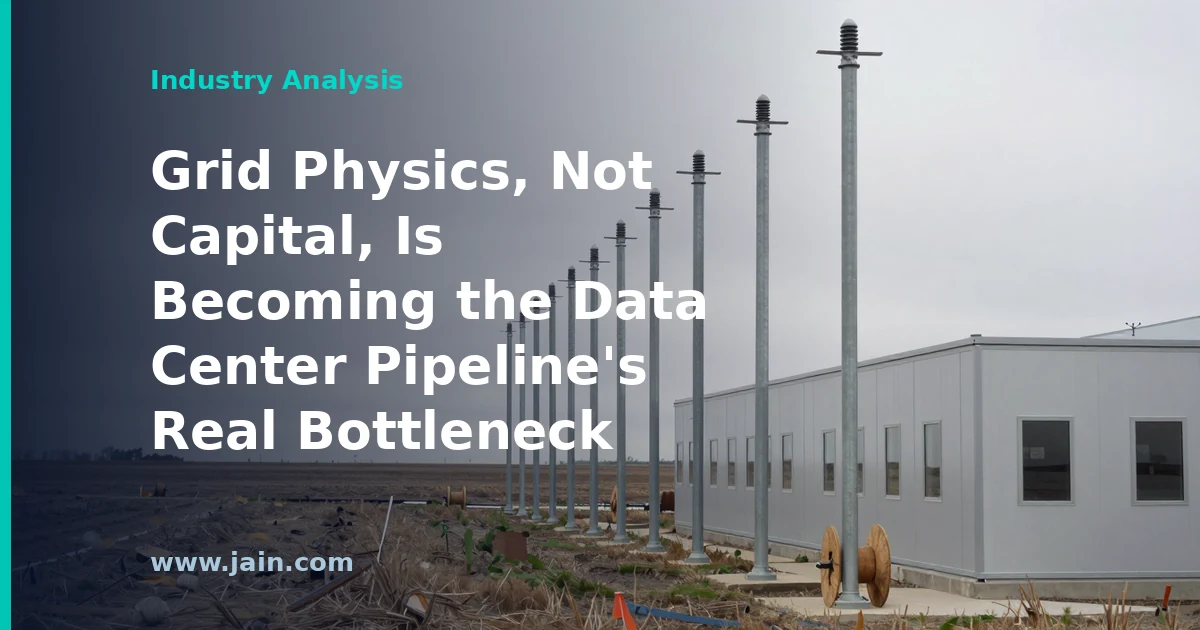
Latitude Media reports that the physical realities of the electric grid are “setting in” for the data center development pipeline. The April 26, 2026 piece frames a shift the industry has been circling for two years: the constraint on new AI-driven data center capacity is increasingly not capital, land, or chips, but whether the grid can physically deliver the power — and how long interconnection and transmission upgrades take.
Executive Summary
The report’s core observation is that the announced data center pipeline — the sum of projects developers have declared — is colliding with what the transmission system can actually serve. Interconnection (the formal process of connecting a large new load or generator to the grid) and transmission capacity (the physical ability of high-voltage lines to move power to a given location) operate on utility timescales measured in years, while hyperscale demand has been announced on timescales measured in quarters.
Why it matters: if grid physics is the binding constraint, then the familiar metrics of the buildout — megawatts announced, acres acquired, capital committed — stop predicting what actually gets energized and when. Siting strategy shifts from “where is land and fiber” to “where is deliverable power,” and the advantage moves to players who secured interconnection positions early or who can bring their own generation.
Announced Megawatts Are Not Energized Megawatts
A recurring pattern in this cycle is the gap between the announced pipeline and deliverable capacity. A developer can buy land, order equipment, and issue a press release in months; a utility must study the new load’s effect on the surrounding network, plan any needed substation and transmission upgrades, and build them — a sequence that routinely runs on multi-year timelines. The Latitude Media framing, that physical realities are “setting in,” suggests the market is starting to discount announcements accordingly. For readers of industry news, the practical takeaway is to treat energization dates, not announcement dates, as the real milestone.
Why Transmission Is the Hard Constraint
Transmission is unforgiving because it is physics plus process. Physically, a high-voltage line can carry only so much power before thermal and stability limits bind, and a concentrated gigawatt-scale load changes flows across an entire region, not just one feeder. Procedurally, upgrades require engineering studies, regulatory approvals, cost-allocation fights over who pays, and often new rights-of-way. None of these steps compresses easily with money. That is what distinguishes this bottleneck from earlier ones like GPU supply or land: you cannot pay a premium to make load-flow studies and line construction happen in a quarter.
Winners: Whoever Holds Deliverable Power
If interconnection position is the scarce asset, several groups benefit. Incumbent data center operators with existing utility relationships and already-energized capacity hold something new entrants cannot quickly replicate. Sites with surplus deliverable power — including brownfield industrial locations with legacy grid infrastructure — gain value relative to greenfield land. And “bring your own power” strategies, from on-site generation to co-location with existing plants, move from novelty to mainstream consideration, though they introduce their own permitting, fuel, and regulatory questions. Conversely, late-arriving developers whose projects sit deep in interconnection queues face the risk that their capacity arrives after the demand it was meant to serve has been placed elsewhere.
The Siting Map Is Being Redrawn
For two decades, data center geography followed fiber routes, tax incentives, and cheap land. A grid-constrained era redraws that map around electrical headroom: regions with spare transmission capacity, faster-moving utilities, or generation-rich locations become competitive even without a legacy data center cluster. This also raises a policy dimension — utilities and regulators must decide how much speculative load to plan for, and how to protect other ratepayers from paying for infrastructure serving projects that may not materialize. How that risk gets allocated will shape which regions court this demand and which slow-walk it.
Background
Data center development historically treated electricity as a routine input: sites were chosen for fiber connectivity, land cost, and tax treatment, and utilities absorbed the load growth without drama. The AI buildout that accelerated from 2023 onward broke that assumption, with individual campuses proposed at power levels comparable to heavy industry and developers announcing capacity far faster than grid infrastructure has historically been built.
By 2026 the conversation across the industry had shifted from chip supply and capital availability to power delivery — interconnection queues, transformer and equipment lead times, and transmission planning. The Latitude Media piece discussed here sits in that context: an energy-sector publication documenting the moment when the announced pipeline meets the grid’s physical and procedural limits.
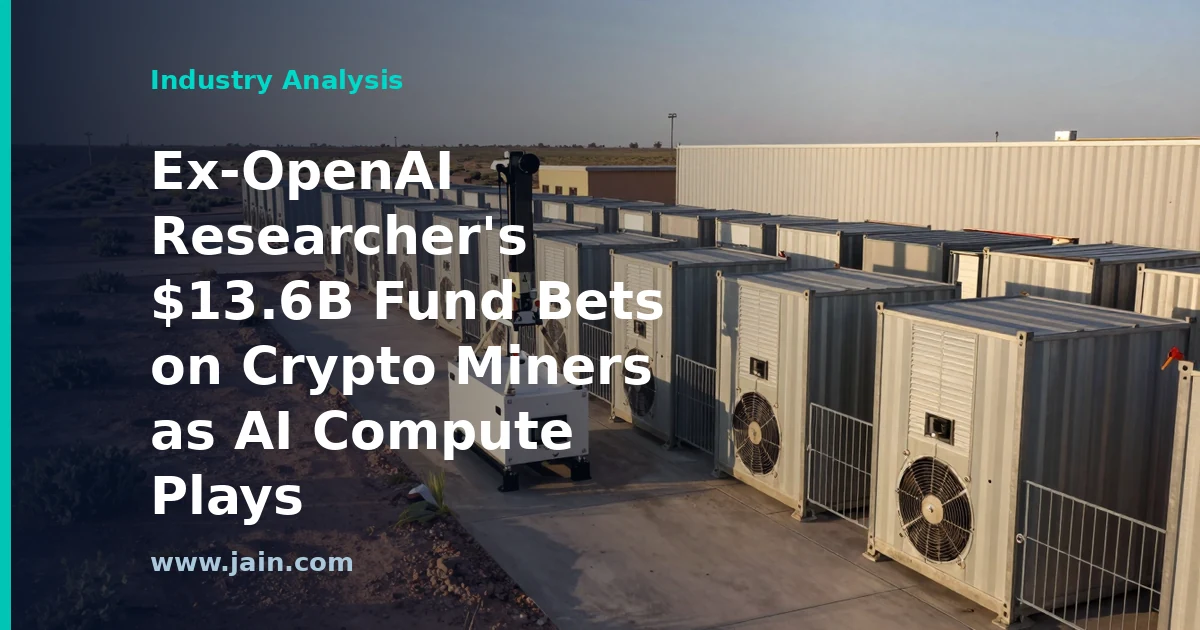
CoinDesk reported on April 25, 2026 that Leopold Aschenbrenner — a former OpenAI researcher who left the lab and became one of the most-watched voices on AI’s trajectory — is directing his roughly $13.6 billion investment vehicle toward crypto mining companies as a way to gain exposure to AI computing infrastructure. The report frames the miners not as bets on bitcoin, but as bets on the power-rich sites and industrial facilities miners control.
Executive Summary
According to CoinDesk, Aschenbrenner’s fund — an AI-focused vehicle now reported at $13.6 billion — is making sizable wagers on publicly traded crypto miners. The logic, as the framing suggests, is that mining companies hold exactly the assets the AI buildout is starved for: contracted electrical capacity, energized substations, industrial land, and operational teams accustomed to running dense computing at scale.
If accurate, this is one of the clearest third-party endorsements yet of the ‘miner-to-AI pivot’ — the industry-wide shift in which bitcoin miners convert or lease their facilities for GPU-based AI workloads. When a prominent AI-native investor allocates institutional capital to that thesis, it signals that the constraint on AI growth is increasingly seen as megawatts and real estate, not chips or models. That reading matters to anyone building, buying, or financing data center capacity.
Why an AI Fund Buys Bitcoin Miners
The trade only makes sense once you see what miners actually own. Training and serving large AI models requires enormous, uninterrupted electricity — and in most markets, new grid interconnections (the utility approvals and hardware needed to draw large power loads) now take years to secure. Crypto miners spent the last cycle locking up precisely those scarce inputs: power purchase agreements, high-capacity substations, cooling-ready industrial shells, and land near cheap generation.
That makes a miner’s equity a potential shortcut to AI capacity. Rather than waiting in an interconnection queue, an AI tenant or investor can access energized megawatts that already exist. Several miners have publicly repositioned themselves along these lines in recent years, converting sites to host GPU computing or signing long-term hosting deals with AI customers. An allocation of this reported size treats that conversion story as investable at institutional scale, not just as a narrative individual miners tell.
The Signal Value of $13.6 Billion
Aschenbrenner is not a generic fund manager; he is best known for his time at OpenAI and for widely circulated writing arguing that AI capabilities — and the industrial buildout behind them — will scale faster than most institutions expect. An investor whose public identity is built on taking AI scaling seriously choosing miners as an expression of that view tells the market where he believes the bottleneck sits: in physical infrastructure and power, the layer beneath the chips.
For data center operators and power developers, that is a meaningful validation. It implies continued appetite from capital markets to fund energized capacity wherever it can be found — including unconventional sources like mining fleets. It also raises the competitive temperature: if converted mining sites become a mainstream way to add AI capacity, they compete with traditional colocation and hyperscale development on speed-to-power, an axis where purpose-built facilities have historically been slow.
The Risks the Thesis Carries
The pivot is not free. Bitcoin mining facilities are engineered for cheap, interruptible, low-redundancy computing; AI training and inference customers typically demand higher reliability, denser networking, and far more sophisticated cooling. Converting a mining site to credible AI-grade infrastructure requires substantial new capital per megawatt, and not every site — or every management team — will make that leap successfully. Investors are, in effect, underwriting a construction and re-engineering project wrapped inside an equity.
There is also two-sided market risk. Miner share prices still move with bitcoin, so an AI thesis expressed through miners inherits crypto volatility it never wanted. And on the AI side, demand for compute is widely assumed but not contractually guaranteed at every site; a slowdown in AI capital spending would hit conversion-story miners harder than incumbents with signed long-term tenants. Concentrated bets by high-profile funds can also crowd a trade, bidding up the very assets whose scarcity made them attractive.
Winners, Losers, and the Rest of the Stack
The immediate beneficiaries of this kind of capital flow are miners with large contracted power positions and credible AI hosting plans — their cost of capital falls as investors reprice their real estate. Utilities and power developers near those sites gain a motivated, well-funded customer class. Traditional data center operators face a more crowded market for AI capacity, but also a rising tide: the same scarcity argument that justifies buying miners justifies premium pricing for any operator who already controls energized space.
The losers, if the thesis holds, are those betting that the power bottleneck resolves quickly — and, potentially, latecomer investors if conversion economics disappoint. The honest summary is that this reported allocation is a strong directional signal about where sophisticated AI capital sees scarcity, not proof that every miner-to-AI conversion will pay off.
Background
Aschenbrenner worked at OpenAI before departing and publishing an influential 2024 essay series on AI scaling, then launched an investment fund built around the thesis that AI’s growth would drive a historic industrial buildout. Over the same period, the crypto mining sector went through its own transformation: after bitcoin’s 2024 halving squeezed mining margins, a wave of miners began repurposing their power-rich facilities for AI computing, with several signing multi-year hosting deals or converting sites outright to GPU data centers.
By early 2026, the ‘miner as AI landlord’ story had moved from novelty to established strategy, with capacity-hungry AI firms competing for any site with large amounts of secured electricity. The reported allocation covered here sits at the intersection of those two arcs — an AI-native fund treating the mining sector’s converted infrastructure as a core way to own the physical layer of the AI economy.
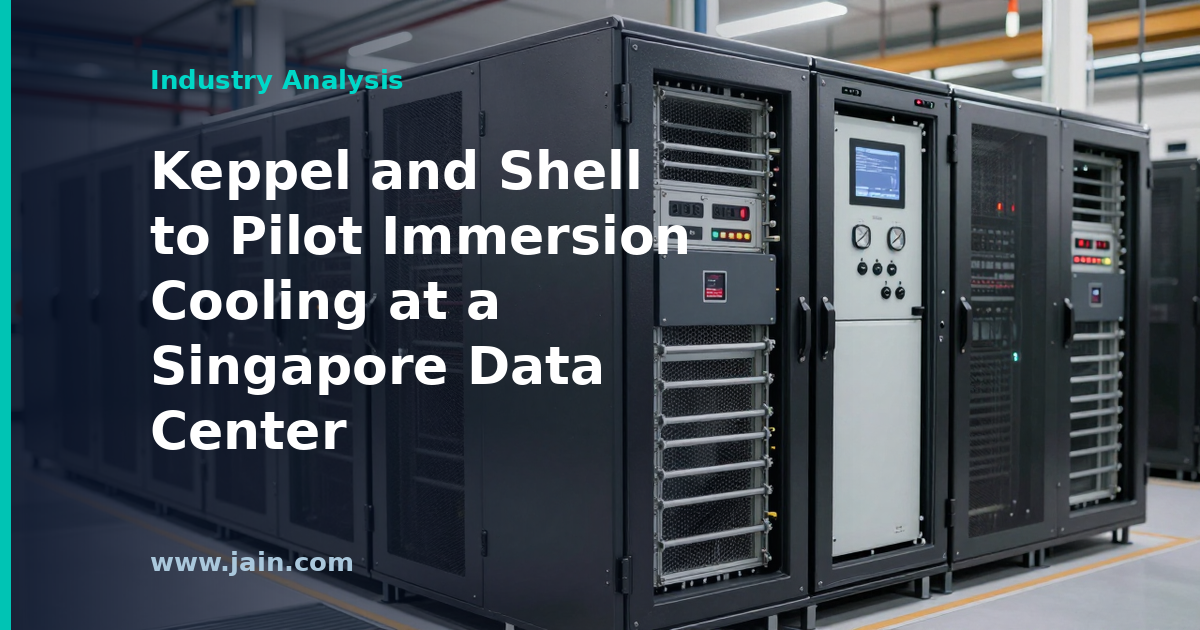
Keppel and Shell will launch an immersion cooling pilot at a data center in Singapore, according to an April 2026 report by Data Center Dynamics. Immersion cooling submerges servers in a non-conductive (dielectric) liquid instead of blowing chilled air across them, and the pilot pairs one of Asia’s most established data-center operators with an energy major that has been developing cooling fluids as a specialty product line.
Executive Summary
The announcement is short on specifics — no facility name, timeline, capacity, or fluid specification was reported — but the pairing itself is the story. Keppel is a longtime data-center developer and operator headquartered in Singapore, and Shell is one of several oil-and-gas majors that have built immersion cooling fluids into their lubricants and specialty-chemicals portfolios. A pilot puts that product in a live operator environment, which is the step fluid vendors need before operators will commit production workloads.
It matters because the industry’s cooling assumptions are shifting. AI accelerators have pushed per-rack power draws well beyond what conventional air cooling handles economically, and Singapore — a tropical, land- and power-constrained market that conditions new data-center capacity on efficiency — is one of the most demanding places to prove out an alternative. If immersion works commercially anywhere, a Singapore pilot is a credible proving ground.
Why Air Cooling Is Running Out of Headroom
For decades, data centers were cooled the same basic way: chill air, push it through server racks, and exhaust the heat. That model works well at the rack densities of the cloud era — roughly 5 to 15 kilowatts per rack — but AI training and inference hardware has driven densities several times higher, and air simply cannot carry heat away fast enough at those levels without extreme airflow and energy cost. Liquid conducts heat far more effectively than air, which is why the industry is moving toward direct-to-chip liquid cooling and, at the more radical end, full immersion.
Immersion cooling takes the concept to its logical conclusion: the entire server is submerged in a bath of dielectric fluid — a liquid engineered not to conduct electricity — so every component sheds heat directly into the liquid. Proponents cite lower cooling energy, reduced fan power, and quieter, denser halls. The trade-offs are real too: servicing a submerged server is messier, hardware warranties and supply chains are built around air, and the fluid itself is a new consumable with its own cost and lifecycle. A pilot is precisely how an operator quantifies those trade-offs on its own workloads rather than a vendor’s test bench.
An Oil Major’s Route Into the Data-Center Thermal Stack
Shell’s participation reflects a broader pattern: oil-and-gas companies repositioning parts of their refining and lubricants expertise toward digital infrastructure. Immersion fluids are, at bottom, specialty chemistry — the same competency that produces engine oils and transformer fluids — and Shell has marketed immersion cooling fluids for several years as part of its lubricants business. For an energy major, data-center cooling offers a growth market tied to AI demand at a time when traditional fuel demand faces long-term uncertainty.
For operators, the entry of large chemical producers addresses a practical adoption barrier: fluid supply at scale, with the quality control, safety documentation, and global logistics that hyperscale procurement requires. A niche fluid from a small vendor is a harder bet for a facility designed to run twenty years. That said, the release as reported does not disclose the commercial structure here — whether Shell is supplying fluid, co-developing the system, or simply lending its name to a joint trial — and those are very different depths of commitment.
Singapore Is a Deliberately Hard Test Bed
Singapore is one of the world’s most important data-center hubs and also one of its most constrained. The city-state paused new data-center approvals for several years over energy concerns, and when it resumed allocations it tied new capacity to stringent efficiency standards. Add a tropical climate — where conventional cooling works hardest and free-air economization is largely unavailable — and Singapore becomes a stress test: cooling technology that pencils out there has cleared a high bar.
That context cuts both ways for this pilot. It gives the results credibility if they are published, and it aligns with Keppel’s interest in squeezing more compute from a fixed power and land envelope. But it also means the pilot’s findings may flatter immersion relative to temperate markets, where cheap outside-air cooling narrows the efficiency gap. Operators elsewhere should read any results with their own climate and power costs in mind.
What a Pilot Proves — and What It Doesn’t
A pilot answers engineering questions: real-world efficiency, serviceability, fluid behavior over time, and how existing operational teams adapt. It does not answer the commercial questions that determine adoption — total cost of ownership at fleet scale, hardware-vendor warranty support, insurance treatment, and whether tenants will accept immersed infrastructure. The history of data-center cooling includes many well-run pilots that never converted to production deployments because the economics or the supply chain wasn’t ready.
The measured read is that this announcement signals direction, not destination. Keppel gains hands-on data for future builds in a market that rewards efficiency; Shell gains an operator reference in a marquee hub. Whether it becomes more than that depends on results neither company has yet reported.
Background
Keppel has been building and operating data centers for over two decades and is one of Asia’s most established players in the sector, with Singapore as its home market. Singapore itself paused new data-center approvals for several years over energy concerns before resuming allocations under strict efficiency conditions, making cooling performance a gating factor for growth there. Shell, like several energy majors, has extended its lubricants and specialty-chemicals expertise into immersion cooling fluids as demand for high-density computing rises — part of a broader repositioning of oil-and-gas capabilities toward digital infrastructure.
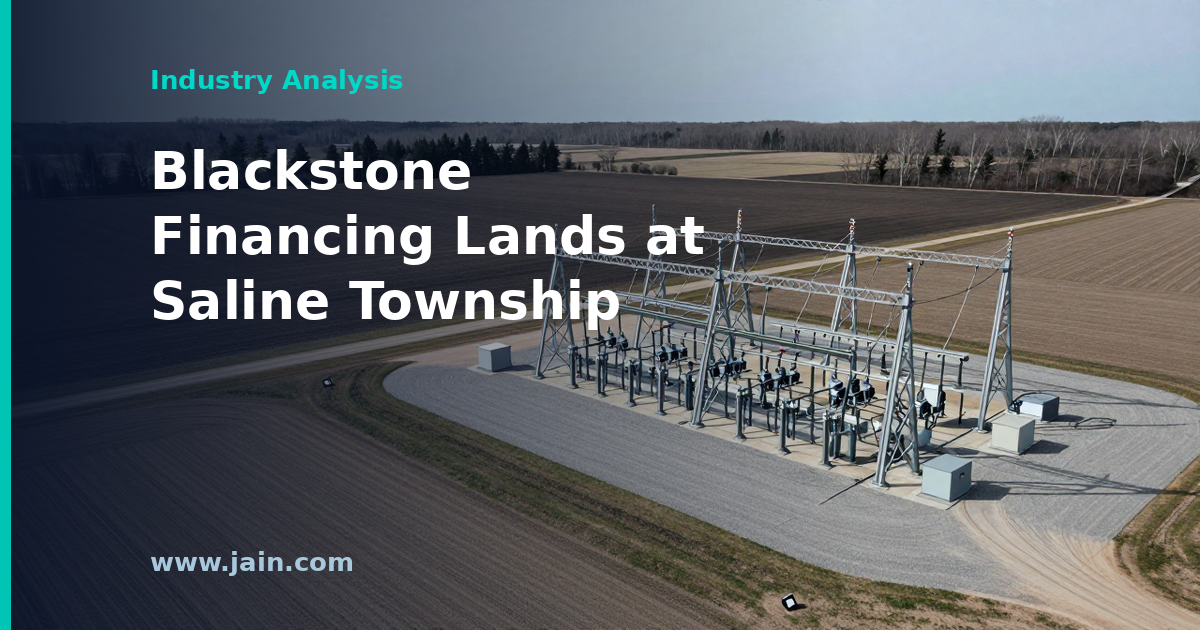
MLive reported on April 25, 2026 that the large data center campus planned for Saline Township, in Washtenaw County, Michigan, has secured financing through Blackstone, the world’s largest alternative-asset manager and a major private-credit lender. Saline Township is a rural farming community roughly south of Ann Arbor, and the site has been the subject of local debate since the project was first proposed.
The report is headline-level. The coverage available to us does not state the size of the facility, the amount or structure of the financing, the identity of the anchor tenant, or the construction schedule. What is established is the fact of a financing commitment from a private-capital provider rather than from a bank syndicate or a utility-led arrangement.
Executive Summary
A financing close is the moment a data center stops being a land-use argument and becomes a construction project. Site control, zoning approvals and power studies can all exist without a single dollar of committed capital; a lender writing a check is the first hard signal that a third party with money at risk believes the project will generate cash. That is why this particular disclosure matters more than its length suggests.
The identity of the lender matters as much as the event. Blackstone has become one of the largest financiers of digital infrastructure through its credit and real-assets platforms, and its involvement places Saline Township inside a broader shift: the capital funding America’s AI-era compute buildout is increasingly private credit — money lent directly by asset managers — rather than utility balance sheets, investment-grade bonds, or traditional construction lending. Private credit moves faster, tolerates more complexity, and prices that flexibility into the interest rate.
The consequence is a redistribution of risk. When a regulated utility builds generation and transmission for a large customer, cost overruns and demand shortfalls can end up in rate cases, where regulators decide how much lands on other ratepayers. When a private lender funds a merchant campus, the first loss sits with the sponsor’s equity and the lender’s loan. Which of those two models Saline Township follows is the single most consequential question the reporting does not yet answer.
Why a Private-Credit Lender, Not a Utility, Is the Story
For most of the last century, the entity that financed heavy electrical load in a place like Washtenaw County was the local utility. It raised capital, built the wires and the plants, and recovered the cost from customers over decades under a regulator’s supervision. The model was slow, but it was durable, and it socialized risk across a large base of ratepayers who had little say in the matter.
Data centers built for artificial-intelligence workloads do not fit that rhythm. The demand signal arrives in months, not decades, and it is concentrated in a handful of hyperscale buyers whose plans can change. Private credit — non-bank lending in which asset managers lend directly from their own funds — has filled the gap because it can underwrite an idiosyncratic asset quickly, structure around construction milestones, and accept collateral that a bank credit committee would struggle with. The borrower pays for that speed in spread.
The trade is real in both directions. A sponsor who takes private credit gets certainty of execution and avoids the political timeline of a rate case. It also accepts covenants, tighter reporting, and a lender that can enforce quickly if lease-up or delivery slips. Reading Blackstone’s involvement as validation of the Saline Township site is reasonable; reading it as a guarantee of completion is not, because financing commitments are typically conditioned on milestones that have not been disclosed here.
The Capital Structure Decides Who Eats the Power Risk
Whether a campus of this scale is financially safe depends less on the headline amount than on what sits behind it. Two structures dominate the sector. In the first, the developer signs long-term leases with a creditworthy tenant before drawing debt; the lender is effectively underwriting the tenant’s credit, and power costs are passed through under the lease. In the second — a merchant or speculative build — the developer takes capacity risk, betting that demand will appear at attractive rates. The interest cost of the two differs sharply, and so does the consequence of being wrong.
Power is where those structures are tested. A large campus needs a firm interconnection, a tariff that sets what it pays per megawatt-hour, and often a commitment to pay for a minimum volume whether or not the servers are drawing it. That last provision — a take-or-pay or minimum-demand charge — is the mechanism by which regulators try to ensure that a large customer, not the general ratepayer base, funds the network upgrades built on its behalf. Whether such terms exist here, and how strict they are, is not in the reporting.
The winners in the current arrangement are relatively easy to identify: landowners who sell into a rising market, contractors and electrical trades, lenders earning wide spreads on secured assets, and local governments that collect property tax on very expensive equipment. The exposed parties are harder to see in advance. They include equity holders if AI compute demand normalizes before the campus is leased, and residential ratepayers if grid investment is later judged to have been undersubscribed by its intended customer. Neither outcome is predictable from a financing headline, which is exactly why the terms matter.
Michigan’s Calculation: Tax Base Now, Load Growth Later
Michigan has actively courted data center investment as part of a broader effort to attract capital-intensive industry, and southeast Michigan offers a genuine set of advantages: cool climate for much of the year, abundant fresh water in the Great Lakes basin, existing transmission built for a manufacturing economy that has shrunk, and proximity to engineering talent around Ann Arbor and Detroit. Those are structural, not promotional.
The fiscal case for a rural township is also real but narrow. A hyperscale campus generates substantial property tax relative to farmland and comparatively few permanent jobs — typically technicians, security and facilities staff, against a much larger but temporary construction workforce. Communities that evaluate these projects as employment engines are usually disappointed; those that evaluate them as tax-base plays are usually not, provided the assessment holds and abatements are modest. The distinction is worth making plainly because it is where local expectations most often go wrong.
The longer-term question for Michigan is load. Adding gigawatt-scale demand to a grid changes generation planning, transmission queues and reserve margins for everyone connected to it. That can be managed well — with large-load tariffs, staged energization, and on-site or contracted generation — or managed poorly. The financing announcement tells us capital has arrived. It tells us nothing about which of those paths the electricity side is on.
A Contested Site, and How to Read Both Sides
The Saline Township project has drawn organized local opposition, as most large rural data center proposals now do. Residents raise farmland conversion, water use, noise from cooling equipment, traffic during construction, and the durability of tax promises. These are legitimate, checkable questions, and dismissing them as reflexive opposition would be lazy — several of them have been substantiated at other sites, particularly noise complaints near residential parcels.
The same standard applies to opposition claims. Water consumption varies by an order of magnitude depending on whether a facility uses evaporative cooling or a closed-loop design, so a figure quoted without the cooling architecture attached is not informative. Ratepayer-impact estimates depend entirely on the tariff, which is a public document once filed. And in a national debate where template campaigns circulate between communities, it is fair to ask of any local group — as of any developer — who is speaking, what the specific local evidence is, and whether the numbers cited come from this project’s filings or from someone else’s. Asking is not an accusation, and there is no basis here for speculating about anyone’s funding.
The most even-handed reading is that both sides are currently arguing about a project whose material terms are not public. The developer has not, in the reporting available, published capacity, water design, or power arrangements; opponents cannot fully assess impact without them. A financing close usually precedes more disclosure, not less, because lenders require documentation that eventually surfaces in permits and utility filings. That is where the argument should be settled.
Background
Blackstone is the world’s largest alternative-asset manager, with major platforms in real estate, infrastructure and private credit. It has become one of the most significant financiers of digital infrastructure globally, lending to and owning data center assets as demand from cloud and artificial-intelligence workloads has outpaced what traditional bank and utility financing could supply on the required timeline.
Saline Township sits in Washtenaw County, southeast Michigan, an agricultural community adjacent to a metropolitan corridor with legacy industrial transmission. Large data center proposals in such places have become a recurring national pattern over the past several years: developers seek land, power and water at rural prices near urban fiber, while residents weigh tax revenue against land use, noise and grid effects. The Saline Township project has been locally contested since it was proposed, and the April 2026 financing report is the point at which the debate moved from land-use approvals toward committed capital.
A proposed hyperscale data center project in Utah is nearing final approval, according to an April 24, 2026 report by The Salt Lake Tribune. The defining fact of the project is its scale: it is expected to both generate and consume more power than the entire state of Utah — a single campus whose energy footprint would exceed that of the roughly 3.5 million residents, industries, and cities around it.
Executive Summary
The announcement matters less for its location than for what it says about the trajectory of AI infrastructure. “Hyperscale” once described data centers in the tens of megawatts; this project is described as exceeding an entire state’s power production and consumption, which places it in a different category altogether — closer to a purpose-built energy district than a traditional data center.
Equally telling is the phrase “generate and consume.” The project is not simply a large load waiting for a utility hookup; it is expected to produce its own power at state-exceeding scale. That reflects a broader industry shift: when grid interconnection queues stretch for years, the largest AI developers increasingly bring their own generation rather than wait for the grid to catch up.
With final approval reportedly near, the project is a live test of how states weigh the economic development promise of AI campuses against questions about energy, water, land, and who ultimately bears the costs.
When One Campus Outweighs a State Grid
The comparison in the headline is the story. A state’s power system is the aggregate of every home, factory, farm, and city within its borders, built out over a century. A single campus expected to exceed that total implies a facility measured in gigawatts — thousands of megawatts — rather than the tens or low hundreds of megawatts that defined “hyperscale” even five years ago. For readers outside the industry: one gigawatt is roughly the output of a large nuclear reactor, and AI training clusters are now being planned in multiples of that unit.
This is the practical consequence of the AI compute race. Training and serving frontier AI models consumes electricity at industrial scale, and the constraint on building more capacity has shifted from chips and buildings to power. Projects are now sited where energy can be produced or delivered, and their announcements are increasingly described in energy terms first and computing terms second — exactly as this one is.
Generate and Consume: The Rise of Self-Powered Campuses
The report’s framing — that the project would generate as well as consume state-exceeding power — points to on-site or dedicated generation. This has become the defining pattern of the largest AI campuses. Utility interconnection queues in much of the U.S. run three to seven years, and no traditional utility planning cycle anticipated single customers requesting gigawatts. Developers who cannot wait are building “behind-the-meter” generation: power plants constructed alongside or within the campus, serving it directly.
Self-generation changes the risk calculus for everyone involved. For the developer, it trades grid dependence for fuel, permitting, and construction risk. For the incumbent utility and its ratepayers, it can be a relief — the load largely pays its own way — or a complication, depending on how the campus interacts with the shared grid for backup, water, and transmission. Which of these applies here is not specified in the source, and it is the single most important detail for assessing the project’s local impact.
Why Utah
Utah has quietly been a data center state for over a decade: it hosts major existing facilities including Meta’s Eagle Mountain campus and the federal government’s Bluffdale data center, and the Intermountain Power installation near Delta has long exported Utah-generated electricity at scale. The state offers comparatively inexpensive land, a dry climate favorable to certain cooling designs, and a regulatory environment that has historically courted large industrial projects.
But a project of this magnitude tests that hospitality in new ways. Water for cooling in an arid state, air-quality implications of any fossil-fueled generation, transmission siting, and the sheer land footprint all become state-level policy questions rather than county zoning matters. The fact that the project is “nearing final approval” indicates it has so far navigated that process — though the source does not detail what conditions, if any, approval carries.
The Economics Nobody Has Priced Yet
Multi-gigawatt campuses imply capital costs in the tens of billions of dollars when computing hardware is included, recovered only if demand for AI compute stays on its current trajectory for years. That is a genuine open question for the industry: these are among the largest private infrastructure bets in American history, and their payback depends on AI adoption curves that remain projections, not guarantees.
For host states, the bargain is also unsettled. Data centers bring construction jobs, property tax base, and prestige, but comparatively few permanent jobs per dollar invested, and their energy and water demands are permanent. States like Utah that approve state-scale campuses early will generate the case studies — favorable or cautionary — that the rest of the country uses to negotiate.
Background
Utah has been part of the U.S. data center map for over a decade, hosting Meta’s Eagle Mountain campus, the federal government’s Bluffdale facility, and the Intermountain Power installation near Delta, which has long generated Utah power at export scale. But the AI era has redefined what a large project looks like: campuses once measured in tens of megawatts are now proposed in gigawatts, with developers increasingly building dedicated generation rather than waiting years in utility interconnection queues. A project expected to exceed an entire state’s power production and consumption represents the outer edge of that trend as of early 2026.