An analysis published by Data Center Frontier on May 22, 2026 argues that the rise of AI workloads is reshaping how data center operators define and manage risk, moving the conversation beyond the long-standing focus on uptime toward a broader notion of resilience that spans power, cooling, network, and workload recovery.
Executive Summary
The piece reframes a debate that has quietly been building for several years. For decades, the data center industry benchmarked itself on uptime — the percentage of time facilities remained available, typically measured against Uptime Institute tier definitions. AI training and inference workloads, with their concentrated power draw, thermal density, and tightly coupled cluster behavior, expose the limits of that single metric.
Why it matters: buyers of colocation and cloud capacity have historically negotiated on service-level agreements built around availability. If the operative risk is now cluster-level disruption, cooling excursions, or grid interaction rather than isolated component failure, the contracts, insurance, and design standards that underpin the industry will need to evolve alongside the hardware.
Uptime Was Built for a Different Workload
The uptime-first mindset was calibrated for enterprise and early cloud workloads: many independent servers, stateless front ends, and applications that tolerated the loss of a node without disrupting the service. A five-nines facility (99.999 percent availability, roughly five minutes of downtime a year) was a defensible proxy for customer experience because software above it was designed to route around small failures.
AI training clusters behave differently. A single training job may span thousands of GPUs (graphics processing units, the specialized chips that do the heavy math for AI models) synchronized on every step. A brief power event, a cooling excursion, or a network partition can force a checkpoint restart that costs hours of compute and, at current GPU rental rates, meaningful money. Availability at the facility level says little about whether the job actually finishes.
Resilience Is a Wider Surface
Resilience, as the source frames it, is a superset of uptime. It includes how quickly a site can ride through a grid disturbance, whether liquid cooling loops degrade gracefully under partial failure, how the network fabric behaves when a spine switch drops, and how workloads are checkpointed so that a disruption does not erase a day of training. Each of those is a distinct engineering discipline, and each has its own vendors, standards, and blind spots.
That widening surface also expands who bears the risk. Uptime SLAs put the operator on the hook for a narrow, well-defined failure mode. Resilience, by contrast, is a shared problem: the utility, the operator, the cooling vendor, the network provider, and the customer’s own software all shape whether a workload survives a bad afternoon. Contract structures have not caught up.
What Changes for Buyers and Operators
For operators, the practical implication is that design margins that looked conservative in a CPU-era facility can look thin under AI density. Rack power draws that used to sit in the 5 to 15 kilowatt range are now routinely quoted in the tens to over a hundred kilowatts per rack for GPU deployments, which stresses power distribution, cooling headroom, and the assumptions baked into concurrent maintainability. Retrofitting a legacy hall is not always cheaper than greenfield.
For buyers, the negotiation should widen. Beyond the availability guarantee, questions worth asking include how the site responds to grid frequency events, how cooling redundancy is validated under load rather than at commissioning, what the network’s failure domains look like, and whether the operator can produce evidence — not just design documents — of resilience under stress. None of this makes uptime irrelevant; it just makes uptime insufficient.
Background
The data center industry has organized itself for decades around the Uptime Institute’s tier system, which rates facilities from Tier I to Tier IV based on redundancy and concurrent maintainability. That framework, alongside vendor SLAs measured in nines of availability, became the common vocabulary for negotiating colocation and cloud contracts.
The rapid buildout of AI training and inference capacity from roughly 2023 onward has introduced rack densities, power profiles, and workload behaviors that the tier framework was not designed around. Industry publications including Data Center Frontier have been tracking the resulting rethink of design standards, power procurement, and cooling architecture.
E&E News by POLITICO reported on May 21, 2026, that a slowdown in data center buildout is easing reliability risks for the U.S. electric grid heading into the summer of 2026 — the season when air-conditioning load pushes power systems closest to their limits. The report’s headline carries a caveat as important as its good news: “trouble looms.”
In plain terms: fewer new server farms plugging in right now means less new demand competing for scarce megawatts this summer, but the underlying collision between surging electricity demand and a slow-moving power supply chain has not been resolved — only postponed.
Executive Summary
The report frames a rare piece of breathing room for grid planners. For the past several years, utilities and reliability watchdogs have warned that data centers — especially those built for artificial intelligence workloads — were adding demand to the grid faster than new power plants and transmission lines could be built. A pause or deceleration in that buildout, as E&E News describes, mechanically reduces the risk that supply falls short of demand during summer heat waves.
Why it matters: summer reliability is the acid test of the U.S. power system. When a regional grid runs short, the consequences are emergency alerts, rolling blackouts, and price spikes that land on every ratepayer, not just data center customers. A slower buildout shifts near-term risk down without requiring a single new power plant.
The equally important message is the second half of the headline. A construction slowdown changes the timing of demand, not the trajectory. The structural drivers — AI computing growth, electrification, aging generators retiring, and multi-year waits to connect new supply — remain in place, which is why the report characterizes the relief as temporary rather than a turning point.
Why Slower Buildout Translates Directly Into Grid Relief
Grid reliability is a math problem: expected peak demand versus available supply, with a safety margin on top. Data centers are unusual demand because they arrive in very large blocks — a single campus can require as much power as a small city — and because they run around the clock, including during the late-afternoon summer peak when the grid is most stressed. When projects slip, pause, or get canceled, the demand side of that equation drops immediately, while the supply side (power plants and transmission already under construction) keeps arriving on schedule. That asymmetry is why even a modest deceleration in data center construction shows up quickly in seasonal reliability outlooks.
For grid operators, the near-term effect is wider reserve margins — the buffer between what the system can generate and what customers demand on the hottest day. Wider margins mean fewer emergency conservation calls and less reliance on aging plants being pushed past their planned retirement dates to keep the lights on.
Why the Reprieve Is Temporary, Not a Trend Change
The forces that created the crunch have not gone away. AI training and inference workloads continue to grow, and hyperscale operators have signaled sustained infrastructure investment even as individual projects get re-timed. Meanwhile, the supply side moves on decade-scale clocks: new gas turbines face multi-year equipment backlogs, transmission lines routinely take seven to ten years from planning to energization, and interconnection queues — the waiting lines where new power plants apply to plug into the grid — remain congested across most regions. A demand slowdown measured in quarters cannot offset a supply problem measured in decades.
There is also a rebound dynamic worth watching. If the slowdown reflects developers pausing to renegotiate power availability, tariffs on equipment, or financing terms rather than abandoning projects, the deferred demand returns — potentially in a more concentrated wave. Grid planners who treat this summer’s relief as a new baseline risk being caught out when re-timed projects come back into the queue.
Winners, Losers, and the Signal to Watch
In the near term, ratepayers and grid operators benefit: less emergency procurement, less upward pressure on capacity prices, and a summer with more margin for error. Utilities that raced to justify new generation on the back of data center forecasts face harder questions — regulators were already probing how much projected load is real versus speculative, and a visible slowdown strengthens the skeptics’ hand. For data center developers themselves, a cooler market has a silver lining: sites with secured power become more valuable relative to speculative announcements, rewarding operators who did the unglamorous work of locking in interconnection and substation capacity early.
The signal to watch is whether the slowdown shows up in canceled interconnection requests (a genuine demand reduction) or merely in slower construction starts (a deferral). The first would meaningfully rewrite load forecasts; the second only reschedules the crunch that reliability authorities have been warning about.
Background
Since the generative-AI boom began in late 2022, forecasts of U.S. electricity demand have swung sharply upward after roughly two decades of flat consumption, driven largely by planned data center campuses alongside manufacturing growth and electrification. Reliability authorities and regional grid operators have repeatedly flagged the resulting squeeze: enormous new loads seeking connection while older coal and gas plants retire and replacement generation and transmission crawl through permitting and interconnection processes.
That mismatch made every seasonal reliability assessment a referendum on data center growth, and it made the pace of buildout — not just its ultimate size — a first-order variable for grid planners. The May 2026 E&E News report lands in that context: the first widely noted moment when the demand side of the equation, rather than the supply side, moved in the grid’s favor.
Axios reported on May 21, 2026 that Chinese-made components and materials are quietly flowing into the United States data-center construction boom, even as Washington tightens export controls on advanced chips headed the other direction. The piece frames the dependency as a geopolitical risk for the AI infrastructure now being stood up at record pace.
Executive Summary
The Axios story argues that America’s data-center surge — the physical backbone of the current AI wave — leans on a supply chain in which Chinese firms still play a meaningful, if under-discussed, role. That includes hardware, electrical gear, and construction inputs sourced directly or through intermediaries.
The reason it matters is straightforward: policymakers have spent two years hardening the outbound side of the US–China technology relationship, restricting what advanced silicon and tools American companies can sell to Chinese buyers. The inbound side of the same relationship — what the US buys to build the facilities that host AI — has drawn far less scrutiny, and the article suggests that gap is now visible in the numbers.
The Buildout Nobody Fully Sourced
Hyperscale data-center construction is a bill of materials problem as much as a real-estate problem. A single campus consumes transformers, switchgear, busways, generators, cabling, cooling coils, racks, and structural steel in volumes that already exceed what Western manufacturers can supply on the timelines operators want. When Tier-1 vendors are booked out, buyers turn to whoever can ship — and Chinese factories remain the marginal supplier for a long list of electrical and mechanical components. The Axios framing is that this quiet substitution is bigger than the industry publicly acknowledges.
None of that is inherently a scandal; global sourcing is how infrastructure gets built. It becomes a policy question when the same components sit inside facilities that host frontier AI training runs, defense workloads, or critical services, and when the exporting country is also the strategic competitor the export-control regime is designed around.
Asymmetric Controls, Symmetric Exposure
US policy since 2022 has focused almost entirely on the outbound flow: chips, chip-making equipment, and increasingly the model weights and cloud capacity that could be used to train frontier AI abroad. The inbound flow — grid-scale transformers, power distribution units, network gear, cooling hardware — has been governed by a patchwork of tariffs, Section 232 reviews, and Buy American rules that were not designed with AI infrastructure in mind.
If the Axios reporting holds, the practical implication is that America’s ability to build AI capacity is partly gated by a country it is simultaneously trying to slow down in AI. That is a fragile equilibrium: a future round of tariffs or export restrictions from either side could stretch already long lead times for the exact components operators need most.
Who Gains, Who Gets Squeezed
Western manufacturers of transformers, switchgear, and cooling equipment stand to benefit if buyers and regulators push harder on country-of-origin — but only if they can add capacity, which takes years and skilled labor that is itself in short supply. Hyperscalers with the balance sheets to pre-buy multi-year allocations from domestic and allied suppliers are best positioned; smaller colocation operators and enterprise builders, who buy in smaller lots and later in the cycle, would feel any supply squeeze first.
For AI customers, the second-order effect is schedule risk. A data-center delivery pushed from Q2 to Q4 because a Chinese-sourced transformer was reclassified or a substitute part is on allocation translates directly into delayed GPU deployments and delayed model training. In an environment where compute is the binding constraint on product roadmaps, that is a real cost.
Reading the Claim Carefully
The Axios piece is a framing article, not a forensic supply-chain audit, and the responsible read is to hold both possibilities open. It is plausible that Chinese content in US data-center construction is material and under-reported, given how opaque multi-tier supply chains are. It is also fair to ask how much of the reported exposure is finished Chinese-branded equipment versus subcomponents inside Western-branded gear, and how much is displaceable at reasonable cost versus genuinely single-sourced. Those distinctions determine whether this is a policy problem, a procurement problem, or a headline.
Background
The US data-center industry is in the middle of the largest capacity expansion in its history, driven by generative AI training and inference demand from hyperscalers and a new tier of AI-native operators. That expansion has already collided with constraints on grid interconnection, transformer supply, water, and permitting.
In parallel, the US and China have spent the past several years decoupling on advanced semiconductors, with successive rounds of US export controls on chips and chip-making tools and Chinese retaliation on critical minerals. The Axios story sits at the intersection of those two trends, arguing that the physical layer of the AI economy is still more entangled with China than the policy conversation has acknowledged.
Law firm Ropes & Gray published a 2026 outlook on data-center investment, arguing that the sector’s trajectory is being set by three intersecting forces: surging AI compute demand, hard limits on grid power, and a wave of private-equity capital flowing into digital infrastructure. The note, dated May 21, 2026, is a legal-advisory perspective aimed at sponsors, lenders, and strategic investors, not a transaction announcement.
Executive Summary
The outlook is notable less for any single data point than for the framing: Ropes & Gray, a firm that advises on a meaningful share of large digital-infrastructure transactions, is telling its client base that AI, power, and private capital are now the master variables governing deal flow. That framing shapes how term sheets get drafted, how diligence is scoped, and where sponsors are willing to plant multi-hundred-megawatt bets.
For a broader audience, the significance is that a legal advisor is publicly acknowledging what operators have been saying privately for two years: siting a data center is now a power-and-permitting problem first and a real-estate problem second. Capital is abundant; interconnection queues are not.
AI Demand as the Underwriting Case
The outlook positions AI as the demand engine underwriting new capacity. In practical terms, that means investment committees are being asked to approve builds whose economics depend on tenants — hyperscalers and large AI-native firms — signing long-dated leases at densities (kilowatts per rack) that would have looked exotic in 2022. That shift is real, but it concentrates counterparty risk: a handful of buyers now anchor a large share of pre-leased pipeline, and their capex plans can move quarter to quarter.
For lenders, the underwriting question is whether an AI-training campus retains value if a specific hyperscaler pulls back. The answer depends on power interconnect, fiber, and land — assets that outlast any single tenant — but the note is measured rather than triumphant about that resilience.
Power as the Binding Constraint
The most useful contribution of the outlook is naming power, not capital or land, as the binding constraint on 2026 growth. Interconnection queues at major utilities now stretch multiple years; substation upgrades, transmission build, and generation additions all sit on longer clocks than data-center construction itself. That inverts the traditional development sequence, where power was assumed and site selection led.
The economic consequence is a premium on shovel-ready sites with executed interconnection agreements, and a growing willingness among sponsors to co-invest in generation — behind-the-meter gas, on-site solar-plus-storage, and, in a smaller number of cases, small modular reactor offtake — to shortcut the queue. Each of those paths carries its own permitting and community-acceptance risk that the note flags without resolving.
Private-Equity Capital Flows
The third leg of the thesis is that private equity, infrastructure funds, and sovereign capital are increasingly the marginal buyer of data-center platforms, often through take-privates, minority stakes, or joint ventures with operating partners. The appeal is straightforward: contracted cash flows on twenty-year time horizons match liability profiles for pension and insurance capital better than most alternatives.
The risk, which the outlook implies rather than states, is valuation. When capital chases a scarce input — in this case, powered land — entry prices can outrun the operating economics that justified the initial thesis. That is not a prediction of a correction; it is a caution that the same forces driving deal volume also compress future returns.
Background
Data centers evolved from enterprise back-office facilities into a distinct asset class over the last fifteen years, driven first by cloud computing and, since 2023, by generative AI. The sector now attracts dedicated infrastructure funds, sovereign wealth capital, and hyperscaler self-build alongside traditional colocation operators.
Ropes & Gray is one of several major law firms — alongside peers such as Latham & Watkins, Kirkland & Ellis, and Simpson Thacher — that advise on the largest digital-infrastructure transactions. Periodic outlooks from these firms function as a barometer of where sponsor appetite and legal risk are converging.
SpaceX has filed for an initial public offering that positions the company not primarily as a launch provider or satellite broadband operator, but as an AI infrastructure company, according to a May 20, 2026 report from Data Center Knowledge. The framing places one of the most valuable private companies in the world directly into the capital-markets conversation that has, until now, centered on terrestrial data centers, chips, and power.
The aggregated report is headline-level: it confirms the filing and the AI-infrastructure positioning, but the underlying financial details, offering terms, and the specific claims SpaceX makes in its prospectus were not included in the source material available at publication.
Executive Summary
The significance of the reported filing is less the IPO itself — SpaceX going public has been speculated about for years — than the identity the company has reportedly chosen for its public debut. “AI infrastructure” is today’s most valuation-rich category in public markets, encompassing the data centers, accelerated computing, power, and networks that train and serve artificial-intelligence models. By recasting itself under that banner, SpaceX invites comparison not with aerospace peers but with the companies building gigawatt-scale compute campuses on the ground.
For the data center industry, the filing is a signal worth taking seriously even before the prospectus details emerge. SpaceX uniquely controls two assets that any credible orbital-compute story requires: low-cost, high-cadence launch capacity, and an operating satellite constellation with optical inter-satellite links. If the public markets fund an orbital extension of AI infrastructure, the competitive and complementary effects on terrestrial operators — in power procurement, connectivity, and edge architecture — become a live strategic question rather than a thought experiment.
That said, the reporting available so far substantiates a positioning choice, not a product roadmap. What SpaceX has actually committed to build, on what timeline, and with what economics remains to be read in the filing itself.
From Rockets to Racks: Why the Reframing Matters
Capital markets price companies by category as much as by cash flow. Launch services are a lumpy, contract-driven business; consumer broadband is a subscription business with heavy capital expenditure. AI infrastructure, by contrast, has commanded premium multiples because investors see structural, multi-year demand from model training and inference outrunning the supply of powered data center capacity. If SpaceX can persuade the market that its launch system and satellite constellation are ingredients of AI infrastructure — the way land, power, and fiber are for a terrestrial operator — it changes the comparison set used to value the company.
The reframing is not baseless on its face. SpaceX’s core capabilities map onto real AI-infrastructure bottlenecks: launch is the logistics layer for putting hardware where energy is abundant, and a laser-linked satellite network is, functionally, a global backbone. But a positioning statement in a filing is a claim, not a delivered capability, and the burden of proof — deployed compute, paying customers, unit economics — sits with the prospectus, which the available reporting does not yet detail.
Orbital Compute: The Physics Is the Business Case — and the Obstacle
The idea behind space-based data centers is straightforward: in the right orbit, a satellite can collect solar power nearly continuously, without land acquisition, grid interconnection queues, water permits, or local opposition — the very constraints that have slowed terrestrial data center construction. For an industry whose defining shortage is powered land, that pitch has obvious appeal.
The counterweights are equally physical. Vacuum removes the two workhorses of terrestrial cooling — air and water — so waste heat must be shed by radiators, which grow large and heavy as compute density rises. Radiation degrades commercial silicon, hardware cannot be swapped by a technician on a three-year refresh cycle, and every kilogram of server, radiator, and solar array must be launched. The economics therefore hinge almost entirely on launch cost per kilogram, which is precisely the variable SpaceX controls better than anyone — and precisely why the company, rather than a startup, can make this argument credibly. Whether the math closes at scale is the question the filing needs to answer with numbers.
What It Means for Terrestrial Data Centers
Near term, orbital compute is not a substitute for ground infrastructure. Latency to low Earth orbit is workable for batch workloads such as model training but adds constraints for interactive inference, and any orbital fleet still depends on ground stations, terrestrial fiber, and earthbound data centers for ingest, storage, and distribution. The more realistic framing is a new tier in the infrastructure hierarchy — a place to put energy-hungry, latency-tolerant workloads — alongside, not instead of, terrestrial campuses.
For operators and buyers on the ground, the second-order effects may arrive sooner than orbital racks do. A publicly traded SpaceX marketing itself as AI infrastructure creates a new benchmark for how investors value connectivity plus compute; it strengthens satellite backhaul as a connectivity option for remote and edge sites; and it intensifies the argument that the binding constraint in AI is energy, not silicon. Data center firms whose value proposition is secured power, dense fiber, and operational reliability should read this filing as validation of that thesis — and as notice that new forms of competition for AI capital are emerging.
Reading a Headline, Not a Prospectus
It is worth being plain about what the source material supports. A single aggregated report confirms that a filing exists and that its framing emphasizes AI infrastructure. It does not, in the material available, disclose revenue mix, profitability, offering size, valuation, or any specific orbital-compute commitment. Headlines about repositioning can reflect a genuine strategic pivot, or they can reflect narrative packaging for an offering into a receptive market — and those two explanations are not mutually exclusive.
The fair test, applied here as we would apply it to any terrestrial operator’s announcement, is disclosure: does the prospectus quantify AI-attributable revenue today, name customers or contracts, and put capital and timelines against the orbital ambitions? Until those pages are public and parsed, the measured conclusion is that SpaceX has made a consequential claim about what kind of company it is — and the evidence for that claim is still to be examined.
Background
Founded in 2002, SpaceX transformed the launch industry by developing reusable rockets, and its Falcon 9 became the workhorse of global spaceflight with a launch cadence no competitor has matched. The company then vertically integrated into satellite services with Starlink, a low-Earth-orbit constellation providing broadband to consumers, enterprises, governments, and maritime and aviation customers. Through repeated private funding rounds, SpaceX became one of the most valuable private companies in the world while developing Starship, a fully reusable heavy-lift vehicle intended to cut launch costs further.
The reported IPO filing lands amid an AI-driven infrastructure boom in which data center development has been constrained less by demand than by electric power and buildable land — conditions that have pushed the industry to examine unconventional sites, and now, potentially, orbit.
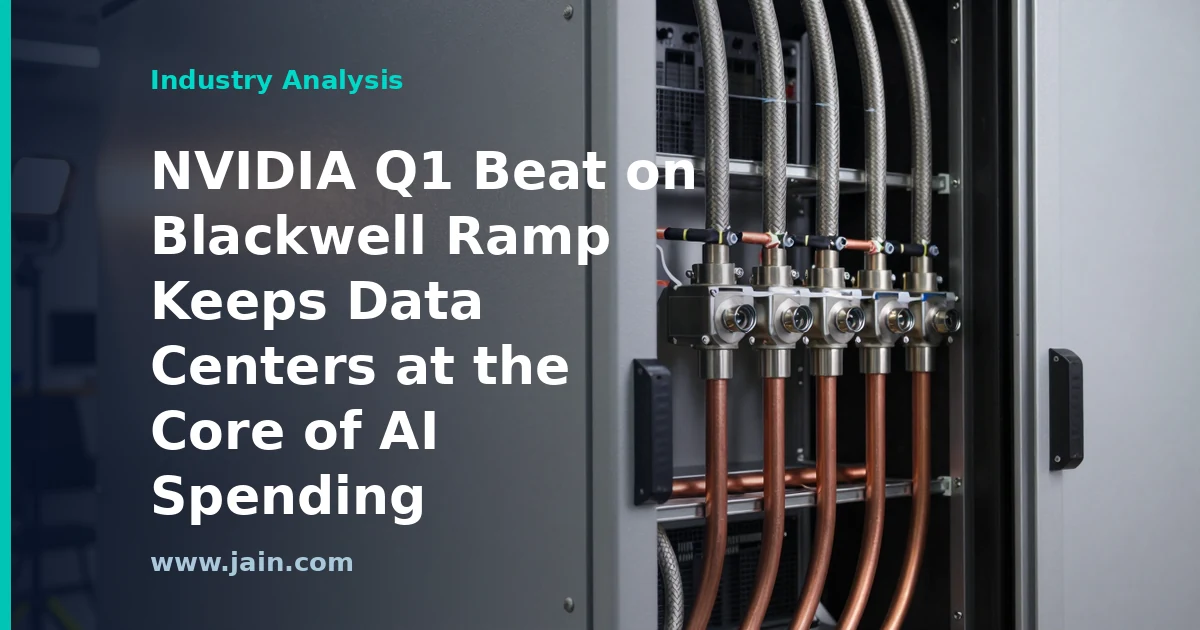
NVIDIA reported fiscal first-quarter results that beat Wall Street expectations, according to a May 20, 2026 report from Yahoo Finance, with the ramp of its Blackwell GPU platform and continued strength in its data center business cited as the drivers. The data center segment — the chips, systems, and networking sold to cloud providers and enterprises building AI capacity — remains the company’s growth engine.
Executive Summary
The headline is short but the signal is clear: as of mid-2026, demand for AI compute has not slowed enough to dent the results of the industry’s dominant supplier. NVIDIA’s quarterly reports have become a de facto barometer for the entire AI infrastructure economy, because nearly every hyperscaler, cloud provider, and AI lab routes a large share of its capital spending through NVIDIA’s data center products. A beat attributed to the Blackwell ramp means the newest generation of accelerators is shipping in volume and being absorbed by buyers.
For the infrastructure industry — data center operators, power providers, network carriers, and cooling vendors — this matters more than the stock move. Every Blackwell system that ships needs a rack to sit in, megawatts to run on, liquid cooling to survive, and high-bandwidth connectivity to be useful. Strong GPU shipments today are a leading indicator of facility demand for the next several quarters.
Why One Company’s Earnings Read as an Industry Health Check
NVIDIA occupies an unusual position: it supplies the scarcest input in the AI buildout, so its revenue is effectively a meter on how much money the world’s largest technology companies are actually spending — not merely announcing — on AI capacity. Press releases about future data center campuses can slip or shrink; recognized GPU revenue cannot. When the data center segment beats expectations, it means purchase orders were placed, systems were built, and customers took delivery.
That is why analysts treat these reports as a proxy for hyperscaler capital expenditure. The persistent worry in this cycle has been a gap between announced AI ambitions and realized spending. A quarter driven by Blackwell — the successor architecture to Hopper, designed for large-scale AI training and inference — suggests buyers are not just sustaining spend but migrating to the newest, most power-dense generation.
The Blackwell Ramp Is a Facilities Story, Not Just a Chip Story
Each GPU generation raises the bar on what a data center must provide. Blackwell-class systems are typically deployed in dense racks that draw far more power than traditional enterprise IT and generally require liquid cooling rather than air. A successful ramp therefore implies a parallel ramp in facilities engineered for high-density, liquid-cooled deployments — and it pressures older facilities that cannot economically retrofit.
The winners in that shift extend well beyond NVIDIA: colocation and wholesale data center operators with available power, utilities and on-site generation providers, cooling-equipment manufacturers, and the optical and electrical networking suppliers that stitch GPU clusters together. The constraint has increasingly moved from chip supply to megawatts and grid interconnection queues — meaning the bottleneck NVIDIA’s customers face next is often land, power, and time, not silicon.
What a Beat Does and Does Not Prove
A single quarter’s beat confirms present demand; it does not settle the debate about durability. Skeptics of the AI buildout argue that spending is concentrated among a handful of hyperscalers and well-funded AI labs, and that returns on AI investment must eventually justify the capital outlay. Supporters counter that inference — running AI models in production, not just training them — is broadening the buyer base. The headline alone does not adjudicate this; it tells us the engine was still pulling as of the April-ending quarter.
It is also worth remembering that expectations themselves are a moving target. “Beat” means results exceeded analyst consensus, and consensus for NVIDIA has been recalibrated upward repeatedly for over two years. The more durable takeaway for infrastructure planners is directional: the newest platform is ramping, and buyers are absorbing it.
Background
NVIDIA began as a graphics-chip company for PC gaming, but its GPUs proved ideal for the parallel math behind modern AI, and since late 2022 the generative-AI boom has transformed it into the central supplier of the AI buildout and one of the world’s most valuable companies. Its data center segment now dwarfs its original gaming business, and its quarterly reports are watched as a barometer for AI capital spending across the technology industry.
The Blackwell platform, announced in 2024 as the successor to the Hopper generation, is deployed in dense, liquid-cooled rack systems by cloud providers and AI companies. Each generational transition raises the power and cooling requirements on the data centers that host these systems, tying NVIDIA’s product cycle directly to the fortunes of the facilities, power, and connectivity industries.
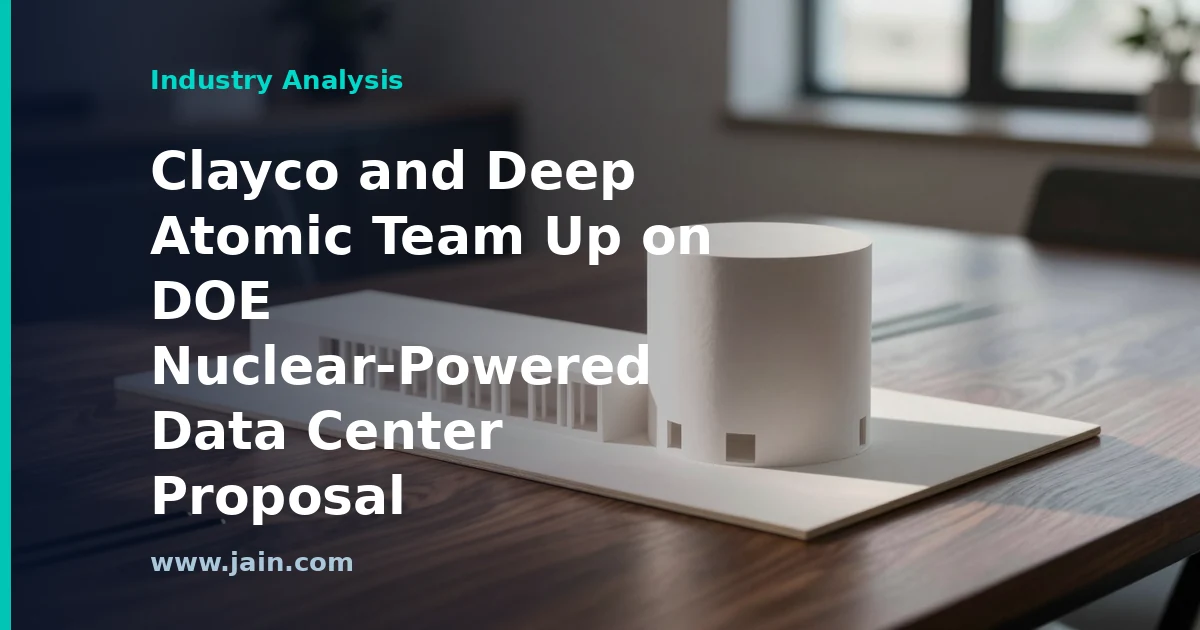
Construction giant Clayco has partnered with reactor startup Deep Atomic on a proposal to the U.S. Department of Energy (DOE) for a nuclear-powered data center, according to a May 20, 2026 report from Engineering News-Record. The move pairs one of the country’s large design-build contractors with a small modular reactor (SMR) developer whose technology is aimed specifically at powering data centers.
The report identifies a proposal — not an award, site, or construction start — so the announcement marks an early but concrete step: a credible builder and a reactor designer jointly putting a nuclear-powered data center concept in front of the federal government.
Executive Summary
According to Engineering News-Record, Clayco — a Chicago-based design-build firm with a substantial mission-critical construction practice — has joined forces with Deep Atomic, a startup developing a compact nuclear reactor tailored to data center loads, to submit a proposal to the Department of Energy for a nuclear-powered data center. The headline fact is the pairing itself: nuclear-for-data-centers announcements have often come from technology companies or utilities, while this one comes from the firms that would actually have to design and build such a facility.
Why it matters: the data center industry’s central constraint has shifted from land and fiber to electric power, and small modular reactors are the most-discussed long-term answer to delivering firm, carbon-free electricity next to compute. Most SMR-plus-data-center concepts to date have lived in slide decks and memoranda of understanding. A joint proposal from a constructor and a reactor designer, aimed at a DOE process, moves the idea toward the engineering and procurement questions — constructability, integration, cost — that will ultimately decide whether it happens.
That said, the source is thin. It confirms a partnership and a proposal, and little else. Capacity, siting, financing, licensing path, and timeline are all unstated, and a proposal to DOE carries no guarantee of selection or funding.
Why a Builder and a Reactor Startup Need Each Other
Nuclear power’s historical weakness in the West has rarely been the physics; it has been construction — schedule overruns and cost escalation on complex, first-of-a-kind projects. Small modular reactors are designed to counter that by shrinking reactor units to sizes that can be substantially factory-fabricated and repeated. But someone still has to integrate a reactor building, a data hall, cooling systems, and site infrastructure into one deliverable project. That is design-build territory, and it explains why a reactor startup would want a partner like Clayco, which brings large-scale industrial and mission-critical construction experience, early in the process rather than after a design is frozen.
The logic runs the other way too. Data center builders face a future in which winning work may depend on solving the power problem, not just the concrete-and-steel problem. A contractor that can credibly offer a generation-integrated campus — where the power plant and the data center are engineered together — is positioning for where the market appears to be heading. For Deep Atomic, which has publicly positioned its compact reactor concept as purpose-built for data center loads, a constructor partner converts a design pitch into something closer to a buildable offering.
The DOE’s Role: Catalyst, Landlord, or First Customer?
The proposal’s destination is as notable as its authors. Over the past two years, federal energy policy has moved aggressively to accelerate advanced nuclear — including efforts to open federally controlled sites to data center and reactor development and to create faster pathways for demonstration reactors. A DOE proposal process gives early-stage nuclear-data-center concepts things the private market struggles to provide: potential site access, a structured evaluation, and a federal counterparty whose involvement can de-risk later private financing.
The report does not say which DOE program or solicitation the proposal targets, and that distinction matters enormously. A demonstration award with site access and cost-share is a very different outcome from an unsolicited concept paper. Until the specific mechanism is known, the fair reading is that Clayco and Deep Atomic are working to be in the room when federal support for nuclear-powered compute is allocated — a rational move, but one whose value depends entirely on selection decisions that have not been reported.
The Economics of Putting Reactors Next to Racks
The commercial case for nuclear-powered data centers rests on one structural problem: interconnection. In many U.S. markets, new large loads face multi-year waits for grid connections and transmission upgrades, while AI training campuses are being planned in the hundreds of megawatts. On-site generation — ‘behind the meter,’ meaning power produced and consumed without traversing the public grid — offers a path around that queue, and nuclear is the only mature carbon-free technology that runs around the clock regardless of weather.
The counterweights are cost and time. No SMR has yet been built and operated commercially in the United States, so the true delivered cost of SMR electricity is unproven, and licensing a new reactor design — through the Nuclear Regulatory Commission or an alternative federal authorization route — is measured in years. Data center operators deciding today between a gas turbine they can procure now and a reactor that might energize early next decade face a genuine tension between speed and long-term positioning. Proposals like this one are, in effect, bids to compress that timeline with federal help.
A Proposal Is Not a Power Plant
It is worth being clear-eyed about where this sits on the maturity curve. The industry has seen a wave of nuclear-data-center announcements — utility partnerships, hyperscaler power purchase agreements, reactor-restart deals — and the distance between announcement and operating megawatts remains long everywhere. A proposal is the earliest rung: no reported site, no reported customer, no reported financing, no reported regulatory filing.
What distinguishes this step is who took it. Constructors are economically conservative actors; they commit engineering resources to pursuits they believe can become projects. Clayco’s participation is a market signal that at least one major builder judges nuclear-powered data centers worth real pursuit cost. Whether that judgment is vindicated depends on the questions the announcement leaves open — which are, for now, most of the important ones.
Background
Data center power demand has surged with AI training and inference workloads, colliding with congested grids and multi-year interconnection queues across major U.S. markets. That collision revived commercial interest in nuclear power: recent years have seen technology companies sign power purchase agreements with SMR developers, back reactor restarts, and lobby for faster licensing, while federal policy moved to open government sites and demonstration pathways for advanced reactors and AI infrastructure.
Clayco is an established Chicago-based design-build contractor active in industrial and mission-critical construction. Deep Atomic is a newer entrant among the dozens of SMR developers worldwide, notable for designing its compact reactor concept specifically around data center power and cooling needs rather than adapting a general-purpose utility reactor. Their joint DOE proposal, reported by Engineering News-Record in May 2026, is an early test of whether the nuclear-data-center thesis can move from agreements-in-principle toward engineered, federally supported projects.
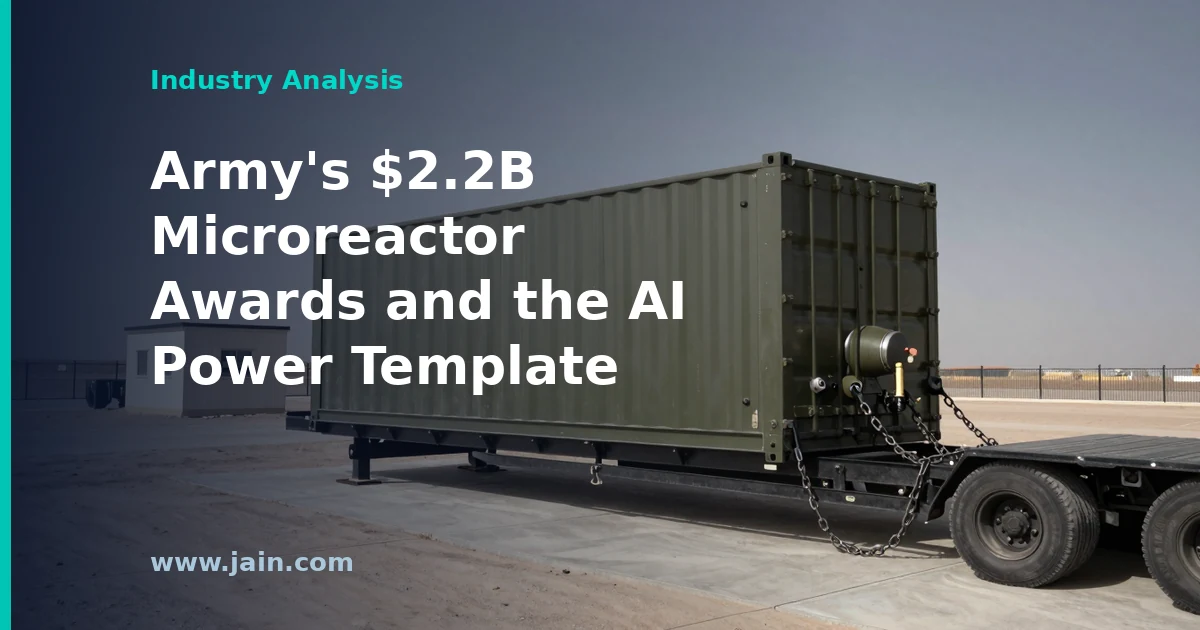
The U.S. Army has awarded contracts worth $2.2 billion for “microreactors” — very small nuclear power units intended to be installed at domestic military bases, according to a report published on May 20, 2026. The awards represent one of the largest federal procurements to date aimed specifically at putting nuclear generation directly on the site that consumes the power.
The reported figure covers the award value; the underlying source available to us does not enumerate the winning vendors, the number of reactors, the installations selected, or the delivery schedule. What is established is the buyer (the Army), the technology class (microreactors), the siting (U.S. bases), and the headline dollar figure.
Executive Summary
Announcements of this size change a technology’s status. Microreactors — reactors typically rated in the single-digit to low-tens of megawatts, small enough to be factory-built and trucked to site — have for a decade been a demonstration-stage technology with more design concepts than operating units. A $2.2 billion award from a single customer with a credible need and a long procurement horizon converts that from a research question into an industrial one.
The Army’s motivation is straightforward and does not require any speculation about climate or commercial policy: military installations depend on commercial electric grids they do not control, and a base that cannot power its mission during a prolonged regional outage is a base with a capability gap. On-site generation that runs for years without refueling addresses that gap in a way diesel gensets, which need continuous fuel convoys, do not.
The reason this matters far beyond the Department of Defense is that the fastest-growing category of commercial electricity demand — AI and high-density computing facilities — has almost exactly the same problem statement: large, constant, uninterruptible load, sited where the grid cannot deliver new capacity quickly. If the Army’s program produces licensed, delivered, operating units, it will have de-risked a supply chain that data center developers have so far been able to talk about but not buy from.
The Military Is Buying Resilience, Not Cheap Electricity
It is important to read a defense energy procurement on its own terms. The Army is not primarily optimizing for the lowest cost per megawatt-hour; it is buying assurance that a specific set of missions keeps running when the surrounding civilian infrastructure does not. That changes the arithmetic entirely. A commercial buyer compares a new generation source against the utility tariff it would displace. A defense buyer compares it against the cost of mission failure, which is not denominated in dollars per megawatt-hour at all.
This is the same logic that makes the federal government a recurring first customer for expensive, immature technologies — jet engines, satellite navigation, integrated circuits. The government tolerates first-of-a-kind cost because it values a capability that markets do not yet price. The commercial spillover comes later, once volume has driven the learning curve down. Whether that pattern repeats here is the entire investment thesis for the microreactor sector, and this award is the first data point large enough to argue from.
A note of proportion is warranted. $2.2 billion is a serious sum, but it is a program-scale commitment, not an industry-scale one. It is roughly the order of magnitude of a single large gas-fired combined-cycle plant or a mid-sized hyperscale data center campus. It is enough to fund a real fleet of first units; it is not enough, by itself, to build the factory-scale production that microreactor economics ultimately depend on.
What $2.2 Billion Buys — and What the Number Does Not Tell You
Large defense award figures are frequently ceilings on multi-year vehicles rather than cash obligated on day one. Without the contract documents, we cannot say whether this $2.2 billion is committed funding, a maximum value across option years, or a shared ceiling across multiple competing vendors who will each draw against it as they hit milestones. Each of those reads implies a very different near-term revenue picture for the winners, and readers evaluating suppliers should insist on that distinction before treating the number as booked business.
The second unknown is unit economics. First-of-a-kind nuclear construction has a long and well-documented history of cost growth, and microreactors are not exempt from it simply because they are small. The sector’s cost argument rests on repetition: build the same unit many times in a factory, and per-unit cost falls. That argument only becomes testable once the first several units are delivered and their actual costs are visible. A single award, however large, does not settle it.
The third is fuel. Many — though not all — advanced microreactor designs are specified for high-assay low-enriched uranium (HALEU), a more concentrated fuel than the enriched uranium that powers today’s commercial reactor fleet, and Western commercial HALEU production capacity has been limited. Because the source does not identify which designs were selected, we cannot say whether these particular awards depend on that fuel supply. If they do, fuel availability — not reactor manufacturing — becomes the schedule-defining constraint, and it is one no single contract can resolve.
The Read-Across to AI Data Centers
The power constraint facing AI infrastructure is not, at root, a shortage of generation. It is a shortage of interconnection — the transmission capacity, substation equipment, and regulatory approvals needed to deliver large blocks of power to a specific location on a specific date. Queue times for large new grid connections in constrained regions are commonly measured in years, and the AI buildout is operating on a procurement cycle measured in quarters. That mismatch is why developers have been chasing power that sits behind the meter: generation built on the customer’s own site, feeding the load directly, without waiting in the interconnection line.
Microreactors are attractive in that frame because they are firm and dense. Unlike solar or wind, their output does not depend on weather, so they can serve a load that runs at high utilization around the clock. Unlike on-site gas turbines, they carry no fuel-delivery dependency and no combustion emissions, which matters for operators with corporate carbon commitments and for siting in air-quality-constrained regions. And their footprint is small relative to output, which suits campuses where land is already spoken for.
The honest caveat is timing. Nothing in this award suggests microreactors will relieve data center power scarcity in the current capacity cycle; the facilities being financed in 2026 will be energized long before any of these units are. The realistic read is that the Army program functions as a de-risking exercise for the 2030s: it funds first units, exercises the licensing pathway, and gives suppliers a reference customer. Commercial buyers benefit from that groundwork later, not now. Winners, if the program executes, are the selected reactor vendors, the fuel-cycle and component suppliers beneath them, and eventually data center developers in power-constrained markets. The pressure lands on incumbent generation and on utilities whose value proposition assumes large loads must come to the grid rather than build around it.
The Failure Modes Worth Watching
The most likely way this template disappoints is schedule slip rather than outright failure. Nuclear projects rarely get cancelled loudly; they get delayed quietly, and each year of delay compounds against the commercial window in which the technology would have been most useful. Any credible assessment of the sector should treat announced in-service dates as the optimistic bound.
Regulatory pathway is the second variable. Reactors on federal military property may be authorized through a different mechanism than a commercial power plant serving the public grid, and if that is the case here, it is a genuine advantage for the Army program — and a genuine limit on how directly the precedent transfers. A commercial data center operator does not get the Department of Defense’s siting posture. Any read-across that skips this distinction is overstating the case, and the specific authorization route for these awards is not something the available source establishes.
Third is public and local acceptance, which is a real cost driver even where it is not a legal barrier. Military installations are comparatively controlled environments with existing security perimeters and a workforce accustomed to sensitive operations. A merchant data center campus outside a metro area is not, and the community engagement burden there is materially heavier. That asymmetry is one of the strongest reasons to treat the Army as a proving ground rather than a direct commercial analogue.
Background
Microreactors sit at the small end of the advanced nuclear sector, below the small modular reactors (SMRs) that have received most public attention. The commercial pitch has always been standardization: instead of building each reactor as a bespoke civil-engineering project, build the same small unit repeatedly in a factory and drive cost down through repetition. That pitch has attracted substantial private capital and considerable federal research support over the past decade, but the sector has produced far more designs than operating units, and its cost claims remain largely untested against delivered hardware.
The demand side has shifted sharply in the same period. The buildout of AI and high-density computing has created large blocks of new electricity demand concentrated in specific locations, colliding with grid interconnection processes and transmission construction timelines that move far more slowly. That collision has pushed hyperscale and colocation operators toward on-site generation, long-term power purchase agreements with existing nuclear plants, and other arrangements that secure firm capacity outside the normal utility queue. Defense energy resilience and commercial data center power have therefore converged on a similar requirement — dense, firm, on-site generation — which is why a military procurement is being read closely by an industry that does not wear a uniform.
Source: Army Awards $2.2 Billion for ‘Microreactors’ On U.S. Bases — The New York Times, May 20, 2026, reporting the Army’s award of $2.2 billion in contracts for small nuclear reactors to be sited at domestic military installations.
Goldman Sachs, the US investment bank, has published a projection that electricity demand from US data centers will double by 2027, according to a report circulated on May 19, 2026. The forecast frames the artificial-intelligence computing buildout not as a niche technology story but as one of the largest near-term drivers of US electricity consumption.
Executive Summary
The headline claim is simple and stark: the amount of power consumed by US data centers — the facilities that house the servers behind cloud services and AI models — is projected by Goldman Sachs to double by 2027. A doubling over such a short horizon is extraordinary for electricity demand, a category that in the US grew slowly or stayed flat for most of the two decades before the AI boom.
Why it matters: power, not land or chips, has become the binding constraint on data-center expansion. If a major financial institution’s base case is a doubling within roughly a year and a half of the report’s publication, then utilities, grid operators, regulators, and data-center developers are all planning against a demand curve steeper than anything the sector has seen. Forecasts like this one shape capital allocation — transmission projects, generation buildouts, and multi-year power purchase agreements are being underwritten on the strength of exactly this kind of projection.
Power Is Now the Product
For most of the industry’s history, data-center capacity was measured in square feet; today it is measured in megawatts. The Goldman Sachs projection captures that shift: the constraint on AI infrastructure growth is no longer how fast servers can be manufactured, but how fast electricity can be generated and delivered. AI training and inference clusters draw far more power per rack than traditional enterprise computing, which is why demand can double even if the number of buildings grows much more slowly.
A doubling forecast, if it holds, effectively converts every data-center siting decision into an energy-procurement decision. Markets with available grid interconnection — the formal process of connecting a large load to the transmission system — gain a decisive advantage over markets with cheaper land or better fiber routes. That reorders the competitive map for developers and colocation providers alike.
Who Absorbs the Demand — and Who Profits
Utilities and independent power producers are the most direct beneficiaries of a demand doubling: large, creditworthy, around-the-clock loads are the customers grid operators dream of. Transmission builders, transformer and switchgear manufacturers, and backup-power suppliers sit next in line, since delivering twice the load requires physical equipment that is already supply-constrained industry-wide.
The cost side is less comfortable. Rapid demand growth tends to push up wholesale power prices and interconnection wait times, which raises operating costs for every data-center operator — including those serving ordinary cloud and enterprise workloads rather than AI. Residential and industrial ratepayers in data-center-heavy regions may also bear part of the grid-upgrade cost, a tension that is already a live regulatory debate in several US states.
Reading a Bank Forecast Critically
It is worth being precise about what this is: a projection by an investment bank, not a measurement. Demand forecasts for AI infrastructure have varied widely across analysts, and they are sensitive to assumptions about chip efficiency, model sizes, and how much announced capacity actually gets energized on schedule. Goldman Sachs has a research franchise in this area, but banks also have commercial exposure to the energy and technology sectors they cover, so the appropriate posture is neither dismissal nor uncritical adoption.
The strongest reason to take the direction of the forecast seriously — even if the exact multiple proves off — is that it aligns with observable behavior: hyperscale operators signing long-dated power agreements, utilities revising load forecasts upward, and interconnection queues lengthening. Forecasts can be wrong on timing and still be right about the trend that planners must build for.
Background
US data centers spent two decades as a quiet, efficient corner of the electricity system: demand grew, but efficiency gains in servers and facility design largely kept national consumption in check. The generative-AI boom that began in late 2022 broke that equilibrium. AI clusters concentrate enormous electrical loads in single campuses, and cloud providers and specialized developers have been racing to build capacity, turning power availability into the industry’s defining constraint.
Goldman Sachs is one of several major financial institutions now publishing recurring research on data-center energy demand, reflecting how central the topic has become to utility planning, energy markets, and technology investment. Its projections are widely cited by developers, utilities, and policymakers — which is precisely why the assumptions behind them merit as much attention as the headlines.
A report published May 19, 2026 by New Atlas describes a copper cold-plate cooling design that, its developers say, could slash data-center cooling energy use by as much as 90%. Cold plates are metal blocks that sit directly on hot chips and carry heat away in circulating liquid, and they are already the workhorse of liquid cooling for AI servers.
The syndicated listing carries the headline claim but few technical specifics, so the central question for operators is what baseline the 90% figure is measured against and how far the design is from production racks.
Executive Summary
The announcement lands in the middle of the data-center industry’s most pressing operational problem: heat. As AI accelerators push individual chips past the point where moving air can cool them, operators are converting to direct liquid cooling, in which coolant is piped to a copper plate mounted on each processor. Cooling can consume a substantial share of a facility’s total power, so a design that meaningfully cuts that overhead would translate directly into more of a site’s grid connection being available for compute — the scarcest resource in the industry right now.
That is why a 90% reduction claim deserves attention, and also why it deserves scrutiny. Laboratory cooling advances routinely post dramatic percentage improvements against narrow baselines — often legacy air cooling rather than the modern liquid systems they would actually compete with. The report as syndicated does not settle which comparison is being made, what workloads were tested, or what the path to manufacturing looks like.
Our read: the direction of the work is squarely aligned with where the industry is going, but the headline number should be treated as a research claim pending the details — test conditions, baseline, and durability data — that determine whether it survives contact with a production rack.
Why Cooling Energy Is the Prize
Every watt a data center spends on cooling is a watt it cannot sell as compute. The industry measures this with PUE (power usage effectiveness), the ratio of total facility power to IT power; cooling is typically the largest contributor to the overhead above 1.0. With utilities quoting multi-year waits for large new grid connections, reducing cooling energy is one of the few ways an operator can add sellable capacity inside an existing power envelope.
AI has sharpened the problem. Modern accelerators dissipate far more heat per chip than the servers most air-cooled facilities were designed around, and rack densities have climbed to the point where liquid cooling is no longer optional for leading-edge deployments. Any credible improvement in how efficiently heat moves from silicon to the outside world therefore has a direct, monetizable value — which is exactly why cooling claims also attract inflated framing.
What a Cold Plate Does, and Where 90% Could Come From
A cold plate is conceptually simple: a copper block with internal channels, clamped to a chip, with liquid flowing through it. Copper is used because it conducts heat exceptionally well. The engineering is in the internal geometry — how the channels are shaped determines how much heat the plate extracts per unit of coolant flow, and how much pumping energy is needed to push liquid through it.
Large system-level energy savings in cooling generally come from one of a few places: extracting heat more effectively so pumps and fans work less; running coolant at warmer temperatures so facilities need little or no energy-hungry mechanical chilling; or exploiting phase change, where evaporating liquid absorbs far more heat than warming it does. The report does not specify which mechanisms this design relies on, and the answer matters — a plate that enables warm-water operation saves energy at the facility level, while one that merely improves plate-level performance saves much less in practice.
The Baseline Question
The most important unstated detail is what the 90% figure is measured against. Compared with a legacy air-cooled facility using mechanical chillers, a well-executed modern liquid-cooling system can already cut cooling energy dramatically — so a new design showing 90% savings against air cooling would be roughly matching the state of the art, not leapfrogging it. A 90% saving against current cold-plate systems would be a genuinely major result, but a far more demanding claim requiring correspondingly strong evidence.
This is not a criticism unique to this announcement; it is the standard failure mode of cooling-technology communication. Percentage claims are only as meaningful as their denominators, and syndicated coverage frequently drops the denominator. Buyers evaluating any such technology should ask for the comparison system, the coolant supply temperature, the heat load tested, and the pumping power included in the accounting.
From Lab Bench to Production Rack
Even a validated design faces a long road to deployment. Cold plates must be manufactured at volume and consistent quality, qualified against leaks over multi-year lifetimes, integrated with server vendors’ thermal designs, and supported by the manifolds, coolant-distribution units, and facility water loops that make up a complete cooling chain. Hyperscale operators typically require extended reliability testing before new thermal hardware touches revenue-generating silicon.
The realistic near-term significance of research like this is therefore directional: it signals continued headroom in cold-plate engineering at exactly the moment the market is standardizing on the technology. Incumbent cooling suppliers, server OEMs, and chipmakers all have active cold-plate programs, so novel designs tend to reach the market through licensing or acquisition rather than as standalone products. For operators, the practical takeaway is that cooling efficiency is still improving quickly enough to factor into facility designs with multi-decade lifetimes.
Background
Data-center cooling has moved through distinct eras: raised-floor air cooling with room-scale chillers, then contained hot/cold aisles and free-air economization, and now direct liquid cooling as AI chips exceed what air can handle. Cold plates — liquid-cooled copper blocks on each processor — have shifted in just a few years from a niche high-performance-computing technique to the default for new AI capacity, alongside alternatives such as immersion cooling, which submerges entire servers in dielectric fluid.
Because cooling is the largest controllable overhead in facility power, and because grid capacity has become the binding constraint on data-center growth, cooling-efficiency research now attracts intense industry and investor attention — along with a steady stream of dramatic percentage claims that reward careful reading of their baselines.