On May 28, 2026, NVIDIA published a blog post titled AI Factories: The New Infrastructure of Intelligence, arguing that facilities purpose-built to train and serve large AI models constitute a new class of infrastructure rather than an extension of the traditional data center.
The post is a positioning piece, not an announcement of a specific project, customer, or product SKU. It reinforces a term NVIDIA executives have used with increasing frequency over the past two years as hyperscalers and neoclouds stand up gigawatt-scale GPU campuses.
Executive Summary
NVIDIA’s message is straightforward: buildings full of GPUs that ingest data and output tokens, weights, and inference responses look and behave differently enough from general-purpose data centers to deserve their own name. The company’s implicit argument is that treating these sites as ordinary colocation halls understates the electrical, thermal, network, and financial redesign they require.
Why it matters: language shapes procurement. If buyers, financiers, and regulators accept ‘AI factory’ as a distinct category, it changes how sites are permitted, how power contracts are written, how depreciation is modeled, and which vendors are considered incumbents. NVIDIA benefits when the category is defined around dense GPU clusters, high-bandwidth fabrics, and liquid cooling — all areas where its stack is already assumed.
For operators and enterprise buyers, the practical question is whether the label describes something genuinely new or repackages a trajectory the industry was already on: higher rack densities, direct-to-chip liquid cooling, campus-scale power procurement, and tighter compute-storage-network integration.
Why NVIDIA Wants a New Category
Categories are strategic. When cloud computing was rebranded from ‘hosted servers,’ it justified a decade of premium pricing and shifted procurement out of IT and into finance and operations. NVIDIA has commercial reasons to define AI infrastructure in terms that center accelerated compute — the more the industry treats an ‘AI factory’ as fundamentally GPU-shaped, the harder it is for CPU-first, ASIC-first, or non-NVIDIA-accelerator architectures to be considered the default. This is not dishonest; it is positioning, and buyers should read it as such.
The framing also helps NVIDIA’s customers. Hyperscalers and specialized GPU cloud providers raising tens of billions in debt and equity benefit from a narrative that these are not commodity data centers competing on price per kilowatt, but capital assets producing a scarce good — intelligence — at industrial scale. Factories, unlike data centers, are supposed to have output curves, unit economics, and productive capacity that justifies their capex.
What Is Actually Different — And What Is Not
The technical case for a distinct category rests on real changes. Training clusters routinely exceed 100 kilowatts per rack, versus roughly 10-20 kW for a typical enterprise hall, forcing liquid cooling rather than air. Network topology is dominated by east-west traffic between GPUs on high-bandwidth fabrics, not north-south client traffic. Power draw is spiky and correlated across thousands of chips, which strains grid interconnections in ways general-purpose workloads do not. Site selection is increasingly driven by available generation capacity rather than proximity to users, since training is latency-tolerant.
What is not obviously new is the underlying building. A well-run modern data center campus with high-density zones, on-site substations, and liquid loops can host these workloads, and many do. The ‘factory’ language risks obscuring a continuum: most operators are retrofitting and expanding existing sites rather than inventing a new asset class from scratch. Whether that continuum deserves a new noun is more a marketing question than an engineering one.
Winners, Losers, and Who Is Watching
Beneficiaries of the framing include NVIDIA and its close ecosystem — networking silicon, liquid cooling vendors, and reference-design integrators — plus GPU cloud specialists whose entire pitch is that they are purpose-built rather than repurposed. Incumbent colocation providers face a subtler pressure: they must show that their halls can be reconfigured to the same density and efficiency, or accept being characterized as legacy.
Regulators, utilities, and communities are the audience that matters most for the label’s staying power. Calling a facility a factory invites questions about industrial siting, emissions accounting, job creation per megawatt, and grid impact that data centers have historically been able to sidestep. NVIDIA’s category may prove more consequential in permitting hearings than in procurement meetings.
Background
NVIDIA is the dominant supplier of GPUs and associated networking used to train and serve large AI models, and over the past three years its executives have repeatedly framed AI infrastructure as a new industrial category. The ‘AI factory’ language has appeared in keynotes, investor communications, and partner announcements, and this blog post consolidates that framing.
The backdrop is a global build-out of purpose-built AI campuses by hyperscalers, sovereign AI initiatives, and specialized GPU cloud providers, funded by tens of billions in equity and debt. Site selection has increasingly shifted toward regions with available power generation, and the industry is in the middle of a transition from air to liquid cooling and from ethernet-centric to specialized high-bandwidth network fabrics.
Hitachi Energy has published a perspective on data center site selection under grid constraints, arguing that power availability — not real estate, fiber, or tax incentives — is now the deciding factor for where hyperscale and colocation campuses can be developed. The piece, dated 28 May 2026, frames the electrical grid as the pacing item for the industry’s AI-driven buildout.
Executive Summary
The message from Hitachi Energy, a major supplier of high-voltage transformers, switchgear, and grid automation, is that the data center industry’s traditional site-selection playbook is breaking down. Where developers once optimized for cheap land, fiber routes, and state tax abatements, they are now confronting multi-year interconnection queues and utilities that simply cannot deliver hundreds of megawatts on the timelines AI workloads demand.
The perspective matters because Hitachi Energy sits on the supply side of that bottleneck. Transformers and high-voltage equipment now carry lead times measured in years, and the company’s public framing signals both a diagnosis of the problem and a positioning statement: that early utility engagement, grid-aware siting, and integrated power design are becoming prerequisites, not enhancements, for getting a campus energized this decade.
Power Has Replaced Land as the Binding Constraint
For most of the cloud era, data center site selection followed a familiar checklist: proximity to fiber routes, favorable tax treatment, low natural-disaster risk, and access to water for cooling. Power was assumed. That assumption has quietly collapsed. A single AI training campus can now request 500 megawatts or more — comparable to the load of a mid-sized city — and utilities across North America and Europe are responding with interconnection studies that stretch four to seven years. Hitachi Energy’s framing acknowledges what developers already know privately: the binding constraint is no longer where you can build, but where the grid can actually deliver electrons.
Why a Transformer Vendor Is Talking About Siting
Hitachi Energy is not a neutral commentator. As one of a small handful of global suppliers of large power transformers, high-voltage switchgear, and HVDC (high-voltage direct current) systems, the company is directly exposed to the buildout it is describing. That is not necessarily a problem — the firms that make the equipment often see the pipeline earliest — but readers should weigh the perspective accordingly. The commercial subtext is that operators who engage grid-equipment suppliers early in siting, rather than after a lease is signed, can lock in delivery slots for gear that is genuinely scarce.
Winners, Losers, and the New Geography of Compute
If power is the constraint, the geography of the industry shifts. Traditional hubs like Northern Virginia and Dublin, where transmission is already saturated, become harder to expand. Secondary markets with underutilized generation — parts of the U.S. Midwest, the Nordics, and regions near stranded renewable output — become more attractive, provided the transmission math works. Operators willing to co-locate near generation, sign long-term power purchase agreements, or fund grid upgrades directly gain an edge over those still shopping for shovel-ready sites. Utilities, meanwhile, gain unusual leverage: they are effectively rationing a scarce good, and the terms they set will shape which hyperscalers and colocation providers can scale in a given region.
The Risk of Treating the Grid as a Marketing Story
The piece is a corporate perspective, not an engineering white paper, and it is fair to note what that format cannot do. It does not quantify how much of the current interconnection backlog is caused by equipment lead times versus utility planning cycles versus permitting, and those causes require different fixes. Framing site selection as primarily a siting-strategy problem risks understating the structural issues — transmission planning, permitting reform, and generation adequacy — that no single developer or vendor can solve on their own. The useful takeaway is directional: power constraints are now a first-order design input. The unresolved question is who bears the cost of fixing them.
Background
Hitachi Energy was formed in 2020 when Hitachi acquired a majority stake in ABB’s power grids business, creating one of the largest global suppliers of high-voltage equipment, grid automation, and HVDC transmission systems. The company sells primarily to utilities, transmission operators, and large industrial customers, and has increasingly turned its attention to data centers as their electrical demand has begun to rival that of heavy industry.
The wider context is a global grid under simultaneous pressure from AI-driven data center growth, the electrification of transport and heating, the retirement of legacy generation, and renewable integration. Transformer lead times, interconnection queues, and transmission planning have moved from back-office concerns to boardroom issues for hyperscalers, colocation providers, and their investors.
Dell Technologies raised its full-year financial forecasts, citing surging demand for servers driven by the ongoing AI data center buildout, according to a Reuters report published May 27, 2026. The company’s shares rose sharply on the news.
The report frames the guidance increase as a direct consequence of accelerating infrastructure spending by organizations racing to deploy AI computing capacity — making Dell’s outlook one of the clearest demand signals yet from the hardware layer of the AI supply chain.
Executive Summary
According to Reuters, Dell lifted its forecasts for the full fiscal year on the strength of AI-driven server demand, and the market responded with a significant share-price rally. A guidance raise — a company telling investors it now expects better results than it previously projected — is a stronger signal than a single good quarter, because it implies management sees the demand trend continuing rather than peaking.
Why it matters: Dell is one of the largest suppliers of the physical machines that AI runs on. When a vendor of its scale raises its outlook because of data center buildouts, it suggests that the capital spending wave from cloud providers, AI specialists, and large enterprises is still translating into real hardware orders — not just announcements. For everyone downstream of that spending — data center operators, power and cooling providers, connectivity firms — Dell’s forecast is a leading indicator of workloads and capacity demand still to come.
The headline-level report reviewed here does not include the specific revised revenue or profit figures, so the magnitude of the raise, and the margin picture behind it, remain to be read from Dell’s own investor disclosures.
Why Dell’s Guidance Is a Supply-Chain Bellwether
AI infrastructure spending is often measured in press releases — announced campuses, pledged gigawatts, multi-year commitments. Server revenue is different: it is recognized when physical machines ship, which makes it one of the more honest gauges of how much of the announced buildout is actually being executed. Dell sits at that conversion point. Its AI-optimized servers — dense systems built around GPUs, the graphics-derived accelerator chips that dominate AI training and inference — are what turn a chipmaker’s roadmap and a developer’s ambitions into installed capacity.
A raised full-year forecast therefore says something beyond Dell itself: purchase orders for AI hardware were strong enough, and visible enough, for management to commit to a higher number publicly. That is meaningful at a moment when parts of the market have debated whether AI capital spending is durable or a bubble. It does not settle that debate — guidance reflects the order book, not the eventual return on the buyers’ investments — but it indicates the spending had not slowed as of late May 2026.
The Economics Behind the Boom
The AI server business is famously a high-revenue, hard-margin trade. A large share of each system’s cost is the accelerator silicon, which the server maker buys from chip suppliers and passes through — so revenue can grow spectacularly while gross margin percentages compress. Industry analysts have repeatedly flagged this dynamic across the server sector. The headline report does not say how Dell’s raised forecast splits between revenue and profitability, and that distinction is exactly what sophisticated readers should look for in the underlying filings: a raise driven by profitable AI systems and attached storage, networking, and services is a different story than one driven by low-margin pass-through volume.
Dell’s structural advantages in this fight are its global supply chain, enterprise sales relationships, financing arm, and deployment services — capabilities that matter more as AI systems get denser, hotter, and harder to integrate. Liquid cooling, rack-scale delivery, and on-site services are where hardware vendors can defend margin against commodity pressure.
Winners and Losers Down the Stack
Strong AI server demand radiates outward. Chip suppliers benefit first and most directly. Data center operators benefit next: every GPU server Dell ships needs space, power, and cooling, and the newest generations demand far more of each per rack than traditional enterprise gear — sustaining demand for high-density colocation and purpose-built AI facilities. Power and cooling infrastructure vendors, and the connectivity providers linking these facilities, ride the same wave.
The competitive picture among server makers is less comfortable. Dell competes with Supermicro, HPE, Lenovo, and the original design manufacturers (ODMs) that build directly for hyperscale cloud companies. A demand environment strong enough to lift Dell’s full-year outlook likely lifts rivals too, but share shifts between them depend on allocation of scarce accelerator supply, cooling engineering, and delivery speed. For traditional enterprise IT budgets, there is also a quieter tension: dollars flowing to AI systems can crowd out spending on conventional servers and PCs, a mix shift worth watching in Dell’s segment detail.
The Durability Question
The risk case is concentration and cyclicality. AI server demand is driven by a relatively small set of very large buyers — hyperscale clouds, well-funded AI companies, and GPU-cloud specialists. If any of those buyers pause, digest capacity, or hit financing constraints, hardware orders can swing quickly, and guidance can be cut as fast as it was raised. Server makers also carry inventory and backlog timing risk across accelerator product transitions, when buyers may delay orders to wait for next-generation chips.
None of that is a prediction of trouble; it is the standard risk frame for reading any AI hardware guidance raise. The signal from this announcement is genuinely positive for the infrastructure economy. The discipline is remembering that a forecast is a forward-looking statement about a fast-moving market, not a contracted outcome.
Background
Dell Technologies, headquartered in Round Rock, Texas, is one of the world’s largest makers of servers, storage systems, and PCs. Its Infrastructure Solutions Group supplies the data center hardware at the center of this story, and over the past several years the company has become a leading integrator of GPU-dense AI systems, competing with Supermicro, HPE, Lenovo, and hyperscale-focused ODMs. Its scale in supply chain, enterprise sales, financing, and deployment services is central to its position in the AI server market.
The announcement lands amid a historic capital-spending wave: cloud providers, AI developers, and enterprises have been racing to build and equip AI data centers, straining supplies of accelerator chips, power, and cooling. Server-vendor guidance has become a closely watched proxy for whether that buildout is translating into real, shipped infrastructure — which is why a Dell forecast raise draws attention well beyond its own shareholders.
Modine Manufacturing has signed a cooling solutions agreement valued at $4 billion with a hyperscale data center customer, as reported by BizTimes Milwaukee on May 27, 2026. The agreement centers on direct-to-chip liquid cooling — technology that removes heat from processors through cold plates mounted directly on the silicon — and ranks among the largest single cooling-infrastructure commitments ever disclosed.
The customer was not named in the report, and details such as contract duration, delivery schedule, and the split between hardware, installation, and services were not disclosed.
Executive Summary
The announcement matters for two reasons. First, the sheer size: $4 billion for cooling alone would have been implausible only a few years ago, when cooling was a modest slice of data center capital budgets dominated by air-handling equipment. A commitment of this scale signals that liquid cooling has become a first-order line item in hyperscale AI buildouts, driven by processor power densities that air cooling cannot economically serve.
Second, the counterparty structure: a single hyperscale customer writing a multi-billion-dollar cooling commitment suggests the largest cloud and AI operators are now locking up thermal-management supply the way they already lock up power, land, and chips. For Modine — a century-old thermal-management company headquartered in Racine, Wisconsin — an agreement of this magnitude is potentially transformative relative to its historical revenue base, though how the value converts to recognized revenue over time is not yet clear from the report.
Cooling Graduates From Line Item to Mega-Contract
Direct-to-chip cooling circulates liquid coolant through cold plates that sit directly on top of processors, carrying heat away far more efficiently than blowing chilled air across server racks. The technology exists because modern AI accelerators draw so much power — and concentrate it in so little space — that traditional air cooling hits physical and economic limits. As rack densities climb from tens of kilowatts toward 100 kilowatts and beyond, liquid cooling shifts from an exotic option to a requirement.
A $4 billion commitment to a single cooling vendor is the clearest evidence yet of that shift. Hyperscalers historically procured cooling equipment project by project, from a fragmented field of suppliers. Consolidating that spend into one long-horizon agreement mirrors how they already contract for power and semiconductors: secure capacity early, at scale, before competitors do. If that procurement pattern spreads, the cooling industry’s competitive dynamics change — scale, manufacturing capacity, and balance-sheet strength start to matter as much as thermal engineering.
What the Deal Could Mean for Modine
Modine is best known as a legacy thermal-management manufacturer — its roots are in vehicle radiators — that has spent recent years repositioning toward data center cooling through its climate-solutions business and its Airedale data center cooling brand. A $4 billion agreement would be large relative to what mid-cap industrial suppliers typically book across multiple years, which is precisely why the announcement drew attention beyond the trade press.
The caveat is that headline contract values and recognized revenue are different things. The report does not say whether the $4 billion represents a firm purchase obligation, a framework agreement with volume expectations, or a ceiling contingent on the customer’s buildout pace. Investors have learned from other AI-infrastructure announcements that multi-year framework deals can be revised as deployment schedules shift. Until Modine discloses the structure, the number is best read as a statement of intended scale rather than booked backlog.
An Unnamed Customer and the Concentration Question
Hyperscale operators routinely require anonymity from suppliers, so the customer’s absence from the report is normal practice, not a red flag. But it leaves open a question that matters for assessing the deal: customer concentration. A supplier whose order book is dominated by one buyer gains scale but inherits that buyer’s capital-spending cycle. If the customer slows its AI data center buildout — for reasons ranging from power availability to shifts in AI demand — the supplier feels it directly.
The flip side is validation. Hyperscalers qualify cooling vendors through demanding technical and reliability reviews, because a cooling failure in a liquid-cooled AI cluster can take down hardware worth far more than the cooling system itself. Winning a commitment of this size implies Modine cleared that bar at scale, which itself is a competitive signal to the rest of the market.
The Competitive Ripple Across the Cooling Market
The direct-to-chip market has been contested by a mix of large incumbents and specialists, and a deal of this size resets expectations for what winning looks like. Rivals will face pressure to demonstrate comparable manufacturing capacity and to pursue their own anchor agreements with major operators. For buyers below hyperscale size — enterprises and smaller cloud providers — the concern runs the other way: if the biggest customers lock up vendor capacity, lead times and pricing for everyone else could tighten.
There is also an upstream effect. Direct-to-chip systems depend on coolant distribution units, quick-disconnect fittings, cold plates, and pumps — components with their own supply chains. A $4 billion program implies significant component demand over its life, which tends to pull investment into that supplier tier. The unanswered question is timing: without a disclosed delivery schedule, it is impossible to gauge how quickly that demand arrives.
Background
Modine Manufacturing is a Wisconsin-based thermal-management company whose history stretches back over a century, beginning with radiators for early automobiles. Like several legacy industrial firms, it has pivoted toward data center cooling as that market’s growth outpaced its traditional vehicle business, building out a climate-solutions portfolio that includes the Airedale data center cooling brand and, more recently, liquid-cooling capabilities aimed at AI workloads.
The backdrop is a structural shift in data center design. The AI buildout that accelerated from 2023 onward pushed rack power densities beyond what air cooling can serve, making liquid cooling — and direct-to-chip systems in particular — one of the fastest-growing segments of data center infrastructure spending.
Market research firm TrendForce declared in late May 2026 that the AI chip industry has entered an “inference economy,” a phase in which the economics of running trained AI models at scale — rather than training them — increasingly dictate silicon design, purchasing decisions, and data center architecture.
Executive Summary
For roughly three years, the AI hardware conversation has been dominated by training: the compute-hungry, capital-intensive process of teaching very large models. TrendForce’s framing signals what many operators have quietly observed: inference — the act of serving those models to end users — is now the workload that pays the bills and shapes procurement.
The distinction matters because training and inference reward different chip characteristics. Training prizes raw floating-point throughput and massive high-bandwidth memory. Inference is more sensitive to latency, memory bandwidth per dollar, power efficiency, and the ability to serve many concurrent users cheaply. If TrendForce is right that the balance has tipped, expect the competitive field for AI silicon to widen and pricing power to shift.
Why Inference Changes the Math
Training a frontier model is a one-time-ish capital event; inference is an operating cost that recurs every time a user asks a question. At web scale, the aggregate compute burned on inference eventually dwarfs training, and each token served must be priced against a competitive market for AI features. That pressure forces buyers to optimize for cost-per-query rather than peak FLOPS, which favors chips tuned for memory bandwidth, batching efficiency, and low idle power over the largest possible training clusters.
This is why hyperscalers have invested in custom accelerators and why merchant-silicon challengers keep finding oxygen. Inference workloads are more heterogeneous — from small classifier models to large language model chat — and no single architecture wins every slice.
Winners, Losers, and the Widening Field
An inference-led market is structurally less concentrated than a training-led one. Training rewards whoever has the biggest, most tightly coupled cluster; inference rewards whoever can serve tokens at the lowest total cost of ownership in the geography where users live. That opens room for alternatives to the incumbent GPU leader — AMD accelerators, custom ASICs from cloud providers, and a growing set of inference-specialist startups — without any of them needing to match training-class performance.
The corollary is pricing pressure. As inference silicon proliferates and model efficiency improves, the per-token cost of serving AI should keep falling, which is good for application builders but complicates the return-on-investment math for operators that placed very large bets on training-optimized fleets.
The Data Center Consequences
Inference reshapes the building, not just the board. Because inference is latency-sensitive and geographically distributed, it pushes capacity toward more, smaller sites closer to users — a different footprint than the gigawatt training campuses that have dominated recent headlines. Power density remains high, but the cooling, networking, and interconnect requirements diverge: inference clusters often need less exotic east-west fabric and can tolerate more conventional rack designs.
For infrastructure operators, that suggests a two-track future. A handful of very large training campuses will continue to anchor the frontier, while a broader fleet of inference-oriented facilities scales out in metro markets. Both are real businesses, but they have different customers, different economics, and different build-out timelines.
Background
AI accelerators — specialized chips optimized for the linear algebra that powers modern machine learning — became the defining semiconductor category of the 2020s, with Nvidia’s data center GPUs capturing an outsized share of a market that grew from niche to central to the entire technology industry in roughly three years. Most of the early demand was tied to training ever-larger foundation models, a workload that rewarded the biggest, most tightly interconnected clusters money could buy.
As generative AI moved from research demos into consumer and enterprise products, the workload mix began to shift. Serving trained models — inference — became a larger share of compute cycles, and buyers started asking sharper questions about cost per query, power efficiency, and geographic latency. TrendForce’s 2026 note formalizes what practitioners had already begun to price in.
Modine Manufacturing announced a long-term capacity agreement valued at $4 billion, running through 2029, with an unnamed strategic data-center customer for its Airedale by Modine cooling solutions. The announcement was made May 26, 2026 via PR Newswire, which Modine itself characterized as a landmark deal.
Executive Summary
Modine, the Wisconsin-based thermal-management company behind the Airedale precision-cooling brand, says it has secured a long-term capacity agreement worth $4 billion through 2029 with a single strategic data-center customer. “Capacity agreement” is the operative phrase: rather than a conventional purchase order for a defined set of equipment, the customer is effectively reserving a share of Modine’s future manufacturing output for years in advance.
That structure matters more than the headline number alone. Reserving cooling capacity years ahead is the kind of behavior the industry previously reserved for scarce inputs like advanced chips, transformers, and grid interconnection. If cooling equipment now warrants the same treatment, it confirms that thermal management — the systems that remove the enormous heat generated by dense AI computing — has moved from a routine line item to a strategic bottleneck in data-center construction.
Cooling Joins the Reservation Economy
AI data centers concentrate far more electrical power — and therefore heat — into each rack than traditional facilities, and every watt that goes in must be removed as heat. That has strained the supply chains for chillers, computer-room air handlers, coolant-distribution units, and related gear, with lead times for major thermal equipment stretching well beyond what developers were accustomed to. In that environment, a developer that cannot lock in cooling deliveries risks having a building, power, and chips ready with no way to keep the hardware from overheating.
A multi-year capacity agreement is the rational response: the customer trades flexibility for certainty of supply, and the manufacturer trades some future pricing freedom for guaranteed volume. The fact that a single data-center customer is willing to commit at a reported $4 billion scale through 2029 is itself a market signal — it implies that the buyer expects its own construction pipeline to remain heavy for years and considers cooling supply a risk worth paying to retire early.
What Locked-In Volume Does for a Manufacturer
For Modine, the appeal of an agreement like this is visibility. Industrial manufacturers typically expand factories cautiously because demand can evaporate faster than a new production line pays for itself. A multi-year committed customer changes that calculus, giving management cover to invest in capacity, hire, and negotiate with its own component suppliers from a position of predictable demand.
The mirror image is concentration risk. A deal this size with one customer ties a meaningful share of the Airedale business to that customer’s continued buildout. If the buyer’s AI capacity plans slow — or if the agreement contains generous rescheduling or exit provisions, which the announcement does not describe — the guaranteed volume may prove softer than the headline suggests. How much of the $4 billion is firmly committed versus a framework ceiling is the single most important unknown, and it is one investors in similar announcements across the industry have learned to probe.
A Data Point in the AI Infrastructure Debate
Announcements like this land in the middle of a live argument about whether AI infrastructure spending is durable or overheated. Skeptics note that multi-year, multi-billion-dollar commitments amplify the damage if demand disappoints; proponents answer that customers do not reserve factory capacity for years unless their own order books justify it. Both readings can be tested against the same evidence: the disclosed terms.
Here, the disclosure is limited — a value, an end date, and an unnamed customer. That is not unusual for supply agreements, where customers often insist on anonymity, but it means outside observers cannot yet verify the deal’s firmness, product mix, or margin profile. The reasonable conclusion is narrower but still significant: at least one major data-center operator judged cooling supply scarce enough, for long enough, to warrant contracting for it the way the industry contracts for chips and power.
Background
Modine Manufacturing, founded in 1916 in Racine, Wisconsin, built its business on heat-transfer technology — radiators, heat exchangers, and HVAC equipment. Its Airedale brand, rooted in UK-based Airedale International Air Conditioning, specializes in precision cooling for critical facilities, and Modine has repositioned the company in recent years around data-center thermal management as its principal growth engine.
That repositioning coincided with the AI construction boom, which transformed cooling from a routine building system into a supply-constrained input. Data-center operators now contend with multi-year lead times across power and thermal equipment, prompting the kind of long-term capacity reservations that this agreement exemplifies.
Infrastructure investment firm I Squared Capital announced on May 26, 2026 the launch of a new United States data center platform focused on AI inference and edge colocation, backed by a $1 billion capital commitment. The announcement, distributed via Business Wire, positions the platform to serve the fast-growing market for running trained AI models close to users, rather than the massive centralized campuses where those models are built.
Executive Summary
I Squared Capital, a global infrastructure investor with a track record of building digital-infrastructure platforms from the ground up, is committing $1 billion to a US platform aimed at two intertwined markets: AI inference — the compute that answers queries after a model is trained — and edge colocation, meaning smaller data centers positioned in or near population centers where enterprises can rent space and power.
The bet matters because it stakes real capital on a specific view of where the AI buildout goes next. Most headline-grabbing investment to date has chased hyperscale training campuses measured in hundreds of megawatts, sited wherever cheap power exists. An inference-and-edge thesis argues the next wave of demand is distributed: many smaller facilities, closer to users, optimized for low latency and steady utilization rather than raw scale. If that view is right, data-center value will spread across many US metros instead of concentrating in a handful of power-rich regions.
Inference Is a Different Business Than Training
Training a large AI model is a batch job: it can run anywhere power is cheap, and users never interact with it directly. Inference is a service: every chatbot reply, search summary, and copilot suggestion is an inference call, and its economics are governed by latency (how fast a response travels to the user), utilization, and cost per query. That pushes inference capacity toward network-dense locations near people — the historic strength of colocation and edge facilities rather than remote gigawatt campuses.
By naming inference and edge together, I Squared is effectively arguing that the AI market is maturing from build-the-model to serve-the-model. Industry observers have long noted that if AI adoption follows the path of earlier computing waves, ongoing inference spending should eventually dwarf one-time training spending. A platform purpose-built for that phase is a bet on the durable, recurring part of the AI stack.
A Contrarian Read on Data-Center Geography
The prevailing US buildout has concentrated in a few power-abundant corridors — the kind of places where a utility can pledge hundreds of megawatts. Edge colocation inverts that logic: smaller footprints, more sites, and proximity to enterprises and consumers in secondary metros. The trade-off is that edge sites face urban land costs, tighter permitting, and constrained grid connections, but they can command premium pricing for low-latency capacity and are less exposed to the single-market risks of mega-campuses.
For enterprise buyers, a credible national inference-and-edge platform would offer an alternative to shipping every AI workload to a distant hyperscale region — relevant for latency-sensitive applications, data-residency requirements, and hybrid architectures that keep proprietary data close to home. For incumbent colocation providers, it signals a well-capitalized new competitor targeting exactly the niche where regional operators have historically differentiated.
What $1 Billion Buys — and What It Doesn’t
A $1 billion commitment is serious money and, at the same time, a measured entry. In today’s market, a single large hyperscale campus can absorb several billion dollars, so this commitment points toward a portfolio of smaller facilities rather than one flagship — consistent with the edge thesis. Infrastructure funds also routinely amplify equity commitments with project-level debt, so the platform’s ultimate buildout capacity could be a multiple of the headline figure, though the release itself does not say so.
I Squared has used the platform playbook before in digital infrastructure, assembling operating companies around a thesis and scaling them through acquisition and greenfield development. The open question is execution: inference-optimized facilities still need power, cooling for dense GPU racks, and — most importantly — tenants. The announcement describes a commitment and a strategy; converting that into leased, revenue-generating megawatts is a multi-year undertaking in a market where skilled operators, grid interconnection queues, and equipment lead times are all under strain.
Risks: The Edge-Inference Thesis Is Not Yet Settled
It is worth stating plainly that the distributed-inference future this platform anticipates is a forecast, not a fact. Today, a large share of inference still runs in the same hyperscale regions as training, because cloud providers concentrate their GPU fleets there and many applications tolerate tens of milliseconds of extra latency. If model efficiency improves faster than demand grows, or if hyperscalers simply extend their own regions closer to users, the addressable market for independent edge inference capacity could prove smaller than proponents expect.
None of that makes the bet unreasonable — infrastructure investing is precisely about positioning capital ahead of demand. But buyers and competitors evaluating this announcement should weigh that the release, as reported, substantiates a commitment and a strategy rather than contracted customers or operating assets.
Background
I Squared Capital is an independent infrastructure investment firm founded in 2012 and headquartered in Miami, managing capital across energy, utilities, transport, and digital infrastructure worldwide. In digital infrastructure specifically, the firm has favored a platform model — creating or acquiring an operating company around an investment thesis, then scaling it through greenfield development and bolt-on acquisitions, including prior edge data-center investments in Europe.
The announcement lands amid an unprecedented US data-center expansion driven by AI. Most capital to date has flowed to hyperscale training campuses in power-rich regions, but a growing school of thought holds that as AI applications reach mass adoption, the serving side — inference — will demand distributed, network-proximate capacity, reviving the strategic value of edge and metro colocation.
Argonne National Laboratory announced on May 26, 2026 that it has launched what it describes as the first large-scale artificial intelligence inference service for open science. In plain terms, the U.S. Department of Energy lab is now operating a shared service that lets researchers run trained AI models on demand — the way commercial AI platforms serve their users — rather than reserving supercomputer time for each job.
The announcement, published by Argonne (anl.gov), positions the service as a resource for the open-science community, the network of publicly funded researchers whose methods and results are meant to be broadly shared.
Executive Summary
The significance here is less about any single piece of hardware and more about an operating model crossing an institutional boundary. Hyperscalers — the large cloud and AI companies — long ago mastered inference serving: keeping trained models resident and answering requests in real time, at scale, for many simultaneous users. National laboratories, by contrast, have historically run batch systems, where scientists queue jobs and wait their turn. Argonne is now claiming a first: bringing that always-on, request-driven serving model to open science at large scale.
If the service works as described, it changes the day-to-day texture of AI-assisted research. Scientists could embed model calls directly into instruments, workflows, and analysis pipelines instead of scheduling supercomputer allocations for every experiment. It also signals that DOE laboratories intend to be operators of AI infrastructure in their own right, not just consumers of commercial APIs — a stance with real implications for data governance, cost, and scientific reproducibility.
The public announcement is short on specifics, however. As of the release date, key details — the hardware behind the service, which models it serves, who qualifies for access, and how capacity is allocated — are not spelled out in the source available to us, and we flag those gaps below.
From Batch Queues to On-Demand Serving
Supercomputing centers were built around a simple economic logic: the machine is the scarce asset, so users line up for it. Jobs are submitted to a scheduler, wait in a queue, run to completion, and release the hardware. That model suits training runs and simulations that take hours or days. It suits inference badly. Inference — using an already-trained model to answer a question, label an image, or steer an experiment — is bursty, latency-sensitive, and interactive. A researcher who wants a model’s answer in two seconds cannot wait two hours in a queue.
Standing up a dedicated inference service means Argonne is carving out capacity that stays warm and answers requests continuously, which is a genuine architectural and operational departure for a national lab. It requires the disciplines hyperscalers developed over a decade: request routing, autoscaling, multi-tenancy, uptime engineering. The claim of being ‘first at large scale’ in the open-science context is Argonne’s framing, but the underlying shift it describes — labs adopting service-oriented AI operations — is real and consequential.
Why Labs Want Their Own Inference Layer
Commercial AI APIs already exist, so it is fair to ask why a national lab should run its own. Three answers are visible in the structure of the announcement. First, data governance: much scientific data is subject to policies that make shipping it to a commercial endpoint complicated or impossible, and an in-house service keeps sensitive or export-controlled data inside the fence. Second, cost and predictability: at the volumes scientific workflows can generate, metered commercial pricing becomes a research-budget problem, while a shared national resource spreads cost across the community. Third, reproducibility: open science depends on knowing exactly which model, at which version, produced a result — control that is easier to guarantee on infrastructure the community operates itself.
The counterweight is that operating inference infrastructure well is hard, and commercial providers iterate faster than public procurement cycles. Whether a lab-run service can keep pace with frontier commercial offerings — in model quality, tooling, and reliability — is the open competitive question, and the release, as available to us, does not yet provide the evidence to judge it.
The Infrastructure Signal: Inference Is Becoming a Baseload Workload
For the data-center industry, the notable thing is what this says about demand. Training gets the headlines, but inference is the workload that persists after the training run ends — continuous, growing with adoption, and increasingly treated as critical infrastructure. When a national laboratory stands up dedicated large-scale inference capacity, it confirms that inference is no longer an afterthought riding on spare cycles; it is a planned, provisioned workload with its own power, cooling, and availability requirements.
That has knock-on effects for everyone who builds and operates facilities. Inference favors sustained utilization and low-latency proximity to users and instruments, which shapes site selection and network design differently than training campuses do. Public-sector entrants also add a new class of buyer for accelerators and serving software — one whose requirements (openness, auditability, long service lifetimes) differ from the hyperscalers’. Vendors who can meet those requirements gain a market; those optimized purely for commercial serving economics may find the fit imperfect.
Background
Argonne National Laboratory, founded in 1946 and located outside Chicago, is one of the U.S. Department of Energy’s largest science and engineering research centers. Its Argonne Leadership Computing Facility provides supercomputing to researchers nationwide through peer-reviewed allocations, and in recent years the lab has been a focal point of DOE’s push into exascale computing and AI for science, including early testbeds for emerging AI accelerator hardware.
That history matters because national labs have traditionally delivered computing as scheduled batch time on flagship machines. The move to an always-on inference service represents the research-computing world adopting the service-oriented operating model that commercial AI platforms pioneered — a shift several labs have discussed, and which Argonne now claims to be first to deliver at large scale for open science.
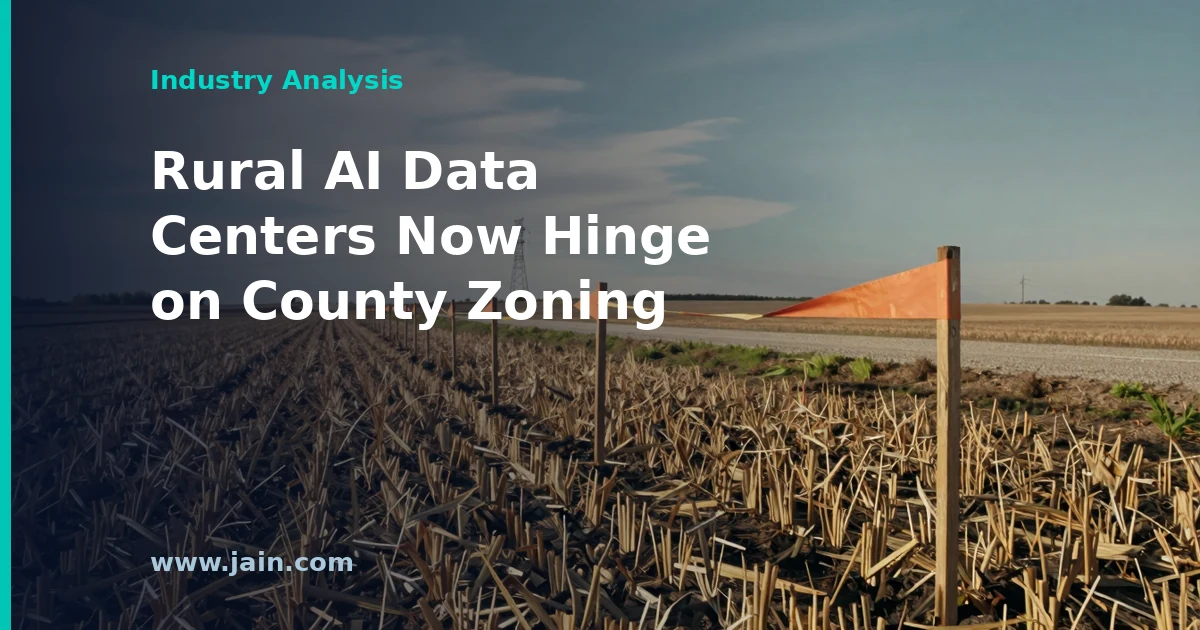
A farm county in southeast Nebraska has put new data centers on hold for up to a year. Data centers are the huge warehouse-like buildings full of computers that run artificial intelligence.
Residents were alarmed by reports of a Google plan for a Nebraska facility that could use more than three times the electricity of the entire city of Lincoln on a hot summer day. They asked about water, power bills and heat.
A new state law now gives counties a deadline to rule on some projects. Counties without rules may pause first and write rules later.
The Otoe County Board of Commissioners in southeast Nebraska voted on Tuesday, May 19, to suspend the permits needed for a new data center for up to a year, Nebraska Public Media reported, carrying reporting by the Flatwater Free Press. Commissioner Chuck Cole said the pause is meant to give county officials time to study the issue and update county regulations.
The vote followed local concern about a Google proposal for a large Nebraska data center. According to documents shared at a private utility meeting in January, that facility could require more than triple the electricity the city of Lincoln uses during its hottest months. The proposal did not name a site. The Omaha-based energy developer Tenaska, described as a potential partner, has optioned large tracts of land in southeast Nebraska, including in Otoe and Gage counties. Gage County’s planning and zoning commission is scheduled to hold a hearing on its own moratorium in June.
Executive Summary
Otoe County has not rejected data centers. It has stopped issuing the permits for one while it writes rules it does not yet have. That distinction matters to anyone planning large AI facilities in rural America. The practical obstacle in Otoe is not a lack of electricity or land. It is the absence of a local rulebook that can answer residents’ questions about water, power costs and heat before a project arrives.
Two new Nebraska laws raise the stakes. One allows private power plants built to serve a single large industrial customer to connect to the grid. That law is widely seen as aimed at data centers and was backed by Tenaska’s CEO at a legislative hearing. The other law requires counties to rule on some projects within a fixed period. Jon Cannon of the Nebraska Association of County Officials said that deadline may prompt counties to adopt moratoriums first so they are not forced to rule without regulations in place.
Otoe is one of several signals. Madison County now requires a special permit for data centers, Gage County is weighing a pause, and, according to the report, at least 14 states have considered statewide moratoriums this year.
A Pause to Write Rules, Not a Permanent No
A moratorium is a temporary halt on a category of approvals. Otoe’s suspends data center permits for up to a year. The board framed it as time to study the issue and update its regulations, not as a verdict on the industry. Wynee Benedict, one of the residents who pushed for it, described the goal in regulatory terms: “We needed regulations on the books prior to a data center coming to this county. We don’t want to have to play catch up and regulate something that’s already here.”
Residents did not all agree. Jim Nemec supported time to study the issue but warned about the signal it sends: “Are we sending out the impression that business is closed here?” That is a fair concern. A county that pauses without a clear end date, or that uses the year to write rules nobody can meet, risks becoming a place developers skip. A county that uses the year to publish clear standards on water, noise, setbacks and power costs may become an easier place to build than one with no rules at all. Setbacks are required distances from homes or roads. The ordinance the county drafts will matter more than the vote itself.
Why AI Siting Now Runs Through the County Board
This is the core of the story. The scale being discussed in southeast Nebraska is large. The Google proposal could require more than triple Lincoln’s summer electricity use, and the organizers in Gage County said they understood it would include a private natural gas plant. At that size, a project needs the grid connection, the generation, the land and the local land-use permit. The state has now eased the power question by allowing private generation dedicated to a large customer. Tenaska has reportedly secured land options, which are contracts giving it the right to buy or lease land later. The piece still in doubt is the county permit, and in Otoe that piece is now frozen for up to a year.
The state’s new decision-deadline law pushes counties in the same direction. It was intended to stop counties from stalling projects indefinitely. But a county with no data center rules that faces a firm deadline to decide on an application has two choices: rule without standards, or pause until it has them. Cannon expects many to pause, and not only for data centers. For developers this matters a great deal. A law designed to shorten approvals could lengthen them in counties that are not ready, and in the short term the counties that are not ready are most of the rural counties where land and gas access make these projects attractive.
This should not be overstated. One county’s vote is not a statewide trend, and Cannon himself said attitudes will vary from county to county, as they have for wind and solar. But Otoe, Madison and Gage have all acted or scheduled action within weeks of each other, and all three are responding to the same prospect. That points to county zoning as the next checkpoint for rural AI campuses, alongside power and fiber.
Power Was Handled in Lincoln; Water Was Left to the Counties
Nebraska’s legislature and Gov. Jim Pillen addressed the energy question directly. The private-generation law is meant to keep large new loads from burdening existing ratepayers. Virginia shows what happens when this goes unaddressed. Joe Lerch of the Virginia Association of Counties said the state’s main utility has had to postpone connecting some new data centers for lack of power and transmission capacity.
Water got no equivalent state-level answer, and in Otoe and Gage it is the concern residents raise first. Gage County organizer Anna Wolken said the top issue would be water, because both a gas plant and a data center can draw on it. Gas plants use water for cooling, and many data centers use water to carry heat away from their servers. How much depends heavily on the cooling design. Air-based and closed-loop systems use far less than evaporative ones. Nobody involved has said publicly which approach the proposed facility would use.
A separate transparency law will require data centers to report their owners, size, location, annual electricity demand, water use and tax incentives each year. That gives county officials comparable data for future decisions. It does not help a county decide on a first project before any such reports exist, which is exactly Otoe’s situation.
What Developers Can Take From Otoe
Cannon’s advice to developers was practical: tell residents early. He described what happens when neighbors learn about a project from each other, through someone who “just signed this big contract for a right of way.” In Otoe and Gage, residents appear to have learned of the potential project through press reporting on a private utility meeting and through land options. It was not an announcement from the companies. A community that pieces a project together from secondhand reports tends to fill the gaps with worst-case assumptions.
The lesson for anyone siting AI capacity in rural areas is that the time-consuming work may be local rather than technical. That means disclosing water and cooling plans, explaining who pays for power, and engaging before the zoning agenda is set. Developers who bring those answers to a county writing its first ordinance have a chance to help set the terms. Developers who arrive afterward will be working within rules written without their input.
Background
Otoe County sits in southeast Nebraska. Its county seat is Nebraska City, south of Omaha and east of Lincoln. Like many rural counties, it has previously dealt with controversial large developments such as wind and solar farms. Its land-use rules were not written with hyperscale data centers in mind. Hyperscale refers to the very large facilities built by major cloud and AI companies.
Demand for AI computing has driven a nationwide search for sites with available land, power and water. Established hubs such as Northern Virginia have run into grid limits. Nebraska responded in 2026 with a law allowing dedicated private power generation for large customers and a separate law requiring annual public reporting on data center energy and water use.
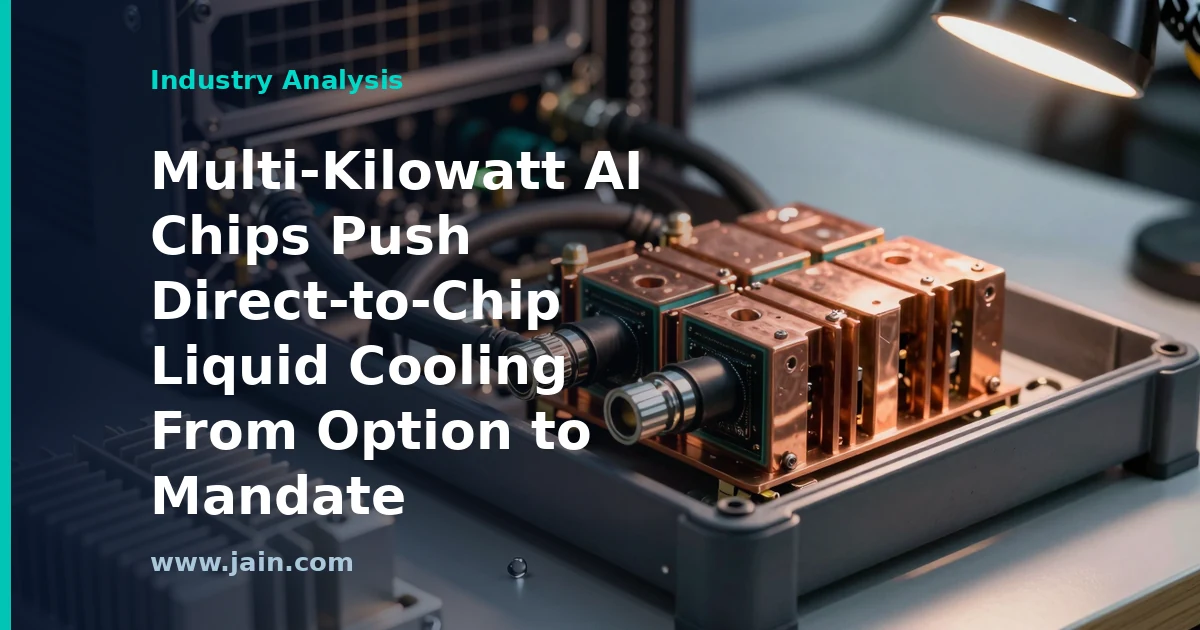
Engineering trade publication Electronics360 published an analysis on May 24, 2026 arguing that direct-to-chip (D2C) liquid cooling — circulating coolant through cold plates mounted directly on processors — has crossed from a design option to a practical requirement, driven by AI accelerator chips whose power draw has reached the multi-kilowatt range per device.
The piece frames this as the end of an era: air cooling, the default thermal strategy for data centers since the industry’s beginning, can no longer keep pace with the heat that flagship AI silicon produces in the small area of a single chip package.
Executive Summary
The core claim is thermodynamic rather than commercial: individual AI processors now dissipate thousands of watts each, and moving that much heat out of a dense rack with air alone requires airflow volumes and temperature differentials that become impractical or impossible at the densities AI clusters demand. Direct-to-chip liquid cooling, which places a liquid-filled cold plate against the chip itself, removes heat far more efficiently because liquids carry heat orders of magnitude better than air.
Why it matters: if D2C is genuinely mandatory rather than optional, every layer of the data-center stack changes — facility design, plumbing, power distribution, rack architecture, maintenance skills, and capital budgets. Operators of existing air-cooled facilities face retrofit decisions, and new builds are being designed liquid-first. For an industry that standardized on air handling for decades, this is a foundational transition, not an incremental upgrade.
Physics Ended the Debate Before the Market Did
Air cooling persisted as the default not because it was elegant but because it was cheap, simple, and universally understood. Its limitation is fundamental: air is a poor heat conductor, so cooling a hotter chip means moving more air, faster, across larger heatsinks. As AI accelerators pushed past one kilowatt per device — with roadmaps pointing well beyond — the heat concentrated in a few square centimeters of silicon began to exceed what any realistic airflow can absorb. Water and engineered coolants transfer heat dramatically more effectively, which is why cold plates bolted directly onto the chip package have become the pragmatic answer.
The word ‘mandatory’ in the source’s framing is worth taking seriously but precisely. Air cooling is not disappearing from data centers generally — the vast installed base of conventional enterprise and cloud workloads runs at rack densities air handles fine. The mandate applies to the frontier: dense AI training and inference clusters built around multi-kilowatt accelerators. That distinction matters for anyone budgeting a transition.
The Retrofit Question Splits the Market
Liquid-first design is straightforward in a new build: coolant distribution units, manifolds, leak detection, and higher floor loading are engineered in from day one. Retrofitting an existing air-cooled facility is harder. Piping must be routed through spaces never designed for it, water supply and heat-rejection capacity must be added, and operations teams must learn to manage a system where a leak — rare but nonzero — sits inches from expensive silicon.
This creates a divergence in asset value across the industry. Facilities that can economically accept liquid cooling — because of their power capacity, structure, and location — become more valuable as AI demand grows. Older facilities that cannot may be relegated to lower-density workloads. Colocation providers, hyperscalers, and enterprise operators are all making that assessment now, and the answers will shape which real estate wins the AI buildout.
A New Supply Chain Rises Around the Cold Plate
A shift of this scale redraws the vendor landscape. Demand moves toward cold plates, coolant distribution units, quick-disconnect fittings, dielectric and water-based coolants, leak-detection systems, and rear-door or facility-level heat exchangers — categories that were niche a few years ago. Established thermal-management and precision-cooling vendors are competing with newer specialists, and chip and server makers increasingly ship liquid-ready designs, effectively deciding the question for their customers.
There is also an efficiency dividend. Because liquid captures heat at the source, less energy is spent on fans and air handling, and the warm coolant leaves at temperatures useful for heat reuse in some settings. For operators facing scrutiny over data-center energy consumption, D2C offers a genuine efficiency story — though it introduces its own considerations around water use and coolant handling that deserve equally honest accounting.
Background
For most of computing history, data centers were cooled the same way: chilled air pushed through raised floors or ducts, across finned metal heatsinks, and back to air-handling units. That model worked because individual chips drew tens or hundreds of watts. The AI era broke the assumption — training and running large models rewards packing the most powerful accelerators as densely as possible, and each generation of AI silicon has raised per-chip power substantially, crossing the kilowatt mark and continuing upward.
Liquid cooling itself is not new; mainframes and supercomputers used water cooling decades ago before commodity air-cooled servers displaced them on cost. What has changed is that the physics that once made liquid cooling a supercomputing niche now applies to mainstream AI infrastructure, pulling a once-specialist discipline back to the center of data-center design.
Source: Multi-kilowatt chips make D2C cooling mandatory — Electronics360 analysis (May 24, 2026) on why multi-kilowatt AI processors are forcing data centers from air cooling to direct-to-chip liquid cooling.