Amazon plans to spend $1 billion on the towns and counties where it builds data centers. Data centers are the giant warehouses of computers that run websites, apps and artificial intelligence tools.
The pledge comes as more neighbors push back against new data centers being built near them.
Why it matters: winning local approval has become something tech companies pay for. If the money gets projects approved faster, other companies will likely copy it. If it doesn’t, the delays stay.
AP News reported that Amazon plans to invest $1 billion in communities that host its data centers, amid growing backlash against data center rollouts. The commitment is aimed at the localities where Amazon builds and operates the facilities behind its cloud and AI computing services.
Executive Summary
Amazon is putting a single, company-level figure on something data center developers have usually handled project by project: the cost of keeping host communities on side. A $1 billion pledge directed at those communities, made explicitly against a backdrop of local opposition, moves community relations from a public-relations task to a budgeted cost of building capacity.
The pledge matters because local decisions, such as zoning, special-use permits and public hearings, increasingly set how fast new data center capacity comes online. That capacity is the physical foundation for AI. Every month a site spends in approvals is a month the computing it would house is not available.
The open question is whether money buys speed. A pledge counts as infrastructure strategy only if it shortens approval timelines or reduces the share of projects stalled by opposition. Otherwise it is goodwill spending.
Local Consent Becomes a Line Item
Building a data center depends on a chain of local approvals: rezoning land, securing special-use or building permits, negotiating tax arrangements and, often, getting through public hearings where residents can object. Each step is a point where opposition can add months or stop a project. For a company building capacity to meet AI demand, that delay has a direct cost: the land, equipment orders and power arrangements sit idle while the approval clock runs.
Developers have long offered site-specific concessions, such as road improvements, local hiring or school funding, negotiated one project at a time. A $1 billion pledge aimed at host communities, announced as a single corporate commitment in response to backlash, changes that. It treats community acceptance as a recurring cost of doing business, budgeted like land, power or construction. That is the core of the shift: Amazon is acknowledging that local consent is now an input to capacity, not an afterthought.
The people affected are the ones on both sides of the approval table. Local officials gain bargaining weight. Utilities and regional planners may see projects move faster or slower depending on how hearings go. Competing developers now negotiate against a visible benchmark.
The Test Is Speed, Not Goodwill
Whether the pledge works depends less on its size than on its design. Money that is written into binding, site-specific agreements, often called community benefit agreements, gives local boards something enforceable to point to when they vote. Discretionary grants announced at the corporate level are easier to dismiss as public relations, especially by residents whose objections concern the facility itself rather than a lack of local funding.
The concerns raised against data centers in many markets include strain on the electric grid and possible effects on household power bills, water use for cooling, noise from equipment, loss of farmland or open space, and tax breaks that reduce local revenue. Funding a park does not answer a question about the grid. The pledge is most likely to speed approvals where the money is matched to the specific objection at each site, for example by offsetting infrastructure costs residents fear they will bear.
The measurable outcomes are concrete: shorter time from site announcement to approval, fewer projects withdrawn or denied, and fewer conditions attached late in the process. Those are the numbers that would show whether this is infrastructure strategy.
A New Baseline for Everyone Else
Every large cloud provider and data center developer goes through the same local processes. If Amazon’s approach visibly shortens approval timelines, competitors have a strong reason to match it. That would raise the starting point in every future negotiation. Large hyperscalers, the biggest cloud companies, can absorb that cost. Smaller developers and colocation operators, which rent data center space to multiple tenants, may find it harder to compete for contested sites.
There are risks on both sides of the argument. For the industry, a large pledge can draw more scrutiny rather than less if residents see it as an attempt to buy approvals rather than resolve concerns. For critics, the pledge is a direct test of their case: if the objections are about real local costs, well-designed community investment should address some of them. If opposition continues regardless, it suggests the concerns lie with the facilities themselves, which no payment fixes. Both readings deserve to be tested against what happens at actual sites.
Background
Amazon, through its Amazon Web Services cloud unit, is one of the world’s largest builders and operators of data centers, the facilities that store data and run software for millions of customers. Demand for computing, particularly for training and running AI models, has driven a wave of large data center construction by the biggest cloud providers, often called hyperscalers.
As these facilities have grown larger and more numerous, they have drawn more attention from the communities around them. Local zoning boards, county commissions and public hearings, once routine steps, have become points where residents can raise objections about power, water, noise and land use. That has made community relations a factor in how quickly new capacity can be delivered.
Digital Realty, a company that builds data centers and rents them out, wants to raise $3 billion from outside investors to pay for very large ones in the Americas.
Data centers are warehouse-sized buildings full of computers that run online services and artificial intelligence. The biggest ones cost so much that even large owners share the bill with investors.
Why it matters: how much money investors actually put in will help decide how many of these buildings get built, and how fast.
IPE Real Assets reported that Digital Realty Trust (DLR) is targeting $3 billion for a fund dedicated to hyperscale data centers in the Americas. Hyperscale facilities are the very large buildings and campuses leased to the biggest cloud and technology companies. The fund would pool capital from outside investors to finance them alongside Digital Realty’s own balance sheet.
The figure is a fundraising target, not a completed raise. No first close, named investors, specific campuses or capacity figures have been disclosed.
Executive Summary
Digital Realty is seeking $3 billion of outside capital for a vehicle focused on hyperscale data centers across the Americas. For a publicly listed real estate investment trust, a private fund is a way to fund capital-intensive campus development without relying only on new shares or corporate debt, while keeping a role as manager and co-owner.
The significance lies in who ends up setting the pace. For the projects routed through this vehicle, the scale of construction depends on how much investors commit and on what terms, not only on Digital Realty’s own capacity to borrow or issue stock. That gives limited partners, the institutions that supply fund capital, a meaningful influence over how much hyperscale capacity this structure can finance.
What the target does not yet show is equally important: how many megawatts the fund covers, which markets, whether tenants are already signed, and whether grid power is secured. Those details will determine whether $3 billion translates into near-term capacity or a longer pipeline.
A $3 Billion Target Is a Ceiling Investors Set
A fundraising target is an ambition, not a bank balance. When a sponsor such as Digital Realty says it is targeting $3 billion, it is telling prospective investors, typically pension funds, insurers and sovereign wealth funds known as limited partners, how large it hopes the vehicle will be. Commitments arrive over one or more closings, and the final total can land below, at or above the target. The committed figure, not the headline, determines how much development the fund can underwrite.
That is the mechanism behind the headline. For whatever share of Digital Realty’s Americas hyperscale pipeline flows through this vehicle, the pace of building (how many campuses break ground, and when) depends on how much outside equity arrives and on the terms investors accept. Borrowing can stretch fund equity further, but lenders generally size loans against the equity beneath them, so investor appetite still sets the base. Digital Realty’s balance sheet remains a funding source. The fund adds a second one whose size the company does not fully control.
The effects reach beyond the REIT. Hyperscale tenants, the cloud and AI companies that lease whole buildings or campuses, gain a capacity source that does not hinge solely on one listed company’s share price and credit. Utilities and equipment suppliers planning around these campuses gain another variable to track: capital availability alongside power availability.
Why a Listed Landlord Shares the Bill
Real estate investment trusts must pay out most of their taxable income as dividends, which limits the cash they can retain for construction. Large hyperscale developments are capital-intensive and take years to reach full rent, so funding them only through retained cash, new shares or corporate debt either dilutes existing shareholders or raises leverage. A private fund offers a third route: outside investors supply much of the equity, while the sponsor typically keeps a stake, manages the assets and collects fees.
The trade-off is that Digital Realty would share the economics of the assets it places in the vehicle. Fee income and a smaller capital outlay per project come at the cost of a smaller ownership slice. For shareholders, the question is whether fees and faster growth outweigh the returns passed to fund partners, a balance that depends on terms that have not been made public.
For institutions, a dedicated vehicle offers direct exposure to hyperscale data centers through an established developer-operator, rather than indirect exposure through listed REIT shares. How strongly they respond to the $3 billion target will be an early signal of how much private capital remains available for this segment.
What Would Make the Fund Matter
The dollar figure matters less than what those dollars buy. The details that would show the fund’s real reach (megawatts of capacity, specific campuses, pre-signed leases, secured grid connections) have not been disclosed. A fund backing pre-leased capacity with power already secured carries very different risk from one financing land that still awaits utility service and tenants.
The “Americas” label also deserves attention. It suggests a mandate that may extend beyond the United States, but no markets have been named. Power availability, permitting timelines and customer demand vary widely across the region, and the fund’s geographic mix will shape both its returns and where new hyperscale capacity actually appears.
Background
Digital Realty Trust, traded under the ticker DLR, is a real estate investment trust that develops, owns and leases data centers to enterprises and large cloud providers. As a REIT, it distributes most of its taxable income to shareholders, which shapes how it funds new construction.
The hyperscale segment, meaning very large facilities built for the biggest cloud and AI customers, is one of the most capital-intensive parts of digital infrastructure. Operators across the industry have increasingly paired their own balance sheets with joint ventures and private funds to finance campus-scale development, sharing ownership in exchange for access to institutional capital.
Amazon is reportedly trying to sell about $8 billion worth of Nvidia computer chips (the specialized processors that power artificial intelligence services) to outside investors.
That is unusual. Big tech companies normally buy these chips and keep them. Selling them would let Amazon free up cash while someone else owns the hardware.
The catch is that these chips can lose value quickly as newer models arrive. Investors who buy in are betting the chips stay useful long enough to pay off. That bet could shape how the artificial intelligence boom gets paid for.
Amazon is seeking to sell roughly $8 billion worth of Nvidia chips to investors, Reuters reported, citing the Financial Times. The chips are graphics processing units (GPUs), the processors that train and run most large AI models. Amazon has not publicly disclosed the structure, the buyers, the pricing or the timing of the transaction, and the effort is described as being sought rather than completed.
Executive Summary
The world’s largest cloud provider is reportedly looking to move a large block of AI hardware it already owns into the hands of outside investors. At $8 billion, this would be one of the largest single transfers of GPU ownership from a hyperscaler (the industry term for the handful of giant cloud operators such as Amazon Web Services, Microsoft Azure and Google Cloud) to financial buyers.
The transaction matters less for what it does to Amazon’s AI capacity, which has not been disclosed, than for what it asks of the buyers. Anyone paying $8 billion for GPUs has to put a price on things the industry has argued about for two years: how fast these chips become obsolete, how reliably they will be rented out, and who is on the hook if they are not. The answer will show whether AI compute can be financed like aircraft or real estate, as an asset owned by one party and used by another, or whether it stays an asset that only the largest technology companies can hold.
Why a Cloud Giant Would Sell Chips It Already Owns
Hyperscalers have historically funded data center buildouts themselves, out of operating cash flow and corporate bonds, and owned the servers inside outright. Selling installed or purchased hardware breaks with that pattern. Amazon has not explained its reasons. Transactions of this kind usually serve one of two purposes. The first is capital recycling: convert hardware into cash that can be redeployed into new data centers, power contracts or newer chips. The second is balance-sheet management: shift ownership, and with it the depreciation (the accounting charge that spreads a purchase’s cost over its useful life), to another party.
Which purpose applies depends on a detail Amazon has not disclosed: whether it keeps using the chips. In a sale-leaseback, a familiar structure in real estate and aviation, the seller hands over ownership and pays rent to keep operating the asset. In an outright sale, the chips leave Amazon’s fleet entirely. The two lead to very different conclusions about Amazon’s own capacity plans, which is why the reported $8 billion figure alone does not show whether Amazon is adding flexibility or reducing exposure.
What an $8 Billion GPU Buyer Actually Has to Underwrite
This is where the transaction becomes a test of GPUs as an investable asset. A building or a jet has decades of useful life and a deep resale market. An AI accelerator has neither. Nvidia releases new chip generations on a short cycle, and each one resets the performance customers expect per dollar and per watt. An investor holding older GPUs is exposed to that curve. The hardware may still work perfectly, but the rent it can command falls as newer chips arrive.
That leaves a buyer two ways to earn a return, and each has a different risk. If Amazon leases the chips back, the investor is mostly underwriting Amazon’s promise to pay. That is a strong credit, and the deal starts to look like corporate lending with GPUs as collateral. If Amazon does not lease them back, the investor is underwriting the chips themselves: their resale value, the cost of hosting and powering them elsewhere, and the strength of demand from other cloud tenants. Pricing that second scenario at $8 billion would be a much bolder bet on GPU residual value, meaning what the hardware is worth after its first few years of use.
Either way, the price investors will pay is information the market has lacked. Little public data exists on what large blocks of used AI accelerators are worth to financial buyers. A completed transaction at this size would give lenders, insurers and equipment financiers a reference point for valuing GPU collateral elsewhere in the industry.
Who Gains if GPUs Become a Financed Asset
If investor appetite proves deep, the most immediate beneficiaries are capital-hungry builders outside Big Tech: specialist GPU cloud providers, often called neoclouds, and data center developers whose growth depends on borrowing against hardware. A market in which a hyperscaler can sell GPUs to investors is also one in which a smaller operator can borrow against them more easily. For hyperscalers, it adds a funding channel at a time when AI capital spending is large enough to draw scrutiny from shareholders.
The risks fall on the other side of the ledger. Moving hardware ownership to investors does not remove the obsolescence risk. It relocates it, possibly into funds and credit vehicles that are less able to absorb a fast drop in chip values than a cloud operator that can redeploy older chips to cheaper workloads. For Nvidia, the transaction involves chips already sold and does not by itself change its revenue. A deeper financing market could still widen the pool of buyers able to afford its next generation. That makes the terms of any completed deal more informative than the headline number.
Background
Amazon Web Services is Amazon’s cloud computing division and one of the largest buyers of AI hardware in the world. It purchases Nvidia GPUs and also designs its own AI chips, including Trainium. Nvidia is the leading supplier of the accelerators used to train and run large AI models, and it releases new chip generations on a short cycle.
Hyperscalers have traditionally financed data centers and servers themselves and owned that hardware outright. As AI spending has grown, outside capital has moved into the sector. Specialist GPU cloud providers routinely borrow against their chips, and investors have debated how quickly AI accelerators lose value. The reported Amazon transaction brings that financing model to the scale of the largest cloud operator.
An Australian company called Sharon AI has borrowed 356 million US dollars and pledged the computer chips it is buying as security, much like a mortgage uses the house.
The chips are powerful Nvidia processors that run artificial intelligence. The loan costs about 10 percent a year, and Goldman Sachs is among the lenders.
The twist: lenders get repaid from what customers pay to rent those chips. So the loan really rests on Sharon AI’s customer deals, and it is only the first of several loans behind a plan to install 68,000 chips by mid-2027.
SharonAI Holdings Inc. (NASDAQ: SHAZ), an Australian provider of AI computing infrastructure, announced on October 1, 2026 that it has entered its first GPU-backed debt facility: a US$356 million committed, senior secured loan held in a special purpose vehicle and priced at a fixed 9.95%, excluding fees. The facility is secured against the GPUs and their associated cash flows, and proceeds will fund compute capacity dedicated to customer contracts.
Lenders include Goldman Sachs and select large private credit funds alongside Australian, Asian and global investors, with Jarden Australia acting as sole financial advisor and arranger. Sharon AI called it the first in an expected series of GPU financings supporting more than 68,000 NVIDIA GPUs deployed by mid-2027, and said it has now secured more than US$2.6 billion of debt and equity capital over ten months against a customer contract book worth more than US$8.8 billion.
Executive Summary
Sharon AI has opened a new funding channel for its GPU fleet: debt secured directly by the chips and the customer revenue they generate. The US$356 million facility is modest against the company’s 68,000-GPU build-out plan, but Sharon AI presents it as the template for a series of similar financings, shifting part of its hardware funding from equity to borrowed money at a fixed 9.95% rate before fees.
The significance lies in the structure. Because the security package combines hardware and contracted cash flows, the lenders are effectively underwriting Sharon AI’s customer contracts, with GPU resale value as the fallback. That makes the quality, length and enforceability of those contracts, rather than raw chip count, the variable that determines how much Sharon AI can borrow and at what price.
The deal also lands days after Sharon AI disclosed a change of auditor to Ernst & Young and announced a confidential-computing collaboration with VAST Data aimed at regulated customers, two developments that bear on how lenders and investors will judge the company’s reporting and its contract pipeline.
The Chip Is the Collateral, the Contract Is the Repayment
Sharon AI describes the facility as senior secured and GPU-backed, held in a special purpose vehicle (SPV), a separate legal entity set up to own specific assets and borrow against them. The security is “the GPUs and associated cash flows,” and proceeds will fund compute “dedicated to customer contracts.” Senior secured means these lenders are paid first and hold a direct claim on the pledged assets.
Put those pieces together and the lenders’ position becomes clear. In normal operation, the debt is serviced from what customers pay to use the specific GPUs inside the SPV. The chips themselves matter mainly if something goes wrong: if a customer stops paying or the SPV defaults, lenders can claim the hardware and its revenue stream. From the lender’s seat, each GPU is worth largely what its attached contract is expected to earn over the life of the loan, with resale value as the backstop.
That has consequences beyond Sharon AI’s balance sheet. Graphics processors are a fast-moving asset class, and each new NVIDIA generation can change what older chips fetch on the secondary market. A lender relying on resale value alone would carry that risk directly. Tying security to contracted cash flows moves the central credit question from what a chip will be worth at the end of the loan to whether the customer will keep paying, which makes the strength and duration of the customer book the main driver of how cheaply an AI cloud operator can finance hardware.
What a Fixed 9.95% Buys, and What It Leaves Out
The 9.95% rate is fixed, so Sharon AI’s interest bill will not rise if benchmark rates do, a useful match for revenue that comes from multi-year contracts at agreed prices. The figure explicitly excludes fees, however. Arrangement and commitment fees on structured facilities can be meaningful, so the all-in cost of this borrowing is higher than 9.95% by an amount the company has not stated.
Chief Executive James Manning said the structure is “designed to enhance return on equity.” The mechanism is simple: if the GPUs earn more than the cost of debt, borrowing lets shareholders keep the difference on a smaller equity base. The arithmetic also runs in reverse. If utilization, pricing or customer payments fall short, leverage magnifies losses for equity holders, who rank behind senior lenders. Whether the claim holds depends on contract economics Sharon AI has not published.
The lender roster adds context. Goldman Sachs and “select large private credit funds” sit alongside Australian and Asian investors. Private credit, meaning lending by investment funds rather than banks, commonly provides asset-backed loans of this kind, and a committed facility (money promised up to a limit) gives Sharon AI drawable capacity as deployments come online.
$356 Million Is the Opening Tranche of a 68,000-GPU Plan
Sharon AI calls the facility “the first in an expected series of GPU financings” behind a scheduled build-out of more than 68,000 NVIDIA GPUs by mid-2027. It has not said how many of those chips this US$356 million covers, but the framing is clear: this is a repeatable structure, not the whole bill.
Two company figures set the scale. Sharon AI says it has secured more than US$2.6 billion of institutional debt and equity over the past ten months, and that its customer offtake, meaning contracted commitments to buy compute, stands at a total contract value (TCV) above US$8.8 billion. TCV sums the full value of contracts across their entire terms, so it is not annual revenue, and its worth to a lender depends on contract length, cancellation rights and counterparty strength. Sharon AI lists hyperscalers (the largest cloud platforms), AI-native companies, government, enterprise and research organizations among its customers, without naming those behind this facility.
The company is also building product features for regulated buyers. On September 23 it announced a collaboration with VAST Data to offer VAST DataEnclave, a confidential-computing environment in which, the companies say, customer data and model weights remain encrypted even from Sharon AI as operator, targeting banks, government agencies and other regulated organizations. If such features help win long-dated contracts from institutional customers, they feed directly into the cash flows that secure facilities like this one.
Reporting Discipline Matters More Once Debt Is Layered In
Lenders monitor borrowers through their financial reporting, so audit quality becomes more important as debt is added. In an 8-K filed September 24, Sharon AI disclosed that its Audit Committee approved ending HoganTaylor LLP’s engagement on September 20 and engaged Ernst & Young on September 23 for the fiscal 2026 audit, following a competitive process involving several firms.
The filing states there were no disagreements with HoganTaylor and that its audit reports for 2024 and 2025 carried no adverse or qualified opinions. It does list one reportable event: a material weakness, meaning a significant gap in internal controls over financial reporting, identified by HoganTaylor and disclosed in the 10-K filed March 31, 2026. Moving to a Big Four auditor is a common step for a growing public company, and the filing gives no indication of a dispute. It does not say whether the material weakness has been remediated, and for a borrower planning a series of GPU-backed facilities, reliable controls over cash flows and asset records are part of what lenders are underwriting.
Background
SharonAI Holdings Inc. trades on Nasdaq under the ticker SHAZ and describes itself as an Australian “neocloud,” a specialist provider that rents GPU computing power for AI rather than offering general-purpose cloud services. Through its AI Factory platform and a network of technology and co-location partners (data center operators that host its equipment), it serves organizations training and running AI models, with an emphasis on sovereign infrastructure that keeps data within national borders. It reports to the SEC as an emerging growth company.
Companies in this segment typically need large sums up front to buy GPUs before customer revenue arrives, which makes financing structure central to their growth. Sharon AI says its ambition is gigawatt-scale compute capacity across Australia, New Zealand and the broader Asia-Pacific, a gigawatt being roughly the output of a large power station.
Eaton, one of the world’s biggest makers of electrical equipment, has finished enlarging its factory in Schrems, Austria. It added floor space nearly the size of an American football field in under ten months.
The new space makes small circuit breakers, the switches in a fuse box that cut power when something goes wrong, on fully automated lines. It also builds more of the larger equipment that spreads power around a building.
Why it matters: the computer warehouses behind artificial intelligence need large amounts of this gear. Eaton has not said how much more it will make.
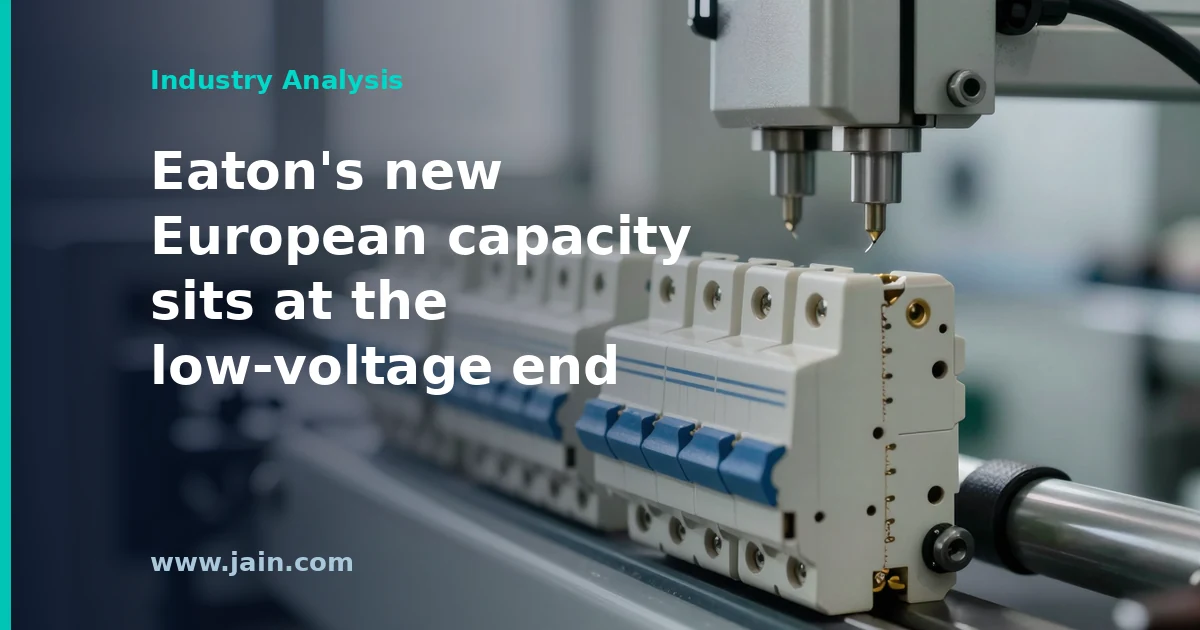
Eaton is marking the completion of a 5,000-square-metre expansion of its manufacturing site in Schrems, Austria, on 1 October 2026, according to a company announcement published by the Financial Times. The new space houses fully automated production of miniature circuit breakers (the small protective devices that sit in electrical distribution panels and trip when a circuit overloads or faults) and expanded assembly capacity for low-voltage systems.
Eaton says the project was completed in less than ten months and ties it to rising European demand from electrification, digitalisation and critical infrastructure that depends on highly available electrical power. The company did not disclose the investment amount, production volumes or headcount.
Executive Summary
Eaton, which reported $27.4 billion in 2025 revenue, has added 5,000 m² of manufacturing space at its Schrems plant in Austria. The expansion combines fully automated miniature circuit breaker production with a manufacturing execution system, software that links machines, internal logistics and enterprise systems in real time, and end-to-end traceability for every product that leaves the line.
The announcement matters to data center builders because of where the capacity sits. Miniature circuit breakers and low-voltage systems form the downstream end of a facility’s electrical chain, the layer that distributes and protects power close to racks, cooling and building systems. Large AI facilities use this equipment in volume, and Eaton names data centers among its core markets.
The announcement covers less ground than a headline about European power capacity might suggest. It says nothing about medium-voltage switchgear or transformers, and Eaton has not quantified the added output. The expansion adds European supply at the breaker and panel level. Eaton has not shown that it relieves the larger, grid-side equipment queues.
Capacity at the Low-Voltage End of the Power Chain
To see where this expansion matters for AI data centers, follow electricity from the grid to a server. Power arrives at high voltage and is stepped down by transformers. It then passes through medium-voltage switchgear, the heavy equipment that switches and protects large feeders, and into low-voltage switchboards and distribution panels. Finally, individual circuit breakers protect each circuit feeding racks, cooling units and building systems. Eaton’s Schrems expansion adds fully automated miniature circuit breaker production and more low-voltage systems assembly, which places it at the downstream end of that chain.
That placement shapes how buyers should read the news. A large data center contains a great many protected circuits, so breakers and distribution equipment are consumed in volume. More European output at this layer is relevant to electrical contractors and developers who source panels and protective devices regionally. The announcement does not mention medium-voltage switchgear or transformers. Those are the larger, more engineered items that tend to dominate discussions of power-equipment lead times on AI projects.
The practical read is that any easing this expansion brings will show up at the breaker and panel level. Projects whose schedules depend on grid-side equipment should not treat it as relief on that front. The same product families also serve Eaton’s residential, commercial, industrial and utility customers. Data center demand therefore competes for this output with every other electrification project in Europe.
Ten Months to Build, With Software Coordinating the Floor
Eaton says the expansion was completed in less than ten months. How fast a supplier can add capacity is one of the few supply-side variables it controls directly. A short build suggests Eaton can respond within a single planning cycle when it decides a product line needs more output.
The more distinctive element is the factory’s digital layer. A manufacturing execution system (MES) is the software that tells machines what to make, tracks work in progress and connects production to inventory and ordering systems. Eaton describes Schrems’ MES as linking manufacturing, intralogistics and enterprise systems in real time. Combined with end-to-end traceability, meaning each unit’s production history can be followed, this addresses what the company calls increasingly demanding performance and compliance requirements. Operators of critical facilities typically need documentation of exactly what was installed and how it was made.
Full automation also fits the product. Miniature circuit breakers are high-volume, standardised devices, the kind of item where automated lines can raise output without a proportional increase in labour. Eaton has not said what output the new lines deliver. The economic logic is sound, but its effect on supply cannot yet be measured.
Regional Manufacturing as a Supply-Chain Argument
Eaton makes its case in supply-chain terms: faster response to changing customer needs, lower logistics costs, a smaller carbon footprint from proximity to European markets, and greater resilience in critical supply chains. For European data center developers, regionally made equipment can mean shorter shipping legs and less exposure to cross-border disruption. Those advantages matter most when construction schedules are tight.
Scale needs perspective. Eaton operates across 180 countries with $27.4 billion in 2025 revenue, so a 5,000 m² addition at a single site is incremental relative to the whole company. What the expansion offers is a signal of direction. Eaton is adding European capacity in product lines that data centers consume, and it has done so quickly. That is not the same as a step change in regional supply.
The workforce element addresses a quieter constraint. Eaton points to partnerships with local schools and its Connected Learning Center, opened in 2024, as ways of building the automation and digital-manufacturing skills the site needs. Those skills determine whether new capacity can be staffed and sustained as well as installed.
Background
Eaton is a Dublin-based power management company founded in 1911. It makes electrical protection and distribution equipment for data center, utility, industrial, commercial and institutional, residential, machine building, aerospace and mobility customers. It reported $27.4 billion in revenue in 2025 and serves customers in 180 countries.
Inside a data center, power flows from the grid through transformers and medium-voltage switchgear, then into low-voltage switchboards, distribution panels and circuit breakers that protect individual circuits. Every layer must be delivered before a facility can energise. Supply of this equipment has therefore become a planning concern for AI builds, and capacity additions by major manufacturers are watched closely.
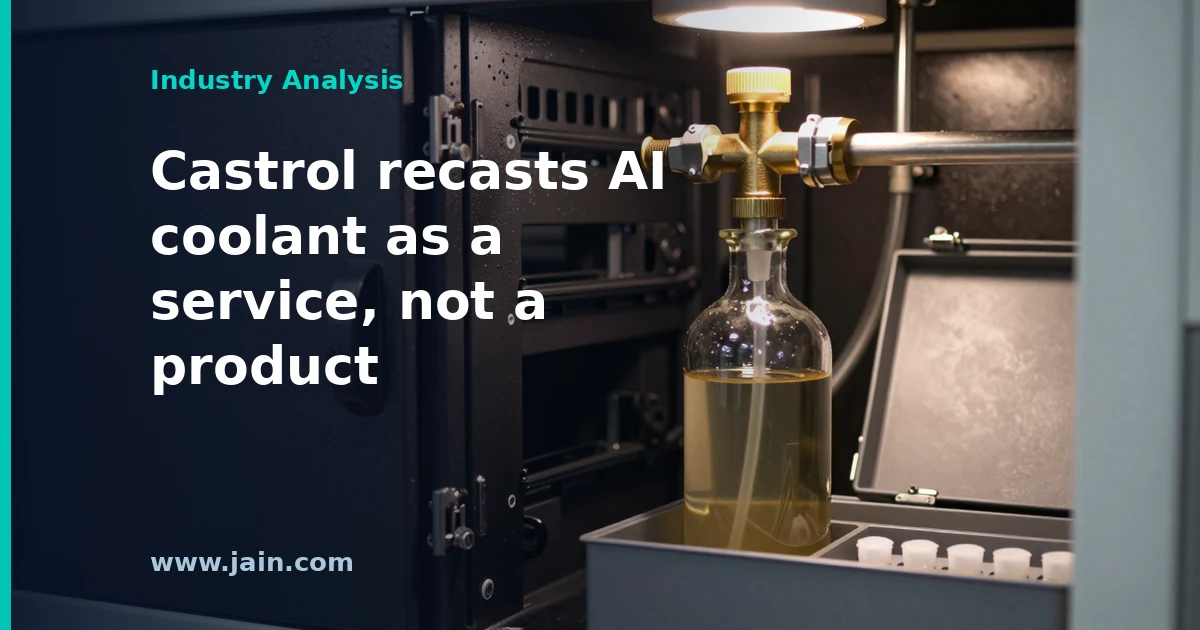
Castrol, best known for motor oil, is now selling a full package to keep the computers behind artificial intelligence from overheating.
Those chips run so hot that many buildings now cool them with liquid instead of fans. Castrol says it will help design those cooling systems, supply the fluid, test it, and look after it for years, backed by service teams in more than 150 countries.
This matters because a cooling failure can knock very expensive computers offline. Castrol is wagering that customers would rather pay one company to own that risk.
Castrol announced on September 29, 2026, from Singapore, the launch of Castrol CORE, an end-to-end thermal management offer for data centers, in a release distributed through PR Newswire. The package combines Castrol’s cooling fluid technology with testing, new design capabilities, and support through deployment, commissioning, operation and maintenance. It is backed by Castrol labs in the UK, US, Germany and China, joint labs across Asia, and a service-provider network covering more than 150 countries.
Castrol says its cooling technology has been tested and validated by leading chip and hardware makers including NVIDIA and Intel. It has completed a proof-of-concept program with an unnamed major data center operator in China and is working with other global operators on similar projects.
Executive Summary
Castrol CORE is Castrol’s move from selling cooling fluid to selling responsibility for how that fluid performs over a facility’s life. Rather than supplying a product that operators must integrate with hardware from other vendors, Castrol says it will act as a single point of contact, coordinating a network of partners in products, infrastructure, design and services. The company attributes the shift to its own industry study, which it says found rising demand for integrated thermal management, plus concerns about supply chains and the high cost of failures.
The launch matters because liquid cooling, circulating fluid close to or around hot chips instead of relying on air, is becoming a standard requirement for AI and high-performance computing. When cooling moves from fans to fluids, the chemistry of the fluid becomes part of the uptime equation. A supplier that tests and monitors that fluid on site, across more than 150 countries, is offering something closer to an operational guarantee than a commodity.
What Castrol has not disclosed is how much of this is already contracted. It names no customers, deployed capacity, pricing or performance commitments, so CORE is best read as a clear statement of strategy with one completed pilot behind it.
Why a Coolant Maker Is Selling Accountability
The core of the announcement is a change in what the customer is paying for. Castrol says CORE covers the full lifecycle, from early design and specification through deployment, commissioning, operation and maintenance, and that its service network in more than 150 countries enables ongoing testing, validation and on-site monitoring to reduce the risk of costly interruptions. That is the mechanism behind the headline: the fluid is no longer the whole product. It is the anchor for a recurring relationship built around keeping the cooling loop healthy.
This follows from how liquid cooling works. In an air-cooled hall, a failing fan is a swappable part. In a liquid-cooled system, the fluid’s condition, including contamination, degradation or incompatibility with pumps, seals and cold plates, can affect every server on the loop. Castrol’s own study, it says, flagged the high cost of failures as a major industry concern. A supplier that samples and validates fluid on site throughout a facility’s life is effectively selling a reduction in that risk, and the geographic reach of the service network is what makes that promise credible for operators with sites on several continents.
The people most affected are data center operators and the engineering firms that design their facilities. For operators, a single interlocutor could simplify procurement and clarify who is responsible when something goes wrong. For design and integration firms, a fluid supplier moving upstream into design is a new participant in work they have typically led. Castrol frames this as partnership, saying CORE brings together specialists across products, infrastructure, design and services, but the balance of who leads a project will depend on terms it has not yet published.
What Chipmaker Validation Does and Does Not Establish
Castrol’s strongest technical claim is that its cooling technology has been tested and validated by leading chip and hardware makers, including NVIDIA and Intel. For buyers, validation from the companies whose processors are being cooled carries real weight, because running an unapproved fluid can raise questions about hardware compatibility and support.
The claim is also broad. Castrol does not specify which products or platforms were validated, whether the fluids are for direct-to-chip cooling (where liquid flows through plates mounted on processors) or immersion cooling (where servers sit submerged in a non-conductive fluid), or what the validation tested. Operators evaluating CORE will want that detail, since compatibility with one generation of hardware does not automatically carry over to the next.
Asia-Pacific as the Proving Ground
Castrol has set up a regional data center design team in Asia-Pacific, supported by local specialists, and describes the region as adopting new cooling infrastructure quickly. Its one disclosed field result is a completed proof-of-concept program with a leading data center operator in China, with similar projects now under way with global operators.
A proof of concept demonstrates that the approach can work in a real facility; it is not a commercial rollout. The combination of a Singapore launch, an Asian design team, joint labs across Asia and a China pilot suggests Castrol sees the region as its early market for the integrated model. Whether CORE scales from pilots into multi-site contracts is the question that will determine whether the service shift is a strategy or a business.
The Trade-Off in One-Stop Cooling
Integrated offers solve a real coordination problem, but they shift risk in both directions. For Castrol, taking on design and lifecycle responsibility means absorbing some of the liability that previously sat with integrators and operators, and managing a partner network it does not fully control. For customers, a single supplier simplifies accountability but can raise switching costs if fluids, monitoring and design are tightly bundled.
Castrol also says CORE is a platform that should gradually extend its thermal management offering beyond data centers. That signals the company views thermal management as a growth line in its own right, not a side market for lubricants, though it has not said which applications come next or on what timeline.
Background
Castrol is one of the world’s largest lubricant brands, with more than 127 years of experience formulating fluids for automotive, marine, industrial and energy applications. Its data center work sits within a dedicated Data Centers and Thermal Management division, led globally by president Peter Huang, who says customers are looking for experienced partners to handle the full range of thermal challenges rather than another standalone product.
The broader context is the rise of liquid cooling. As AI and high-performance computing push chip heat output higher, operators are adopting systems that use specialized fluids to carry heat away from processors. That has turned fluid suppliers into participants in data center design and operations, a role Castrol is now formalizing with CORE.
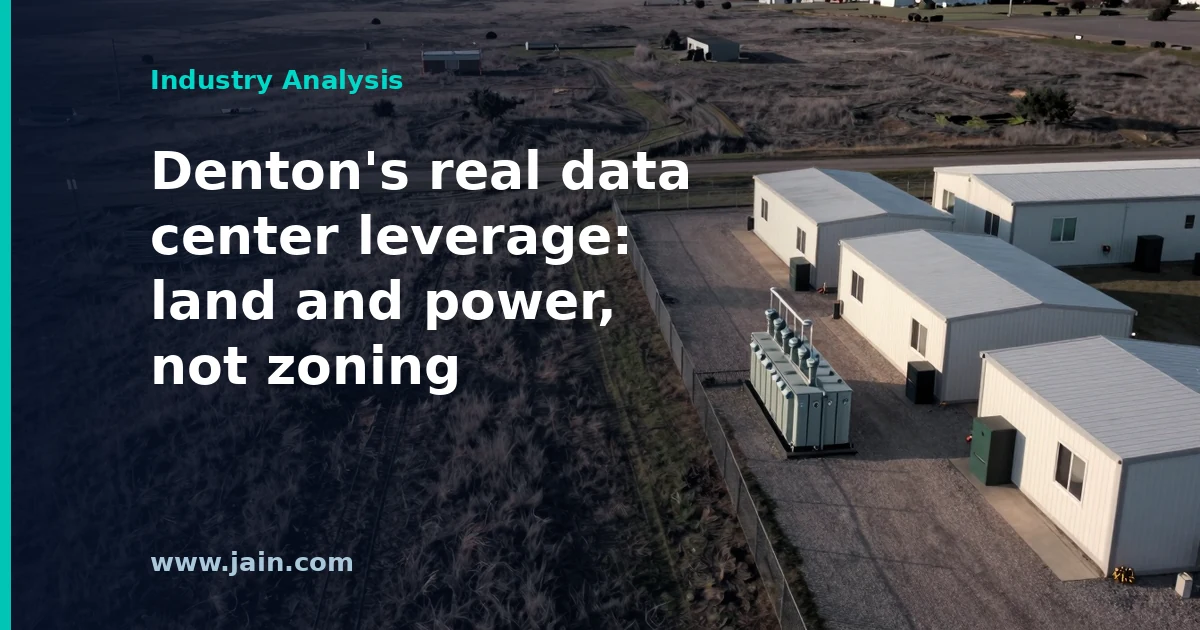
Denton, a Texas city north of Dallas, is weighing a 90-day pause on new data centers. These are giant buildings full of computers that run online services and artificial intelligence.
The surprise: the pause may not reach the biggest one already there. Core Scientific’s site is built to handle 391 megawatts, about as much electricity as a sizable city uses. Its growth depends more on the city-owned power company, which sells it electricity and owns the land it wants to rent.
Residents are split between worries about the power grid and a $3 billion rise in the value of local taxable property.
Denton City Council held the first of two required public hearings on a proposed moratorium on new data center development during its Sept. 22 meeting, Community Impact reported. The moratorium would halt all new data center development and permitting in city limits for 90 days, with an option to extend for another 90. A second hearing is set for Oct. 27, and the council could vote as early as Dec. 2.
At the same meeting, city officials said Core Scientific, which operates a 391-megawatt (MW) data center in Denton, had asked Denton Municipal Electric (DME), the city-owned utility, to lease additional public land south of its facility. A second project, Qumulus AI’s 20 MW data center, is planned to start operating in 2028 but has not begun construction.
Executive Summary
Denton is moving through the legal steps to pause new data center development, a process the council started with a unanimous vote on Aug. 18. The city attorney, Mack Reinwand, told the council that “a moratorium being passed does not necessarily stop an existing project from being built out.” Whether the pause would apply to an operator expanding or needing more land to meet its agreement with the city will depend on what that project’s original submission included.
That distinction matters because Denton is not only a zoning authority. Through DME, it sells electricity to its largest data center under a power purchase agreement (PPA, a long-term contract for electricity) and owns the land that operator wants to lease. The hearing also landed days after Texas Gov. Greg Abbott ordered state environmental regulators to stop issuing new data center permits while ERCOT, the state grid operator, audits proposed projects.
For data center operators, including bitcoin miners repositioning as hosts for AI and high-performance computing, Denton shows how local, state and grid-level controls now stack on the same site. For an existing operator, the most precise controls sit with the utility, not the moratorium.
What a Moratorium Can and Cannot Reach
A moratorium is a temporary pause on accepting or processing new development applications. Denton’s version would stop new data center development and permitting in city limits as soon as it passed. That is a blunt tool aimed at what has not been built yet. The city attorney’s caution that it “does not necessarily stop an existing project from being built out” means the pause bites hardest on projects that have not yet secured approvals.
That puts the two projects in different positions. Core Scientific’s 391 MW facility is operating. Qumulus AI’s 20 MW data center has a 2028 target, according to Charlie Rosendahl, Denton’s director of development services, but has not started construction. Whether Qumulus falls under the pause depends on the same question Mayor Chris Watts raised: what was submitted, and what the city already approved. Until the council answers that, the moratorium’s practical reach is unclear at both ends.
The Utility Is Also the Landlord
The headline point rests on what DME officials said about Core Scientific. DME Assistant General Manager Chris Lutrick said Core Scientific’s PPA limits how many megawatts it can consume. Those limits are controlled by ERCOT. He also said the company “ha[s] not got there” and has not asked for more power than the contract allows. So the operator’s electrical ceiling is already set by a contract with the city’s utility and by the state grid operator, whatever the council decides on the moratorium.
Land is the second lever. Lutrick said Core Scientific asked three to four months earlier to lease public land just south of its facility. He said the company did not say how it would use that land, and that it had been renting space at a private residence to park contractor vehicles. He added that the company “never mentioned another data center.” Rosendahl said the city is not discussing future data center development while the moratorium process continues. Interim City Manager Cassey Ogden said Core Scientific had not contacted the city about leasing more land, which does not match the utility’s account.
Taken together, the city’s decisions on whether to lease that parcel and how to administer the PPA will shape the 391 MW site more precisely than a pause on new applications. For operators on municipal utilities, the city can be regulator, power supplier and landlord at once. Each role gives it a separate point of leverage.
State and Grid Controls Stack on Top
Denton’s process does not run alone. According to the same reporting, Gov. Abbott said on Sept. 21 that state environmental regulators must stop issuing new data center permits. His order expands an existing state pause while ERCOT audits proposed data center projects. Rosendahl told the council that any interconnection, meaning the physical and contractual hookup to the grid, requires a study. Loads over 75 MW also need ERCOT approval, and that category is now under closer review at the governor’s direction.
The grid itself is the backdrop. Rosendahl said recent studies show Denton’s transmission system was already running near its limits before the large data center developments came online. That gives the moratorium’s supporters a concrete argument. It also suggests that any large new load would face capacity questions even without a local pause. For developers, the practical result is three layers of review: city permitting, state permits and ERCOT interconnection approval. Any one of them can set the schedule.
A $3 Billion Tax Base Against Unanswered Questions
The trade-off residents described is real on both sides. Denton saw a $3 billion increase in property tax value from data center development, according to earlier reporting. That is a direct fiscal benefit to the city and other local taxing bodies. Opponents cited long-term community effects and grid strain. Council Member George Ferrie said the city lacks long-term data on questions such as air quality because data centers “haven’t been this dense, this present for two decades.”
Neither side’s case is settled by what was presented at the hearing. The tax figure is a documented gain, but the grid concerns are backed by the city’s own transmission findings. A 90-day pause, extendable once, is a way to buy time for those studies rather than a final verdict. For AI infrastructure investors, the signal is that Texas sites near constrained municipal grids now carry local political review as a scheduling risk alongside power and equipment lead times.
Background
Denton, a fast-growing city in the Dallas-Fort Worth area, runs its own public power utility, Denton Municipal Electric. It currently has two data center operators: Core Scientific, with a 391 MW facility already operating, and Qumulus AI, with a 20 MW project planned for 2028. The moratorium effort began with a two-minute pitch from Mayor Pro Tem Nick Stevens on May 14. The council approved the pitch June 2 and voted unanimously on Aug. 18 to start the legal process.
Core Scientific built its business on bitcoin mining and has been repositioning toward hosting AI and high-performance computing workloads, part of a wider shift among miners with large power allocations. Most of Texas is served by the ERCOT grid, which has become a central gatekeeper for large new electricity loads such as data centers.
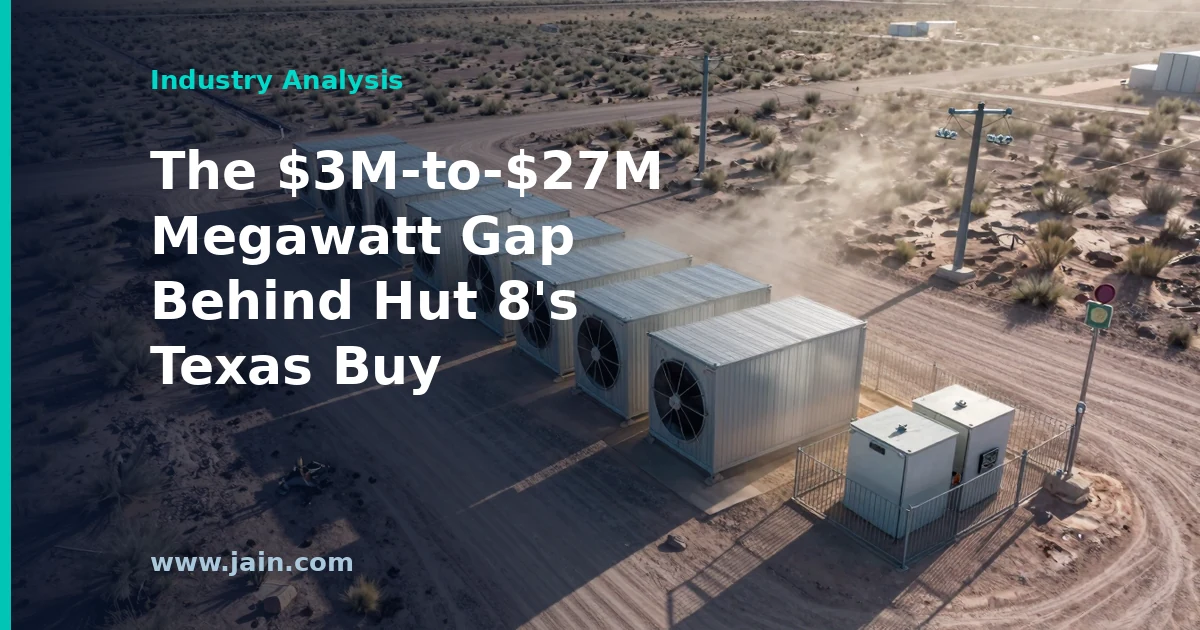
Hut 8, a company that mines bitcoin and builds computer centers, won a bankruptcy auction for two Texas computer sites with a $140 million offer. A judge still has to approve the sale on September 29.
The prize is the electricity. Power-ready space at crypto miners has been valued at less than one-ninth of what similar space fetches once an artificial intelligence company rents it. Buying sites that already exist can mean skipping a crowded line to connect to the Texas grid.
The catch: Hut 8 has not said how much power the sites have, and the Texas governor just ordered a pause on permits for these facilities.
Hut 8 has won the bankruptcy auction for Poolin’s two Texas data centers, the Pyote and Tarbush sites, with a $140 million bid, Bitbo reported on September 24, 2026, citing court records. The sale still requires approval from the U.S. Bankruptcy Court for the District of New Jersey, which has scheduled a hearing for September 29.
The sites would add to the roughly 1.5 gigawatts of power capacity Hut 8 already controls in Texas across operating and development-stage sites. The result arrives days after Texas Governor Greg Abbott directed the Texas Commission on Environmental Quality to halt data-center permits until ERCOT, the state’s main grid operator, completes an audit.
Executive Summary
Hut 8 placed the winning $140 million bid for two Texas data centers being sold out of Poolin’s bankruptcy. If the court approves the sale on September 29, the Pyote and Tarbush sites join a Texas portfolio of about 1.5 gigawatts that Hut 8 already has operating or in development.
The deal matters because grid access has become one of the scarcest inputs for both AI data centers and bitcoin mining in Texas. Data centers now account for 87% of ERCOT’s large-load queue, which totals 410 gigawatts, according to CoinShares. An existing site whose power arrangements come with it is a way to acquire capacity without starting at the back of that line.
Whether $140 million is cheap or expensive cannot yet be judged. Data-center capacity is priced per megawatt, and the megawatt capacity of Pyote and Tarbush has not been disclosed. The purchase also lands just as Texas has paused data-center permitting, which could either raise the value of sites that already hold permits or slow any plan to convert them.
The $3M-to-$27M Megawatt Gap Behind the Bid
Data-center capacity is priced per megawatt, meaning the amount of electrical power a site can deliver to the computers inside it. Two recent market marks bracket what sites like Pyote and Tarbush could be worth. At the low end, the energized but unleased capacity of some listed bitcoin miners is valued at less than $3 million per megawatt. At the high end, three fully leased AI facilities in Northern Virginia recently sold for about $27 million per megawatt. Between those two marks sits the cost of moving from one to the other: converting a mining site to AI-grade infrastructure runs roughly $8 million to $15 million per megawatt.
Stacking those figures shows where the value is. Power at the miner mark plus conversion comes to about $11 million to $18 million per megawatt, against a $27 million mark for leased AI capacity. The residual, roughly $9 million to $16 million per megawatt on these numbers, is what a buyer captures only if it converts the site and signs a tenant. The comparison is directional rather than precise. Northern Virginia is a more mature data-center market, the Virginia sales were of finished and leased buildings, and Texas sites differ in power, land and permitting.
Where the $140 million lands on that ladder depends on a figure that has not been published: the sites’ capacity. The arithmetic is simple. If Pyote and Tarbush together carry more than about 47 megawatts, Hut 8 bid less per megawatt than the sub-$3 million mark for miner capacity. If they carry less, the bid priced in a premium to that mark, effectively paying in advance for part of the conversion upside. In either case, the auction tests how much buyers will pay for a position on the gap before any tenant exists.
Buying Around a 410-Gigawatt Queue
ERCOT’s large-load queue is the line of big electricity customers asking to connect to the Texas grid. CoinShares puts its total at 410 gigawatts, with data centers making up 87% of it. A gigawatt is 1,000 megawatts. A new project joins that line and waits for grid studies and upgrades before it can draw power. An existing data center lets a buyer start further up the line, provided its grid connection and power agreements survive the change of ownership. That is the core case for buying distressed sites: the asset is the interconnection as much as the buildings.
Governor Abbott’s September 21 directive to halt data-center permits until ERCOT completes an audit, alongside reviews of grid and water impacts, cuts both ways for this deal. If the pause applies only to new applications, sites that already hold their permits become scarcer relative to demand, which strengthens the case for buying over building. If expanding or converting an existing facility requires new or amended permits, the pause could reach Pyote and Tarbush too and delay any AI conversion until the audit concludes.
On August 10, Hut 8 said it welcomed state scrutiny focused on grid reliability, local resources and community impacts. That statement predates the permit pause. How the company paces its Texas expansion against the audit is now an operational question as well as a policy one.
A Small Check Against a Large Book
For Hut 8, $140 million is modest. In the second quarter the company reported 949 megawatts of contracted IT capacity, worth an estimated $26.6 billion in base-term contracts, and said it had secured $7.5 billion in investment-grade financing so far. The bid equals less than 2% of that financing. For a developer at this scale, the binding constraint looks less like capital and more like power that can be connected and permitted, which is what a bankruptcy auction can offer.
CoinShares estimates AI work can earn about $1.5 million in annual profit per megawatt, compared with $0.5 million for bitcoin mining. That tripling explains the pull toward conversion. On the same figures, though, the extra $1 million per megawatt a year takes roughly 8 to 15 years to repay an $8 million to $15 million conversion, before financing costs. The economics therefore rest on long, contracted leases, which is why a leased Virginia megawatt trades at many times an unleased one and why Hut 8 reports contracted capacity and contract value rather than raw megawatts alone.
Mining Distress Is Supplying the Sites
The second quarter was hard on miners. Bitcoin ended June at $58,400, while listed miners faced a weighted-average cash cost of about $75,500 per coin, which left the sector below breakeven overall. Conditions improved by mid-August as bitcoin recovered and a stronger hash price, the expected revenue per unit of computing power, pushed most operators back above cash breakeven. Stretches like that test weaker balance sheets, and assets that change hands through court processes are one result.
The likely beneficiaries are creditors and estates selling energized sites, because the pool of bidders now includes developers who value power for AI, not only for mining. Listed miners whose capacity carries sub-$3 million marks could see those marks revisited if more auctions clear at higher per-megawatt prices. One auction is a single data point, though. The September 29 hearing, and any disclosure of the sites’ capacity, will say more about the market than the headline price does.
Background
Hut 8 is a publicly traded company (Nasdaq: HUT) that began in bitcoin mining and has built a large data-center business alongside it, reporting 949 megawatts of contracted IT capacity in the second quarter and about 1.5 gigawatts of operating or development-stage power capacity in Texas. Poolin is best known in bitcoin mining as a mining-pool operator. Its two Texas data centers, Pyote and Tarbush, are being sold through a bankruptcy proceeding in the U.S. Bankruptcy Court for the District of New Jersey.
Texas has become a center of both bitcoin mining and AI data-center development because of its large, largely self-contained grid run by ERCOT. Demand to connect has surged, with data centers making up most of ERCOT’s large-load queue. That has made sites with existing power connections valuable and drawn closer scrutiny from state officials over grid reliability and water use.
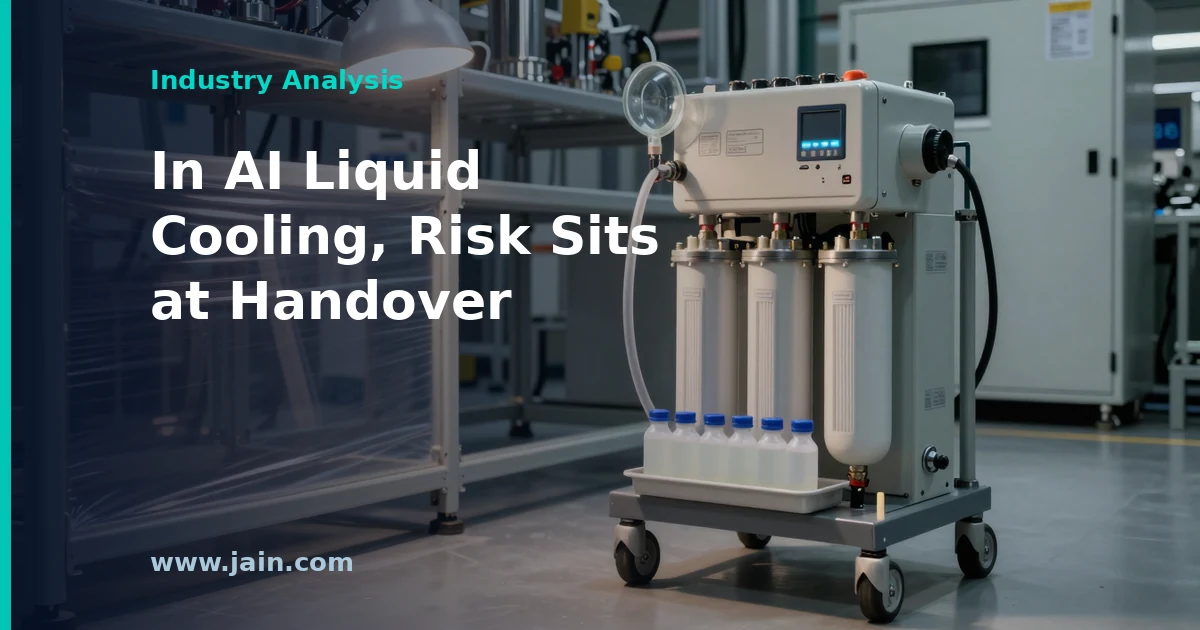
Vertiv, an American company that makes the power and cooling equipment inside data centers, is buying King Environmental Services, a Dublin firm whose crews clean, fill and test the liquid cooling systems used by artificial intelligence computers.
Those chips run so hot that many new buildings pipe liquid right to them, much like a car’s radiator. A little dirt or trapped air in the pipes can overheat very expensive machines.
It is Vertiv’s second purchase of this kind in under a year. The bet: the hard part is getting the plumbing right on day one.
Vertiv Holdings Co (NYSE: VRT) said on September 24, 2026 that one of its wholly owned subsidiaries has signed a definitive agreement to acquire King Environmental Services Ltd. (KES), a fluid management, commissioning and load-testing specialist founded in 2002 and headquartered near Dublin, Ireland, with hubs in North Dublin and Frankfurt. Vertiv disclosed the deal in an 8-K filed the same day, with its press release furnished as Exhibit 99.1.
The transaction is expected to close in the fourth quarter of 2026. Vertiv did not disclose financial terms and said the deal is not expected to be material to its financial results. It follows Vertiv’s December 2025 acquisition of PurgeRite, which the company describes as the foundation of its North American fluid management business.
Executive Summary
Vertiv is extending into Europe, the Middle East and Africa (EMEA) a services line it began building in North America less than a year ago: preparing, cleaning, balancing and testing the liquid loops that carry heat away from high-density AI servers. KES brings pipework flushing, filtration and water treatment, testing, adjusting and balancing (TAB, the process of tuning flow so every branch of a cooling system gets the fluid it was designed for), and large-scale thermal and electrical load testing, in which heaters and load banks stand in for real servers so a facility can be proven before it goes live.
The deal is small by Vertiv’s own account, but the pattern is the story. Two consecutive fluid-management acquisitions, PurgeRite and now KES, put Vertiv’s capital into field crews rather than factories. CEO Gio Albertazzi framed the rationale directly: as computing density rises, cooling and power performance “will depend as much on execution in the field as on engineering and system design.”
For data-center builders and operators in Europe, the practical consequence is that one of the largest thermal equipment vendors now intends to own the commissioning and lifecycle fluid work around its systems, offering what it calls a single accountable partner from construction through operation.
Why Liquid Cooling Risk Concentrates at Handover
Air-cooled data centers are forgiving: if a fan underperforms, the room runs a little warmer. Direct liquid cooling is less forgiving. Heat moves from chips into a closed loop of treated water or coolant, and Vertiv’s own description of what can go wrong is specific: contamination, trapped air, corrosion, improper chemistry and flow imbalances can reduce heat-transfer efficiency, degrade equipment and create commissioning and operational risks. Every one of those failure modes is introduced or caught in the same window, when a newly built system is flushed, filled, balanced and brought under load for the first time.
That window is the handover between construction and live operation, and it is exactly where KES sits. The company describes itself as bridging construction and live operation, validating that cooling systems are clean, balanced, design-compliant and ready for AI workloads, including through thermal load testing before a facility enters service. PurgeRite plays the equivalent role for Vertiv in North America. Buying two such firms in under ten months, December 2025 and September 2026, is a clear signal of where Vertiv believes customer risk now sits: not in whether a coolant distribution unit or cold plate works on a test bench, but in whether the loop around it was installed and prepared correctly on site.
This matters to three groups. Operators carry the downtime risk if a contaminated loop fouls hardware. General and mechanical contractors carry schedule risk if commissioning uncovers problems late. And hardware vendors carry reputational risk when a field problem is blamed on their equipment. Vertiv’s pitch of “a single accountable partner for commissioning, testing, fluid management and ongoing operations” is aimed squarely at that last point, collapsing a chain of hand-offs into one party that owns the outcome.
A Small Check With a Strategic Signal
Vertiv says the deal is not expected to be material to its results, and it furnished the announcement under Item 7.01, the Regulation FD disclosure item, in its September 24 8-K. In plain terms, this is a capability purchase, not a revenue purchase. Vertiv is buying people, procedures, regional permits and an operating footprint that would take years to build organically.
The economics also point toward recurring work. The release stresses that beyond initial commissioning, customers need lifecycle fluid management for availability, thermal performance and equipment longevity. Fluid chemistry drifts, filters load up and systems get expanded, so a firm that commissions a loop is well placed to maintain it. For an equipment maker, attaching a service relationship to each installed liquid-cooling system is a way to stay involved long after the hardware sale.
Vertiv’s own risk language underlines what it is really acquiring. Among the transaction risks listed in the release are its ability to maintain relationships with KES’s customers and suppliers and to retain KES management and key employees. In a field-services business, those relationships and people are the asset.
What EMEA Adds, and What Remains to Be Proven
KES operates from North Dublin and Frankfurt, two established European data-center hubs, and serves customers across EMEA. The release also highlights compliance with regional fluid handling, treatment and disposal requirements, a less glamorous but real advantage: treated coolant is a regulated waste stream, and a firm with local disposal routes and regulatory familiarity removes friction that a North American team would face entering the market.
The broader claims deserve a measured reading. Vertiv describes “significant customer benefits” and KES’s “strong reputation” but offers no figures on KES’s headcount, number of projects, load-testing capacity or customer base, so the scale of the European execution capacity being added cannot yet be assessed. Reach is also a fair question: two hubs in Ireland and Germany can serve a lot of Europe, but supporting the Middle East and Africa at the same standard is a different logistical task.
There is also a structural question for buyers. Commissioning has traditionally been valued partly for its independence from the equipment supplier. When the firm validating a cooling system is owned by the company that made parts of it, operators may want clarity on how test results, disputes and non-Vertiv equipment are handled. That is not a criticism of either company; it is the natural question any procurement team will ask as vendors move deeper into services.
Background
Vertiv, headquartered in Westerville, Ohio, and doing business in more than 130 countries, supplies power, thermal management and IT infrastructure equipment and services for data centers, communication networks and commercial and industrial facilities. As AI and high-performance computing push more heat into each server rack, operators are increasingly adopting liquid cooling, in which coolant is piped to or near the chips instead of relying only on moving air through the room.
Liquid cooling shifts a new kind of work onto construction sites and operations teams: the cleaning, filling, balancing and ongoing treatment of cooling loops. Vertiv entered that business in North America with its December 2025 acquisition of PurgeRite. KES, founded in 2002, has specialized in the same class of work in Europe and serves customers across EMEA from North Dublin and Frankfurt.
A factory near Milwaukee wants up to 300 new workers. It builds giant cooling systems for data centers, the warehouse-sized buildings full of computers that run websites and artificial intelligence tools.
Pay starts at $23 an hour, about $47,800 a year full-time. No factory experience is needed, and training happens on the job.
The surprising part is that the building opened a year ago. What the company needs now is people to run a second shift. Every one of those computer buildings needs cooling before it can switch on, so this hiring helps decide how fast they arrive.
Modine (NYSE: MOD), the Racine, Wisconsin-based thermal management company, said on September 23, 2026 that it is hiring for up to 300 long-term manufacturing positions at its data center cooling plant in Franklin, Wisconsin. The roles span first and second shifts. Production assembler pay starts at $23 an hour, second shift earns an extra $1 an hour, and benefits begin on day one. A walk-in hiring fair runs September 24 from 4 to 7 p.m., and a billboard campaign across the Milwaukee area will run while hiring continues over the coming months.
The 153,000-square-foot Franklin plant opened in September 2025 and makes Modine’s Airedale data center cooling systems. The announcement comes a week before Modine completes the spin-off of its Performance Technologies business into a combination with Gentherm, which is expected to close October 1.
Executive Summary
Modine’s announcement is a hiring notice, but it also shows where the company is in its data center cooling expansion. In July 2025 Modine announced added U.S. capacity for Airedale cooling products across plants in Franklin, Wisconsin; Grand Prairie, Texas; Grenada, Mississippi; and Jefferson City, Missouri. The Franklin building has now been operating for a year. Modine says the next step is people: “We’re now at a point where we need a larger, committed workforce,” said Karen Sutherland, Vice President of Human Resources for Data Centers, Americas.
That matters to anyone who depends on cooling equipment arriving on schedule. Once a plant exists, its output is set mainly by how many shifts it can staff and how quickly new workers become productive. Modine is recruiting mostly people without manufacturing experience and training them on the job. The speed of that process will shape how quickly the Franklin plant converts demand into shipped units.
The timing adds a corporate dimension. Filings made September 17 show Modine separating its Performance Technologies business on October 1. The company that remains, which Modine has said will be renamed Modexus Solutions, will be smaller and more concentrated on businesses like Airedale.
The Building Is Done. The Shifts Are Not.
A factory’s output comes down to three things: floor space, the hours that space is in use, and the productivity of the people working in it. Modine settled the first in September 2025, when it opened the 153,000-square-foot Franklin plant dedicated to Airedale data center cooling systems. This week’s announcement concerns the other two. Modine says the up-to-300 new hires will “help ramp up production to meet increasing demand,” and it is hiring across both first and second shifts, paying a $1-an-hour premium to fill the later one.
A second shift is usually the fastest and cheapest way to raise output from an existing plant. It needs no new permits, no construction, and no new utility connection. It needs people, and in Modine’s own words that is the requirement it has now reached. For the Franklin plant, the pace of growth now depends mainly on recruiting and training. Construction timelines matter less at this stage. This is the plain meaning of the title. Floor space in Franklin is fixed at 153,000 square feet, and extra output from it has to come from staffing more hours.
This affects data center developers and operators who are waiting on cooling equipment. A cooling supplier’s plant footprint is only a rough proxy for its delivery capacity. Shift coverage and workforce experience are closer measures. For Modine’s investors, the hiring pace becomes a leading indicator of whether Franklin can turn demand into revenue at the rate the company expects. Modine has not published any output targets for the plant.
What $23 an Hour and No Experience Required Signal
At $23 an hour and 40-hour weeks, a starting assembler earns about $47,800 a year before overtime, or about $49,900 on second shift. If all 300 positions were filled at the starting rate on full-time hours, base wages alone would come to roughly $14.4 million a year, before benefits and shift premiums. This is an illustrative calculation from the release’s figures, not a number Modine disclosed. Still, it shows that the ramp represents a meaningful recurring cost commitment.
The recruiting approach says more than the wage does. Modine says most entry-level roles need no prior manufacturing experience and that it provides on-the-job training. That widens the pool of applicants, but it also means new hires start at the bottom of a learning curve. Output per worker is likely to rise over months, not immediately. A walk-in fair with on-the-spot interviews and a Milwaukee-area billboard campaign point to hiring at volume. Modine also describes the roles as long-term. Hiring a permanent workforce rather than temporary labor suggests Modine expects demand to last, although that is the company’s own characterization and it has not tied the roles to a disclosed order book.
A Smaller Modine, More Concentrated on Cooling
The hiring announcement arrives days before a major change in Modine’s structure. According to an 8-K and the joint Gentherm–Modine release filed September 17, Modine will spin off its Performance Technologies business and merge it into Gentherm in a Reverse Morris Trust. In this structure, a unit is distributed to shareholders and immediately merges with another company, generally so the separation can be tax-free. The record date is September 28, and the distribution and merger are both expected October 1, 2026. Former SpinCo holders are expected to own about 43.6% of the combined company.
The filings also revise the cash side of the deal. Because falling overlap between Modine and Gentherm shareholders will increase the exchange ratio, Gentherm expects to issue about 2,902,466 additional shares. To offset that, the cash distribution to Modine before the merger is expected to fall from $210 million to $159 million, and Gentherm will pay its own shareholders a special dividend of about $58.35 million. The companies describe the adjustment as economically neutral, and final figures will be set at closing.
The Airedale data center cooling business stays with Modine. After October 1 it becomes a larger share of a smaller company, which Modine has said will be renamed Modexus Solutions. That raises the importance of execution at plants like Franklin. The analyst and investor day scheduled for November 18, 2026 is the next natural occasion for the company to put numbers on capacity, staffing and demand.
Background
Modine has worked in thermal management for more than 100 years. It is headquartered in Racine, Wisconsin, employs more than 11,000 people, and operates in North America, South America, Europe and Asia. It has reported two segments, Climate Solutions and Performance Technologies. Performance Technologies is being separated and combined with Gentherm on October 1, 2026, and the remaining company is due to be renamed Modexus Solutions. Modine’s data center cooling products are sold under the Airedale brand.
Data center cooling is the equipment that removes heat from server halls: chillers, air handlers and related systems that keep computing hardware within safe operating temperatures. As U.S. data center construction has grown, suppliers have added manufacturing capacity. Modine’s July 2025 expansion across four U.S. plants, including the Franklin facility that opened in September 2025, is its part of that buildout.