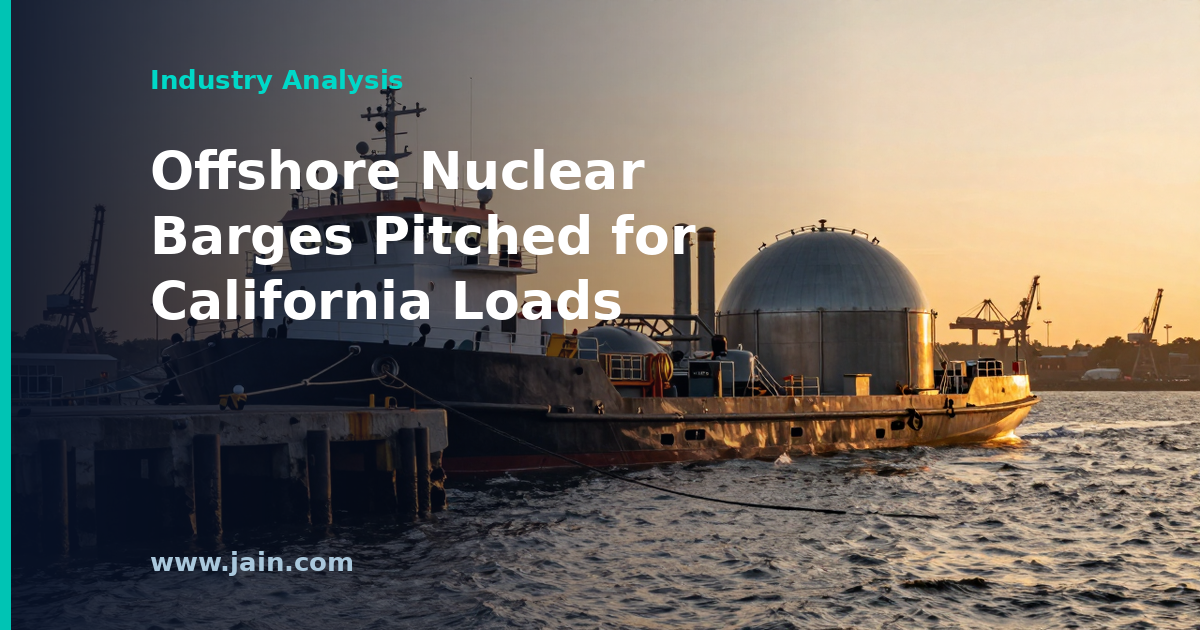
A concept for floating, offshore nuclear power barges is being pitched as a way to supply electricity to California ports and data centers, with proponents arguing that siting reactors in federal waters could avoid the state’s long-standing prohibition on new onshore nuclear plants. Fortune reported the proposal on June 16, 2026.
Executive Summary
The pitch pairs two trends: a resurgent interest in small, modular nuclear reactors and an acute shortage of firm, carbon-free power for AI-era data centers and electrified ports. By mounting reactors on barges moored offshore, developers argue they can deliver power directly to coastal customers behind the meter — meaning the electricity flows to the buyer without traversing the public grid — while operating under federal rather than state jurisdiction.
The stakes are significant for California, where data center operators and port electrification programs are competing for the same constrained grid capacity, and where the state’s 1976 moratorium on new nuclear construction has effectively frozen a category of firm, low-carbon generation. Whether an offshore barge genuinely sits outside that moratorium — legally, politically, and practically — is the central question the proposal raises.
Why Offshore, and Why Now
The appeal is straightforward on paper. California data center demand is rising with generative AI workloads, and the state’s largest ports — Los Angeles, Long Beach, and Oakland — are under pressure to electrify cargo handling and shore power for docked ships. Both need round-the-clock electricity that solar and wind alone cannot provide without significant storage. A barge-mounted reactor delivered to a mooring can, in principle, be built in a shipyard, towed into place, and connected to a single large customer, compressing the multi-year permitting and construction timelines that plague land-based projects.
Offshore siting also reframes the political map. State moratoria on new nuclear plants apply on land; federal waters begin three nautical miles from shore in most of California. A vessel-based reactor could plausibly be regulated primarily by federal agencies — the Nuclear Regulatory Commission and, for a marine platform, the Coast Guard — rather than the state. That is the crux of the sidestep argument, and it will be tested by lawyers long before it is tested by engineers.
The Behind-the-Meter Economics
Behind-the-meter power arrangements let a generator sell electricity directly to a co-located customer, bypassing utility tariffs and, often, transmission queues that now stretch years. For hyperscale data center operators, that shortcut has become the single most valuable feature of any new generation project, which is why they have signed deals for restarted nuclear plants and are exploring small modular reactors on their own campuses. An offshore barge extends the same logic to sites that lack the land for on-site generation.
The economics still have to close. Marine nuclear platforms carry costs that land plants do not: marinization of equipment, mooring and undersea cable systems, corrosion management, and specialized crews. They also inherit the industry’s chronic problem — first-of-a-kind small reactors have consistently come in above their initial cost estimates. Whether the shipyard-build efficiencies proponents cite can offset those headwinds is unproven at commercial scale.
Regulation, Siting, and the Politics of a Workaround
Framing a project as a jurisdictional workaround invites the jurisdiction being worked around to push back. California has other levers even if the reactor sits in federal waters: the California Coastal Commission reviews activities affecting the coastal zone, cable landings require state and local permits, and the electricity buyer on shore is a regulated entity. A project marketed primarily as a way to avoid state law is likely to draw sharper scrutiny than one that engages the state on its merits.
There are also legitimate questions to ask of critics as well as proponents. Opposition to nuclear in California has historically blended safety, seismic, and waste concerns with broader anti-industrial sentiment, and the coalition that upheld the 1976 moratorium is not monolithic. A fair debate requires pressing both sides: proponents on safety, security, and decommissioning of a marine reactor; opponents on what alternative firm, low-carbon supply they propose for the same coastal loads on the same timeline.
Background
California enacted its moratorium on new nuclear construction in 1976, tying future approvals to a federal solution for high-level radioactive waste that has not materialized. The state’s last operating commercial nuclear plant, Diablo Canyon, was scheduled to retire but received a life extension amid grid reliability concerns. Meanwhile, AI-driven data center demand and port electrification are straining coastal grid capacity.
Interest in small modular reactors and factory-built nuclear designs has revived globally, with hyperscale technology companies signing power deals for restarted plants and exploring on-site reactors. Marine nuclear propulsion has decades of naval history, and Russia has operated a civilian floating nuclear plant since 2020, but no comparable commercial offshore reactor has been deployed in U.S. waters.
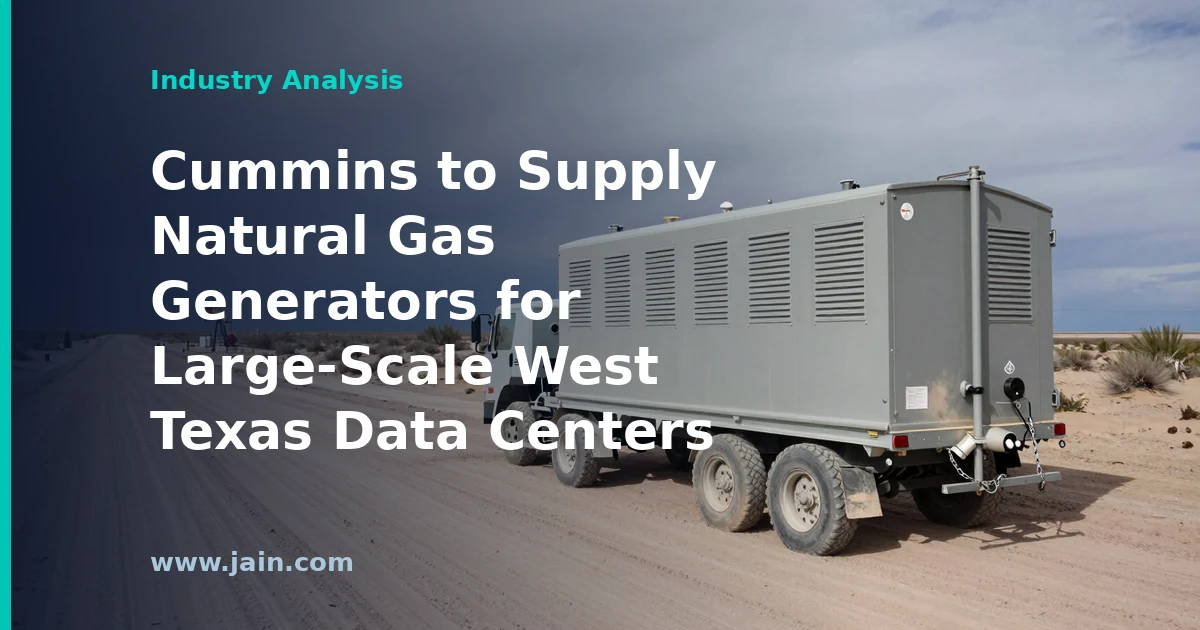
Cummins announced on June 15, 2026 that its natural gas generators will power large-scale data centers in West Texas. The announcement, issued by the engine and power-systems maker itself, confirms a supply arrangement for on-site power generation but does not disclose the customer, the number of units, the total generating capacity, or the delivery schedule.
Executive Summary
Cummins, the Indiana-based manufacturer best known for diesel engines and generator sets, says its natural gas generators have been selected to power large-scale data center development in West Texas. Stripped to its substantiated core, the announcement establishes three facts: the vendor (Cummins), the fuel (natural gas), and the setting (large-scale data centers in West Texas). Everything else — megawatts, dollars, dates, and the developer’s name — is left unstated.
Even so, the deal is worth attention because of what it represents. Data center developers are increasingly buying their own power plants rather than waiting years for utility interconnections, and West Texas — with abundant natural gas, cheap land, and a congested grid — has become the proving ground for that model. A generator manufacturer announcing data-center-scale natural gas orders is a data point in one of the most consequential shifts in how digital infrastructure gets energized.
Why Data Centers Are Buying Their Own Power Plants
The traditional model — build a data center, plug it into the utility grid — is breaking down under AI-era demand. Requests for new grid connections in fast-growing markets can take several years to fulfill, because utilities must study, permit, and build transmission lines and substations before energizing a large new load. For developers racing to deliver capacity to cloud and AI tenants, that queue is often the single longest item on the schedule.
On-site generation — sometimes called behind-the-meter power, because it sits on the customer’s side of the utility meter — collapses that timeline. Reciprocating natural gas generators of the kind Cummins builds can be manufactured, shipped, and commissioned far faster than a transmission project, and they can be added in increments as a campus grows. What was once purely backup equipment, sized to ride through rare outages, is increasingly being specified as primary or bridge power that runs for thousands of hours a year.
West Texas: Abundant Gas, Strained Wires
West Texas is a logical setting for this model. The region sits atop the Permian Basin, one of the most productive oil and gas regions in the world, where natural gas is plentiful and pipeline infrastructure is dense. Land is inexpensive, and the area already hosts substantial wind and solar development. What the region lacks is transmission: moving power across the Texas grid, operated by ERCOT (the Electric Reliability Council of Texas), is constrained by long distances and congested lines.
For a data center developer, that combination — fuel at the wellhead, but a bottlenecked grid — makes on-site gas generation attractive. Rather than exporting the region’s energy as electrons over strained wires, the data center effectively moves the demand to the fuel. The announcement does not say whether these facilities will also seek grid connections later, a common strategy in which on-site generation serves as a bridge until utility service arrives.
What It Means for Cummins and the Genset Market
For Cummins, data-center demand is reshaping a business that historically sold generators as insurance. Backup generators run perhaps a few dozen hours a year; prime-power installations run continuously, which means more units, larger service contracts, and steadier parts revenue. Major engine and turbine makers across the industry have reported stretched lead times for large power equipment as data-center orders stack up, so a manufacturer publicizing a West Texas win is competing for position in a genuinely supply-constrained market.
The competitive backdrop matters too. Data center developers weighing on-site power can choose among reciprocating gas engines, gas turbines, and, eventually, small modular nuclear or fuel-cell options. Reciprocating engines like Cummins’ occupy a middle ground: faster to deploy and more modular than turbines, though generally better suited to incremental capacity than to single gigawatt-scale blocks. Which architecture wins at a given site depends on scale, gas supply, and air-permitting headroom — none of which this announcement details.
The Trade-Offs the Headline Skips
Natural gas generation is cleaner than the diesel that has long dominated data-center backup — it burns with lower particulate and sulfur emissions — but it is still a fossil-fuel source with carbon dioxide and nitrogen oxide emissions, and large installations require air-quality permits from Texas regulators. Hyperscale tenants with public net-zero commitments will want to know whether gas-powered campuses fit their carbon accounting, whether the plants are bridge or permanent solutions, and whether the equipment can later run on lower-carbon fuels.
Reliability cuts the other way: a well-designed fleet of gas generators with firm fuel supply can rival or exceed grid reliability, and it insulates the tenant from ERCOT’s scarcity-priced energy market during extreme weather. The honest framing is that on-site gas is a pragmatic trade — speed and control in exchange for emissions and fuel-price exposure — and this release, as circulated, makes the case for the first half without quantifying the second.
Background
Founded in 1919 in Columbus, Indiana, Cummins built its reputation on diesel engines for trucks and heavy equipment, and its power systems division has long been a leading supplier of standby generator sets for data centers, hospitals, and industry. In recent years the company has expanded its natural gas engine lineup as customers seek lower-emission alternatives to diesel.
The backdrop is a historic surge in electricity demand from AI and cloud computing that has outpaced utilities’ ability to connect new loads. Texas has emerged as a leading destination for this buildout, and West Texas in particular — sitting atop the Permian Basin’s gas supply but far from major transmission corridors — has become a testbed for data centers that generate their own power on-site rather than waiting for the grid.
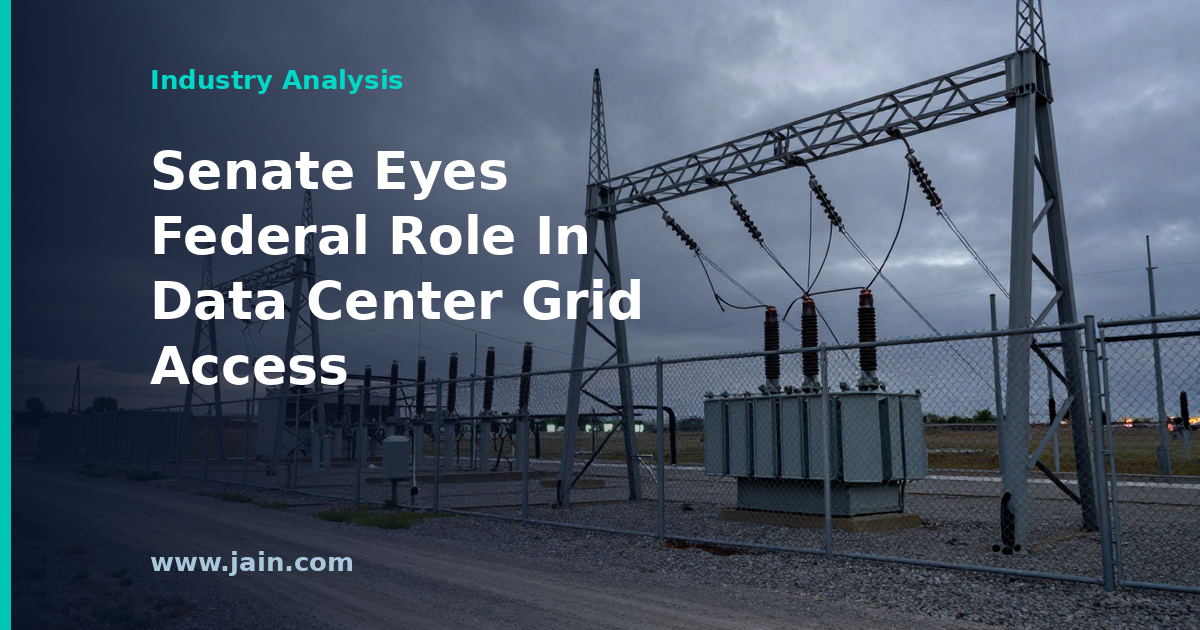
A Republican U.S. senator has introduced a bill that would give the federal government authority over data centers’ access to the electric power grid, NBC News reported on June 15, 2026. The measure targets the fast-growing AI and cloud data center sector, whose interconnection requests have become a flashpoint in state utility proceedings across the country.
Executive Summary
The proposal, as summarized by NBC News, would insert a federal role into what has historically been a state- and regional-utility matter: deciding when, where, and on what terms large data centers can plug into the grid. The senator’s office has framed the bill as a response to concerns that hyperscale AI campuses are absorbing scarce generation and transmission capacity ahead of residential and industrial customers.
For the data center industry, the stakes are meaningful even if the bill never becomes law. A federal review layer — depending on scope — could add time, cost, and uncertainty to interconnection, the process by which a new load or generator is approved to connect to the grid. It would also reopen a long-settled jurisdictional question about who governs retail electric service.
Why Washington Is Suddenly Interested In Interconnection Queues
Interconnection — the technical and contractual process of hooking a large customer up to the transmission system — used to be a sleepy engineering topic. AI has changed that. Single hyperscale campuses now request hundreds of megawatts, and in some regions gigawatts, of firm capacity. That has produced multi-year queues, contested rate cases, and political pressure on governors and public utility commissions. A federal bill directed specifically at data center grid access is a signal that the issue has migrated from utility filings to national politics.
The measure appears to target a genuine coordination problem: individual state regulators approve individual interconnections, but the cumulative effect ripples across multi-state grid operators such as PJM, MISO, and ERCOT. Whether a federal gatekeeper is the right fix, or would simply add a layer on top of existing FERC and regional transmission organization processes, is the substantive question the bill will have to answer.
Who Wins And Who Loses If A Federal Role Is Added
Incumbents with signed interconnection agreements and energized sites are the clearest short-term winners of any friction added to new connections: their capacity becomes scarcer and more valuable. Developers still in queue — particularly speculative sites without anchor tenants — face the most exposure, because a federal review could reshuffle priority or impose siting criteria unrelated to a project’s engineering readiness.
Utilities are harder to place. Some have complained that speculative data center requests inflate their planning forecasts; a federal filter could relieve that pressure. Others rely on large-load growth to spread fixed costs across more kilowatt-hours and would resist anything that slows revenue. Residential ratepayer advocates, who have argued that AI loads are effectively cross-subsidized by households, may find themselves unusual allies of a bill from across the aisle.
What The Bill Would Have To Overcome
Retail electric service — the sale of power to end customers, including data centers — has traditionally been a state matter under the Federal Power Act, with FERC’s jurisdiction limited to wholesale sales and interstate transmission. A federal veto over data center grid access would test that boundary and likely draw legal challenge from states that have aggressively courted the industry, as well as from operators with existing contracts.
The politics are also non-obvious. A Republican-led bill imposing federal oversight on a private industry cuts against the party’s usual deregulatory posture, suggesting the sponsor sees data center power consumption as a constituent-facing affordability and reliability issue rather than a market question. Whether that framing attracts bipartisan support or stalls in committee will determine if this is a serious legislative vehicle or a marker bill.
Background
Data centers house the servers that run cloud computing, streaming, and AI workloads. Historically they consumed a manageable share of U.S. electricity, but the training and deployment of large AI models since 2023 has driven exceptional growth in individual site sizes and total sector demand. That has collided with a slower-moving power system, where new generation and transmission routinely take five to ten years to build.
Grid access for large customers has traditionally been a state matter, with utility regulators approving special contracts and rates. Federal involvement has been limited to wholesale markets and interstate transmission, primarily through the Federal Energy Regulatory Commission. Proposals to expand that federal role, from either party, mark a departure from decades of practice.
The Information reported on June 14, 2026 that Nvidia’s share of the AI inference chip market appears to be rising. The headline finding cuts against a widely held industry expectation: that the shift of AI workloads from model training toward day-to-day inference would open the door to cheaper, specialized alternatives and gradually dilute Nvidia’s dominance.
The report’s underlying data and figures sit behind The Information’s paywall, so the specific share numbers, timeframe, and methodology were not available in the syndicated headline. What is notable is the direction of the claim itself — share rising, not merely holding.
Executive Summary
For two years, the standard bear case on Nvidia has gone like this: training new AI models demands the most powerful, flexible chips — Nvidia’s home turf — but inference, the act of actually running a trained model to answer queries, is a more predictable, cost-sensitive workload where custom chips from cloud providers and startups could undercut GPUs. As inference grows to dominate total AI compute spend, the theory went, Nvidia’s grip would loosen.
The Information’s report suggests the opposite may be happening: even as inference becomes the larger workload, Nvidia appears to be gaining share within it. If accurate, that matters enormously, because inference is the recurring, revenue-generating side of AI — every chatbot reply, every AI-assisted search, every coding suggestion is an inference event. Winning inference means winning the long tail of AI economics, not just the up-front build-out.
The caveat is equally important: ‘appears to be rising’ is a hedged formulation, and without the report’s underlying figures, buyers and investors should treat this as a directional signal to test against their own deployment data rather than a settled fact.
Inference Was Supposed to Be the Open Flank
In AI infrastructure, ‘training’ means teaching a model from massive datasets — a bursty, brutally demanding job — while ‘inference’ means serving the finished model to users, millions of times a day. Because inference workloads are more repetitive and predictable, they are in principle easier to serve with purpose-built silicon: chips designed to do one thing cheaply rather than everything well. That logic is exactly why Google built its TPUs, Amazon built Inferentia and Trainium, Microsoft developed Maia, and a wave of startups raised billions to attack the inference market specifically.
A report that Nvidia’s inference share is rising, then, is not a routine data point — it challenges the core mechanism by which competitors expected to gain ground. It suggests that whatever advantages custom chips hold on paper, buyers deploying real inference fleets at scale are still, on the margin, choosing GPUs.
Why the Moat May Be Software, Not Silicon
The most plausible explanation for durable GPU share in inference is not raw chip performance but the surrounding ecosystem. Nvidia’s CUDA software platform, and the inference-serving stack built on top of it, lets teams deploy new model architectures quickly. In a period when leading models change every few months, flexibility has real economic value: a custom chip optimized for last year’s model architecture can become a stranded asset when the industry pivots to a new one.
There is also a fleet-management argument. Operators who own large GPU installations for training can redeploy the same hardware for inference as demand shifts, keeping utilization high. A mixed fleet of GPUs plus several custom accelerators, by contrast, fragments capacity and multiplies engineering overhead. None of this makes custom silicon unviable — hyperscalers continue to deploy their own chips internally at scale — but it helps explain why the merchant market, where chips are sold to third parties, may be consolidating around the incumbent.
What Rising Share Would Mean for the Rest of the Market
If Nvidia is gaining inference share, the squeezed parties are the merchant challengers — chip startups and rival semiconductor firms selling inference accelerators to enterprises and neoclouds — more than the hyperscalers, whose custom chips mostly serve their own internal workloads and are measured by different economics. For chip startups, inference was the beachhead market; a rising incumbent share shortens their runway and raises the bar for differentiation on price-performance.
For buyers of AI infrastructure — enterprises, cloud customers, and the data centers that house this equipment — the practical implication is continuity: power densities, cooling requirements, and networking architectures will keep following Nvidia’s roadmap, and supply allocation from a single dominant vendor remains a planning risk. A more competitive inference market would have given buyers pricing leverage; this report suggests that leverage is not materializing yet.
How Much Weight Can One Headline Carry?
It is worth being precise about what has and has not been established. The Information is a subscription outlet with a strong track record on AI-industry reporting, but the syndicated headline alone — ‘appears to be rising’ — carries visible hedging, and the definition of the market matters greatly. A share measured in revenue will favor Nvidia’s premium pricing; a share measured in deployed inference volume might tell a different story, especially if hyperscalers’ internal chips are excluded. Until the methodology is visible, the fair reading is that the custom-silicon disruption thesis is arriving more slowly than predicted — not that it has been refuted.
Background
Nvidia became the dominant supplier of AI computing hardware on the strength of its graphics processing units (GPUs), which proved ideally suited to the parallel math behind modern AI, and its CUDA software ecosystem, which made those chips the default target for AI developers. Its data center business grew into one of the largest revenue engines in the semiconductor industry during the generative-AI build-out that began in late 2022.
From early in that boom, cloud providers and startups invested heavily in custom AI accelerators — Google’s TPU line being the longest-running example — with inference widely identified as the segment where alternatives would gain traction first. The June 2026 report from The Information lands directly on that fault line, suggesting the incumbent is consolidating rather than ceding the inference market.
Vertiv, the NYSE-listed data center power and cooling vendor, announced a deal to acquire ThermoKey, an Italy-based heat-exchanger manufacturer, in a move the company frames as expanding its AI data center cooling capabilities. The announcement was reported on June 14, 2026; Vertiv’s shares slipped on the news. Financial terms were not detailed in the source report.
Executive Summary
The acquisition extends a clear pattern: as AI compute densities climb, the large data center infrastructure vendors are buying their way down the thermal supply chain rather than relying on third-party component makers. Heat exchangers — the coils and dry coolers that ultimately move server heat into outside air or water loops — are an unglamorous but capacity-constrained link in every cooling system, whether air-cooled or liquid-cooled.
For Vertiv, owning that link means more control over lead times, cost, and engineering integration at a moment when hyperscalers and colocation operators are ordering thermal equipment years ahead. The market’s muted reaction — shares slipped on the announcement — is a reminder that investors are weighing acquisition spending and integration risk against the strategic logic, particularly with no publicly detailed deal terms to anchor the math.
Why Heat Exchangers Matter in the AI Era
Every watt a GPU consumes becomes heat that must be rejected outdoors. Whatever technology sits at the rack — air handlers, rear-door heat exchangers, or direct-to-chip liquid cooling — the chain ends at heat-rejection hardware: coils, dry coolers, and condensers of the kind ThermoKey manufactures. As rack densities move from tens of kilowatts toward 100 kW and beyond, that heat-rejection stage scales in direct proportion, and it is built from metal, fabrication capacity, and factory floor space that cannot be conjured quickly.
By acquiring a heat-exchanger maker outright, Vertiv converts a supplier relationship into owned capacity. That matters less in a slack market and enormously in a tight one — and the AI buildout has made thermal equipment a long-lead-time item across the industry.
Vertical Integration Follows the GPU Buildout
This deal fits a broader consolidation wave. Vertiv itself has been assembling a fuller thermal stack for years, including its 2023 move on liquid-cooling specialist CoolTera, and competitors across the cooling landscape have pursued similar component-level acquisitions. The strategic logic is consistent: hyperscale customers increasingly want one accountable vendor for an integrated thermal chain, from the cold plate on the chip to the dry cooler on the roof, with matched controls and warranties.
For independent component makers, that creates a squeeze. Remaining suppliers may find their largest customers are now also their competitors’ owners — which historically pushes further consolidation, as remaining independents either scale up, specialize, or sell.
Reading the Share-Price Slip
The headline pairing — an expansion deal and a stock decline on the same day — deserves an even-handed reading. A slip on acquisition news is common and can reflect many things: general market movement, questions about price paid, or wariness about integration workload during a demand boom. Without disclosed terms, none of these can be confirmed from the source material, and a one-day move is a weak signal of a deal’s long-term merit.
What can be said is that investors are applying more scrutiny to AI-infrastructure spending across the board in 2026, and vendors announcing acquisitions now carry the burden of showing how each deal converts into margin or capacity rather than merely into breadth. Vertiv’s task is to demonstrate that owning heat-exchanger manufacturing shortens its lead times or improves its unit economics in ways customers and shareholders can measure.
Background
Vertiv became an independent company in 2016 when private equity firm Platinum Equity carved Emerson Network Power out of Emerson Electric, and it listed on the NYSE in 2020. It has since ridden the data center construction wave as one of the leading suppliers of the power distribution, thermal management, and enclosure systems that sit around the servers themselves, competing with firms such as Schneider Electric and a field of specialist cooling vendors.
The AI boom that accelerated in 2023 transformed cooling from a mature, slow-growth product line into a strategic battleground. Heat-exchanger manufacturing — historically a fragmented, regional business serving HVAC and industrial refrigeration as well as data centers — has become a supply chain chokepoint, setting the stage for component-level acquisitions like this one.
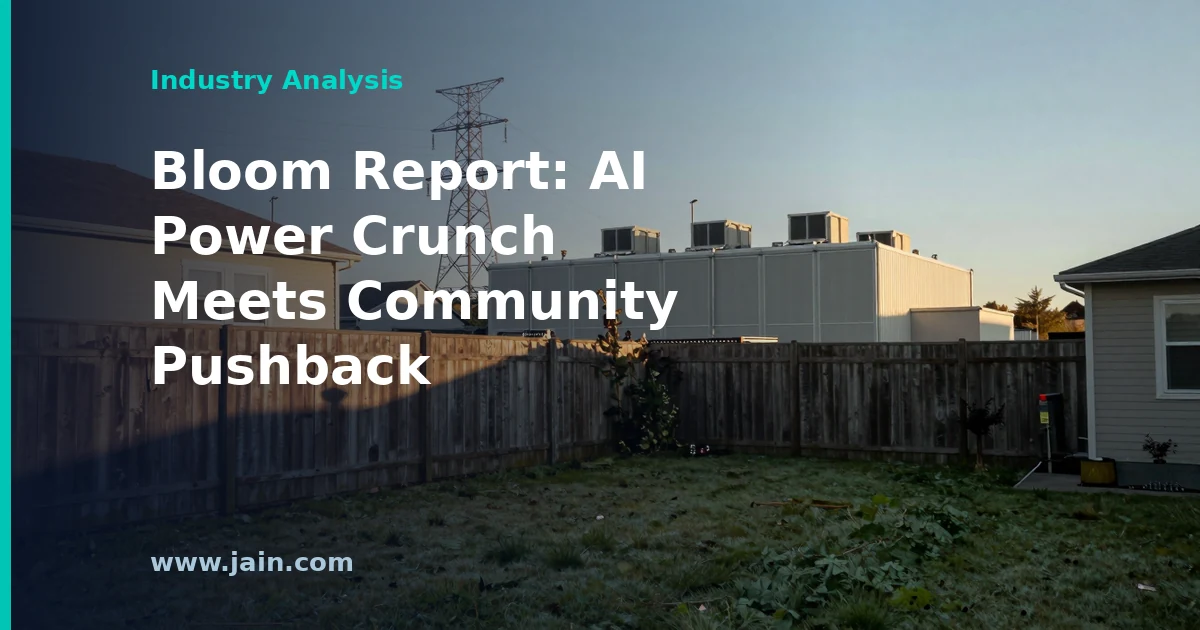
Bloom Energy has published a report arguing that continued expansion of AI data centers depends on operators addressing two intertwined constraints in parallel: electricity supply and local community acceptance. The report, released in June 2026, frames the two issues as inseparable rather than sequential.
Executive Summary
The fuel-cell maker’s central thesis is that the AI buildout cannot be solved by megawatts alone. Even where generation, transmission, or on-site power can be procured, projects increasingly stall on zoning, noise, water, and land-use objections from neighbors and municipalities. Conversely, community outreach without a credible power plan is equally insufficient.
For an industry accustomed to treating power and permitting as separate workstreams, the framing is a nudge toward integrated planning. It also, unsurprisingly, positions Bloom’s distributed on-site generation product as a natural fit for that integrated approach — a commercial interest readers should weigh alongside the analysis.
Why ‘Power And Community’ Is The Real Bottleneck
For most of the cloud era, data center siting followed a familiar recipe: cheap land, fiber, tax incentives, and a utility willing to sign an interconnect. AI workloads have broken that recipe. A single hyperscale AI campus can now request hundreds of megawatts — comparable to a small city — on timelines that outpace utility planning cycles measured in years. Bloom’s report reframes this as a two-variable problem: neither raw generation nor social license alone is sufficient, and progress on one without the other tends to collapse the project.
That framing matters because the industry has historically optimized for the technical variable and treated community relations as public affairs. When a substation upgrade takes five years and a rezoning fight can add two more, the bottleneck is whichever constraint binds first — and increasingly, both bind simultaneously.
Winners, Losers, And The Distributed-Generation Pitch
The report’s logic favors technologies that can be sited close to load, deployed quickly, and configured to reduce visible community impact — a description that fits Bloom’s solid-oxide fuel cells, but also natural-gas peakers, on-site solar-plus-storage, and eventually small modular reactors. Utilities that can offer flexible, phased interconnection may win share from those that cannot. Operators willing to co-locate generation with compute gain optionality against constrained grids.
The losers, if the thesis holds, are projects that assume grid capacity will materialize on hyperscaler timelines, and jurisdictions that treat every large load as a windfall without offering a permitting path. It is worth noting that the report comes from a vendor whose products directly address the problem it describes; that does not make the diagnosis wrong, but readers should treat the prescription as one option among several.
Community Concerns Are Not A Communications Problem
The more substantive point in the report — to the extent the summary conveys it — is that community opposition is being driven by material impacts: water use for cooling, diesel backup emissions, noise from chillers and generators, truck traffic during construction, and property-value anxieties. These are engineering and siting questions, not messaging questions. Treating them as PR problems has, in several high-profile cases, hardened opposition rather than defused it.
For buyers and investors, the implication is that due diligence on new capacity should include the permitting posture and neighbor relations of a site, not just its power and fiber. A campus with signed interconnects but an organized opposition can be as delayed as one with willing neighbors and no transformer.
Background
Bloom Energy, founded in 2001 and headquartered in San Jose, makes solid-oxide fuel cells that generate electricity on-site from natural gas, biogas, or hydrogen. Its customers include large enterprises and, increasingly, data center operators seeking alternatives to constrained grid interconnection.
The wider context is a global surge in AI training and inference demand that has pushed data center power requests to levels utilities did not plan for. In the United States in particular, several regions have seen multi-year queues for large interconnects, prompting operators to explore on-site and behind-the-meter generation, direct utility partnerships, and, in some cases, relocation to more permissive jurisdictions.
Data Center Knowledge reports that the AI industry’s next major data center challenge is scaling memory for the inference era. As of June 13, 2026, the trade publication frames memory — its capacity, bandwidth, and cost — rather than GPU supply alone as the constraint that will shape how AI infrastructure is built and operated as workloads shift from training models to serving them at scale.
Executive Summary
For the past several years, the AI infrastructure conversation has been dominated by one question: can you get enough GPUs? Data Center Knowledge’s report signals a maturing of that conversation. As deployed AI systems move from the training phase — where a model is built once on a massive cluster — to the inference phase — where that model answers millions of user requests every day — the binding constraint increasingly shifts toward memory: how much data an accelerator can hold close to its processors, and how fast it can move that data in and out.
This matters because inference is where AI meets its users and its revenue. Training is an episodic capital project; inference is a continuous operating workload whose economics are set by how efficiently each request can be served. If memory is the gating factor on that efficiency, then memory — not just compute — becomes a first-order design variable for chipmakers, server vendors, and the data center operators who house them. That has implications for procurement, facility design, and where the industry’s next supply-chain pressure points appear.
Why Inference Stresses Memory Differently Than Training
Training and inference are both AI workloads, but they stress hardware in different ways. Training is a throughput problem: enormous batches of data are pushed through a model in parallel, and the industry has optimized clusters, networks, and cooling around it. Inference is a latency and concurrency problem: a served model must hold its parameters — and, for modern conversational systems, the working context of many simultaneous user sessions — in fast memory, ready to respond in fractions of a second.
That is why the framing in this report resonates. A GPU with idle compute cycles but exhausted memory is, for inference purposes, a smaller GPU. The practical ceiling on how large a model you can serve, how long a context you can support, and how many users you can handle per accelerator is often set by memory capacity and bandwidth — the rate at which data moves between memory and processor — rather than by raw arithmetic performance. In industry shorthand, many inference workloads are ‘memory-bound’ rather than ‘compute-bound.’
From a GPU Supply Story to a Memory Supply Story
If the industry’s constraint migrates from processors to memory, the competitive map shifts with it. High-performance accelerators depend on specialized memory stacked directly alongside the processor — high-bandwidth memory, or HBM — which is produced by a small number of manufacturers and is among the most complex components in the server supply chain. A world in which inference demand keeps compounding is a world in which memory suppliers, packaging capacity, and memory-rich system designs command growing strategic attention.
It also opens the door to architectural alternatives. When fast on-package memory is scarce or expensive, system designers look for ways to tier it: pooling memory across servers, offloading less-frequently-accessed data to slower but larger stores, and caching repeated work so it need not be recomputed. Which of these approaches wins at scale is one of the genuinely open questions of the inference era, and the answer will influence everything from server bills of materials to network design inside the rack.
What It Means for Data Center Operators
For facility operators, the shift is subtler but real. Inference fleets are provisioned for sustained, user-facing demand, which favors availability, geographic distribution, and predictable power draw — a different profile from the concentrated, campus-scale training builds that have dominated recent headlines. Memory-heavy server configurations also change the calculus per rack: the balance of power, cooling, and floor space allocated to a given amount of useful serving capacity depends on how much memory ships alongside each accelerator.
The measured takeaway for buyers and operators is to treat memory as a first-class capacity-planning metric. Contracts, density assumptions, and refresh cycles built purely around GPU counts may misestimate what an inference-era fleet actually needs. That is not a crisis; it is the normal maturing of a young industry learning which of its inputs is truly scarce.
A Claim Worth Testing, Not Taking on Faith
It is worth being clear about the nature of this story: it is an analytical trend piece from a trade publication, not an announcement with commitments attached. The thesis — that memory becomes the bottleneck as inference scales — is directionally consistent with how served AI workloads behave, but its strength depends on variables the headline alone cannot settle: how fast inference demand actually grows, how quickly memory supply and packaging capacity expand, and whether software techniques blunt the constraint faster than hardware demand compounds. Readers should treat ‘memory is the next bottleneck’ as a well-founded hypothesis to plan against, not a settled fact.
Background
The AI infrastructure boom that accelerated from 2023 onward was defined first by a scramble for GPUs — the specialized processors used to train large AI models — and then by a scramble for the power and data center capacity to house them. As trained models moved into production across consumer and enterprise applications, the industry’s center of gravity began shifting from building models to serving them, a phase widely called the inference era.
That shift changes which hardware inputs are scarce. Modern accelerators pair their processors with high-bandwidth memory, a stacked, tightly integrated memory type made by only a few manufacturers worldwide. Because a served model’s size, context length, and concurrent user count are all bounded by available memory, industry attention has increasingly turned to memory supply, advanced packaging capacity, and architectures that stretch scarce fast memory further — the backdrop against which Data Center Knowledge’s June 2026 report was published.
NVIDIA announced on June 12, 2026, via its corporate blog, that its Blackwell GPU platform leads the results of what the company describes as the first infrastructure benchmark designed for agentic AI — artificial-intelligence systems that plan, call tools, and execute multi-step tasks rather than answering a single prompt. The announcement positions Blackwell as the performance standard for the next wave of inference-focused data center buildouts.
Executive Summary
The claim itself is narrow but consequential: a new benchmark category now exists for agentic AI infrastructure, and NVIDIA says its current flagship platform sits at the top of it. Benchmarks matter in this industry because they are how buyers — cloud providers, enterprises, and the operators building gigawatts of AI capacity — translate marketing claims into procurement decisions. Being first on the first test of a new workload class is a statement about where NVIDIA believes demand is heading.
It is worth being precise about what is and is not substantiated here. The source available to us is NVIDIA’s own announcement headline distributed through Google News; the underlying methodology, the benchmark’s governing body, competitor submissions, and the specific metrics behind the word “leads” are not detailed in the material we can verify. That does not make the result wrong — NVIDIA has a long, independently audited record of topping industry benchmarks — but it does mean the announcement should be read as a vendor-reported result until the full submission data is examined.
Why Agentic AI Broke the Old Yardsticks
Traditional AI inference benchmarks measure a straightforward transaction: a prompt goes in, a response comes out, and the system is scored on throughput (how many requests per second) and latency (how fast each answer arrives). Agentic AI does not work that way. An agent handling a single user request may make dozens of chained model calls — reasoning about a plan, querying tools and databases, checking its own work — with each step depending on the last. That workload stresses infrastructure differently: long context windows strain memory, sequential call chains magnify every millisecond of latency, and the interconnect fabric between GPUs becomes as important as the GPUs themselves.
A benchmark purpose-built for this pattern is therefore a genuine industry milestone, whoever leads it. It gives infrastructure buyers a shared vocabulary for a workload class that, by mid-2026, is driving much of the growth in inference demand. The open question — one the announcement’s headline alone cannot answer — is whether this benchmark was defined by a neutral industry consortium with multi-vendor participation, or shaped around the strengths of the hardware that now leads it. That distinction determines how much weight the result deserves.
First Place on a First Test Is Also a Marketing Position
There is a well-worn dynamic in infrastructure markets: the vendor that helps define a new benchmark tends to win it, and winning it early lets that vendor set the terms of comparison for everyone who follows. NVIDIA has earned real credibility here — its results in established suites like MLPerf have been submitted, peer-reviewed, and reproduced for years, and Blackwell’s rack-scale systems were explicitly engineered for exactly the long-chain inference work agentic AI demands. The leadership claim is consistent with that track record and should not be dismissed.
At the same time, a fair reading asks the questions any buyer would: Did AMD, custom cloud silicon, or other accelerator vendors submit results to be compared against? Is “leads” measured per chip, per rack, per watt, or per dollar? Normalization matters enormously — a platform can lead on absolute throughput while trailing on cost- or energy-efficiency, and for operators paying for power by the megawatt, those are the numbers that decide deployments. None of this is a criticism of the result; it is the standard scrutiny any first-of-its-kind benchmark claim should invite, from any vendor.
What It Signals for the Inference Buildout
The larger story is the one this benchmark’s existence confirms: the center of gravity in AI infrastructure spending is shifting from training frontier models to serving them at scale, and agentic workloads multiply the compute consumed per user interaction. For data center operators, that shift has physical consequences — sustained high utilization rather than bursty training runs, rack power densities that push liquid cooling from optional to standard, and network architectures where east-west GPU-to-GPU traffic dominates. Facilities planned around last generation’s assumptions will feel that pressure first.
For buyers, the practical takeaway is not to change procurement based on one headline, but to recognize that agentic inference performance is now a measurable, comparable dimension — and to demand full methodology, competitor data, and efficiency-normalized results before treating any leaderboard position as decisive. Benchmarks are the beginning of an evaluation, not the end of one.
Background
NVIDIA transformed itself from a graphics-chip maker into the dominant supplier of AI computing infrastructure, and its Blackwell architecture — announced in 2024 as the successor to the Hopper generation that powered the first ChatGPT-era buildout — anchors that position. Blackwell’s signature is rack-scale integration: systems that connect large numbers of GPUs over high-bandwidth links so they behave as a single accelerator, a design aimed at the long, chained inference workloads that agentic AI produces.
Benchmarking has long been the industry’s proving ground: consortium-run suites such as MLPerf established the norm of peer-reviewed, multi-vendor performance submissions, and NVIDIA has consistently led those results. The emergence of a benchmark dedicated to agentic AI infrastructure reflects how quickly that workload class has grown from research curiosity to a primary driver of data center demand.
Research and advisory firm Gartner has published a forecast projecting that data-center electricity consumption will grow 26% in 2026. The figure, released in June 2026, puts a number on what utilities, grid operators, and data-center builders have been experiencing on the ground: power — not land, capital, or chips — has become the binding constraint on digital-infrastructure growth.
Executive Summary
Gartner’s headline claim is simple: the electricity consumed by data centers will rise 26% in 2026. For context, most mature electricity systems in developed economies have spent two decades planning around annual demand growth in the low single digits. A single customer class growing 26% in one year is the kind of step-change that utility resource plans — documents typically written on five-to-fifteen-year horizons — were not designed to absorb.
The forecast matters less as a precise number than as a planning signal. If even a substantial fraction of that growth materializes, it shapes generation procurement, transmission buildout, interconnection queues, and electricity rates for every other customer sharing the grid. For data-center operators and their customers, it also signals that access to secured, deliverable power will continue to separate projects that get built from projects that wait.
A 26% Jump Is a Planning Problem, Not Just a Number
Electric utilities plan in decades. Building a new gas plant, a transmission line, or a large substation typically takes years of permitting, procurement, and construction. Demand that grows 26% in a single year — even within one customer segment — compresses those timelines past what traditional integrated resource planning can handle. The practical consequence is already visible across the industry: multi-year interconnection queues (the waiting list to connect large new loads or generators to the grid), utilities demanding long-term take-or-pay commitments from data-center customers, and regulators debating who bears the cost if forecast demand fails to show up.
The forecast, in other words, is best read as a statement about mismatch: digital infrastructure now moves at software-industry speed, while the electricity system that feeds it still moves at heavy-civil-engineering speed. Closing that gap — through faster permitting, on-site generation, or demand flexibility — is the defining infrastructure challenge the number points to.
AI Is Rewriting the Load Curve
Growth of this magnitude is not organic expansion of traditional enterprise computing. Conventional data-center workloads — web serving, databases, storage — grew steadily for years while efficiency gains (better chips, better cooling, higher utilization) kept electricity demand roughly flat. What changed is accelerated computing: AI training and inference run on dense GPU racks that can draw several times the power of traditional server racks and tend to run at sustained high utilization rather than in daily peaks and troughs.
That load profile is a mixed blessing for utilities. Flat, predictable, around-the-clock demand is easier to serve than spiky demand and can improve grid economics by spreading fixed costs over more kilowatt-hours. But it also removes slack: a grid serving large always-on loads has less headroom for extreme weather events and less tolerance for generation shortfalls. How much of Gartner’s projected growth is firm, flexible, or interruptible will matter as much as the total.
Winners, Losers, and the Power Value Chain
If the forecast is directionally right, the beneficiaries extend well beyond data-center operators. Makers of transformers, switchgear, generators, and cooling equipment — many already quoting extended lead times — see demand visibility measured in years. Generation developers, from gas turbines to nuclear restarts to utility-scale renewables paired with storage, gain a creditworthy customer class willing to sign long-dated contracts. Utilities in data-center-heavy regions gain load growth after decades of stagnation, though with real execution and rate-design risk.
The squeezed parties are those competing for the same electrons and equipment: other large industrial loads, smaller colocation players without utility relationships, and — if cost allocation is handled poorly — residential ratepayers. For data-center operators themselves, the forecast reinforces an emerging hierarchy: companies holding contracted, deliverable power capacity own an appreciating asset, while those still in interconnection queues hold an option of uncertain value.
Treat the Number as a Signal, Not a Certainty
A forecast is a model, and this one — as syndicated — arrives without its assumptions attached. Projections of AI-driven power demand have varied widely across analysts, and history urges caution: early-2000s forecasts of runaway internet power consumption overshot badly because they underestimated efficiency gains. Chip-level performance-per-watt improvements, smarter model architectures, and rising inference efficiency could all bend the curve; conversely, faster-than-expected enterprise AI adoption could steepen it.
The even-handed reading is that Gartner’s 26% figure is a credible-sounding midpoint from an established research house, but its value depends on methodology the public headline does not disclose — baseline year, geographic scope, and workload assumptions among them. Planners should treat it as one scenario input, not a settled fact.
Background
Data-center electricity demand was, for roughly a decade before the AI era, a story of successful restraint: workloads migrated into ever-more-efficient hyperscale facilities, and total consumption grew far more slowly than computing output. That equilibrium broke with the generative-AI buildout that began in earnest in 2023, as operators raced to deploy GPU clusters whose power density and utilization patterns overwhelmed the old efficiency offsets. Since then, power availability has displaced real estate as the industry’s primary constraint, and forecasts from analysts, utilities, and government agencies have been repeatedly revised upward.
Gartner, a research and advisory firm whose projections are widely used in enterprise technology planning, publishes recurring forecasts on data-center spending and infrastructure. Its June 2026 electricity-consumption forecast lands amid active debate among utilities, regulators, and operators over how much of the projected AI load will actually materialize — and who should pay to serve it.
Texas Governor Greg Abbott has publicly called for regulators to clamp down on data centers, according to a June 11, 2026 report from E&E News by POLITICO headlined “Texas governor talks tough on data centers, calls for clampdown.” The remarks signal a potential policy shift in the state that has become one of the largest and fastest-growing data center markets in the United States.
The syndicated report available to us carries only the headline, so the specific mechanisms the governor proposed — and which regulators he addressed — are not detailed in the source material.
Executive Summary
The significance here is less about any single proposal and more about who is speaking. Texas has spent years courting data centers with cheap power, fast permitting, abundant land, and a light-touch regulatory reputation. When the governor of that state “talks tough” and calls for a clampdown, it suggests the political calculus around hyperscale computing growth is changing even in the market most identified with welcoming it.
The pressure has been building. Texas’ independent grid, operated by the Electric Reliability Council of Texas (ERCOT — the body that manages electricity flow for most of the state), has projected enormous demand growth driven heavily by large loads such as data centers. In 2025 the state enacted Senate Bill 6, a law giving regulators new tools to manage very large electricity users, including requirements that they be able to reduce consumption during grid emergencies. Gubernatorial rhetoric about a clampdown, if it translates into rulemaking or legislation, would extend that trajectory.
For the industry, the message is straightforward: even in the most development-friendly major market, social license is not unconditional. Grid reliability, cost allocation, and community impact are now live political issues that developers must plan for rather than assume away.
When the Friendliest Market Turns Cautious
Texas — anchored by the Dallas–Fort Worth metro, one of the largest data center hubs in the world, plus fast-growing clusters in San Antonio, Austin, and West Texas — has been a primary beneficiary of the AI-driven construction boom. Developers chose Texas precisely because its political environment favored speed: deregulated retail electricity, no state income tax, and officials who actively recruited large projects. A governor from that same political tradition calling for a clampdown is therefore a meaningful signal, whatever the eventual policy details turn out to be.
It is worth being precise about what a headline can and cannot tell us. “Talks tough” and “clampdown” are the reporter’s characterizations; the underlying remarks could range from a demand for strict new siting rules to a narrower push for large loads to pay their own way on the grid. Political rhetoric about data centers also does not always convert into binding regulation. But the direction of travel matches a broader national pattern in 2025–2026: statehouses in both parties’ hands have moved from recruiting data centers to scrutinizing them.
The Grid Is the Battleground
The most likely driver is electricity. ERCOT has repeatedly flagged that large flexible loads — data centers, crypto miners, industrial electrification — are the dominant source of projected demand growth, on a grid that already suffered a catastrophic failure during Winter Storm Uri in 2021. Every gigawatt of new computing load raises two politically sensitive questions: can the grid stay reliable, and who pays for the transmission and generation needed to serve it?
Texas’ 2025 Senate Bill 6 was the first major answer, imposing interconnection requirements on very large loads and enabling their curtailment (mandatory reduction of power use) in emergencies. A gubernatorial call for further clampdown suggests officials may view those tools as insufficient — or at least politically insufficient — as residential ratepayer concerns about rising bills and water use gain traction. For an industry whose product is uptime, curtailment obligations and slower interconnection are direct commercial threats, which is why many operators are already investing in on-site generation and storage to reduce their grid dependence.
Winners, Losers, and the Cost of Uncertainty
If Texas tightens meaningfully, the near-term losers are speculative developers whose pipeline value depends on fast, cheap grid connections. Established operators with secured power and existing interconnection agreements arguably benefit, since barriers to entry protect incumbents. Utilities and grid operators gain leverage to demand stronger financial commitments from data center customers, reducing the risk that infrastructure is built for projects that never materialize — a growing concern given inflated interconnection queues nationwide.
Competing markets should temper their enthusiasm, though. Rival states may market themselves as alternatives, but most face their own power constraints, and Texas’ fundamental advantages — land, energy resources, and scale — do not disappear because of tougher rules. The more realistic outcome is not an exodus but a repricing: longer timelines, more self-supplied power, and heavier upfront commitments becoming the standard cost of building in Texas. For buyers of data center capacity, that ultimately flows into pricing and delivery schedules.
Background
Texas rose to the top tier of global data center markets over the past decade on the strength of cheap and abundant energy, available land, fast permitting, and active state recruitment. The AI construction boom that accelerated from 2023 onward magnified that growth, with hyperscale campuses proposed across the Dallas–Fort Worth area, Central Texas, and West Texas — and with them, unprecedented projected demand on the ERCOT grid, which operates independently of the two large interconnections serving the rest of the continental U.S.
The politics shifted as the load forecasts grew. After the deadly 2021 winter blackout exposed the grid’s fragility, Texas lawmakers grew warier of unmanaged demand growth, culminating in 2025’s Senate Bill 6, which created a regulatory framework for very large electricity users. The governor’s June 2026 call for a clampdown, as reported by E&E News, suggests that framework may have been a starting point rather than a settlement.