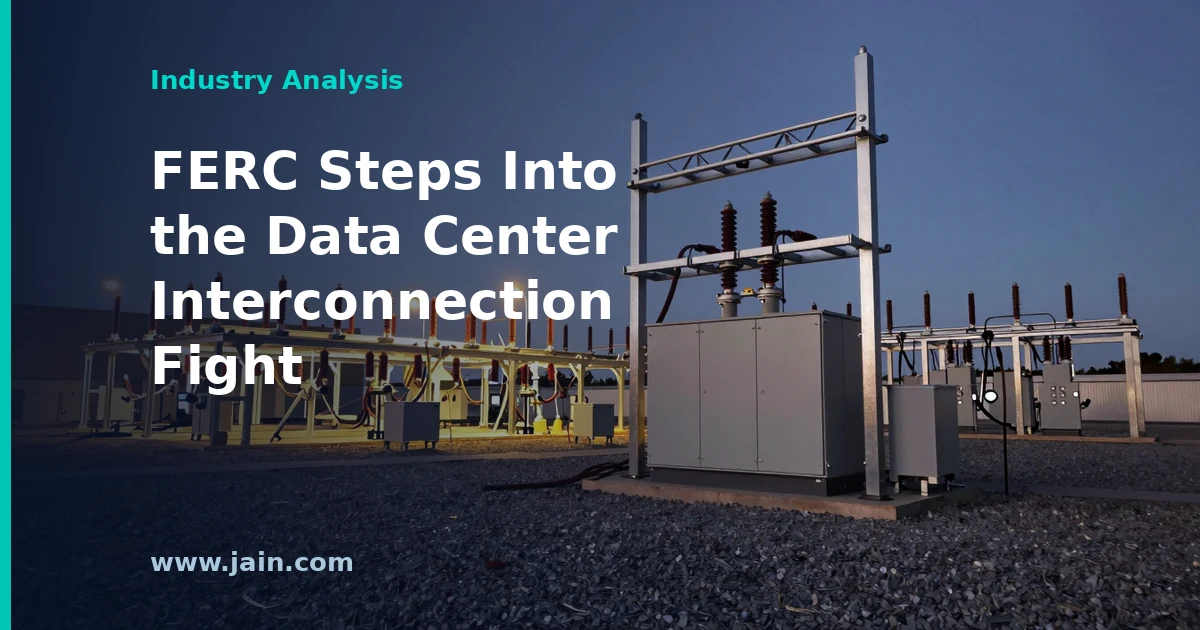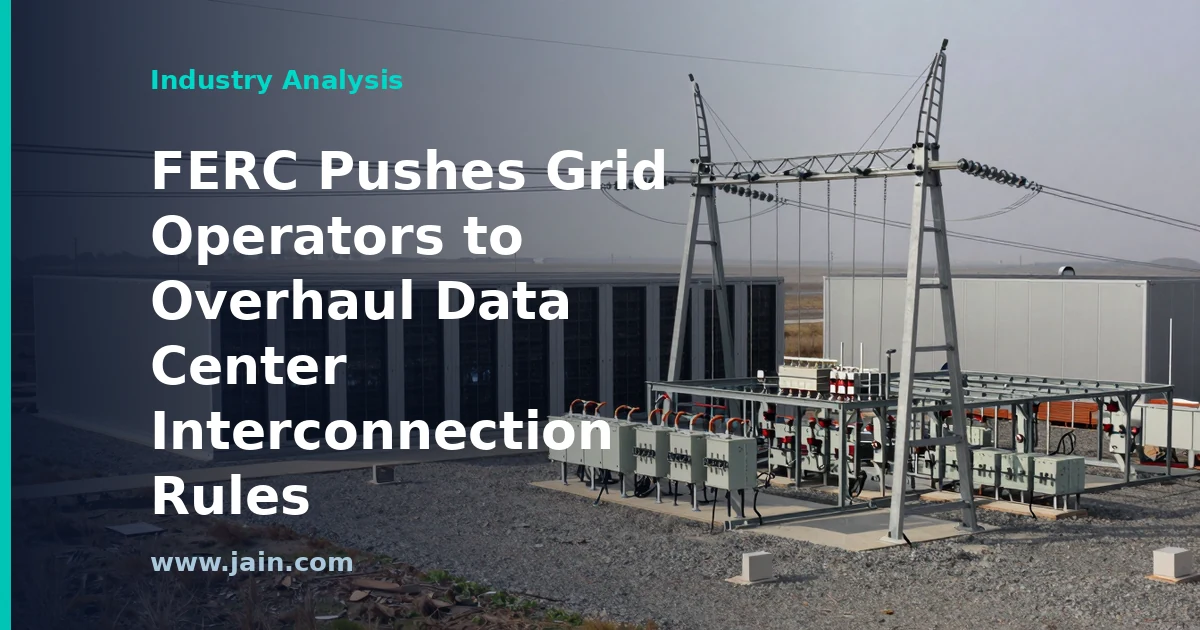
The Federal Energy Regulatory Commission (FERC) — the U.S. agency that oversees interstate electricity transmission and wholesale power markets — is taking aim at the delays data centers face when connecting to the power grid, according to a May 11, 2026 report from Broadband Breakfast. Interconnection, the formal process by which a large new electricity load or generator gets studied and physically wired into the transmission system, has become one of the tightest bottlenecks in the AI infrastructure buildout.
Executive Summary
According to the report, FERC is targeting the interconnection delays that have left large data center projects waiting — often years — for grid connections. The report available to us is brief and does not detail the specific mechanism, so it is not yet clear whether the action takes the form of a rulemaking, an order directed at grid operators, or a preliminary inquiry. What is clear is the direction: the federal regulator most responsible for transmission access is treating data center connection timelines as a problem worth its attention.
Why it matters: capital, chips, and land have largely stopped being the binding constraints on AI data center construction — power is. A hyperscale campus can be financed and built in two to three years, but securing a firm grid connection can take longer than that in constrained regions. Any FERC move that compresses those timelines, or that standardizes how utilities and regional grid operators study large new loads, goes directly to the pace at which announced AI capacity actually energizes.
The Queue Is the Chokepoint
For most of the grid’s history, interconnection processes were designed around new power plants, not new consumers. A data center drawing hundreds of megawatts — comparable to a small city — inverts that model: it is a load so large that utilities must run detailed studies to confirm the transmission system can serve it without destabilizing service to everyone else. Those large-load studies are handled inconsistently across the country, often utility by utility, with no uniform federal timeline. The result is a patchwork in which functionally identical projects can face wait times that differ by years depending on jurisdiction.
FERC has already spent years reforming the generator side of this problem — its Order 2023 overhauled generator interconnection queues with clustered, first-ready-first-served studies after backlogs stretched to multi-year waits. The load side, where data centers sit, has had no equivalent national framework. FERC has also been drawn into adjacent fights, most visibly over co-location arrangements that would place data centers directly at existing power plants, a structure that raised contested questions in the PJM region about who pays for the grid and who gets access to scarce capacity. An action targeting data center interconnection delays fits a pattern of the Commission being pulled, docket by docket, into the collision between AI demand growth and grid process.
What Federal Action Can and Cannot Fix
FERC’s leverage is real but bounded. It regulates interstate transmission and the regional grid operators (RTOs and ISOs) that administer most of the U.S. bulk power system, so it can standardize study timelines, impose deadlines, and clarify cost responsibility for network upgrades. That could meaningfully shrink the procedural portion of interconnection delays — the months lost to sequential studies, restudies, and ambiguity about process.
What FERC cannot conjure is physical capacity. Where delays reflect genuinely constrained transmission — lines and transformers that do not yet exist — faster paperwork simply delivers a faster “no” or a large upgrade bill. Transformers and high-voltage equipment carry their own multi-year supply lead times, and retail-level service decisions remain with states and local utilities. The honest framing is that federal reform can remove artificial delay, not engineering reality; both matter, and the report available does not indicate which FERC believes is dominant.
Winners, Losers, and the Cost Question
Faster, more predictable interconnection most benefits large, well-capitalized developers — hyperscalers and major colocation operators — who can meet readiness requirements and post financial commitments quickly. It also benefits regions competing for data center investment, where interconnection uncertainty has begun steering projects toward states or utilities perceived as faster. Utilities face a more mixed picture: standardized deadlines add pressure and potential liability, but a clearer process also protects them from accusations of arbitrary treatment.
The hardest question any reform must answer is cost allocation: when a multi-hundred-megawatt load triggers transmission upgrades, does the data center pay, or do those costs spread across all ratepayers? Consumer advocates have pressed this issue sharply as residential bills rise in data-center-heavy regions, and it was central to the co-location disputes FERC has already handled. A reform that accelerates connections without settling who pays would relocate the fight rather than resolve it — and that question deserves scrutiny regardless of which side raises it.
Background
FERC’s involvement in the data center power crunch has been building for several years. U.S. electricity demand, flat for roughly two decades, began rising sharply in the mid-2020s as AI training and cloud workloads drove a wave of hyperscale construction, and grid operators repeatedly raised their load forecasts in response. The Commission modernized generator interconnection with Order 2023, but large consuming loads had no comparable national framework, leaving data centers subject to a patchwork of utility-specific processes. FERC was also pulled into high-profile disputes over co-locating data centers at power plants, which crystallized the cost-allocation and market-access questions that any broader interconnection reform will have to answer. Action targeting data center connection delays is the logical next step in that progression.
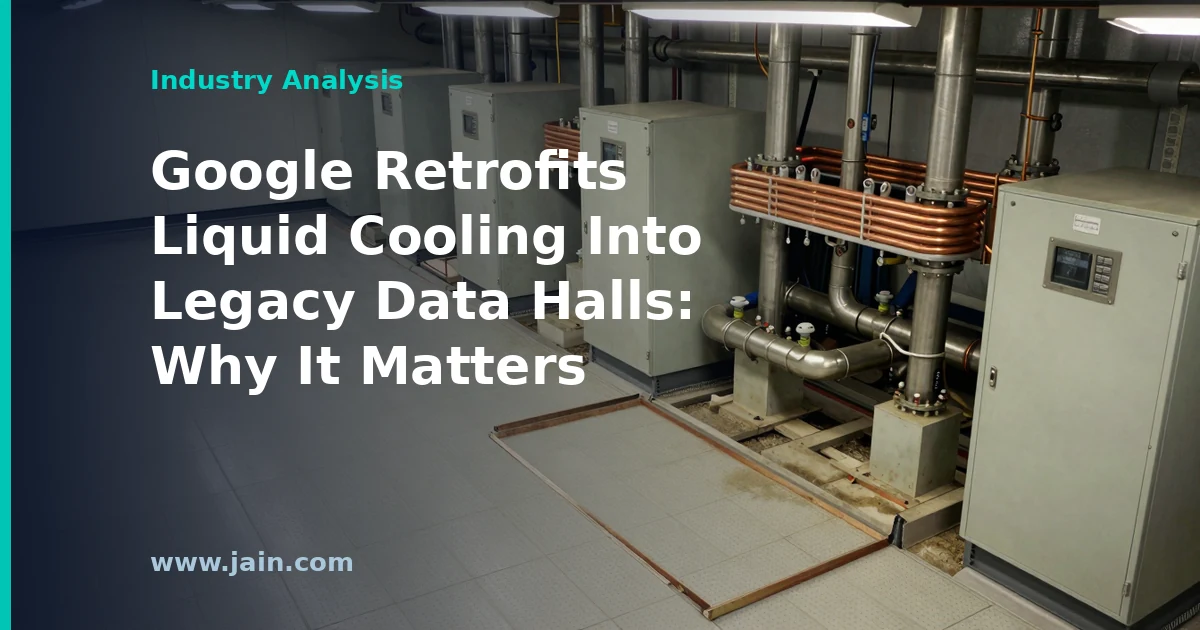
Data Center Knowledge published an analysis on May 11, 2026, titled “Redefining Hydronic Design for D2C Liquid Cooling,” addressing how the shift to direct-to-chip (D2C) liquid cooling is changing the way data center water systems — the hydronic plant — must be designed. The piece lands amid an industry-wide transition in which AI-driven rack power densities have climbed beyond what traditional air-cooled facility designs were built to handle.
Executive Summary
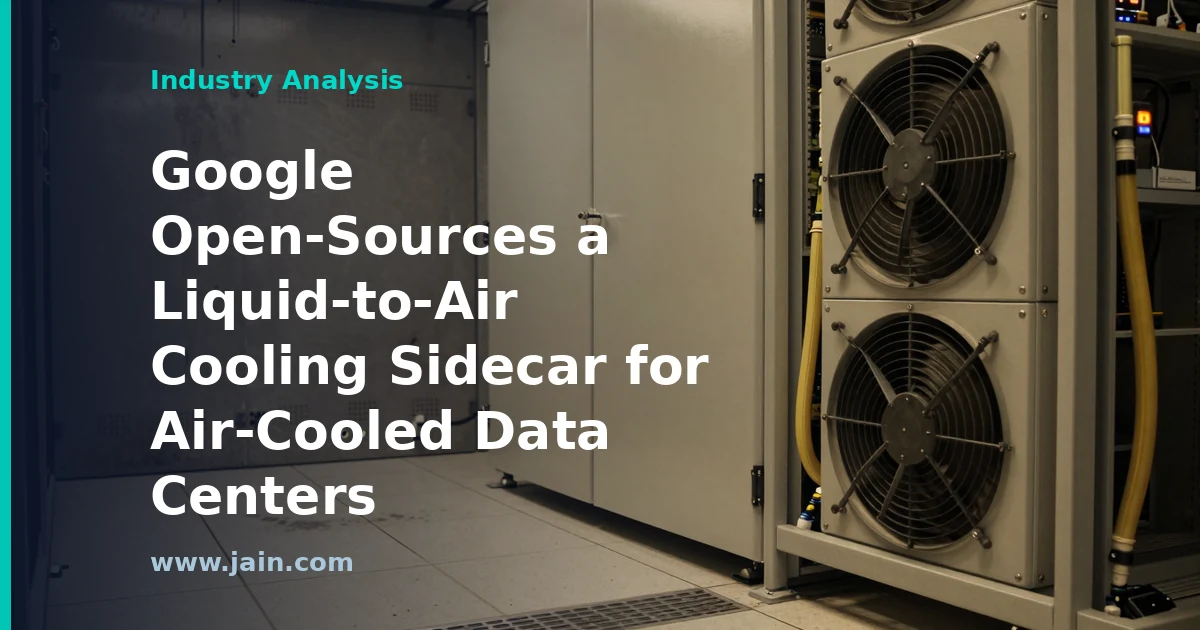
The core issue flagged by the headline is straightforward but consequential: direct-to-chip liquid cooling — where coolant is piped through cold plates mounted directly on processors, rather than cooling servers with chilled air — does not simply bolt onto the chilled-water infrastructure most data centers already have. Hydronic design, meaning the engineering of the pumps, piping, heat exchangers, and control systems that move liquid through a facility, was historically sized around air handlers serving racks of modest power draw. D2C changes the temperatures, flow rates, water quality requirements, and failure modes the plant must support.
Why it matters: liquid cooling has moved from niche to mainstream as AI accelerators push per-rack power well beyond what air can economically remove. Operators deciding between retrofitting existing plants and building new liquid-native facilities are making capital decisions that will constrain them for decades. A trade-press focus on hydronic fundamentals — rather than just on the servers or cold plates — signals that the industry’s bottleneck conversation is shifting upstream, from the rack to the plant room.
The Plant Room Becomes the Bottleneck
For two decades, data center cooling design treated the white space and the plant as loosely coupled: air handlers absorbed variation on the floor, and the chilled-water loop behind them changed slowly. Direct-to-chip cooling collapses that buffer. The coolant loop now terminates inches from the silicon, typically through a coolant distribution unit (CDU) — a device that isolates the clean, tightly controlled technology loop serving the servers from the facility water loop. That coupling means plant-side decisions about supply temperature, flow stability, and redundancy propagate directly to chip behavior, and legacy assumptions about acceptable temperature bands and transient response no longer hold automatically.
This is why hydronic design is having its moment in the trade press. The hard problems in liquid cooling are increasingly civil and mechanical engineering problems — pipe sizing, pump redundancy, water treatment, commissioning — not server-vendor problems. Operators who treat D2C as a rack-level product purchase, rather than a facility-level design change, risk discovering the mismatch after the equipment is on the dock.
Warm Water Changes the Economics
A frequently underappreciated aspect of D2C cooling is that cold plates can generally accept much warmer supply water than air-cooling systems require. Warmer facility water expands the hours in which outside air can reject heat without running chillers — so-called free cooling — which can reduce energy consumption and, in some designs, eliminate mechanical refrigeration for part or all of the year. But capturing that benefit requires designing the hydronic system around it: heat exchangers, dry coolers, and controls sized for warm-water operation, not a legacy chilled-water loop running at temperatures chosen for air handlers.
The economics cut both ways. A retrofit that simply taps an existing chilled-water plant may work, but it can leave the efficiency upside of liquid cooling unrealized and burden an aging plant with duty it was never sized for. A purpose-designed warm-water system costs more up front and demands different operational expertise. The Data Center Knowledge piece’s framing — redefining hydronic design rather than extending it — suggests the editorial judgment that incrementalism has limits here, a view worth testing against each facility’s actual constraints.
Winners, Losers, and the Skills Gap
If hydronic design is the new frontier, the beneficiaries are the firms that own that competence: mechanical engineering consultancies, CDU and heat-rejection equipment manufacturers, and colocation providers that invested early in liquid-ready plants. Operators of large fleets of air-era buildings face harder choices — retrofit selectively, densify only some halls, or cede the highest-density workloads to newer facilities. There is also a human dimension: hydronic systems at this criticality level need commissioning agents and operators fluent in water chemistry, two-phase transients, and leak response, and that talent pool is thin relative to the pace of AI buildout.
None of this makes air cooling obsolete. Most enterprise workloads remain comfortably air-coolable, and hybrid facilities — liquid for accelerator rows, air for everything else — are likely the dominant pattern for years. The design challenge the article’s title points to is precisely that hybridity: one plant serving two very different thermal customers.
Background
Data centers have been overwhelmingly air-cooled since the industry’s beginnings: chillers or outside air cool water, water cools air handlers, and air cools servers. That chain held while racks drew a few kilowatts each. The AI buildout of the mid-2020s broke the assumption, as accelerator-dense racks pushed power draw to levels where moving enough air became impractical, driving rapid adoption of direct-to-chip liquid cooling across hyperscale, colocation, and enterprise deployments.
The transition has unfolded in stages — first server-level cold plates, then rack-level manifolds and CDUs, and now, as this Data Center Knowledge piece reflects, a reckoning with the facility-level hydronic plant itself. Industry bodies and operators have been working toward common temperature classes and reference designs, but practice is still consolidating, which is why plant-level design questions remain live editorial territory in 2026.
Source: Redefining Hydronic Design for D2C Liquid Cooling — Data Center Knowledge analysis, published May 11, 2026, on how direct-to-chip liquid cooling is reshaping data center water-system design.
Nscale, the London-headquartered AI infrastructure company, announced on May 10, 2026 that it has secured $790 million in financing to support its AI infrastructure buildout in Norway. The announcement, distributed via PR Newswire, did not publicly detail the structure of the financing or the specific facilities it will fund.
The raise extends a rapid string of capital events for the two-year-old company, which operates hydropower-fed data center capacity in northern Norway and has positioned itself as a European alternative for large-scale AI compute.
Executive Summary
The headline fact is simple: $790 million in fresh financing, earmarked for AI infrastructure in Norway. What makes it worth analyzing is the pattern it confirms. Capital for AI data centers — both equity and, increasingly, project-style debt — is flowing toward locations selected for power and cooling economics rather than proximity to traditional internet hubs. Norway offers abundant hydroelectric power, some of Europe’s lowest industrial electricity costs, and a climate that allows servers to be cooled largely by outside air, a technique known as free cooling.
For Nscale, the money supports a buildout strategy the company has pursued since its 2024 founding: convert stranded or under-used Nordic renewable power into GPU capacity (the graphics processors that train and run AI models) and sell that capacity to hyperscalers and AI labs. For the broader market, a financing of this size directed at a Norwegian buildout is another data point that lenders and investors now treat AI compute facilities as a financeable infrastructure asset class — provided the power story is strong.
Why the Money Is Going North
Traditional European data center markets — Frankfurt, London, Amsterdam, Paris, Dublin — are power-constrained. Grid connection queues stretch for years, and several jurisdictions have imposed moratoria or tight limits on new capacity. AI training workloads, which need enormous amounts of electricity but are far less sensitive to network latency than a website or trading system, break the old rule that data centers must sit near users. That decoupling is the entire Nordic thesis: build where power is cheap, renewable, and available now, and ship the model weights rather than fighting for megawatts in a congested metro.
Norway sharpens that thesis further. Its grid is overwhelmingly hydroelectric, giving operators both low costs and a clean-energy claim that matters to hyperscale customers with public carbon commitments. Sub-Arctic ambient temperatures cut cooling energy dramatically — cooling can consume 30% or more of a conventional data center’s power budget, so free cooling flows straight to operating margin. A $790 million financing aimed specifically at Norway is capital underwriting exactly those advantages.
From Venture Rounds to Infrastructure-Scale Finance
Nscale’s earlier fundraising followed a venture pattern: a Series A in late 2024 and a Series B in late 2025 that ranked among Europe’s largest. The release does not specify whether the new $790 million is equity, debt, or a hybrid, but financings of this size in the sector have increasingly taken the form of asset-backed or project-level debt, where lenders advance capital against contracted future revenue and the hardware and facilities themselves. If that is the shape here, it would mark a maturation milestone — the point where a young company’s buildout is bankable on its contracts rather than purely on investor conviction in the AI boom.
The economics explain why that distinction matters. GPU clusters are extraordinarily capital-intensive, and the chips depreciate quickly as new generations arrive. Equity alone cannot efficiently fund gigawatt-scale ambitions; the industry needs debt markets to participate, and debt markets need predictable cash flows. Every large financing that closes on a power-advantaged site lowers the perceived risk for the next one, which is how a regional buildout becomes a self-reinforcing capital cycle.
Winners, Losers, and the Latency Trade
The obvious beneficiaries are Nordic host communities and utilities, which convert surplus renewable generation into industrial investment and jobs, and the AI labs and cloud providers that gain a European supply of compute at competitive cost — a point with real weight as European institutions push for “sovereign AI” capacity on EU-adjacent soil. Suppliers of high-density and liquid-cooling equipment, long-haul fiber, and grid interconnection services also ride the wave.
The trade-off is real but narrowing. Remote sites are poorly suited to latency-sensitive inference serving end users in central Europe, so Nordic capacity skews toward training and batch workloads. Competition is a second pressure: Sweden, Finland, and Iceland pitch similar advantages, and enormous buildouts in the United States and the Gulf compete for the same GPUs, transformers, and turbines. Cheap power is an advantage, not a moat — execution speed and customer contracts decide who wins.
The Risks Behind the Momentum
Three risks deserve sober attention. First, customer concentration: merchant AI compute providers typically depend on a small number of very large offtakers, so one renegotiated or lost contract can move the whole revenue model. Second, technology risk: financing hardware that may be economically obsolete in three to five years requires contract terms and depreciation assumptions that have not yet been tested through a full cycle. Third, local constraints: even in power-rich Norway, grid capacity in the far north is finite, and large industrial loads have drawn scrutiny over transmission upgrades and electricity-price effects for residents. None of these invalidate the buildout — but they are the variables that will determine whether today’s financings look prescient or aggressive in hindsight.
Background
Nscale was founded in 2024 as a spin-out of data center operator Arkon Energy, inheriting a hydropower-supplied site in Glomfjord in northern Norway. In roughly two years it moved from startup to one of Europe’s most heavily funded AI infrastructure players, raising a Series A in late 2024 and a Series B in late 2025 that ranked among the continent’s largest venture rounds, alongside major capacity agreements with hyperscale customers and a joint venture with Norwegian industrial group Aker to build AI capacity in Narvik with OpenAI as a customer.
The company’s rise tracks a broader industry shift: as AI training demand collided with power shortages in established data center hubs, operators and their financiers turned to energy-rich regions — the Nordics chief among them — where renewable generation, cool climates, and available grid capacity make gigawatt-scale computing economically and politically feasible.
PPL Corporation’s pipeline of “advanced-stage” data center projects seeking to connect in its Pennsylvania service territory has grown to 28.3 gigawatts, according to a May 10, 2026 report by Utility Dive. The figure refers to prospective load — data centers that have progressed beyond casual inquiry into serious interconnection planning with the utility — not capacity that is contracted, under construction, or energized.
For scale, 28.3 GW of potential new demand concentrated in one utility’s footprint is several times the historical peak load of PPL’s Pennsylvania system, making it one of the clearest single data points yet on how large the AI-driven interconnection wave has become.
Executive Summary
Utilities increasingly disclose their data center “pipelines” — the aggregate megawatts of projects in active interconnection discussions — as a forward indicator of load growth. PPL’s disclosure that its advanced pipeline has reached 28.3 GW in Pennsylvania matters for three reasons. First, it quantifies demand pressure in PJM Interconnection, the 13-state grid region that already faces tightening capacity margins. Second, it signals that Pennsylvania, with its proximity to fiber routes, available land, and in-state generation, has become a first-tier data center market rather than a spillover from Northern Virginia. Third, it frames the central planning question of this cycle: how much of a paper pipeline converts into steel, concrete, and actual megawatt-hours.
The distinction between pipeline and reality is the heart of the story. Developers routinely file interconnection requests at multiple utilities for the same project, and “advanced” is a utility-defined category, not a standardized industry term. Even so, the direction and magnitude of the number — and the fact that it keeps growing — tells investors, regulators, and infrastructure buyers that the interconnection queue, not chips or capital, is now the binding constraint on data center growth.
What “Advanced” Actually Means — and Why the Definition Matters
When a utility labels pipeline projects “advanced,” it generally means the developer has moved past an initial inquiry: engineering studies are underway, agreements may be in negotiation, and sites are typically identified. That is meaningfully stronger than the raw interconnection queue, which is notorious for speculative and duplicative requests. But it still is not a commitment. No standardized definition governs the term across utilities, so a project counted as advanced at PPL could simultaneously appear in another utility’s pipeline while the developer shops for the fastest path to power.
The practical consequence is that 28.3 GW should be read as a demand signal, not a construction forecast. Utilities themselves typically plan around a conversion rate — an internal estimate of what fraction of the pipeline materializes — though the report at hand does not disclose PPL’s assumption. The honest framing is that even a modest conversion of a pipeline this size would represent transformative load growth for a single service territory.
Pennsylvania’s Emergence as a Load-Growth Epicenter
For two decades, U.S. data center demand concentrated in Northern Virginia. As land, power, and community tolerance tightened there, developers fanned out along the PJM footprint, and central and eastern Pennsylvania — PPL’s territory — offered a compelling combination: transmission access, proximity to East Coast network routes, comparatively available land, and significant in-state generation including nuclear and gas. A 28.3 GW advanced pipeline suggests that migration is no longer incremental; Pennsylvania is being treated as a primary market.
That creates a genuine economic opportunity for the state — construction activity, tax base, and potential anchor tenants for new generation — alongside a genuine planning burden. Interconnecting even a fraction of this load requires new transmission, substations, and ultimately generation, all of which run on multi-year timelines that sit awkwardly against data center developers’ desired 24- to 36-month schedules.
The Ratepayer Question Hanging Over Every Gigawatt
The unresolved policy issue beneath these numbers is cost allocation: who pays for the grid upgrades that hyperscale load requires, and who bears the risk if forecast load never shows up. PJM’s recent capacity market results have already drawn scrutiny over rising costs attributed partly to data center demand, and utilities across the region have been developing large-load tariffs — contract structures requiring minimum payments, collateral, or long-term commitments from data center customers — precisely to shield residential ratepayers from stranded-asset risk.
A pipeline of 28.3 GW sharpens that debate rather than settling it. If utilities build for demand that fails to materialize, ordinary customers can be left carrying the cost; if they under-build, they forfeit economic development and constrain a strategically important industry. The quality of the screening — how rigorously “advanced” projects are vetted for financial commitment — is therefore not a technicality. It is the mechanism that determines whether this boom is financed by its beneficiaries.
Winners, Losers, and the New Scarcity
The clearest winners from a demand signal of this size are owners of existing generation in PJM, transmission developers, and the electrical-equipment supply chain — transformers, switchgear, and high-voltage gear already carry long lead times, and this level of demand extends them. Data center operators with interconnection positions already secured hold assets that appreciate as the queue lengthens. The squeezed parties are late-arriving developers facing multi-year waits, industrial customers competing for the same grid headroom, and any market participant that underestimated how quickly regional capacity margins would tighten.
For enterprise buyers of data center capacity, the takeaway is concrete: power availability, not real estate, now drives site selection and delivery dates. Contracted, deliverable megawatts in PJM have become the scarce commodity, and pipelines like PPL’s explain why.
Background
PPL Corporation, headquartered in Allentown, Pennsylvania, delivers electricity through PPL Electric Utilities to roughly 1.5 million customers in central and eastern Pennsylvania, a territory inside PJM Interconnection — the regional transmission organization spanning 13 states and Washington, D.C. For most of the past two decades, U.S. utilities planned around flat or declining load; efficiency gains offset economic growth, and grid investment focused on reliability rather than expansion.
The AI buildout that accelerated from 2023 onward broke that pattern. Hyperscale and AI-specialist developers began requesting grid connections measured in hundreds of megawatts per campus, overwhelming interconnection processes designed for a slower era. Utilities across PJM — where Northern Virginia’s data center concentration already strained the system — started publishing pipeline figures to communicate the scale of prospective demand to investors and regulators, and those figures have grown with nearly every disclosure. PPL’s 28.3 GW advanced pipeline is among the largest single-utility totals reported to date.
Amazon Web Services suffered a data center outage that the company attributed to a “thermal event,” according to a May 9, 2026 report from CRN. At the time of the report, some AWS services were still impacted, indicating recovery was ongoing rather than complete when the cause was disclosed.
The disclosure was notably spare: the phrase “thermal event” confirms a cooling- or heat-related failure inside an AWS facility, but the public reporting available at publication did not detail which region was hit, how many customers were affected, or how long full restoration would take.
Executive Summary
The world’s largest cloud provider experienced a facility-level outage traced not to software, networking, or a cyberattack, but to heat. A “thermal event” is industry shorthand for a situation in which a data center’s cooling systems can no longer remove heat as fast as the IT equipment produces it, forcing servers to throttle or shut down to protect themselves. That this occurred at AWS — an operator with deep engineering resources and decades of operational experience — is the story.
It matters because the physics of cloud computing are changing. Modern servers, especially those built for artificial intelligence workloads, draw far more power per rack than the equipment data centers were designed around a decade ago, and every watt consumed becomes heat that must be removed. Cooling has quietly moved from a background utility to one of the most consequential single points of failure in cloud infrastructure.
For enterprises, the incident is a prompt to treat facility-level physical risk — cooling and power, not just software bugs — as a first-class input to cloud architecture and continuity planning. For the industry, it is a data point in a pattern: as densities rise, thermal margins shrink, and the cost of a cooling failure grows with every server packed into the room.
What a ‘Thermal Event’ Actually Means
Data centers are, at their core, heat-management machines. Every server converts electricity into computation and, unavoidably, into heat; chillers, cooling towers, air handlers, and increasingly liquid-cooling loops carry that heat away. When any link in that chain fails — a chiller trips, a pump loses power, a control system misbehaves, or outside conditions exceed design assumptions — temperatures inside the data hall can climb within minutes. Servers respond by throttling performance and then shutting down to avoid permanent damage.
The phrase “thermal event” confirms the failure mode without revealing the failure cause. It could reflect mechanical breakdown, a power interruption to cooling equipment, a controls fault, or environmental stress. Each has different implications for how preventable the incident was, and the public reporting at the time did not say which applied. What the phrase does establish is that physical infrastructure, not code, took cloud services down — a category of failure that no amount of software redundancy inside a single facility can fully paper over.
Why Cooling Is Now a Top-Tier Reliability Risk
For most of the cloud era, the outages that made headlines were logical: configuration errors, DNS problems, cascading software failures. Cooling rarely featured because thermal margins were generous — racks drawing a few kilowatts left plenty of headroom. That headroom is disappearing. AI accelerators and dense compute have pushed rack power demands up sharply across the industry, and higher density means a cooling interruption becomes critical faster, with less time for operators to respond before equipment protection kicks in.
The economics cut both ways. Operators pack facilities densely because space, power, and capital are expensive, but density concentrates risk: one cooling plant now underpins far more revenue-generating compute than it once did. The industry’s shift toward liquid cooling addresses heat removal at the chip level yet introduces new mechanical dependencies — pumps, loops, coolant distribution units — each a component that can fail. The engineering trend line points one direction: thermal management is becoming more complex precisely as the tolerance for its failure shrinks.
The Customer’s Dilemma: Redundancy Is a Design Choice, Not a Default
Cloud providers, AWS included, architect their platforms around Availability Zones — physically separate facilities within a region — precisely so that a single-building failure like a thermal event need not become a customer outage. But that protection only applies to workloads customers have deliberately architected to span zones, and the fact that “some services” remained impacted when CRN reported suggests the blast radius extended beyond any one customer’s choices.
The practical lesson for buyers is uncomfortable but familiar: the shared-responsibility model extends to physical risk. Enterprises that treat a single cloud region — or a single zone — as infinitely reliable are making an implicit bet on someone else’s chillers. Incidents like this one argue for testing failover paths rather than assuming them, and for asking providers harder questions about facility-level dependencies that sit beneath the abstractions. It also strengthens the case, for the most critical workloads, of multi-region or hybrid designs whose costs were once hard to justify.
Transparency as a Competitive Variable
Two words — “thermal event” — carried the entire public explanation at the time of the report. That is consistent with how hyperscalers typically communicate mid-incident, and there are defensible reasons for early caution: root causes genuinely take time to establish. But the information asymmetry is real. Customers making architecture and procurement decisions cannot weigh a risk they cannot see, and cooling-plant design, maintenance posture, and thermal headroom are precisely the details cloud providers disclose least.
How AWS follows up matters more than the initial phrasing. The company has historically published detailed post-event summaries for major incidents, and a substantive account of what failed and what will change would convert this outage into usable information for the market. Absent that, enterprises are left to price the risk blind — and the industry loses a chance to learn from a failure at one of its most sophisticated operators.
Background
Amazon Web Services, launched in 2006, is the largest cloud infrastructure provider in the world, operating dozens of regions composed of multiple Availability Zones — physically separate data center facilities engineered so that a failure in one need not take down the others. Enterprises, governments, and a large share of the consumer internet run on its platform, which is why even partial AWS disruptions ripple widely and draw immediate scrutiny.
Data center cooling, meanwhile, has shifted from a background utility to a strategic constraint across the industry. Rising rack power densities — accelerated by the AI buildout — have pushed operators toward higher-capacity cooling designs, including liquid cooling, while simultaneously narrowing the time margin between a cooling interruption and equipment shutdown. Facility-level physical failures now sit alongside software faults among the principal threats to cloud availability.
The U.S. Securities and Exchange Commission — the federal agency that polices what public companies must tell investors — is pressing companies to spell out how their artificial-intelligence data center buildouts are being paid for, according to a Bloomberg Tax report published on May 8, 2026.
The report is headline-level: it signals a regulatory focus on the financing structures behind AI compute capacity, rather than on the projects themselves. No specific companies, dollar figures, deadlines or enforcement actions are described in the source material available to us.
Executive Summary
The substance of the story is narrow but consequential. Regulators are not questioning whether AI data centers should be built; they are questioning whether investors can tell, from public filings, who is actually on the hook when they are. That is a disclosure question, and disclosure questions tend to arrive before accounting questions, which in turn tend to arrive before repricing.
It matters because the current buildout is being funded through a wider mix of instruments than the last data center cycle. Alongside ordinary corporate debt and equity, capacity is being financed through special-purpose vehicles (separate legal entities created to hold a single project and its debt), joint ventures, long-dated leases, prepaid capacity contracts and vendor financing, in which a supplier helps fund the customer that buys its equipment. Each of these can sit at, near, or entirely off the balance sheet depending on structure and judgment.
For infrastructure buyers, the practical read is that counterparty diligence is about to get more informative and more demanding. If issuers respond by disclosing more about guarantees, residual-value obligations and consolidation decisions, everyone in the supply chain — from landlords to power providers — gets a clearer view of who bears risk in a downturn. That is a net positive for the industry, even if it is uncomfortable for individual balance sheets in the short run.
Why Financing Structure Is Now an Infrastructure Question
Data centers have always been capital-intensive, but the AI cycle has changed the shape of the capital. A conventional colocation facility could be underwritten against a diversified tenant base and a long operating history. A purpose-built AI campus is often underwritten against a small number of very large contracts, expensive and rapidly depreciating accelerators, and power interconnection timelines measured in years. That combination pushes sponsors toward structures that isolate risk: put the asset and its debt in a separate vehicle, sign a lease rather than buy, or let the equipment vendor carry part of the financing burden.
None of that is inherently improper. Project finance exists precisely because large, long-lived assets are easier to fund when their risks are ring-fenced, and the same techniques built power plants, pipelines and toll roads for decades. The disclosure question is different from the propriety question: it asks whether a reader of the financial statements can identify the obligations that remain with the parent even after the asset has been moved elsewhere. Guarantees, residual-value backstops, minimum-volume commitments and reconsolidation triggers are the details that decide whether a structure genuinely transfers risk or merely relocates its label.
For laypeople, the intuition is simple. If a company builds a warehouse with borrowed money, the debt is obvious. If it instead signs a fifteen-year lease on a warehouse built by someone else, the economics can be nearly identical while the presentation is not. Accounting rules have narrowed that gap considerably over the past decade, but judgment still governs consolidation of variable-interest entities and the classification of complex, multi-party arrangements.
Circularity, Vendor Financing and the Question Regulators Tend to Ask
The structure that attracts the most supervisory attention in any capital cycle is the one where a supplier’s revenue depends on financing the supplier provides. Vendor financing is a legitimate and long-standing commercial tool — it accelerates adoption of expensive technology and it is common in telecom, aviation and semiconductor equipment. It also creates an information problem: revenue recognized today may be funded by credit that the vendor itself extended, which means the vendor’s earnings quality is partly a function of its customer’s future ability to pay.
An investor cannot assess that risk without knowing its size and terms. Nor can a lender to the same ecosystem. This is where a disclosure push does more useful work than a rule change would: it does not prohibit anything, it simply asks the parties to state clearly what they have committed to. The critical caveat, and it applies to the skeptics as much as to the issuers, is that the existence of vendor financing in a sector is not by itself evidence of a problem. Aggregate exposure, tenor, collateral and concentration determine whether a practice is prudent or fragile, and those figures are exactly what is not yet public.
Equally, industry pushback deserves the same scrutiny. The argument that AI demand is contracted far into the future is a claim about counterparty durability, not just about demand: a twenty-year capacity commitment is worth what the signer can pay. Both the bullish and the bearish narratives around the buildout currently rest on data that a stronger disclosure regime would make checkable, which is a reasonable argument in favor of the SEC’s reported interest regardless of which narrative one finds more persuasive.
Who Gains and Who Absorbs the Cost
The likeliest winners from clearer disclosure are the operators with conventional, well-capitalized balance sheets and long track records — mainly the large hyperscale platforms and the established REIT-structured wholesale providers, whose funding is already visible and whose cost of capital is set in liquid public markets. If the market can more easily distinguish transparent structures from opaque ones, the premium for transparency widens. Lenders, insurers and power utilities that must underwrite decade-long commitments also benefit, because their diligence currently relies heavily on private information.
The cost falls on smaller and newer sponsors, particularly those whose economics depend on structuring rather than on scale. Additional disclosure raises compliance expense, lengthens deal timelines and can narrow the pool of financing techniques that survive investor scrutiny. That is not the same as saying such sponsors are doing anything wrong; it means the burden of a disclosure regime is not distributed evenly, and consolidation pressure in the middle tier of the market is a plausible second-order effect.
For enterprise buyers of capacity, the sensible response is procedural rather than dramatic. Contracts for AI capacity should be read as credit exposures: ask who owns the facility, who owns the equipment inside it, which entity signs the service agreement, what recourse exists to a parent, and what happens to a tenant’s rights if the project vehicle is restructured. Those questions were always worth asking. A disclosure push simply makes the answers easier to obtain — and makes it more conspicuous when a counterparty declines to give them.
Background
The current AI buildout is the largest wave of data center construction on record by capital committed, and it has coincided with a broadening of how that capital is raised. Traditional corporate debt and equity now sit alongside project-level structures borrowed from the power and infrastructure world: joint ventures, special-purpose vehicles, asset-backed issuance, long-dated leases and prepaid capacity agreements. The underlying assets are also unusual — accelerator hardware depreciates far faster than the buildings housing it, while the power and land beneath it may hold value for decades.
Regulatory attention to financing structure is a recurring feature of large capital cycles rather than a novelty. Accounting and disclosure regimes for leases and for consolidating off-balance-sheet entities have been tightened repeatedly over the past two decades, generally after periods in which structures outpaced the reporting conventions describing them. A disclosure push during an expansion, rather than after a contraction, is the comparatively benign version of that pattern.
NVIDIA and IREN Limited announced a strategic partnership on May 7, 2026, aimed at accelerating the deployment of up to 5 gigawatts (GW) of AI infrastructure. IREN, a Nasdaq-listed data center operator that pivoted from Bitcoin mining to AI cloud services, becomes one of the largest publicly named partners in NVIDIA’s growing web of direct infrastructure alliances.
The announcement, issued through NVIDIA’s newsroom, frames the deal as a build-out acceleration pact; the headline figure is capacity — power, not dollars — and the companies did not disclose financial terms in the material reviewed here.
Executive Summary
The world’s dominant AI chipmaker and one of the fastest-rising ‘neocloud’ operators — companies that build GPU-packed data centers and rent the computing power out — have formalized a partnership targeting up to 5GW of AI infrastructure. For scale, 5GW is roughly the output of five large nuclear reactors and exceeds the total data center capacity of most major metropolitan markets today.
Why it matters: NVIDIA has been steadily moving beyond selling chips into shaping who gets to build the facilities that consume them — through investments, supply commitments, and named partnerships with operators like CoreWeave and now IREN. A GPU vendor putting its name directly behind a gigawatt-scale buildout compresses the traditional separation between component supplier and infrastructure developer.
For IREN, NVIDIA’s public endorsement is arguably as valuable as any commercial term: it signals priority access to scarce GPUs, the binding constraint for every AI cloud operator, and validates the company’s multi-year pivot from cryptocurrency mining to AI compute.
The Chipmaker Becomes the Kingmaker
Historically, semiconductor vendors sold components and let customers worry about buildings, power, and financing. That model is inverting. NVIDIA has taken equity stakes in GPU cloud providers, arranged supply priority for favored partners, and now attaches its name to a 5GW deployment target with a single operator. When allocation of the scarcest input in the AI economy — leading-edge GPUs — flows through strategic partnerships, the vendor effectively chooses which infrastructure players scale and which wait in line.
This has real market-structure consequences. Operators inside NVIDIA’s partnership perimeter can raise capital more cheaply, because lenders and investors treat GPU access as the key execution risk. Operators outside it face a harder story. The deal is therefore best read not just as an IREN milestone but as another data point in NVIDIA’s construction of a vertically aligned ecosystem — one that competitors, regulators, and hyperscale customers are all watching closely.
Why IREN: Power First, Chips Second
IREN’s core asset is not silicon — it is secured electrical capacity. The company, which began as Bitcoin miner Iris Energy, spent years assembling large, renewables-oriented power positions, including a multi-gigawatt development hub in West Texas and hydro-powered sites in British Columbia. In today’s market, grid interconnection queues stretch years and available power — not capital or land — is the gating factor for AI data centers. An operator holding contracted gigawatts is holding the scarce complement to NVIDIA’s scarce GPUs.
The partnership logic is symmetrical: NVIDIA needs credible places to deploy the chips it sells in enormous volumes; IREN needs assured chip supply to monetize its power pipeline. IREN’s late-2025 multi-billion-dollar AI cloud contract with Microsoft — reported at roughly $9.7 billion — had already demonstrated hyperscaler demand for its capacity. A named NVIDIA partnership adds the supply-side anchor.
Reading ‘Up to 5 Gigawatts’ Carefully
The phrase ‘up to’ is doing significant work. A 5GW ceiling is an ambition, not a contracted delivery schedule, and the announcement as reviewed does not specify phasing, capital commitments, or who funds what. Building 5GW of AI-grade data centers would plausibly require investment on the order of hundreds of billions of dollars across facilities, chips, and grid upgrades over many years — commitments far beyond what a partnership press release itself establishes.
That is not a criticism unique to this deal; it is the standard grammar of AI infrastructure announcements in this cycle, where headline gigawatt and dollar figures routinely describe multi-year aspirations. The substantiated core here is narrower but still meaningful: NVIDIA has publicly designated IREN a strategic deployment partner at a scale ceiling few operators can claim. Investors and customers should track converted megawatts — energized, GPU-filled capacity under contract — rather than announced ceilings.
Winners, Losers, and the Financing Question
Winners, if the buildout converts: IREN, whose cost of capital and customer pipeline both improve; power-rich regions like West Texas that host the load; and NVIDIA itself, which locks in demand visibility for future GPU generations. Under pressure: mid-tier colocation and cloud players without vendor alignment, and any operator whose business case assumed GPU scarcity would ration competitors’ growth.
The open question is who carries the balance-sheet risk. GPU-backed infrastructure depreciates fast — accelerator generations turn over roughly every one to two years — and neocloud operators fund buildouts with debt secured against chips and customer contracts. If AI compute pricing softens before this capacity earns out, the pain lands on whoever financed the gap between announcement and cash flow. The release, as reviewed, does not say how that risk is allocated between the partners.
Background
IREN began life in 2018 as Iris Energy, an Australian-founded Bitcoin miner that differentiated itself by siting operations on low-cost, renewable-heavy power in British Columbia and later Childress, Texas. It listed on Nasdaq in 2021, and as AI demand exploded it converted its power-first playbook into an AI cloud business, buying NVIDIA GPUs and building high-density data centers — a pivot capped by a reported multi-billion-dollar cloud contract with Microsoft in late 2025.
NVIDIA, meanwhile, has evolved from graphics chipmaker into the central supplier of AI computing and, increasingly, an active architect of the infrastructure layer: investing in cloud partners, steering GPU allocation, and publicly backing large deployments. This partnership sits squarely in that pattern — a chip vendor underwriting, at least reputationally, a gigawatt-scale buildout.
On May 7, 2026, CNBC reported that shares of Akamai Technologies surged roughly 20% after the company posted quarterly earnings and disclosed a $1.8 billion AI infrastructure deal. The headline pairing — an earnings beat narrative and a large AI-branded contract — was enough to produce one of the stock’s sharpest single-day moves in years.
Details of the deal itself, including the customer, the contract length, and how the $1.8 billion figure is measured, were not spelled out in the report summary, making the market reaction as notable as the disclosed facts.
Executive Summary
Akamai, best known as the company that pioneered the content delivery network (CDN) — the globally distributed layer of servers that speeds up websites and video by caching content close to users — is now being valued, at least for a day, as an AI infrastructure company. A $1.8 billion deal figure attached to AI infrastructure is large by Akamai’s historical contract standards, and the ~20% share-price response suggests investors see it as evidence of a genuine second act rather than a one-off.
The strategic significance is bigger than one contract. AI ‘inference’ — the work of running an already-trained model to answer queries, as opposed to the massive centralized job of training it — is widely expected to become the dominant, recurring cost of AI. Inference rewards low latency and proximity to users, which is precisely the asset CDN operators have spent decades building. This deal is an early, dollar-denominated data point for the thesis that edge networks can capture a meaningful slice of AI spending long dominated by hyperscale cloud providers and GPU ‘neocloud’ specialists.
That said, the public record here is thin: a headline number, a stock move, and an earnings print. What the deal actually obligates, over what period, and at what margin remains unstated — and those details determine whether this is a turning point or a well-timed press moment.
From Cache to Compute: A Second Act Decades in the Making
Akamai has reinvented itself before. Founded in 1998 out of MIT to solve web congestion, it built one of the world’s most distributed server networks, then layered a substantial security business on top of it, and in 2022 acquired cloud provider Linode to add general-purpose computing. The through-line is a single physical asset: thousands of points of presence wired close to end users. An AI inference business is the logical next tenant for that real estate — the servers change from caching video to running models, but the geographic advantage is the same.
The strategic question has always been whether that advantage is monetizable at scale, or whether AI spending would remain concentrated in a handful of giant centralized data centers. A $1.8 billion figure — if it represents committed customer revenue — would be the strongest public evidence yet that at least one large buyer believes distributed inference is worth paying for. The market’s 20% re-rating says investors are willing to extend that belief to the whole franchise.
Why Inference Economics Could Favor Distributed Networks
Training a frontier AI model is a centralized, power-hungry project measured in gigawatts and months. Inference is the opposite: billions of small, latency-sensitive requests arriving from everywhere, all day, forever. For chatbots, voice agents, translation, fraud scoring, and video analysis, shaving tens of milliseconds by serving the request near the user materially improves the product. That is the same physics that made CDNs valuable, and it is why edge operators argue the inference market will fragment geographically even as training consolidates.
There is also a cost argument. Inference does not always need the newest, scarcest GPUs; a distributed fleet of mid-range accelerators running close to demand can undercut centralized capacity that carries hyperscaler margins and long-haul network costs. If Akamai can fill its existing footprint with inference workloads, the incremental economics could be attractive — the network, facilities, and customer relationships are already paid for. The unproven part is utilization: an inference fleet only earns those economics if demand actually shows up across hundreds of locations rather than pooling in a few metros.
What $1.8 Billion Does — and Does Not — Tell Us
Headline contract values in infrastructure deserve scrutiny regardless of who announces them. A $1.8 billion deal could be a multi-year total contract value recognized over five or more years, a capacity reservation with usage-based true-ups, or something structured differently — each implies a very different annual revenue impact for a company of Akamai’s size. The reporting available at publication does not say which, nor does it identify the customer, and a deal this large is by definition concentrated: one counterparty’s fortunes and renewal decision matter enormously.
The same even-handedness applies to the skeptics’ case. A 20% single-day move on a deal without disclosed terms can look like AI-headline enthusiasm — but it coincided with an earnings report, so the market was plausibly repricing the whole business, not just one contract. The honest reading as of May 7, 2026: the deal is a substantiated, material fact; the interpretation that edge players are now structural winners in AI is a reasonable thesis this deal supports but does not yet prove.
Competitive Ripples: Hyperscalers, Neoclouds, and the Rest of the Edge
If distributed inference contracts of this size become repeatable, several markets shift. Hyperscale clouds (AWS, Microsoft Azure, Google Cloud) would face price and latency competition at the edge of the network they largely ceded to CDNs. GPU neoclouds — specialists that rent raw AI compute — would face a rival that bundles compute with a global delivery and security network. And Akamai’s CDN peers, along with data center operators with many small regional facilities, gain a template: the deal implicitly re-prices every well-distributed footprint as potential AI infrastructure.
For enterprise buyers, more credible suppliers is straightforwardly good news — inference pricing has been set in a sellers’ market. The caveat is execution risk: operating AI infrastructure at the edge means securing accelerator supply, power, and cooling across many sites, disciplines where hyperscalers have a decade of hard-won scar tissue. Winning the deal is the beginning of that test, not the end.
Background
Akamai Technologies was founded in 1998 by MIT researchers to solve early-web congestion and grew into the archetypal content delivery network, at one point carrying a substantial share of global web traffic across tens of thousands of distributed servers. As CDN pricing commoditized through the 2010s, Akamai diversified into web and API security, which became a major revenue pillar, and then into cloud computing with its 2022 acquisition of developer-favorite Linode.
The AI boom initially concentrated infrastructure spending in massive centralized training campuses built by hyperscalers and GPU specialists. By 2025–2026, attention was shifting toward inference — the ongoing cost of actually serving AI to users — reopening the question of whether distributed, latency-optimized networks would claim a structural role in AI economics. Akamai’s May 2026 deal disclosure landed squarely in that debate.
Johnson Controls, one of the world’s largest building-technology and HVAC companies, reported an 8% year-over-year increase in sales for its fiscal second quarter, with data center cooling demand cited as a principal driver, according to a May 7, 2026 report by Facilities Dive. Because Johnson Controls’ fiscal year ends in September, its second quarter covers roughly January through March 2026.
Executive Summary
The headline number — 8% sales growth at a company of Johnson Controls’ scale — is notable less for its size than for its attribution. When a diversified industrial that sells everything from fire-suppression systems to building controls credits data center cooling as the engine of a quarter, it quantifies something the industry has sensed for two years: AI-driven data center construction has become a primary demand source for the industrial HVAC sector, not a niche vertical.
Cooling is the second-largest consumer of power and capital in a data center after the IT equipment itself, because nearly every watt a server draws becomes heat that must be removed. As hyperscale operators — the companies running the largest cloud and AI facilities — race to add capacity, the vendors who make chillers, air handlers, and thermal-management systems are seeing that race show up directly in their revenue lines. Johnson Controls’ quarter is one of the cleaner public data points yet on how large that effect has become.
From Building Controls to AI Infrastructure Supplier
Johnson Controls has spent recent years narrowing its portfolio toward commercial buildings and applied HVAC — the large, engineered cooling systems used in campuses, hospitals, and data centers — including divesting its residential and light-commercial HVAC business to Bosch and acquiring Silent-Aire, a maker of modular cooling and hyperscale data center equipment, in 2021. A quarter in which data center cooling is called out as the growth driver suggests that repositioning is doing what it was designed to do: concentrate the company’s exposure where capital spending is heaviest.
That matters for how investors and customers should read the company. Johnson Controls is increasingly priced and evaluated not as a building-products conglomerate but as a supplier to AI infrastructure buildouts — a category that commands different growth expectations, and different scrutiny, than traditional construction-linked HVAC.
The Economics of the Cooling Boom
Data center cooling is attractive business for industrial vendors for structural reasons. The equipment is large, engineered-to-order, and often sold with long-term service contracts — chillers (machines that produce chilled water to absorb heat from server halls) run continuously for decades and require ongoing maintenance. Hyperscale projects are also ordered in fleets rather than units, which fills factory backlogs years ahead and gives manufacturers unusual visibility and pricing power compared with the one-building-at-a-time commercial construction cycle.
The industry is simultaneously navigating a technology transition. As AI chips grow denser, air cooling reaches physical limits, and liquid cooling — circulating coolant directly to the chips or their racks — is taking a growing share of new deployments. That transition is an opportunity for incumbents with liquid-capable portfolios and a risk for anyone whose installed strength is concentrated in legacy air-based systems. The source report does not break down how much of Johnson Controls’ growth came from which technology, a distinction that matters for judging how durable the growth is.
A Rising Tide Across the Vendor Field
Johnson Controls is not alone in reporting data-center-driven strength; the same demand wave has lifted results across thermal-management and power-equipment vendors, and competitors such as Vertiv, Carrier, Trane Technologies, Schneider Electric, Munters, and Daikin all compete for slices of the same buildouts. The significance of this quarter is corroborative: each vendor that attributes measurable growth to data centers adds evidence that hyperscale capital spending is flowing through to the industrial supply chain broadly, rather than pooling with one or two specialists.
For data center operators and enterprises planning capacity, the flip side of vendor prosperity is procurement reality: strong vendor demand typically means longer lead times and firmer pricing for large cooling equipment. Buyers who plan orders early, standardize designs, and lock delivery slots hold the advantage in a seller’s market.
The Concentration Question
The risk embedded in an 8% quarter driven by one end market is the same as its appeal: concentration. Data center demand is ultimately a derivative of a handful of hyperscalers’ AI capital-expenditure decisions. If AI infrastructure spending decelerates — because of monetization pressure, power-availability constraints, or efficiency gains that reduce cooling intensity per unit of compute — the vendors that re-oriented toward this vertical would feel it quickly. Nothing in the source report suggests that is imminent, but a growth story built on one customer class deserves to be monitored as one.
The even-handed reading: this quarter substantiates real, current demand flowing to a major HVAC vendor. It does not, by itself, establish how long the cycle runs, and the headline-level detail available leaves the durability question open.
Background
Johnson Controls traces its roots to 1885, when Warren S. Johnson commercialized the electric room thermostat, and grew over the following century into one of the world’s largest building-technology companies, spanning HVAC equipment (including the York chiller brand), building automation, and fire and security systems after its 2016 merger with Tyco. In recent years the company has deliberately narrowed toward commercial and engineered building systems, selling its residential and light-commercial HVAC business to Bosch and investing in data center capabilities, most visibly through the 2021 acquisition of hyperscale cooling specialist Silent-Aire.
That repositioning coincided with the AI infrastructure boom, in which data center construction — and the power and cooling systems it requires — became one of the fastest-growing capital-spending categories in the global economy, reshaping demand for the entire industrial HVAC sector.
S&P Global, the ratings and market-intelligence firm, reported that AI infrastructure results for 2025 topped its expectations and, on the strength of those results, has upgraded its forecast for the sector. The announcement, published May 7, 2026, signals that one of the most closely watched independent forecasters now sees more AI-driven data center, compute, and power investment ahead than it previously modeled.
Executive Summary
Forecast upgrades come in two flavors: those driven by sentiment and those driven by results. S&P Global’s revision belongs to the second category — the firm says actual 2025 outcomes in AI infrastructure exceeded what its prior models anticipated, and it has raised its outlook accordingly. That distinction matters. A results-based upgrade means the checks cleared: capital was deployed, capacity was delivered or contracted, and revenue showed up in reported financials rather than in investor-day slideware.
For the infrastructure ecosystem — data center operators, connectivity providers, power utilities, and the vendors that supply them — an independent forecaster moving its baseline upward extends the planning horizon for an already historic buildout. It also raises the stakes: the higher the consensus forecast climbs, the more painful any eventual shortfall in demand, power availability, or financing would be. The syndicated headline, however, carries no figures, so the size of the beat and the magnitude of the upgrade remain to be read in the underlying report.
An Upgrade Anchored in Results, Not Hype
Throughout the AI investment cycle, skeptics have argued that spending projections rest on circular enthusiasm — model builders forecasting demand for their own models. What distinguishes this announcement is its direction of inference: S&P Global is looking backward at 2025 actuals and concluding its earlier numbers were too low. When realized results outrun a forecast, the forecaster faces a choice between treating the beat as a one-time pull-forward of demand or as evidence the underlying trend is steeper. By upgrading, S&P Global has chosen the second interpretation.
That said, extrapolation is exactly how forecasters get caught at cycle peaks. Strong 2025 results confirm that money was spent and capacity absorbed; they do not by themselves prove that the returns on that spending will justify the next round. Readers should distinguish between the fact of the beat — which is evidence — and the upgraded projection, which remains a model.
What More Capex Means for Power and Land
AI infrastructure is shorthand for a physical supply chain: chips, servers, the data centers that house them, the fiber that connects them, and — increasingly the binding constraint — the electricity that powers them. A raised forecast implies more of all of it. For data center markets already contending with multi-year utility interconnection queues, transformer lead times, and community pushback on siting, an upgraded demand outlook translates directly into more competition for powered land and grid capacity.
For utilities and power developers, a higher independent forecast strengthens the case for generation and transmission investment that regulators must approve. For enterprise and colocation buyers, it points the other way: sustained demand above prior expectations tends to keep vacancy low and pricing firm, meaning tenants who deferred capacity decisions waiting for the market to loosen may be waiting longer than they planned.
Winners, Losers, and the Widening Gap
A rising forecast does not lift all boats equally. Operators with secured power, entitled land, and access to capital can convert an upgraded outlook into pre-leased expansion. Smaller players without those ingredients face the same rising input costs — power, equipment, construction labor — without the contracted revenue to offset them. The upgrade also sharpens the divide between markets: regions that can deliver megawatts on credible timelines will absorb a disproportionate share of the incremental demand the new forecast implies.
The risk ledger deserves equal attention. Every upward revision embeds assumptions about continued hyperscaler spending, stable financing conditions, and AI applications generating enough end-customer revenue to sustain the cycle. If any of those assumptions weakens, capacity ordered against the upgraded forecast could arrive into a softer market. S&P Global’s own ratings business exists precisely because leverage built in good times gets tested in bad ones — a useful lens to apply to its market forecasts as well.
Background
The AI infrastructure buildout accelerated sharply after generative AI reached mass adoption, with hyperscale cloud providers and AI developers committing historic sums to chips, data centers, and power. Throughout 2024 and 2025, a running debate pitted those who saw the spending as a durable platform shift against those who warned of overbuild, with independent forecasters like S&P Global serving as referees between the narratives.
S&P Global occupies an unusual vantage point in that debate: its ratings arm evaluates the creditworthiness of the utilities, data center operators, and technology firms doing the spending, while its market-intelligence arm models the demand itself. When a firm with exposure to both sides of the ledger raises its outlook based on realized results, it carries more weight than promotional projections — which is precisely why the details behind this upgrade merit close reading.