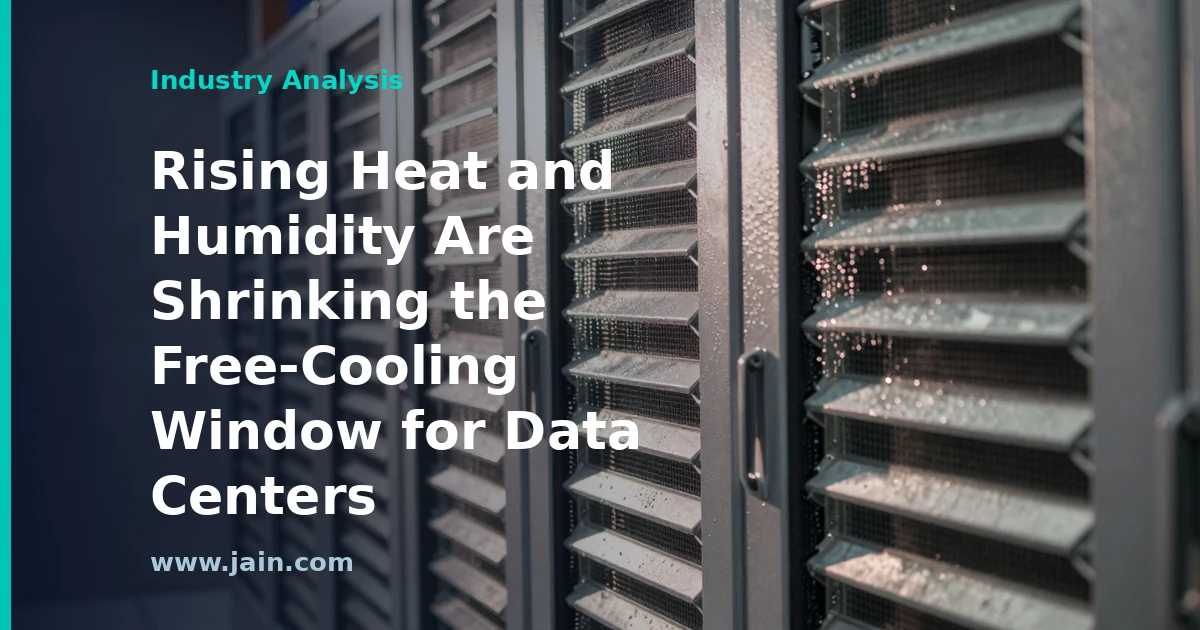
Research highlighted by Phys.org on June 26, 2026 warns that rising global temperatures and humidity are undermining one of the data center industry’s most important energy-efficiency strategies: free cooling, the practice of using cool outside air or water to remove server heat instead of running energy-hungry mechanical chillers. As more hours of the year become too hot or too humid for outside air to do the job, facilities worldwide face growing cooling energy demand.
The finding lands at a sensitive moment. Data center construction is accelerating to serve AI workloads, and cooling is typically the largest energy consumer in a facility after the IT equipment itself — so any climate-driven loss of free-cooling hours compounds an already steep power challenge.
Executive Summary
The core claim is straightforward: free cooling only works when the outside environment is cooler and drier than the conditions servers require, and climate change is steadily reducing the number of hours per year when that is true. Heat is only half the story — humidity matters just as much, because evaporative cooling systems, which cool air by evaporating water, lose effectiveness as the air becomes more saturated. Regions that were designed around thousands of free-cooling hours a year are watching that budget shrink.
Why it matters: efficiency assumptions made at design time are baked into a data center for decades. A facility engineered in a climate that no longer exists will either consume more energy than its models promised, lean harder on water, or require retrofit investment. For an industry under scrutiny over electricity and water consumption, the research reframes climate not as a sustainability talking point but as an engineering input — one that belongs in site selection, cooling-system choice, and capacity planning from day one.
Free Cooling Was the Industry’s Efficiency Workhorse
For the past fifteen years, the biggest gains in data center efficiency — reflected in falling PUE, the ratio of total facility power to IT power — came largely from using the outdoors as a heat sink. Air-side economizers pull in filtered outside air; water-side economizers and evaporative systems use cooling towers to shed heat with modest energy input. Hyperscale operators famously sited facilities in cool climates precisely to maximize these hours.
The research reported by Phys.org attacks the durability of that playbook. If the number of hours cool and dry enough for economization declines, chillers run more, and the efficiency gap between a well-sited facility and a poorly sited one narrows in the wrong direction. The gains of the last decade were real, but they were partly a loan from a stable climate — and the terms of that loan are changing.
Humidity Is the Underappreciated Variable
Public discussion of data center cooling fixates on temperature, but wet-bulb temperature — a combined measure of heat and humidity that sets the floor for evaporative cooling — is the more binding constraint. When wet-bulb temperatures rise, evaporative systems must work harder and consume more water for less cooling effect, and in extreme conditions they cannot reach the setpoints servers need at all. That pushes operators back toward mechanical refrigeration exactly when grid demand for air conditioning also peaks.
This has a second-order consequence: the trade-off between energy and water gets sharper. Evaporative cooling saves electricity but consumes water; dry coolers and chillers save water but consume electricity. Rising humidity degrades the attractiveness of the water-based option in many regions, forcing a choice between two increasingly expensive resources — often in communities already contesting data center water use.
Winners: Liquid Cooling, Cool Geographies, and Honest Modeling
If outside air can carry less of the load, the premium shifts to technologies that tolerate warmer heat rejection. Direct-to-chip liquid cooling and immersion cooling move heat in water or fluid rather than air, allowing higher operating temperatures and, in many designs, year-round heat rejection without compressors even in warm climates. The AI build-out was already pushing the industry toward liquid cooling for density reasons; climate trends add an efficiency rationale.
Geography gains value too. Sites in cool, dry, or high-latitude regions — the Nordics, parts of Canada, high-altitude locations — become relatively more attractive, though they bring their own constraints in connectivity, latency, and power availability. And engineering firms that model cooling against forward-looking climate projections rather than historical weather files gain a real advantage: a 25-year asset should be designed for the climate of 2040, not 2010.
Risks: Stranded Efficiency and Rising Operating Costs
The losers in this shift are facilities whose economics depend on free-cooling assumptions that no longer hold — particularly older air-cooled sites in regions warming fastest. Their operating costs drift upward without any change in workload, and their sustainability reporting deteriorates through no operational fault. For colocation providers, whose customers increasingly scrutinize PUE and water metrics in procurement, that drift is a competitive problem, not just an engineering one.
There is also a grid-level risk. The hours when data centers lose free cooling are the same hot hours when regional grids are most stressed. Climate-driven cooling demand is therefore correlated demand — it arrives when power is scarcest and most carbon-intensive, which is precisely the scenario utilities and regulators planning for data center growth need to model.
Background
Data center cooling has evolved through distinct eras. Early facilities ran cold and relied almost entirely on mechanical chillers. From roughly 2010 onward, hyperscale operators drove a revolution in economization — siting in cool climates, using outside air and evaporative systems, and widening acceptable server temperature ranges — which pushed the best facilities’ PUE from around 2.0 toward 1.1. That efficiency story became central to the industry’s answer to critics of its energy footprint.
The current AI build-out is testing every part of that model: rack power densities have jumped severalfold, cooling loads are climbing, and communities are scrutinizing both electricity and water consumption. Research showing that climate change is eroding free cooling adds a structural pressure on top of a cyclical boom — and helps explain the industry’s accelerating shift toward liquid cooling and climate-aware site selection.
Data Center Dynamics published an analysis on 25 June 2026 contrasting the cooling demands of AI factories — facilities purpose-built for dense GPU training and inference clusters — with those of conventional cloud data centers, arguing that liquid cooling is now essential for high-density AI workloads rather than an optional upgrade.
The piece lands amid an industry-wide retooling: operators worldwide are redesigning halls, mechanical plants, and supply chains around direct-to-chip and other liquid cooling approaches as accelerated computing outgrows the air-cooled designs that served the cloud era.
Executive Summary
The core claim is straightforward: the data center designs that carried the cloud computing era are hitting a physical ceiling. Conventional cloud halls were engineered around air cooling — moving chilled air through racks drawing power in the single-digit-to-low-double-digit kilowatt range. AI training clusters concentrate far more power in each rack, because modern GPU systems pack accelerators tightly together to keep them on fast, short interconnects. At those densities, air simply cannot carry heat away fast enough, and liquid — which is far denser and holds vastly more heat per unit volume than air — becomes the only practical medium.
Why it matters: cooling is no longer a back-of-house mechanical detail but a gating factor for who can host AI workloads at all. Operators with liquid-ready facilities can court the highest-value tenants; operators with legacy air-cooled halls face expensive retrofits or a narrowing addressable market. For enterprises buying AI capacity, a provider’s cooling architecture is now a proxy for whether it can actually deliver current-generation GPU infrastructure.
The analysis frames this as a structural divide — ‘AI factory’ versus ‘cloud hall’ — rather than a spectrum, which is a useful lens even if real-world facilities often blend both.
The Physics Sets the Deadline, Not the Marketing
Air cooling works by blowing large volumes of conditioned air through servers, and it has a well-understood practical ceiling: as rack power climbs, the airflow, fan energy, and temperature gradients required become unmanageable. Liquid cooling — most commonly direct-to-chip cold plates, where coolant flows across a metal plate bonded to the processor, or immersion, where hardware is submerged in a dielectric (electrically non-conductive) fluid — removes heat at the source with far greater efficiency. This is not a vendor preference; it is thermodynamics. Water-based coolants can absorb on the order of thousands of times more heat per unit volume than air, which is why every leading accelerated-computing platform roadmap now assumes liquid at the high end.
The important nuance is that the ceiling is not a single number. Well-engineered air systems with hot-aisle containment can stretch surprisingly far, and many inference and enterprise workloads will remain comfortably air-coolable for years. The ‘non-negotiable’ framing applies specifically to dense training clusters, where chips must sit physically close together for interconnect performance. Density is a networking decision as much as a thermal one — and that is precisely why it cannot be relaxed just to make cooling easier.
Economics: Liquid Costs More Up Front and Less to Run
Liquid cooling shifts spending from operations to capital. Cold plates, coolant distribution units, manifolds, leak detection, and plumbing add up-front cost and engineering complexity that air systems avoid. In exchange, operators typically get lower fan energy, better power usage effectiveness (PUE — the ratio of total facility power to IT power, where closer to 1.0 is better), and the ability to run warmer coolant loops that reduce or eliminate energy-hungry chillers. Heat captured in liquid at useful temperatures is also far easier to reuse — for district heating or industrial processes — than diffuse warm air.
The strategic consequence is that cooling architecture now shapes site selection and facility economics together. A liquid-cooled AI factory can put more revenue-generating compute on the same power envelope, which matters enormously when grid connections — not land or capital — are the scarcest input in the industry. That said, buyers should treat sweeping efficiency claims with care: realized PUE depends on climate, design discipline, and utilization, and figures quoted for flagship builds do not automatically transfer to retrofits.
Winners, Losers, and the Retrofit Question
The clearest winners are operators and builders that committed early to liquid-ready designs — reinforced floors for heavier racks, space for coolant distribution, higher-capacity power delivery — along with the supply chain behind them: cold-plate and CDU manufacturers, fluid suppliers, and mechanical contractors with liquid experience. Chipmakers benefit too, since liquid cooling removes a constraint on how much power their next generations can draw.
The harder story is the installed base. Thousands of existing air-cooled halls cannot be casually converted: adding liquid means new piping, floor loading analysis, leak-management protocols, and often a rethink of the entire mechanical plant. Some facilities will be retrofitted profitably, some will serve the still-large market for air-coolable workloads, and some will be stranded relative to AI demand. For colocation providers, the honest question customers should ask is not ‘do you support liquid cooling?’ but ‘how many megawatts of it can you deliver, at what density, and by when?’
Operational Risk: New Skills, New Failure Modes
Bringing liquid into the white space introduces failure modes the air-cooled era rarely faced: leaks near live electronics, coolant chemistry maintenance, and the coordination of facility water loops with IT equipment loops. None of these are exotic — mainframes were water-cooled decades ago, and modern systems are engineered with negative-pressure loops and leak detection — but they demand skills that many data center operations teams are still building. Expect certification programs, standardized quick-disconnect fittings, and reference designs to matter as much as raw technology in determining who executes this transition smoothly. The industry’s real constraint may be trained people, not parts.
Background
Data center cooling has followed computing density for decades: water-cooled mainframes gave way to air-cooled commodity servers in the client-server and cloud eras, when racks drawing modest power made air the cheap, simple choice. The generative AI boom reversed the trend — modern accelerator systems concentrate unprecedented power in single racks, and leading GPU platform roadmaps now assume liquid cooling at the high end, pulling the entire industry’s mechanical design along with them.
Data Center Dynamics, the publication behind this analysis, is a long-established trade outlet covering data center design and operations. Its framing of ‘AI factories’ versus conventional cloud facilities echoes terminology popularized by the accelerated-computing industry to describe purpose-built AI infrastructure — a sign of how thoroughly that vocabulary has permeated the sector.
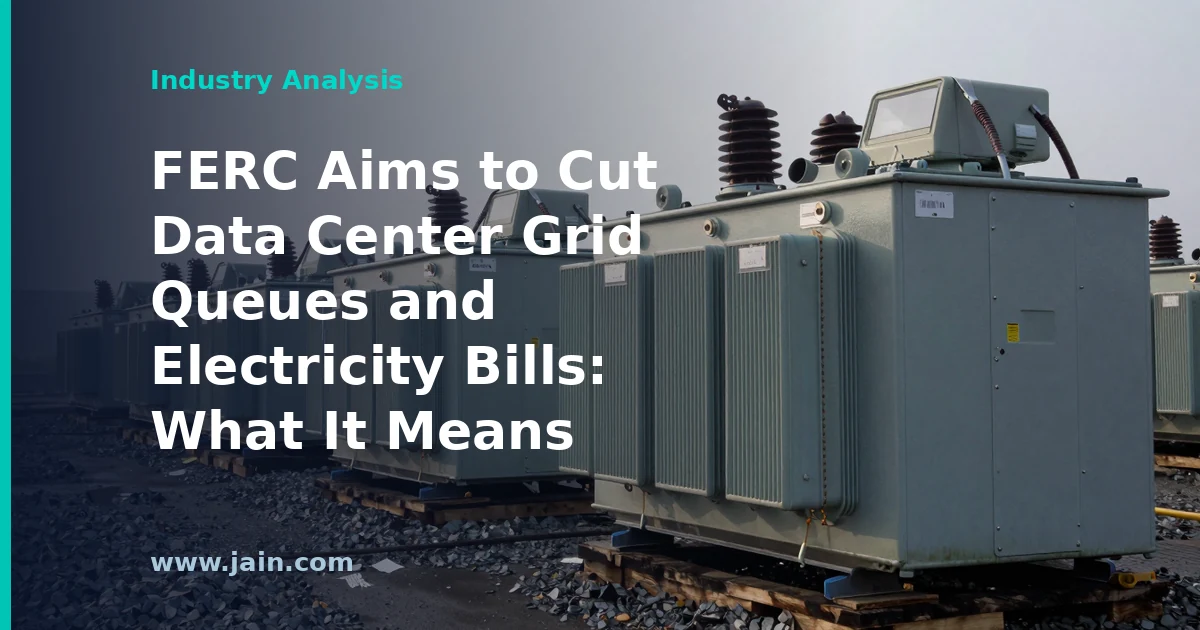
IEEE Spectrum reported on June 25, 2026, that the Federal Energy Regulatory Commission (FERC) — the U.S. agency that oversees the interstate power grid and wholesale electricity markets — aims to cut the queues that data centers face when seeking grid connections, while also containing electricity bills. The syndicated item carries only the headline, so the specific mechanism, docket, and timeline are not detailed in the material available here.
The framing itself is significant: the regulator is treating slow grid interconnection and rising consumer power costs as a single, linked problem — the two pressures the AI data center boom has placed on the U.S. electric system.
Executive Summary
According to the report, FERC is moving to shorten the waits that large new loads — chiefly AI data centers — endure before they can connect to the grid, and to do so in a way that limits the impact on ordinary electricity bills. Interconnection is the process by which a new generator or major customer is studied, assigned any needed grid-upgrade costs, and physically wired into the transmission system; the backlog of these requests is widely regarded as one of the tightest bottlenecks on U.S. data center growth.
Why it matters: hyperscale operators can erect a building in 18 to 24 months, but securing hundreds of megawatts of firm grid power can take far longer, and utilities in several regions have quoted multi-year waits. At the same time, household and business electricity prices have become politically charged in data-center-heavy regions, with debates over how much of the grid buildout ordinary ratepayers should fund. A federal move that credibly addresses both — speed and cost — would be the single biggest regulatory lever on how fast AI infrastructure can actually energize.
What is and is not substantiated: the available source confirms the regulator’s stated aim but not the instrument. Whether this is a formal rulemaking, a policy statement, or guidance to grid operators — and whether it is binding — cannot be determined from the headline alone, and readers should weight it accordingly until the underlying FERC documents are public.
Why the Interconnection Queue Is the Real Bottleneck
Every large project that wants to plug into the high-voltage grid — a solar farm, a gas plant, or increasingly a gigawatt-scale data center campus — must file an interconnection request and wait for engineering studies that determine what upgrades the grid needs and who pays for them. By the end of 2023, Lawrence Berkeley National Laboratory counted roughly 2,600 gigawatts of generation and storage capacity waiting in U.S. queues — more than double the nation’s entire installed generating fleet — with typical waits stretching toward five years from request to operation.
Data centers sit on the demand side of this equation, and large-load interconnection has historically been even less standardized than the generator process, handled utility by utility and state by state. For AI operators, the queue — not chips, land, or capital — is frequently the schedule-defining constraint. That is why a federal regulator signaling it wants to compress these timelines matters more to data center delivery dates than most technology announcements.
Two Goals in Tension: Faster Hookups and Lower Bills
Cutting queues and cutting bills pull in different directions, and the report’s pairing of them is the most analytically interesting element. Connecting multi-hundred-megawatt loads quickly often requires transmission upgrades whose costs, under traditional utility ratemaking, are spread across all customers. Consumer advocates in several data-center-heavy states have argued that households are subsidizing the grid expansion that serves hyperscale computing; utilities and data center operators counter that large, steady loads can spread fixed grid costs over more sales and put downward pressure on rates.
Both claims can be true depending on how cost allocation is structured — which is precisely the kind of question FERC decides. Mechanisms observers have debated in recent years include dedicated large-load rate classes, requirements that data centers fund their own upgrades or bring their own generation, and co-location arrangements that place computing directly at power plants. Which of these, if any, the regulator is now advancing is not specified in the available source.
What a Federal Regulator Can — and Cannot — Fix
FERC has a track record here: its Order 2023 overhauled the generator interconnection process, replacing first-come-first-served study lines with clustered, first-ready-first-served batches, backed by deposits and readiness requirements to flush speculative projects from the queue. Extending comparable discipline to large loads would be a logical next step, and FERC has also been drawn into the co-location debate through disputes over data centers sited at existing power plants.
But the agency’s jurisdiction has hard edges. States control retail rates, generation siting, and most permitting; regional grid operators run their own study processes; and no order can conjure the transformers, turbines, and skilled crews that are in genuinely short supply worldwide. A FERC action can remove procedural delay — often years of it — but the physical buildout still moves at the pace of supply chains and state approvals. Expectations should be calibrated to that split.
Winners, Losers, and What to Watch
If queue reform for large loads materializes and works, the clearest beneficiaries are hyperscalers and data center developers with projects stalled behind study backlogs, along with the transmission engineering firms and equipment suppliers that would see demand pulled forward. Utilities face a mixed outcome: faster load growth boosts their invested capital base, but tighter federal timelines and cost-assignment rules constrain how they manage it. Generation developers could gain if load and supply requests are studied more coherently together.
The unresolved variable is the ratepayer. If the regulator pairs faster interconnection with cost rules that make large loads bear the upgrades they cause, the political friction around data center power could ease; if speed comes without that discipline, bill impacts could intensify the local backlash that has already slowed projects in several markets. The details — still unpublished in the material available here — will determine which scenario unfolds.
Background
FERC is the century-old independent agency that governs the U.S. interstate grid, and interconnection reform has been its defining workstream of the 2020s. After two decades of essentially flat electricity demand, AI data centers, manufacturing, and electrification pushed load growth back onto utility planning maps around 2023–2024, colliding with queue backlogs that Lawrence Berkeley National Laboratory measured at roughly 2,600 gigawatts of waiting capacity by the end of 2023. Order 2023 tackled the generator side of the problem; large loads — the data centers themselves — remained governed by a patchwork of utility and state processes.
Through 2024 and 2025, disputes over co-locating data centers at power plants and over who pays for grid expansion made large-load policy one of the most watched dockets in U.S. energy. The June 2026 report places FERC’s next move squarely in that lineage: an attempt to standardize and speed how the grid absorbs its biggest new customers without letting the cost land on everyone else’s bill.
Pennsylvania’s state House voted 201 to 1 to let towns stop considering new data centers for six months while they write rules for them. Data centers are the huge warehouses of computers that run artificial intelligence and online services.
Lawmakers also voted to end a tax break for these buildings that was expected to cost the state $517 million a year by 2030. That break was the reward in the governor’s plan to get builders to promise jobs, clean power and water limits.
If the break disappears, local town boards become the place these projects are decided. The state Senate still has to act.
With the June 30 state budget deadline days away, the Pennsylvania House passed three bills on data center development on June 24 and 25, 2026, the Pennsylvania Capital-Star reported. House Bill 2496 lets municipalities pause consideration of data center applications for 180 days and passed 201-1. House Bill 2650 writes Gov. Josh Shapiro’s Governor’s Responsible Infrastructure Development (GRID) Standards into law and passed 134-68. House Bill 2198 repeals the state’s 6% sales and use tax exemption on data center computer equipment and passed 197-5.
The tax exemption is projected to cost the commonwealth $517 million a year by 2030. On the afternoon of the House vote, the Senate adopted the repeal language as an amendment to a separate tax code bill. The other two bills now sit with the Republican-led Senate, which could send them to Shapiro or leave them unconsidered.
Executive Summary
Pennsylvania’s House has moved from courting large data centers to regulating them. In two days it voted for a local construction-review pause, a certification regime that ties tax benefits to disclosure and job commitments, and the repeal of the tax benefit that regime depends on.
The votes point in different directions. The GRID Standards are voluntary. Developers who meet targets on in-state clean energy, investment, prevailing-wage construction jobs and permanent jobs would get a sales tax exemption and faster permits. The repeal bill, which drew a 197-5 vote and quick Senate action, would eliminate that exemption. That leaves the standards with little to offer beyond permitting speed.
The measure with the broadest support was the local pause, which passed 201-1. For developers of AI-scale facilities in one of the country’s most active data center markets, the practical gate is moving from state tax terms to municipal land-use calendars. That shift is not yet final, because the Senate has not acted on the pause or the GRID bill.
The Incentive Is Going Before the Standards Arrive
Pennsylvania’s 6% sales and use tax exemption on data center computer equipment is about five years old. House Environmental Resources Committee Chairperson Greg Vitali, who sponsored the repeal, said it was passed “during an era when lawmakers were trying to attract them to the commonwealth.” It is now projected to cost $517 million a year by 2030. For a facility filled with servers, networking gear and storage, a sales tax on equipment is a real line item. Across a whole state’s pipeline, it has become a budget question.
The repeal has the most momentum of the three bills. It passed the House 197-5, and the Senate adopted the same language as an amendment to another tax code bill within hours. That creates a sequencing problem. HB 2650, passed a day earlier, is built on the exemption: it would make the tax break contingent on certification from the Department of Revenue. Rep. Craig Williams (R-Delaware) put it bluntly: “Like Lucy holding the football for Charlie Brown, we’re going to pull that football away.” Repeal supporters such as Rep. Kyle Mullins (D-Lackawanna) described the industry as “no longer an emerging sector looking for a foothold.” In their view the subsidy has simply outlived its purpose.
Why Leverage Shifts From Harrisburg to the Township Board
The GRID Standards are designed as a trade. A developer discloses its ownership structure, energy procurement strategy, water usage, community engagement and environmental plans, and meets investment and job floors. In return it gets the sales tax exemption and expedited permitting. Remove the exemption and the state’s offer shrinks to faster permits. That is a thinner inducement for a program that is voluntary. Critics were already skeptical that the largest companies would participate even with the tax benefit.
The tool that drew near-unanimous support is local. Under HB 2496, a municipality could stop considering data center applications for 180 days and use that time to adopt, amend or repeal the parts of its land use ordinance that cover data centers. Any application received during the pause would be treated as received the day after the pause ends. That detail matters. The pause does not reject projects. It holds them until new rules exist, so a proposal filed mid-pause would be judged against whatever ordinance the township writes. Rep. Paul Friel (D-Chester) noted that many rural municipalities have no zoning ordinance at all, and others lack provisions for facilities of this scale.
The people most affected are data center developers and their site-selection teams. Their schedule risk would be set by municipal meeting calendars rather than state tax terms. Landowners holding land options are also exposed, as are the utilities and power suppliers whose planning depends on when large new loads actually arrive. One borough in Lackawanna County faces 16 data center applications, according to Mullins, which shows how concentrated these decisions can become. There is an important caveat. If the repeal becomes law and the pause bill stalls in the Senate, Pennsylvania would have neither the state incentive nor the new local pause. Projects would proceed under existing ordinances, which Friel says many townships lack.
What the GRID Terms Say About Power and Scale
The certification requirements go beyond jobs. Developers would need to increase their use of clean energy from Pennsylvania sources step by step, reaching 32% by 2035. That makes the standards a power procurement rule, not just an economic development one. The other floors are:
at least $250 million in cumulative new investment;
at least 200 prevailing-wage construction jobs;
50 permanent jobs paying at least 125% of the statewide average wage within four years;
at least $1.5 million a year in compensation to full-time employees after that.
Energy procurement and water usage both appear on the application. That reflects the pressures lawmakers cited: large AI facilities draw heavily on water resources, energy infrastructure and public services. Pennsylvania sits inside PJM Interconnection, the regional grid operator for much of the mid-Atlantic and Midwest, where large new loads weigh directly on grid planning. The state’s most visible project shows how developers are responding to power constraints. The former Homer City Generating Station in Indiana County, once Pennsylvania’s largest coal-burning power plant, is being turned into a natural gas-powered data center campus, and construction was under way as of mid-May.
Testing Both Sides’ Claims
Williams argued that companies such as Google and the parent company of X “don’t care” about the sales tax exemption and would forgo it rather than accept conditions. The $517 million projection suggests the break is worth a lot in total, so it is hardly trivial. But total cost does not show that the exemption decides where any particular facility goes, and the debate did not include a developer saying either way.
Repeal supporters argue the break is “not needed,” and the volume of applications supports the claim that demand exists without it. Current filings, though, do not show what happens to marginal projects once the benefit is gone. Neither does the phrase “speculative gold rush,” which one legislator used, tell us how many of the dozens of hyperscale applications have tenants, power and financing behind them. A 180-day pause may be the mechanism that sorts firm projects from speculative land positions.
Background
Pennsylvania spent much of the past half-decade trying to attract data centers, including through a sales and use tax exemption on their computer equipment. The race to build artificial intelligence capacity has since produced hyperscale proposals across the commonwealth, and local officials are now weighing dozens of applications. Some of the most prominent projects repurpose power-plant sites, such as the former Homer City Generating Station, which is being converted from coal to a gas-powered data center campus.
Gov. Josh Shapiro outlined his approach to data center development in his February 2026 budget address and released details in May as the GRID Standards. The state is part of PJM Interconnection, the regional grid operator where the arrival of large new electricity loads has become a central planning concern. That places Pennsylvania’s policy choices at the intersection of land use, tax policy and power supply.
OpenAI and Broadcom announced an inference chip optimized for large language models (LLMs) — the AI systems behind products like ChatGPT — in a release dated June 24, 2026. The unveiling is the visible next step in the partnership the two companies disclosed in October 2025, under which Broadcom is co-developing and deploying racks of OpenAI-designed accelerators targeting some 10 gigawatts of computing capacity, with deployments slated to begin in the second half of 2026.
Executive Summary
The announcement marks OpenAI’s transition from designing custom silicon on paper to unveiling a product: a chip built specifically for inference, the work of running a trained AI model to answer queries, as distinct from the training runs that build the model in the first place. Inference is where the ongoing operating cost of AI lives — every user prompt consumes it — so a chip tuned to OpenAI’s own models attacks the largest recurring line item in the company’s cost structure.
For Broadcom, the chip validates its custom-accelerator (XPU) business model: rather than selling merchant chips as Nvidia does, Broadcom co-designs silicon to a single customer’s workload and pairs it with its Ethernet networking portfolio. For the broader market, the announcement escalates a race in which nearly every hyperscaler — Google, Amazon, Meta, Microsoft — now fields in-house AI silicon aimed at reducing dependence on Nvidia’s GPUs. What the headline announcement does not yet substantiate, based on the source available, is performance data, manufacturing details, or deployment volumes; we flag those open questions below.
Why Inference Is the Battleground
Training a frontier model is a periodic, enormous expense; serving it to hundreds of millions of users is a continuous one. Industry economics increasingly hinge on the cost per generated token — the small units of text an LLM produces — and general-purpose GPUs carry silicon and features that inference of a known model family doesn’t need. A chip co-designed around OpenAI’s own model architectures can, in principle, strip that overhead: right-sized memory bandwidth, dense low-precision math, and interconnects matched to how the models are actually sharded across racks.
That logic explains why the first unveiled product of the partnership is an inference part rather than a training part. It is the safer engineering bet — inference workloads are more predictable than training — and the faster payback. It also preserves a pragmatic split: OpenAI can keep buying Nvidia and AMD hardware for training frontier models while shifting the high-volume serving fleet onto silicon it controls.
Broadcom’s Quiet Counter-Model to Nvidia
Broadcom does not sell a rival to Nvidia’s GPU catalog. Instead it builds custom accelerators — the model proven over roughly a decade with Google’s TPUs — supplying design expertise, chip infrastructure such as serializer/deserializer (SerDes) and packaging technology, and the Ethernet switching that ties accelerators together. The October 2025 agreement made OpenAI the marquee addition to that franchise, with racks scaled entirely on Ethernet rather than Nvidia’s proprietary NVLink interconnect.
That networking detail matters more than it may appear. If the industry’s largest inference fleets standardize on open Ethernet for chip-to-chip traffic, the moat around Nvidia’s full-stack platform — GPU plus NVLink plus InfiniBand plus the CUDA software layer — narrows at exactly the layer where Broadcom is strongest. A working, unveiled chip converts that thesis from investor-deck material into deployable hardware.
The Custom-Silicon Race Nobody Can Sit Out
Every major AI buyer now hedges the same way: Google with TPUs, Amazon with Trainium and Inferentia, Meta with MTIA, Microsoft with Maia. OpenAI joining that club is notable because it is not a cloud provider — it is the highest-profile pure consumer of AI compute, and its willingness to fund custom silicon signals that even Nvidia’s best customers see strategic risk in single-vendor dependence. None of this displaces Nvidia in the near term; demand still outstrips everyone’s supply, and custom chips typically serve internal workloads rather than the open market.
The realistic effect is on the margin: each gigawatt of inference that moves to custom silicon is pricing leverage for buyers and a ceiling on how much of the AI build-out flows through one vendor. For data-center operators, the practical takeaway is architectural diversity — facilities must now plan for heterogeneous racks, Ethernet-based scale-up fabrics, and the power and cooling densities these custom systems demand, rather than a single GPU-defined template.
Background
OpenAI, the developer of ChatGPT and the GPT model family, has pursued an aggressive infrastructure expansion as usage of its models has grown, layering large compute agreements with cloud and chip partners. In October 2025 it announced a partnership with Broadcom — a semiconductor and networking company best known in AI for co-designing Google’s TPU accelerators and for its data-center Ethernet switch silicon — to build and deploy OpenAI-designed accelerator racks totaling roughly 10 gigawatts, connected with Broadcom’s Ethernet technology.
The move places OpenAI in a well-established industry pattern: Google, Amazon, Meta, and Microsoft have all built in-house AI chips to supplement Nvidia GPUs, control costs, and secure supply. The June 2026 unveiling of an LLM-optimized inference chip is the first public product milestone of the OpenAI–Broadcom program.
Nvidia has announced a liquid cooling system for AI data centers that circulates water described as running “hotter than a hot tub,” a design the company says can reduce electricity consumption and cut water use by up to 100%. The announcement, reported June 24, 2026 by Tom’s Hardware, targets one of the AI build-out’s most scrutinized side effects: the enormous water and energy appetite of the facilities that host Nvidia’s chips. The same report notes that sustainability challenges remain despite the headline claims.
Executive Summary
Nvidia, the dominant supplier of AI accelerators, is moving further down the stack — from chips and rack-scale systems into the cooling infrastructure that keeps them running. The newly announced system uses hot-water liquid cooling: instead of chilling coolant to low temperatures before it reaches the hardware, the loop runs deliberately warm, hotter than the roughly 40°C (104°F) at which a typical hot tub is kept, which is the comparison Nvidia’s framing invites.
Why does that matter? Warmer coolant is the key that unlocks both of the claimed benefits. If the water returning from the chips is already hot, a facility can often reject that heat to the outside air with simple dry coolers rather than energy-hungry chillers — cutting electricity — and without evaporative cooling towers, which consume water by design. That is the engineering logic behind the “up to 100%” water-reduction figure. The claim is significant if it holds up at scale, but as reported it is a vendor claim with important qualifiers, and the source coverage itself flags that sustainability challenges remain.
Water Is Becoming AI’s Second Resource Fight
Electricity has dominated the AI infrastructure debate, but water is close behind. Many conventional data centers cool themselves with evaporative systems: they literally evaporate water to carry heat away, because evaporation is cheap and effective. As hyperscale and AI campuses have multiplied, their water draw has become a flashpoint in drought-prone regions and a recurring obstacle in permitting and community relations.
Nvidia has a direct commercial stake in defusing that fight. Its rack-scale AI systems concentrate so much heat that air cooling is no longer practical, which already pushed the industry toward liquid cooling. If the company can also credibly claim its reference designs eliminate on-site cooling water, it removes an objection that slows down the very data center projects that buy its chips. In that sense this is as much a market-access play as an engineering one.
The Counterintuitive Physics of Cooling with Hot Water
“Hot-water cooling” sounds like a contradiction, but it rests on straightforward thermodynamics. A chip does not need cold coolant; it needs coolant that is cooler than the chip and flowing fast enough to carry heat away. Liquid is far denser than air as a heat-transfer medium, so even warm water can hold chip temperatures within limits.
The payoff comes at the other end of the loop. Cold-water systems need chillers — essentially industrial refrigerators — whose compressors are among the largest energy consumers in a data center. Evaporative towers avoid some of that electricity but spend water instead. A loop that returns water hotter than the outdoor air can shed its heat through dry coolers, closed radiators that use neither compressors nor evaporation. That is the mechanism behind both claims in the announcement: less electricity because chillers shrink or disappear, and less water because nothing is evaporated. Hotter return water is also more useful for heat reuse, such as district heating, though the reporting here does not say whether Nvidia is claiming that benefit.
Reading the “Up to 100%” Claim Carefully
“Up to 100%” is a ceiling, not a promise. Real-world results will depend on climate — dry cooling gets harder on very hot days, when some designs fall back on water assist — as well as on facility design and how much of a site’s load actually sits on the new system. The reported claim does not, on its face, distinguish between a best-case new build in a favorable climate and a typical deployment.
There is also a boundary question. Eliminating on-site cooling water does not eliminate a data center’s water footprint, because the power plants that generate its electricity often consume water themselves. Reduced electricity consumption helps on that front too, but “water-free” at the fence line is not the same as water-free end to end. The source’s own caveat — that sustainability challenges remain — is best read in this light: the announcement addresses a real problem without dissolving it.
Who Feels This Announcement
Cooling incumbents and the liquid-cooling supply chain feel it first. When the dominant chip vendor blesses a particular thermal architecture, it tends to become the default for new AI capacity, shaping demand for cold plates, coolant distribution units, and dry coolers, and putting pressure on vendors invested in evaporative or chilled-water designs. Operators, meanwhile, gain a potential permitting and siting advantage: a campus that can credibly promise near-zero cooling-water draw is an easier sell to water-stressed municipalities.
The open competitive question is whether this arrives as an open reference design others can build on or as another layer of the Nvidia-specified stack. The reporting available here does not say. Either way, buyers should expect warm-water readiness — higher allowable coolant temperatures across IT hardware — to show up in procurement requirements, because the economics above only materialize if the whole rack tolerates the heat.
Background
Nvidia is the world’s leading supplier of the GPUs (graphics processing units) that train and run modern AI models, and its data center business has grown into one of the largest in the technology industry. As its systems evolved from individual chips into full pre-integrated racks drawing unprecedented power, the company has taken an increasingly active role in specifying the surrounding infrastructure — power delivery and cooling included — because its hardware roadmap now depends on facilities that can handle the heat.
Data center cooling has historically split between air cooling, chilled-water systems, and evaporative designs that trade water for electricity. AI’s density has pushed the industry rapidly toward direct liquid cooling, and water consumption has become a headline issue in siting battles. Warm-water liquid cooling — long used in some high-performance computing installations — is the established engineering idea this announcement scales up and brands for the AI era.
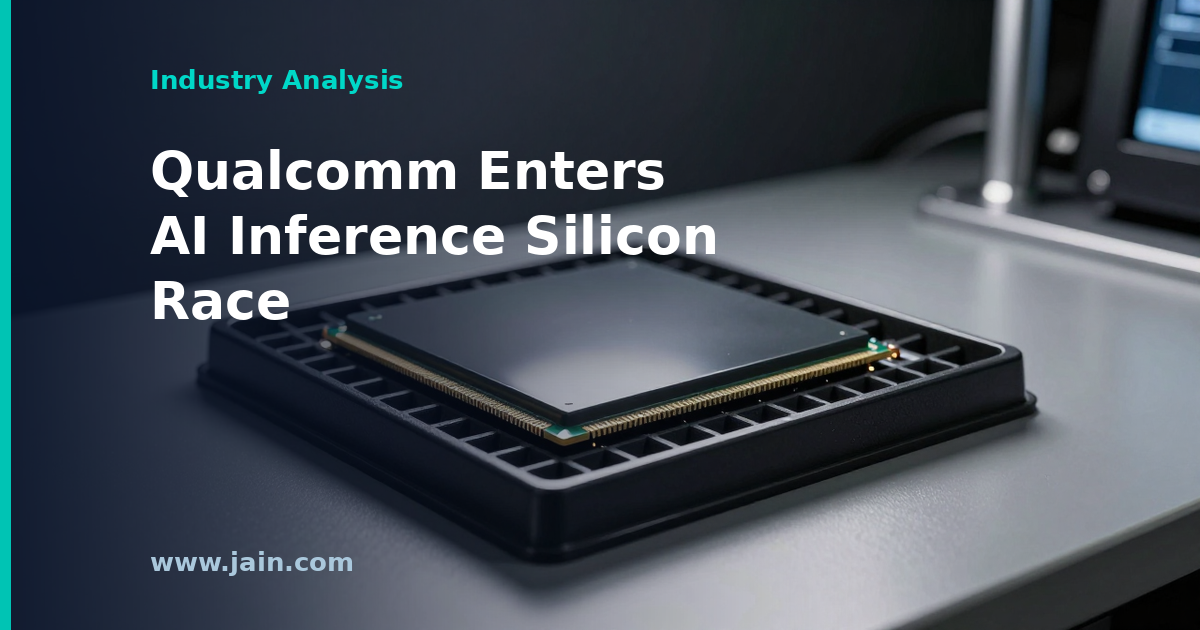
On June 24, 2026, Qualcomm announced a comprehensive data center roadmap built around a new product family it calls Dragonfly, positioning the portfolio for what the company describes as the agentic AI era — workloads where AI systems act autonomously across chained tasks rather than answering single prompts.
The announcement marks Qualcomm’s most explicit push yet into data center silicon, a market currently dominated by Nvidia with AMD as the principal challenger.
Executive Summary
Qualcomm is best known for smartphone modems and mobile system-on-chip designs. With Dragonfly, the company is signaling that it intends to translate its low-power, inference-oriented engineering heritage into a full data center accelerator roadmap aimed at agentic AI — inference workloads that are longer-running, more memory-intensive, and more sensitive to cost-per-token than the training runs that made Nvidia’s H100 and Blackwell generations famous.
Why it matters: hyperscalers, sovereign cloud buyers, and neocloud operators have been vocal about wanting a viable third source for AI accelerators to ease supply constraints and pricing power. A credible Qualcomm entry, alongside AMD’s Instinct line and in-house silicon from AWS, Google, and Microsoft, would reshape purchasing leverage across the data center stack. Whether Dragonfly clears that bar depends on details the June 24 release does not fully disclose.
For infrastructure operators, the immediate question is not whether Qualcomm can build competitive silicon — it has a strong NPU (neural processing unit) track record in mobile — but whether it can deliver the software stack, systems integration, and multi-year supply commitments that hyperscale procurement demands.
Why Inference, and Why Now
The AI silicon market has bifurcated. Training the largest models remains a specialized, capital-intensive workload where Nvidia’s CUDA software moat and networking assets (NVLink, InfiniBand via Mellanox) give it a durable lead. Inference — actually running trained models to serve users — is a larger and faster-growing spend line, and it is more fragmented technically. Different model sizes, latency targets, and cost envelopes favor different silicon architectures. Qualcomm’s positioning of Dragonfly around agentic inference is a rational reading of where the addressable market is opening up: agentic workloads chain many inference calls together, making cost-per-token and energy-per-token the metrics that matter most to operators.
Qualcomm’s mobile heritage is genuinely relevant here. The company has shipped billions of NPU-equipped chips optimized for running neural networks under tight power budgets — a discipline the data center now needs as grid capacity, not GPU supply, becomes the binding constraint on AI buildouts.
The Third-Source Thesis
Buyers of AI infrastructure have made no secret of wanting alternatives to Nvidia. AMD has partially filled that role with its Instinct MI300 and successor accelerators, and hyperscalers have invested heavily in custom silicon — AWS Trainium and Inferentia, Google TPU, Microsoft Maia. Qualcomm’s Dragonfly enters a field that is crowded but still supply-constrained, and where any credible merchant-silicon alternative can command attention simply by existing. The commercial question is whether Qualcomm can win design wins at hyperscalers that already have in-house programs, or whether its natural customers are tier-two clouds, sovereign AI initiatives, and enterprise on-premises deployments where a turnkey vendor stack is more valuable than bespoke silicon.
The competitive risk cuts both ways. If Dragonfly ships on schedule with competitive performance-per-watt and a workable software stack, it pressures Nvidia’s pricing on inference SKUs and validates AMD’s playbook. If it slips or underdelivers on software, it joins a long list of ambitious accelerator programs — from Intel’s Gaudi to various startups — that failed to convert silicon competence into share.
Software Is Where Accelerator Roadmaps Live or Die
The unspoken subject of any new AI silicon announcement is the software stack. Nvidia’s advantage is not primarily transistors; it is CUDA, cuDNN, TensorRT, and a decade of framework integration that makes developers productive on day one. Any Dragonfly evaluation by a serious buyer will focus on how well Qualcomm supports PyTorch, vLLM, TensorRT-equivalent inference runtimes, and increasingly the open standards like OpenAI-compatible APIs and the emerging agentic frameworks. The June 24 release frames Dragonfly as a portfolio and roadmap rather than a single product, which suggests Qualcomm is aware that ecosystem depth matters as much as peak throughput numbers.
For infrastructure operators evaluating Dragonfly, the practical checklist is well-established: what models run out of the box, what quantization formats are supported, how does the compiler handle novel architectures, and what is the update cadence when a new model family lands. None of these are answered in the announcement itself.
Power, Density, and the Data Center Fit
Modern AI accelerators are increasingly constrained by rack-level power and cooling rather than chip-level cost. A meaningful Dragonfly value proposition would show up in performance-per-watt at realistic inference batch sizes, and in the thermal envelope that determines whether the parts drop into air-cooled facilities or require liquid cooling retrofits. Qualcomm’s mobile pedigree suggests an efficiency-first design philosophy, which aligns with where the industry’s power problem is heading, but the announcement does not disclose the numbers that would let operators model total cost of ownership.
Background
Qualcomm built its business on wireless modems and Snapdragon system-on-chip designs that power much of the global smartphone market. Its neural processing units have delivered on-device AI in mobile phones for years, giving the company deep expertise in low-power inference. A prior effort to enter the server market with the Centriq Arm CPU in the late 2010s was ultimately discontinued, making Dragonfly the company’s most substantial data center push since.
The AI accelerator market took its current shape after 2022, when generative AI demand made Nvidia’s data center GPUs the scarcest resource in enterprise computing. AMD’s Instinct MI300 series became the primary merchant-silicon alternative, while AWS, Google, and Microsoft accelerated in-house silicon programs. Buyers across hyperscale, sovereign cloud, and enterprise segments have consistently signaled that a credible third source would be welcome — the question Dragonfly will answer over the coming quarters is whether Qualcomm can be that source.
Virginia has approved what is being described as the first-ever data center power tax, according to a June 23, 2026 report from Data Center Knowledge. The measure makes Virginia — home to the largest concentration of data centers in the world — the first U.S. state to attach a dedicated levy to data center power consumption.
Details of the tax’s rate, structure, and effective date were not included in the initial report, but the “first-ever” framing marks a significant policy departure: rather than courting data centers exclusively with incentives, the state that hosts more of them than any other is now taxing the electricity they use.
Executive Summary
The significance of this measure lies less in its mechanics — which the initial reporting does not detail — than in its symbolism and its likely ripple effects. Virginia built its data center dominance in part on a generous sales-and-use tax exemption for data center equipment, a policy other states copied for two decades. A power tax moving in the opposite direction signals that the political economy of hosting data centers has shifted: the question in Richmond is no longer only how to attract capacity, but how to make that capacity pay for the grid strain it creates.
For operators, hyperscalers, and their customers, the precedent matters more than the immediate cost. Utilities and regulators across the country have been wrestling with how to allocate the enormous transmission and generation investments driven by AI-era load growth — and whether ordinary ratepayers are subsidizing them. A dedicated tax on data center power is one answer to that question, and now the largest data center market on earth has adopted a version of it. Other states weighing similar debates will be watching closely.
Because the available source is a headline-level report, the analysis below focuses on the policy context and the questions the measure raises, rather than on provisions that have not yet been publicly detailed.
Why Virginia Was Always Going to Move First
Northern Virginia — particularly Loudoun County’s “Data Center Alley” — hosts the densest cluster of data centers anywhere in the world, a position built on early internet-exchange infrastructure, proximity to federal customers, and a long-standing tax exemption on data center equipment. That concentration has made Virginia the place where the costs of the AI buildout show up first and loudest: transmission congestion, multi-year interconnection queues, land-use fights, and public concern that residential electricity bills are absorbing grid investments made largely to serve large industrial loads.
Virginia’s own legislative auditors flagged these tensions in a December 2024 study of the industry’s fiscal and energy impacts, and the General Assembly has debated data center energy policy in every session since. Seen against that backdrop, a power tax is not a bolt from the blue — it is the next step in a multi-year negotiation between a state and an industry that has become its signature economic engine and its biggest new source of electricity demand.
The Real Question: Who Pays for AI-Era Grid Growth?
Electric grids recover their costs from customers through rates, and when one customer class grows explosively — as data centers have — regulators must decide whether the new transmission lines, substations, and generation get billed to that class or spread across everyone. Consumer advocates argue that spreading the cost amounts to households subsidizing some of the world’s wealthiest companies; utilities and operators counter that large, steady loads can actually lower average system costs by spreading fixed expenses over more kilowatt-hours. Both arguments have evidentiary support in different circumstances, which is precisely why the allocation fight has been so contentious.
A tax is a blunter instrument than a rate class. Utility ratemaking assigns costs based on engineering studies of who causes them; a tax is a legislative judgment that a category of consumption should contribute more to public coffers, whatever the cost-causation math says. Whether Virginia’s measure funds grid infrastructure specifically, flows to the general fund, or offsets residential bills will determine whether it functions as genuine cost allocation or as a revenue measure wearing cost-allocation clothing. The initial reporting does not say — and that distinction is the single most important thing to watch as details emerge.
What It Means for Operators, Tenants, and Competing States
For data center operators, a per-unit levy on power lands directly on the largest line item in their operating budgets. Colocation providers will face the classic question of how much they can pass through to tenants under existing contracts; hyperscalers running their own facilities will absorb it as a marginal cost increase on Virginia capacity relative to other markets. The competitive effect depends entirely on magnitude: a modest levy on power in the market with the best fiber connectivity in the country changes few siting decisions, while a heavy one accelerates the diversification toward Ohio, Texas, Georgia, and the Carolinas that grid constraints were already driving.
Competing states now face a strategic choice of their own. Some will advertise the absence of such a tax as a recruitment tool. Others — facing identical ratepayer politics as AI load arrives on their grids — may treat Virginia’s measure as proof of concept. It is worth remembering that Virginia’s data center equipment tax exemption was copied by more than thirty states. Policy that starts in the world’s data center capital has a history of traveling.
A Precedent That Cuts Both Ways
The industry has long argued, with some justification, that data centers are exceptional taxpayers — Loudoun County’s budget depends heavily on data center property tax revenue — and that layering new levies on top risks punishing a sector for succeeding. That argument deserves a fair hearing, and it will get one in the rate cases and legislative fights ahead. But the industry has also benefited from a bargain in which states competed to reduce its tax burden while the public bore growing grid costs, and Virginia’s move suggests that bargain is being renegotiated rather than abandoned.
The measured takeaway: this is neither the end of Virginia’s data center industry nor a trivial development. It is the first formal acknowledgment, in statute, by the market that matters most, that data center power consumption is a distinct fiscal category. How the tax is structured — and whether it stabilizes the industry’s social license to operate or simply raises its costs — will determine whether operators come to see it as the price of durable acceptance or the start of an unwelcome trend.
Background
Virginia’s data center industry dates to the early internet era, when network interchange points in Northern Virginia made the region a natural home for hosting infrastructure. Over two decades, aided by a state sales-and-use tax exemption on data center equipment, Loudoun and neighboring counties grew into the world’s largest data center cluster, and data center property taxes became a pillar of local budgets. The AI boom then supercharged demand: utilities serving the region have projected sustained, historic load growth, and interconnection wait times stretched to years.
That growth turned data centers into a live political issue in Richmond. A December 2024 state legislative audit examined the industry’s fiscal benefits and energy costs, and subsequent General Assembly sessions produced a stream of bills on data center siting, ratepayer protection, and tax treatment. The power tax reported in June 2026 is the most consequential product of that debate to date — the first time the industry’s electricity consumption itself has been made a taxable category.
Reuters reported on June 22, 2026 that investors in data centers are acquiring power developers outright — not merely signing supply contracts with them — as competition to build new compute capacity intensifies. The report frames the trend as a race in which control of electricity generation has become as strategically important as control of the data center itself.
Executive Summary
According to Reuters, the capital behind data center construction is moving up the energy supply chain: rather than waiting in utility interconnection queues or negotiating power purchase agreements (long-term contracts to buy electricity from an independent producer), data center investors are simply buying the companies that develop power projects. Ownership gives them the pipeline of sites, permits, equipment orders, and grid connection positions that a developer has assembled — assets that have become scarce as AI-driven demand outruns the grid’s ability to deliver new supply.
The significance is structural. For decades, digital infrastructure and power generation were separate industries connected by contracts. If investors now find contracts insufficient and are acquiring generation capability outright, the boundary between the compute business and the energy business is dissolving. That changes who competes for power projects, what those projects are worth, and how quickly new data center capacity can realistically come online.
Power, Not Land or Chips, Is the Binding Constraint
A data center is, economically, a machine for converting electricity into computation. In recent years the hardest input to secure has shifted from real estate and even from processors to firm electric capacity — a guaranteed, always-available supply of megawatts. Connecting a large new load or a new power plant to the transmission grid requires passing through an interconnection queue, the utility and grid-operator study process that determines what upgrades are needed; those processes are widely understood across the industry to take years. A power developer’s real inventory is its queue positions, land control, permits, and equipment reservations. Buying the developer is a way of buying time — the years of lead work already done.
Seen that way, the behavior Reuters describes is rational sequencing. When an input is scarce and the market for it is slow, firms integrate backward into it. Railroads bought coal mines; aluminum smelters built dams. Data center capital buying power development capability is the same industrial logic applied to the AI build-out.
From Contracts to Control
The traditional instrument linking the two industries is the power purchase agreement. A PPA transfers energy and price risk, but it does not transfer control: the developer still decides which projects advance, on what schedule, and who else gets served. In a seller’s market for capacity, contract counterparties compete for the developer’s attention. Ownership removes that competition — the acquirer directs the entire pipeline toward its own loads and captures the development margin rather than paying it.
The trade-off is that data center investors are taking on a business with a very different risk profile. Power development involves permitting risk, supply chain exposure for equipment such as turbines and transformers, community opposition, and regulatory processes that money alone cannot compress. Vertical integration internalizes those risks instead of leaving them with a specialist counterparty. Whether the acquirers can manage them as well as standalone developers did is an open execution question, and the answer will vary by acquirer.
Winners, Losers, and the Ones in Between
The clearest immediate winners are power developers themselves and their backers: an asset class that was priced against utility-scale project returns is now being bid for by buyers who value it against AI infrastructure returns. Sellers of development pipelines are exiting into unusual demand. Conversely, buyers of power who lack that capital — smaller data center operators, industrial users, and potentially ordinary utility customers — face a market in which the deepest-pocketed players are locking up future supply at the source.
Utilities and grid operators sit in the middle. Well-capitalized customers willing to fund generation can accelerate supply additions, which helps everyone connected to the grid. But if acquired pipelines are steered toward dedicated or behind-the-meter service (generation wired directly to a facility rather than through the shared grid), the public grid may see less of that new supply than the raw development numbers suggest. How regulators allocate costs and capacity between hyperscale loads and everyone else was already contentious; concentrated ownership of development pipelines sharpens the question rather than settling it.
What This Signals About the AI Build-Out
Strategically, the trend is a statement about expectations. Buying a developer only makes sense if you believe demand for compute — and therefore for power — will remain strong past the multi-year horizon on which power projects are built. It is also a statement about the grid: participants with the most information about future load evidently do not expect conventional utility processes to deliver capacity fast enough, and are paying to route around the wait. Both signals are worth registering, with the usual caution that aggressive capacity bets made near the top of an investment cycle are precisely the ones that look overextended if demand growth moderates.
Background
Data centers — the facilities housing the servers behind cloud services and AI — have historically obtained electricity the way other large customers do: from utilities, supplemented by long-term purchase contracts with independent power producers. The surge in AI computing that began in the early 2020s changed the balance, pushing projected data center power demand up sharply while new generation and transmission remained slow to permit and build. Operators responded first with ever-larger contracts and reserved grid capacity; the acquisitions Reuters describes are the next step, moving from buying a developer’s output to buying the developer itself.
Reuters is a global news agency whose energy and infrastructure coverage is widely used as a market reference, and its June 2026 report distills a pattern visible across the sector rather than a single transaction.
The Federal Energy Regulatory Commission (FERC) — the U.S. agency that oversees the interstate transmission grid — has issued a decision on how data centers and other very large electricity loads interconnect to that grid, according to a June 21, 2026 Utility Dive analysis distilling the ruling into six takeaways. The decision lands in the middle of the defining constraint of the AI buildout: data center campuses now requesting hundreds of megawatts, and in some cases gigawatts, of power from a grid whose connection processes were never designed for loads of that scale.
Executive Summary
For most of the grid’s history, connecting a new factory or office park was a routine utility matter. AI-era data centers broke that model: single campuses now ask for as much power as a mid-sized city, and the question of how — and how fast — they plug into the high-voltage grid has escalated from a paperwork exercise into a national policy fight. FERC’s decision, as covered by Utility Dive, speaks directly to that question of large-load interconnection.
Why it matters: ‘speed to power’ has become the number-one site-selection criterion in the data center industry, ahead of land, fiber, and even tax incentives. Any FERC ruling that clarifies the rules of the road for large-load interconnection reshapes where capital flows — which utilities and regions can credibly promise fast connections, which co-location strategies (siting data centers next to power plants) remain viable, and who pays for the grid upgrades these loads trigger. The six-takeaways framing of the trade-press coverage signals a decision with multiple moving parts rather than a single yes/no outcome; the specifics of each takeaway are not enumerated in the source material available to us, and we flag that plainly in the gaps below.
Why the Grid’s Referee Stepped Into the Load Line
FERC regulates the interstate transmission system and the wholesale power markets that run on it, while states regulate retail electric service. Data centers sit awkwardly across that seam: they are retail customers, but at gigawatt scale their connections have unmistakable effects on the interstate grid — congestion, reliability margins, and the cost of upgrades shared across entire regions. That is why disputes over large-load and co-located interconnection have been climbing toward FERC for the past two years, most visibly in the PJM region (the 13-state mid-Atlantic grid operator), where fights over siting data centers behind the meter at existing power plants forced the commission to examine the rules directly.
The deeper issue is asymmetry. FERC’s Order 2023 overhauled how new generators queue up to connect — moving to clustered, first-ready-first-served studies — but no equivalent standardized federal framework existed for very large loads. Each utility and regional grid operator improvised its own process, producing wildly different timelines and study requirements. A FERC decision on data center interconnection is significant precisely because it addresses that gap: it tells utilities, grid operators, and developers what the referee expects when a gigawatt-class customer knocks on the door.
Speed to Power Is the Whole Ballgame
In today’s market, the scarce input for AI infrastructure is not chips or capital — it is energized megawatts on a firm date. Interconnection timelines of four to seven years for large loads in constrained markets have pushed developers toward workarounds: co-locating next to nuclear or gas plants, contracting for on-site generation, or chasing secondary markets with spare grid headroom. Every one of those strategies is priced off the baseline question of how long a conventional grid connection takes, which is exactly the variable a FERC interconnection ruling moves.
The economics cut both ways. Clearer, faster, more standardized processes would compress project timelines and reduce the option value of exotic workarounds. But greater rigor — more demanding studies, firmer cost-allocation rules, or requirements that large loads demonstrate readiness — could slow the most speculative requests. That would be a feature, not a bug, for grid planners: utilities report far more requested data center load than will ever be built, as developers file duplicate requests across multiple territories, and ‘phantom load’ distorts forecasts and infrastructure spending that ratepayers ultimately fund.
Winners, Losers, and the Cost-Allocation Question
Watch three constituencies. Hyperscalers and large developers benefit from any added certainty, even if the rules tighten — sophisticated players with real projects and balance sheets clear readiness screens that speculative filers cannot. Utilities in load-growth regions gain a firmer basis for the tens of billions in transmission investment that data center demand justifies, but inherit whatever process obligations the decision imposes. Existing ratepayers have the most at stake and the least voice: the central distributive question in every large-load proceeding is whether the data center pays the full cost of the grid capacity it triggers or whether some of it socializes into everyone’s bills.
There is also a competitive-geography effect. Interconnection friction has been quietly redistributing the data center map away from saturated hubs like Northern Virginia toward regions marketing surplus grid capacity. A federal ruling that harmonizes how large-load requests are handled would narrow the arbitrage between jurisdictions — good for national planning coherence, less good for regions whose pitch was procedural speed rather than physical capacity.
What a Six-Takeaways Ruling Usually Signals
When the trade press needs six takeaways to summarize a decision, the outcome is rarely a clean win for any single party — it typically indicates a framework ruling that resolves some questions, defers others to compliance filings or regional processes, and draws jurisdictional lines that will themselves be tested. Readers should treat the decision as the start of an implementation phase, not the end of the argument: FERC orders of this consequence routinely draw rehearing requests and appellate challenges, and the practical effect on connection timelines will depend on how grid operators and utilities translate the ruling into tariff language over the following months. We note candidly that the source material available for this article does not enumerate the six takeaways themselves; the analysis here reflects the well-documented context of the proceeding rather than the order’s specific holdings.
Background
The road to this decision runs through two years of escalating conflict between the AI buildout and the grid. FERC’s Order 2023 modernized interconnection for generators but left large loads without a standardized federal process. Then the co-location fights began: high-profile disputes in the PJM region over siting data centers behind the meter at existing power plants — including the commission’s closely watched 2024 rejection of an expanded arrangement at a nuclear station — pushed FERC to open proceedings examining large-load and co-located interconnection directly. Meanwhile, utility load forecasts, flat for two decades, turned sharply upward on data center demand, making the question of how these loads connect one of the most consequential in U.S. energy policy.
Utility Dive, the trade publication behind the six-takeaways analysis, is a widely read source of daily coverage of the U.S. electric power sector, and its framing of commission orders is a common first read for industry professionals tracking regulatory developments.