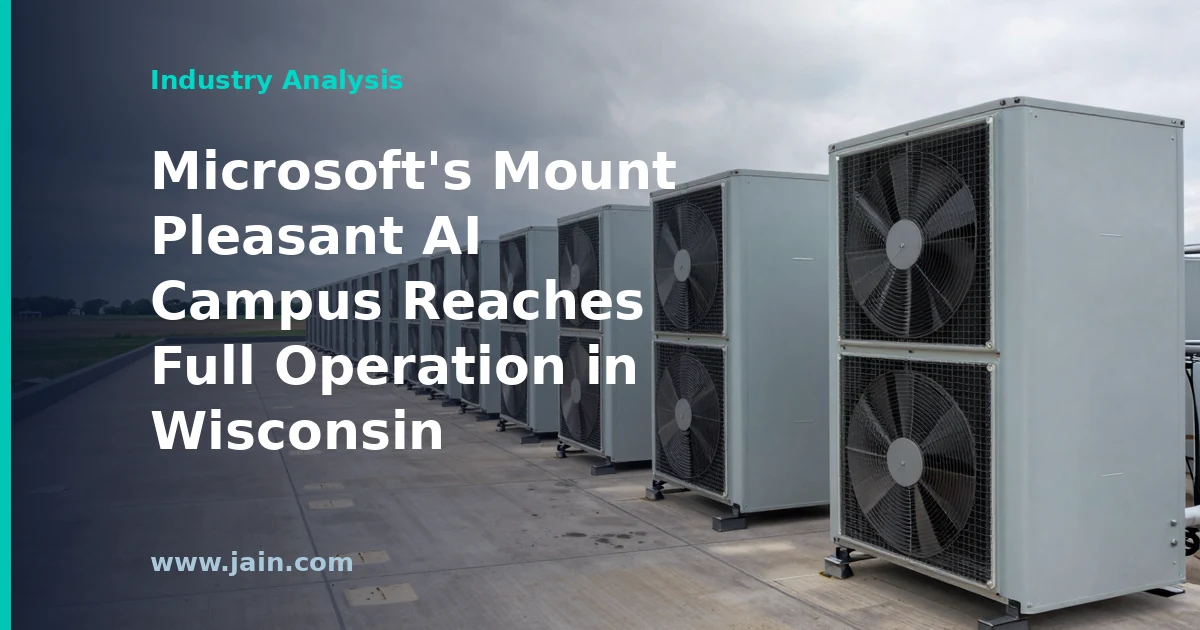
Microsoft’s AI data center campus in Mount Pleasant, Wisconsin is now fully operational, according to a June 24, 2026 report from Data Center Knowledge. The milestone marks the completion of the commissioning phase for one of the most closely watched hyperscale AI sites in the United States — a campus Microsoft has publicly positioned as a flagship of its AI infrastructure program since announcing a $3.3 billion investment there in May 2024.
Executive Summary
The report that Microsoft’s Wisconsin campus has gone fully operational converts years of announcements into working capacity. “Fully operational” in hyperscale terms means the facility has moved past construction and phased commissioning — the staged process of energizing electrical systems, validating cooling loops, and bringing compute halls online rack by rack — into steady-state production service.
It matters for three reasons. First, the site is a bellwether: Microsoft branded its Mount Pleasant build “Fairwater” and described it as among the most powerful AI data centers in the world, purpose-built for training large AI models on massive GPU clusters. Second, the location carries unusual economic symbolism, occupying land originally assembled for Foxconn’s largely unrealized 2017 manufacturing project. Third, it is a data point on whether the AI capital-expenditure cycle is delivering finished, revenue-generating infrastructure on schedule — a question investors and utilities are asking with increasing urgency.
One caveat readers should hold onto: the source is a headline-level trade report. Specific operational figures — megawatts energized, GPU counts in service, final headcount — are not independently confirmed in it, and we flag below what remains unverified.
From Foxconn’s Ghost Site to an AI Flagship
Few parcels of American industrial land carry as much narrative weight as Mount Pleasant. In 2017, Foxconn pledged a $10 billion LCD manufacturing campus there with talk of up to 13,000 jobs; the project was dramatically scaled back, leaving the village and Racine County with prepared land, water infrastructure, and unmet expectations. Microsoft’s arrival in 2023–2024 — culminating in the $3.3 billion commitment announced in May 2024 — recast the site as AI infrastructure rather than manufacturing.
Full operation closes that redemption arc, at least physically. For local officials who financed roads, water mains, and land assembly for Foxconn, a running hyperscale campus finally puts heavy, long-lived capital on the tax rolls. It is worth being precise about what changed, though: a data center campus employs far fewer people per dollar of investment than the factory once promised. The win for the region is tax base, grid and fiber investment, and anchor-tenant credibility — not mass employment.
What “Fully Operational” Actually Means at Hyperscale
Hyperscale campuses do not flip on like a light switch. They are commissioned in phases: substations and switchgear are energized, cooling plants are load-tested, and data halls are accepted one at a time, often over 12 to 24 months. A “fully operational” declaration means the last planned phase of the current build has passed acceptance and is carrying production workloads — in this case, most likely AI training and inference for Microsoft’s own models and its Azure cloud customers.
Microsoft has said the Wisconsin facility was designed around dense GPU clusters — the specialized processors that do the mathematical heavy lifting of AI — networked into effectively one giant computer for training large models. That design choice matters commercially: a training-oriented campus is measured less by how many customers it hosts and more by how fast it lets its owner iterate on frontier models. Full operation here is capacity Microsoft has been publicly hungry for throughout the AI demand surge.
Power and Cooling: The Real Constraints on the AI Buildout
The binding constraints on AI infrastructure are no longer chips alone but electricity and heat. Microsoft has described the Mount Pleasant design as using closed-loop liquid cooling — water is filled once and continuously recirculated to carry heat away from densely packed GPUs, rather than being evaporated and replaced as in traditional cooling towers. If it performs as described, that design substantially reduces ongoing water draw, a sensitive issue in any community hosting a large data center near the Lake Michigan basin.
Electricity is the harder question. Facilities of this class draw utility-scale power measured in the hundreds of megawatts, and Wisconsin utilities have been planning generation and transmission additions with data center demand explicitly in view. Who pays for that grid expansion — hyperscalers through special tariffs, or ratepayers broadly — is one of the live policy debates of the AI era, in Wisconsin as elsewhere. A fully operational campus moves that debate from the hypothetical to the measurable: actual load data now exists, even if it is not yet public.
A Bellwether for the AI Capex Cycle
The AI buildout is one of the largest private capital deployments in history, and skeptics reasonably ask whether announced projects become working assets or stall in permitting, power queues, and supply chains. Mount Pleasant going fully operational is evidence for the “it’s getting built” side of the ledger — a site that went from announcement to full operation in roughly two years, and which Microsoft subsequently doubled down on with a second announced facility that pushed its stated Wisconsin commitment past $7 billion.
For competitors and suppliers, the milestone sharpens the map. Rivals racing to stand up comparable training capacity now face a Microsoft with another flagship online. For the ecosystem of electrical contractors, cooling vendors, and fiber providers, a completed phase means crews and supply chains roll to the next site — including, presumably, the second Wisconsin building. And for enterprise buyers of AI services, more training capacity upstream generally translates, with a lag, into more capable models and more available GPU capacity downstream.
Background
Microsoft is one of the world’s largest cloud and AI providers, and since 2023 it has led one of the largest infrastructure buildouts in corporate history to supply computing capacity for AI model training and services delivered through its Azure cloud. Data centers — warehouse-scale buildings packed with servers, specialized AI processors, power distribution, and cooling — are the physical foundation of that effort, and Microsoft has announced multibillion-dollar campuses across the United States and abroad.
The Mount Pleasant, Wisconsin site carries particular history. It was assembled for Foxconn’s heavily subsidized 2017 manufacturing project, which largely failed to materialize. Microsoft began acquiring land there in 2023, announced a $3.3 billion AI data center investment in May 2024, later unveiled the campus under the “Fairwater” banner as a flagship AI training facility with closed-loop liquid cooling, and announced a second Wisconsin data center that raised its stated commitment in the state above $7 billion. The June 2026 report that the campus is fully operational marks the completion of that first flagship build.
Source: Microsoft’s Wisconsin AI Data Center Campus Now Fully Operational — Data Center Knowledge, June 24, 2026, reporting that Microsoft’s Mount Pleasant AI campus has completed commissioning and entered full production service.