Tag: AI factory

  • Cisco and Supermicro Deepen Secure AI Factory Ties: What Holds Up

    Cisco and Supermicro Deepen Secure AI Factory Ties: What Holds Up

    Investment commentary site Simply Wall St reports that Cisco has expanded its Secure AI Factory partnership with Super Micro Computer (NASDAQ: SMCI), and argues the development could alter the bull case for the server maker’s stock. A “Secure AI Factory” is industry shorthand for a pre-validated bundle of GPU servers, networking, storage and security software sold as a single, tested design rather than as parts a customer must assemble.

    The item reaching our desk is a stock-watchlist analysis rather than a joint corporate announcement. It does not, in the material available to us, disclose contract value, product availability dates, named customers or revenue expectations. The substantiated fact is the direction of travel: two large infrastructure vendors are binding security more tightly into a packaged AI compute stack.

    Executive Summary

    The headline claim is narrow but strategically legible. Cisco supplies networking and security; Super Micro supplies dense, rapidly-configured GPU server systems. An expanded partnership around a “Secure AI Factory” means the two are shipping a joint reference design in which security controls are part of the validated architecture rather than a layer a customer bolts on after the racks are powered up.

    That matters because AI clusters have changed the security problem. A traditional enterprise application sits behind a perimeter. An AI training or inference cluster concentrates enormous value in one place — proprietary model weights, curated training data, high-bandwidth east-west traffic between GPUs that never touches a conventional firewall — and it is often stood up on aggressive timelines by teams under pressure to show results. Retrofitting controls onto that environment is slow and expensive; designing them in is the cheaper path if the design actually holds.

    For readers assessing the news, the important distinction is between a genuine architectural shift and a marketing package. The available source supports the former as a hypothesis and the latter as a risk. It does not yet supply the specifics — validated configurations, availability, pricing, support ownership — that would let a buyer or an investor tell the difference.

    Why Security Is Migrating Into the Rack

    The economics of retrofit are unforgiving. Adding segmentation, traffic inspection and identity controls to a live GPU cluster usually means change windows on hardware that a business has justified on utilization, plus integration labour that scales with every non-standard choice made during the build. A pre-validated design moves that cost to the vendor, who amortizes it across every customer who buys the same bundle. That is the same logic that produced converged and hyperconverged infrastructure a decade ago, applied to a workload with far higher value density.

    There is a technical driver too. Much of the traffic inside an AI cluster is east-west — GPU to GPU, node to node, across high-speed fabrics — and it is precisely the traffic that classic perimeter tooling was never designed to see. Controls have to live closer to the fabric and the host. That pushes security decisions into the reference architecture, where the networking vendor and the server vendor have to agree on them jointly, rather than into a procurement conversation that happens six months later.

    The unresolved question is depth. “Designed in” can mean security functions genuinely embedded in the data path and validated under load, or it can mean the same products tested together and sold on one quote. Both are useful; only the first changes the risk profile of the deployment. The source material does not distinguish between them.

    Asymmetric Stakes: What Each Side Gets

    The strategic value is not evenly split. Super Micro competes largely on speed and configurability — getting new GPU platforms into shipping systems quickly, at competitive cost. Its structural vulnerability is being seen as a box supplier in deals where enterprise buyers want a single accountable party for a full stack. Association with a validated security architecture from a large incumbent addresses that objection directly, and does so in enterprise and sovereign accounts where procurement rules and audit expectations favour recognized names.

    Cisco’s position is different. It has an installed base and a security portfolio, and its exposure in the AI build-out is the risk that compute-centric architectures route around it. Being embedded in the reference design of a fast-moving server vendor keeps its networking and security attached to workloads that might otherwise be specified by GPU vendors and cloud operators. For Cisco this is defense of attach rate; for Super Micro it is a credibility upgrade. That asymmetry is worth holding in mind when reading any claim that the partnership is transformative for either party.

    The plausible losers are pure-play security vendors selling into AI environments as an overlay, and system integrators whose margin comes from assembling and hardening clusters by hand. Neither is displaced by an announcement. Both are squeezed if validated bundles become the default way mid-sized enterprises buy AI capacity.

    Reading a Thin Source Fairly

    Editorial candour is warranted here. What we have is a headline and framing from an investment-commentary publisher, written to address whether a stock thesis changes. That is a legitimate genre, but it is not a primary disclosure. It carries no contract terms, no availability window, no customer reference and no financial quantification, and its intended reader is an investor rather than a buyer of infrastructure.

    The fair reading is neither dismissal nor amplification. Partnership expansions between established vendors are ordinary commercial activity and are usually incremental; they become material when they convert into named designs, shipping SKUs and disclosed revenue. Equally, the underlying trend — security folded into AI infrastructure architectures — is real and observable across the sector, and this report is consistent with it. The claim that deserves scepticism is not that the partnership exists, but that its existence alone should move a valuation.

    Buyers can apply a simple test. Ask for the validated design document, the specific security functions it covers, the performance overhead measured under representative load, and the name of the party who owns a support case when something in the integrated stack fails. Answers to those four questions separate an engineered product from a joint logo on a slide.

    What This Means for Enterprise AI Buyers

    For organizations building their first serious AI cluster, packaged secure designs lower the skill barrier. The scarcest resource in most enterprises is not GPUs but people who understand GPU networking, storage tiering and cluster security simultaneously. A validated architecture substitutes vendor engineering for in-house expertise, which is a real and quantifiable saving in time-to-first-workload.

    The trade is flexibility and negotiating position. Reference designs constrain component choice, and the deeper the security integration, the more expensive it becomes to swap a networking or server vendor at the next refresh. That is not automatically a bad deal — standardization has genuine operational value — but it should be priced. Buyers who intend to run mixed estates, or who expect to procure GPUs opportunistically across suppliers, should confirm how much of the security architecture survives when the compute underneath it changes.

    The practical recommendation is to treat this as a signal to ask better questions during the next AI infrastructure procurement, not as a reason to reopen a settled vendor decision. The market is moving toward integrated, security-inclusive stacks; which specific bundle wins remains an open commercial question.

    Background

    The AI build-out has reorganized how enterprises buy infrastructure. Rather than selecting servers, switches, storage and security tools separately, many organizations now purchase pre-validated “AI factory” designs — complete architectures tested by vendors and delivered as a unit — because the in-house expertise to integrate GPU clusters correctly is scarce and expensive. Server manufacturers, networking incumbents and GPU suppliers have responded with joint reference architectures aimed at shortening deployment from months to weeks.

    Super Micro Computer built its position by moving new silicon into shipping systems quickly and offering unusually wide configuration choice, which suited early GPU buyers optimizing for speed and cost. Cisco entered the same conversation from networking and security, where its interest is ensuring that AI infrastructure decisions do not bypass its portfolio. Partnerships between the two categories are a natural consequence: the server vendor gains stack credibility with conservative enterprise buyers, and the networking vendor stays attached to the fastest-growing workload in the data center.

    Source: The Bull Case For Super Micro Computer (SMCI) Could Change Following Cisco’s Secure AI Factory Partnership Expansion — investment commentary from Simply Wall St on the expanded Cisco and Super Micro Secure AI Factory partnership and its implications for the SMCI thesis.
  • NVIDIA Pushes Security Into Silicon: DOCA and the Agentic AI Factory

    NVIDIA Pushes Security Into Silicon: DOCA and the Agentic AI Factory

    NVIDIA published a technical blog on May 30, 2026 making the case for “in-silicon security” for agentic AI infrastructure, delivered through DOCA — the software framework for its BlueField data processing units (DPUs). The pitch: as AI systems shift from answering prompts to autonomously taking actions, the security controls protecting AI data centers should move out of host software and into dedicated hardware at the network edge of every server.

    Executive Summary

    The post positions DOCA, NVIDIA’s development framework for BlueField DPUs, as the security layer for what the company calls AI factories — data centers purpose-built to produce AI inference at scale. A DPU is a programmable processor that sits on the server’s network card and handles networking, storage, and security tasks so the CPU and GPU don’t have to. Running security there, rather than in the operating system, means the enforcement point survives even if the host itself is compromised.

    The timing tracks the industry’s pivot to agentic AI — systems that plan, call tools, and act on other systems with limited human supervision. That autonomy multiplies machine-to-machine traffic inside the data center and widens the blast radius of any single compromised workload, which is precisely the traffic that perimeter firewalls never see. NVIDIA’s argument is that the enforcement point has to move to where that east-west traffic actually flows: the server’s own network interface.

    It matters because NVIDIA is not a neutral party here. If security becomes a silicon feature of the AI stack, the company that already supplies the GPUs, the networking, and the DPUs consolidates one more layer of the platform. The blog is a technical argument, not a product launch — and readers should weigh it as both engineering guidance and strategic positioning.

    Agentic AI Breaks the Perimeter Model

    Traditional data center security assumes a hard shell and a soft interior: inspect traffic at the boundary, trust most of what happens inside. Agentic AI erodes that assumption. When autonomous agents call APIs, query databases, spin up jobs, and message other agents, the overwhelming majority of traffic is east-west — server to server inside the facility — and it is generated by software identities, not humans logging in.

    That shifts the useful control point from the perimeter to the individual server. Zero trust — the model in which no connection is trusted by default and every request is verified — has been the stated direction of enterprise security for years, but enforcing it on every packet between thousands of GPU servers is computationally expensive. NVIDIA’s framing of the DPU as the natural place to do that enforcement is a coherent answer to a real architectural problem, whatever one concludes about the specific product.

    Why the DPU Is an Attractive Security Boundary

    Putting security in the DPU buys two things. First, isolation: the DPU runs its own software stack, so firewalling, encryption, and telemetry keep operating even if an attacker gains root on the host — a meaningful property when the host is running semi-autonomous agents whose behavior is hard to fully predict. Second, offload: security processing done in dedicated silicon doesn’t consume the CPU cycles or GPU time that the facility exists to sell.

    That second point is the quiet economic argument. In an AI factory, every host cycle spent on packet inspection is margin lost. In-silicon security is thus pitched not only as safer but as cheaper per unit of useful work — an argument that will resonate with operators watching utilization dashboards. The trade-off is operational: security teams gain a new hardware layer to program, patch, and monitor, and DOCA skills are far scarcer than firewall administration skills.

    Platform Consolidation Cuts Both Ways

    For NVIDIA, embedding security into DOCA deepens an already formidable platform position spanning GPUs, interconnects, and networking. For buyers, that is simultaneously the appeal and the risk. A vertically integrated stack where security is co-designed with the fabric can genuinely outperform bolted-on alternatives; it also concentrates dependency on a single vendor for compute, networking, and now the control plane that polices both.

    Incumbent security vendors face a positioning question rather than immediate displacement: several already ship DPU-accelerated versions of their products, and the realistic outcome is DOCA as a substrate that third-party security software runs on, rather than a wholesale replacement. Infrastructure operators — including colocation and cloud providers hosting AI workloads — should read this as directional: the security perimeter of AI infrastructure is migrating into the server itself, and facility-level offerings will need to interoperate with it.

    Background

    NVIDIA transformed from a graphics chip maker into the dominant supplier of AI data center infrastructure, with its GPUs powering the large-scale model training and inference boom. Its 2020 acquisition of Mellanox brought high-performance networking in-house, yielding the BlueField DPU line and the DOCA framework introduced alongside it. Since then NVIDIA has steadily pitched a full-stack vision — compute, networking, software — for what it brands AI factories.

    The security angle gained urgency through 2025 and 2026 as enterprises moved from chatbot-style AI to agentic deployments, where autonomous software acts on live business systems. That shift has pushed the industry’s long-running zero-trust conversation from corporate networks into the AI cluster itself, making the question of where enforcement lives — perimeter, host, or silicon — a live architectural debate.

    Source: Advancing AI Infrastructure for Agentic AI with NVIDIA DOCA In-Silicon Security — NVIDIA Technical Blog post arguing for DPU-layer, in-silicon security as the foundation for agentic AI data centers.

  • Johnson Controls Publishes Second AI Factory Cooling Reference Design Guide

    Johnson Controls Publishes Second AI Factory Cooling Reference Design Guide

    Johnson Controls announced on May 5, 2026 the release of its second data center reference design guide, aimed at advancing cooling for industrial-scale AI factories — the very large, GPU-dense data centers built to train and run artificial intelligence models. The guide follows the company’s earlier reference design publication and continues its effort to give data center developers pre-engineered, repeatable cooling blueprints rather than one-off custom designs.

    Executive Summary

    The announcement itself is straightforward: a major cooling and building-technology vendor has published a second installment in a series of reference design guides for AI data center thermal management. A reference design, in this context, is a validated engineering template — equipment selections, piping and airflow topologies, controls logic — that a developer can adopt largely as-is instead of engineering a cooling plant from scratch for every project.

    Why it matters is the industry moment. AI computing has pushed rack power densities far beyond what traditional air cooling handles economically, forcing a rapid shift to liquid cooling. That shift has collided with a shortage of engineers who have actually designed liquid-cooled facilities at scale. Vendors who can package proven designs stand to compress project timelines and, not incidentally, lock their own equipment into the template. Johnson Controls publishing a second guide signals both that the first found an audience and that the company sees standardized, productized cooling design as a durable competitive front — not a one-off marketing exercise.

    Reference Designs Are the Industry’s Answer to a Speed Problem

    The binding constraints on AI data center construction are power, equipment lead times, and engineering hours — in roughly that order. Every hyperscaler and colocation developer is trying to shorten the time from land acquisition to energized racks, and bespoke mechanical design is one of the slowest, most error-prone stages. A reference design guide attacks that stage directly: if the cooling plant is pre-engineered and pre-validated, developers can order long-lead equipment earlier, permit faster, and reuse the same design across multiple sites.

    This mirrors what happened in earlier infrastructure waves. Hyperscale data centers of the 2010s converged on repeatable electrical and mechanical templates, which is a large part of how build times fell even as facilities grew. AI factories reset that progress because liquid cooling — circulating fluid directly to chips or to rear-door heat exchangers instead of relying on chilled air — changed the entire mechanical architecture. Reference designs are how the industry rebuilds its muscle memory for the new architecture.

    Standardization Is Also a Land Grab

    A vendor-published reference design is not a neutral standard. It is a template built around the publisher’s own chillers, coolant distribution units, controls, and services. If a developer adopts the guide, Johnson Controls equipment becomes the default bill of materials, and switching components later means re-validating the design. That is the same playbook chip vendors use with their own data center reference architectures: publish the blueprint, become the default.

    Seen that way, a second guide is a competitive statement aimed at the other large thermal players — the established chiller and precision-cooling manufacturers all racing to publish AI-ready architectures — and at engineering firms whose custom-design business a good-enough template partially displaces. For buyers, the trade-off is real but usually favorable: some vendor lock-in in exchange for schedule certainty and a design someone else has already de-risked. The buyers with the least to gain are those with strong in-house engineering; the biggest beneficiaries are the second wave of AI data center developers — enterprises, sovereign projects, smaller colocation firms — who lack liquid-cooling experience entirely.

    What a Guide Can and Cannot Prove

    It is worth being clear-eyed about what a design document demonstrates. Publishing a guide shows engineering investment and market intent; it does not by itself prove field performance, energy efficiency, or delivery capacity at the scale AI factories demand. The metrics that ultimately matter — cooling capacity per megawatt, water and energy consumption, equipment lead times, uptime in operation — are established by built projects, not publications. The announcement, as reported, is a step in productizing AI cooling; the evidence of success will be reference customers and operating facilities that used the designs. That is not a criticism of the release so much as the correct lens for reading any vendor reference architecture.

    Background

    Johnson Controls traces its history to the 19th-century invention of the room thermostat and has grown into one of the world’s largest building-technology companies, spanning HVAC equipment, industrial chillers, controls, and services. Over the past several years it has leaned hard into data centers as a growth market, positioning its chiller lines, coolant distribution equipment, and controls for the AI buildout.

    The market context is a structural shift: the AI boom has driven rack power densities beyond air cooling’s practical limits, making liquid cooling a requirement rather than a niche option and setting off a race among thermal-management vendors to publish standardized, repeatable designs. Reference architectures — long a fixture in chip and server ecosystems — have become the mechanism through which cooling vendors compete to define how AI factories get built.

    Source: Johnson Controls releases second data center reference design guide to advance industrial-scale AI factory cooling — PR Newswire announcement, May 5, 2026, of the company’s second cooling reference design guide for AI data centers.

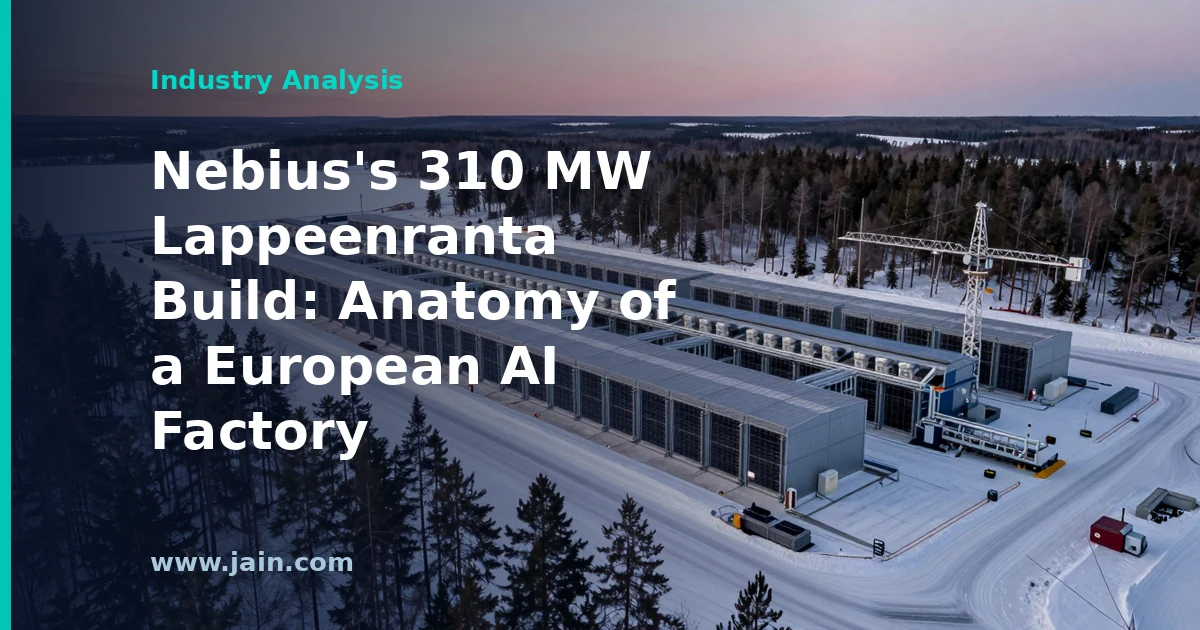
  • Nebius’s 310 MW Lappeenranta Build: Anatomy of a European AI Factory

    Nebius’s 310 MW Lappeenranta Build: Anatomy of a European AI Factory

    A project profile published April 25, 2026 by Northwise Project details a 310 megawatt (MW) data center in Lappeenranta, Finland attributed to Nebius Group, the Amsterdam-headquartered AI infrastructure company that trades on Nasdaq under the ticker NBIS. The report frames the facility as an “AI factory” — a data center purpose-built for training and running artificial-intelligence models rather than for general-purpose computing.

    At 310 MW, the Lappeenranta site would sit firmly in the top tier of European data center projects by power capacity, and would extend Nebius’s existing Finnish footprint, anchored by its long-running campus in Mäntsälä.

    Executive Summary

    The headline fact is the number: 310 MW of power capacity dedicated to AI computing in a single Finnish location. Power capacity — the electricity a facility can draw and convert into computation — has become the standard yardstick for AI infrastructure because modern graphics processing units (GPUs) are constrained less by floor space than by the megawatts available to feed and cool them. A conventional enterprise data center might draw a few megawatts; 310 MW is the scale at which a facility can host tens of thousands of accelerators and compete for the largest AI training workloads.

    The location is just as telling as the size. Finland offers a cool climate that slashes cooling costs, a grid that is among Europe’s most carbon-free, political stability inside the EU, and — in Nebius’s case — years of accumulated operating experience in the country. Lappeenranta, a university city in southeastern Finland, adds a local energy-engineering talent base.

    What the profile does not settle is equally important: it is a single third-party report, and details on timeline, phasing, investment, power contracts, and customers are not substantiated in the source material. The scale claim is specific, but readers should treat the project’s parameters as reported rather than independently confirmed.

    Why Finland Keeps Winning AI Capacity

    Finland has quietly become one of Europe’s most competitive destinations for compute-intensive infrastructure, and the reasons are structural rather than promotional. Cooling is one of the largest operating costs in a data center, and Finland’s climate allows “free cooling” — using outside air or nearby water — for much of the year. The Finnish grid is also unusually clean, drawing heavily on nuclear, hydro, and wind, which matters both for operating economics and for AI customers facing sustainability reporting obligations in the EU.

    Nebius knows this terrain better than most entrants. Its Mäntsälä campus, inherited from the company’s pre-2024 corporate history, is well known in the industry for piping waste heat from servers into the local district heating network — turning a cost center into community energy. A second, far larger Finnish site would suggest the company is doubling down on a playbook it has already proven, rather than experimenting in an unfamiliar market.

    What 310 MW Actually Buys

    For readers outside the industry: data centers are sized by power, not square footage, because electricity is the true scarce input. A 310 MW facility operates on a different plane from traditional colocation sites. Individual AI server racks now draw 100 kilowatts or more — ten times the density of conventional racks — so hundreds of megawatts translate into the tens of thousands of GPUs needed to train frontier-scale models.

    The “AI factory” framing is more than marketing shorthand. Purpose-built AI facilities differ from general-purpose data centers in their electrical distribution, liquid-cooling infrastructure, and network fabric, which must move enormous volumes of data between GPUs at very low latency. Retrofitting a legacy facility to these specifications is often harder than building new — which is why the current AI cycle is producing greenfield gigascale campuses rather than expansions of existing colocation stock.

    Nebius and the Neocloud Race

    Nebius belongs to a category investors have taken to calling “neoclouds”: companies that rent GPU capacity for AI workloads, competing with the hyperscale clouds on price, availability, and specialization. The strategic logic of a 310 MW owned site is vertical integration — controlling land, power, and buildings rather than leasing from wholesale data center providers should yield structurally lower cost per GPU-hour, which is the metric on which this market ultimately competes.

    The risk side of that logic is capital intensity. Facilities at this scale require investment in the billions of dollars before revenue arrives, and the GPU rental market is young, with demand concentrated among a relatively small set of AI labs and enterprises. A purpose-built AI factory is a leveraged bet that today’s extraordinary demand for training and inference capacity persists through the multi-year window it takes to permit, build, and fill such a site. That bet may well pay off — but it is a bet, and the source material offers no visibility into how this one is financed or contracted.

    Europe’s Sovereignty Subtext

    A gigascale AI facility on EU soil lands in the middle of Europe’s “sovereign AI” debate — the push to ensure European companies and governments can access frontier compute under European jurisdiction rather than depending entirely on U.S.-based capacity. An Amsterdam-headquartered operator building hundreds of megawatts in Finland fits that narrative neatly, and European AI startups and public-sector buyers are an obvious customer constituency.

    Whether the project actually serves that market, or is absorbed by one or two large anchor tenants, is not something the source addresses. The distinction matters: a facility serving broad European demand changes the region’s compute landscape; a facility pre-committed to a single large customer changes one company’s supply chain. Both are legitimate businesses, but they have different implications for European AI buyers watching capacity announcements with interest.

    Background

    Nebius Group took its current form in 2024, when Yandex N.V. — the Dutch holding company of the Russian internet group — sold its Russia-based businesses and rebuilt itself around international assets, including a data center in Mäntsälä, Finland. Rebranded as Nebius and relisted on Nasdaq under the ticker NBIS in October 2024, the company positioned itself as a European-rooted provider of AI cloud infrastructure, backed by partnerships in the Nvidia ecosystem and an aggressive data center expansion program across Europe and beyond.

    The broader backdrop is a global scramble for AI compute. Training and serving large AI models requires unprecedented concentrations of GPUs and electricity, and power availability has replaced land or fiber as the industry’s gating resource. The Nordics — with cool climates, clean grids, and supportive municipalities — have become one of the main theaters for this build-out, and Finland in particular has converted those advantages into a steady pipeline of hyperscale and AI-specialized projects.

    Source: NBIS Lappeenranta Data Center: The 310 MW Finland AI Factory — Northwise Project, a project profile of the reported 310 MW Nebius AI data center in Lappeenranta, Finland, published April 25, 2026.