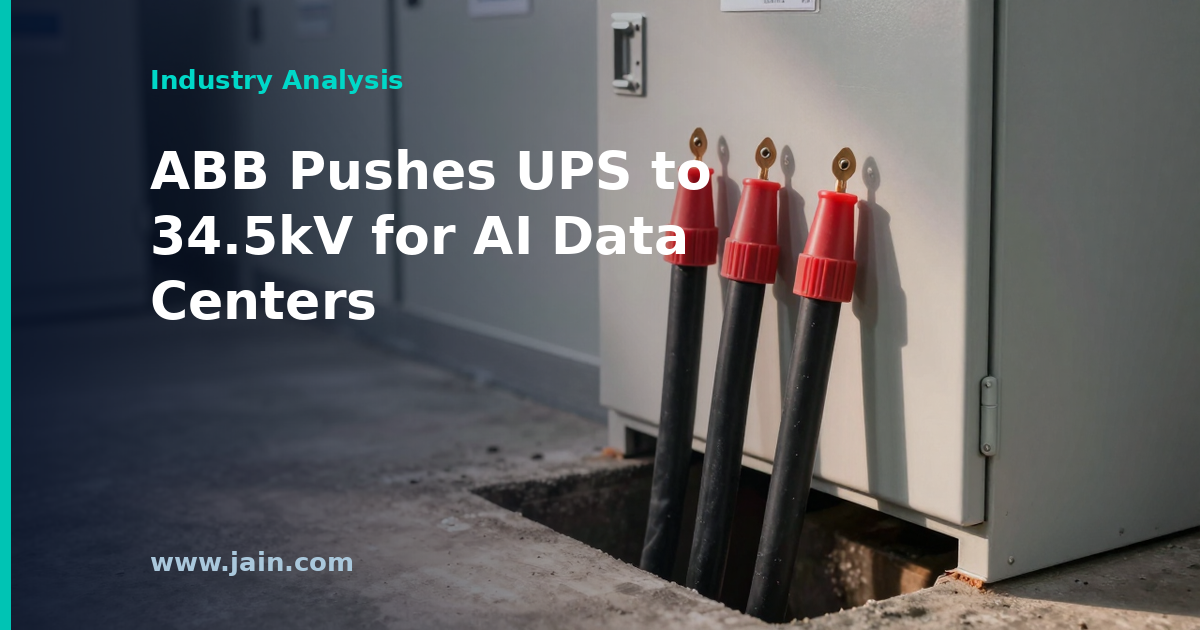
ABB has introduced a 34.5kV version of its HiPerGuard medium-voltage uninterruptible power supply, announced on 22 April 2026. The company positions the product as connecting directly to a medium-voltage grid feed, eliminating conversion steps between the utility connection and the data center’s power train, and says the result is lower power costs for AI data centers.
At 34.5kV, the unit sits at the top of the medium-voltage distribution class commonly used by North American utilities. The announcement is a product-capability disclosure rather than a customer deployment: the material published alongside the headline does not name sites, buyers, delivery dates or measured efficiency gains.
Executive Summary
An uninterruptible power supply is the equipment that keeps a data center’s servers running through a grid disturbance, bridging the seconds or minutes until generators take over. Conventionally, that equipment lives at low voltage — typically a few hundred volts — which means utility power arriving at medium voltage must first be stepped down through transformers, then protected, then distributed. Every one of those stages costs a percentage of the power passing through it, and each percentage becomes heat that must itself be cooled.
ABB’s claim with the 34.5kV HiPerGuard is that the UPS can sit further upstream, taking the medium-voltage feed directly and removing conversion stages from the chain. The commercial argument is straightforward: fewer stages mean fewer losses, less transformer and switchgear capacity to buy, and less floor space consumed by electrical rooms that could otherwise hold revenue-generating IT equipment.
The timing matters more than the voltage number. AI training and inference racks have moved from tens of kilowatts to the hundreds, with megawatt-scale racks on vendor roadmaps. At those densities the electrical distribution system, not the building shell, becomes the constraint. Medium-voltage UPS is one of several architectural responses to that constraint — and this announcement is a claim about a direction of travel that the released material does not yet quantify.
Voltage Is the New Density Lever
Power density in data centers has historically been solved by moving air and water more cleverly. That era is ending. When a single rack draws hundreds of kilowatts, the limiting factor shifts to how much current the distribution system can carry without unmanageable conductor sizes, losses and fault energy. Physics is unhelpful here: for a given amount of power, halving current requires doubling voltage, and copper cost and resistive loss scale with current, not with power.
Raising the voltage at which protected power is handled is therefore one of the few structural levers available. Doing it at the UPS means the medium-voltage feed can travel deeper into the facility before being stepped down close to the load, shortening the low-voltage runs that dominate conductor spend. It also compresses the equipment chain: each transformation stage carries its own footprint, maintenance regime, failure modes and efficiency penalty. Removing stages removes all four at once.
The counterpoint worth stating plainly is that this is a re-architecture, not a component swap. Medium-voltage equipment brings different clearance requirements, different arc-flash considerations, different qualification standards for the technicians who work on it, and a smaller pool of contractors able to commission it. Operators who adopt it are trading one set of engineering problems for another, and the trade only pays at scale.
Where the Savings Actually Come From
The headline frames the benefit as lower power costs. In a data center’s cost structure, electrical losses are compounded rather than linear: a watt lost in a transformer or rectifier is a watt bought from the utility and also a watt of heat that the cooling plant must remove, at further energy cost. Small efficiency percentages at the front of the power chain therefore multiply through the operating budget over a facility life measured in decades.
The capital side may matter as much. Eliminating conversion stages means fewer step-down transformers, less associated switchgear, and less electrical room area — space that, in a market where construction timelines and grid connections are the binding constraints, converts directly into deployable IT capacity per site. For operators who cannot get more megawatts from their utility, extracting more usable compute from the megawatts already contracted is the highest-value optimization available.
None of that is quantified in the material accompanying this announcement. There is no published efficiency figure, no comparison baseline, no total-cost-of-ownership model and no pricing. The mechanism ABB describes is sound engineering and widely understood in the industry; the specific magnitude of the benefit is, on the evidence released so far, an assertion rather than a demonstrated result. Buyers should treat it accordingly and ask for the numbers.
A Crowded Answer to a Real Problem
ABB is not alone in reading the AI power problem this way. Medium-voltage UPS lines, solid-state transformer research, and the broader industry push toward higher-voltage direct-current distribution inside the rack are all attacking the same bottleneck from different points in the chain. Chip and system vendors have been pushing rack-level power architectures upward in voltage for similar reasons. These approaches are complementary rather than mutually exclusive — a facility could plausibly take medium voltage deep into the hall and then distribute at high-voltage DC to the racks.
The likely winners are hyperscale and large colocation operators building new capacity, where greenfield design allows the electrical architecture to be chosen rather than retrofitted, and where volume justifies training staff on medium-voltage practice. The likely losers are smaller enterprise sites and retrofit projects, which carry the complexity without the scale to amortize it. For ABB, the strategic value is defending a position in the electrification supply chain against competitors selling into the same buildings.
The risk to watch is supply chain rather than technology. Medium-voltage switchgear, transformers and related equipment have been in constrained supply across the electrical industry, with lead times that already shape data center schedules. A product that reduces the count of such components could ease that pressure; one that simply relocates demand to a differently scarce component would not. The announcement does not address lead times or manufacturing capacity.
Background
ABB is a long-established electrification and automation supplier whose portfolio spans switchgear, transformers, drives and power protection. Its HiPerGuard line is a medium-voltage UPS family aimed at large industrial and data center loads, positioned against the conventional approach of stepping utility power down to low voltage before it reaches protection equipment.
The market context is the rapid escalation of data center power requirements driven by AI workloads. As rack densities climb, operators face constrained utility connections, long grid interconnection queues and shortages of electrical equipment. That has pushed power architecture — historically a settled part of data center design — back into active competition among vendors, with voltage levels, conversion topologies and distribution schemes all under reconsideration.
Source: New 34.5kV HiPerGuard UPS: direct grid connection cuts AI data center power costs – ABB — ABB’s 22 April 2026 announcement of a 34.5kV medium-voltage UPS positioned to remove conversion stages between the grid and AI data center loads.