Tag: AI data centers

  • GE Vernova’s AI Order Surge Signals Power and Cooling Are the New AI Bottleneck

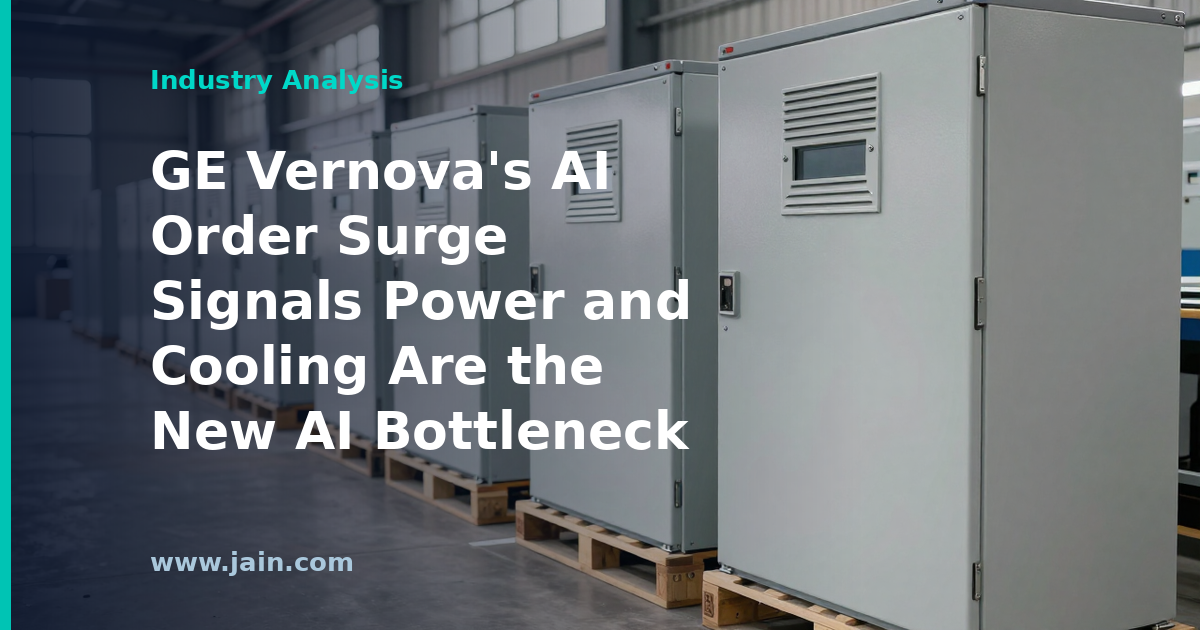
    GE Vernova’s AI Order Surge Signals Power and Cooling Are the New AI Bottleneck

    Financial media reports in August 2026 highlight that GE Vernova’s orders for AI data-center equipment in the first half of the year have already doubled the total it booked in all of 2025, according to coverage from The Motley Fool syndicated across Yahoo Finance and The Globe and Mail. In parallel, Yahoo Finance analysis asks whether Eaton Corporation and Trane Technologies — suppliers of electrical distribution gear and cooling systems, respectively — can emerge as major winners from the same AI data-center boom.

    None of the items is a company press release; they are investor-focused analyses built around the order-growth headline. But taken together, they point at a consistent industry story: the equipment that powers and cools AI facilities, not the chips inside them, is where demand is now outrunning supply.

    Executive Summary

    The headline claim is striking: in one half-year, GE Vernova — the energy-equipment company spun out of General Electric — booked more AI data-center orders than in the entire previous year. The coverage frames this as evidence that hyperscalers and data-center developers are racing to lock in turbines, grid equipment, and electrical infrastructure years ahead of need. The companion piece extends the thesis to Eaton, which makes the switchgear, transformers, and power-distribution systems inside data centers, and Trane, whose chillers and thermal-management systems remove the enormous heat that AI server racks generate.

    Why it matters: for the past two years, the constraint on AI capacity was widely assumed to be GPU supply. These reports suggest the constraint is migrating downstream — to megawatts and cooling tons. A data center without secured power generation, electrical distribution, and heat rejection cannot deploy a single chip, no matter how many accelerators its owner has purchased. If order books at the equipment makers are filling this fast, delivery lead times become a strategic variable for everyone building AI infrastructure.

    A caveat up front: the source material is investment commentary, not audited disclosure. The doubling claim originates in stock-analysis coverage, and the articles supply no dollar figures, customer names, or delivery schedules that we can independently verify from the release text alone. The direction of the signal is consistent across outlets; the precision of it is not something this coverage establishes.

    The Bottleneck Has Moved Downstream from Chips to Electrons

    Every AI data center is, functionally, a machine for converting electricity into computation and heat. The industry spent 2023–2025 focused on the computation side — who could get GPUs, and how many. But GPUs are a fast-cycle product: fabs can expand output on a timescale of quarters. Heavy electrical equipment is not. Gas turbines, large power transformers, and high-capacity switchgear are engineered-to-order products with lead times measured in years, built in a small number of factories worldwide. When demand doubles, capacity cannot.

    That asymmetry is what makes the reported GE Vernova order surge significant beyond one company’s income statement. If AI data-center orders in six months exceeded all of last year’s, buyers are effectively queueing — paying now for delivery slots later. In infrastructure markets, a lengthening queue is the classic signature of a bottleneck: the constraint on how fast the AI buildout can proceed stops being capital or chips and becomes the physical delivery calendar of the equipment supply chain.

    Three Companies, Three Layers of the Same Stack

    The coverage bundles GE Vernova, Eaton, and Trane together for a reason: they occupy successive layers of the same value chain. GE Vernova sits upstream, supplying power generation and grid-scale equipment — the megawatts themselves. Eaton sits in the middle, making the electrical distribution gear — switchgear, uninterruptible power supplies, transformers — that moves power safely from the substation to the server rack. Trane sits at the end of the energy journey, providing the chillers and cooling systems that reject the heat those racks produce. In a conventional data center, cooling can consume a substantial share of total power; AI racks, which run far denser than traditional IT loads, intensify that thermal problem.

    The strategic implication is that AI demand does not create one winner but a chain of them — and a chain of potential choke points. An operator who secures generation but not switchgear, or switchgear but not chillers, still cannot open. That is why the market is asking the Trane-and-Eaton question at all: if the upstream layer (GE Vernova) is visibly capacity-constrained, the same dynamic plausibly applies to the layers behind it. Plausibly — the coverage poses the question about Eaton and Trane rather than documenting equivalent order data for them, and that distinction matters.

    Reading Order Books Honestly: Signal, Not Revenue

    Orders are a forward indicator, not money in the bank. An order becomes backlog, backlog becomes revenue only upon delivery, and the coverage here does not disclose the dollar value of the orders, their delivery timeline, cancellation terms, or margin profile. History counsels some humility: capital-equipment cycles have seen order books swell during booms and thin out when customers re-time projects. If AI capital spending decelerates — because model economics disappoint, power prices spike, or financing tightens — equipment orders placed years ahead of need are among the first things large buyers revisit.

    There is also a framing question worth noting even-handedly. All three source articles are investor commentary keyed to stock tickers, published across financial outlets asking “is the stock still a buy?” That genre rewards dramatic framing of growth statistics. The underlying fact pattern — surging demand for power and cooling equipment from AI builders — is consistent with what the broader industry has been experiencing, and nothing in the coverage appears contrived. But readers should distinguish between the well-supported directional claim (demand is heavily outrunning historical levels) and the precise multiples in headlines, which the articles as syndicated do not source to specific filings in the material available here.

    What This Means for Anyone Building or Buying Capacity

    For data-center operators and enterprise buyers, the practical takeaway is that procurement of electrical and thermal equipment has become a competitive discipline, not a back-office function. When lead times stretch, operators who ordered early hold an asset — a delivery slot — that late movers cannot buy at any price in the short run. Expect that advantage to show up in which projects actually energize on schedule, and in the pricing power of colocation providers who already hold contracted power and installed cooling.

    For the equipment makers, the boom is an opportunity wrapped in a capacity-planning dilemma: expand factories aggressively and risk overcapacity if AI spending normalizes, or expand cautiously and cede share. How GE Vernova, Eaton, and Trane each answer that question — none of which this coverage addresses — will shape the supply side of the AI buildout for the rest of the decade.

    Background

    GE Vernova became an independent company in 2024 when General Electric split into separate aviation, healthcare, and energy businesses, giving the energy unit a standalone identity spanning power generation, wind, and grid electrification. Eaton is a long-established power-management company whose electrical segment supplies the distribution and backup-power equipment inside commercial facilities and data centers. Trane Technologies, formed from the 2020 separation of Ingersoll-Rand’s climate businesses, is one of the world’s largest suppliers of commercial HVAC and chiller systems.

    The market context is the AI infrastructure buildout that accelerated from 2023 onward, as hyperscale cloud providers and specialized developers began constructing data centers of unprecedented power density to train and run large AI models. That expansion has pushed demand for generation capacity, grid interconnection, electrical gear, and industrial cooling well beyond historical data-center norms — turning previously unglamorous equipment categories into strategically contested supply.

    Source: Can Trane Technologies plc (TT) and Eaton Corporation, PLC (ETN) Become Major Winners from the AI Data Center Boom? — Yahoo Finance analysis, alongside syndicated Motley Fool coverage reporting that GE Vernova’s first-half AI data-center orders doubled its full-2025 total.
  • Corero Adds AI Cloud-Assist to SmartWall ONE as DDoS Attacks Go Automated

    Corero Adds AI Cloud-Assist to SmartWall ONE as DDoS Attacks Go Automated

    Corero Network Security (AIM: CNS; OTCQX: DDOSF), the London-headquartered DDoS protection specialist, announced AI-Augmented Cloud-Assist for its SmartWall ONE platform on August 20, 2026. The new capability layers cloud-delivered AI analysis, threat intelligence, and policy optimization on top of Corero’s existing on-premises, edge-based DDoS mitigation.

    The system analyzes attack telemetry in Corero’s cloud, recommends new protection policies that can be applied manually or automatically in seconds, and keeps Corero’s security experts in an oversight role. It targets AI data centers, NeoCloud providers, service providers, and digital enterprises.

    Executive Summary

    The announcement is Corero’s answer to a problem the whole DDoS defense industry is wrestling with: attackers are using AI to develop and evolve attack campaigns faster than human security teams can write countermeasures. Corero’s proposed remedy is a continuous intelligence loop — on-premises SmartWall ONE appliances at the network edge feed attack telemetry and forensic data to Corero’s cloud, where AI identifies emerging attack behaviors and generates recommended protection policies, which flow back to the edge devices with human experts supervising the loop.

    Why it matters: a distributed denial of service (DDoS) attack floods a network or service with junk traffic until legitimate users cannot get through, and mitigation speed is measured in seconds, not hours. If cloud-scale AI can genuinely shorten the gap between a novel attack pattern appearing and an effective policy being deployed, that is a meaningful operational improvement — particularly for AI data centers and cloud GPU providers (so-called NeoClouds) whose expensive workloads make downtime costly. The release, however, offers no benchmarks, pricing, availability dates, or named customers, so the launch is best read as a directional architecture statement rather than a proven result.

    Fighting Automation With Automation

    The premise of the launch is an arms-race argument: as attackers use AI to mutate DDoS campaigns mid-attack, defenses that depend on humans hand-tuning mitigation policies fall behind. Corero frames AI Cloud-Assist as restoring symmetry — machine-generated attacks met with machine-generated countermeasures, applied “in seconds.” That framing is consistent with where the broader security industry is heading, and the underlying logic is sound: policy generation is the slow, human-bottlenecked step in DDoS response, so it is the rational place to apply AI.

    What the release does not provide is evidence of the improvement. There are no response-time figures, detection-accuracy comparisons, or before-and-after case studies. “Reduce response times, improve protection accuracy, and strengthen operational efficiency” are the intended outcomes, not measured ones. Buyers evaluating the claim will need to ask for data the release does not contain.

    The Hybrid Architecture: Cloud Brains, Edge Muscle, Human Oversight

    The design choice worth noting is what Corero did not do: it did not move mitigation to the cloud. Traffic scrubbing stays on the on-premises SmartWall ONE appliances at the network edge — close to the applications and AI workloads being protected — which preserves low latency, while the computationally heavy analysis moves to the cloud where scale is cheap. This is a sensible division of labor, and it plays to Corero’s installed base: the AI works from SmartWall ONE’s existing telemetry and forensic data rather than requiring a new sensor footprint.

    Equally deliberate is keeping humans in the loop. Recommendations can be applied automatically or manually, with Corero’s security experts providing oversight. That addresses the real operational fear about AI-driven security — a false positive that auto-deploys a policy blocking legitimate customer traffic is itself a denial of service. The trade-off is that human oversight reintroduces some of the latency the automation was meant to eliminate; how customers tune that dial will determine how much of the promised speed they actually realize.

    Reading the Target Market: AI Data Centers and NeoClouds

    Corero names its target buyers explicitly: AI data centers, NeoCloud providers (the newer class of specialized GPU cloud operators), service providers, and digital enterprises. That ordering tells a market story. AI infrastructure operators run revenue-dense, latency-sensitive workloads and are attractive DDoS targets precisely because their downtime is expensive and visible. Positioning a DDoS product launch around them signals where Corero sees growth — and follows its recent momentum with infrastructure operators, including the deal in which its technology powers TierPoint’s Adapt DDoS protection service.

    Competitively, Corero claims the capability “is largely missing in most DDoS solutions.” That is a contestable assertion in a market where large cloud-delivered DDoS providers also advertise machine learning and automated mitigation. Corero’s genuine differentiation argument is narrower and more defensible: combining cloud AI with on-premises edge mitigation and the forensic-grade telemetry its appliances already collect. The release asserts the broader claim without a competitive comparison, so readers should treat the “largely missing elsewhere” framing as positioning rather than established fact.

    What Is Substantiated — and What Is Not

    Substantiated by the release: the product exists as an announced extension of SmartWall ONE; it uses cloud-based AI analysis of attack telemetry; recommendations can be applied manually or automatically; human experts oversee the loop; and it targets edge mitigation for AI-era infrastructure. Unsubstantiated as yet: any quantified performance gain, the nature of the AI models involved, general availability timing, pricing, and customer adoption. None of this is unusual for a product launch release, but the gap between the confident claim that “this is the future of DDoS protection” and the absence of measurable evidence is exactly the space a prospective buyer’s proof-of-concept should fill.

    Background

    Corero Network Security has spent years as a pure-play DDoS specialist, selling automatic detection and mitigation for complex edge and subscriber environments — the kind of always-on, real-time protection that internet service providers and hosting operators embed in their networks. The company is dual-listed on London’s AIM market and the US OTCQX, with operational centers in Massachusetts and Edinburgh.

    The launch continues a run of activity for the company: Corero was recently recognized as a leader and innovator in the 2026 DDoS SPARK Matrix vendor assessment, and its technology powers TierPoint’s new Adapt DDoS protection service — evidence of its strategy of reaching enterprises through infrastructure and service-provider partners. AI Cloud-Assist extends that installed edge footprint with a cloud intelligence layer rather than replacing it.

    Source: Corero Network Security Launches AI-Augmented Cloud-Assist for SmartWall ONE™ — PR Newswire release, August 20, 2026, announcing cloud-delivered AI analysis and policy optimization for Corero’s edge-based DDoS protection platform.

  • OpenAI’s 8 GW Ohio Campus: Legacy Grid Covers 800 MW, New Power Plants Gate the Rest

    OpenAI’s 8 GW Ohio Campus: Legacy Grid Covers 800 MW, New Power Plants Gate the Rest

    TL;DR · 30-second read

    The Short Version

    • OpenAI, the maker of ChatGPT, will rent space in a huge computer campus planned on the grounds of an old Cold War uranium plant in rural southern Ohio.
    • At full size, the campus would use about as much electricity as eight large nuclear reactors produce.
    • Only about a tenth of that can come from today’s power lines, starting in 2028. The rest needs new power plants, including gas-fired ones, that have not been built yet.
    • The developer promises to pay for the grid upgrades itself, so local electric bills do not cover them.

    OpenAI announced on August 17 that it has agreed to secure approximately 8 gigawatts of IT capacity at the PORTS-Pike Technology Campus in Pike County, Ohio, working with developer SB Energy, NVIDIA and the U.S. Department of Energy. The campus is being developed on private land and on remediated federal land at the former Portsmouth Gaseous Diffusion Plant. SB Energy will build, own and operate the data center under a 20-year lease to OpenAI, and the site will exclusively host NVIDIA AI computing hardware.

    The first 800 megawatts are expected to be available in 2028, largely using existing AEP infrastructure. Later phases will require new grid-connected power plants, including natural gas generation, plus new transmission lines. NVIDIA will invest $1.5 billion in SB Energy and provide credit support for the land, power and shell buildout of the initial 4.25 gigawatts. The companies project 35,000 construction jobs over a six-year buildout through 2032 and 2,500 long-term operating jobs.

    Executive Summary

    The PORTS-Pike agreement is one of the largest single-site AI capacity commitments announced to date: roughly 8 gigawatts of power delivered to computing equipment, on a former uranium enrichment site in southern Ohio. OpenAI is the tenant, SB Energy is the developer and owner, NVIDIA is both the exclusive hardware supplier and a financial backer, and the Department of Energy is contributing federal land and an existing onsite water system.

    The more telling number is the smaller one. Only the first 800 megawatts, about a tenth of the headline figure, is expected to come online in 2028 on largely existing grid infrastructure. Everything after that depends on new power plants and new transmission lines, along with permits, environmental reviews and financing that the companies say must still be in place. In practice, this is a power-development project with a data center attached, and its pace will be set by generation and wires rather than by chips.

    The package also includes a pledge that SB Energy will pay the full cost of grid upgrades and new transmission rather than passing them to Ohio ratepayers, a closed-loop cooling design meant to limit ongoing water use, and more than $160 million in community grants and student software credits.

    Nine-Tenths of the Campus Waits on Power That Does Not Yet Exist

    The headline figure is 8 gigawatts-IT, a measure of the electricity delivered to servers and networking gear rather than the site’s total draw, which is higher once cooling and power conversion are counted. Against that, the companies say the first 800 megawatts should be available in 2028 “largely using existing AEP infrastructure,” meaning the transmission and substation capacity American Electric Power already has in the area. That is roughly 10% of the campus. The remaining 7 gigawatts or so, per OpenAI’s announcement, “will require new power plants connected to the grid, including natural gas generation, as well as new transmission lines and associated infrastructure.”

    That split is the operational core of the deal. Existing wires are the fastest path to power for any large data center, because new generation and new high-voltage lines each require siting, permitting, interconnection studies and equipment procurement before a single rack can be energised. Gas turbines, transformers and high-voltage switchgear have all been in heavy demand as utilities and data center developers compete for the same supply chains. The six-year buildout window through 2032 signals that the companies expect most of the capacity to arrive only as that new infrastructure is completed.

    The parties most exposed to this sequencing are OpenAI, whose compute roadmap depends on the later phases; SB Energy, which carries the development risk; AEP and PJM, the regional grid operator covering Ohio, which must study and integrate the new plants and lines; and NVIDIA, whose hardware sales at the site scale with each tranche of power that comes online.

    Why a Former Uranium Plant Works as a Power-First AI Site

    The Portsmouth Gaseous Diffusion Plant was built in the 1950s to enrich uranium, a process that consumed enormous amounts of electricity. That history left the area with heavy grid infrastructure, a large industrial footprint and federal land that has been under cleanup for years. For an AI campus, those legacy assets matter more than proximity to cities or fiber hubs: they are what allows the first 800 megawatts to arrive in 2028 instead of later.

    The Department of Energy’s role extends beyond land. PORTS-Pike is working with DOE to use the site’s existing onsite water system, and the data center will use closed-loop, air-cooled systems that recirculate water rather than evaporative cooling towers, which continuously consume water. OpenAI says ongoing water use, once the system is filled, should be comparable to an office building supporting a similar number of people, and well below what the enrichment plant historically used. It has committed to publish expected water use once the design is final.

    The model is replicable only where similar conditions exist: large parcels of already-disturbed land, legacy high-voltage infrastructure, and a federal owner willing to redevelop. Retired industrial and federal sites with those traits are a finite set, which is why they are becoming contested real estate for AI developers.

    Who Carries the Financial Risk

    The deal is structured to keep capital off OpenAI’s balance sheet up front. SB Energy builds and owns the facility, and OpenAI begins paying only as completed capacity becomes available for lease, funding those payments from revenue, cash flow and investor capital. That protects OpenAI from paying for capacity that is delayed, but it shifts construction and power-development risk to SB Energy and its financiers.

    NVIDIA fills part of that gap. Its $1.5 billion investment in SB Energy and its credit support, a guarantee-like backing that lowers borrowing costs, cover land, power and shell buildout for the initial 4.25 gigawatts. Because the site will exclusively host NVIDIA hardware, the chipmaker is effectively helping finance demand for its own products. That aligns incentives among the three companies, but it also concentrates exposure: the project’s financing, customer and supplier are tightly linked, and the backing described covers just over half of the 8 gigawatts.

    The Ratepayer Pledge Addresses the Biggest Local Objection

    Data center growth has become a flashpoint over whether households end up paying for grid expansion that serves large corporate loads. SB Energy’s commitment to pay the full cost of grid upgrades and new transmission lines, without shifting those costs to Ohio ratepayers, speaks directly to that concern, and the companies argue the new lines will also strengthen regional reliability.

    The community package, which includes $40 million from OpenAI on top of SB Energy’s earlier $40 million and $84 million in Codex credits for about 844,000 Ohio students, adds up to more than $160 million by OpenAI’s count. Alongside a union memorandum of understanding and annual public reporting on hiring, water and energy use, it is designed to build local consent for a project whose largest phases will require new permits and reviews over the coming years.

    Background

    The Portsmouth Gaseous Diffusion Plant near Piketon, Ohio, was built in the 1950s to enrich uranium for national defense and later for nuclear power fuel. Gaseous diffusion was extremely electricity-intensive, which left the region with substantial grid infrastructure. Enrichment ended in the early 2000s, and the Department of Energy has since overseen decontamination and cleanup, with parts of the site now available for redevelopment.

    SB Energy, a SoftBank-backed energy and infrastructure developer, is leading development of the PORTS-Pike campus. OpenAI has been expanding its computing capacity through long-term agreements with developers and hardware partners to support training of frontier AI models and growing demand for products such as ChatGPT and Codex.

    Sources

    Source: OpenAI joins PORTS-Pike project, OpenAI’s announcement of an approximately 8 gigawatt capacity agreement with SB Energy, NVIDIA and the U.S. Department of Energy in Pike County, Ohio.

  • Nvidia’s 4.25-GW Ohio Guarantee Puts Chipmaker Credit Behind AI Land and Power

    Nvidia’s 4.25-GW Ohio Guarantee Puts Chipmaker Credit Behind AI Land and Power

    TL;DR · 30-second read

    The Short Version

    Nvidia, the company whose chips run most of today’s artificial intelligence, has agreed to financially vouch for the land, power and buildings of a huge computing campus in southern Ohio. The campus is on the site of a closed Cold War uranium plant.

    In return, only Nvidia’s equipment can go inside. OpenAI, the maker of ChatGPT, has signed a 20-year lease to use it.

    At full size, the computers would use roughly the output of eight large nuclear reactors. The first sections are due in 2028. The unusual part is the financing: a chip seller is helping pay for the buildings its chips will sit in.

    Nvidia announced on August 17, 2026 that it will provide credit support for the land, power and shell buildout at SB Energy’s PORTS-Pike Technology Campus in Pike County, Ohio. In this context, credit support means Nvidia’s financial backing stands behind the project’s obligations. The support secures an initial 4.25 gigawatts of IT capacity, meaning power delivered to computing equipment, and Nvidia holds an option on the remaining 3.75 IT-GW. In exchange, Nvidia will be the exclusive AI compute provider on the site. OpenAI will be the customer for the full 8 IT-GW. SB Energy will build, own and operate the data center under a 20-year lease to OpenAI.

    Nvidia will also invest $1.5 billion in SB Energy, joining existing investors SoftBank Group and OpenAI. SB Energy and SoftBank committed to build at least 10 gigawatts of new generation and to invest at least $4.2 billion in regional grid infrastructure with AEP Ohio. Capacity is expected to come online in phases beginning in 2028.

    Executive Summary

    The headline numbers are 8 gigawatts of AI capacity, a 20-year lease and a $1.5 billion equity check. The structural news is who is standing behind the real estate. Data center developers typically finance land, power hookups and building shells against the creditworthiness of the tenant. At PORTS-Pike, Nvidia is supplying credit support for the first 4.25 IT-GW. That makes the chipmaker a financial backer of the physical site as well as the vendor of the hardware inside it.

    What Nvidia gets in return is explicit: exclusivity. Every AI system on the campus will be Nvidia’s, deployed on its DSX AI factory platform of GPUs, CPUs and networking. Jensen Huang framed it as securing “long-lived infrastructure for NVIDIA compute” that can be upgraded with each new chip generation. That implies a site designed to take several future Nvidia generations over the life of the lease.

    The deal matters beyond Ohio for a simple reason. If a chip supplier’s balance sheet can make a gigawatt-scale site financeable, then access to land, power and shells becomes something hardware vendors compete for directly, not just something their customers arrange.

    Why a Chipmaker Is Backing Buildings

    A data center campus has three expensive layers that come before any chip is installed: land, power (generation, substations and grid connections) and the shell, meaning the building, cooling plant and electrical rooms. The industry abbreviates these as LPS. Whoever finances that layer wants confidence that someone creditworthy will keep paying for the space for the life of the investment. At PORTS-Pike, SB Energy owns the asset and OpenAI is the 20-year tenant. Nvidia is adding a third layer of assurance: credit support on the LPS buildout covering the first 4.25 IT-GW.

    That is the mechanism behind the headline. Nvidia is using its own credit to reduce the financing risk of a site it does not own. In return, it gets a guaranteed home for its hardware at a scale of more than four gigawatts, with an option on 3.75 more. Nvidia’s statement makes the logic explicit: “land, power and shell have become vital in the age of AI.” A supplier that is worried about customers finding buildings and electricity for its systems fast enough is now helping underwrite the buildings and electricity itself.

    Several groups are affected. Developers gain a new kind of counterparty whose backing may unlock project finance. Lenders get another large name standing behind the obligations. Competing accelerator vendors face a campus that is closed to them by contract. For OpenAI, the arrangement ties a very large block of future capacity to a single supplier’s roadmap. This is one deal, not yet a market pattern. It does show that chipmaker credit can serve as a financing input for AI sites, and other developers will take note.

    Exclusivity, Upgrades and Concentration

    The exclusivity clause is the price of the guarantee, and it cuts both ways. Nvidia describes the site as upgradeable “with each new generation delivering more intelligence and better economics.” A 20-year lease spans many hardware cycles, so the value to Nvidia is not a single sale. It is a standing claim on refresh after refresh. For OpenAI, a site built around one vendor’s full stack can simplify design and speed deployment. It also narrows negotiating leverage over future generations at this location.

    A fair question is how tightly interlinked the parties now are. SoftBank Group and OpenAI were already investors in SB Energy. Nvidia is now investing $1.5 billion and backing the site’s buildout. OpenAI is the tenant and will run Nvidia hardware. Arrangements like this are not unusual in early infrastructure markets, and nothing in the announcement suggests anything improper. Still, it means the campus’s economics rest on a small group of counterparties whose fortunes are correlated with continued AI demand. The announcement asserts that demand is “growing at an extraordinary pace.” Investors will want to see it in contracted revenue as phases come online.

    Power-First, With Overhead Built In

    SB Energy and SoftBank committed to at least 10 gigawatts of new generation to support 8 IT-GW of AI capacity. The gap between those numbers is instructive. Roughly a fifth of the generation is not delivered to computing equipment. It covers cooling, power conversion and other facility overhead, plus any margin the developers are holding. That is a useful reminder that AI capacity figures quoted in IT-GW understate the electricity a campus actually requires.

    The grid commitment is at least $4.2 billion in regional infrastructure through a partnership with AEP Ohio that the companies say is “designed to protect ratepayers.” The release does not explain how that protection works: who pays for which upgrades, and what happens to those costs if demand falls short. Those questions matter to Ohio households as much as to investors. Reusing the decommissioned Portsmouth Gaseous Diffusion Plant site, with the Department of Energy and Department of Commerce involved, may offer existing industrial land and transmission advantages. Spanning federal and private land also adds approval steps that the companies have not detailed.

    Background

    SB Energy describes itself as an integrated data center and power infrastructure company that develops, builds and operates gigawatt-scale data center campuses and utility-scale power generation. Its investors before this deal included SoftBank Group and OpenAI. Its pitch is a “power-first” model: securing electricity before building compute, on the view that power is the industry’s primary bottleneck.

    The PORTS-Pike site sits on the former Portsmouth Gaseous Diffusion Plant in Appalachian Ohio. The plant was a Cold War-era uranium enrichment facility that has since been decommissioned. Redeveloping it as an AI campus places some of the country’s largest planned computing capacity in a region that SB Energy says has long shaped American industry, and it involves both federal and private land.

    Sources

    Source: NVIDIA Guarantees SB Energy’s PORTS-Pike Technology Campus in Ohio to Exclusively Host NVIDIA AI Compute. Nvidia Newsroom, August 17, 2026: Nvidia’s announcement of credit support, exclusivity and a $1.5 billion investment in SB Energy for OpenAI’s 8 IT-GW Ohio campus.

  • Iloilo’s Stalled 50 MW AI Campus Shows Community Consent Is a Siting Input

    Iloilo’s Stalled 50 MW AI Campus Shows Community Consent Is a Siting Input

    TL;DR · 30-second read

    The Short Version

    A company calling itself Norway Green Energy wanted to build a large artificial intelligence computing center in Oton, a town in the central Philippines. The site covers about 10 hectares, roughly 14 soccer fields. At full load it would use about as much electricity as a small city.

    At a public meeting on August 14, residents pushed back. The project’s presenter walked out and said there was no reason to keep talking.

    The lesson: these giant computer buildings need more than electricity and land. They also need neighbors who agree to host them.

    A public consultation on a proposed 50-megawatt AI data center in Oton, Iloilo, ended without resolution on Friday, August 14, 2026. The Manila Times reported that the project’s Norwegian proponent, Daniel Stefan Robertsen, walked out of the meeting amid mounting opposition from residents and declared there was no reason to continue the discussion.

    Robertsen had presented the project under the name Norway Green Energy. The plan was a 10-hectare hyperscale AI data center campus in Barangay Abilay Sur, Oton. A barangay is the smallest unit of local government in the Philippines, roughly equivalent to a village or neighborhood. The project’s status is now uncertain.

    Executive Summary

    The proposal was substantial for a provincial site: 50 megawatts of capacity on a 10-hectare campus, described as hyperscale. That term usually means facilities built to the scale and specifications of the largest cloud and AI operators. The consultation was meant to put the project before the people who would live beside it. It ended with the proponent leaving and no agreed path forward.

    The episode matters beyond Oton because it shows where an AI data center project can stall before any construction starts. Developers typically screen sites for grid power, fiber connectivity, land and water. The Oton consultation shows that local acceptance belongs on the same list. A project that cannot get through a public consultation has an unresolved siting input, however strong its power or land position.

    Consent Works Like Power: Without It, the Site Doesn’t Close

    Data center developers rank candidate sites by the inputs they cannot build without. These include deliverable grid power, a fiber route, buildable land, and water or an alternative cooling design. Each input gates financing. Lenders and prospective tenants want evidence that it is secured before capital is committed. Local consent works the same way, even though it rarely appears on a site-selection scorecard. In the Philippines, a project of this kind generally needs local clearances, starting at the barangay level and running through municipal zoning and business permits. Projects with potential environmental effects may also require clearance under the national environmental impact assessment system. The public consultation is where affected residents’ positions enter that process.

    That is why the Oton meeting matters. A proposal for 50 megawatts on 10 hectares is a large footprint for one barangay. A consultation that ends with the proponent declaring there is no reason to continue leaves the question of local acceptance unresolved. Until that changes, the site lacks one of the inputs every later stage depends on. The developer, any prospective tenant, any lender, and the Oton local government are all left waiting on the same open item.

    The lesson for the wider AI buildout is modest but concrete. When a developer treats consultation as a formality to get through, the siting schedule assumes an outcome the community has not yet given. Iloilo is a single case and does not by itself establish a regional trend. It does show the mechanism clearly.

    Why 50 Megawatts Draws Scrutiny in a Provincial Setting

    Fifty megawatts is a meaningful load anywhere. Run at full capacity for a year, it comes to about 438 gigawatt-hours of electricity. AI data centers also draw power differently from homes or shops. They run close to flat around the clock, so the demand does not ease overnight. In a metropolitan market, that load is absorbed into a large, dense grid. At a provincial site, the same load is a bigger share of the local system, and residents can reasonably ask how it will be supplied.

    Communities facing AI data center proposals usually ask a consistent set of questions. Where will the power come from? Will it affect local reliability or rates? How will the servers be cooled, and does that use water? What will the site sound and look like? How many local jobs will it create? The name Norway Green Energy suggests a renewable-energy angle. However, no generation plan was set out publicly. A consultation is where a developer can answer those questions in detail, and it is the setting in which concerns can turn into conditions rather than into outright opposition.

    What a Walkout Does to the Project’s Options

    Leaving a consultation does not by itself end a project. It does narrow the options. A developer in this position can seek a new consultation with a revised proposal, change the design to address objections, or look for a different site. Each option costs time. The last one discards whatever work went into securing land and local relationships in Abilay Sur.

    The claim worth examining is the implied one: that the discussion had nothing left to offer. From a siting perspective, the opposite is usually true. A consultation that surfaces strong objections tells the developer exactly which conditions it would have to meet, whether on power sourcing, water use, noise or community benefits. Stopping the conversation leaves those conditions undefined, and that is harder to finance around than a known set of commitments.

    For the Philippines’ broader push to attract AI and cloud infrastructure beyond Metro Manila, the episode is a useful early data point. Provincial sites can offer cheaper and larger land parcels. But the host community is closer to the project there, and its consent is part of the site’s value, not a step to schedule around.

    Background

    The Philippines has become a growing market for data centers, driven by cloud adoption, digital services and, more recently, demand for AI computing capacity. Most existing capacity is concentrated in and around Metro Manila, where grid infrastructure, fiber routes and corporate customers are densest. Developers looking for larger and cheaper sites have begun to consider provincial locations.

    Iloilo province, on the island of Panay in the Western Visayas, is anchored by Iloilo City, one of the region’s main commercial hubs. Oton is an adjacent municipality. The proposed campus in Barangay Abilay Sur would have been one of the larger AI-oriented data center projects proposed outside the capital region. That scale is one reason local consultation carried so much weight.

    Sources

    Source: Norwegian proponent’s walkout halts Iloilo AI data center plans (The Manila Times). A public consultation on a proposed 50-megawatt AI data center in Oton, Iloilo, ended in uncertainty after its proponent walked out amid resident opposition.

  • Aalo’s 50 MW Pod Shows Small Nuclear’s AI Benchmark Is On-Site Gas

    Aalo’s 50 MW Pod Shows Small Nuclear’s AI Benchmark Is On-Site Gas

    TL;DR · 30-second read

    The Short Version

    Crusoe, a company that rents out computing power for artificial intelligence, will spend six months testing a small nuclear reactor from startup Aalo alongside one of its compact data centers.

    Aalo’s reactor is sized to match the gas-fired generators many of these sites already run on. The test is about whether it can keep the computers running reliably, even as their demand for electricity swings up and down.

    If it works, the two companies aim to start building for real in 2029, but first Aalo needs a green light from federal nuclear safety regulators.

    Crusoe, a cloud provider built specifically for AI workloads (often called a neocloud), and reactor developer Aalo Atomics will pair Aalo’s small modular reactor (SMR) technology with Crusoe’s modular Spark AI data center for a six-month trial, Fierce Network reported on August 11, 2026. The test will examine the reactor’s capacity factor, meaning how consistently it can run without downtime, along with its ability to follow the fluctuating power draw of AI workloads when combined with battery storage.

    Both companies are targeting commercial nuclear-powered AI data center deployments in 2029. Aalo’s first product is the Aalo One Reactor in a 50-megawatt Aalo Pod configuration. Commercial deployment in the United States depends on approval from the Nuclear Regulatory Commission.

    Executive Summary

    The Crusoe–Aalo trial is a small-scale engineering test, not a power purchase deal. The goal is to find out whether a factory-built reactor and a factory-built data center can be tightly coupled on one site. According to Aalo CEO Matt Loszak, this will be the first time the two types of infrastructure are so closely integrated. Crusoe co-founder Cully Cavness described the work as mostly electrical engineering: controls, monitoring, load profiles and fault conditions running in both directions.

    The strategic significance lies in how the reactor is sized. The large nuclear deals signed by the major hyperscalers mostly secure output from existing large plants. Aalo, by contrast, has built its 50-megawatt pod to fit the 10-to-50-megawatt range where on-site gas turbines currently power many data centers, and says it can make nuclear’s economics very competitive with natural gas. If that holds, small reactors would be competing for the on-site generator slot rather than against utility-scale nuclear. That claim is still a target and has not been demonstrated.

    The Benchmark Is a Gas Turbine, Not a Gigawatt Plant

    Hyperscaler nuclear deals have mostly involved large legacy plants that deliver power over the grid. Aalo is aiming at a different market. Loszak said many data centers are being powered by gas turbines and small modular gas generators in the 10-to-50-megawatt range, and that this is the reason Aalo chose a 50-megawatt pod. He described the design as a balance between economy of scale, which argues for larger units, and economy of number, which argues for mass-producing many identical ones. He added that a reactor as small as 1 megawatt would suffer on economics.

    This sizing decision identifies the real competitor. A 50-megawatt pod that can be stacked is meant to fill the same role in a site plan that on-site gas fills today: dedicated, behind-the-meter capacity, sized in blocks, added as a campus grows. It is not meant to replace a grid connection to a 1-gigawatt plant. The people affected are data center developers and neoclouds that currently use gas to get around grid interconnection delays. Crusoe is one of them, and Cavness said the company already pursues natural gas, solar and batteries as a portfolio.

    The comparison also sets the standard the technology must meet. On-site gas is a known quantity with established supply chains. Aalo’s statement that it can be very competitive with natural gas is a stated goal, and neither company has published cost-per-megawatt-hour figures to back it up. The benchmark is clear. Whether Aalo can hit it has not yet been shown.

    Why the Trial Is About Load Following, Not Reactor Physics

    Loszak said the first priority is capacity factor: can the reactor run for months with very limited downtime? The second priority is load following, meaning how well the power supply tracks demand as it changes. AI workloads are not flat. Loszak said Crusoe may simulate the different fluctuation patterns it sees across training and inference jobs. The setup will include battery storage so the companies can test how nuclear and batteries share the job of absorbing those swings.

    This is the practical challenge of tight coupling. When a data center draws from the grid, the grid absorbs its variability. When a reactor sits beside the load with no grid in between, any mismatch between supply and demand has to be handled on site, through controls, storage, or the reactor’s own response. Cavness’s emphasis on fault conditions in both directions points to the same problem: a disturbance on either the data center side or the reactor side has to be contained without taking down the other.

    This is also where the gas comparison is tested in practice. On-site generators are often chosen because operators can dispatch them to match load. A nuclear pod paired with batteries needs to show similar operational behavior before a buyer will treat it as a replacement. Six months of data on that pairing is exactly what a prospective buyer would want to see.

    Time Is the Cost Line Both Companies Are Trying to Cut

    Cavness described nuclear’s historic problem as time and money. Build timelines of a decade or more lead to cost overruns, which raise the price per kilowatt-hour. The proposed solution is modular, mass-manufactured units that bring down both the timeline and the cost. Aalo reached criticality, a sustained nuclear chain reaction, within three years of its founding, which is fast by the standards of the nuclear industry. Crusoe’s modular data center approach follows the same manufacturing-led thinking.

    The 2029 target is aggressive, and several dependencies stand in the way. Aalo needs Nuclear Regulatory Commission approval before any domestic commercial deployment. The companies also acknowledge they will need to win over local communities, which are increasingly skeptical of data centers even without a reactor involved. Their stated answer is careful site selection and public education. A successful trial would reduce engineering risk, but it would not settle licensing, siting or cost, and those are the factors that will determine whether small nuclear actually takes a share of the on-site power market from gas.

    Background

    Crusoe is a neocloud, a cloud provider focused on AI computing, that builds its own data centers, including its modular Spark design. It has pursued several energy sources, including natural gas, solar and batteries, to power those sites as grid capacity for data centers has become harder to secure. Aalo Atomics is a nuclear developer building factory-made reactor pods. Its first product is the Aalo One Reactor in a 50-megawatt Aalo Pod configuration, and the company reached criticality within three years of its founding.

    Nuclear power has become a major topic in data center planning. All three major hyperscalers have signed nuclear supply agreements, mostly with large existing plants. Small modular reactors are a newer, largely unproven category. Proponents argue they can avoid the decade-plus build times and cost overruns of traditional nuclear, but they have yet to demonstrate that at commercial scale.

    Sources

    Source: Neocloud Crusoe puts Aalo nuclear power to the AI data center test (Fierce Network), covering Crusoe and Aalo’s six-month trial pairing a small modular reactor with Crusoe’s Spark AI data center.

  • Amazon’s 33M-Ton Gas Permit Shows AI’s Private Power Leaves No Grid Mix to Dilute Carbon

    Amazon’s 33M-Ton Gas Permit Shows AI’s Private Power Leaves No Grid Mix to Dilute Carbon

    TL;DR · 30-second read

    The Short Version

    Amazon is building its own natural gas power plant in west Texas to run a giant artificial intelligence computer center on the same site.

    Its permit allows up to 33 million tons a year of carbon dioxide, the main gas warming the planet. That is more than any other power plant in the country.

    Plugging into the public grid mixes in wind, solar and nuclear power. A private gas plant does not, so every ton traces back to one project, while Amazon still promises to cancel out its carbon pollution by 2040.

    Amazon is building a natural gas power plant in Pecos County, Texas, to supply a new AI data center on the same site, according to a New York Times report on August 8 that Tom’s Hardware covered the following day. Project permits describe a plant of up to 7.65 gigawatts (GW) running 35 gas turbines, authorized to release up to 33 million tons of carbon dioxide a year. That is more than any other power plant in the United States.

    Amazon co-founded The Climate Pledge in 2019 and committed to net-zero carbon emissions across its global operations by 2040. Amazon spokeswoman Margaret Callahan said “the world looks different now than when we co-founded the climate pledge,” but that “our commitment hasn’t changed.”

    Executive Summary

    The Pecos County project is a clear example of “behind-the-meter” generation at hyperscale. Behind-the-meter means power is produced on site for a single user instead of being drawn from the public grid. Hyperscalers are the handful of companies that run cloud platforms at global scale. At 7.65 GW, this is a utility-sized power station built to serve one data center campus.

    The scale matters, and so does the structure. A grid-connected data center’s footprint is an allocated share of a regional mix that includes gas, wind, solar and nuclear, and the operator can lower its reported figure with clean-energy contracts. A dedicated gas plant has one fuel and one customer. Every ton it emits traces to the AI campus it serves, and at the permitted ceiling those tons would make it the country’s largest single point source of power-sector CO2.

    For Amazon, the plant sits in direct tension with a public 2040 net-zero goal. The company says the goal is intact but has not described how the two will be reconciled. For the wider industry, the permit is a preview of the emissions ledger that comes with choosing speed-to-power over grid interconnection.

    No Grid Mix, No Dilution: Why Bring-Your-Own Power Changes the Carbon Math

    A data center plugged into the public grid consumes electrons from a shared pool. Its reported electricity emissions are calculated from that regional mix, and under common greenhouse-gas accounting practice a buyer can point to renewable-energy contracts to lower the figure it reports. Two things soften the number: the grid’s own blend of generation sources, and the contracts layered on top.

    A dedicated gas plant removes both. The 35 turbines permitted in Pecos County burn a single fuel for a single customer, so the permitted 33 million tons a year maps directly onto one AI campus. There is no wind farm or nuclear unit in the blend to average it down. If Amazon owns or controls the plant, standard accounting treats those tons as the company’s direct emissions, which are the hardest category to offset with purchased certificates. Even under a third-party ownership model, the link between the smokestack and the server hall is unambiguous.

    That is why the number stands out. The permit is a ceiling, and actual emissions will depend on how many turbines are built and how hard they run. At the permitted level, though, one company’s AI buildout would exceed every other power plant in the country. Everyone weighing on-site generation is affected: Amazon’s own 2040 accounting, the more than 700 members of The Climate Pledge that Amazon co-founded, and every other hyperscaler now pricing the trade-off between waiting for the grid and building its own power.

    Speed to Power Is Choosing the Fuel

    The shift to on-site generation is driven mainly by time. Connecting a large new load to the grid can take years of studies and upgrades, and communities have grown wary of data centers pushing up local electricity bills. Building power on site sidesteps both problems. Gas has become the leading choice because turbines scale quickly and fuel is available. Nuclear agreements such as Microsoft’s Three Mile Island deal and large renewable portfolios are also being pursued, but they generally take longer to deliver at gigawatt scale.

    Policy points in the same direction. The Trump administration has backed gas-fired data center projects and promoted oil, natural gas and coal over renewables, which lowers the regulatory friction for fossil-fueled generation at data center sites. Pecos County sits in the Permian Basin region, and that proximity to gas production strengthens the logistics case.

    The economics change too. By building a 7.65 GW plant, Amazon effectively becomes a major power producer, which means taking on turbine procurement, fuel supply, plant operations and fuel-price exposure that grid customers leave to utilities. Turbine manufacturers and gas suppliers gain a large anchor customer. The operator gains control over its timeline, and in exchange it owns the emissions outright.

    Testing the Claim That the Commitment Hasn’t Changed

    Amazon’s position is that its 2040 net-zero goal stands even as the landscape shifts. The claim deserves a fair test. The company’s emissions have risen each year for the past several years, a trend analysts attribute to data center construction for AI. Microsoft has made a similar case about its 2030 goal amid its own carbon-intensive expansion. Neither company has abandoned its target, and ambitious targets set in advance of a technology shift are not inherently disingenuous.

    The tension is structural, though. Gas plants are typically built to operate for decades, which would carry a facility of this size well past 2040. For a net-zero commitment to hold, something has to bridge the gap. That could be carbon capture, a later fuel switch, running the turbines far below their permitted ceiling as grid or clean supply arrives, or large-scale offsets. None of these has been described for this site. Until one is, the commitment is a statement of intent that the Pecos County permit does not yet support.

    Background

    Amazon operates more data centers than any other company worldwide and is building several new AI-focused campuses around the world. In 2019 it co-founded The Climate Pledge, committing to net-zero carbon emissions across its operations by 2040. Its emissions have nonetheless risen each year for the past several years as data center construction accelerated.

    Across the industry, hyperscalers and data center operators are increasingly building dedicated on-site power instead of waiting for grid connections, driven by long interconnection timelines and local concern over rising electricity bills. Some are pursuing nuclear and renewable deals, but natural gas has become the leading choice because it can be scaled and brought online quickly.

    Sources

    Source: Amazon’s new 7.65GW Texas AI data center power plant could become the largest source of CO₂ pollution in the US (Tom’s Hardware, August 9, 2026): coverage of permits for Amazon’s 35-turbine gas plant powering an AI data center in Pecos County, Texas.

  • BCE’s $1.3B AI Capex Jump Shows Sovereign AI Is Paid For With Telecom Cash Flow

    BCE’s $1.3B AI Capex Jump Shows Sovereign AI Is Paid For With Telecom Cash Flow

    TL;DR · 30-second read

    The Short Version

    Bell, one of Canada’s biggest phone and internet companies, is spending an extra $1.3 billion this year, mostly to build a giant computer center for artificial intelligence in Saskatchewan.

    The site is planned at 300 megawatts, roughly the electricity a small city uses. The idea is that Canadian businesses and governments can run artificial intelligence on computers kept inside Canada.

    The catch is that Bell pays from its own pocket. In the three months to June, more cash came in, but less was left over after building costs.

    Pulse 2.0 reported on August 9, 2026 that BCE, the parent of Bell Canada, expects its 2026 capital expenditures to rise by $1.3 billion from 2025, primarily because of construction of Bell AI Fabric’s 300 MW data center in Saskatchewan. BCE expects 2026 capital intensity of approximately 20% and free cash flow of $2.1 billion to $2.3 billion.

    In the second quarter, capital expenditures rose 41.5% year over year to $1.08 billion from $763 million, including $163 million of U.S. investment in Ziply Fiber’s fiber-to-the-premises expansion. Free cash flow fell 9.5% to $1.042 billion even as cash flow from operating activities rose 11% to $2.162 billion. Revenue rose 1.5% to $6.176 billion and adjusted EBITDA rose 1% to $2.702 billion.

    Executive Summary

    BCE is turning a slow-growing telecom business into the funding base for one of Canada’s larger AI infrastructure projects. The headline figure is a $1.3 billion year-over-year increase in 2026 capital spending, directed mainly at a single 300 MW data center campus in Saskatchewan under the Bell AI Fabric banner, alongside continued work on an expansion in Merritt, British Columbia.

    The second-quarter numbers show how that bet is financed. Operating cash flow grew 11%, but capital spending grew 41.5%, so free cash flow, the cash left after investment, fell 9.5%. Revenue and adjusted EBITDA grew only 1.5% and 1%. In other words, the AI build is being carried by an established cash engine whose earnings are growing far more slowly than its investment program.

    BCE frames the spending as part of a sovereign AI strategy, meaning compute capacity located and controlled in Canada, and points to 29% combined growth at its Ateko and Bell Cyber enterprise units as evidence of demand for AI-powered services. Whether the 300 MW campus earns its keep will depend on details BCE has not yet laid out, chiefly who has committed to use it and when.

    The Bill Arrives in Free Cash Flow

    The clearest way to see how Bell AI Fabric is being funded is to compare two lines in BCE’s second quarter. Cash flow from operating activities, the cash the existing business generates, rose 11% to $2.162 billion. Capital expenditures, money spent building and upgrading physical assets, rose 41.5% to $1.08 billion, an increase of about $317 million from $763 million a year earlier. The result was a 9.5% decline in free cash flow to $1.042 billion. The operating business improved; the build program absorbed the improvement and then some.

    The full-year guidance extends that pattern. BCE expects 2026 capital spending to be $1.3 billion higher than in 2025 and capital intensity, capital spending as a share of revenue, to reach approximately 20%. Second-quarter capex of $1.08 billion against $6.176 billion of revenue works out to about 17.5%, which suggests spending is expected to run heavier in the back half of the year as Saskatchewan construction advances. BCE’s free cash flow guidance of $2.1 billion to $2.3 billion is the company’s own acknowledgment that the AI investment weighs on near-term cash generation.

    This matters because it defines who is carrying the risk. BCE has not described project-level financing, partner equity or a joint venture for the Saskatchewan campus, so on the disclosed figures the build is funded through the corporate balance sheet and paid for, in effect, by Bell’s telecom customers’ monthly bills. With revenue up 1.5% and adjusted EBITDA up 1%, the funding source is stable but not growing quickly. That places the burden of proof on Bell AI Fabric itself: the capacity has to attract paying tenants fast enough to restore free cash flow growth, which is exactly the outcome BCE’s CEO says the company is focused on.

    Why a Telecom Is Building 300 MW of AI Capacity

    Sovereign AI, meaning AI computing that sits within a country’s borders and under domestic control, has become a policy and procurement priority for governments and regulated industries that do not want sensitive data or models processed abroad. A national carrier has natural advantages in that market: an existing fiber backbone to connect data centers to customers, long-standing relationships with government and enterprise buyers, and a brand that already signals domestic ownership. BCE is explicitly positioning Bell AI Fabric in that role.

    The scale is notable. Data centers built for AI are sized in megawatts because dense graphics-processor servers draw and shed enormous amounts of power; 300 MW is a large campus by any standard, not an incremental add to an existing colocation footprint. Siting it in Saskatchewan, alongside the Merritt, B.C. expansion, puts the capacity away from the country’s most congested metropolitan markets, where power and land are harder to secure, though BCE has not detailed the power arrangements behind the site.

    The demand signal BCE cites is its enterprise technology business: combined Ateko and Bell Cyber revenue rose 29% year over year. That is strong growth, but BCE did not disclose the dollar base, so it is not possible to gauge how much of a 300 MW facility that business could plausibly fill. The growth rate supports the direction of the strategy more than it supports the size of this particular bet.

    Two Build Programs Competing for One Cash Engine

    Bell AI Fabric is not the only capital-hungry project on BCE’s books. Second-quarter spending included $163 million of U.S. investment supporting Ziply Fiber’s fiber-to-the-premises expansion, which runs fiber directly to homes and businesses. BCE is therefore financing a Canadian AI data center build and a U.S. residential fiber build from the same slow-growing earnings base at the same time.

    The two programs have very different economics. Fiber-to-the-premises is a familiar telecom model with long asset lives and subscriber-driven returns. AI data centers depend on a smaller number of large customers, rapid hardware cycles and power availability. Running both concurrently raises capital intensity and leaves less room to absorb delays or cost overruns in either. For investors, the practical question is sequencing: which program yields returns first, and how much flexibility BCE retains to slow one if the other disappoints.

    For the wider market, BCE’s approach is a useful test case. If a national carrier can fill a 300 MW sovereign AI campus with domestic demand, other telecoms with similar assets have a template. If lease-up is slow, the cost shows up plainly in free cash flow, as it already has in the second quarter.

    Background

    BCE is the parent company of Bell Canada, one of the country’s largest communications providers, with wireless, internet, media and enterprise businesses. It also owns Ziply Fiber, a U.S. fiber provider, whose fiber-to-the-premises buildout is part of BCE’s capital program.

    BCE introduced Bell AI Fabric in 2025 as a network of Canadian data centers designed for AI workloads, positioned around sovereign AI: keeping compute capacity and sensitive data within Canada. Alongside it, BCE’s enterprise technology and cybersecurity units, Ateko and Bell Cyber, sell AI-powered services to business and public-sector customers.

    Sources

    Source: BCE: $1.3 Billion AI Data Center Spending Increase Supports 300 MW Bell AI Fabric Expansion (Pulse 2.0), on BCE’s higher 2026 capital spending plan and second-quarter results.

  • NVIDIA’s Reported $50B Lease Is Really a $19.6B Bet on Powered AI Capacity

    NVIDIA’s Reported $50B Lease Is Really a $19.6B Bet on Powered AI Capacity

    TL;DR · 30-second read

    The Short Version

    NVIDIA, the company whose chips run most artificial intelligence, has reportedly agreed to rent a huge computer campus in Texas from a firm called Hut 8. NVIDIA has not confirmed it.

    The deal is described as worth $50 billion, but only $19.6 billion is locked in for the first 15 years. The rest depends on renewals after that.

    What is really being rented is electricity: a guaranteed grid connection roughly equal to what one large nuclear reactor produces. For artificial intelligence, that has become as important to secure as the chips themselves.

    Data Center Frontier reported on August 3, 2026 that NVIDIA has emerged as the tenant behind Hut 8’s lease commitments at its one-gigawatt Beacon Point AI data center campus in Nueces County, Texas. Hut 8 has disclosed two 15-year leases covering 704 megawatts of IT capacity with a combined base-term value of $19.6 billion. That figure rises to as much as $50.2 billion if all renewal options are exercised. The Financial Times identified NVIDIA as the tenant. Reuters said it could not independently verify that, and NVIDIA neither confirmed nor denied its role, saying only that it works with ecosystem partners to deploy AI infrastructure through its DSX AI factory architecture.

    In a separate announcement, Aalo Atomics and Crusoe said they will partner on a nuclear-powered AI data center. They plan to demonstrate it at Idaho National Laboratory in 2027 and then deploy 50-megawatt Aalo Pod reactors at Crusoe data centers by the end of 2029.

    Executive Summary

    Hut 8 has fully commercialized Beacon Point with two 352-megawatt phases, each carrying a base-term contract value of about $9.8 billion. The campus runs on a one-gigawatt interconnection agreement with AEP Texas and is being designed around NVIDIA’s DSX reference architecture. If the reported tenant is confirmed, NVIDIA would move beyond supplying GPUs and become an anchor tenant whose credit helps make a multibillion-dollar campus financeable.

    The headline number overstates what is firm. Only $19.6 billion of the $50.2 billion is committed. The remaining $30.6 billion depends on renewals beyond the initial 15 years. What the firm commitment secures is 704 megawatts of capacity that is already power-connected, and in the current AI buildout that is the scarcest input.

    The Aalo–Crusoe partnership takes the opposite approach to the same constraint. Instead of locking up a gigawatt of grid power, it aims to manufacture both a small reactor and a modular data center and to add them 50 megawatts at a time. Beacon Point itself is grid-connected, not nuclear-powered.

    Most of the $50 Billion Sits in Renewal Options

    The $50.2 billion figure is a ceiling, not a check. Hut 8 has disclosed two 15-year leases with a combined base-term contract value of $19.6 billion, about $9.8 billion for each 352-megawatt phase. The remaining $30.6 billion, roughly 61 percent of the headline, materializes only if every renewal option beyond the initial terms is exercised.

    The firm commitment is still very large. Spread evenly, $19.6 billion over 15 years comes to about $1.3 billion a year, or roughly $1.9 million per megawatt of IT capacity annually. That is a simple average and not a rent schedule, because payment start dates and escalators have not been published.

    Whether the renewals happen depends on something no one can promise today: that a campus designed in 2026 will still be competitive decades from now. Computing systems turn over rapidly, while the land, the shell and the grid connection last far longer. Power density and cooling will need repeated upgrades to keep the site useful. The base term prices the next 15 years of AI demand, and the option value prices how long the power connection itself stays valuable.

    What the Lease Actually Buys Is Powered Capacity

    Set aside the headline value, and the scarce asset at Beacon Point is electricity that has already been promised. The campus holds one gigawatt of utility capacity under an interconnection agreement with AEP Texas. An interconnection agreement is the utility contract that lets a large load plug into the grid, and obtaining one has become as important as obtaining GPUs. The two leases commit 704 megawatts of IT capacity, meaning the power delivered to servers, networking and storage. The gap between that figure and the 1 GW connection typically covers cooling and electrical overhead.

    Hut 8’s own disclosure shows which variable is fixed. The company said it redesigned the first Beacon Point data hall around NVIDIA’s architecture and increased capacity by 57 percent within the same land and utility footprint. The grid connection did not grow. What changed was how much compute the design could extract from it. NVIDIA pitches DSX on the same logic, emphasizing token performance per megawatt (AI output per unit of power) rather than floor space.

    The parties most affected are those who cannot secure this kind of power allocation on their own. Some reporting has speculated that NVIDIA could sublease capacity. If it does, smaller GPU cloud providers, often called neoclouds, would gain access to power and space they could not finance independently. For Hut 8, the leases bring its contracted AI portfolio to 949 megawatts on 1,330 megawatts of utility capacity, with $26.6 billion of aggregate base-term value. Beacon Point accounts for roughly three-quarters of that value.

    A Chip Supplier’s Credit Becomes Construction Finance

    If the Financial Times identification holds, the bigger shift is NVIDIA’s role in the market. Campuses at this scale are typically financed against the creditworthiness of the tenant, and Hut 8 has described its counterparty as investment-grade. An NVIDIA lease would make the company an anchor tenant whose balance sheet helps get a multibillion-dollar campus built. It would no longer be only the supplier of the GPUs, networking, systems and software inside.

    The strategic logic is clear. A supplier that underwrites capacity can pull forward projects that might otherwise stall on financing. It can also standardize those projects around its own reference design and widen the pool of customers able to rent its hardware. The open question, which only NVIDIA can answer, is how much of the demand behind such a campus comes from end customers and how much is the supplier’s own commitment. A lease anchored by the chip vendor and sublet to the vendor’s customers concentrates risk around a single forecast of compute demand. That is the tradeoff the model accepts in exchange for speed.

    The Other Model: Putting the Reactor Next to the Racks

    The nuclear model in this news cycle comes from Aalo Atomics and Crusoe, not from Beacon Point. The two companies plan to run a Crusoe Spark modular data center on power from an Aalo reactor at Idaho National Laboratory in 2027. They then intend to deploy Aalo Pods, which are 50-megawatt-electric nuclear plants, at Crusoe data centers by the end of 2029. Crusoe puts its Spark factory lease, buildout and initial module fleet at more than $200 million. Aalo has secured more than $136 million in funding.

    The milestone so far should be read precisely. On July 4, 2026, Aalo’s Critical Test Reactor reached criticality, meaning it sustained a nuclear chain reaction. It did so at zero power, before sodium coolant or any electricity-generating systems were added. The 10-megawatt-electric Aalo-X power reactor is being built next door. Commercial sites will still require regulatory approval, fuel, waste-management plans, insurance, financing and community support. For that reason, 2027 and 2029 are better read as ambitious targets than as delivery dates.

    Side by side, the two projects answer the same constraint in opposite ways. Beacon Point locks up a gigawatt of grid power and fills it in 352-megawatt blocks. Aalo and Crusoe aim to manufacture both the power plant and the data center and to add capacity 50 megawatts at a time. In both cases, securing power comes first in the contract.

    Background

    Hut 8 built its business in bitcoin mining and has been repositioning toward AI data center development, leasing power-connected capacity to large tenants under long-term contracts. Its Beacon Point campus in Nueces County, Texas, is now fully contracted and sits within a 949-megawatt contracted AI portfolio supported by 1,330 megawatts of utility capacity. NVIDIA supplies the GPUs, networking, systems and software that many AI data centers run on. It promotes DSX as a reference architecture for designing entire facilities around its platforms.

    Crusoe is an AI cloud and data center company that sells computing through Crusoe Cloud and builds prefabricated Spark data center modules. Aalo Atomics is developing small advanced reactors, including the 10-megawatt-electric Aalo-X, a sodium-cooled design, and the 50-megawatt-electric Aalo Pod. The company is expanding toward a one-million-square-foot manufacturing operation, and its planned demonstration with Crusoe is sited at Idaho National Laboratory.

    Sources

    Source: NVIDIA’s Reported $50B Lease and the Nuclear-Powered AI Factory: Data Center Frontier’s August 3, 2026 analysis of Hut 8’s Beacon Point leases and the Aalo–Crusoe nuclear data center partnership.

  • At $130-145bn Capex, Meta’s AI Data Centers Start to Look Like a Cloud Business

    At $130-145bn Capex, Meta’s AI Data Centers Start to Look Like a Cloud Business

    TL;DR · 30-second read

    The Short Version

    Meta, the company behind Facebook and Instagram, now expects to spend between $130 billion and $145 billion this year. The cost of the huge computer buildings that power artificial intelligence keeps climbing. This is the second time this year Meta has raised that figure.

    The bill is biting. In the latest three months, the cash Meta had left after all its spending shrank to $784 million, from $8.5 billion a year earlier. Its shares fell about 10 percent.

    The twist: other companies are offering to pay Meta more than it paid for its computing power. Meta may start renting that power out.

    Meta has raised its 2026 capital expenditure guidance to between $130bn and $145bn, DatacenterDynamics reported on August 2, 2026. The range had been $115bn–$135bn at the start of the year and $125bn–$145bn in April. The increase comes as AI data center costs rise. In the same week, Amazon lifted its own capex guidance by $20bn and cited the cost of memory for AI servers.

    Meta shares fell around 10 percent. Quarterly free cash flow dropped to $784m, its lowest level in five years, compared with $8.5bn a year earlier. Revenue rose 28 percent to $61bn and profit fell 14 percent to $6bn. Meta again confirmed its interest in becoming a cloud provider. It recently hired AWS cloud lead David Brown, and it is reportedly in early talks to rent compute to Anthropic in a deal that could be worth as much as $10bn.

    Executive Summary

    Meta now expects to spend $130bn to $145bn this year on capital projects, the long-lived assets such as AI servers, data center buildings and the electrical and cooling systems that support them. This is the second upward revision of 2026. The midpoint of the range has risen from $125bn at the start of the year to $137.5bn. The latest step lifts the bottom of the range and leaves the $145bn ceiling set in April unchanged.

    The spending is now visibly squeezing Meta’s cash generation. Free cash flow of $784m for the quarter was a fraction of the $8.5bn Meta generated a year earlier, and the stock fell around 10 percent. Amazon’s shares rose after its own capex increase. The difference shows that investors distinguish between AI spending that feeds an existing cloud business and AI spending whose return is still prospective.

    The bigger strategic signal is Mark Zuckerberg’s remark that Meta is receiving offers for its compute “at a significant premium over what we paid for it.” Three things point the same way: that remark, a senior cloud hire from AWS, and reported talks with Anthropic. Together they suggest Meta’s AI fleet may become a product it sells as well as a cost it carries. That would matter for AI developers hunting for capacity, for incumbent clouds, and for the suppliers who build and power data centers.

    The Raise Lands at the Floor, Not the Ceiling

    Meta’s new range of $130bn to $145bn is its second upward revision of 2026. The year opened at $115bn–$135bn, and April’s update moved it to $125bn–$145bn. This time the top of the range held at $145bn and the bottom rose by $5bn. Since the start of the year, the midpoint has climbed from $125bn to $137.5bn, an increase of $12.5bn or 10 percent. The latest step, however, is a narrowing. Meta is signalling that it is less likely to land at the low end. It is not signalling that it has found room to go higher.

    The increase comes as AI data center costs rise. In the same week, Amazon raised its guidance by $20bn and pointed specifically to the price of memory for AI servers. That context matters for how the number is read. Capital expenditure can rise because a company is building more. It can also rise because each unit it builds costs more. Meta has not said how its increase splits between the two. Amazon’s explanation is a reminder that at least part of the industry’s recent guidance creep reflects price rather than volume.

    Why Meta’s Data Centers Start to Look Like a Cloud Business

    The most consequential line from the earnings call was not the capex figure. It was Zuckerberg’s observation that Meta is “getting a lot of offers for compute at a significant premium over what we paid for it.” Compute here means the processing capacity of Meta’s AI server fleet. If outside buyers will pay more than Meta’s cost for that capacity, every server Meta installs has two possible uses. It can train and run Meta’s own models, or it can be rented to someone else at a margin. That shifts the capex line from pure cost toward something closer to inventory.

    Meta has taken steps consistent with acting on that. It again confirmed its interest in becoming a cloud provider, it recently hired AWS cloud lead David Brown, and it is reportedly in early talks to rent compute to Anthropic. That deal could be worth as much as $10bn. For scale, $10bn is roughly 7 percent of the low end of this year’s capex range. That is meaningful, but a single deal of that size would not by itself change the investment case, and the talks are described as early.

    The effects would reach both sides of the market. AI developers that cannot secure enough capacity from established clouds would gain another large supplier. Incumbent cloud providers would face a competitor whose capacity was financed by an advertising business rather than by cloud customers. Data center developers and equipment vendors could find Meta’s demand extending beyond what its own apps require. None of this is settled. Running a cloud business requires customer contracts, service-level commitments, support and sales functions that Meta has not historically built. The direction, though, is visible in what the company has said and done.

    Why Investors Treated Meta and Amazon Differently

    Amazon raised its guidance and its shares jumped. Meta raised its guidance and its shares fell around 10 percent. The cash figures help explain the gap. Free cash flow is the cash left after operating costs and capital spending. Meta’s was $784m for the quarter, its lowest level in five years, against $8.5bn a year earlier. Revenue grew 28 percent to $61bn, but profit fell 14 percent to $6bn, so costs are growing faster than sales.

    One reasonable reading of the split reaction is about visibility. Amazon’s spending feeds a business that already sells computing capacity to customers, so investors can see where the return comes from. Meta’s spending serves its own products, and much of the payoff depends on AI products that Zuckerberg described as “coming.” Meta’s third-quarter revenue forecast of $61bn to $64bn has a midpoint of $62.5bn, below the $63.1bn Wall Street expected, so it offered little near-term offset. Renting out capacity is one way Meta could make the return on its data centers easier to see. That is another reason the cloud ambition and the capex number belong in the same story.

    What the Spending Means Down the Supply Chain

    For suppliers of power, cooling and construction, guidance at this level signals sustained demand from one of the largest private buyers of data center infrastructure. For a transformer maker or a cooling vendor, though, the useful question is not the dollar total. It is how many megawatts of capacity the money buys, on what timetable, and where. Meta has not broken that out. And if more of each dollar is going to pricier components such as memory, then $137.5bn buys less physical build-out than the same sum would have a year ago.

    A cloud push would add another layer. Capacity built for external customers generally has to meet those customers’ expectations for reliability and connectivity. It could also extend Meta’s need for sites, power and cooling beyond its internal requirements. Until Meta says how much capacity it intends to offer to others, suppliers can plan only against the capex range.

    Background

    Meta Platforms, founded by Mark Zuckerberg as Facebook, owns Facebook, Instagram and WhatsApp. It is one of a handful of “hyperscalers,” companies that design and operate their own data centers at enormous scale. Unlike Amazon Web Services, Microsoft Azure or Google Cloud, Meta has historically built that capacity only for its own apps and advertising systems. It has not rented it to outside customers.

    The race to build artificial intelligence has changed the scale of that spending. Training and running large AI models requires dense clusters of specialized servers, along with the electricity, cooling and networking to support them. That has made capex guidance from Meta, Amazon and their peers one of the most closely watched demand signals for chipmakers, memory suppliers, data center developers and utilities.

    Sources

    Source: Meta boosts AI data center capex, forecasts $130-145bn spend — DatacenterDynamics on Meta’s raised 2026 capital expenditure guidance, second-quarter results and cloud ambitions.