Riot Platforms, a company that runs huge warehouses of computers that mine bitcoin, has paid off a $200 million loan from the crypto exchange Coinbase about seven months early, with no penalty.
To get that loan, Riot had set aside about half of its bitcoin as a guarantee, the way a house backs a mortgage. That bitcoin is no longer tied up.
The timing is the interesting part. Riot recently signed a 20-year deal to rent a large, power-hungry part of its site to an artificial intelligence company, and getting that space ready will take money.
Riot Platforms (Nasdaq: RIOT) repaid all outstanding principal and accrued interest on its fully drawn $200 million credit facility with Coinbase Credit on September 21 and terminated the agreement, according to an 8-K filed with the SEC on September 25. The Energy Mag reported that the repayment carried no early termination fee, that Coinbase’s commitment to lend further ended, and that its security interests in Riot’s pledged bitcoin, USDC and cash were released at the same time.
As of June 30, Riot had pledged 5,821 bitcoin, valued at about $340.7 million, roughly 51% of its 11,380-bitcoin holdings, to secure the loan. The facility carried a fixed 6.15% annual rate and was not due until April 20, 2027.
Executive Summary
Riot has retired a bitcoin-backed loan that, at its fixed 6.15% rate, cost about $12.3 million a year in interest, and in doing so lifted a lender’s claim on what was, at last disclosure, about half of its bitcoin treasury. The repayment came one month after the facility’s early termination fee window closed on August 21, so Riot exited about seven months ahead of maturity at no penalty.
The move matters beyond crypto treasury management because of what Riot is building. In August, the company announced a 20-year lease for 191 megawatts of computing capacity at its Rockdale campus with an unnamed artificial intelligence developer, which it said was expected to generate about $9.1 billion in revenue over the initial term. Riot now approaches the delivery of that capacity with no Coinbase debt outstanding and no lender holding a lien on its bitcoin under this agreement.
What Riot has not said is how it intends to fund the AI build, or where the cash for the repayment came from. The payoff widens the company’s options; it does not by itself reveal which option Riot will take.
The Balance Sheet Riot Carries Into a 191 MW AI Build
A megawatt is a unit of electrical power, and data center capacity is quoted in megawatts because power, not floor space, is what limits how many AI servers a site can run. A 191 MW lease is utility-scale: Riot has committed to deliver computing capacity on that scale to a single AI tenant for 20 years, against expected revenue of about $9.1 billion over the initial term. Riot has not disclosed what readying that capacity will cost or how it will be financed, but converting mining infrastructure into AI-grade data halls typically requires substantial capital before lease revenue arrives.
That is the context in which the Coinbase payoff reads as more than housekeeping. While the facility was in place, Riot carried a $200 million liability due April 2027, roughly $12.3 million a year in interest, and a lien over pledged assets that stood at 5,821 bitcoin on June 30. Pledged coins cannot be freely sold or offered to a different lender. With the security interests released, those assets are back under Riot’s unrestricted control, where they can be held, sold, or used to back new financing sized for a data center build rather than a crypto credit line.
The test the headline refers to is still ahead: delivering 191 MW on schedule for a single counterparty is a capital and execution exercise, and lenders, the AI tenant and shareholders will all be watching how Riot funds it. The repayment does not answer that question. It means Riot enters it without this particular claim on its largest liquid asset.
Why Repay 6.15% Debt Seven Months Early
The timing lines up closely with the agreement’s own terms. The early termination fee applied only through the four-month anniversary of the facility’s original April 21, 2026, maturity date, a window that closed on August 21. Riot repaid on September 21, one month later, and paid nothing beyond principal and accrued interest. At a 6.15% fixed rate on $200 million, the roughly seven months of remaining term would have carried on the order of $7 million in interest, a simple arithmetic estimate rather than a disclosed figure.
The facility’s history shows why Riot may have been content to close it. When first opened in April 2025 as a $100 million line, it priced at the greater of the federal funds target range’s upper limit or 3.25%, plus 4.5 percentage points, implying a minimum of 7.75%. Doubling it the following month cost a one-time $1 million fee. The April 2026 amendment fixed the rate at 6.15% and extended maturity, but it remained a loan secured by a volatile asset from a crypto-native lender.
There is a trade-off. Coinbase’s commitment to provide further loans also ended, so Riot gave up an established borrowing relationship, and the cash used to repay is no longer available for other purposes. Whether that is a sound exchange depends on what the money would otherwise have earned and on what financing Riot lines up next.
Bitcoin Collateral Is Cheap Until the Price Moves
On June 30 figures, the $200 million loan equaled about 59% of the reported $340.7 million value of the pledged coins. Loans secured by an asset as volatile as bitcoin generally leave the borrower exposed to its price: a sharp decline can erode the collateral cushion and pressure the borrower to add assets or reduce debt. For a company whose strategy increasingly rests on long-dated data center contracts, removing a financing arrangement tied to bitcoin’s price reduces one source of balance-sheet volatility.
That observation should not be stretched into a verdict on the wider sector. This is one company clearing one facility, and it says nothing definitive about how other miners pursuing AI hosting will finance themselves. What it does show is a practical point for anyone evaluating a miner’s AI ambitions: the size of its bitcoin treasury matters less than how much of that treasury is already spoken for.
Background
Bitcoin miners run large fleets of specialised computers that consume enormous amounts of electricity, which means they have spent years securing sites, power connections and cooling at scale. Those same assets are what AI developers need to run their servers, and several miners have begun leasing capacity to AI tenants alongside, or instead of, mining. Many miners also hold bitcoin on their balance sheets and have used it as collateral for loans.
Riot Platforms is one of the larger US-listed miners. It took out a bitcoin-backed loan from Coinbase Credit in April 2025, expanded it to $200 million a month later, and refinanced it to a fixed 6.15% rate in April 2026. In August 2026 it announced its 191 MW, 20-year AI lease at Rockdale, marking a significant step into data center leasing.
WhiteFiber, a company that rents out computing power for artificial intelligence, is now selling a way to make two data centers about 50 miles apart work as one giant computer. The two buildings are joined by a bundle of fiber-optic cables.
Why it matters: the computers that train artificial intelligence are often limited by how much electricity a single building can get. WhiteFiber’s idea is to combine spare electricity at several existing buildings instead of building one enormous new site.
The top speed is still being tested, and no customers have been named yet.
StorageReview reported on September 25 that WhiteFiber (WYFI) has made WhiteFiber Continuum commercially available. Continuum is the productized version of Project Redwood, a two-site GPU supercluster the company first detailed in July. It links two HITRUST-certified QTS data centers 83 kilometers apart over 12 Zayo dark fiber strands, with DriveNets supplying the Ethernet network fabric and WEKA’s NeuralMesh supplying shared storage and memory.
WhiteFiber rates the architecture at 136 Tbps of aggregate bandwidth, which it describes as 170 wavelength channels of 800 gigabits per second each, with 0.9 milliseconds of guaranteed round-trip latency. The July research result measured 111.2 Tbps on part of the fiber spectrum. Full-spectrum testing to confirm the guaranteed commercial specifications is underway, and the company has submitted patent applications for the implementation.
Executive Summary
WhiteFiber is selling a way to make GPUs in two separate buildings behave like a single cluster. GPUs are the chips that train and run AI models, and large training jobs have normally been confined to one building because the chips have to exchange data constantly. Continuum stretches that boundary to 83 kilometers by carrying the traffic over leased, unlit fiber that WhiteFiber lights itself, which the industry calls dark fiber.
The launch matters because of what WhiteFiber says the design is for. The company pitches Continuum as a way to get past the power and space ceiling of a single campus. Enterprises would pool GPUs across sites, and telecom and metro facilities with spare power could contribute capacity to one logical cluster. If that works at the stated performance, the useful unit of AI capacity is no longer one building with enough electricity. It is any set of buildings connected by enough fiber.
The headline number still needs confirmation. The 136 Tbps figure is a design rating that depends on additional wavelengths coming online and on full-spectrum testing now in progress. The figure WhiteFiber has actually measured is 111.2 Tbps, taken in July on part of the spectrum.
Fiber as a Way Around the Single-Site Power Ceiling
AI capacity is increasingly set by power: how many megawatts a single building or campus can draw. A megawatt is a million watts, and a large GPU campus uses many of them. A company that has filled its power allocation at one site usually faces a choice between waiting for more grid capacity and building a new campus from scratch. WhiteFiber offers a third option. Continuum lets enterprises pool GPUs across sites and add overflow training and inference capacity without a separate greenfield deployment. It also lets telecom and metro facilities with spare power and fiber join the same logical cluster.
The design choice that makes this plausible is what crosses the link. According to WhiteFiber’s product page, both sites carry live traffic at the same time and only model gradients cross the 83 km connection. Gradients are the incremental updates each group of GPUs computes during training. The bulk of the work and data stays local to each site, and the two halves synchronize their learning over the fiber. A single job can span both sites, or the cluster can be split into independent workloads that burst from one site to the other as demand shifts.
Fiber does not create power. It lets power that already exists in two places be used by one workload. The groups most affected are operators whose sites have stranded capacity, such as telco central offices and metro facilities with power to spare but too little of it to host a full cluster. Fiber owners like Zayo, whose dark fiber becomes part of the compute fabric, stand to gain as well. Enterprises that have maxed out a campus are the third group. Whether this changes where AI capacity gets built will depend on how much of a real training job’s performance survives the split, and WhiteFiber has not yet published that comparison.
What 136 Tbps Establishes, and What It Does Not Yet
The internal arithmetic holds together. 170 wavelength channels at 800 gigabits per second each come to 136 terabits per second. Dense wavelength-division multiplexing sends many separate colors of light down the same fiber strands, each carrying its own data stream. Adding wavelengths is how the design scales from the 111.2 Tbps measured in July to the 136 Tbps now rated.
The status of the number matters to buyers. WhiteFiber says the design reaches 136 Tbps after additional wavelengths come online, and that full-spectrum testing is underway to confirm the guaranteed commercial specifications. Enterprises evaluating Continuum should treat 111.2 Tbps as the demonstrated figure and 136 Tbps as the contracted target until test results are released.
The latency figure tells a different story. WhiteFiber guarantees 0.9 milliseconds round trip, which it says is within 8% of the physical limit for light in fiber over 83 km. There is little left to optimize, so distance itself is the fixed cost of the architecture. Longer links between sites add latency in proportion to distance. The 83 km result shows the approach works at metro-to-regional range, and it says nothing yet about sites much farther apart.
Resilience and Data Boundaries as the Enterprise Pitch
Continuum is also sold as a resilience and compliance product. WhiteFiber says neither site is a single point of failure, so training runs are designed to continue if one location goes down. For regulated industries, it says sensitive workloads can stay within their originating jurisdiction while failover and pooled compute happen across locations. HITRUST is a security and privacy certification framework widely used in healthcare, and the certification of both QTS facilities is aimed at that audience.
CEO Sam Tabar framed the product around both themes, saying it is for enterprises that need AI compute to “hold up under compliance requirements, and not break when a single site has a problem.” These are credible goals for a two-site design. They are also claims about behavior under failure, and no failure test results have been released.
A Partner Stack With a Patent Claim on Top
Continuum is assembled from named partners. QTS provides the facilities, Zayo the fiber, DriveNets the Ethernet-based network fabric, and WEKA the shared storage and memory layer. WEKA CEO Liran Zvibel said NeuralMesh lets GPUs that sit many kilometers apart “operate as if the data were local.” DriveNets said its fabric is built to maximize GPU utilization across scale-across superclusters. Using Ethernet rather than proprietary interconnects for the inter-site fabric keeps the design within a widely supported networking standard.
WhiteFiber calls Continuum the first commercially available distributed GPU supercluster architecture and has submitted patent applications for the implementation. Submitted applications are not granted patents. Because most of the stack comes from third-party vendors, WhiteFiber’s lasting advantage will likely come from its integration and operating know-how, and from customer contracts once it signs them.
Background
WhiteFiber, which trades under the ticker WYFI, provides AI infrastructure. In July it detailed Project Redwood, a research effort that connected GPUs in two data centers 83 km apart and measured 111.2 Tbps across the link. Its partners are well-established infrastructure suppliers. QTS operates data centers, Zayo owns and leases fiber networks, DriveNets builds Ethernet networking for AI clusters, and WEKA makes high-performance data storage software.
Large AI models have traditionally been trained inside a single building. The GPUs doing the work exchange data constantly, and longer distances add delay. As single campuses run up against limits on how much power and space they can secure, operators have looked for ways to spread one workload across several sites. Continuum is WhiteFiber’s commercial answer to that problem.
A company called Brightray wants to build a five-storey data center in Macao, the small, crowded territory next to Hong Kong. A data center is a building packed with computers, and this one would run artificial intelligence. More than nine-tenths of it would be made in a factory and stacked together on site like giant building blocks.
It would use about as much electricity as a small town. But nobody has agreed to buy anything yet. The deal only becomes real if a business signs up to rent the space. If none does by the end of September 2027, the deal simply expires.
On September 25, 2026, Brightray Veridian Pte. Ltd., a wholly owned subsidiary of Brightray Science Inc., signed a Prefabricated Module Sales Framework Agreement with an unnamed developer planning an AI data center in Coloane, Macao. Brightray is 60% owned by Nasdaq-listed BUUU Group Limited, which furnished the announcement as Exhibit 99.1 to a Form 6-K filed with the SEC the same day. Under Brightray’s current design, the campus would deliver about 40MW of IT capacity (the power available to the servers themselves) in a building of up to five storeys on a site of roughly 9,000 square meters. Delivery is targeted for the third quarter of 2027.
The agreement is conditional. It creates no obligation to buy or supply modules, its pricing is provisional and non-binding, and the parties must negotiate a definitive sales contract only after Brightray Veridian secures a tenant and the developer signs a legally binding lease with that tenant. If that does not happen by September 30, 2027, the agreement terminates automatically.
Executive Summary
Brightray is proposing to build Macao’s first modular AI data center using its FPD system. FPD is a fully prefabricated approach in which steel-structure modules form the permanent building. Power distribution, cooling, cable trays and piping are installed and inspected in the factory before the modules ship. The company puts its factory prefabrication rate above 90%. It says the approach is designed to deliver construction efficiency gains of more than 30% compared with data centers of the same class. The design supports racks drawing anywhere from 10kW to 500kW, which covers conventional servers through to dense AI clusters. It also targets an average power usage effectiveness (PUE) below 1.35 at full load.
The more consequential detail is contractual rather than technical. Every speed advantage Brightray claims applies to the construction phase. Under the agreement’s own terms, the path to a construction contract runs first through a tenant lease that does not yet exist. The lease deadline, September 30, 2027, is also the last day of the quarter in which delivery is targeted.
For the industry, the project is a useful test of whether factory-built, multi-storey AI facilities can unlock capacity on land-constrained sites. For BUUU, which moved into AI data center delivery only this month, it is an early signal of pipeline. It is not yet a booked order.
The Critical Path Runs Through a Lease, Not a Factory
Prefabrication shortens the part of a project that happens after someone commits to building it. Brightray describes that part in detail. Modules are fabricated while foundations and minor municipal works proceed in parallel, then lifted, joined and commissioned on site. That sequence is where the claimed 30%-plus efficiency gain lives. Under the framework agreement, however, none of it is triggered by signing. There is no obligation to purchase or supply modules, and the price is provisional. Talks on a definitive contract begin only once a tenant is secured and a binding lease is signed.
That makes the lease, not the factory, the first item on the project’s critical path. The dates sharpen the point. BUUU’s 6-K sets the long-stop date at September 30, 2027, and the targeted delivery window is the third quarter of 2027. The agreement technically allows the tenant condition to be met at almost the same moment the building is supposed to be handed over. In practice, any Q3 2027 delivery requires a lease, then a negotiated contract, then factory production, then on-site assembly, all ahead of that deadline. Brightray has not disclosed its manufacturing lead time, so the latest workable lease date cannot be calculated. It must, however, fall well before the long-stop date.
The allocation of that risk is also unusual. The agreement makes Brightray Veridian, the module seller, responsible for securing the tenant. The developer’s role is to sign the lease. In effect, the supplier is also acting as the project’s leasing engine. That aligns incentives, because Brightray only sells modules if the building is let. It also means Brightray’s revenue here depends on its ability to find AI demand in Macao, not only on its ability to manufacture. The affected parties are Brightray and BUUU shareholders, whose order depends on the lease; the developer, whose schedule depends on it; and any prospective tenant, whose requirements will shape the final design.
Why Macao Turns Density Into the Selling Point
Macao is one of the most densely built places on earth, and Brightray’s founder, Bin Wang, framed the project around that constraint. In the company’s announcement he said the territory’s limited space places higher demands on land-use efficiency and on how on-site construction is organized. Municipal height rules cap the building at five storeys. Fitting about 40MW onto roughly 9,000 square meters works out to around 4.4 kilowatts of IT capacity per square meter of site. Reaching that figure depends on stacking floors rather than spreading out across a campus.
This is where the design choices matter to technical buyers. Brightray says the building can be configured for fully air-cooled, fully liquid-cooled or hybrid deployments, and can move across power configurations, including AC/DC upgrades. It also says it can support racks from 10kW to 500kW, deployed in phases. Liquid cooling pipes coolant directly to hot chips instead of relying only on moving air. It becomes necessary at the densities modern AI accelerators demand. Designing a multi-storey steel structure to carry both that equipment weight and that cooling plant is a real engineering problem. Solving it in a factory, where tolerances are easier to control, is the core of Brightray’s pitch.
The flexibility also reflects where the project stands. The final design will depend on tenant requirements, so offering a wide envelope of rack densities and cooling types keeps the building marketable to the widest range of potential occupants. That flexibility is useful. The width of the range is also a reminder that no single anchor workload has yet been identified.
What the Performance Claims Establish, and What They Don’t
Several of Brightray’s figures are design targets, and they deserve to be read that way. The 30%-plus construction efficiency gain is measured against data centers of the same class, but the company has not specified the baseline or the metric. Time, labor, cost and schedule certainty would each produce a different number. The sub-1.35 PUE figure is an average at full IT load. PUE compares total facility power with the power reaching the computers, so 1.35 implies about 0.35 watts of cooling and electrical overhead per watt of compute. A facility running below full load, as a phased build would for some time, typically performs differently from its full-load design point. The building is designed to meet Tier III standards, meaning it can be maintained without shutting down IT equipment. Brightray has not said whether it will seek formal certification.
The company’s main reference point is Johor, Malaysia. Wang said Brightray’s project there has 70MW in operation and a further 50MW planned. If that holds up in detail, it is meaningful evidence that Brightray can deliver at scale. Brightray has not published the Johor customer, the construction timeline, or whether that site used FPD specifically or one of its other product lines: in-building prefabrication (IPD) or containers (CPD). Those details would make the Johor record a much stronger proof point for a five-storey Macao build.
A New Business Line Under a Nasdaq Parent
BUUU’s core business was meetings, incentives, conferences and exhibitions (MICE) services, including event management and stage production. According to the company, it acquired its controlling interest in Brightray in September 2026 and now describes industrialized AI data center delivery as its core growth business. The Macao agreement is therefore among the first commercial announcements under the new structure. The forward-looking statements in the filing flag Brightray’s integration into BUUU as a risk. They also flag the project’s land rights, approvals, financing, and trade and export control measures.
For investors, the correct reading is pipeline, not revenue. A framework agreement with no purchase obligation, a provisional price and an automatic termination date is an option on a future contract. It could become a substantial order if a tenant signs. BUUU’s future filings will show whether it converts.
Background
Brightray Science Inc. describes itself as an AI infrastructure industrialization company. It sells prefabricated data center solutions in three forms: fully prefabricated buildings (FPD), prefabricated systems installed inside existing buildings (IPD) and containerized units (CPD). Its services cover design, manufacturing, delivery and lifecycle support. BUUU Group Limited, a Hong Kong-based Nasdaq issuer previously focused on event and exhibition services, acquired its 60% controlling stake in September 2026.
Prefabricated and modular construction has gained ground in the data center industry as operators race to add AI capacity. Factory assembly can shorten on-site schedules and improve quality consistency, though it shifts the work into manufacturing and logistics. Macao, a compact special administrative region whose economy has long centered on tourism and gaming, has pursued greater industrial diversification. The project pitches AI computing capacity as part of that effort.
Cipher Digital, a company that started out mining bitcoin, has signed a second tenant for its giant computer warehouse in Colorado City, Texas. That tenant will not move in for about ten years.
The tenant is described only as a leading artificial intelligence company. It has promised roughly $5.2 billion in rent for that later decade, so the site now has 20 years of signed leases instead of 10.
Why it matters: an artificial intelligence company is locking up a building a decade in advance. The catch: Cipher pays the first $359.3 million of any building cost overruns.
Cipher Digital (Nasdaq: CIFR) announced on September 25, 2026 that it has extended the contracted term of its Barber Lake data center in Colorado City, Texas, from 10 years to 20. In an 8-K filed the same day, Cipher disclosed that its subsidiary amended its existing lease with Fluidstack, an AI cloud provider. Alongside the amendment, Cipher signed a binding commitment with an unnamed “leading AI lab” to lease the facility for a further ten years once the Fluidstack term ends. Cipher expects the new lease to add about $5.2 billion of contracted revenue, raising the facility’s total from $3.8 billion to more than $9 billion.
The amendment also set a revised phased delivery schedule, with data halls expected between the fourth quarter of 2026 and the first quarter of 2027. It also established a cost-sharing framework under which Cipher absorbs the first $359.3 million of costs above the original budget. 24/7 Wall St. reported that Cipher’s shares rose 4% on the news, with TeraWulf and Applied Digital each gaining 2%.
Executive Summary
Cipher has added a second decade of contracted rent to a facility whose first data halls have not yet been handed over. The new ten-year lease will be a separate contract with a different tenant, the unnamed AI lab. According to Cipher’s press release, it will carry economic terms “substantially consistent” with the Fluidstack lease. The roughly $5.2 billion it adds exceeds the $3.8 billion the original lease carried, and Cipher did not need a new site to get it.
This matters because the largest unknown in owning a single-tenant data center is usually what the building is worth after the first lease ends. At Barber Lake, that residual value is now contracted rather than assumed. There is a cost attached. Cipher took on tenant-requested design changes, a revised delivery schedule, and the first $359.3 million of any overruns above the initial budget.
For investors and industry participants, the deal offers a concrete benchmark: what a committed second term can be worth on an AI campus already under construction. It also raises fair questions. The $9 billion headline is a nominal sum stretched over two decades, the second tenant is unnamed, and Cipher has not disclosed the construction budget.
The Second Decade Now Has a Price Tag
Much of the risk in owning a data center built for one customer sits in what happens when that customer’s lease ends. A facility laid out around one tenant’s hardware, power density and floor plan may need costly refits before a new occupant moves in, or may sit partly empty while one is found. For that reason, lenders and investors usually treat residual value, meaning what the asset is worth after the contracted term, conservatively. The concern is sharper for AI facilities, where chip generations and rack designs change quickly.
Cipher’s deal turns that uncertainty into a contract. The AI lab’s commitment is binding and covers the ten years after Fluidstack’s term. Cipher’s 8-K says the new lease will carry economic terms substantially consistent with the existing one. The result is roughly $5.2 billion of revenue attached to years 11 through 20 of a facility whose first rent is not expected until the fourth quarter of 2026. A tenant is effectively reserving capacity about a decade in advance. One reasonable reading is that the lab places a high value on securing an identified, already-developing site now rather than competing for one later.
This is the mechanism behind the headline. A company like Cipher, which moved from bitcoin mining to leasing capacity to AI tenants, has two broad ways to grow contracted value. It can build more energized capacity, or it can lengthen the contracted life of capacity it is already building. This deal uses the second approach, and Cipher has not said it involves additional capacity. One transaction does not establish an industry pattern. It does show that, at this site, contract duration was worth more in nominal terms than the entire original lease.
Why “Past $9 Billion” Overstates Today’s Value
Contracted revenue is a sum of future rent, not a present value. The $5.2 billion only begins once Fluidstack’s ten-year term ends. With first rent expected in late 2026, that is roughly a decade away, and it then runs for another ten years. At any realistic cost of capital, a dollar of rent received in the 2040s is worth considerably less than a dollar today. The $9 billion total is accurate as a contractual figure. It should not be read as $9 billion of near-term cash flow.
The figure also carries two decades of counterparty exposure. Cipher’s return depends on the AI lab still being willing and able to pay ten to twenty years from now, in a sector where demand, technology and tenant finances can change substantially over that span. Cipher has not disclosed any guarantee, deposit or other credit support tied to the new lease.
There is also an arithmetic question. If the terms are substantially consistent with the first lease, it is not obvious why the second decade adds about $5.2 billion while the first carries $3.8 billion, roughly 37% more. Rent escalators, the redesigned facility, or the cost-recovery rent could each contribute, but Cipher has not broken the figure down. Chief Executive Tyler Page said the deal underscores “the durability of demand for hyperscale computing capacity.” That claim is well supported for this campus. As evidence about the wider market, it remains a single data point.
The $359.3 Million Cost of Securing the Term
The amendment came with tenant-modification change orders, which are redesigns requested by the occupant, and a revised phased delivery schedule. Individual data halls are now expected between the fourth quarter of 2026 and the first quarter of 2027, and rent starts hall by hall as each is delivered. Cipher says it remains on track with the revised schedule.
The cost framework is where the trade-off becomes visible. Cipher bears the first $359.3 million of costs above the initial budget. Beyond that, the tenant reimburses 50% over the full twenty-year term as additional rent, calculated to give Cipher a contracted rate of return. Cipher therefore carries the first tranche in full and, by implication, the other half of anything above it. Part of the price of the second decade is Cipher taking on construction-overrun risk today. Because Cipher has not disclosed the initial budget, outsiders cannot tell whether $359.3 million is a remote cushion or a likely spend.
For the people who design and build these facilities, the operational lesson is clear. AI tenants’ requirements are still changing while construction is under way. At Barber Lake, the landlord that accommodated those changes, and absorbed the first layer of their cost, came away with a longer contract.
A Benchmark for Converted Miners
Cipher, TeraWulf and Applied Digital each built businesses around cryptocurrency mining or hosting before turning to AI and high-performance computing (HPC) tenants. HPC is the dense, power-hungry computing used to train and run large AI models. Much of these companies’ appeal to AI customers has rested on sites with large grid connections, which can take years to secure.
Barber Lake gives the group a reference point. The commercial question shifts from how many megawatts a company can energize to how many years of rent it can lock in on what it energizes. Investors may reasonably ask peers whether their first-term leases carry renewal commitments or follow-on tenants. Neither TeraWulf nor Applied Digital disclosed a comparable arrangement alongside Cipher’s announcement, so their gains reflect read-across rather than new contracts of their own.
Background
Cipher Digital, formerly Cipher Mining, built its business on bitcoin mining before repositioning as a developer and operator of industrial-scale data centers for high-performance computing tenants. Barber Lake in Colorado City, Texas is its flagship campus of this kind. The original lease with Fluidstack, an AI cloud provider, covered ten years and $3.8 billion of contracted revenue.
Several former miners, including TeraWulf and Applied Digital, have taken a similar path. They lease sites with large existing or planned power connections to AI customers who need capacity faster than new grid connections can typically be secured. Investors increasingly judge these companies by the size, duration and quality of their contracted leases.
Applied Digital, a company that builds giant computer warehouses for artificial intelligence, says customers have signed leases worth about $36 billion. Before five new deals this past year, that figure was $7 billion.
The buildings covered by those leases are designed to draw about as much electricity as roughly a million American homes.
The catch: in this business, rent generally starts only once a building is finished, powered and handed over. The company now pays its president partly on how much capacity actually gets delivered, not just how much gets signed.
Applied Digital (Nasdaq: APLD) reported in its definitive proxy statement, filed with the SEC on September 25, 2026, that five leases signed during fiscal 2026 (the year ended May 31, 2026) raised its initial-term contracted revenue from $7 billion to approximately $36 billion, before any customer renewal or expansion options. Stock Titan, summarizing the filing, reported that total contracted critical IT load stands at 1.41 gigawatts (GW).
The same proxy sets out five-year equity awards for CEO Wes Cummins, President Jason Zhang and CFO Saidal Mohmand, and calls stockholders to a virtual annual meeting on November 4, 2026, to elect six directors, ratify CBIZ CPAs P.C. as auditor, and cast an advisory vote on executive pay.
Executive Summary
The headline number is a roughly fivefold jump in contracted revenue in a single fiscal year: from $7 billion to about $36 billion, driven by five leases. That places Applied Digital among the AI data center developers with the largest disclosed lease backlogs, and it is tied to 1.41 GW of critical IT load, meaning the electricity available to the servers themselves, before cooling and building overhead.
What makes the filing more than a backlog update is how the company has chosen to pay its leadership against it. President Jason Zhang’s performance shares are measured half on contracted revenue and half on ready-for-service delivery, CFO Saidal Mohmand’s on net operating income, and CEO Wes Cummins’s on share-price hurdles the proxy describes as interdependent with the other two. In effect, the board has written into its pay plan that signing leases is only half the job; turning them into energized, revenue-producing capacity is the other half.
That framing matters because it arrives after only 52.6% of votes supported the company’s 2025 say-on-pay proposal, and because the conversion from contract to delivered megawatt is where AI infrastructure schedules most often slip.
From $7 Billion to $36 Billion in One Fiscal Year
The proxy’s figure is initial-term contracted revenue: the total rent customers have committed to pay over the base length of their leases, excluding renewal and expansion options. On that measure, five leases signed between June 2025 and May 2026 added roughly $29 billion. Dividing $36 billion by 1.41 GW gives a blended figure of about $25.5 million of initial-term revenue per contracted megawatt. That is simple arithmetic on two disclosed totals, not an annual rate, because the lease terms are not broken out; a 15-year lease and a 10-year lease at the same headline value imply very different yearly income.
The excluded options cut both ways. They represent potential upside if tenants renew or expand, but they are not commitments, and the $36 billion should be read as the contracted floor rather than a projection of lifetime value. For industry readers, the useful comparison is not against other developers’ press-release totals but against Applied Digital’s own delivery rate: how quickly 1.41 GW of contracted load becomes billing capacity.
Contracted Is Not Delivered: Why 1.41 GW Is the Real Test
In wholesale data center leasing, rent typically begins when a hall or building is declared ready for service (RFS): powered, cooled, commissioned and handed to the tenant. Until then, a signed lease is a promise on both sides, and the developer carries the construction cost, the equipment procurement and the utility interconnection work. A 1.41 GW critical IT load also understates the site-level power requirement, since total facility draw is higher once cooling and electrical losses are added; the proxy lists power usage effectiveness (PUE), the ratio of total facility power to IT power, among its key terms for exactly this reason.
Applied Digital’s compensation design makes this conversion explicit. Jason Zhang’s performance stock units (PSUs, shares that vest only if targets are hit) are split evenly between contracted revenue and ready-for-service delivery. Saidal Mohmand’s rest on two net operating income hurdles, which can only be cleared once leased capacity is operating and paying. Wes Cummins’s three share-price hurdles are described as interdependent with the success of the other two awards. The board has, in other words, tied the top three executives’ largest equity grants to the same chain: sign, deliver, earn.
The people most exposed to that chain sit outside the company as well. Tenants are planning AI deployments around RFS dates. Lenders and equity holders are underwriting construction against rent that has not yet started. Utilities, transformer makers and cooling suppliers are the ones who have to deliver the physical inputs on schedule. A backlog this large is a strong demand signal; whether it is a strong earnings signal depends on those delivery dates, which is the measure the company itself has chosen to be judged on.
A Five-Year Pay Plan After a 52.6% Vote
The awards to Cummins, Zhang and Mohmand use a five-year performance and vesting horizon, a 25/75 split between time-based restricted stock units (RSUs) and performance-based PSUs, and a two-year holding requirement after PSUs vest. They are intended to be the three executives’ only company equity awards for five years from grant. The Compensation Committee says the structure reflects longer project cycles and that stockholder feedback, following 52.6% support for say-on-pay in 2025, informed its fiscal 2026 decisions. Support at that level is well below the threshold at which proxy advisers commonly expect a board to show it has responded.
Both sides of the debate have a fair point to test. Supporters of front-loaded, multi-year grants argue they match compensation to multi-year construction timelines and reduce annual grant churn. Skeptics of the design generally ask how demanding the hurdles are, how share-price targets interact with dilution from future capital raises, and whether a single large grant concentrates risk. The November 4 advisory vote will indicate which reading stockholders favor.
The proxy also notes that on April 29, 2026, the board formed separate committees of directors it identifies as independent to review and approve or ratify related-party transactions with ChronoScale and Base Electron expected to exceed, or potentially exceed, $120,000 in a fiscal year. Establishing dedicated committees is a governance safeguard; the scale and nature of those relationships are what stockholders will want to follow.
Background
Applied Digital is a Dallas-based developer and operator of data centers that began by hosting high-power computing for cryptocurrency mining and has since repositioned toward purpose-built campuses for AI and high-performance computing, leased to large compute customers on long-term contracts. Its fiscal year ends May 31.
The wider AI infrastructure market has shifted toward multi-year, gigawatt-scale leases in which developers secure land and power, build to a tenant’s specification and begin collecting rent once capacity is ready for service. Backlogs have grown quickly across the sector; the pace at which utilities, equipment suppliers and construction crews can turn those contracts into energized capacity has become the practical constraint on how fast they convert into revenue.
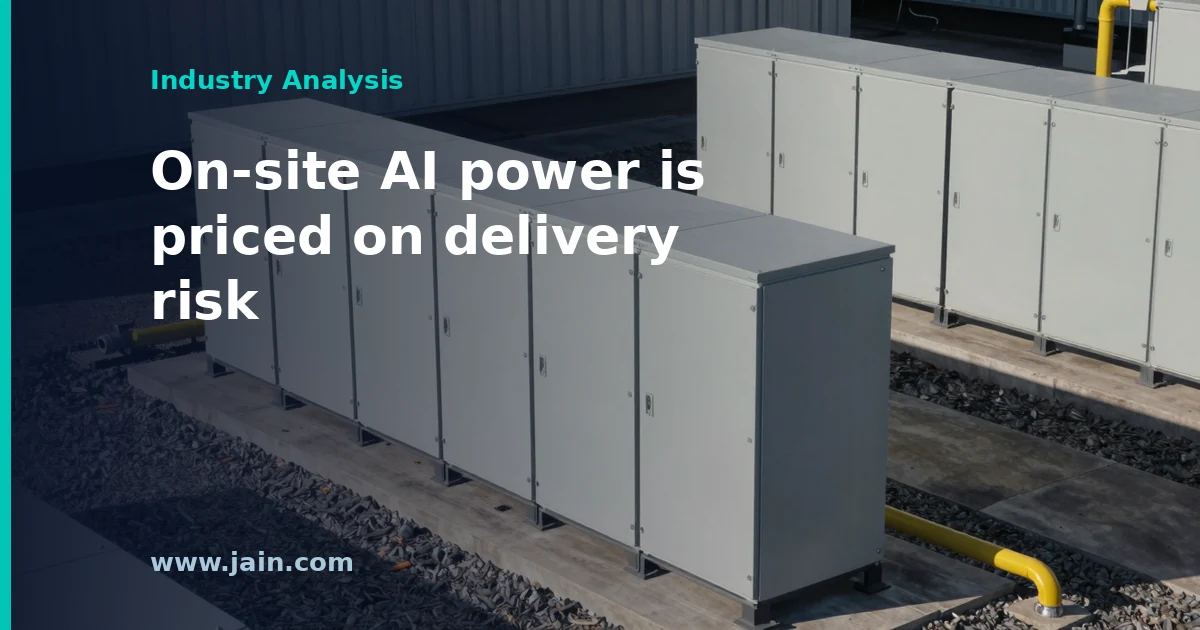
Oracle, one of the giant companies that rents out computing power over the internet, has confirmed it still plans to buy a huge amount of power equipment from a company called Bloom Energy.
The equipment is fuel cells: machines that turn natural gas into electricity on site without burning it. Together they would produce roughly as much power as two large nuclear reactors, to run artificial intelligence computer centers.
A formal warning had said deliveries might be disrupted. When Oracle said the deal was still on, Bloom’s stock jumped about 8 percent. The deal didn’t get bigger. Investors were simply relieved it would happen.
Bloom Energy shares climbed after Oracle reaffirmed its commitment to a 2.4 gigawatt (GW) fuel cell contract that had been put in question by a force majeure notice. A force majeure notice is a formal warning that events outside a party’s control may delay or prevent it from meeting its obligations. Yahoo Finance put Bloom’s gain at 8.7%, and 24/7 Wall St. reported a jump of about 8%.
The contract covers on-site fuel cell generation intended to power AI data center capacity. Oracle’s reaffirmation left the headline size of the commitment unchanged at 2.4 GW.
Executive Summary
Oracle has publicly stood by a 2.4 GW fuel cell agreement with Bloom Energy after a force majeure notice raised the possibility that deliveries under the contract could be disrupted. Investors responded by bidding Bloom’s shares up roughly 8% to 8.7%.
The notable part is what did not change. The contract was 2.4 GW before the notice and 2.4 GW after it. The share move therefore reflects restored confidence that the equipment will actually be delivered and used, not any new demand. That is a useful read on how the market values on-site power for AI. The megawatts on paper matter less than whether the delivery chain behind them holds.
The episode also highlights concentration. A single customer’s statement about a single contract moved Bloom’s valuation this much, which suggests investors see this relationship as central to the company’s outlook. Bloom has not publicly quantified that dependence.
A Reaffirmation, Not a New Order, Moved the Stock
Bloom’s rally did not come from new business. The contracted capacity stayed at 2.4 GW, and no expanded scope was announced. What changed was the perceived probability that the contract would be performed as planned. A move of roughly 8% to 8.7% on that alone is effectively a market price on delivery risk. Before the reaffirmation, investors were discounting the chance that the notice would lead to delays, renegotiation or a smaller commitment. Oracle’s statement removed much of that discount.
The mechanism runs through the force majeure clause. That clause lets a party suspend or delay its obligations when an event beyond its control intervenes. For on-site generation, performance depends on a long chain: fuel cell modules have to be manufactured, shipped, installed, connected to a gas supply, permitted and commissioned. A notice under that clause signals that at least one link is under strain. For the buyer, the stakes are high, because on-site fuel cells are the power plant for the data center. If the modules arrive late, the computing capacity switches on late.
Three groups feel that directly. Bloom’s shareholders are exposed because revenue timing depends on delivery. Oracle’s capacity plans assume the power arrives on schedule. Contractors and lenders have built plans around the same timeline. For on-site AI power, the variable that moves value is delivery certainty, and this episode puts a number on how much.
Why AI Builders Are Taking Power Into Their Own Hands
Large AI data centers need enormous, steady amounts of electricity. Connecting that much new demand to the utility grid often means joining an interconnection queue, the line of projects waiting for grid operators to study and approve new connections, and that wait can stretch for years. On-site generation offers a way around it. Fuel cells can be installed next to the data center and added in modules as capacity grows.
That speed comes with a trade-off. An operator that generates its own power exchanges dependence on a regulated utility for dependence on a vendor contract. That means exposure to the manufacturer’s factory output, to natural gas pipeline availability and to local air permits. Fuel cells avoid combustion, but they still emit carbon dioxide when running on natural gas, so permitting and emissions questions do not disappear.
Scale sharpens the risk. A gigawatt is 1,000 megawatts, and 2.4 GW is roughly the output of two to three large nuclear reactors. At that size, on-site generation is no longer backup power. It is the primary supply for the campus, so any disruption to it matters.
One Buyer, Outsized Weight
The size of the market’s reaction suggests investors treat the Oracle contract as central to Bloom’s outlook. Bloom has not said what share of its backlog or expected revenue the contract represents. Concentration of this kind cuts both ways. An anchor customer from the hyperscale tier (the handful of companies running cloud platforms at global scale) validates the technology at a scale few buyers could offer, and it can justify factory expansion. The same concentration means one counterparty’s decisions on site priorities, schedules or procurement flow directly into Bloom’s revenue timing.
In fairness to both companies, Oracle’s reaffirmation is a meaningful signal. A buyer looking to exit or reprice a deal could have used a force majeure notice as leverage, and Oracle chose to stand by the commitment publicly. Still, a public reaffirmation is not the same as disclosed terms. It is not known whether delivery schedules, pricing or remedies were adjusted along the way.
What Buyers and Financiers Should Take From It
For data center developers, the practical lesson is in the contract drafting. That includes how force majeure is defined, what remedies apply if delivery slips, whether deliveries are staged against milestones, and what backup supply exists if a vendor cannot perform. These terms carry weight well beyond boilerplate when on-site generation is the campus’s main power source.
Lenders and equity investors underwriting AI campuses powered on site will likely want more visibility into the vendor’s manufacturing throughput and the fuel supply behind each project. This episode shows the market is already pricing that risk. Better disclosure is how the discount narrows.
Background
Bloom Energy builds solid oxide fuel cells, modular systems that convert natural gas or other fuels into electricity through an electrochemical reaction rather than combustion. The company has positioned its systems as a fast way for data center operators to secure large blocks of power without waiting for grid upgrades, a pitch that has gained traction as AI workloads push electricity demand well beyond what many local grids can supply quickly.
Oracle runs Oracle Cloud Infrastructure and has become one of the most aggressive builders of AI computing capacity. Its proxy statement filed with the SEC on September 25 lists Clayton M. Magouyrk and Michael D. Sicilia, alongside Safra A. Catz, as principal executive officers for the fiscal year ended May 31, 2026. That is the leadership team now responsible for Oracle’s large power commitments, including the 2.4 GW Bloom contract.
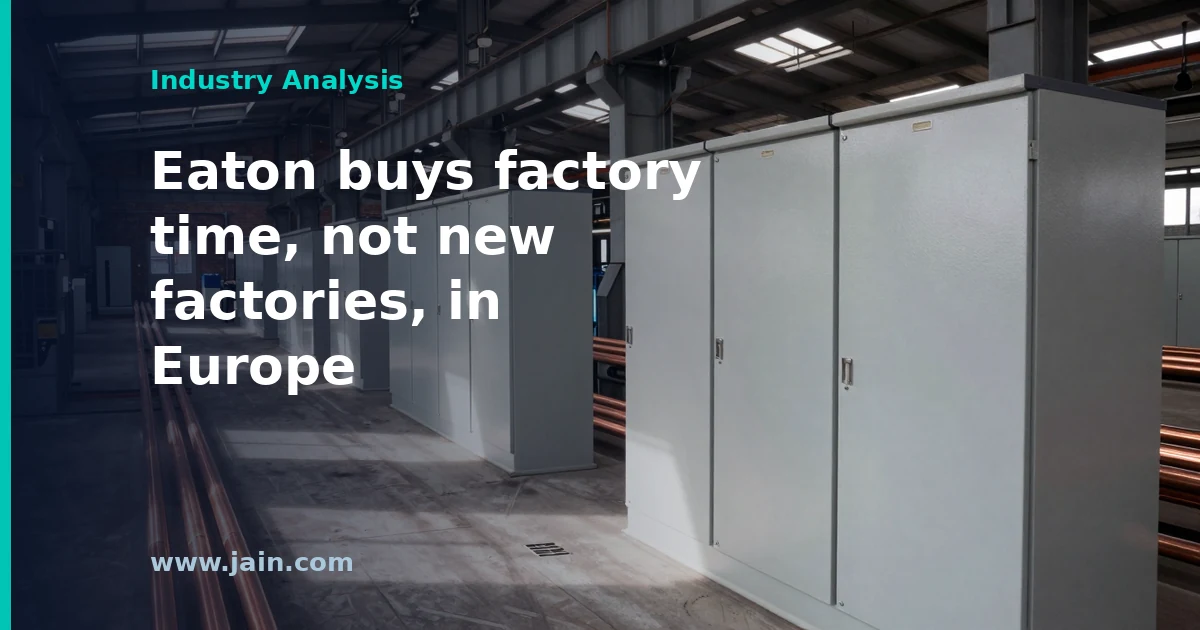
Eaton, a large electrical-equipment company, is buying COL Group, an Italian company that builds equipment for the power grid, for about 923 million dollars.
That equipment includes the heavy machinery that turns high-voltage electricity into power a building can use. It is often one of the slowest things to get when building the giant computer warehouses behind artificial intelligence.
Instead of spending years building new factories in Europe, Eaton is buying factories that already run. That could speed up supply there, but it also leaves buyers with one fewer independent supplier.
Eaton Corporation has agreed to acquire COL Group, an Italian manufacturer of electrical grid equipment, for €810 million, Reuters reported. Yahoo Finance put the price at about $923 million. Eaton describes the deal as a way to expand its footprint in Europe.
Executive Summary
Eaton, one of the largest suppliers of power-distribution equipment to data centers, utilities and commercial buildings, is paying €810 million (about $923 million) for COL Group, an Italian maker of grid equipment. The stated purpose is European expansion. Eaton has not disclosed financing, an expected closing date or COL’s revenue.
The transaction matters beyond Eaton’s own geography because of what it acquires: working production. Grid equipment such as transformers and switchgear is heavy, largely built to order and slow to scale, and the rising power demands of AI data centers, electrification and renewable connections all compete for it. Buying an operating manufacturer gives Eaton plants, trained workers and qualified products at once. Building from scratch would mean waiting years for all three.
For developers, utilities and operators in Europe, the practical question is whether this adds effective supply or mainly moves existing supply under a new owner. Eaton’s answer will show up in what it does with COL’s plants after closing.
Buying a Factory Is Buying Time
The core logic of this deal is sequencing. A new plant for electrical grid equipment has to move through site selection, permitting, construction, tooling, hiring and training. Its products then have to be tested and qualified before utilities and large customers will accept them. Each step mostly waits on the one before it. An acquired manufacturer arrives with every one of those steps already done: the buildings stand, the workforce knows the processes, and the products already carry the approvals customers require.
Seen that way, the €810 million is partly a payment for time. Eaton gets European production capacity immediately, not at the end of a multi-year greenfield program (‘greenfield’ meaning built new on an empty site). The deal does not say how much capacity that is, and Eaton has not published COL’s output or revenue. The direction of the trade-off is still clear. When customers are waiting on equipment, a supplier that already has capacity in hand can capture orders that a supplier still pouring concrete cannot.
The people most affected are European data-center developers and utilities. Their project schedules depend on when electrical equipment arrives. Eaton’s competitors in the region are affected too, because they now face a rival with more local production and a broader portfolio.
Why Grid Gear Sits Upstream of Every AI Data Hall
Before a single AI server can switch on, power has to travel from the high-voltage grid into the building. Transformers step that voltage down to usable levels. Switchgear (the assemblies of breakers and switches that route and protect electrical circuits) directs it safely to each part of the facility. AI data centers need far more power per site than conventional ones, so they need more of this equipment, and they often need larger units.
Eaton already sells much of the power-distribution chain inside data centers. Adding a grid-equipment maker extends its reach toward the utility side of the connection, where equipment is heavier, more customized and typically slower to deliver. That upstream position is attractive when the binding constraint on a project is the electrical connection, not the building or the chips.
A caution applies to that thesis. The companies have framed this as European expansion, not as an AI or data-center move. Eaton has not said what share of COL’s business serves data centers versus utilities, industry or renewable projects. The AI demand case explains why grid-equipment capacity is valuable right now. It does not by itself establish that COL’s output will go to data centers.
What European Equipment Buyers Should Watch
Consolidation cuts two ways for buyers. An integrated supplier that can deliver equipment from the grid connection through to the server rack may simplify procurement and coordination on large projects. The same deal also leaves one fewer independent supplier in the market. That can weaken buyers’ negotiating position and concentrate supply risk with a single vendor.
Allocation is the other open issue. If COL’s existing customers are mainly utilities and industrial firms, they will want to know whether their orders keep their place in the queue once the plants belong to a company with heavy data-center exposure. A clear statement from Eaton on capacity expansion at COL’s sites, as opposed to reprioritizing existing output, would settle much of that uncertainty.
The Price and the Proof
The €810 million figure is the only hard number in the announcement. Without COL’s revenue, earnings or production volumes, outside observers cannot judge whether Eaton paid a premium for scarcity or a conventional industrial multiple (the price expressed as a multiple of the target’s earnings). The European-expansion claim is supported by the act of buying a European manufacturer. The larger claim, that this adds meaningful grid-equipment supply where AI and electrification projects need it, remains to be shown.
The evidence will come in stages. First is regulatory clearance. Then comes any announced investment in expanding COL’s plants. Last is whether Eaton begins quoting shorter European delivery times for the product lines COL makes. Until then, the deal is best read as a bet that owning production capacity now is worth more than building it later.
Background
Eaton is a diversified power-management manufacturer whose electrical segment supplies utilities, buildings, industrial sites and data centers. Its data-center products include power-distribution units, uninterruptible power supplies (backup systems that keep servers running through outages) and switchgear. The company has long used acquisitions to add product lines and regional manufacturing.
Europe’s grid is under pressure from several directions at once. Renewable generation needs new connections. Electrification of heating and transport raises demand. AI data centers compete for scarce connection capacity and for the equipment that makes those connections possible. That combined demand has made established grid-equipment makers valuable acquisition targets for suppliers that want production capacity quickly.
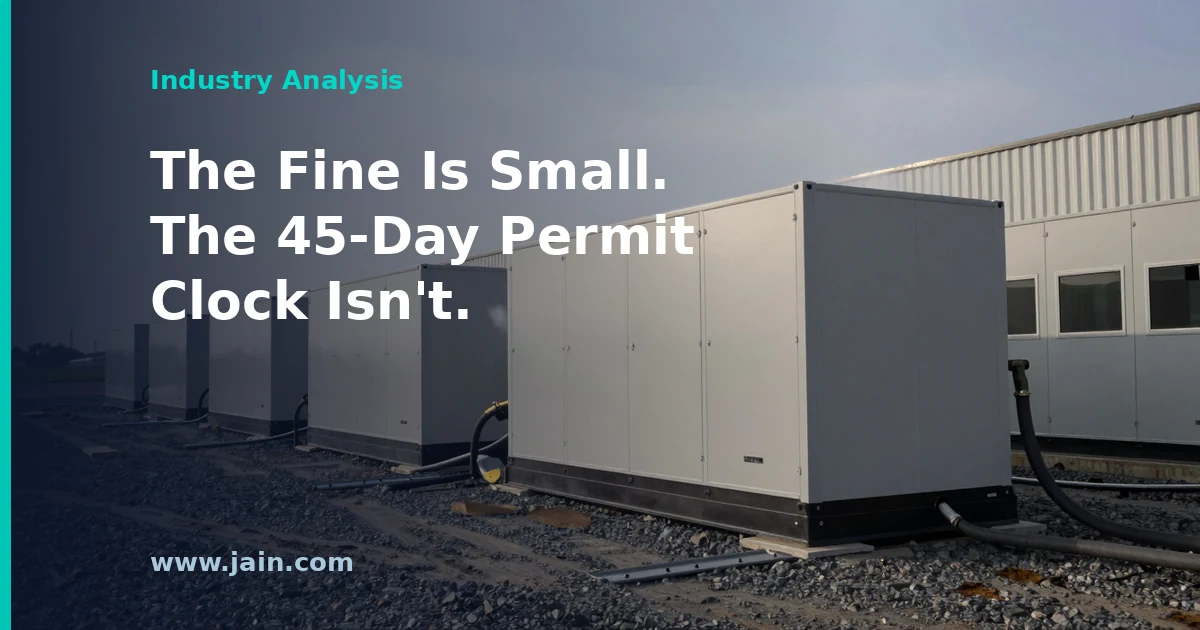
New Jersey fined the builder of an artificial intelligence data center in the town of Vineland a record $1.07 million for running 62 portable power generators without pollution permits.
Split across the generators, that is about $17,000 each. Neighbors called it pocket change. The real threat is a deadline: get the permits within 45 days or switch the generators off.
The site supplies computing power for a $33 billion deal involving Microsoft, so losing its power source would be a far bigger problem than the fine.
New Jersey has fined DataOne a record $1.07 million for running 62 unpermitted portable generators at its AI data center construction site in Vineland. The state also ordered the company to obtain air permits within 45 days or stop using the units. Tom’s Hardware reported the action on September 25, 2026, citing The New York Times. State inspectors found the generators powering the facility in late July. DataOne supplies computing capacity to Nebius, which Microsoft signed to a $33 billion deal.
Residents have raised several other complaints:
the construction, without a permit, of a 1.5-million-gallon liquefied natural gas (LNG) tank;
night-time noise reaching homes within half a mile;
little public consultation before the project began.
DataOne disputed the fine. It said it will apply for air permits for the temporary generators and is moving from portable turbines to fuel cells.
Executive Summary
The penalty is modest against the scale of the project. Spread across 62 generators, it comes to roughly $17,300 per unit, a point residents made bluntly. The 45-day order is what carries operational weight. Generators that were powering the site must be permitted by state regulators in that window or switched off. That puts a regulatory decision, not a construction milestone, on the critical path for a facility tied to one of the larger AI capacity contracts in the market.
The case matters beyond Vineland. On-site generation, often called bridge power, lets developers bring their own electricity instead of waiting for a utility connection, and it is an increasingly common way to get AI capacity online quickly. New Jersey’s action and the earlier dispute over unpermitted turbines at SpaceXAI’s Colossus 2 site in Memphis point to the same limit: the workaround only moves as fast as the air-permit process allows.
Why the 45-Day Clock Outweighs the $1.07 Million
Divide $1.07 million by 62 generators and the penalty works out to about $17,300 per unit. Next to a $33 billion capacity contract, that is a rounding error. Residents said so directly. Longtime Vineland resident Steve Brown called it “a drop in the bucket,” and Tiffany Leone-Vespa argued the fine should have applied to each generator. As a financial deterrent, a penalty of this size does little to change the calculation behind what Brown described as a “don’t ask for permission, just ask for forgiveness later” approach.
The shutdown order is a different kind of lever. New Jersey told DataOne to meet its permitting requirements and to stop running the generators if permits are not granted within 45 days. Inspectors found those units powering the facility. If the permits do not come through, DataOne has to replace that power on a schedule set by regulators rather than by its own construction plan. The replacement could be utility supply, the fuel cells it says it is adopting, or other permitted equipment. For a company whose product is computing capacity, a power gap is a delivery problem, not an accounting line.
That exposure runs down a contract chain. DataOne supplies Nebius, and Nebius supplies Microsoft. The company has said it will apply for the permits. Whether regulators can review and grant them inside the window is the operative question, and it matters far more to the project’s timeline than the size of the fine.
Bring-Your-Own Power Comes With a Permit Attached
AI developers are bringing their own power because utility connections for very large new loads can take years, while trailer-mounted turbines and generators can be delivered and running in weeks. When a data center is built to rent out expensive AI processors, every month without power is lost revenue.
The trade-off is that fuel-burning equipment emits pollutants such as nitrogen oxides, along with noise. That is why states require air permits, which are licenses that set emission limits, operating hours and monitoring for combustion equipment. At 62 units, a temporary generator fleet starts to resemble a small power plant, and it draws the scrutiny that comes with one. Noise complaints from homes within half a mile show the effects are felt locally, not just on paper.
Memphis offers the closest comparison. SpaceXAI’s unpermitted turbines at Colossus 2 led to a lawsuit, and the Department of Justice asked the court to dismiss it on the grounds that the site “supports mission-critical operations.” The company ultimately agreed to remove the unpermitted turbines. It said the process would take more than a year as replacement plants totaling 1.2 gigawatts come online. Both cases end with temporary generation giving way to permanent, permitted supply. What differs is who sets the pace: more than a year in Memphis, 45 days in Vineland.
Fuel Cells, an LNG Tank and the Replacement Question
DataOne’s stated fix is to move from portable turbines to fuel cells. Fuel cells generate electricity through a chemical reaction rather than combustion. They are generally quieter and emit fewer local pollutants, so they address both of the neighbors’ main complaints. They still need fuel, most commonly natural gas, and they would have to match the output the 62 units were providing. DataOne has not said how much capacity it plans to install, who will supply it, or when it will be running.
The 1.5-million-gallon LNG tank is a separate exposure. Liquefied natural gas is gas cooled until it becomes a liquid so it can be stored in bulk, and on-site storage at that scale is one way to fuel generation where pipeline supply is limited. DataOne has not explained what the tank is for. Residents say it was built without a permit, which could make its status a second regulatory question alongside the generators.
Community Consent Is Now Part of the Power Plan
According to residents, they learned a data center was going up in their neighborhood only after Microsoft announced its deal with Nebius. They raised concerns at a February town hall, citing satellite imagery that showed “some type of unit” on site. Inspectors had found no generators during a December visit, then found 62 in late July. When the units first arrived remains unclear, and so does how long they ran before enforcement.
Both sides deserve a fair reading. DataOne’s commitment to seek permits and move to cleaner equipment points in the direction regulators want. Residents’ argument that a flat fine is too small for a well-capitalized operator is a legitimate question about how penalties are designed, including whether they should scale per unit. For developers, the lesson is practical. Permitting and early community engagement cost time up front, but enforcement mid-construction imposes a deadline the developer does not control.
Background
Nebius is an AI cloud company, sometimes called a neocloud, that rents out computing capacity built on graphics processors, the chips used to train and run AI models. It is headquartered in Amsterdam, listed on Nasdaq, and emerged in 2024 from the restructuring of Yandex’s international business. Its $33 billion deal with Microsoft makes it a major capacity supplier to one of the largest buyers of AI computing. DataOne is the developer contracted to provide computing capacity for that arrangement at Vineland, in southern New Jersey.
AI data centers draw far more electricity than traditional facilities, and utility connections for large new loads can take years. Many developers now use on-site generation such as gas turbines, engines or fuel cells as bridge power until grid supply is ready. Under the federal Clean Air Act framework, states require air permits for fuel-burning equipment above certain size thresholds. Operating without one exposes a site to fines and orders to shut the equipment down.
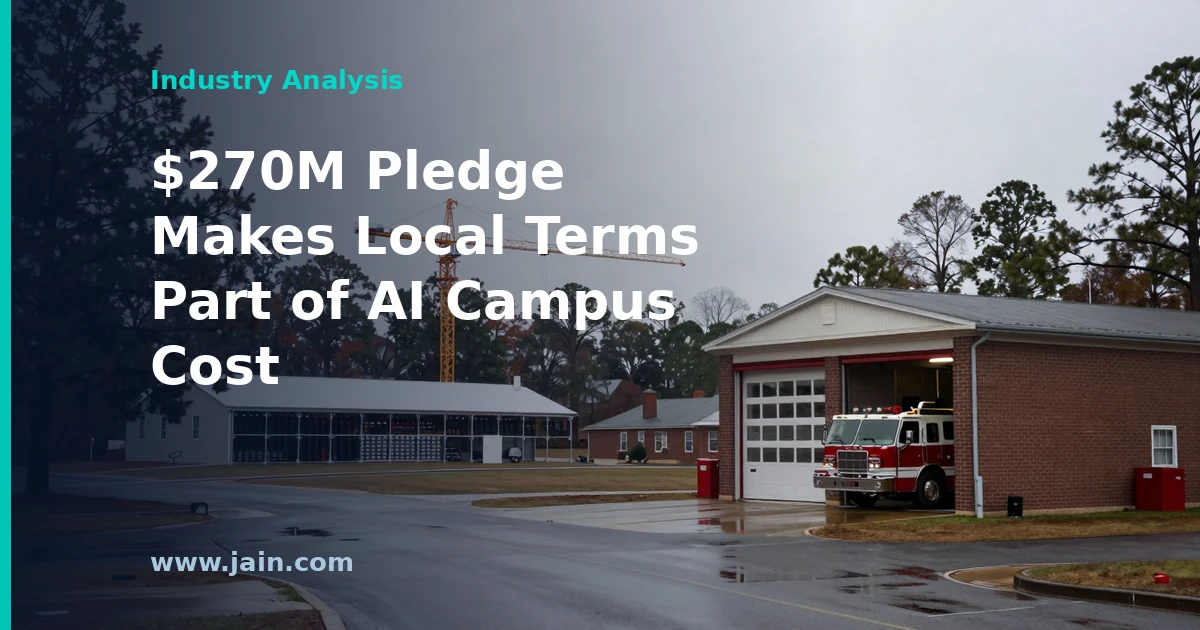
A company called Applied Digital plans to spend $3.2 billion on a huge building full of computers for artificial intelligence near Brookwood, a town in Alabama. At full size it would have about as much floor space as 20 American football fields. It should start running in 2028.
The notable part is the deal with the town. Applied Digital promised to pay the local area $270 million over 20 years. That is on top of an estimated $131 million in taxes, even though only about 100 people will work there permanently.
Applied Digital has confirmed that Delta Forge 2, a $3.2 billion, 210MW AI data center, will be built on a 1,300-acre site near Brookwood in Alabama’s Tuscaloosa County, Data Center Dynamics reported on September 25, 2026. The campus is planned at 1.2 million square feet at full build-out, with operations expected to begin in 2028. The tenant is an unnamed customer that Applied Digital describes as an “investment grade hyperscaler,” meaning one of the very large cloud and AI platform operators.
The company is committing $270 million in community benefits payments to the Tuscaloosa County Economic Development Authority over 20 years, alongside an estimated $131 million in tax revenue for the area. The project is expected to support up to 1,000 construction jobs and 100 permanent roles. The Tuscaloosa Thread reported that the county board approved incentives for the project unanimously.
Executive Summary
Applied Digital said in June that it had signed a customer for a new 210MW data center, but it did not say where. Naming Brookwood completes a basic picture of the project: a customer, a site, a budget, a target date and local approval. It also puts a campus on the company’s map outside North Dakota, where its Polaris Forge 1 and 2 campuses sit.
The most informative number is not the $3.2 billion headline. It is the $270 million community payment. That is roughly 8% of the stated investment and larger than the project’s estimated tax contribution. For a facility with 100 permanent jobs, the negotiated fiscal package, more than employment, is what the host community receives in return. That makes the local agreement a real cost of bringing AI capacity online, one that developers have to budget for alongside land, power and construction.
The $270 Million Pledge Is a Line Item, Not a Gesture
Applied Digital’s commitment of $270 million over 20 years to the Tuscaloosa County Economic Development Authority is large enough to register in the project’s economics. Against the $3.2 billion stated investment, it is roughly 8%. Spread across 210MW of capacity, it comes to about $1.3 million per megawatt. Averaged over two decades, it is about $13.5 million a year, although the company has not said whether payments are level, front-loaded or tied to construction milestones.
The pledge is also larger than the other fiscal figure attached to the project, an estimated $131 million in tax revenue. The period behind that tax estimate was not specified, so the two numbers are not a strict like-for-like comparison. Still, of the two local benefits disclosed, the negotiated payment is the bigger one, not the ordinary tax base. For site selection, that changes the calculation. When a county’s approval comes with a multi-decade cash commitment on this scale, the community agreement becomes part of the cost of delivering capacity. It has to be priced into the lease the same way power and construction are.
Three groups are affected. Other developers pitching large AI campuses to rural and suburban counties may now find this package used as a reference point in negotiations. Local economic development authorities gain a contracted revenue stream instead of relying only on assessed taxes, which can be reduced by abatements. The tenant’s lease pricing ultimately has to cover the developer’s full cost of delivering the site.
Why Capital-Heavy, Job-Light Projects Pay Their Way in Cash
A $3.2 billion project that supports 100 permanent roles represents about $32 million of investment per permanent job. That ratio is typical of large data centers. Most of the spending goes to buildings, electrical equipment and cooling systems, not payroll. The up-to-1,000 construction jobs are substantial, but they are temporary by definition.
This is the mechanism behind the size of the payment. Traditional economic development deals trade tax incentives for jobs. A data center cannot offer many jobs, so it offers direct fiscal commitments instead. Brookwood mayor Joe Barger’s comments point in that direction. The mayor framed the project around “strengthening our schools” and benefits “for generations to come,” which reflects a long-term revenue case more than a hiring case. The unanimous board vote suggests the county found the exchange acceptable. The value of the incentives the county granted in return has not been published, so the net fiscal benefit cannot yet be calculated.
A Portfolio Built on a Few Very Large Tenants
Applied Digital, founded in 2021 as Applied Blockchain, now reports a contracted portfolio of five AI Factory campuses totaling 1.4GW of critical IT load. Critical IT load is the power available to servers and networking gear, excluding cooling and other facility needs. The company reports approximately 2.15GW of grid-connected utility power behind that portfolio. The gap of roughly 750MW is the extra electricity a site must secure to run cooling and other facility systems and to keep some headroom. Securing grid power, not just signing tenants, is the harder half of this business.
Chairman and CEO Wes Cummins called Delta Forge 2 part of “repeatable AI infrastructure delivered at scale.” Part of that claim is supported by disclosed facts: multiple campuses under contract, one tenant named (CoreWeave at Polaris Forge 1), and repeat business from one customer. The same high-investment-grade hyperscaler that signed at Delta Forge 1 also took 300MW at Polaris Forge 3. The company’s statement that it has a “proven track record of delivering on our commitments to our host communities” is not accompanied by delivered-capacity or payment-history figures. Much of the portfolio is concentrated in a small number of unnamed hyperscale tenants. That concentration brings strong credit, but it also means the business depends heavily on a few counterparties.
What Has to Go Right by 2028
Delta Forge 2’s 2028 start follows Polaris Forge 3, where initial operations are targeted for August 2027. That puts overlapping large builds on the company’s schedule. Hitting both dates depends on things not addressed in the announcement: the utility and grid connection for a 210MW load in Tuscaloosa County, procurement of long-lead electrical equipment, and financing for a project of this size. The move to Alabama widens the company’s geographic reach, but it also means building a new set of utility, contractor and permitting relationships far from its North Dakota base.
Background
Applied Digital was founded in 2021 as Applied Blockchain and has repositioned itself as a developer of data centers for artificial intelligence and high-performance computing. It builds large campuses and leases them to a small number of major tenants. Its Polaris Forge 1 campus in Ellendale, North Dakota, is set to be leased to CoreWeave. Polaris Forge 2 in Harwood, North Dakota, is largely committed to an unnamed investment-grade hyperscaler. Polaris Forge 3, on 600 acres in an unnamed northern state, will provide 300MW to the same hyperscaler that signed at Delta Forge 1, with initial operations targeted for August 2027.
AI data centers differ from conventional ones mainly in power density. Training and running large AI models requires far more electricity per rack of servers, so developers compete on how much grid power they can secure and how quickly. That has made site selection a negotiation over power, land and local fiscal terms, as much as over proximity to users.
CleanSpark, a company best known for mining bitcoin, is borrowing about $2.3 billion to finish a huge building full of computers for artificial intelligence. The tenant is a company owned by Meta, the parent of Facebook and Instagram, and Meta itself guarantees 20 years of rent.
Even with that promise, lenders are charging nearly 8% interest, or about $179 million a year.
Why so expensive? The building is not scheduled to start paying rent until late 2027, and lenders are betting it gets finished. That interest rate shows what it costs a bitcoin company to become a landlord for artificial intelligence.
On September 18, 2026, CleanSpark (Nasdaq: CLSK) said in an 8-K that its wholly owned subsidiary CSDC Finance I, LLC had priced $2.276 billion of 7.875% senior secured notes due 2031 at 98.5% of face value. The deal is expected to close on September 25. It is larger than the $2.227 billion CleanSpark proposed a day earlier. The notes were sold privately to large institutional investors under Rule 144A and to non-U.S. buyers under Regulation S.
The proceeds will finish building CleanSpark’s Sandersville Facility, reimburse the company for equity it has already put into the project, and fund debt service reserves. The investor presentation CleanSpark furnished on September 17 describes Sandersville as a 175 MW AI data center campus. It is leased for 20 years to Anviran, LLC, a wholly owned Meta subsidiary, and Meta guarantees the rent and operating expenses. First-phase rent is targeted for Q4 2027.
Executive Summary
CleanSpark has raised project-level debt for its first large AI hosting campus, and the price is specific: a 7.875% coupon, sold at a 1.5-point discount. The notes are secured by first-priority liens on the Sandersville project and the issuer’s equity, a completion guarantee from CleanSpark backs them, and part of the proceeds funds cash reserves for interest payments. Behind all of that sits a 20-year triple-net lease guaranteed by Meta, a company the presentation values at about $1.7 trillion.
The notable feature is the gap between the tenant and the terms. Meta’s credit is not in question. The coupon and the protective package reflect what is still unfinished: a building that is not scheduled to earn rent until late 2027, owned by a sponsor that is moving from bitcoin mining into data center development. For operators trying to turn mining power into AI capacity, this deal is a concrete, disclosed reference point for what that conversion costs to finance.
Meta Signed the Lease. Lenders Still Priced the Build.
On paper, Sandersville is about as strong a credit story as a data center gets. The investor presentation CleanSpark furnished on September 17 describes these terms:
a 20-year base lease with Anviran, LLC, a Meta subsidiary, plus two five-year extension options;
Meta itself as guarantor of rent and operating expenses;
a triple-net structure, meaning the tenant covers taxes, insurance and upkeep;
a 3% annual rent escalator;
about $6.6 billion of base-term contract value.
To underline the tenant’s strength, the presentation cites Meta’s $117 billion of first-half 2026 revenue.
Even so, the notes carry a 7.875% coupon, the fixed annual interest rate. They were also sold at 98.5 cents on the dollar, which by rough estimate lifts investors’ effective yield to a little over 8%. Bondholders also received three protections. They hold first-priority liens on substantially all assets of the issuer and its guarantor subsidiary, plus the issuer’s equity. Reserves funded from the proceeds cover debt service. And CleanSpark gives a completion guarantee, a promise to supply more money if the proceeds cannot finish the facility on time. Each protection guards against the same thing. The question is not whether Meta can pay. It is whether the building gets delivered.
The timeline explains why. First-phase rent is targeted for Q4 2027, so interest accrues for more than a year before rent arrives, and the lease pays only once the capacity exists. For a bitcoin miner moving into AI hosting, a lease with a hyperscaler (one of the giant cloud and internet platforms) turns megawatts into something lenders will finance. It does not, on its own, earn the borrowing costs of the investment-grade tenant. Construction and sponsor risk sit in between. In this deal, CleanSpark carries the construction risk directly through its guarantee.
The Per-Megawatt Math Behind $2.276 Billion
The presentation puts development cost at about $11.9 million per megawatt of critical IT load, which is the power delivered to the servers themselves, not counting cooling and building overhead. For 175 MW, that implies roughly $2.1 billion. At 98.5% of face value, $2.276 billion of notes raises about $2.24 billion before fees, which is more than that implied total cost. That fits the stated uses: finishing the build, reimbursing CleanSpark’s prior equity contributions, and funding reserves. In practice, the debt is sized to fund close to the whole project, and CleanSpark recovers part of what it has already spent.
Annual interest on the notes comes to about $179 million, or roughly $1.0 million per megawatt per year. Net operating income (NOI) is rent minus operating expenses, and under a triple-net lease it is nearly all of the rent. CleanSpark projects average NOI of about $330 million a year, or roughly $1.9 million per megawatt. That covers interest about 1.8 times on average. The early years are thinner. The presentation’s schedule shows NOI of about $220 million in 2028, the first full rent year, which covers interest about 1.2 times, before the escalator widens the margin.
The resizing is worth noticing. CleanSpark proposed $2.227 billion on September 17 and priced $2.276 billion the next day. At the 98.5% price, the larger deal raises slightly more than the original principal target. The extra $49 million of face value more than offsets the discount. CleanSpark has not said why it changed the size. Either way, the issuer now pays 7.875% on the larger amount.
What 7.875% Means for Miners Sitting on Megawatts
CleanSpark says it controls more than 1.8 GW of power, land and data centers. Sandersville’s 175 MW of IT load is less than a tenth of that figure. The comparison is only rough, because IT megawatts and grid megawatts are measured differently. The company’s own forward-looking disclaimers list the risks of converting mining sites into data centers: permitting and utility constraints, construction delays, cost overruns, financing, supply chains and tenant performance. Sandersville is where that list first meets billions of dollars of committed capital.
The 2031 maturity matters as much as the coupon. The notes come due about four years after targeted rent start, while the lease runs 20 years. If the campus is delivered and paying rent by then, the construction risk that shaped this coupon will be gone, which could support cheaper refinancing. That outcome still depends on rates and credit markets in 2031. The refinancing risk moves to a later date; it does not disappear.
For other miners pursuing the same path, this is one data point, not a trend. It shows that an investment-grade lease plus secured, project-level debt can fund a full AI build, at this price and with the parent still responsible for completion. Three groups are affected. CleanSpark shareholders get part of their equity back but take on a contingent obligation. Noteholders hold a claim on a single asset. Other operators now have a public benchmark that their own conversions will be compared against.
Background
CleanSpark, based in Las Vegas and listed on Nasdaq as CLSK, built its business on bitcoin mining. It now describes itself as a data center developer that controls more than 1.8 GW of power, land and data centers across the United States. Its investor materials describe an evolving strategy: expanding into data center development, high-performance computing and AI, including by converting some of its bitcoin mining sites into data centers for other uses.
The move follows a wider pattern. Bitcoin miners hold what AI developers most need: land with large grid connections already in place. Turning a mining site into an AI data center, however, takes a different class of building, with heavier cooling, redundant power and stricter uptime requirements. It also takes financing on a different scale. That is why Sandersville’s financing terms draw attention well beyond CleanSpark itself.