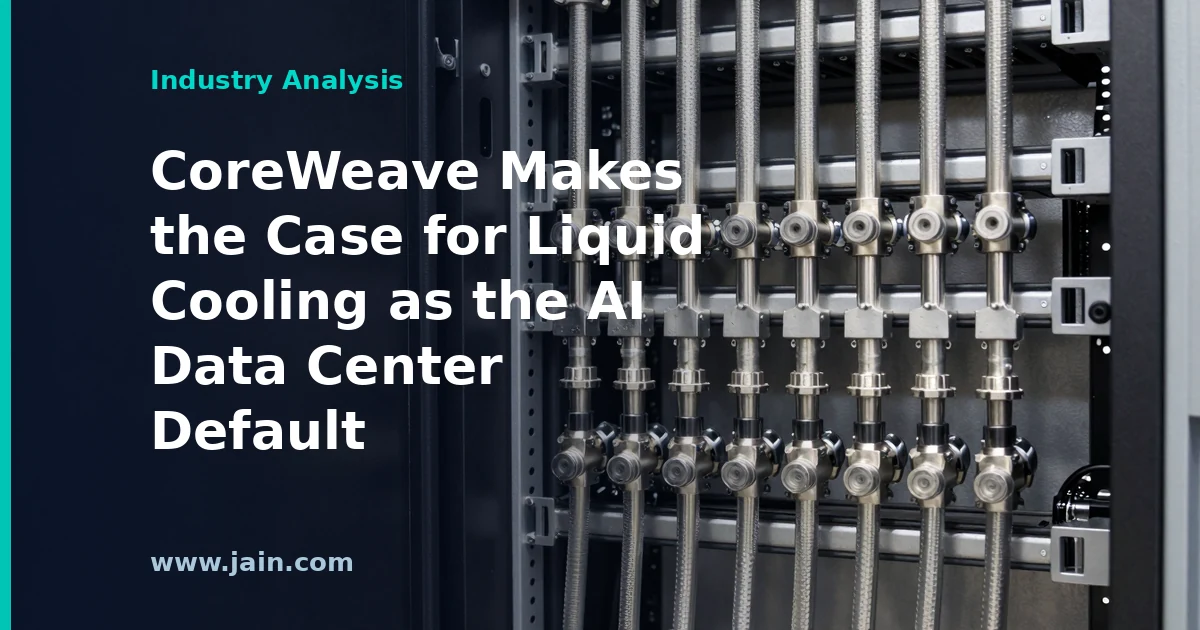
CoreWeave, the AI-focused cloud provider, published a piece titled “Liquid Cooling for AI Data Centers: Run Cold, Act Bold,” making the argument that liquid cooling — circulating fluid directly to or near the chips rather than relying on chilled air — should be treated as the default engineering choice for dense AI training and inference clusters, not a specialty option.
The post, surfaced in early May 2026, is a vendor thought-leadership piece rather than a product or facility announcement: no new sites, capacity figures, or customer commitments accompany it. Its significance lies in who is saying it — one of the largest dedicated AI cloud operators publicly framing liquid cooling as table stakes.
Executive Summary
The core claim is architectural: modern AI accelerators are being packed into racks at power densities that air cooling struggles to serve economically, so operators who standardize on liquid cooling now will deploy the newest hardware faster and run it more efficiently than those who retrofit later. That position aligns with the direction of the hardware itself — flagship AI rack systems from the leading accelerator vendors are increasingly designed around liquid cooling from the outset.
Why it matters: cooling has quietly become one of the binding constraints on AI buildout, alongside power availability and chip supply. A data center designed for traditional air-cooled racks often cannot accept the densest AI systems without significant rework of its mechanical plant, piping, and floor layout. When a major AI cloud provider says liquid cooling is the default, it is effectively telling the colocation and construction ecosystem what the demand side now expects.
For buyers and investors, the practical takeaway is less about CoreWeave specifically and more about the signal: the market for AI capacity is bifurcating between facilities that can support liquid-cooled density and those that cannot, and the gap affects deployment speed, efficiency, and ultimately the cost of delivered compute.
Why Cooling Became the Bottleneck
For most of the data center industry’s history, air cooling was sufficient: racks drew a few kilowatts, and moving enough cold air through the room was a solved problem. AI changed the arithmetic. Training clusters concentrate power-hungry accelerators as tightly as possible to shorten the distances data travels between chips, because interconnect latency and bandwidth directly affect training performance. That pushes rack densities far beyond what conventional air handling was designed for, and at some point the physics favors liquid — water and engineered fluids carry heat far more effectively than air.
CoreWeave’s framing of liquid cooling as a default rather than an exception reflects where the hardware roadmap already points. The densest current-generation AI rack systems are engineered for direct liquid cooling, meaning operators who want the newest silicon at full density have limited choice. In that sense the post is less a prediction than a description of a constraint the industry is already living with — but stating it as doctrine matters, because much of the world’s existing data center stock was not built for it.
The Economics: Efficiency Versus Retrofit Cost
The business case for liquid cooling rests on two ledgers. On the operating side, liquid systems can reduce the energy spent on cooling itself — a meaningful lever, since cooling is typically one of the largest non-IT loads in a facility, and every watt saved on cooling is a watt available for revenue-generating compute in power-constrained markets. On the capital side, however, liquid cooling requires piping, coolant distribution units, leak management, and often structural changes, which is straightforward in a new build and expensive in a retrofit.
That asymmetry is the strategic subtext of a piece like this. Operators that standardized early on liquid-ready designs can absorb each new accelerator generation with incremental changes; operators with large air-cooled footprints face a harder choice between costly conversion and ceding the densest workloads. CoreWeave, which built its business specifically around GPU infrastructure for AI, has an obvious interest in emphasizing a criterion where purpose-built AI clouds hold an advantage over general-purpose incumbents — which does not make the underlying engineering argument wrong, but readers should recognize the alignment between the message and the messenger.
Winners, Losers, and the Supply Chain Ripple
If liquid cooling is the default, the beneficiaries extend well beyond AI clouds. Suppliers of coolant distribution units, cold plates, piping, and heat-rejection equipment see their addressable market expand from a niche to a standard line item in every AI facility. Colocation providers with liquid-ready halls gain pricing power for AI tenants; those without face pressure to invest. Engineering and construction firms with liquid-cooling experience become scarcer resources in an already stretched buildout.
The risk side deserves equal attention. Liquid cooling adds mechanical complexity — leaks, coolant chemistry, maintenance procedures — into environments that prize uptime above almost everything. Standardization across vendors is still maturing, which raises the possibility of stranded investment if designs shift between hardware generations. And efficiency gains at the rack level do not eliminate the larger constraint: many AI projects today are gated by grid power availability, a problem no cooling technology solves on its own.
Background
CoreWeave began as a cryptocurrency mining operation before pivoting to GPU cloud computing, and rode the generative AI boom to become one of the largest providers of dedicated AI infrastructure, going public in 2025. Its business model — building or leasing data centers purpose-designed for dense GPU clusters and renting that capacity to AI developers — makes facility engineering choices like cooling central to its competitive position.
The broader industry context: for decades, air cooling dominated data centers because rack power draws were modest. The AI era reversed that, with accelerator racks reaching power densities that favor liquid-based heat removal, and the latest flagship AI rack systems are designed for liquid cooling from the factory. That has turned cooling from a back-of-house mechanical detail into a strategic differentiator in the race to deploy AI capacity.
Zayo Group has completed its $4.25 billion acquisition of Crown Castle’s fiber business, according to a May 2, 2026 report from Fierce Network. The close finalizes a transaction first announced in March 2025, when Crown Castle agreed to exit fiber entirely by splitting the segment between Zayo, which took the fiber solutions business, and EQT, which took the small-cell operations, in a combined deal valued at roughly $8.5 billion.
The completion makes Zayo — already one of North America’s largest independent bandwidth-infrastructure providers — a substantially bigger force in both long-haul and metro fiber, while returning Crown Castle to its roots as a pure-play wireless tower company.
Executive Summary
The announcement itself is short: the deal has closed. But the closing matters more than most, because it formally redraws the ownership map of US fiber at a moment when fiber has shifted from a commodity business to a strategic one. Long-haul fiber — the high-capacity routes that carry traffic between cities — and metro fiber — the dense local networks that connect buildings, data centers, and cell sites within a city — are both being repriced by the AI build-out, as hyperscalers and data center developers scramble to connect new campuses.
For Zayo, the acquisition is a bet that scale wins in that environment: more routes, more conduit, more on-net buildings, and more ability to sell end-to-end connectivity to the customers spending most aggressively. For Crown Castle, it is the final step in unwinding a decade-long fiber strategy that the market never rewarded, refocusing the company on towers. Two companies looked at the same asset class and reached opposite conclusions — which is precisely what makes this deal worth watching.
Fiber Is Having Its Moment — and Zayo Is Consolidating Into It
For most of the 2010s, long-haul fiber was treated as a mature, low-growth business: capacity was abundant, prices declined steadily, and the assets traded hands repeatedly among private-equity owners. The AI infrastructure cycle has changed that calculus. New data center campuses are being sited in secondary and rural markets where power is available but fiber often is not, and connecting those sites — to each other and to major interconnection hubs — requires exactly the kind of route diversity and dark fiber (unused fiber strands leased whole, rather than as managed bandwidth) that Zayo sells.
Absorbing Crown Castle’s fiber business gives Zayo a much denser metro footprint to pair with its national backbone. In connectivity, density compounds: the more buildings and data centers a provider can reach on its own network, the more of each customer’s traffic it can carry without paying another carrier, and the better its margins and win rates. That logic, not nostalgia for telecom assets, is what a $4.25 billion price tag implies.
Two Readings of the Same Asset
The striking feature of this transaction is the strategic divergence it crystallizes. Crown Castle spent heavily to build its fiber segment in the mid-2010s — including the reported $7.1 billion purchase of Lightower in 2017 — on the thesis that fiber and small cells would complement its tower business. Investors, including prominent activist shareholders, ultimately disagreed, arguing the fiber business consumed capital while earning returns below the tower segment’s. The March 2025 agreement to sell the entire segment, and now its completion, is the definitive verdict of that internal debate: Crown Castle is a tower company again.
Zayo’s owners are making the opposite wager — that fiber’s return profile has structurally improved with AI-era demand, and that assets underperforming inside a tower REIT can perform well inside a focused fiber operator with a different cost base and sales motion. Both positions are defensible. Crown Castle’s shareholders wanted capital discipline and simplicity; Zayo’s private owners can hold a capital-intensive asset through a demand cycle without quarterly scrutiny. The deal is less a judgment on fiber than on who is best structured to own it.
Integration Is Where $4.25 Billion Deals Are Won or Lost
Zayo was itself assembled through dozens of acquisitions, so network integration is a core competency — but this is among the largest single integrations it has attempted. Merging two national fiber operations means reconciling network inventories, OSS/BSS systems (the operational and billing software that tracks what fiber exists and who is paying for it), overlapping routes, and two sales organizations, all without disrupting enterprise and carrier customers who treat connectivity outages as existential. Historically, fiber roll-ups have stumbled less on the assets than on the systems and service quality during the merge.
There is also a balance-sheet dimension. Fiber consolidation of this scale is typically debt-financed, and the sector’s private owners have been navigating a higher-rate environment than the one in which many of these assets were last underwritten. Strong AI-driven demand improves the revenue side of that equation, but execution risk during integration is the variable Zayo most controls.
What Changes for the Market
For enterprise and wholesale buyers, one fewer independent fiber provider means the competitive set in some metros narrows, which bears watching on pricing and on route diversity — customers who deliberately bought from both companies for redundancy may now find both circuits on one network. For data center developers, a larger Zayo is arguably good news: a single counterparty that can deliver metro entrances and long-haul routes together simplifies procurement for new campuses. And for the remaining independent fiber operators, the deal resets the benchmark for what scaled fiber platforms are worth, which tends to invite further consolidation rather than end it.
Background
Zayo was founded in 2007 and grew into one of North America’s largest independent fiber operators through a long series of acquisitions, going public in 2014 before being taken private in 2020 by a consortium led by DigitalBridge and EQT. Crown Castle, one of the largest US tower REITs, moved aggressively into fiber in the mid-2010s — including the reported $7.1 billion acquisition of Lightower in 2017 — betting that fiber and small cells would complement its tower franchise.
That bet faced years of investor pushback over returns on the fiber capital, culminating in a strategic review and the March 2025 agreement to sell the entire fiber segment for roughly $8.5 billion, split between Zayo and EQT. The May 2026 closing of Zayo’s $4.25 billion portion completes Crown Castle’s retreat to towers and lands just as AI data center construction has made fiber routes one of the most sought-after asset classes in digital infrastructure.
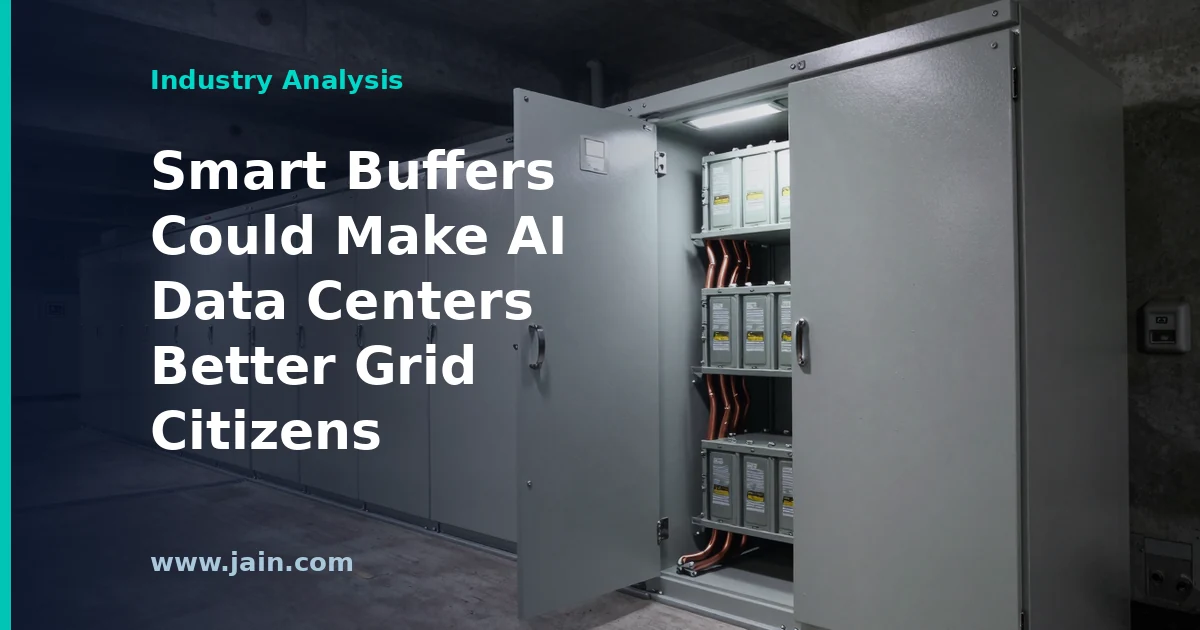
IEEE Spectrum reported on April 29, 2026 that AI data center operators are adopting “smart buffer” technologies — on-site energy storage and power-management systems that sit between the utility grid and racks of GPUs — to smooth the sharp swings in electricity demand that large AI workloads create. The framing is notable: rather than another story about AI’s appetite for power, this one covers an emerging engineering fix that could make AI facilities “better grid citizens.”
Executive Summary
The problem being solved is real and increasingly well documented. When thousands of GPUs start or pause a synchronized AI training run, a facility’s power draw can swing by tens of megawatts in seconds — behavior that looks, to a utility, less like a steady industrial customer and more like a giant load that lurches unpredictably. Grid operators plan around stable, forecastable demand; loads that spike and sag rapidly can stress local equipment, complicate frequency regulation, and slow interconnection approvals.
Smart buffering attacks the problem at the meter. By placing fast-responding energy storage and intelligent power electronics between the grid connection and the compute floor, an operator can present the utility with a flattened, predictable demand profile while the GPUs behind the buffer surge and idle as the workload demands. If the approach matures, it addresses one of the sharpest objections utilities and communities raise against new AI capacity — and could shorten the interconnection waits that have become the industry’s biggest bottleneck.
Why AI Loads Misbehave on the Grid
Traditional data centers — the kind running websites, databases, and enterprise applications — are prized utility customers precisely because their demand is boringly flat. AI training clusters break that model. A large training job synchronizes thousands of accelerators: they compute in lockstep, pause together to exchange data, and can drop to a fraction of peak power in an instant if a job checkpoints or fails. The result is a load that oscillates on timescales of seconds to minutes, at magnitudes utilities historically associated with arc furnaces or industrial motors starting up.
Utilities engineer their networks — transformers, voltage regulation, frequency response — around expected load behavior. A customer whose demand swings violently forces conservative planning: bigger margins, more spinning reserve, longer studies before a connection is approved. That conservatism shows up for data center developers as multi-year interconnection queues, which today gate AI buildouts more tightly than chips or capital do.
Buffering as a Peace Treaty With Utilities
The smart-buffer concept is conceptually simple: put a shock absorber between the grid and the GPUs. Batteries, ultracapacitors, or other fast storage charge when the compute load dips and discharge when it spikes, so the grid sees a smooth draw while the cluster behind the buffer does whatever the workload requires. Layer in intelligent controls, and the same hardware can go further — capping peak demand, riding through brief grid disturbances, or even reducing draw on request when the grid is stressed, a capability utilities call demand response.
The business logic is compelling on paper. An operator that can credibly promise a flat or flexible load profile becomes a customer utilities want rather than one they study for years. That can translate into faster interconnection, access to sites previously deemed grid-constrained, and lower demand charges — the fees utilities levy based on a customer’s peak draw. In a market where time-to-power is the dominant competitive variable, anything that compresses the utility approval cycle has direct commercial value.
The Economics Cut Both Ways
Buffering is not free. Batteries sized to absorb tens of megawatts of swing add meaningful capital cost, consume space and cooling, introduce their own fire-safety and permitting considerations, and degrade with heavy cycling — and the rapid charge-discharge duty cycle of load smoothing is exactly the kind of use that ages battery cells fastest. Operators will weigh those costs against the value of faster grid access and lower peak charges, and the answer will differ by site: buffering pencils out most clearly where the grid is congested and interconnection is the binding constraint.
There is also a partial software alternative. Some of the same smoothing can be achieved by scheduling workloads intelligently — staggering job starts, injecting dummy computation to prevent sudden power drops, or throttling training slightly during grid stress. Software costs less than batteries but sacrifices some compute efficiency and cannot deliver the instantaneous response hardware can. The likely end state is hybrid: firmware and schedulers doing coarse smoothing, with electrical buffers handling the fast transients. Vendors of batteries, power electronics, and data-center power-management software all stand to gain if buffering becomes a standard requirement rather than an exotic add-on.
A Narrative Shift Worth Watching
Coverage of AI and electricity over the past two years has been dominated by alarm: rising demand forecasts, delayed fossil-plant retirements, and disputes over who pays for grid upgrades. A story centered on data centers becoming better grid citizens signals a maturing conversation — one where the industry is expected not merely to consume power but to actively support grid stability. Regulators are already moving in this direction; several jurisdictions have proposed requiring large new loads to be curtailable or to bring their own flexibility.
The strategic implication for operators is that grid behavior is becoming a design specification, not an afterthought. Facilities engineered from day one to present flexible, well-mannered load profiles will find friendlier utilities, faster approvals, and possibly favorable tariff treatment. Those that show up asking for hundreds of firm megawatts with volatile draw will increasingly wait at the back of the queue. Buffering technology, in that light, is less a gadget than an admission ticket.
Background
The collision between AI computing and the electric grid became one of the defining infrastructure stories of the mid-2020s. Data centers historically earned reputations as ideal utility customers — large but remarkably steady loads. Generative AI changed both variables at once: individual campuses grew from tens to hundreds of megawatts, and the synchronized nature of GPU training made demand volatile in ways the grid had rarely seen from digital infrastructure. Utilities responded with longer interconnection studies, and communities with growing skepticism about hosting new facilities.
IEEE Spectrum, the flagship publication of the IEEE (the world’s largest technical professional organization for engineering), has covered this tension extensively. Its April 2026 report on smart buffering reflects the industry’s response phase: rather than simply requesting ever more firm power, operators are investing in storage, power electronics, and workload-management techniques that make AI facilities easier for grids to accommodate — a shift from consuming grid capacity to actively managing their footprint on it.
Sherwood News reports that bitcoin mining economics “have gone from bad to worse,” and that mining companies are responding by pivoting their businesses — or selling assets outright — to survive. According to the report, publicly traded miners on investor watchlists, including names such as Riot Platforms and Hut 8, are redirecting attention from pure hashrate growth toward converting their power-rich sites into AI data-center capacity.
The story, published April 29, 2026, frames the shift not as opportunistic diversification but as a survival response: when the core business of minting bitcoin no longer covers its costs for many operators, the land, power contracts, and electrical infrastructure miners control become more valuable serving artificial-intelligence workloads than mining rigs.
Executive Summary
The announcement here is really a diagnosis: the economics of industrial-scale bitcoin mining have deteriorated to the point that pivoting and selling are now mainstream strategies, not edge cases. Bitcoin mining profitability is a squeeze between three variables — the price of bitcoin, the total computing power competing on the network (which rises relentlessly), and the cost of electricity. When the spread between what a miner earns per unit of computing power and what it pays for energy compresses, weaker operators run out of room. Sherwood’s reporting says that spread has kept compressing.
Why it matters to the infrastructure industry: bitcoin miners collectively control one of the scarcest assets in technology today — large blocks of grid-connected power with substations, transformers, and cooling already in place. AI data-center developers routinely wait years for utility interconnections. A distressed miner with hundreds of megawatts energized is, from an AI developer’s perspective, a shortcut through the single longest item on the construction schedule. That is why the pivot is happening, and why acquirers are circling the sellers.
The unresolved question is execution. A mining shed and an AI data center share a power feed and little else. Whether watchlist miners can finance and deliver true high-density AI facilities — or whether they simply become land-and-power sellers to better-capitalized buyers — will separate the survivors from the exits.
Why Mining Economics Keep Getting Worse
Bitcoin’s protocol is deliberately unforgiving. Roughly every four years, a “halving” cuts the new-coin reward miners receive in half, mechanically slashing industry revenue per unit of work unless the bitcoin price doubles to compensate. Meanwhile, network hashrate — the total computing power competing for those rewards — tends to grow as new, more efficient machines come online, which dilutes every incumbent’s share. The result is a treadmill that speeds up on a schedule: costs are largely fixed in electricity and debt service, while revenue per terahash structurally declines.
Sherwood’s “bad to worse” framing captures the position of miners caught between those forces without a low-cost energy advantage. In commodity industries — and bitcoin mining is one, producing an identical product where the only durable edge is cost — deteriorating unit economics do not punish everyone equally. They sort the industry into low-cost survivors, distressed sellers, and pivots. The report indicates all three categories are now visible.
The Real Asset Was Always the Power
The pivot toward AI data centers rests on a simple arbitrage. AI training and inference facilities need enormous amounts of electricity delivered through utility-scale interconnections — agreements with grid operators that can take years to secure. Bitcoin miners spent the last cycle acquiring exactly those assets, often in power-rich regions, because cheap electricity was their business model. A miner’s site with an energized substation can be worth more as an AI campus shell than it ever earned mining.
But the conversion is not cosmetic. Mining facilities are typically air-cooled warehouses running hardware that tolerates heat and interruption; AI data centers demand dense power distribution, liquid or precision cooling, redundant systems, and uptime guarantees written into contracts. The capital cost per megawatt of a genuine AI facility is a large multiple of a mining build-out. That gap is precisely why some miners pivot while others sell: the pivot requires capital and data-center operating credibility that a distressed balance sheet may not support.
Winners, Losers, and the Middle
The likely winners are miners holding large, well-located power positions and enough financial flexibility to either fund conversions or strike partnerships with hyperscalers and AI cloud providers on favorable terms. Buyers of distressed sites also win: acquiring energized capacity is faster than greenfield development. Utilities and communities hosting these sites may see steadier, longer-term tenants, since AI facilities sign multi-year commitments in a way price-sensitive mining loads generally do not.
The losers are miners with small sites, expensive power, or leveraged balance sheets — operators whose assets are not distinctive enough to attract AI tenants and whose mining margins no longer cover obligations. For them, “pivot or sell” can shade into “sell at whatever the market offers.” Investors should also note a subtler risk in the middle: a miner that announces an AI strategy has not yet built one. The industry has an incentive to rebrand faster than it can execute, and the market has at times rewarded the announcement before the revenue.
What This Means for the Broader Data-Center Market
Every mining megawatt that converts to AI use adds supply to a data-center market defined by power scarcity — but not always where AI customers most want it. Mining sites were chosen for cheap power, not proximity to network hubs or enterprise demand, so converted capacity will suit some workloads (large-scale training, which tolerates remote locations) better than others (latency-sensitive inference near population centers). The pivot wave is therefore additive to AI infrastructure supply, but selectively so.
It also serves as a market signal. When an entire adjacent industry concludes its power portfolio earns more serving AI than its original purpose, it confirms how deep the demand for energized capacity runs. The countervailing question — one worth asking of the AI build-out with the same rigor applied to mining — is what happens to converted sites if AI infrastructure demand ever cools. Assets that have been repurposed once can be repurposed again, but the capital sunk into the conversion cannot.
Background
Industrial bitcoin mining grew through the early 2020s into a public-company sector, with operators such as Riot Platforms and Hut 8 raising capital to build warehouse-scale facilities wherever electricity was cheap — Texas, the U.S. Midwest, Canada, and beyond. The business model was a leveraged bet on bitcoin’s price against relentlessly rising network competition and scheduled halvings that cut mining rewards in half roughly every four years, most recently in April 2024.
As generative AI ignited unprecedented demand for grid-connected data-center capacity, the industry discovered that miners’ real strategic asset was their power portfolios rather than their mining machines. Core Scientific’s high-profile agreements to host AI computing marked an early template, and by 2026 the question facing much of the sector had become not whether to engage with AI infrastructure, but whether each miner would be a converter, a landlord, or a seller.
On April 28, 2026, RAND — the nonprofit, nonpartisan policy research institution — published an analysis titled “How Much More Power Can the U.S. Grid Provide for AI? Projections and Policy Implications for 2030.” The work models the gap between surging AI-driven electricity demand and the grid’s realistic ability to serve it this decade, and maps the policy choices that will widen or narrow that gap.
Executive Summary
The question in RAND’s title is arguably the central resource question of the AI buildout. Data centers running artificial-intelligence workloads have become one of the fastest-growing sources of new electricity demand in the United States, and every hyperscale campus announcement ultimately depends on an answer to the same question: can the grid actually deliver the power, and by when?
What makes a RAND treatment notable is the framing. Rather than starting from what AI developers say they need — the demand-side forecasts that dominate industry discourse — the title starts from what the grid can provide, a supply-side constraint analysis. Pairing “projections” with “policy implications” signals that the answer is not a fixed number but a range whose outcome depends on decisions about generation, transmission, and interconnection that federal and state policymakers are making right now.
Because our source is the publication listing rather than the full report, this article analyzes the question RAND is posing and the market context around it, and flags below what the listing alone does not tell us about the report’s specific findings.
Why the Supply-Side Framing Matters
Most public numbers in the AI-power debate come from the demand side: forecasts of how many gigawatts AI data centers will request. Those forecasts are genuinely uncertain — utilities have reported that the same prospective data center project often applies for service in multiple territories, which can inflate aggregate demand figures if requests are summed naively. A supply-side analysis flips the question to the binding constraint: how much new load the existing fleet of power plants, transmission lines, and distribution infrastructure can absorb by 2030 under realistic buildout assumptions.
That reframing matters commercially. If credible headroom estimates exist region by region, they become a de facto siting map — telling developers where power is available and telling investors which announced projects face energization risk. It also disciplines the conversation: a project announcement is not capacity until a utility can serve it.
The Bottleneck Is Delivery, Not Just Generation
For readers new to the topic: connecting a large new power plant or a large new customer to the grid requires an engineering study process called interconnection, and in much of the country those study queues have stretched to multiple years. High-voltage transmission lines — the long-distance wires that move bulk power — routinely take the better part of a decade from proposal to operation because they cross many permitting jurisdictions. Meanwhile, a modern AI campus can be requesting hundreds of megawatts, the scale of a small city, on a two-to-three-year construction schedule.
That timing mismatch, not any absolute shortage of energy resources, is the crux of the 2030 question. It explains why data center operators are increasingly pursuing workarounds: siting at retired industrial locations with existing grid connections, contracting directly with power plants, adding on-site generation, and offering demand flexibility — agreeing to reduce draw during grid stress in exchange for faster hookups.
The Policy Levers on the Table
The “policy implications” half of RAND’s title points at a live agenda. The levers most commonly debated in this space include: reforming interconnection queues so viable projects move faster; accelerating transmission permitting and cost allocation; deciding who pays for grid upgrades triggered by large loads, a question with direct consequences for other ratepayers’ bills; and setting rules for large flexible loads and behind-the-meter generation. Each lever sits with a different actor — federal regulators, regional grid operators, state commissions — which is why national demand projections translate so unevenly into local reality.
For the infrastructure industry, the stakes cut both ways. Faster interconnection and transmission buildout expands the addressable market for data center development. But cost-allocation decisions that shift upgrade costs onto large loads change project economics, and jurisdictions that move slowly will simply watch capacity — and the tax base that comes with it — land elsewhere. An evenhanded, nonpartisan modeling effort that quantifies these tradeoffs is useful precisely because most numbers in circulation come from parties with a commercial or advocacy position.
Background
US electricity demand was roughly flat for about two decades before data centers — accelerated sharply by the generative AI boom that began in late 2022 — joined electrification and reshored manufacturing in pushing load growth back onto utility planning agendas. Since then, hyperscale campus announcements measured in the hundreds of megawatts or more have become routine, and access to power has displaced land and fiber as the primary siting constraint for the data center industry.
RAND, founded in 1948, is a nonprofit research institution known for quantitative analysis of defense, infrastructure, and technology policy. Its entry into the AI-and-grid debate adds an independent modeling voice to a discussion otherwise dominated by utilities, developers, and advocacy groups, each with a stake in how big the numbers are said to be.
Carrier Ventures, the venture arm of HVAC and building-systems giant Carrier Global, announced on April 28, 2026 that it is expanding its investment in ZutaCore, a maker of two-phase, direct-to-chip liquid cooling technology. The stated purpose is to scale liquid cooling for AI data centers, where rapidly rising chip power densities are outrunning traditional air cooling. The announcement, distributed via PR Newswire, did not disclose the size or terms of the expanded investment.
Executive Summary
Carrier first backed ZutaCore with a strategic investment and partnership announced in late 2024. This follow-on commitment signals that Carrier sees direct-to-chip cooling — hardware that removes heat at the processor itself rather than from the room around it — as central to its data center strategy, not a side experiment. For a company whose traditional data center business is facility-level equipment such as chillers and air handlers, that is a meaningful shift in where it believes thermal value will be captured.
The ‘why now’ is straightforward: AI accelerators have pushed rack power draws from the tens of kilowatts into the hundreds, a range where moving heat with air alone becomes physically and economically impractical. Liquid cooling has moved from niche to necessity for AI deployments, and every major thermal-management vendor is racing to own a piece of the resulting stack. The open question is whether the announcement represents scaled commercial traction or primarily a strategic option on a still-contested technology — the release headline promises scale, but the syndicated text offers no deployment figures, customer names, or dollar amounts to measure it by.
Why an HVAC Giant Wants Inside the Rack
Carrier’s historical position in data centers is at the facility level: chillers, cooling towers, and air-handling systems that condition entire halls. Direct-to-chip cooling changes where the critical engineering happens. When heat is captured at the silicon by cold plates and carried away in fluid loops, the highest-value thermal decisions move from the building to the rack — territory contested by specialists like ZutaCore, CoolIT, and Motivair, and by IT-side players such as Vertiv and the server manufacturers themselves. An expanded investment in ZutaCore is a hedge against disintermediation: if Carrier does not have a credible chip-level offering, it risks being relegated to supplying the commodity heat-rejection equipment at the end of someone else’s thermal chain.
There is also a plausible offensive logic. A vendor that can pair chip-level heat capture with its own facility-scale heat rejection can sell an integrated thermal chain — from cold plate to cooling tower — which is attractive to operators who currently stitch that chain together from multiple vendors. Whether Carrier and ZutaCore intend to productize such an integrated offering is not stated in the announcement, but it is the strategic prize this kind of pairing points toward.
Two-Phase Cooling, Explained — and Why It Is Contested Ground
Most liquid cooling deployed for AI today is single-phase: water or a water-glycol mix flows through a cold plate on the chip, warms up, and carries the heat away. ZutaCore’s approach is two-phase — a dielectric (non-electrically-conductive) fluid boils directly on the cold plate, absorbing large amounts of heat as it vaporizes, then condenses elsewhere in the loop. The physics advantage is real: boiling absorbs far more heat per unit of fluid than simple warming, which matters as individual accelerator packages climb toward and beyond kilowatt-class heat output. Because the fluid is non-conductive, a leak is also less catastrophic than a water leak inside a server.
The counterweight is ecosystem maturity. Single-phase water cooling is the volume standard for current AI reference designs, with an established supply chain, well-understood operating practices, and trained technicians. Two-phase systems introduce different fluids, pressures, and service procedures, and specialty dielectric fluids carry their own cost and, depending on chemistry, environmental scrutiny. The bet embedded in Carrier’s investment is that next-generation chip heat densities will strain single-phase designs enough to open a mainstream window for two-phase — a defensible thesis, but one the market has not yet settled.
What the Announcement Does and Does Not Substantiate
Read carefully, this is a statement of investor conviction, not a disclosed commercial milestone. A follow-on investment from a strategic corporate backer is a genuine positive signal: corporate venture arms rarely double down on portfolio companies whose technology their own engineers have found wanting. It suggests the 2024 partnership produced enough validation to justify more capital.
What the syndicated release does not provide is the evidence a buyer or investor would need to gauge momentum: the investment amount, ZutaCore’s resulting valuation or Carrier’s stake, named customers, deployed megawatts, or manufacturing capacity commitments. ‘Scale liquid cooling for AI data centers’ is a direction, not a metric. That does not make the announcement empty — strategic capital and an incumbent’s distribution reach are real assets for a smaller technology vendor — but the gap between the headline’s ambition and the disclosed specifics is worth keeping in view. The same skepticism should be applied evenly: competing single-phase vendors’ claims of inevitability are also assertions, not settled fact, in a market where chip roadmaps can shift the thermal calculus every generation.
Background
Carrier Global, spun off from United Technologies in 2020, is one of the world’s largest providers of heating, ventilation, air conditioning, and refrigeration systems, with a long-standing data center business centered on facility-level cooling equipment. ZutaCore, founded in the mid-2010s with roots in Israel, developed a waterless two-phase direct-to-chip cooling platform aimed at high-density computing. The two companies first linked up in late 2024, when Carrier announced a strategic investment and partnership with ZutaCore as part of a broader industry pivot toward liquid cooling.
That pivot has been driven by the AI buildout: accelerator-dense racks have pushed power and heat densities beyond what air cooling can economically handle, turning liquid cooling from a specialty into a core requirement of new AI data center designs and drawing HVAC incumbents, power-infrastructure vendors, and startups into direct competition for the rack thermal stack.
An entity calling itself the Transatlantic Investment Group announced on April 27, 2026 a €50 billion AI data center and innovation campus in Croatia. The announcement describes the project as the largest investment in Croatian history and among the largest private U.S. investments in Europe. Beyond that headline framing, the release provides few operational details — no named site, power figure, timeline, or anchor tenant.
Executive Summary
The announcement positions Croatia — an EU, eurozone, and Schengen member on the Adriatic — as the destination for one of the largest AI infrastructure commitments ever declared in Europe. A €50 billion figure, if realized, would place the project in the same conversation as the multi-hundred-billion-euro wave of AI campus announcements that has swept the U.S. and, increasingly, Europe and the Gulf since 2024.
Why it matters: hyperscale AI buildout is going global. Power, land, and permitting constraints in Europe’s established data center markets — Frankfurt, London, Amsterdam, Paris, Dublin — have pushed developers toward secondary markets, and a commitment of this size in Croatia would be the strongest signal yet that the frontier has moved to Southeast Europe. But the announcement, as published, is a statement of intent. The distance between a declared figure and energized capacity is measured in grid connections, financing closes, and construction phases — none of which are detailed here. Readers should treat this as a significant claim awaiting substantiation, not a shovel-ready project.
Why Croatia? The Logic of AI’s Geographic Spillover
Europe’s traditional data center hubs are effectively full. Utilities in Dublin and Amsterdam have restricted new grid connections for large facilities, and Frankfurt and London face similar power and land pressure. That has redirected capital toward markets that can offer three things at once: available power, developable land, and EU regulatory standing. Croatia checks the third box cleanly — it is inside the EU single market, the eurozone, and Schengen — which matters for data sovereignty rules that push European enterprises and governments to keep AI workloads on EU soil.
The strategic framing as a “private U.S. investment in Europe” also fits a broader pattern: American capital funding AI capacity abroad, both to serve regional demand and to diversify away from congested U.S. power markets. For Croatia, a country whose economy leans heavily on tourism, an anchor investment in digital infrastructure would be transformative — which is precisely why the announcement’s superlatives deserve careful measurement against what has actually been committed.
What €50 Billion Buys — and What an Announcement Doesn’t
At current costs, hyperscale AI capacity runs very roughly in the tens of millions of euros per megawatt once you include the chips inside. A €50 billion program therefore implies gigawatt-class ambitions — a campus that would rank among the largest in Europe and consume electricity on the scale of a sizable city. Nothing in the announcement explains where that power comes from, and in AI infrastructure, power is the project. Grid interconnection queues, not capital, are the binding constraint almost everywhere.
Industry observers have also learned to discount announcement figures. Across the sector, headline commitments are typically phased over a decade, contingent on demand, and structured so that early phases are a small fraction of the total. That is not a criticism of this project specifically — it is how large campuses are legitimately built — but it means the meaningful milestones to watch are land acquisition, a signed grid agreement, a financing close, and a named hyperscale or AI-lab tenant. None appear in the source material.
Winners, Losers, and the Regional Ripple
If even a first phase proceeds, the beneficiaries are identifiable: Croatia’s grid operator and power producers (who would need to expand generation and transmission), regional construction and electrical trades, European chip-adjacent suppliers of cooling and power equipment, and connectivity providers building fiber routes to link the Adriatic to Frankfurt, Milan, and Vienna. An “innovation campus” component, if real, could seed a local AI workforce — though such components are also the easiest part of an announcement to promise and the last to be funded.
The competitive question is who this capacity would serve. Europe’s AI compute demand is growing, and the EU has actively courted large-scale AI infrastructure through initiatives like its AI gigafactory push. But Croatia would be competing with Spain, the Nordics, and Southern European markets that offer abundant renewables and established subsea connectivity. A project of this scale succeeds or fails on tenant demand, and the announcement names none.
Background
Croatia joined the European Union in 2013 and adopted both the euro and Schengen membership in 2023, completing its integration into the EU single market. Its economy has historically leaned on tourism and shipping, with a small but growing technology sector; it has not previously hosted hyperscale data center capacity, which in Europe has concentrated in the so-called FLAP-D markets — Frankfurt, London, Amsterdam, Paris, and Dublin.
That concentration is now breaking up. Power and land constraints in the established hubs, EU data sovereignty rules encouraging in-region AI capacity, and Brussels-backed initiatives to attract large-scale AI computing have pushed developers toward Southern and Eastern Europe. The Croatian announcement, if substantiated, would be the largest expression of that shift to date.
Anthropic, the AI lab behind the Claude family of models, is pursuing a push into European AI data centers and is recruiting for a key dealmaking role to drive it, according to a CNBC report published April 26, 2026. The report signals that Anthropic intends to secure compute capacity in Europe directly, rather than relying solely on its cloud partners — though no sites, capacity figures, or financial commitments have been disclosed.
Executive Summary
According to CNBC, Anthropic is working to expand its AI data center footprint in Europe and is hiring for a senior dealmaker position to lead infrastructure negotiations. A “dealmaker” hire in this context typically means someone who structures large, complex transactions — capacity leases, joint ventures, land and power agreements — rather than a conventional corporate development role.
The move matters because it marks a broader industry shift: frontier AI labs, which historically consumed compute through hyperscale cloud providers, are increasingly acting like infrastructure buyers in their own right. If Anthropic contracts European capacity directly, it becomes a new class of anchor tenant — or even developer — in a market already straining under power and land constraints. For data center operators, utilities, and governments courting AI investment, that changes who sits across the negotiating table.
From Tenant to Buyer: Frontier Labs Are Changing Seats at the Table
Until recently, the division of labor in AI infrastructure was clean: labs trained models, cloud providers built and operated the data centers. Anthropic has historically run its workloads on partner infrastructure, backed by deep compute relationships with Amazon and Google. Recruiting a dedicated dealmaker for a European push suggests the company wants direct agency over where its capacity sits and on what terms — the same trajectory other frontier labs have followed as training and inference demand outgrew what standard cloud contracts comfortably deliver.
The economics explain the shift. AI compute is now the dominant cost line for a frontier lab, and multi-year capacity commitments are effectively infrastructure finance decisions. Negotiating directly with data center developers, power providers, and governments can secure capacity earlier and potentially on better terms than consuming it through an intermediary — but it also requires skills labs did not traditionally employ: site selection, power procurement, and structured real-estate-style dealmaking. A dealmaker hire is the organizational tell that this capability is being built in-house.
Why Europe: Sovereignty Demand Meets a Supply-Constrained Market
Europe is a logical but difficult target. On the demand side, European enterprises and public-sector buyers increasingly want AI workloads processed in-region — a mix of data-protection law, the EU AI Act’s compliance regime, and a broader political push for “sovereign AI” capability. A lab that can offer European customers inference served from European soil holds a genuine commercial and regulatory advantage over one that cannot.
On the supply side, however, Europe’s prime data center markets — Frankfurt, London, Amsterdam, Paris, Dublin — are among the most power-constrained in the world, with grid-connection queues stretching years and some jurisdictions having imposed moratoria on new builds. That scarcity is precisely why a dealmaker matters: available large-scale capacity in Europe is won through early, creative transactions — secondary markets, powered-land deals, partnerships with utilities — not by placing an order. Anthropic entering that hunt adds a well-capitalized bidder to an already competitive field.
Ripple Effects: Operators, Hyperscalers, and Governments
For European data center operators and developers, a frontier lab shopping directly is attractive: AI labs sign large, long-duration commitments that can anchor entire campuses and underwrite new construction. Utilities and grid operators face the harder version of the same news — more gigawatt-scale demand arriving in systems already juggling electrification and renewable-integration timelines.
For the hyperscalers, the picture is nuanced rather than adversarial. Anthropic’s cloud partnerships remain central to its compute story, and a European buildout could well be executed with or through those partners. But every direct deal a lab signs shifts some negotiating leverage and some margin away from the cloud intermediary. Governments, meanwhile, gain a new courtship target: expect member states competing for AI investment to treat frontier labs, not just hyperscalers, as strategic accounts.
Background
Anthropic was founded in 2021 by former OpenAI researchers and has grown into one of the leading frontier AI labs, best known for its Claude models. Its compute has historically come through deep partnerships with Amazon — which has committed roughly $8 billion in investment — and Google, both of which also serve as cloud infrastructure providers for its training and inference workloads.
The European data center market it is now reportedly entering is large but supply-constrained: the established FLAP-D hubs (Frankfurt, London, Amsterdam, Paris, Dublin) face power scarcity and permitting friction, pushing new AI capacity toward secondary markets such as the Nordics, Iberia, and Southern Europe. European policymakers, for their part, have been actively courting AI infrastructure investment as part of a broader push for regional AI capability.
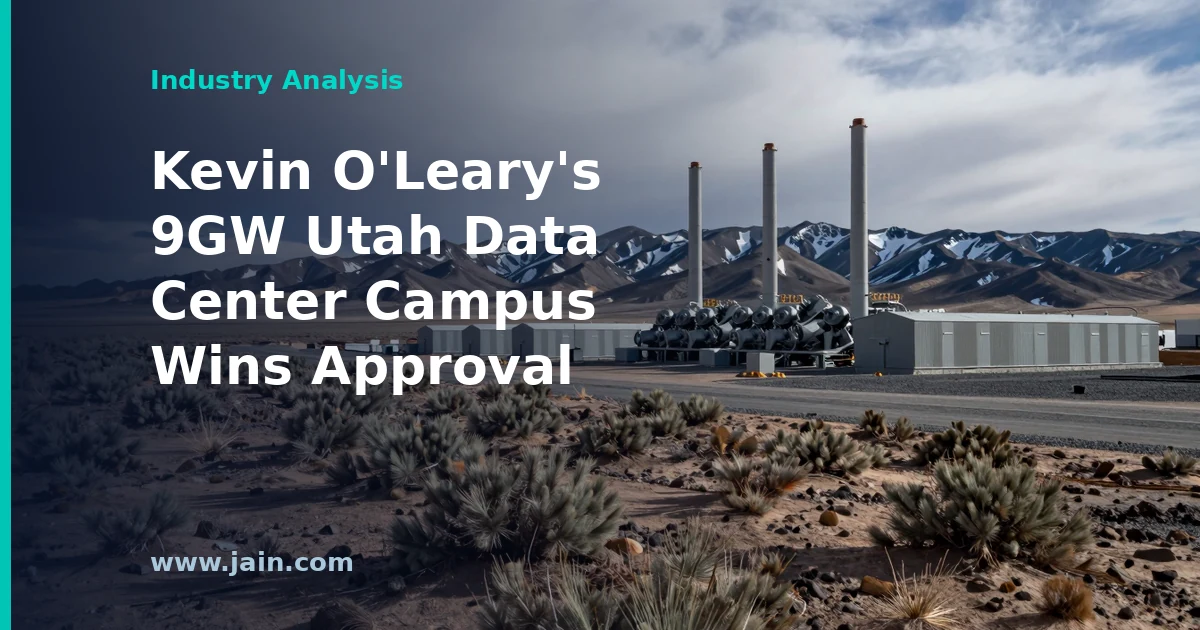
A 9-gigawatt AI data center campus backed by investor Kevin O’Leary has been approved in Utah, according to an April 26, 2026 report from Tom’s Hardware. The project is described as generating and consuming more than twice the amount of power the entire state of Utah currently uses — placing it among the largest data center developments ever announced anywhere in the world.
Executive Summary
The headline fact is the scale: 9 gigawatts is not a data center in any conventional sense — it is a power project with computing attached. For perspective, 9GW is roughly the output of nine large nuclear reactors, and the report frames it as more than double Utah’s entire statewide electricity draw. Notably, the report says the campus will generate as well as consume that power, which signals a behind-the-meter model: building dedicated generation on site rather than asking the regional grid to supply it.
The second fact is the word “approved.” Some jurisdictional body has said yes to something — but at headline level, the report does not specify which approval this is: land-use zoning, an air-quality permit, a generation license, or a state economic-development agreement. In mega-project development, each of those is a different gate, and clearing the first one is a long way from moving dirt. What is substantiated here is an approval milestone for an extraordinarily ambitious plan; what is not yet substantiated is financing, customers, a construction timeline, or the generation technology behind the 9GW figure.
A Power Plant First, a Data Center Second
The most telling detail in the report is that the campus will “generate and consume” its power. AI campuses at gigawatt scale have collided with a hard constraint across the United States: utility interconnection queues — the waiting lines to connect large new loads to the grid — now stretch years in many regions. Developers who cannot wait are going behind the meter, building their own gas turbines, and in some proposals nuclear or geothermal capacity, dedicated to the site. A 9GW self-generation plan sidesteps the queue but inherits a different set of problems: gas turbine order books are backed up years, fuel supply must be contracted at enormous volume, and on-site generation still typically requires air-quality permits and some grid tie for backup and startup power.
For lay readers, the practical meaning is this: the binding constraint on AI infrastructure has shifted from chips and buildings to electricity. Projects are now sized and sited around where power can be created, not where fiber or customers happen to be. Utah — with land, gas access, and a development-friendly posture — fits that new map.
What “Approved” Does and Does Not Mean
Approval is a genuine milestone; it is also the cheapest one. The industry has spent the past two years in an announcement race, with proposed multi-gigawatt campuses in the U.S., Canada, and the Gulf states collectively promising far more capacity than the supply chain — turbines, transformers, switchgear, chips, and skilled labor — can deliver on the advertised timelines. Analysts increasingly distinguish between announced gigawatts and energized gigawatts, and the gap between the two is wide. Kevin O’Leary himself previously announced a separate multi-gigawatt AI data center park in Alberta, Canada, which illustrates the pattern: high-profile backers can secure land and early approvals quickly, while the capital-intensive middle of the project — measured in tens of billions of dollars for a campus this size — takes years and committed tenants to close.
None of that makes the Utah project unserious. It makes it unproven, which is the honest status of nearly every gigawatt-class announcement at the approval stage. The credible test will be what follows: named anchor tenants, equipment orders, and financing commitments, not renderings.
Winners, Losers, and the Utah Question
If the campus advances, the near-term winners are clear: turbine and electrical-equipment manufacturers with the scarcest order slots, construction and trades labor in Utah, and the state’s tax base. Hyperscalers and AI labs hungry for capacity gain another potential supply option in a market where powered land is the scarcest commodity. The open question is who bears the risks. Behind-the-meter gas generation at this scale raises air-quality and emissions questions; data centers in the arid West raise water and cooling questions; and residents near any 9GW generation complex will have views on all of it. A project sized at more than twice the state’s current consumption will, fairly or not, become a referendum on how Utah wants to participate in the AI buildout — and community sentiment has already slowed or stopped large data center proposals in other states. Developers who engage those concerns early, with specific commitments on emissions, water, and grid impact, have fared better than those who lead with the gigawatt number.
Background
The AI boom has turned electricity into the data center industry’s scarcest input. Training and running large AI models requires dense clusters of power-hungry chips, and since 2023 developers have raced to secure “powered land” — sites where gigawatt-scale electricity can be delivered or built. With utility interconnection queues stretching years, a new class of power-first campuses has emerged that builds its own generation on site, and announced capacity across North America and the Gulf now far outstrips what has actually been energized.
Kevin O’Leary, the investor and Shark Tank personality behind O’Leary Ventures, entered this race with a previously announced multi-gigawatt AI data center park in Alberta, Canada. The Utah campus extends that playbook to the U.S. at even larger scale: at 9GW, the approved plan would exceed the entire current power draw of the state that will host it — a first even by the standards of this buildout.
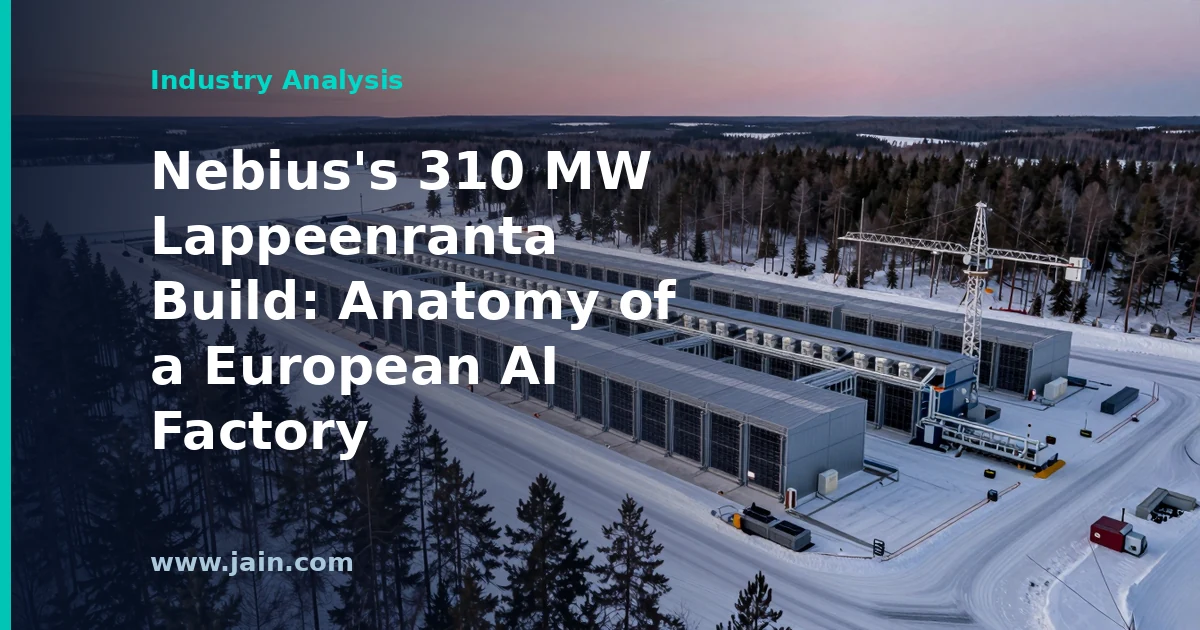
A project profile published April 25, 2026 by Northwise Project details a 310 megawatt (MW) data center in Lappeenranta, Finland attributed to Nebius Group, the Amsterdam-headquartered AI infrastructure company that trades on Nasdaq under the ticker NBIS. The report frames the facility as an “AI factory” — a data center purpose-built for training and running artificial-intelligence models rather than for general-purpose computing.
At 310 MW, the Lappeenranta site would sit firmly in the top tier of European data center projects by power capacity, and would extend Nebius’s existing Finnish footprint, anchored by its long-running campus in Mäntsälä.
Executive Summary
The headline fact is the number: 310 MW of power capacity dedicated to AI computing in a single Finnish location. Power capacity — the electricity a facility can draw and convert into computation — has become the standard yardstick for AI infrastructure because modern graphics processing units (GPUs) are constrained less by floor space than by the megawatts available to feed and cool them. A conventional enterprise data center might draw a few megawatts; 310 MW is the scale at which a facility can host tens of thousands of accelerators and compete for the largest AI training workloads.
The location is just as telling as the size. Finland offers a cool climate that slashes cooling costs, a grid that is among Europe’s most carbon-free, political stability inside the EU, and — in Nebius’s case — years of accumulated operating experience in the country. Lappeenranta, a university city in southeastern Finland, adds a local energy-engineering talent base.
What the profile does not settle is equally important: it is a single third-party report, and details on timeline, phasing, investment, power contracts, and customers are not substantiated in the source material. The scale claim is specific, but readers should treat the project’s parameters as reported rather than independently confirmed.
Why Finland Keeps Winning AI Capacity
Finland has quietly become one of Europe’s most competitive destinations for compute-intensive infrastructure, and the reasons are structural rather than promotional. Cooling is one of the largest operating costs in a data center, and Finland’s climate allows “free cooling” — using outside air or nearby water — for much of the year. The Finnish grid is also unusually clean, drawing heavily on nuclear, hydro, and wind, which matters both for operating economics and for AI customers facing sustainability reporting obligations in the EU.
Nebius knows this terrain better than most entrants. Its Mäntsälä campus, inherited from the company’s pre-2024 corporate history, is well known in the industry for piping waste heat from servers into the local district heating network — turning a cost center into community energy. A second, far larger Finnish site would suggest the company is doubling down on a playbook it has already proven, rather than experimenting in an unfamiliar market.
What 310 MW Actually Buys
For readers outside the industry: data centers are sized by power, not square footage, because electricity is the true scarce input. A 310 MW facility operates on a different plane from traditional colocation sites. Individual AI server racks now draw 100 kilowatts or more — ten times the density of conventional racks — so hundreds of megawatts translate into the tens of thousands of GPUs needed to train frontier-scale models.
The “AI factory” framing is more than marketing shorthand. Purpose-built AI facilities differ from general-purpose data centers in their electrical distribution, liquid-cooling infrastructure, and network fabric, which must move enormous volumes of data between GPUs at very low latency. Retrofitting a legacy facility to these specifications is often harder than building new — which is why the current AI cycle is producing greenfield gigascale campuses rather than expansions of existing colocation stock.
Nebius and the Neocloud Race
Nebius belongs to a category investors have taken to calling “neoclouds”: companies that rent GPU capacity for AI workloads, competing with the hyperscale clouds on price, availability, and specialization. The strategic logic of a 310 MW owned site is vertical integration — controlling land, power, and buildings rather than leasing from wholesale data center providers should yield structurally lower cost per GPU-hour, which is the metric on which this market ultimately competes.
The risk side of that logic is capital intensity. Facilities at this scale require investment in the billions of dollars before revenue arrives, and the GPU rental market is young, with demand concentrated among a relatively small set of AI labs and enterprises. A purpose-built AI factory is a leveraged bet that today’s extraordinary demand for training and inference capacity persists through the multi-year window it takes to permit, build, and fill such a site. That bet may well pay off — but it is a bet, and the source material offers no visibility into how this one is financed or contracted.
Europe’s Sovereignty Subtext
A gigascale AI facility on EU soil lands in the middle of Europe’s “sovereign AI” debate — the push to ensure European companies and governments can access frontier compute under European jurisdiction rather than depending entirely on U.S.-based capacity. An Amsterdam-headquartered operator building hundreds of megawatts in Finland fits that narrative neatly, and European AI startups and public-sector buyers are an obvious customer constituency.
Whether the project actually serves that market, or is absorbed by one or two large anchor tenants, is not something the source addresses. The distinction matters: a facility serving broad European demand changes the region’s compute landscape; a facility pre-committed to a single large customer changes one company’s supply chain. Both are legitimate businesses, but they have different implications for European AI buyers watching capacity announcements with interest.
Background
Nebius Group took its current form in 2024, when Yandex N.V. — the Dutch holding company of the Russian internet group — sold its Russia-based businesses and rebuilt itself around international assets, including a data center in Mäntsälä, Finland. Rebranded as Nebius and relisted on Nasdaq under the ticker NBIS in October 2024, the company positioned itself as a European-rooted provider of AI cloud infrastructure, backed by partnerships in the Nvidia ecosystem and an aggressive data center expansion program across Europe and beyond.
The broader backdrop is a global scramble for AI compute. Training and serving large AI models requires unprecedented concentrations of GPUs and electricity, and power availability has replaced land or fiber as the industry’s gating resource. The Nordics — with cool climates, clean grids, and supportive municipalities — have become one of the main theaters for this build-out, and Finland in particular has converted those advantages into a steady pipeline of hyperscale and AI-specialized projects.