TL;DR · 30-second read
The Short Version
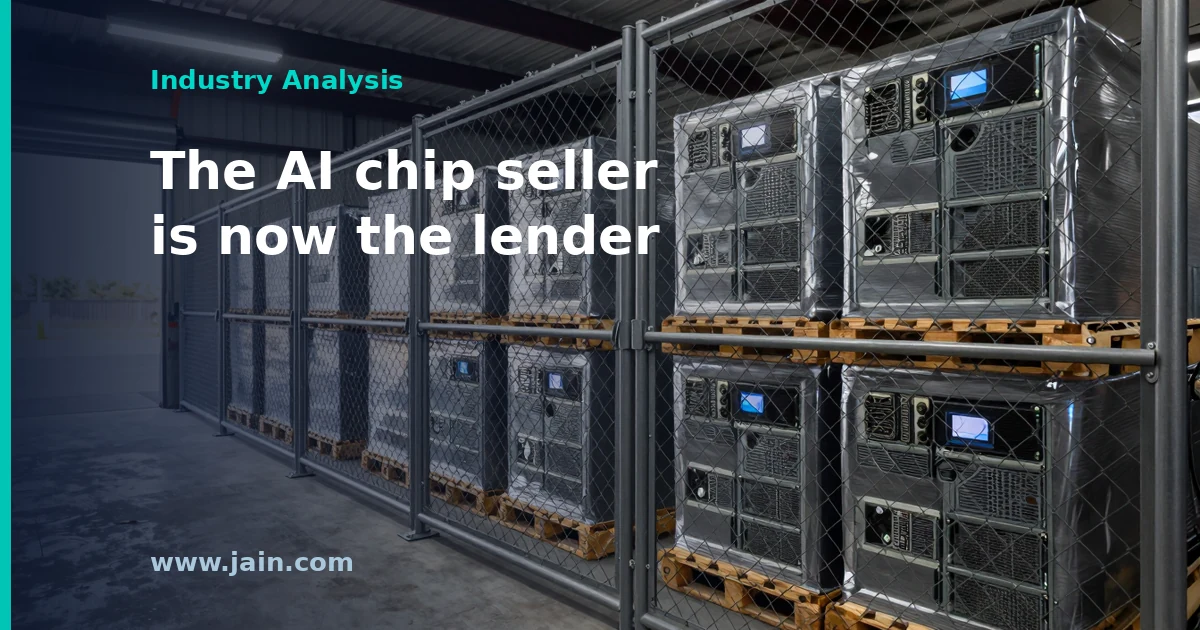
Broadcom, one of the world’s biggest chip makers, has agreed to lend Anthropic, the company behind the Claude chatbot, up to $42 billion, according to a financial filing. The money is for Anthropic to rent Broadcom’s own chips.
Think of a carmaker lending you the money to lease its cars. If you stop paying, the carmaker takes the loss.
That is the real story: some of the risk that an artificial intelligence company cannot pay its bills now sits with the company selling it the hardware.
Broadcom has agreed to lend Anthropic up to $42 billion so the AI developer can lease Broadcom’s chips, Reuters reported in an exclusive, citing a filing. The arrangement makes Broadcom both the supplier of Anthropic’s AI computing hardware and the source of the money used to pay for it.
The figure is a ceiling, not a fixed sum. How much Anthropic will draw, over what period, and on what terms has not been made public by either company.
Executive Summary
The headline number is large, but the structure is what matters. In a typical hardware deal, a chipmaker sells, gets paid, and any question about whether the buyer can afford the purchase belongs to the buyer and its lenders. Here, the chipmaker is also the lender. If the facility is drawn, Broadcom holds a claim on Anthropic’s future ability to pay, not just a completed sale.
For Anthropic, the facility offers a way to secure large amounts of AI computing capacity without paying for it upfront. For Broadcom, it helps lock in demand for its chips with one of the most prominent AI model developers. For everyone else watching AI infrastructure spending, it is a concrete example of compute financing moving onto a supplier’s balance sheet, and it raises fair questions about collateral, pricing and how the resulting revenue should be read.
When the Chip Vendor Becomes the Bank
The mechanism is simple. Broadcom extends credit of up to $42 billion; Anthropic uses it to lease Broadcom chips; Anthropic repays over time from the money it earns selling AI products. Every dollar drawn becomes a dollar of exposure for Broadcom to a single borrower, and that exposure is only as good as Anthropic’s future revenue. This is what the term credit risk means here: the chance that a borrower cannot repay in full and on time.
That risk now sits on a chipmaker’s books rather than solely with banks, bond investors or specialist equipment lessors, the parties that normally absorb it. The people affected are Broadcom shareholders and creditors, who inherit exposure to the economics of AI model development; credit analysts, who must now assess a semiconductor company partly as a lender; and Anthropic itself, whose funding for compute is tied to one supplier’s balance sheet.
None of this makes the arrangement unsound. A loan tied to hardware may be secured by that hardware, and a large, profitable chipmaker can be a more patient lender than a bank. But the risk does not disappear because the lender is also the seller. It changes hands.
Why Lease, and Why Let the Supplier Pay
Leasing chips, rather than buying them, lets a customer spread the cost over the period it uses the hardware instead of paying everything upfront. For an AI developer whose computing needs are growing quickly, that matches cash going out to the revenue the chips help generate. Financing the lease through the chip supplier can also be faster than arranging a syndicated loan, and the supplier has unusual insight into the value of the hardware being financed.
For Broadcom, the logic is demand certainty. Custom AI chips are designed over long cycles, and a customer committed through a multi-billion-dollar financing facility is a customer less likely to switch suppliers. In effect, the loan helps secure the order book. The trade-off is that a portion of Broadcom’s future chip revenue would be funded with Broadcom’s own capital.
What Credit and Equity Analysts Will Look For
The first question is revenue quality. When a vendor finances its own sales, the revenue it reports is only fully realized once the customer repays. Investors will want to see how Broadcom accounts for the leases and the loan, and how much of any reported AI revenue is tied to this facility.
The second question is collateral. AI chips lose value as newer generations arrive, so hardware that secures a loan today may be worth considerably less within a few years. A lender’s protection depends on how fast the loan amortizes relative to how fast the hardware depreciates.
The third is precedent. Customer financing by telecom equipment makers around 2000 is the case credit analysts most often cite, because losses mounted when financed customers failed. The comparison is a question to test, not a verdict: the outcome depends on the borrower’s revenue, the lender’s concentration, and the security behind the loan, none of which have been fully disclosed here.
The Ripple Effect Beyond the Two Companies
Chips are only one part of AI computing capacity. Leased accelerators still need data center space, cooling, networking and, above all, electricity. As reported, this facility is tied to chips, so operators and utilities serving any resulting deployment will still look to other parties for commitments on buildings and power.
For competing chip suppliers and AI cloud providers, the deal sets a visible reference point. Customers negotiating large hardware orders may ask whether financing is on the table. One transaction does not establish an industry pattern, but it does show that supplier balance sheets are now part of how frontier AI compute gets paid for.
Background
Broadcom is a large US semiconductor and infrastructure software company. In AI infrastructure, it is best known for designing custom accelerator chips for major cloud and AI companies and for the networking silicon that links thousands of processors together. Custom chips are an alternative to general-purpose graphics processors, and they tie a customer to a specific design partner over multi-year development cycles.
Anthropic, founded in 2021, builds the Claude family of AI models. Like other developers of frontier AI models, it needs enormous amounts of computing capacity to train and serve its models, which makes access to chips, and the financing to pay for them, a central business constraint. Source: EXCLUSIVE: Broadcom to lend Anthropic up to $42 billion to lease its chips, filing says, Reuters’ report on Broadcom’s financing facility for Anthropic’s chip leases.Sources