
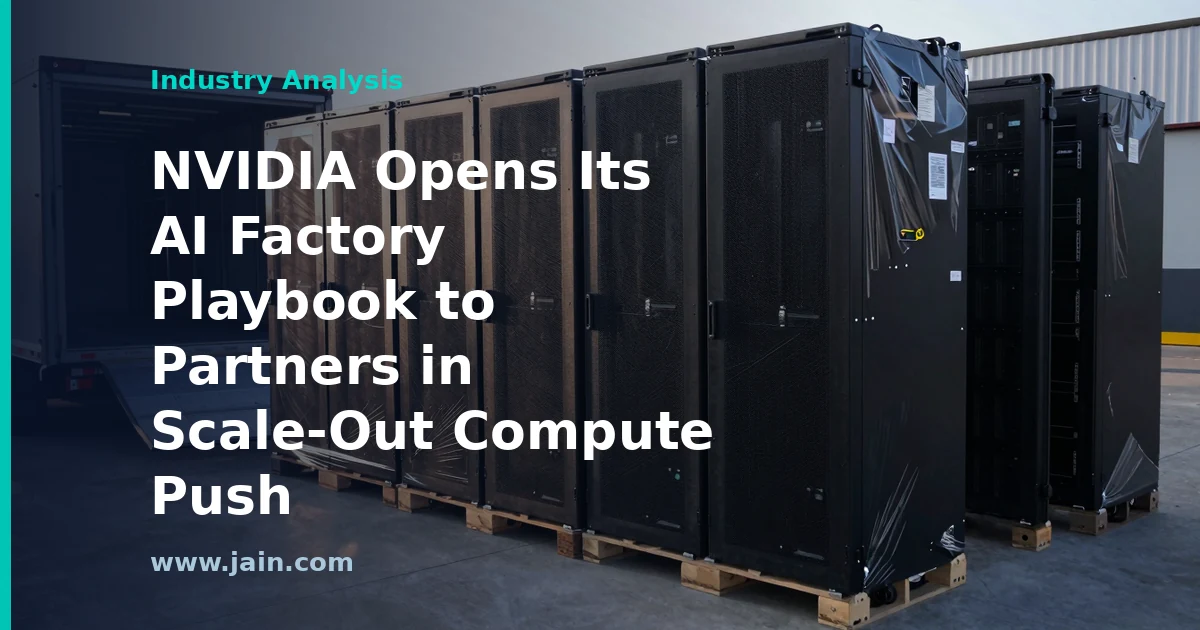
On July 2, 2026, NVIDIA published a blog post titled “NVIDIA Unlocks AI Compute at Scale, Inviting Partners to Power the AI Infrastructure Buildout.” The framing is direct: the world’s dominant supplier of AI accelerators is positioning its partner ecosystem — not just its own products — as the engine of the next phase of AI data center construction.
The syndicated release available to us carries the headline and framing but few operational specifics, so this article analyzes what that positioning signals and flags what the announcement, as distributed, does not substantiate.
Executive Summary
NVIDIA’s announcement extends a theme the company has been building for several years: that AI computing is no longer bought as individual chips or servers but as “AI factories” — entire data centers engineered end to end to turn electricity and data into AI model output. The July 2026 post signals that NVIDIA wants partners — cloud providers, data center operators, system builders and enterprises — to carry that model forward at a scale larger than any single company can build alone.
Why it matters: the constraint on AI growth has shifted from chip supply toward land, power, capital and construction capacity. An invitation to partners is an acknowledgment that the buildout’s next phase depends on the broader infrastructure industry — the operators who own sites, substations and customer relationships. For that industry, the strategic question is what “unlocking” means in practice: reference designs, software licensing, supply allocation, financing support, or something else. The headline alone does not say, and that distinction determines who benefits and how much.
From Chip Vendor to Infrastructure Architect
NVIDIA’s language — “AI compute at scale,” “AI infrastructure buildout” — reflects a deliberate repositioning that predates this announcement. The company popularized the term “AI factory” to describe a data center designed as a single integrated machine: accelerators, high-speed networking, system software and orchestration tools sold as a validated whole rather than as parts. In plain terms, NVIDIA increasingly behaves less like a component supplier and more like an architect that hands builders a full set of blueprints.
Opening that playbook to partners is the logical next step. NVIDIA does not own land, power contracts or construction crews at the scale the AI buildout demands. Its partners — hyperscale clouds, specialized GPU cloud providers, colocation operators and server makers — do. An ecosystem strategy lets NVIDIA’s designs propagate through other people’s capital and real estate, which multiplies its footprint without multiplying its balance sheet.
Why Partners, and Why Now
The timing tracks the industry’s binding constraints. By mid-2026, the practical bottlenecks in AI infrastructure were power availability, grid interconnection queues, cooling for ever-denser racks, and the sheer construction lead time of large facilities — problems that sit squarely in the domain of data center operators and utilities, not chipmakers. Inviting partners to “power the buildout” is, read plainly, a recognition that NVIDIA’s growth now depends on other companies’ ability to deliver megawatts and buildings on schedule.
There is also a demand-side logic. A broader partner base diversifies NVIDIA’s revenue beyond a handful of hyperscale buyers, reaches enterprises and governments that want AI capacity in their own regions or facilities, and seeds regional “sovereign AI” deployments. Each partner that standardizes on NVIDIA’s factory design also standardizes on its software stack — historically the stickiest part of the company’s franchise.
Winners, Risks and the Economics of the Buildout
If the program is substantive, the likely beneficiaries are infrastructure holders: colocation and wholesale data center operators with contracted power, GPU-cloud providers seeking supply and validation, and system integrators who assemble certified designs. For enterprise buyers, more qualified partners should mean more places to procure AI capacity without building it themselves.
The risks are equally concrete. Partners who build to one vendor’s blueprint concentrate their capital on that vendor’s product cycle; each new chip generation can compress the economics of the last. Utilization risk — building capacity ahead of proven demand — sits with the partner, not with NVIDIA. And a partner-led buildout raises the industry-wide question of whether capacity additions are pacing real workload growth or outrunning it. None of this makes the strategy unsound, but the release’s framing places the rewards up front and leaves the risk allocation to be inferred.
Background
Founded in 1993 and best known for inventing the modern graphics processing unit, NVIDIA transformed over two decades into the central supplier of AI computing. Its CUDA software platform, introduced in 2006, made GPUs programmable for general-purpose work, and the deep-learning boom of the 2010s and the generative-AI surge that followed made its data center business the company’s dominant segment — and NVIDIA, at points, the most valuable public company in the world. Along the way it acquired Mellanox for high-speed networking and expanded into full systems, positioning itself as a seller of complete “AI factories” rather than chips alone.
The July 2026 announcement lands in a market defined less by chip scarcity than by physical constraints: power availability, grid interconnection queues and multi-year construction timelines for the data centers that house AI hardware — the context in which an invitation to infrastructure partners carries its weight.
Source: NVIDIA Unlocks AI Compute at Scale, Inviting Partners to Power the AI Infrastructure Buildout — NVIDIA Blog post of July 2, 2026, framing the company’s partner ecosystem as the engine of the next phase of AI data center expansion.