
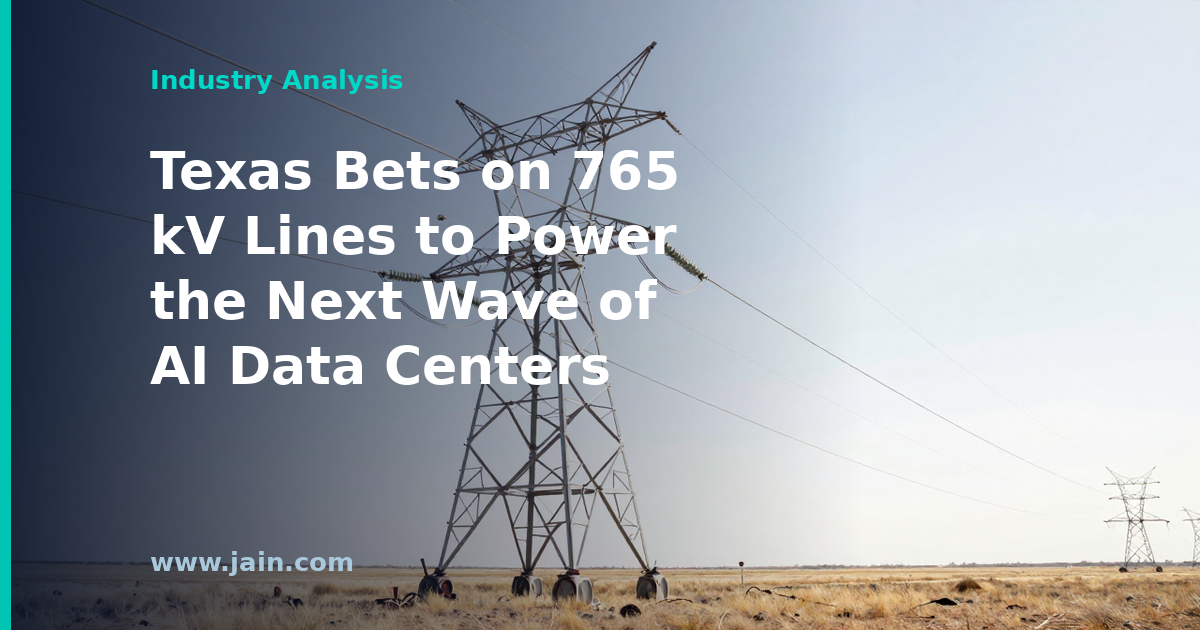
Texas has committed to building out its grid with 765 kilovolt (kV) transmission lines — the highest-capacity class of overhead power line used in North America — in a strategy Data Center Knowledge summarized on July 5, 2026 as “build the wires, the AI will follow.” Rather than waiting for AI data center projects to sign up first, the state’s approach is to construct extra-high-voltage backbone capacity in anticipation of that demand arriving on the ERCOT grid.
Executive Summary
The decision reported here is less about a single project than about a planning philosophy. Historically, most U.S. transmission has been built reactively: a large customer or generator commits, studies are run, and wires follow years later. Texas is inverting that sequence at the 765 kV level — the class of line capable of moving several times the power of the 345 kV circuits that have long formed the backbone of ERCOT, the grid operator serving most of Texas.
Why it matters: access to power has become the single biggest constraint on AI data center siting. A state that can credibly promise deliverable gigawatts on a known timeline gains a decisive edge in attracting capital-intensive AI campuses. But anticipatory building also shifts risk — if the forecast load arrives late, smaller than expected, or somewhere else, the cost of underused infrastructure lands on someone, and that someone is usually the ratepayer.
Why 765 kV Is a Statement, Not Just a Specification
Voltage class is the freeway-versus-farm-road question of the power grid. A 765 kV line can carry far more power than a 345 kV line over the same corridor, with proportionally lower electrical losses, which means fewer parallel lines, fewer towers, and less land consumed per delivered gigawatt. For a grid staring at data center campuses that each want hundreds of megawatts — sometimes a gigawatt or more — 765 kV is the only overhead technology that comfortably matches the scale of the ask.
Choosing it is also a signal. 765 kV projects take longer to permit and build, require specialized transformers with notoriously long lead times, and cost more up front than incremental 345 kV additions. A jurisdiction that standardizes on 765 kV is telling the market it expects load growth measured in tens of gigawatts, not incremental upticks — and that it intends to be structurally ready rather than perpetually catching up.
The Economics of Building Ahead of Demand
The core bet is that transmission, not land or fiber, is now the scarce input for AI infrastructure. Interconnection timelines — the queue a new large customer or generator waits in before it can plug into the grid — have stretched to years across much of the country. Every month of waiting is a month of idle capital for an AI developer whose chips depreciate quickly. If Texas can compress that wait by having backbone capacity already energized, it converts grid readiness directly into economic development.
The counterargument is forecast risk. AI load projections are among the most volatile numbers in the utility industry right now: they depend on chip supply, model efficiency gains, corporate capital cycles, and siting decisions that can pivot on a single tax incentive. Building wires for demand that hasn’t signed contracts means the state is, in effect, underwriting a demand forecast. If the forecast is right, the infrastructure looks prescient. If it’s wrong, Texas will have built expensive capacity whose carrying costs must still be recovered.
Winners, Losers, and Who Carries the Risk
The clearest winners are large-load customers — AI and cloud data center developers — who gain siting certainty, and the transmission utilities and equipment suppliers who get a multi-year construction pipeline. Landowners along new corridors face the familiar friction of routing and easement disputes, which 765 kV’s larger towers can intensify even as its higher capacity reduces the total number of corridors needed.
The pivotal question is cost allocation. In ERCOT, transmission costs have traditionally been spread across consumers, which works when new load broadly benefits everyone but becomes contentious when the driver is a handful of very large private customers. Whether Texas requires AI-scale loads to shoulder a larger, more direct share of the wires built substantially for them — through contribution requirements, minimum-take commitments, or special rate classes — will determine whether this build-out is remembered as smart industrial strategy or as a subsidy from households to hyperscalers. The source piece frames the bet; it does not settle who holds the downside.
What It Means Beyond Texas
Other states and grid operators are watching, because Texas is running the experiment they have avoided: proactive, speculative, extra-high-voltage expansion in a market famous for moving faster and regulating lighter than its peers. If the wires fill up with AI load on schedule, expect copycat programs and renewed pressure on slower-moving regional planning processes elsewhere. If they don’t, the episode will become the cautionary tale cited in every future transmission docket.
For the data center industry itself, the message is immediate: power-first siting is now official policy in at least one major market. Developers comparing regions will increasingly weigh not just today’s available megawatts but a grid’s demonstrated willingness to build ahead of them — and Texas has just bid aggressively on that dimension.
Background
Texas operates most of its grid through ERCOT, a system largely separate from the rest of the U.S., which allows the state to plan and permit infrastructure faster than regions governed by multi-state processes. That autonomy, combined with abundant land and energy resources, has already made Texas one of the country’s fastest-growing data center markets. The backbone of the ERCOT grid has long been built at 345 kV; standardizing new backbone corridors at 765 kV represents a step-change in the scale of power the state is preparing to move.
The backdrop is the AI infrastructure boom: since the early 2020s, demand from AI training and cloud computing has transformed electricity access from a routine utility matter into the decisive factor in where billions of dollars of data center capital lands. Grid operators nationwide have struggled with long interconnection queues — the waiting line for new large loads and generators — and Texas’s 765 kV program is a direct attempt to turn that bottleneck into a competitive advantage.
Source: Texas’ 765 kV Decision: Build the Wires, the AI Will Follow — Data Center Knowledge’s July 5, 2026 report on Texas’s anticipatory extra-high-voltage transmission strategy for AI data center growth.