
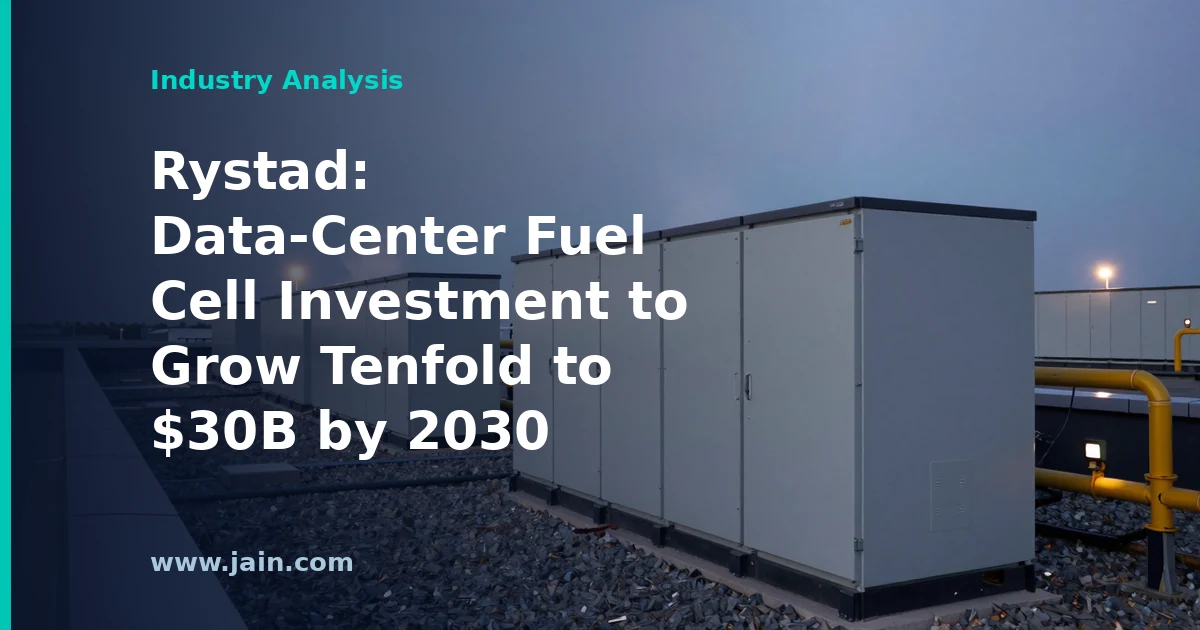
Research firm Rystad Energy projects that investment in fuel cells by data-center operators will grow roughly tenfold, reaching $30 billion by 2030, according to a report published June 26, 2026. The forecast points to on-site power generation moving from a niche backup strategy to a mainstream way of energizing new data-center capacity as connections to the electric grid grow slower and harder to secure.
Executive Summary
Rystad Energy, a Norway-based energy research and intelligence firm, has put a headline number on a trend the data-center industry has been living with for several years: when the grid cannot deliver power on the timeline a project needs, operators increasingly buy their own generation. Its new forecast calls for data-center fuel cell investment to grow tenfold by 2030, reaching $30 billion — a figure that implies today’s spending is on the order of a few billion dollars a year.
Fuel cells convert a fuel — most commonly natural gas today, potentially hydrogen in the future — directly into electricity through an electrochemical reaction rather than combustion. That gives them attractive properties for data centers: they can be deployed in modular blocks at the site, run continuously as primary power rather than just backup, and generally face lighter air-permitting burdens than combustion turbines or diesel generators. A tenfold growth call, if it materializes, would make fuel cells one of the fastest-growing categories of behind-the-meter power — generation installed on the customer’s side of the utility connection — in the broader AI-infrastructure buildout.
The Grid Queue Is the Real Story
The most important context for this forecast is not the fuel cell itself but the waiting line in front of it. In many major data-center markets, utilities and grid operators have quoted multi-year waits for large new interconnections — the formal process of hooking a big load up to the transmission system. For an AI data center whose revenue depends on being energized quickly, a delay of several years is often more costly than paying a premium for on-site generation. That inversion of economics — time-to-power mattering more than cost-per-megawatt-hour — is what turns a niche technology into a $30 billion market forecast.
Fuel cells are one of several answers to that problem, alongside gas turbines, reciprocating engines, and eventually small modular nuclear reactors. Their particular appeal is speed and siting flexibility: modular units can be added in increments as a campus grows, they operate quietly with no combustion exhaust plume, and in many jurisdictions they clear environmental permitting faster than combustion alternatives. For operators, that can compress the gap between breaking ground and serving customers.
What Tenfold Growth Would Actually Require
Growing an equipment market tenfold in roughly four years is not just a demand question — it is a manufacturing and supply-chain question. Fuel cell systems depend on specialized components and materials, and stepping up output by an order of magnitude means new factory capacity, expanded supplier networks, and trained installation and service workforces. The release headline does not indicate whether Rystad’s forecast is constrained by manufacturing capacity or is a pure demand-side projection, and that distinction matters a great deal for whether the number is achievable.
The fuel supply side deserves equal scrutiny. Most commercially deployed data-center fuel cells today run on natural gas, which means large deployments need pipeline capacity and gas contracts — their own version of an interconnection queue. Operators are effectively trading one infrastructure dependency for another. That trade often still makes sense, because gas infrastructure can frequently be expanded faster than high-voltage transmission, but it is not a free pass around the physical world.
Winners, Losers, and the Emissions Question
If the forecast is directionally right, the clearest beneficiaries are fuel cell manufacturers and the developers who package on-site generation into ready-to-run power solutions for data centers, along with gas utilities that supply the fuel. Traditional electric utilities face a more nuanced picture: behind-the-meter generation can relieve pressure on constrained grids, but it also diverts what would have been decades of steady load growth — and the revenue that comes with it — away from the regulated system.
The environmental ledger is genuinely mixed and worth stating plainly. Natural gas fuel cells emit carbon dioxide, though generally with higher electrical efficiency and far lower local air pollutants than combustion generation. Advocates point to a future switch to hydrogen as a path to low-carbon operation; skeptics note that low-carbon hydrogen remains scarce and expensive. Buyers and communities evaluating these projects should ask which fuel is actually contracted today, not which fuel is possible in principle.
A Forecast Is a Scenario, Not a Commitment
It is worth being clear about what a research-firm projection is: a modeled scenario built on assumptions about data-center demand, grid-connection timelines, technology costs, and competing options. Rystad is a well-established energy intelligence firm, but the headline figure arrives without published methodology in the source at hand. If AI capacity growth slows, if utilities accelerate interconnections, or if gas turbine supply loosens, the fuel cell number could land well short of $30 billion. Conversely, if grid queues lengthen further, it could prove conservative. The forecast is best read as a signal about the direction and seriousness of the on-site power trend, not as a precise measurement of the future.
Background
Data-center electricity demand has surged with the AI buildout, and in several major markets the ability to get grid power — not land or capital — has become the binding constraint on new capacity. That has pushed operators toward on-site generation of many kinds, from gas turbines to fuel cells, and made “time to power” a core competitive metric. Fuel cells entered the data-center world primarily as clean backup and supplemental power, with a small number of vendors building a commercial track record over the past decade; the shift Rystad describes is their promotion to primary, at-scale power for new facilities.
Rystad Energy, founded in Oslo in 2004, built its reputation on oil and gas market intelligence and has since expanded into power, renewables, and energy-transition research, making it one of the more frequently cited independent forecasters in the energy sector.
Source: Fuel cell investment by data centers set to grow tenfold, reaching $30 billion by 2030 — Rystad Energy, a research forecast on data-center on-site power published June 26, 2026, via Google News.