
TL;DR · 30-second read
The Short Version
A company best known for mining bitcoin just signed a 20-year deal worth about $9.1 billion to house computers for an artificial intelligence lab, reportedly Anthropic.
The catch: the new job is more than seven times the size of what it has finished for AI customers so far. The whole company brought in about $174 million last quarter.
Mining sites have something AI companies want: access to huge amounts of electricity. Now the question is whether this one can build fast enough.
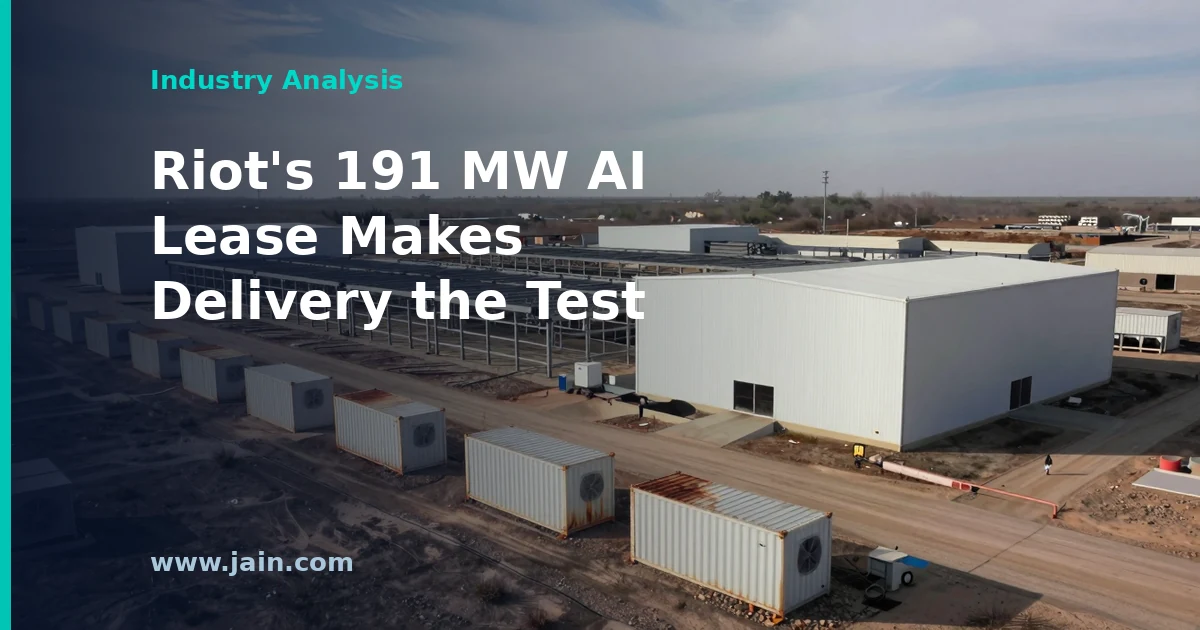
Riot Platforms disclosed on August 10, 2026, that it has signed a 20-year data center lease for 191 megawatts (MW) of critical IT capacity, the power available to run computing equipment, at its Rockdale campus in central Texas. Riot expects about $9.1 billion in contract revenue over the initial term, which runs through June 2048, and about $16.1 billion if the tenant exercises two five-year extensions.
CNBC reported that Riot struck a deal with Anthropic. Riot’s earnings release describes the tenant only as “one of the world’s leading frontier AI labs,” meaning a developer of the most advanced AI models.
Executive Summary
The lease is Riot’s second at Rockdale, following the Advanced Micro Devices (AMD) agreement announced on January 16, 2026. Riot’s earnings release says the two leases total 241 MW and about $9.8 billion of long-term contracted revenue. An 8-K filed the same day also says Riot has entered a non-binding letter of intent for a proposed lease at its Corsicana Facility.
The deal matters because of the gap between what Riot has signed and what it has built. Riot reports delivering 25 MW to AMD on time and on budget, while the new lease is more than seven times that size. With a large contract now in hand, the questions move from whether a bitcoin miner can win an AI tenant to whether it can deliver at this scale, and how much protection the contract offers over two decades.
From 25 MW to 191 MW: Why Execution Is Now the Test
Riot’s delivery record is real but still small relative to its new obligation. The company says it completed AMD’s initial 25 MW on time and on budget. A further 10 MW is due in November 2026 and 15 MW in May 2027, which would bring AMD to 50 MW. The new 191 MW lease is more than seven times what Riot has delivered and nearly four times AMD’s full contracted capacity.
The calendar sharpens the point. A 20-year initial term running through June 2048 implies a start around mid-2028, roughly 22 months after the announcement. That inference does not establish how the capacity will be phased. It does suggest that Riot may need to deliver far more capacity, in less time per megawatt, than it has so far.
Tenants depend on that schedule to bring computing online, lenders and investors depend on it to start the revenue, and suppliers and contractors must be lined up to support it. Riot credits its in-house procurement, engineering and construction capabilities for the AMD record. The Rockdale lease will test whether that model holds at a much larger scale.
What the $9.1 Billion Figure Does and Does Not Say
Spread evenly, $9.1 billion over 20 years averages about $455 million a year, or about $2.4 million per MW annually. That is simple arithmetic rather than a payment schedule, and actual revenue may vary with phasing and contract terms. Even so, the scale is striking: Riot reported total second-quarter revenue of $174.2 million, up 14% from a year earlier, including $23.2 million from data centers, about 13% of the total.
The larger $16.1 billion figure needs more care. Its additional $7.0 billion depends on two five-year extensions that are exercisable at the tenant’s election, so that portion is optional for the tenant rather than committed. Those ten years would average about $700 million annually, well above the initial-term average, though the reason for the difference is not explained in the company’s statement of the headline figures.
Contract revenue is also not profit. The agreement is a “Data Center Lease and Services Agreement,” so the total may reflect more than rent, and returns will depend on the cost of building and operating the capacity.
Tenant Credit Becomes Part of the Asset
A long-term lease is worth only as much as the tenant’s ability to pay and the protections written into the contract. That is especially relevant here because a 20-year term is longer than today’s frontier AI labs have existed. Their spending is substantial, but a contract of this length requires lenders and investors to underwrite a young sector across decades. Credit support, termination rights and remedies for delays would all shape how much of the headline value is dependable.
The contract book is also concentrated. By Riot’s figures, the new lease accounts for about 79% of contracted capacity (191 of 241 MW) and about 93% of contracted revenue ($9.1 billion of $9.8 billion). Having both AMD and a frontier lab broadens Riot’s customer list, but the financial outcome now rests heavily on one agreement.
Power Wins the Meeting, but It Does Not Finish the Building
Riot CEO Jason Les says the platform combines “multi-gigawatt-scale power capacity that is already fully approved and energized” with in-house development expertise and custom engineering. Approved, energized power is a meaningful advantage, and it helps explain why bitcoin miners have become candidates for AI development. They already operate large, power-intensive sites.
A grid connection is not a finished data hall, however. Critical IT capacity counts only the power available to computing equipment, so a site must also supply cooling and other facility loads. AI facilities also generally demand higher reliability and more complex cooling than mining, which can tolerate interruptions more readily. Riot’s power position may reduce one major development risk, but it leaves construction and commissioning risk in place.
The deal is one data point rather than proof that every miner can make this transition. Riot’s 10-Q now reports Data Centers as a segment alongside Bitcoin Mining and Engineering, but the Corsicana letter of intent is non-binding and should not be counted alongside signed leases. The measure of the pivot will be capacity commissioned and revenue recognized.
Background
Riot Platforms, based in Castle Rock, Colorado, describes itself as a digital infrastructure company specializing in large-scale data centers and bitcoin mining. It operates facilities in central Texas and Kentucky, with engineering and fabrication facilities in Denver and Houston.
Bitcoin mining uses specialized computers and large amounts of electricity to validate transactions and earn bitcoin. Developers of advanced AI systems also need large amounts of power, which has made mining operators’ sites and grid access relevant to the AI data center market. Riot’s move into leasing began publicly with the AMD agreement in January 2026. Source: Riot Platforms strikes deal with Anthropic as bitcoin miners shift focus to AI infrastructure – CNBC, on Riot’s deal and the wider shift by bitcoin miners toward AI infrastructure. Primary sources: Riot Platforms 10-Q filed 2026-08-10; Riot Platforms 8-K filed 2026-08-10; Exhibit 99.1 to 8-K filed 2026-08-10, Riot Platforms Reports Second Quarter 2026 Financial Results and Strategic Highlights; Exhibit 99.2 to 8-K filed 2026-08-10, Q2 2026 Earnings Deck.Sources