
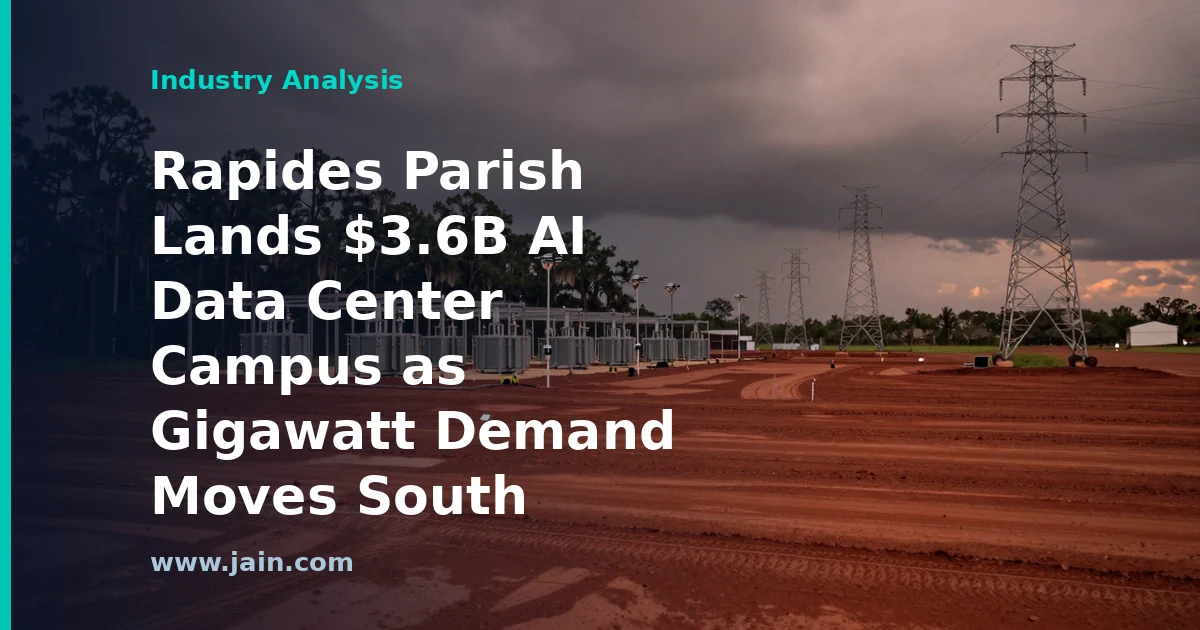
A $3.6 billion artificial-intelligence data center campus is planned for Rapides Parish in central Louisiana, according to a May 25, 2026 report by the Louisiana Illuminator. The project would rank among the largest private capital investments in the parish’s history and, per the reporting, involves a power arrangement with Cleco, the regulated utility serving the region.
Executive Summary
The reported plan places a multibillion-dollar AI campus in Rapides Parish, whose seat is Alexandria — a part of Louisiana that has not historically competed for hyperscale data center projects. At $3.6 billion, the investment is on the scale that typically implies hundreds of megawatts of computing load, purpose-built substations, and years of construction, though the report available to us does not specify capacity, acreage, or a construction timeline.
Why it matters: the announcement is another data point in a clear pattern. AI training and inference facilities are landing in the South — Louisiana, Mississippi, Texas, Georgia — where land is available, power can be contracted at scale, and state incentives are aggressive. For a mid-sized regulated utility like Cleco, a single customer of this size can reshape its entire resource plan. That dynamic, more than the campus itself, is the story worth watching.
Louisiana’s Second Act in the AI Land Rush
Louisiana entered the hyperscale conversation in late 2024, when Meta announced a roughly $10 billion AI data center campus in Richland Parish in the state’s northeast — at the time the largest such announcement in Meta’s fleet. That project demonstrated that Louisiana could deliver what hyperscalers need: large contiguous sites, a cooperative regulatory environment, and a utility (there, Entergy Louisiana) willing to build generation for a single anchor customer. A $3.6 billion campus in Rapides Parish suggests that playbook is now being run in Cleco territory as well.
For central Louisiana, the economic-development logic is straightforward. Data centers bring outsized capital investment and property-tax base relative to their headcount — construction employs thousands for several years, but steady-state operations typically employ dozens to a few hundred. Communities weighing these projects should therefore evaluate them primarily as tax-base and infrastructure plays rather than as mass employers, a distinction that matters when incentives are negotiated.
Why the Utility Is the Real Story
Cleco serves roughly the central third of Louisiana and is small compared with national investor-owned utilities. A data center campus at this investment level would likely represent a load addition measured in hundreds of megawatts — material against a system of Cleco’s size. In regulated markets, serving that load means new generation, transmission upgrades, or long-term power purchases, all of which flow through integrated resource plans and rate proceedings before the Louisiana Public Service Commission.
The central question in every such deal is cost allocation: does the data center customer pay the full incremental cost of the capacity built to serve it, or do some costs socialize across residential and small-business ratepayers? Utilities and regulators across the South are actively developing large-load tariffs — special rate classes with long contract terms, minimum-take provisions, and exit fees — precisely to answer that question. The report available to us does not disclose the structure of the Cleco arrangement, so the fairest reading is that this is the item most deserving of public scrutiny as the project moves through regulatory review.
The Economics of Gigawatt-Scale Siting
The South’s dominance in recent AI-infrastructure siting comes down to arithmetic. Training-class AI facilities are constrained less by fiber or labor than by time-to-power: how quickly a utility can deliver hundreds of megawatts of firm capacity. States with vertically integrated utilities can compress that timeline by building dedicated generation, something fragmented or capacity-constrained markets struggle to match. Add comparatively cheap land, natural-gas proximity, and sales-tax exemptions on data center equipment, and the region’s pipeline of announcements becomes easy to explain.
The risk side deserves equal weight. Multibillion-dollar campus announcements are commitments of intent, not completed buildings; across the industry, some announced projects have been resized, phased, or delayed as AI demand forecasts and chip supply evolve. A parish and utility that invest in infrastructure ahead of a project that later shrinks can be left carrying costs. Well-structured agreements put that risk on the developer through take-or-pay terms — which is why the unpublished details matter more than the headline number.
Background
Louisiana emerged as an AI-infrastructure destination in late 2024, when Meta selected Richland Parish for a roughly $10 billion data center campus backed by dedicated generation from Entergy Louisiana — at announcement, one of the largest data center commitments in the United States. The state offers hyperscalers large rural sites, abundant natural gas, sales-tax relief on data center equipment, and vertically integrated utilities that can build power for anchor customers.
Cleco, headquartered in Pineville in Rapides Parish itself, is central Louisiana’s regulated utility. For a utility of its size, a single hyperscale customer represents a step-change in load — the kind of demand shock that utilities across the South are now addressing through integrated resource plans and new large-load rate structures overseen by state regulators.
Source: $3.6 billion AI data center campus planned for Rapides Parish — Louisiana Illuminator report, May 25, 2026, on a planned AI data center campus in central Louisiana.