
TL;DR · 30-second read
The Short Version
A rural Wyoming county has approved a giant artificial intelligence computer complex on a family ranch. It would use more electricity than every home in Wyoming combined.
Residents filled public meetings with environmental concerns. The builder, Prometheus Hyperscale, says it won’t take river water to cool its computers. It plans to truck in a coolant that lasts six years.
The bigger question is power. Most of it would come from burning natural gas, and that is a lot of gas to line up for one site.
Commissioners in Uinta County, Wyoming, voted unanimously on Tuesday, June 16, to permit a 1.25-gigawatt artificial intelligence data center from Prometheus Hyperscale, KPCW reported, citing the Uinta County Herald. The approval followed public pushback at packed town hall meetings.
The 506-acre campus would sit roughly 12 miles east of Evanston, on the south side of Interstate 80, on land the company says founder Trenton Thornock’s family has ranched for six generations. Prometheus says construction will begin within six months of “final permitting” and take four to five years.
Executive Summary
Prometheus Hyperscale has cleared a major local hurdle for what it calls its flagship project. A gigawatt is 1,000 megawatts, and at 1.25 gigawatts the campus would use more electricity than all the homes in Wyoming. That places a single private development on a scale usually discussed in terms of statewide demand.
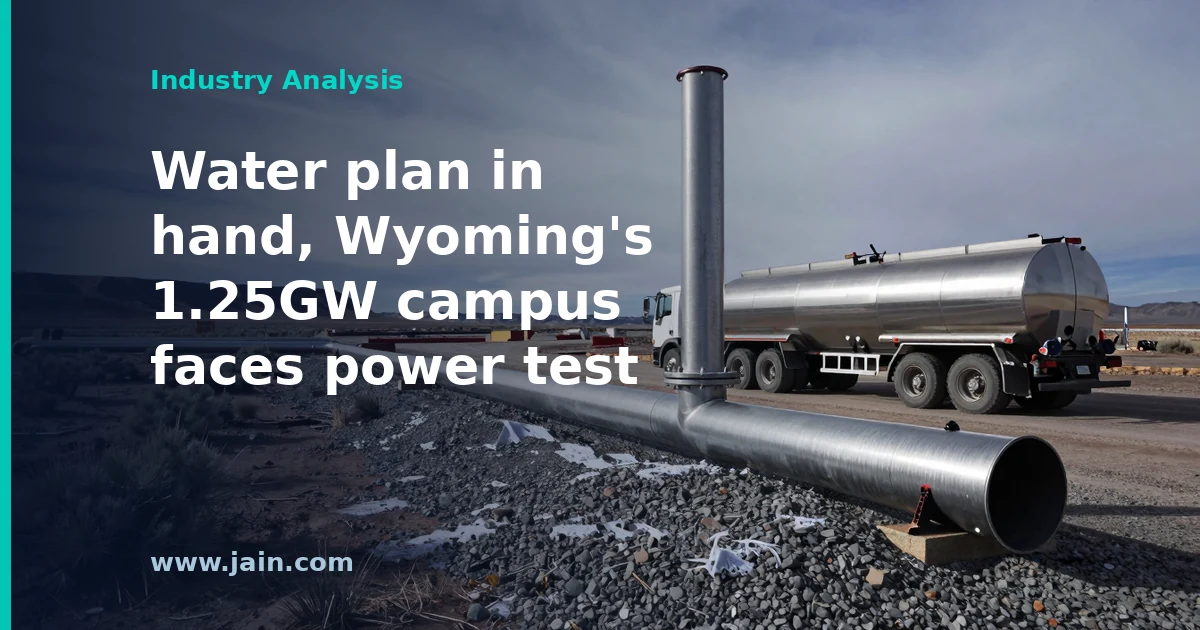
The company’s response to the loudest local concern, water, is unusually specific. It says servers will be cooled with a water-glycol mixture, a blend similar in concept to engine antifreeze, that is trucked in and lasts six years before being changed out. It also says it won’t use water from the nearby Bear River, which feeds the Great Salt Lake.
Power is less fully defined. Thornock has said most of the electricity will come from natural gas, with nuclear as a later ambition. Naming a fuel answers only the first of several questions about how a load this size gets served, and those questions now become the project’s next test.
The Water Plan Is Built for the Local Argument
Water has become a deciding issue for data center proposals in this part of the West. In neighboring Box Elder County, Utah, two water rights applications for a separate 9-gigawatt project linked to investor Kevin O’Leary have been withdrawn amid concerns about depleting the Great Salt Lake, and it remains unclear where that project will source its cooling water. Against that backdrop, Prometheus has given opponents a concrete claim to evaluate: no groundwater or surface water for cooling and no Bear River water at all.
The design described is a closed loop, meaning the same fluid circulates repeatedly instead of being evaporated and replaced. Eric Schlidt, director of Prometheus’ Build Wyoming initiative, said the mixture will be trucked in. A six-year change-out interval, if achieved, would make cooling water a periodic delivery rather than a continuous withdrawal.
The plan does not take the site off the water map entirely. A private on-site well will supply the plumbing, and trucked coolant has to come from somewhere and eventually go somewhere. Closed loops also still have to reject heat to the outside air, which in general requires equipment that consumes electricity. The water answer is therefore specific and easy to test, but it remains untested by operation, and part of its burden may shift toward the power system.
Why Power Is the Harder Question at 1.25 Gigawatts
The comparison to Wyoming’s homes shows the scale of the challenge. Serving more than the state’s entire residential electricity use at one site requires more than a fuel choice. A gas-led supply depends on pipeline capacity, generating equipment, air permits and a decision about whether generation sits on site or arrives through a utility. Each is its own negotiation with its own schedule, and each affects the lenders and potential tenants who need confidence that the electricity will be there when the buildings are finished.
The energy pitch has also moved beyond its initial framing. In a Wyoming Public Media interview last November, Thornock described the project as a green data center amid fields of wind and solar, while saying most of its power would come from natural gas, a fossil fuel that is readily available and relatively clean. Both statements can stand together, but a mostly gas-powered campus will be judged on its gas plan and emissions, not on the renewable projects around it. Nuclear energy remains a stated long-term wish, with no timeline attached to it in Thornock’s remarks.
Timing raises the stakes. A four-to-five-year build beginning within six months of final permitting points to completion around 2030 or later. The phrase “final permitting” also suggests the county vote may not be the last approval required. For the people who would build, finance and buy capacity at the site, the practical milestone is a firm power arrangement more than the June vote.
Acreage Understates the Load
Prometheus’ footprint is about 20 times smaller than Box Elder’s planned 10,000 acres, a comparison that makes the Wyoming project sound modest. By power, the gap is much narrower: 9 gigawatts is about seven times 1.25 gigawatts. On planned figures, the Evanston site works out to roughly 2.5 megawatts per acre, compared with about 0.9 megawatts per acre at Box Elder.
That matters for how communities read these proposals. Land is the most visible measure of a project, but electricity demand, fuel supply and heat rejection scale with load. A smaller site can still present a very large energy question, as this one does.
Remote Land Moves the Debate, Not the Constraints
Ranchland along an interstate offers space, and in this case a founder with deep family ties to the site. Two projects in one region do not establish a national pattern, but they show how gigawatt-scale ambitions are reaching places whose planning rules were not written for them. They also show that distance from a city does not spare a developer from public scrutiny, as the packed Uinta County meetings and the Box Elder hearings both demonstrate.
The response is already spreading. KUER has reported that communities across Utah are drafting data center regulations, and the Utah Association of Counties is training local officials on handling such proposals, according to Summit County Councilmember Chris Robinson. Eastern Summit County’s development code does not address data centers, though planners have discussed adding guidelines. Robinson doubts the area’s bumpy topography and expensive land make it an easy fit, while allowing: “I’m no expert, but I guess if you can do one in Evanston, or Uinta, you could do it in our county.”
Background
AI data centers are large buildings full of specialized computers that consume electricity and turn it into heat, which must then be removed. “Hyperscale” describes facilities built at very large scale, and proposals in the gigawatt range have brought energy and water questions to county commissions that rarely dealt with projects of this type.
Prometheus Hyperscale has presented its Evanston campus as its flagship, with further sites planned in central Wyoming and Texas. The region is already debating the same issues through Box Elder County’s 9-gigawatt proposal near the Great Salt Lake, which has helped prompt communities across Utah to work on data center rules. Source: 1.25GW data center approved on ranchland near Evanston, Wyoming, KPCW’s report on the Uinta County vote permitting Prometheus Hyperscale’s AI data center campus.Sources