
TL;DR · 30-second read
The Short Version
Oracle, the business-software giant, is building huge computer warehouses for artificial intelligence faster than the gas pipelines meant to power them can be finished. So it is filling trucks with natural gas and driving the fuel to the sites instead.
It works, but the gas costs roughly four times its normal price. It also does not go far. Running even a small slice of one planned site in New Mexico would need a fresh truckload about every 40 minutes, day and night.
The lesson is that building artificial intelligence now depends on pipes, permits and trucks, not just computer chips.
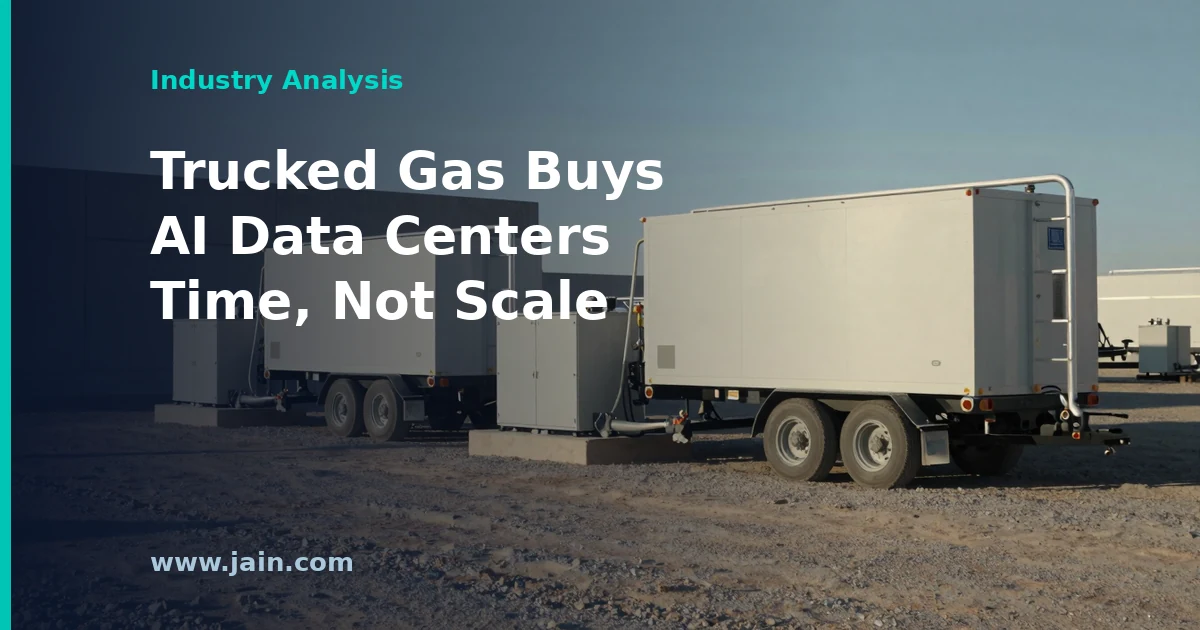
Bloomberg reported that Oracle has been trucking compressed natural gas (CNG) directly to several data center sites so that on-site generators can run before permanent gas pipelines are ready. According to people familiar with the work, truck deliveries kept a data center outside Salt Lake City moving for more than a year while Oracle waited for a pipeline. The same approach is supporting initial work at a campus Oracle is building for OpenAI in Shackelford County, Texas. Oracle is now considering it for Project Jupiter in New Mexico, where a delayed pipeline threatens the timeline of a site with an ultimate footprint of 2.45 gigawatts.
Certarus, a unit of Superior Plus, supplied the Utah deliveries, and VoltaGrid supplies Texas. Oracle publicly thanked VoltaGrid for “finding cost-effective power solutions to ensure our customers can access OCI capacity on schedule,” referring to Oracle Cloud Infrastructure. Last month Oracle sent the New Mexico project’s developer a force majeure notice. Oracle shares closed down 5.5% at $135.69, their steepest one-day drop since July 16.
Executive Summary
The announcement-free headline here is a supply chain story. Many large AI data centers have turned to on-site gas-fired power plants because grid connections take too long. Those plants still need fuel, and fuel normally arrives by pipeline, which can take months to design and build and can be held up by regulators. Oracle is filling that gap with “virtual pipelines”: fleets of trucks hauling compressed gas from a pipeline tap to the site, where it is decompressed and burned in generators.
The approach buys time, but it has limits. Jack Weixel of East Daley Analytics puts the delivered cost at roughly four times the price of gas at a major pipeline hub once labor, specialized equipment and truck fuel are included. Ellie Holbrook of SemiAnalysis estimates that if Project Jupiter ran just 100 megawatts on trucked gas, which is about 4% of its planned capacity, each large trailer would supply only about 40 minutes of electricity. Trucked gas can energize the first phases of a campus. The date the whole campus comes online is still set by the pipeline.
For the industry, the episode adds a new item to the list of things that can delay a data center. Developers already track turbines, transformers and interconnection queues. Gas logistics now belongs on that list too, along with the regulators who approve pipeline routes.
The Trailer Math Sets the Ceiling
Holbrook’s figures are the clearest way to see how far a virtual pipeline can stretch. At a 100-megawatt load, one large CNG trailer lasts about 40 minutes. A day has 1,440 minutes, so running that load around the clock means roughly 36 trailer loads every day, or one arrival every 40 minutes with no gaps for weather, traffic or a missed fill. Each load is a full cycle. Gas is drawn from a pipeline, compressed into the trailer, driven to the site (sometimes for several hours), then decompressed into the generators. A trip that long ties up several trailers on the road for every one unloading, so the fleet behind a steady stream of arrivals is much larger than the arrival count.
That 100 megawatts is only about 4% of Project Jupiter’s planned 2.45 gigawatts. As a rough illustration, if fuel demand scaled in a straight line with load, the full footprint would need close to 900 trailer loads a day. No one has proposed doing that, and the arithmetic shows why. Trucked gas is a bridge sized for early phases, such as commissioning, initial server halls and construction power. It cannot replace a pipeline at campus scale.
The consequence for people planning AI capacity is straightforward. A virtual pipeline can move the date a site first produces revenue. It does not move the date the site reaches full capacity. That second date still depends on Energy Transfer’s rerouted pipeline, which has slipped from this summer to next year.
Fuel Logistics Joins Turbines and Grid Queues on the Critical Path
On-site gas generation became popular because it let developers skip the years-long wait to connect to the electric grid. The Oracle sites show that the workaround brings its own bottleneck. A gas plant without a gas pipeline is idle equipment, and pipelines face many of the same constraints as power lines. In New Mexico, state regulators rejected Energy Transfer’s proposed route, forcing a reroute that pushed back the in-service date. The approval delay simply moved from the power line to the pipe.
This has practical effects on how sites are chosen and planned. When fuel may need to arrive by road for a year or more, as it did in Utah, factors that rarely appeared in data center site studies start to matter. These include the distance to a pipeline tap with available compression, road access able to handle constant heavy-truck traffic, and on-site space for decompression equipment and trailer staging. Developers comparing sites need to weigh the logistics of the interim fuel supply alongside land, water and fiber.
The suppliers stand to benefit. Until now, CNG trucking has mostly served remote mining and oil drilling operations far from the grid. Certarus and VoltaGrid are now marketing to data center builders as a transitional power source. Certarus said longer timelines for pipeline and grid connections “have created a growing need for rapidly deployable and scalable energy solutions.” Whether these services can scale is a separate question. The number of trucks, compressors and trailers available, along with the drivers to move them, sets a physical limit on how many large campuses can rely on trucked gas at the same time.
Paying Four Times for Speed
Oracle described VoltaGrid’s service as “cost-effective,” while East Daley’s estimate puts trucked gas at about four times hub prices. The two claims can both hold, because they measure different things. Per unit of fuel, trucked CNG is expensive. Compared with leaving finished data halls empty, missing delivery dates for customers such as OpenAI, or facing contractual exposure, a costly fuel bill can still be the cheaper choice. Oracle has not disclosed the numbers that would show which effect is larger.
Those numbers matter because of Oracle’s financial position. Its free cash flow is negative and is expected to stay that way until more of its AI data centers are completed, so each month a site comes online earlier brings revenue forward. The force majeure notice points to the same pressure from another direction. A force majeure clause excuses a party from certain obligations when events beyond its control occur, and Oracle’s notice may shield it from some payments to the New Mexico developer if delays continue. The trucks and the notice are two responses to the same pipeline delay. One keeps work moving, and the other limits the cost if work stalls.
The open question for investors and customers is where the extra cost lands. It could reduce Oracle’s margins in the early phases, be passed through to the tenant, or be absorbed through the developer agreement. None of these arrangements has been made public, and the answer will determine whether trucked gas is a minor bridging expense or a significant cost of speed.
Background
Oracle, long known for database and business software, has become a major builder of AI data centers through Oracle Cloud Infrastructure (OCI). It has committed billions of dollars and its reputation to delivering capacity quickly for customers including OpenAI, and its free cash flow is expected to remain negative until more of those facilities are complete. Its projects include a campus for OpenAI in Shackelford County, Texas, a data center near Salt Lake City, and Project Jupiter in New Mexico.
Power has become one of the main constraints on the AI data center buildout. Many large developments now generate their own electricity with on-site natural gas plants rather than waiting for grid connections. That approach depends on gas pipelines, which take months to design and build and can be delayed by regulators. Compressed natural gas trucking companies such as Certarus and VoltaGrid, which previously served mainly remote mining and drilling operations, are now offering their services to data center developers as a temporary fuel supply. Source: Oracle Moves Gas by Trucks to Avoid Data Center Power Delays (SupplyChainBrain, via Bloomberg) on Oracle’s use of trucked compressed natural gas to keep data center projects in Utah, Texas and New Mexico on schedule.Sources