
TL;DR · 30-second read
The Short Version
Before an artificial intelligence system can answer a question, someone has to build the machines behind it. A lot of that work happens in Taiwan, where NVIDIA says more than 1 million parts for its next computer cabinets come together from 25 factory sites.
Several of these manufacturers are also using AI to find faults faster and waste less. NVIDIA says one of them, Wistron, cut electricity demand at its facility by a fifth.
Why care? How quickly these factories can build and test machines helps decide how quickly AI services can grow.
NVIDIA said in a May 31, 2026 blog post that Taiwan is home to more than 500 of its ecosystem partners, and that more than 1 million MGX rack components for its Vera Rubin AI infrastructure come together on the island from 25 factory sites. The company said Vera Rubin is ramping into full production.
The post also describes how TSMC, Foxconn, Quanta Cloud Technology (QCT), Wistron, Pegatron and Inventec are using NVIDIA software in their own operations. Reported results include an estimated 80% faster root-cause analysis at Foxconn and a 20% cut in facility power demand at Wistron.
Executive Summary
NVIDIA has mapped the Taiwanese supply chain behind Vera Rubin, its rack-scale AI platform, from wafer and chip partners such as TSMC, SPIL, Kinsus, KYEC and UMTC to systems builders including Foxconn, Pegatron, QCT, Wistron and Inventec. The headline figures are more than 500 partners, 25 factory sites and more than 1 million rack components.
The more telling detail is what those partners are trying to improve. Their reported gains concern fault diagnosis, first-time pass rates, visual inspection, factory layout and stress-test power. These are measures of manufacturing throughput rather than chip performance.
That matters to anyone planning AI capacity. Chips and grid power tend to dominate the conversation, but a finished rack also has to be assembled, tested and qualified. The results are company-reported and come with limited context, so they point to where effort is going more than they prove how much capacity has been gained.
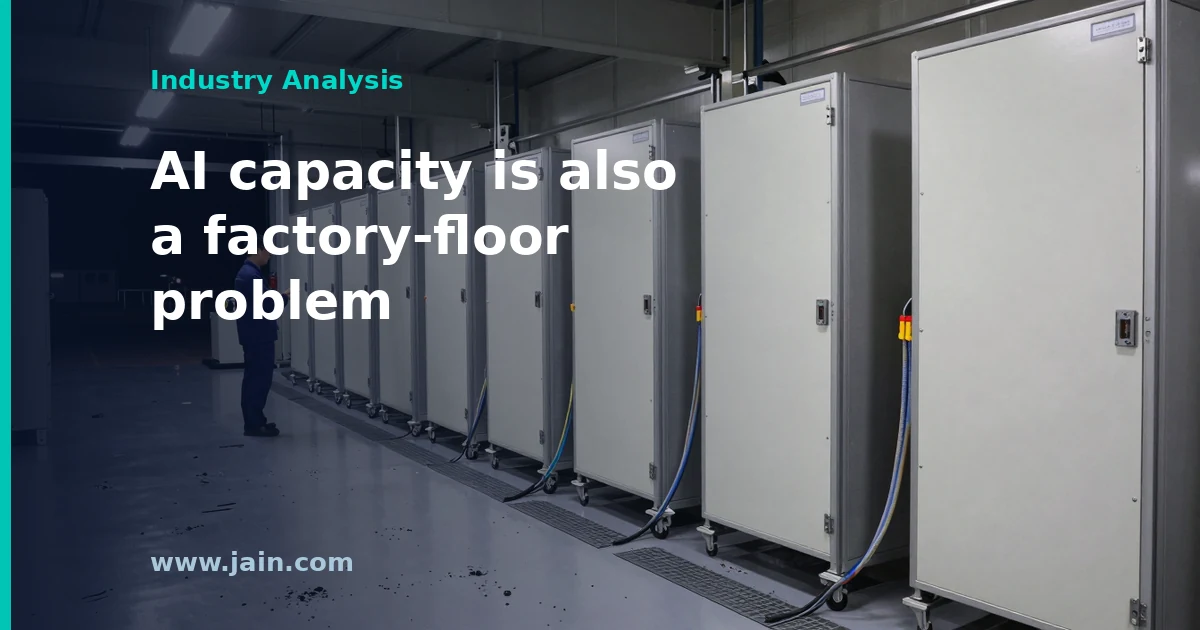
Why AI Capacity Is Also a Factory-Floor Problem
Vera Rubin NVL72 is sold as rack-scale infrastructure, meaning an entire cabinet of tightly linked hardware works as one large computer. That changes the manufacturing task. A rack cannot ship until its components have converged and the finished system has passed testing. With more than 1 million components arriving from 25 sites, the pace of output depends on coordination across many facilities as well as on the supply of any single chip.
The partners’ reported metrics follow that logic. Foxconn estimates that its MoMClaw operations agent speeds root-cause analysis, the work of tracing why something failed, by 80%, while lifting labor productivity by 15% and reducing machine failure rates by 10%. It also credits vision AI with a 3% boost to first pass yield, the share of units that clear inspection without rework. Pegatron reports a 67% reduction in the time needed to deploy AI visual inspection, and Wistron reports layout analysis that is as much as 70% faster. Each figure targets time or waste on the production line.
The people affected sit downstream: data center operators, cloud providers and enterprise buyers whose schedules depend on when finished racks arrive. None of this establishes that factories are the main constraint on AI buildout, and NVIDIA has not claimed a production shortage. The narrower conclusion is that factory throughput belongs in capacity planning alongside chips and power, and that the industry is spending engineering effort accordingly.
Wistron’s 20% Figure Puts Power Inside the Factory
Power is usually discussed as a data center siting problem, but Wistron’s example moves it upstream. The company is using the NVIDIA Omniverse DSX Blueprint, the PhysicsNeMo framework and Cadence Reality DC Design to simulate burn-in environments, where hardware runs under stress before shipment so that early failures surface in the factory rather than at a customer site. NVIDIA says these workflows cut facility power demand by 20% through dynamic rack optimization.
The overlap in tools is instructive. Pegatron is adopting the same DSX blueprint to connect design data, thermal simulation, digital twins (virtual models of physical facilities) and physical qualification as it accelerates AI factory design and deployment. A factory that stress-tests AI racks has to plan for electrical and thermal loads, and so does the data center that will eventually run them, so the same simulation approach is being applied to both.
For manufacturers, this suggests that test capacity may be shaped by available power as well as by floor space and labor, although Wistron’s example alone cannot show how widespread that is. A 20% reduction would be significant at any large test site, but its value depends on the baseline, which has not been disclosed.
What the Numbers Do and Do Not Establish
The claims vary in strength and should not be read as a single body of proof. Foxconn’s 80%, 15% and 10% results are its own estimates. Inventec’s figures are more tentative still: internal validation on notebook cosmetic inspection, using more than 10,000 synthetic defect images, showed the potential to reduce data collection and labeling by about 30%, shorten deployment by about 25% and improve anomaly detection by about 10%. Those results concern notebook computers, not AI servers.
TSMC’s numbers require similar care. NVIDIA says cuLitho improves cost-effectiveness or cycle time by 20-50% over CPU-based computational lithography, the heavy calculation used to prepare the patterns printed onto chips, at the same cost of ownership. The wording is “or,” so it does not promise both benefits at once. The cuEST library’s 50x average improvement applies to semiconductor material simulation. Faster simulation can shorten engineering work, but it does not translate directly into 50 times more of anything leaving a fab.
There is also a commercial context. NVIDIA supplies the software, sells the resulting platform and benefits when its partners ramp smoothly, which gives it good reason to highlight these results. That does not make them wrong, and specific operational figures are more useful than general promises. Still, without baselines, sample sizes or time periods, they cannot yet be compared across companies or converted into additional racks.
Taiwan’s Advantage Comes With Concentration
The case for Taiwan is density. Having wafer, packaging, test and systems partners within one ecosystem makes it easier to share data and repeat methods across a supply chain. Foxconn also shows how the roles are blurring: it builds AI infrastructure and is constructing a $1.4 billion AI cloud supercomputing center in Taiwan with 10,000 NVIDIA GPUs and GB300 NVL72 hybrid cooling. Simple division gives about $140,000 of project cost per GPU, a rough measure of the full project rather than a chip price.
TSMC’s recent SEC reports show the financial scale of the supply chain’s largest member, though they do not tie directly to Vera Rubin. A 6-K filed May 27 confirms a cash dividend of about NT$155.6 billion for the fourth quarter of 2025, adjusted to NT$6.00003573 per share and payable July 9. A 6-K filed May 26 reports no board-approved capital appropriations and no unsecured bond issuance in April, along with NT$21.7 billion of fixed-income acquisitions and NT$7.3 billion of equity dispositions. One month without an appropriation should not be read as a signal about AI capacity in either direction.
The same density creates a planning risk for buyers, because significant production steps sharing one geography can share exposure to a regional disruption. Wistron’s reference to global manufacturing sites shows that the network extends beyond the island, but NVIDIA has not said how much Vera Rubin output could be sourced elsewhere. Large buyers will reasonably want to understand that split.
Background
Taiwan occupies a central place in the AI hardware supply chain. TSMC, based in Hsinchu Science Park and listed on the New York Stock Exchange, manufactures advanced chips for other companies, while firms such as Foxconn, Quanta, Wistron, Pegatron and Inventec build electronics and server systems. NVIDIA designs AI platforms and relies on this kind of partner network to turn those designs into shipping hardware.
As AI systems have grown from individual servers into complete liquid- or hybrid-cooled racks, more of the engineering challenge has moved into integration, testing and facility design. That shift is the context for NVIDIA’s latest description of its Taiwanese ecosystem, which was published alongside its GTC Taipei keynote. Source: Taiwan’s Industry Titans Turbocharge World’s AI Infrastructure Buildout With NVIDIA, NVIDIA’s account of its Taiwanese partners, Vera Rubin production and their use of AI in manufacturing. Primary sources: TSMC Form 6-K filed 2026-05-27; TSMC Form 6-K filed 2026-05-26.Sources