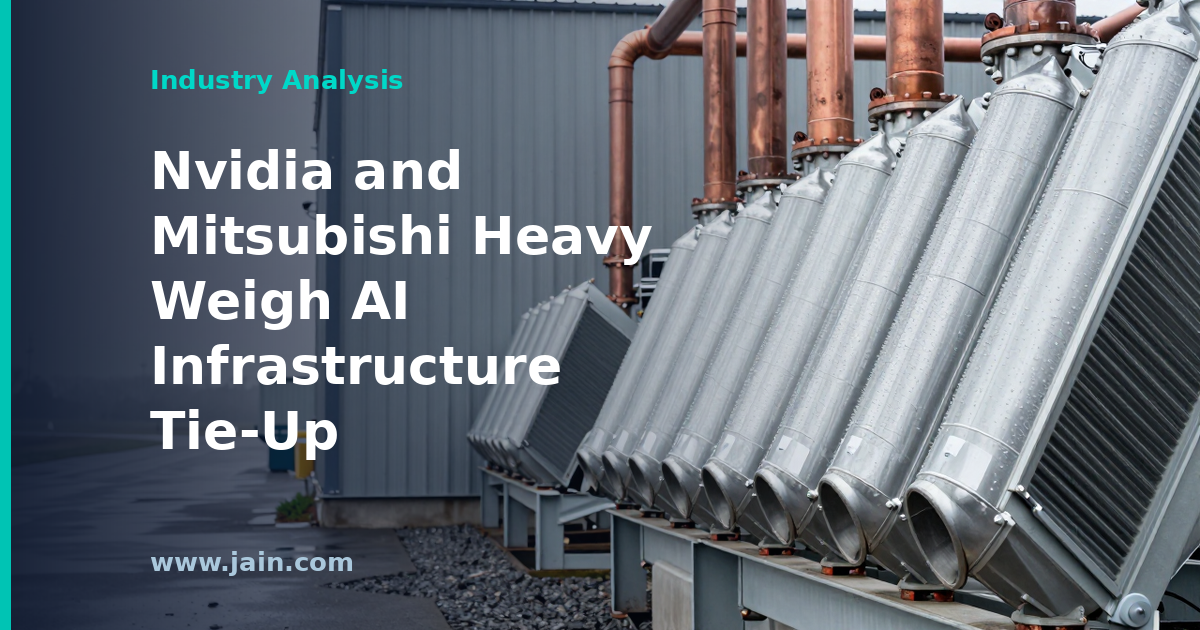
Nvidia and Japan’s Mitsubishi Heavy Industries are reportedly in early discussions about collaborating on cooling and power infrastructure for AI data centers, according to a July 13, 2026 Seeking Alpha report surfaced via Google News.
The item is a brief report of external reporting; no formal announcement, deal value, timeline, or product scope has been confirmed by either company.
Executive Summary
The reported talks would pair the dominant supplier of AI accelerators with one of the world’s largest heavy-engineering conglomerates, whose portfolio spans gas turbines, HVAC systems, and industrial cooling. On paper, the fit is obvious: AI clusters built around Nvidia’s highest-end GPUs are pushing rack densities and heat loads well past what conventional air-cooled data centers were designed to handle, and grid interconnection queues in key markets are measured in years rather than months.
What matters for readers is less the headline than the pattern. Chipmakers are increasingly reaching upstream into the physical plant — power generation, thermal management, on-site energy — because compute deployment is now gated by megawatts and cooling capacity, not silicon supply. Whether this specific pairing produces a concrete product, a joint venture, or nothing at all remains unclear from the available reporting.
Why a Chip Company Cares About Chillers
Modern AI training racks can dissipate 100 kilowatts or more — an order of magnitude above traditional enterprise servers — and next-generation GPU platforms are pushing hotter still. At those densities, air cooling stops being economical and liquid cooling, whether direct-to-chip cold plates or full immersion, becomes mandatory. Mitsubishi Heavy’s industrial thermal and HVAC businesses are the kind of scaled manufacturing base that a chip vendor would want aligned with its reference designs, so that when a customer buys a rack, the cooling loop is engineered, warrantied, and shippable at the same cadence as the servers.
The power side of the reported discussion is equally telling. Mitsubishi Heavy builds gas turbines and is active in nuclear and hydrogen-adjacent equipment. Data center developers in the United States, Japan, and Europe are increasingly signing behind-the-meter or on-site generation deals because utility interconnection timelines cannot keep pace with hyperscaler expansion plans. A relationship with a turbine manufacturer is one way to shorten that critical path.
Strategic Logic, With Caveats
For Nvidia, the strategic prize is deployment velocity: every month a customer waits for power or cooling is a month of deferred GPU revenue and a window for a rival platform. For Mitsubishi Heavy, aligning with the dominant AI compute vendor could pull its industrial equipment into a growth market with unusually inelastic demand. Both narratives are plausible, and both have been used to explain similar chatter around other equipment makers over the past 18 months.
The measured read, however, is that a report of exploratory talks is not a partnership. Neither company has published terms, and Seeking Alpha itself is aggregating reporting rather than breaking primary news. Readers should treat the item as a signal of direction — chip vendors seeking closer ties to power and thermal OEMs — rather than as a confirmed commercial arrangement.
Winners, Losers, and the Middle of the Stack
If a formal collaboration materializes and yields co-engineered reference designs, the pressure would land squarely on independent liquid-cooling specialists and on power-equipment competitors that lack a chip-vendor relationship. Colocation operators would likely welcome a validated, warrantied stack because it reduces integration risk on the largest deals. Hyperscalers, who tend to prefer multi-sourcing and their own custom designs, may care less at the design level but still benefit from a deeper supplier bench.
The counter-scenario is that talks fizzle, or produce only a narrow marketing arrangement. That outcome would be consistent with how many announced infrastructure partnerships have played out — press coverage first, meaningful shipments much later, if at all. Either way, the underlying constraint is real: AI infrastructure is now a power-and-cooling problem as much as a semiconductor one.
Background
Nvidia is the dominant supplier of graphics processing units used for AI training and inference, and its data center segment has become the fastest-growing business in enterprise compute. Its accelerators are the reference platform for most large-model training clusters, which has made the physical constraints of deploying them — power, cooling, real estate — the industry’s binding bottleneck.
Mitsubishi Heavy Industries is a diversified Japanese engineering conglomerate with more than a century of history in power generation, thermal equipment, aerospace, and industrial machinery. Its portfolio includes gas turbines, HVAC systems, and nuclear-related equipment, giving it multiple potential entry points into the data center power-and-cooling stack.