
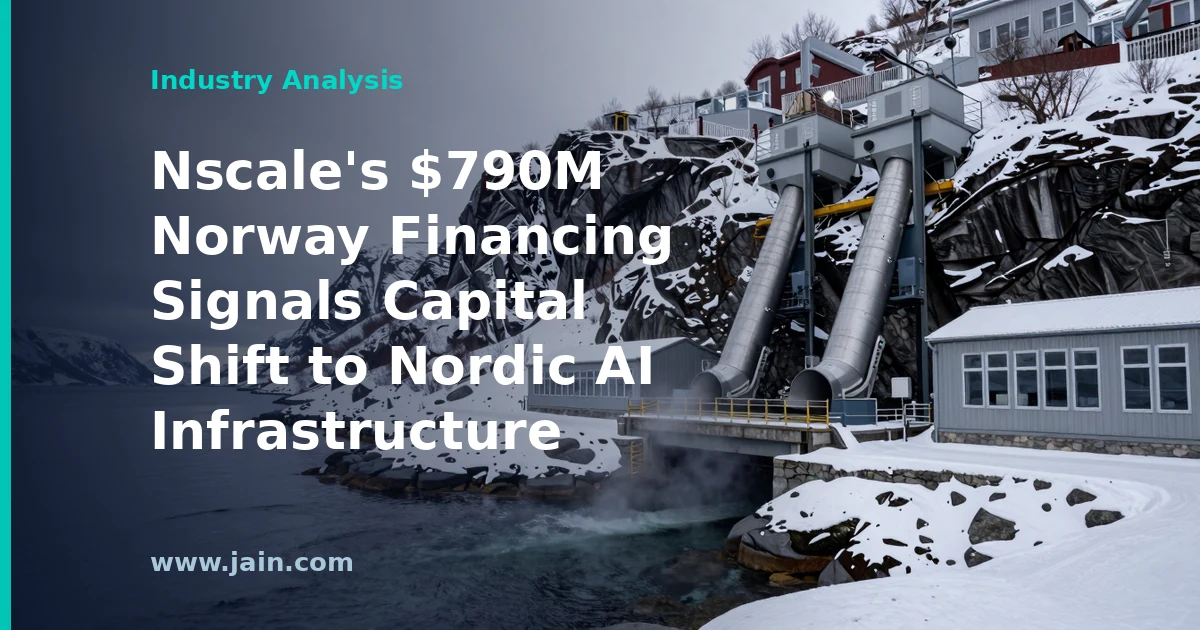
Nscale, the London-headquartered AI infrastructure company, announced on May 10, 2026 that it has secured $790 million in financing to support its AI infrastructure buildout in Norway. The announcement, distributed via PR Newswire, did not publicly detail the structure of the financing or the specific facilities it will fund.
The raise extends a rapid string of capital events for the two-year-old company, which operates hydropower-fed data center capacity in northern Norway and has positioned itself as a European alternative for large-scale AI compute.
Executive Summary
The headline fact is simple: $790 million in fresh financing, earmarked for AI infrastructure in Norway. What makes it worth analyzing is the pattern it confirms. Capital for AI data centers — both equity and, increasingly, project-style debt — is flowing toward locations selected for power and cooling economics rather than proximity to traditional internet hubs. Norway offers abundant hydroelectric power, some of Europe’s lowest industrial electricity costs, and a climate that allows servers to be cooled largely by outside air, a technique known as free cooling.
For Nscale, the money supports a buildout strategy the company has pursued since its 2024 founding: convert stranded or under-used Nordic renewable power into GPU capacity (the graphics processors that train and run AI models) and sell that capacity to hyperscalers and AI labs. For the broader market, a financing of this size directed at a Norwegian buildout is another data point that lenders and investors now treat AI compute facilities as a financeable infrastructure asset class — provided the power story is strong.
Why the Money Is Going North
Traditional European data center markets — Frankfurt, London, Amsterdam, Paris, Dublin — are power-constrained. Grid connection queues stretch for years, and several jurisdictions have imposed moratoria or tight limits on new capacity. AI training workloads, which need enormous amounts of electricity but are far less sensitive to network latency than a website or trading system, break the old rule that data centers must sit near users. That decoupling is the entire Nordic thesis: build where power is cheap, renewable, and available now, and ship the model weights rather than fighting for megawatts in a congested metro.
Norway sharpens that thesis further. Its grid is overwhelmingly hydroelectric, giving operators both low costs and a clean-energy claim that matters to hyperscale customers with public carbon commitments. Sub-Arctic ambient temperatures cut cooling energy dramatically — cooling can consume 30% or more of a conventional data center’s power budget, so free cooling flows straight to operating margin. A $790 million financing aimed specifically at Norway is capital underwriting exactly those advantages.
From Venture Rounds to Infrastructure-Scale Finance
Nscale’s earlier fundraising followed a venture pattern: a Series A in late 2024 and a Series B in late 2025 that ranked among Europe’s largest. The release does not specify whether the new $790 million is equity, debt, or a hybrid, but financings of this size in the sector have increasingly taken the form of asset-backed or project-level debt, where lenders advance capital against contracted future revenue and the hardware and facilities themselves. If that is the shape here, it would mark a maturation milestone — the point where a young company’s buildout is bankable on its contracts rather than purely on investor conviction in the AI boom.
The economics explain why that distinction matters. GPU clusters are extraordinarily capital-intensive, and the chips depreciate quickly as new generations arrive. Equity alone cannot efficiently fund gigawatt-scale ambitions; the industry needs debt markets to participate, and debt markets need predictable cash flows. Every large financing that closes on a power-advantaged site lowers the perceived risk for the next one, which is how a regional buildout becomes a self-reinforcing capital cycle.
Winners, Losers, and the Latency Trade
The obvious beneficiaries are Nordic host communities and utilities, which convert surplus renewable generation into industrial investment and jobs, and the AI labs and cloud providers that gain a European supply of compute at competitive cost — a point with real weight as European institutions push for “sovereign AI” capacity on EU-adjacent soil. Suppliers of high-density and liquid-cooling equipment, long-haul fiber, and grid interconnection services also ride the wave.
The trade-off is real but narrowing. Remote sites are poorly suited to latency-sensitive inference serving end users in central Europe, so Nordic capacity skews toward training and batch workloads. Competition is a second pressure: Sweden, Finland, and Iceland pitch similar advantages, and enormous buildouts in the United States and the Gulf compete for the same GPUs, transformers, and turbines. Cheap power is an advantage, not a moat — execution speed and customer contracts decide who wins.
The Risks Behind the Momentum
Three risks deserve sober attention. First, customer concentration: merchant AI compute providers typically depend on a small number of very large offtakers, so one renegotiated or lost contract can move the whole revenue model. Second, technology risk: financing hardware that may be economically obsolete in three to five years requires contract terms and depreciation assumptions that have not yet been tested through a full cycle. Third, local constraints: even in power-rich Norway, grid capacity in the far north is finite, and large industrial loads have drawn scrutiny over transmission upgrades and electricity-price effects for residents. None of these invalidate the buildout — but they are the variables that will determine whether today’s financings look prescient or aggressive in hindsight.
Background
Nscale was founded in 2024 as a spin-out of data center operator Arkon Energy, inheriting a hydropower-supplied site in Glomfjord in northern Norway. In roughly two years it moved from startup to one of Europe’s most heavily funded AI infrastructure players, raising a Series A in late 2024 and a Series B in late 2025 that ranked among the continent’s largest venture rounds, alongside major capacity agreements with hyperscale customers and a joint venture with Norwegian industrial group Aker to build AI capacity in Narvik with OpenAI as a customer.
The company’s rise tracks a broader industry shift: as AI training demand collided with power shortages in established data center hubs, operators and their financiers turned to energy-rich regions — the Nordics chief among them — where renewable generation, cool climates, and available grid capacity make gigawatt-scale computing economically and politically feasible.
Source: Nscale Secures $790 Million in Financing to Support AI Infrastructure Buildout in Norway — company announcement distributed via PR Newswire, May 10, 2026.