
TL;DR · 30-second read
The Short Version
Computers that run artificial intelligence get extremely hot, and keeping them cool has become a serious business.
Mitsubishi Heavy Industries, a Japanese industrial giant, says it is deploying a huge cooling machine in the United States. It is built to handle heat on a scale comparable to the electricity used by several thousand homes.
The company also says it is collaborating within the business network around NVIDIA, the leading maker of artificial intelligence chips. Makers of heavy machinery now see a real opening in this market.
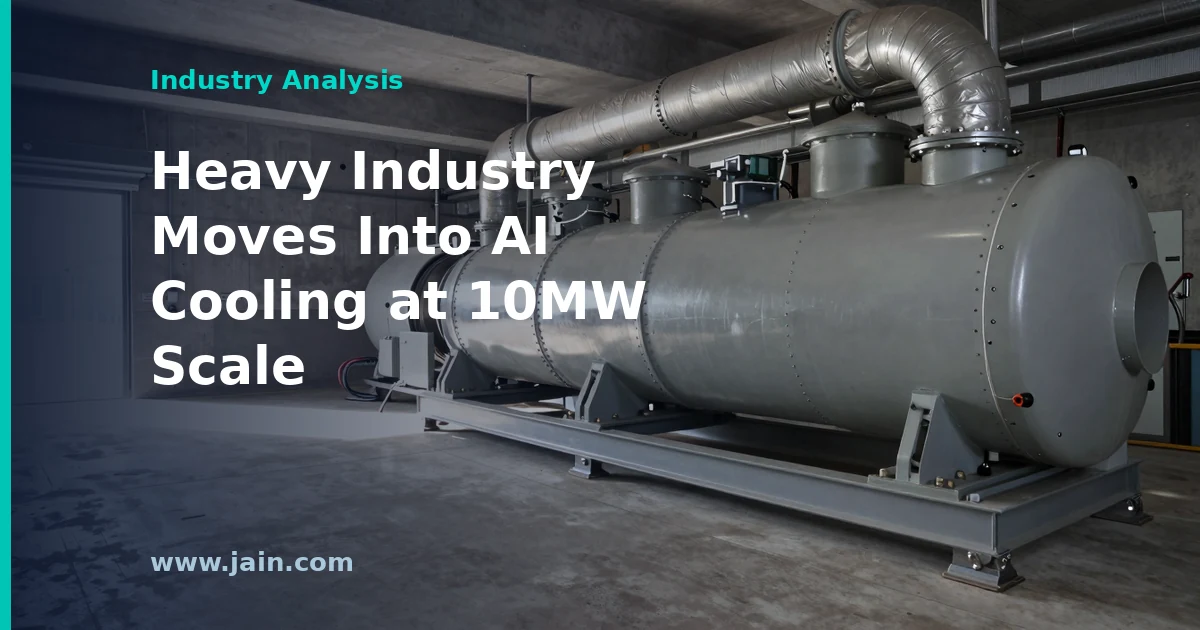
Mitsubishi Heavy Industries (MHI) said in an announcement published July 16, 2026 that it is advancing the commercialization of its AI infrastructure business through the US deployment of a 10MW-class chiller and the development of a product it calls MCP. The company framed both efforts as support for AI infrastructure through modular cooling and collaboration within the NVIDIA ecosystem.
Executive Summary
MHI is presenting three things as one commercial push: a large chiller deployed in the United States, continued MCP development, and collaboration with the group of companies building around NVIDIA’s AI computing platforms. A chiller is the machine that removes heat from the water circulating through a building’s cooling system, and the 10MW-class label places this unit at the large end of what a single data center block might use.
The announcement matters less as a single equipment placement than as a statement of market entry. MHI’s word choice, commercialization, signals a move from development toward selling. The combination it has chosen, physical scale, modular packaging and ecosystem alignment, shows the route a heavy-industry manufacturer can take into a supply chain shaped by the needs of AI computing.
Three Moves That Make Up the Entry Strategy
The headline number describes what MHI is bringing to market. Chillers are generally rated by the heat they remove, so 10MW-class most naturally reads as cooling capacity. As an illustration, a rack of current AI servers can draw on the order of 100 kilowatts, and nearly all of that power becomes heat. On that assumption, 10MW corresponds to the load of roughly 100 such racks, before allowing for backup equipment or the other heat a facility produces. That is a meaningful block of AI computing, and the size plays to the strengths of a manufacturer used to large rotating machinery and industrial plant.
Size alone does not win this business, which is why the other two elements matter. Modularity addresses the way data centers are now built: operators want capacity in repeatable blocks that can be ordered, installed and expanded in step with computing halls. The NVIDIA ecosystem reference addresses a different problem. Cooling designs are increasingly shaped by the requirements of the chips they serve, so a supplier new to the segment benefits from showing that its engineering is connected to that roadmap.
The US deployment completes the picture by placing the equipment in a major market for AI data center construction. For a supplier moving from development to sales, a working installation in that market can do more than a specification sheet, because buyers of critical infrastructure tend to favor equipment they can see operating. Together, these steps form a recognizable path into AI thermal supply: bring industrial scale, package it for fast construction, and align with the platform that sets the requirements.
What This Means for Cooling Buyers and Rivals
For data center operators, another large-equipment supplier is potentially useful in itself. Developers planning multiple sites care about delivery dates and the ability to standardize on a design, and a broader vendor list can reduce dependence on any single manufacturer. Whether MHI delivers that benefit depends on factory output and US service coverage, not on the existence of one deployment.
Established cooling suppliers such as Vertiv, Trane, Carrier and Johnson Controls already serve this market, and they bring installed bases and service networks that a newer entrant in the segment has to match. Heavy-industry manufacturers are likely to compete on engineering depth and large-machine experience. Incumbents can answer with data center track records and field support. Engineering and construction firms will also watch closely, because modular equipment can shift work from the job site to the factory.
The Technical Risk in Betting on Big Chillers
AI cooling requirements are moving quickly. Liquid cooling carries heat directly away from chips, and designs that run on warmer water can reduce the number of hours in which a site needs mechanical chilling, particularly in cooler climates. That does not remove the need for chillers, since many sites still need them for hot weather, mixed air-and-liquid loads and existing computing halls. It does mean the size of the chiller market per megawatt of computing is not fixed.
This is where the MCP work and ecosystem ties could prove more important than the 10MW figure. A supplier whose cooling products track the temperatures and layouts of future computing platforms is better protected against design shifts than one selling a single machine class. The commercial test for MHI is whether this deployment leads to repeat orders across future chip generations.
Background
Mitsubishi Heavy Industries is a Japanese industrial group whose businesses span power generation equipment, aerospace, defense, shipbuilding, and air conditioning and refrigeration. That mix gives it long experience with large machinery and thermal engineering, both of which are relevant to the data center market.
Cooling has become a central constraint in data center design because AI servers pack far more power into each rack than conventional computing, and nearly all of that power turns into heat. As a result, operators are adopting liquid cooling and larger, more standardized facility equipment, widening the opportunity for industrial suppliers. Source: MHI Advances AI Infrastructure Commercialization with U.S. Deployment of 10MW-Class Chiller and MCP Development, Mitsubishi Heavy Industries’ announcement on its modular cooling work and NVIDIA ecosystem collaboration.Sources