
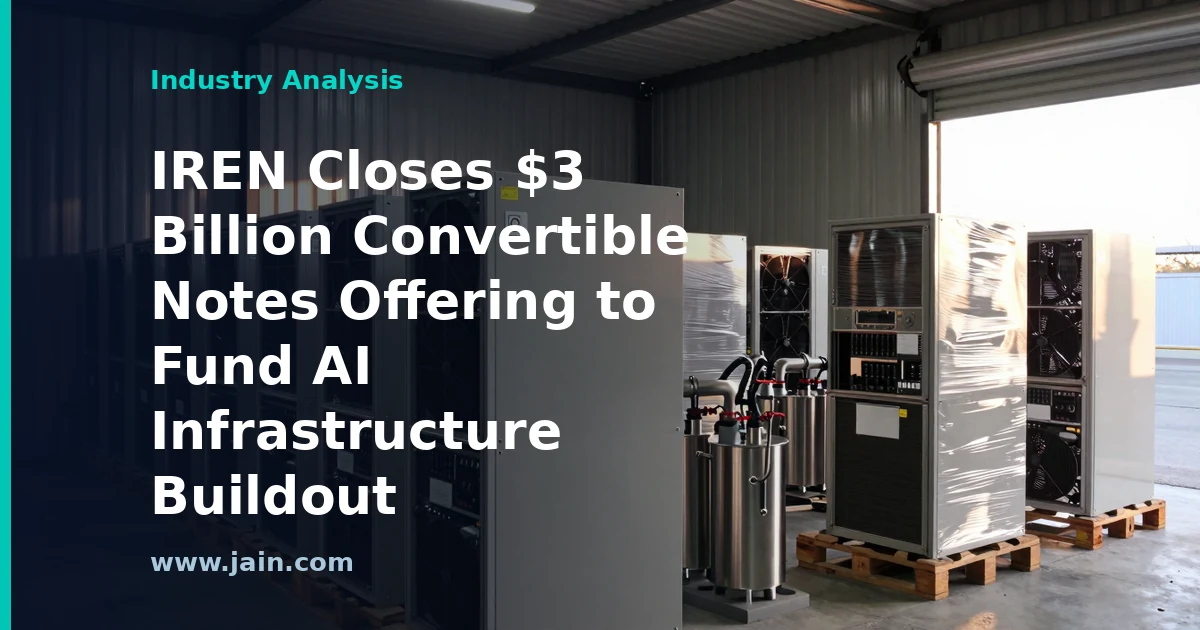
IREN, the publicly traded bitcoin miner repositioning itself as an AI infrastructure company, has closed a $3 billion convertible notes offering, according to a report from The Block dated May 16, 2026. The raise ranks among the largest capital events yet for a company making the miner-to-AI transition.
Convertible notes are debt instruments that can later be exchanged for shares, letting companies borrow at lower interest rates in exchange for potential future dilution. For IREN, the proceeds arrive as the company accelerates its push into AI compute and data center capacity.
Executive Summary
The headline fact is simple: $3 billion in fresh capital, closed, for a company that began life mining bitcoin and now markets itself as an AI infrastructure provider. Capital at that scale is not raised to sustain a mining operation — it is raised to build data centers, buy GPUs, and sign the power and construction commitments that AI compute demands. The offering’s closure, rather than mere announcement, means the money is in hand.
Why it matters: the miner-to-AI pivot has been the dominant strategic story in the bitcoin mining sector for over two years, but most pivots have been announced in press releases rather than financed in capital markets. A closed $3 billion convertible offering is a market verdict of sorts — institutional buyers were willing to lend against IREN’s AI story at convertible terms. It suggests the pivot narrative, at least for the largest and most credible miners, has graduated from concept to bankable strategy.
That said, the report is brief, and the substantive details that determine whether this is cheap or expensive capital — coupon, conversion premium, hedging arrangements, and specific use of proceeds — are not spelled out in the source. Readers should treat the raise as a strong signal of momentum while withholding judgment on its economics.
From Mining Rigs to GPU Halls: Why the Pivot Attracts Capital
Bitcoin miners and AI data center operators need the same scarce ingredients: large blocks of grid power, industrial land, cooling, and the operational muscle to run energy-dense facilities. Miners spent a decade securing exactly those assets, often in power-rich regions where capacity was cheap. When AI demand exploded and grid interconnection queues stretched to five years or more in many markets, energized megawatts became the bottleneck — and miners suddenly held an asset the AI industry desperately wants.
The pivot is not automatic, however. A mining facility is engineered for cheap, interruptible, low-redundancy compute; an AI data center serving enterprise or hyperscale customers typically requires far higher reliability, denser networking, and liquid cooling. Converting one into the other is a genuine construction project, not a rebranding exercise. That is precisely why a raise of this magnitude is the tell: $3 billion is conversion-and-buildout money.
The Economics of Convertible Debt in an AI Land Rush
Convertible notes have become the financing instrument of choice for capital-hungry compute companies. The logic is straightforward: a company with a volatile, high-momentum stock can borrow at a much lower cash interest cost than straight debt would demand, because lenders are partly paid in the option to convert into equity if the stock rises. For shareholders, the trade-off is potential dilution down the road.
For a company straddling bitcoin mining and AI — two of the most volatility-prone narratives in public markets — convertibles are arguably the only large-scale debt market reliably open. Traditional project finance lenders want long-term contracted revenue; a miner mid-pivot often cannot yet show it. The willingness of convertible buyers to absorb $3 billion of IREN paper says the market is pricing meaningful upside into the equity, but it also means the company is, in effect, pre-selling a slice of that upside to fund the buildout.
Winners, Losers, and the Sorting of the Mining Sector
The miner-to-AI transition is sorting the sector into tiers. Companies with large, well-located power portfolios and access to capital markets can finance real conversions; smaller miners without either are left competing in a bitcoin mining business whose economics tighten with every halving — the programmed event that cuts mining rewards roughly every four years. A raise like this one widens that gap: capital compounds, because funded buildouts attract customers, and customer contracts attract cheaper follow-on capital.
For the broader data center industry, well-capitalized former miners are becoming genuine competitors for AI workloads, particularly in the cost-sensitive middle of the market. Incumbent operators retain advantages in reliability track record and enterprise relationships, but the energized-power advantage is real, and $3 billion buys a lot of construction.
What a Closed Raise Does and Does Not Prove
It is worth being precise about what this announcement substantiates. It proves investor appetite: sophisticated buyers committed $3 billion. It does not, by itself, prove customer demand for IREN’s AI capacity, the economics of its contracts, or the timeline on which the capital becomes revenue-generating infrastructure. The AI infrastructure boom has featured both genuinely contracted buildouts and speculative capacity built ahead of demand, and a financing headline cannot distinguish between them. The next meaningful data points will be customer agreements, deployment milestones, and disclosed note terms — not the raise itself.
Background
IREN began as Iris Energy, an Australian-founded bitcoin miner that listed publicly and built a portfolio of power-intensive data center sites, emphasizing access to low-cost and renewable energy. Like much of the mining sector, it faced the structural squeeze of bitcoin’s halving cycle, which periodically cuts mining revenue, just as the generative AI boom created enormous demand for exactly the kind of powered data center capacity miners control.
Over the past two years, the miner-to-AI pivot has become the defining strategic story of the sector, with a handful of large operators securing AI and high-performance computing deals while smaller players remained pure miners. Capital markets have increasingly rewarded the pivot, and large convertible note offerings have become the sector’s signature financing tool for funding GPU purchases and data center conversion at scale.
Source: IREN closes $3 billion convertible notes offering as Bitcoin miner’s AI infrastructure push accelerates — The Block’s May 16, 2026 report on IREN’s completed $3 billion capital raise.