
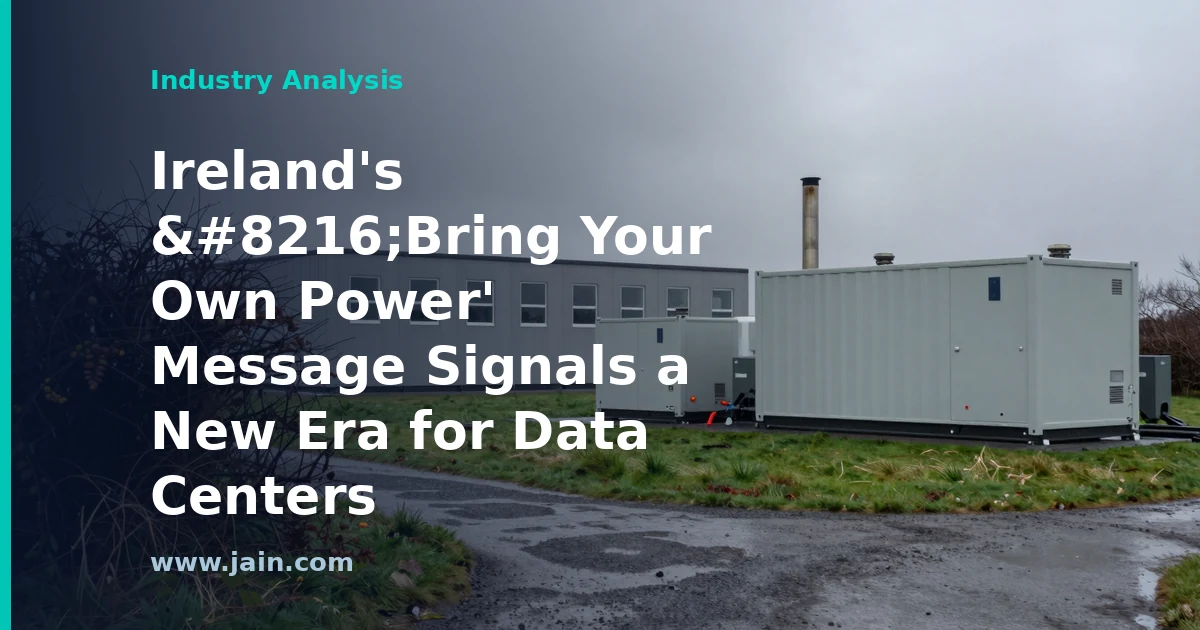
The Wall Street Journal reported on June 6, 2026 that Ireland — one of Europe’s most important data center hubs — is telling technology companies seeking new data center capacity that they should bring their own power generation rather than rely on the national grid. The report frames the stance as a response to years of mounting strain between the country’s booming digital infrastructure sector and an electricity system struggling to keep pace.
Executive Summary
According to the Journal’s reporting, Irish authorities are effectively shifting the burden of powering new data centers onto the companies that build them. Instead of queuing for grid connections that may not materialize for years, hyperscalers — the largest cloud and internet platforms, such as those operating massive server campuses — are being pointed toward on-site or self-procured generation as the price of admission.
Why it matters: Ireland has long punched far above its weight in European data center capacity, and its grid has been under visible stress as a result. If the sovereign host of one of the continent’s densest cloud clusters is now telling its largest customers to power themselves, that is a signal moment for every grid-constrained market — from Dublin to Northern Virginia to Singapore. The economics, siting logic, and competitive dynamics of data center development all change when the utility is no longer assumed to show up.
How Ireland Became the Test Case for Grid Saturation
Ireland’s predicament is not new — it is the culmination of a decade-long collision between two national success stories. Dublin became a preferred European landing zone for American cloud providers, drawn by tax policy, connectivity, a skilled workforce, and EU market access. But data centers are extraordinarily power-dense tenants: official Irish statistics have shown them consuming roughly a fifth of the country’s metered electricity in recent years, a share without parallel among developed economies. The grid operator, EirGrid, had already moved years earlier to restrict new data center connections in the Dublin region, citing capacity and system-stability concerns.
Seen against that backdrop, a “bring your own power” posture is less a sudden policy lurch than the logical end state of a queue that stopped moving. When a grid cannot absorb new large loads without threatening reliability for households and other industry, the choices narrow to three: build transmission and generation faster (slow and politically hard), ration connections (which Ireland has effectively done), or push the load to self-supply. Ireland now appears to be leaning into the third option.
The Economics of Powering Yourself
Self-generation transforms the data center cost model. A grid connection socializes enormous capital costs — power plants, transmission lines, system balancing — across all ratepayers. Bringing your own power means the developer finances generation capacity itself: on-site gas turbines or engines, batteries, contracted private-wire renewables, or some hybrid. That raises upfront capital expenditure substantially and adds fuel-supply, permitting, and emissions obligations that a simple utility contract never carried.
For hyperscalers, this is expensive but survivable — the largest cloud companies have the balance sheets, the energy-procurement teams, and increasingly the appetite to act as their own utilities, as the global wave of data-center-adjacent generation deals demonstrates. For smaller colocation operators and enterprises, the calculus is harsher: self-generation at scale requires expertise and capital that mid-tier players often lack. The likely effect is consolidation of new Irish capacity in the hands of the very largest operators, and a widening gap between markets where power is a utility service and markets where it is a competitive weapon.
Winners, Losers, and the Emissions Question
The clearest near-term beneficiaries are the suppliers of behind-the-meter power: gas turbine and reciprocating-engine manufacturers, battery storage integrators, and developers of private-wire renewable projects, all of which face a customer newly compelled to buy. Grid ratepayers arguably benefit too, since new digital load stops competing with homes and factories for constrained supply. The losers are developers whose Irish pipelines were premised on eventual grid connections, and potentially Ireland’s own climate accounting — if “your own power” means on-site fossil generation, national emissions targets absorb the impact even as grid stress eases.
That tension deserves scrutiny in both directions. Critics of data center growth will note that self-generation can amount to distributed gas plants by another name; industry advocates will counter that hyperscalers have been among the largest corporate buyers of renewable energy in Europe. Both claims can be true, and the honest answer depends on implementation details — fuel types, run hours, and whether storage and renewables are mandated alongside thermal capacity — that the reporting available at publication does not settle.
A Template Other Grids Are Watching
Ireland is not alone; it is simply early. Regulators and utilities in other saturated hubs — the Amsterdam region, Singapore, and parts of the United States where interconnection queues stretch years — have all experimented with pauses, caps, or conditions on data center growth. What makes the Irish stance notable is its directness: rather than saying “no,” it says “yes, if you power it yourself.” That formulation lets a small country keep courting digital investment without asking its citizens to underwrite the electricity. Expect other grid-constrained jurisdictions to study it closely, and expect site-selection teams to treat credible self-generation plans as a standard part of the pitch rather than an exotic fallback. In the AI era, the scarce input is no longer land or fiber — it is firm power, and whoever can bring their own will build first.
Background
Ireland became one of Europe’s foremost data center markets over the past two decades, with Dublin serving as a primary European hub for major American cloud and internet companies. That success came with an unusual burden: official Irish statistics have shown data centers consuming on the order of one-fifth of the country’s metered electricity — a share far higher than in most developed economies — prompting public debate over grid reliability, climate targets, and who should bear the cost of digital growth.
Grid operator EirGrid responded years before this report by constraining new data center connections in the Dublin region, and national policy has since wrestled with how to reconcile continued digital investment with electricity system limits. The reported ‘bring your own power’ stance represents the sharpest articulation yet of where that debate has landed.
Source: Bring Your Own Power, Ireland Tells Tech Titans Hungry for Data Centers — Wall Street Journal report (June 6, 2026) on Ireland directing data center developers toward self-supplied generation.