
TL;DR · 30-second read
The Short Version
Hewlett Packard Enterprise, a company that builds some of the world’s most powerful computers, will spend $75 million over five years to grow its operations in Chippewa Falls, Wisconsin, and hire 75 more people.
The money is not for making computer chips. It pays for assembling, checking and storing finished machines. That is the interesting part: the artificial intelligence boom needs factories and testing space, not just chips.
Wisconsin is backing the plan with up to $5.1 million in tax breaks, which the company only gets if it keeps its promises.
Hewlett Packard Enterprise (HPE) plans to invest $75 million over the next five years to expand its testing, warehousing and manufacturing operations in Chippewa Falls, Wisconsin, and expects to create 75 new jobs, Volume One reported, citing an October 15 joint release from Gov. Tony Evers’ office. The state is supporting the project with up to $5.1 million in additional performance-based Enterprise Zone tax credits.
The new credits amend a 2021 agreement worth $8 million, bringing total available credits to $13.1 million and extending the contract by five years. The Wisconsin Economic Development Corporation (WEDC) board approved the amendment in July 2026. HPE employs about 500 people at its Chippewa Falls sites.
Executive Summary
HPE is putting $75 million into the Wisconsin town where Cray, the supercomputer maker HPE acquired in 2019, was founded. The stated purpose is to add capacity for testing, warehousing and manufacturing so the company can meet what Gov. Evers called “growing global demand for AI and high-performance computing technologies.” High-performance computing, or HPC, is the supercomputer end of the market, and it shares much of its engineering with large AI training systems.
The significance lies in what the money buys. Public debate about AI capacity usually centers on chips and electricity. HPE’s investment targets the step in between: turning processors, memory, networking and cooling hardware into complete systems that have been assembled and verified before they ship. The commitment is modest in dollar terms, but it shows a major systems vendor treating that step as capacity worth expanding.
The investment is also roughly three times the more than $25.9 million HPE invested under its 2021 agreement with the state. That earlier deal, the state says, HPE exceeded. This record helps explain why Wisconsin extended and enlarged the incentive package rather than negotiating a new one.
Why AI Supply Runs Through the Test Floor
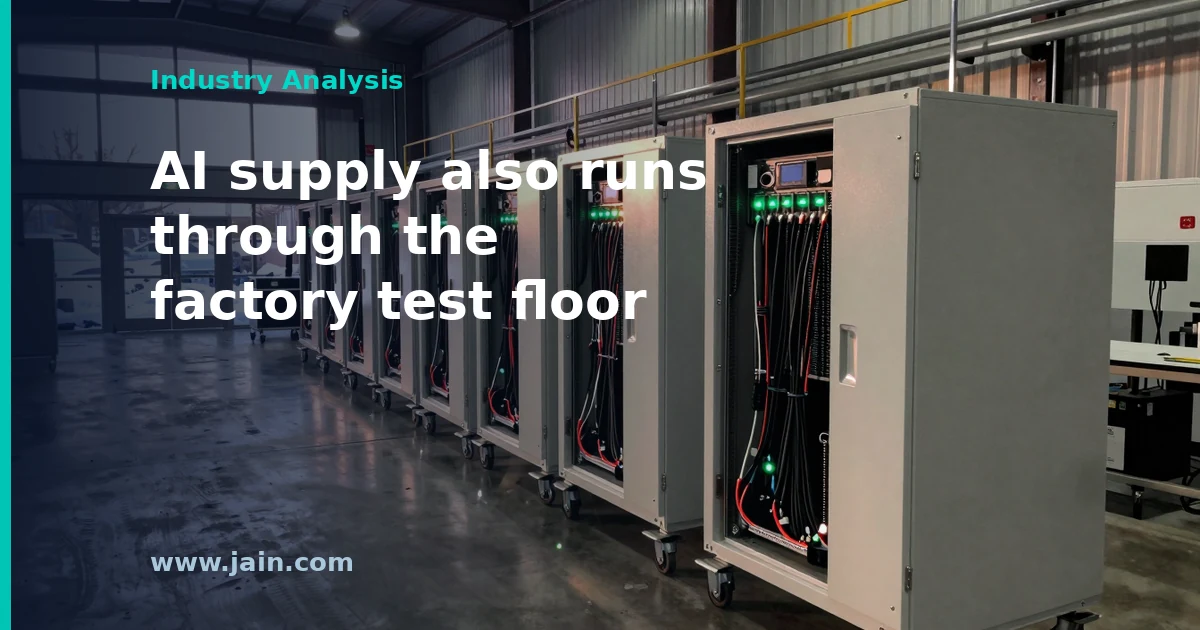
An AI accelerator chip is a component, not a working product. Before it can train a model or run a simulation, it has to be mounted into servers, linked with high-speed networking, connected to power and often to liquid cooling, and grouped into cabinets that hold dozens of such servers. Then the assembled system has to be tested, because faults that surface after installation at a customer’s site are far costlier and slower to fix than faults caught at the factory. In large systems, a single bad cable, memory module or cooling connection can idle work across many processors.
The categories HPE is expanding in Chippewa Falls map directly onto that sequence: manufacturing (assembly), testing (validation) and warehousing (staging components and finished systems). The state ties the expansion explicitly to AI and HPC demand. That is the mechanism behind this article’s headline. When demand for large systems rises, chip supply is only one gate. Others are the floor space, equipment, power and trained technicians needed to build and certify complete machines. A $75 million commitment, roughly triple the investment HPE made under its 2021 agreement, shows the company judging that this gate needs to widen.
The claim has limits worth stating. One company expanding one site does not show an industry-wide shortage of assembly and test capacity, and HPE has not said how much additional system throughput the money buys. What the investment supports is narrower and still useful: a leading supplier of supercomputers and AI systems is spending on domestic integration and testing, not only on procurement. Buyers of large systems and other server makers competing on delivery speed should read that as a sign of where lead times can be won or lost.
The Incentive Math: $5.1 Million Against $75 Million
The new Enterprise Zone credits of up to $5.1 million equal about 6.8% of the planned $75 million investment. Across the full amended contract, available credits total $13.1 million. Because the credits are performance-based, HPE earns them only as it meets investment and hiring targets. That arrangement shifts risk away from taxpayers: if the expansion stalls, the state pays out less.
The track record matters here. Under the 2021 agreement, the state says HPE invested more than $25.9 million, created 120 jobs and retained 486 positions, exceeding its commitments. The WEDC board cited that performance when it amended rather than replaced the contract. For other states courting AI-adjacent manufacturing, the structure is a reference point: extend an existing incentive deal after the company has delivered, instead of front-loading benefits for a new entrant.
The ratio of capital to jobs is also telling. At $75 million for 75 jobs, the plan works out to about $1 million of investment per new position. That points to a project weighted toward facilities and equipment, such as test infrastructure, rather than headcount. It is consistent with system validation, which typically requires power, cooling and specialized gear as well as people.
Chippewa Falls’ Supercomputing Lineage as a Strategic Asset
Chippewa Falls is not a greenfield site. HPE first added Wisconsin to its portfolio in 2016, acquired locally founded Cray in 2019, and in 2021 invested $22 million to create its Global Center of Excellence for High-Performance Computer Manufacturing. That investment produced a 125,000-square-foot manufacturing warehouse on a roughly 15-acre campus. Expanding an established site with an experienced workforce is usually faster and less risky than standing up a new one. In a market where delivery timing matters, that difference counts.
The added 75 jobs would grow a local workforce of about 500 by roughly 15%. Hiring at that scale in a small regional labor market is a real execution task. Technicians who can assemble and debug dense, liquid-cooled systems are not interchangeable with general manufacturing labor. The five-year horizon also deserves a measured view: AI hardware generations turn over quickly, so the capacity HPE builds will need to stay flexible enough to handle systems that do not yet exist.
Background
Chippewa Falls has been a center of American supercomputing since Cray was founded there. Hewlett Packard Enterprise, the enterprise technology company that sells servers, storage, networking and supercomputers, first added Wisconsin to its site portfolio in 2016 and acquired Cray in 2019. In 2021 it invested $22 million to establish its Global Center of Excellence for High-Performance Computer Manufacturing in the city, which led to a 125,000-square-foot manufacturing warehouse on a campus of about 15 acres.
The Wisconsin Economic Development Corporation (WEDC) administers the state’s Enterprise Zone program. The program awards refundable tax credits to companies that commit to significant investment and job creation, and the credits are paid out only as those commitments are met. HPE’s original $8 million Enterprise Zone agreement dates to 2021. Source: Hewlett Packard To Pour $75 Million Into Chippewa Falls Expansion (Volume One), reporting HPE’s $75 million, 75-job expansion and the accompanying Wisconsin Enterprise Zone tax credits. See also Hewlett Packard Enterprise to expand in Chippewa Falls (In Business Madison).Sources