
TL;DR · 30-second read
The Short Version
A former coal power plant site in western Pennsylvania is being rebuilt as what is billed as the biggest natural gas power station now under construction in the United States. It is meant to power the giant computer warehouses behind artificial intelligence.
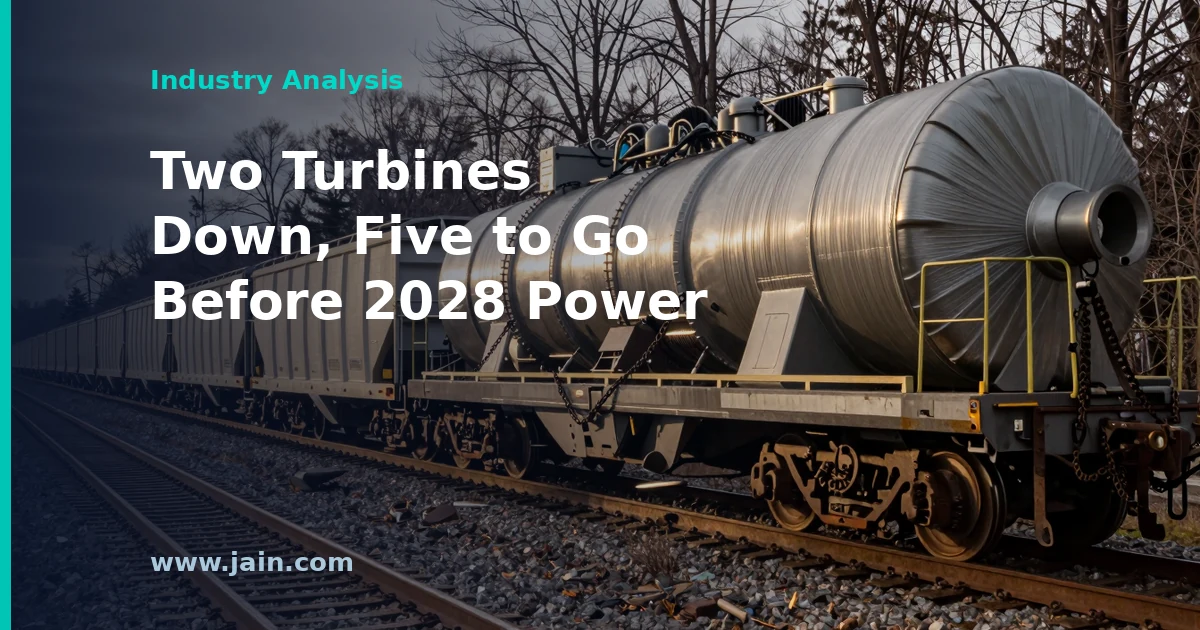
Two of its seven huge turbines, the machines that turn burning gas into electricity, have now arrived. Five more still have to come by train through 2027.
When finished, it could make about as much electricity as four large nuclear plants. Whether it switches on in early 2028 depends on those five deliveries arriving on time.
Foreign Policy Journal reported that two of seven GE Vernova 7HA.02 natural gas turbines were delivered and set at the Homer City Energy Campus in Indiana County, Pennsylvania, in late September 2026. The arrivals mark the start of major equipment installation at the redevelopment of the former Homer City Generating Station, which is projected to produce up to 4.4 gigawatts (GW) when fully operational. The Business Journals described the overall development as a $10 billion project.
Five turbines remain to be delivered by rail later this year and through 2027. Half of the site’s heat recovery steam generators are installed, with the rest due into next year. More than 2,000 tradespeople are on site, and the developers say the project is on pace for first power in early 2028.
Executive Summary
Homer City Generation, its construction partner Kiewit, and turbine supplier GE Vernova have moved the Homer City Energy Campus from site preparation into heavy equipment installation. Two 7HA.02 turbines, GE Vernova’s large, high-efficiency heavy-duty gas turbine class, are now set on their foundations, and the first half of the heat recovery steam generators (HRSGs) is in place. HRSGs capture hot turbine exhaust to make steam for a second, steam-driven generator. That combined-cycle arrangement is what lets a gas plant squeeze more electricity from the same fuel.
The milestone matters because Homer City is one of the clearest tests of whether new gas generation can be built at the scale and speed that data center growth, much of it driven by AI, now demands. At up to 4.4 GW, roughly the output of four large nuclear reactors, the campus is reported to be the largest gas-fired facility under construction in the U.S. The project’s schedule is no longer about whether it will be built. It is about whether the remaining five turbines and the second half of the HRSGs arrive in time to hold an early-2028 first-power date.
Why the 2028 Date Now Depends on Five Deliveries
With two of seven turbines on site, about 29% of the campus’s prime movers are physically present. The other five, along with half of the HRSGs, are still in transit or in manufacturing. The developers have tied the early-2028 first-power target directly to that pipeline: rail deliveries continue later this year and throughout 2027, and the heavy-haul contractor, Edwards Moving and Rigging, is expected back in 2027 for the next phase. Since September it has moved 20 pieces of equipment from Schenley, Pennsylvania, to the site. Each move required coordination with the Pennsylvania Department of Transportation, local police and traffic control.
The mechanism is straightforward. In a combined-cycle plant, foundations, piping and buildings can be built in parallel, but a generating unit cannot be commissioned until its turbine and matching HRSG are installed, connected and tested. Construction labor, now more than 2,000 tradespeople, can be scheduled flexibly. A 7HA-class turbine cannot. These machines are among the largest single pieces of equipment in power generation. They are built to order, and they move on specialized rail cars and road trailers. Spread across seven units, the 4.4 GW target works out to an average of roughly 630 megawatts of plant output per turbine block. Every late delivery therefore postpones a large share of capacity, not a marginal one.
The people exposed to that timing are the data center developers and power buyers who would rely on the campus’s output, the grid planners who must account for it, and the investors financing a $10 billion build. Heavy-duty gas turbines have become a long-lead item across the industry as data center demand has lifted orders. Homer City’s delivery cadence through 2027 will show whether a project that reserved its equipment early can actually convert that reservation into steel on schedule.
From Announcement to Construction
Gigawatt-scale AI power announcements are common. Projects with equipment on foundations are much rarer. Homer City now has delivered turbines, installed HRSGs, a large active workforce and a named equipment supplier and constructor. That evidence puts it ahead of the many proposed AI-power campuses that remain at the land-and-letter-of-intent stage.
Some framing in the coverage deserves calibration. The claim that this is the largest gas facility under construction in the U.S. is stated without a comparison set, though a 4.4 GW figure makes it plausible. The zero OSHA-recordable incident record (OSHA is the federal workplace safety regulator) is cited by Homer City Generation, Kiewit and GE Vernova themselves. It is a meaningful indicator on a site this size, but it is self-reported. The CEO’s description of “an unprecedented level of economic opportunity” for Indiana County is an aspiration, not a measured outcome.
What Gas at This Scale Means for AI Power Buyers
For data center developers, Homer City illustrates the trade-off behind gas-fired AI power. Combined-cycle gas plants can be built faster than new nuclear and run around the clock, unlike solar or wind without storage, which suits the steady loads of AI training clusters. The cost of that speed is concentrated exposure: one site, one turbine model, one supplier and one fuel. A delay at any link affects gigawatts at once.
For GE Vernova, the delivery is a visible proof point for its gas power business. Dave Ross, who leads that business in the Americas, linked the project to rising electricity demand. For the wider market, the important signal is not the turbine landing itself. It is whether the next five arrive on the schedule now set out publicly, because other buyers weighing gas-backed AI campuses will treat Homer City’s 2027 delivery record as a reference case.
Background
The Homer City Generating Station in Indiana County, western Pennsylvania, was a large coal-fired power plant before it closed. Homer City Generation is redeveloping the site as a natural gas-fired energy campus, working with construction firm Kiewit and turbine supplier GE Vernova. The project has been positioned to serve the surge in electricity demand from data centers, much of it tied to AI computing.
GE Vernova, spun off from General Electric and listed on the New York Stock Exchange as GEV, makes gas turbines, grid equipment and wind and nuclear technology. Large gas turbines have become one of the most sought-after pieces of equipment in the power industry as utilities and data center developers race to add firm, always-available generation. Source: 4.4-Gigawatt Position On U.S. Gas Power Takes Shape As GE Vernova (NYSE: GEV) Turbines Land In Pennsylvania (Foreign Policy Journal) reports on the first turbine deliveries and equipment installation at the Homer City Energy Campus. Also: Homer City Energy Campus installs first equipment as development of $10B project advances (The Business Journals).Sources