
TL;DR · 30-second read
The Short Version
A company best known for mining Bitcoin has put more than $250 million into large computer facilities in Paraguay, beside one of the world’s biggest hydroelectric dams.
The bet is that cheap, clean electricity can power the computers behind artificial intelligence tools. The site already uses electricity on the scale of a city, and the company plans to grow it by a third.
The catch is that cheap power is only the start. Artificial intelligence customers also want backup systems, fast internet links and fewer outages, and the company is still building those.
Crypto Briefing reported that HIVE Digital Technologies, a Nasdaq-listed Bitcoin miner, has committed more than $250 million to data centers in Paraguay over the past 18 months as part of a push to build an AI hub there. The sites sit near the Itaipú hydroelectric dam and currently run at 300 megawatts (MW) of capacity. Including energy procurement and infrastructure costs, HIVE’s total commitments exceed $400 million.
HIVE plans to raise capacity to 400 MW at its Yguazú facility, with a third-quarter 2026 target. It calls the next stage of the sites “Tier 3 AI factories.” HIVE produces about 8.5 bitcoin per day, says it exports compute capacity to the United States, and reports adding more than 300 jobs in Paraguay, 40 of them engineering roles.
Executive Summary
HIVE Digital Technologies is turning a hydro-powered Bitcoin mining footprint in Paraguay into what it hopes will become an AI compute hub. The spending is substantial for a company of HIVE’s size: more than $250 million on data centers and more than $400 million once power procurement and supporting infrastructure are included, all concentrated in one country.
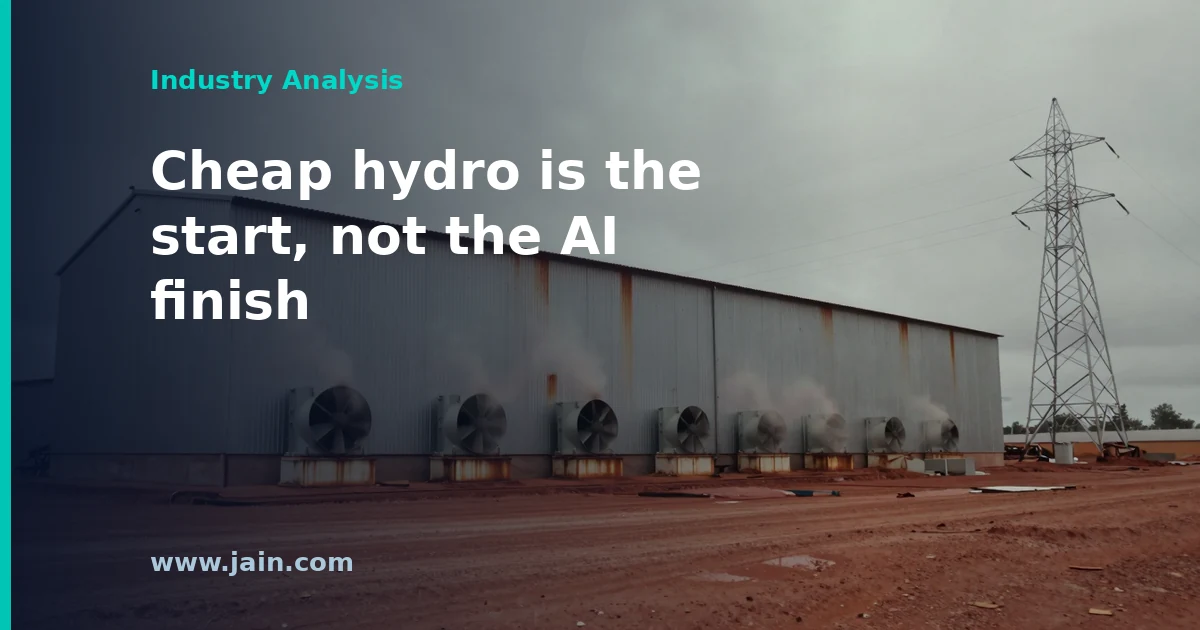
The detail that matters most for AI buyers is the description of the facilities themselves. HIVE’s existing sites are described as Tier 1, the most basic data center class, built without redundant power or cooling paths. Its own label for the next stage, Tier 3, is the class most enterprise and cloud customers expect. That gap between what exists and what AI tenants typically require is the real story behind the headline dollar figure.
Paraguay offers what many U.S. data center markets now struggle to supply: large blocks of available, renewable electricity. The open question is whether HIVE can add the redundancy, connectivity and contracted customers that turn cheap megawatts into rentable AI capacity.
Tier 1 to Tier 3: The Upgrade That Turns Power Into an AI Product
Data center tiers, a classification system popularized by the Uptime Institute, describe how resilient a facility is. A Tier 1 site has a single path for power and cooling and no redundant components, so maintenance or a single equipment failure can take machines offline. A Tier 3 site is “concurrently maintainable”: any component can be serviced without shutting down the computing load, because there are redundant power and cooling paths.
For Bitcoin mining, Tier 1 is a rational choice. Mining rigs can be switched off and on with little consequence beyond lost output, and many miners deliberately curtail during grid stress. AI customers renting GPU capacity are a different buyer. They pay for guaranteed availability, often under service-level agreements, and an interrupted training run or an unavailable inference endpoint has real costs. HIVE’s own description of its next phase as “Tier 3 AI factories” concedes the point: the 300 MW running today is power-rich infrastructure, not yet the class of facility most AI tenants contract for.
That reframes the spending. The gap between the $250 million data center figure and the more-than-$400 million total reflects energy procurement and infrastructure, and the Tier 1-to-Tier 3 conversion adds redundant electrical systems, backup capacity and, for dense GPU racks, cooling that mining halls were never designed for. Some large-scale training workloads tolerate less redundancy than enterprise inference does, so the mix of tenants HIVE targets will determine how much of the site needs the full upgrade. Either way, the people affected are HIVE’s capital budget, the contractors and equipment suppliers who would build the upgrade, and any AI tenant weighing whether the site meets its uptime requirements.
Cheap Hydro Solves the Scarce Input, Not the Distance
Power has become the binding constraint on AI data center construction in many U.S. markets, where new large loads can wait years for grid connections. Paraguay inverts that problem. Its share of the binational Itaipú dam, which it co-owns with Brazil, gives the country far more hydroelectric output than it consumes domestically, and HIVE’s site sits next to that supply. For a company competing on cost per megawatt, that is a genuine advantage.
Distance is the trade-off. Paraguay is landlocked, so international fiber routes must cross neighboring countries before reaching subsea cables to North America. That matters less for model training, which runs for days or weeks and is insensitive to a few extra milliseconds, than for inference, where users and applications expect fast responses. HIVE says it is already exporting compute capacity to the United States; how that capacity is delivered, and for which workloads, will determine whether the site competes for training jobs only or can serve latency-sensitive customers too.
A Single-Country Bet Funded Partly by Mining
With total commitments above $400 million, HIVE has concentrated a large share of its future in one country’s grid, regulatory environment and politics. The company has emphasized local benefits, including more than 300 jobs, 40 engineering roles and education programs supplying Starlink connectivity and computers to schools, and its investment preceded recent diplomatic activity between the U.S. and Paraguay. Those factors may support its standing locally, but they do not substitute for long-term power contracts and regulatory certainty.
The roughly 8.5 bitcoin per day HIVE produces gives it operating cash flow during the transition, but also creates an allocation question. Every megawatt converted to AI hosting is a megawatt no longer mining. Several listed miners have made a similar pivot toward AI and high-performance computing hosting, and the ones that have convinced investors are generally those that announced contracted tenants. Until HIVE discloses how its Paraguay capacity splits between mining and AI, the AI hub remains an ambition backed by power and real estate rather than by signed demand.
Background
HIVE Digital Technologies, formerly HIVE Blockchain Technologies, is a Nasdaq-listed company that built its business mining cryptocurrency and has since repositioned toward AI and high-performance computing. Executive Chairman Frank Holmes has been a leading voice for the company’s Paraguay strategy. HIVE entered the country in 2025 by acquiring a hydro-powered site from Bitfarms, and expanded it to 300 megawatts within roughly 18 months.
Paraguay’s electricity comes overwhelmingly from hydropower, much of it from the Itaipú dam it shares with Brazil. That surplus of low-cost renewable power has made the country attractive to Bitcoin miners, and now to companies hoping to convert mining infrastructure into AI data centers, a shift several listed miners have attempted as AI demand has outpaced available power in established data center markets. Source: HIVE commits more than $250 million to build an AI hub in Paraguay (Crypto Briefing) on HIVE Digital Technologies’ data center investment and 400 MW expansion plan near the Itaipú dam.Sources