
TL;DR · 30-second read
The Short Version
HIVE Digital, a company that runs large computer centers, is borrowing $129 million to help buy about 2,300 of Nvidia’s top artificial intelligence chips. The purchase totals $165 million, and the chips will be installed in Canada.
The chips will serve one customer: the artificial intelligence company Cohere, which signed a three-year deal worth $225 million. The loan also lasts three years. It will be paid back out of Cohere’s payments, using up roughly two-thirds of them.
The surprising part is who the lender is really betting on. It is mostly counting on one customer paying its bills, with the chips themselves as the fallback.
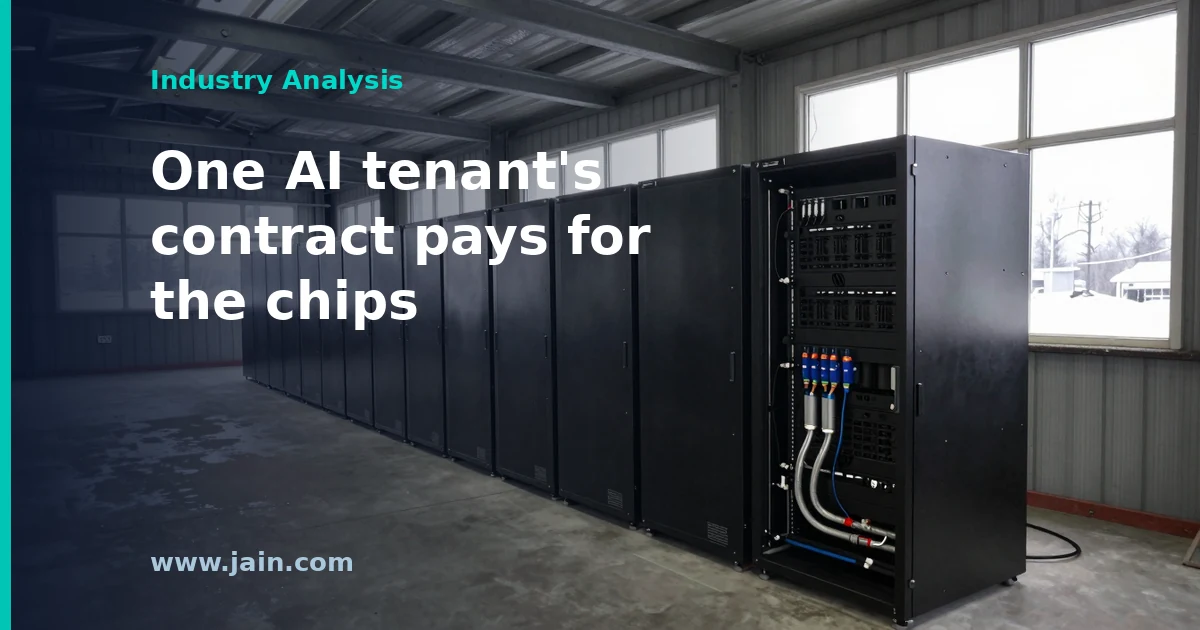
StreetInsider reported on October 28, 2026 that HIVE Digital Technologies (NASDAQ: HIVE) has secured a $129 million fixed-rate credit facility from an institutional lender. The money will buy an Nvidia GB200 NVL72 cluster of 2,303 GPUs, the graphics processors that do the heavy computing in AI, for artificial-intelligence company Cohere. HIVE is borrowing through its indirect subsidiary BUZZ Alpha Cloud Inc. The loan carries a 9.0% annual rate over three years and fully amortizes. That means principal and interest are paid down over the life of the loan, and no lump-sum payment is due at the end.
The $165 million cluster is tied to a three-year, fixed-term contract with Cohere. HIVE values that contract at $225 million, covering GPU compute, connectivity and storage. The loan covers about 80% of the cluster’s cost. The rest comes from 0% convertible bonds HIVE issued earlier. Delivery is expected toward the end of the fourth quarter of 2026, for deployment in Canada.
Executive Summary
On its face this is an equipment loan, but its structure is closer to project finance. A ring-fenced subsidiary borrows against the chips it buys. A single customer contract supplies the cash to repay the loan. The loan’s three-year term matches the contract’s three-year term. The disclosed security package has three parts:
- the GPUs and related assets;
- a pledge of the subsidiary’s shares;
- a limited-recourse guarantee from HIVE’s BUZZ HPC unit.
That makes Cohere’s payments the engine of the deal. On standard amortization assumptions, servicing the loan would take roughly two-thirds of the $225 million contract value. The remainder must cover power, cooling, networking, storage and operations, and provide a return on the roughly $36 million HIVE is contributing. At the end of the term, HIVE owns the hardware outright with no residual payment.
The deal also shows how companies that built their businesses on cryptocurrency mining are financing a move into AI cloud services. They sign contracted revenue first, then raise debt sized to it, and push equity dilution into the future through convertible bonds. HIVE’s chief executive, Aydin Kilic, said the company has signed $600 million in total contract value across three GPU off-take agreements this year. Cohere’s contract accounts for a little more than a third of that.
Cohere’s Contract Is the Credit
Three figures define this deal: the loan, the contract and the clock.
- The loan is $129 million at a fixed 9%.
- The contract is worth $225 million.
- Both run three years.
BUZZ Alpha Cloud intends to repay the facility from contract revenue. Cohere’s payments, not HIVE’s wider mining and hosting business, are therefore the planned source of repayment. The lender is underwriting a customer relationship as much as a borrower.
HIVE has not published the payment schedule, but the arithmetic falls within a narrow range:
- Monthly payments: a $129 million loan at 9% over 36 months costs about $4.1 million a month, or roughly $148 million in total.
- Annual payments: the total rises to about $153 million.
Either way, debt service consumes about 66–68% of the contract’s stated value. Spread evenly, the Cohere contract brings in about $75 million a year. Loan payments would take roughly $49–51 million of that.
What remains is on the order of $72–77 million over three years. It must pay for electricity, cooling, network capacity, storage, site operations and staff, and generate a return on HIVE’s equity. That cushion is real, but it assumes the cluster arrives on schedule and starts billing early in the term. A late start, an extended outage or a renegotiation would hit HIVE’s margin first. If revenue stopped altogether, the lender’s fallback would be the chips, and they lose value as newer Nvidia generations ship.
The exposure is concentrated:
- The lender depends on a single customer.
- HIVE’s shareholders depend on the operating margin left after debt service.
- Cohere, for its part, gets dedicated capacity without owning hardware.
A Project-Finance Template for GPU Clouds
The loan sits inside BUZZ Alpha Cloud, a special-purpose subsidiary. It is secured by that entity’s GPUs and related assets, backed by a limited-recourse guarantee from BUZZ HPC, and supported by a pledge of BUZZ HPC’s shares in BUZZ Alpha Cloud. A limited-recourse guarantee caps how far the lender can reach beyond the pledged assets. The share pledge lets the lender take control of the subsidiary if it defaults. Pipelines and power plants are financed the same way: lend against a contracted cash flow and a hard asset, and keep the obligation inside a box.
Full amortization is the telling design choice. Because no residual payment is due, the lender takes no view on what a GB200 will be worth in three years. The contract alone is meant to retire the debt. The question of the chips’ value after three years therefore passes to HIVE. If they hold value, HIVE can re-lease or resell them and keep the upside. If newer chips erode their value, the lender has already been repaid. A three-year payoff is a conservative estimate of a GPU’s useful life, and it ties the debt to the contract rather than to the hardware’s possible life.
The unit economics give industry readers a benchmark:
- Cost: $165 million across 2,303 GPUs is roughly $71,600 per GPU, all-in with related infrastructure.
- Revenue: the $225 million contract works out to about $97,700 per GPU over three years.
- Hourly rate: that is roughly $3.70 per GPU-hour, blended across compute, connectivity and storage, assuming full use from day one.
The 9% rate is fixed, so HIVE carries no floating-rate risk over the term. Combined with the zero-coupon equity slice, the cash interest cost on the full $165 million is about 7%.
Zero-Coupon Converts Carry the Equity Slice
The roughly $36 million not covered by the loan comes from convertible bonds HIVE issued earlier: $245 million gross, about $200 million net after capped calls. A convertible bond is debt that can later turn into shares. At 0%, it pays no cash interest. A capped call is a hedge bought when the bonds are issued. It offsets dilution from conversion up to a set share price, which is why net proceeds are lower than gross. This cluster uses about 18% of those net proceeds.
The statement that no common shares are being issued in connection with the financing is accurate for this loan. But the equity slice draws on instruments that can become shares later. Dilution has been deferred and partly hedged, not eliminated.
The template also has to scale. HIVE says it has signed $600 million in contract value across three off-take agreements this year. If the other two contracts, worth about $375 million combined, are financed the same way, HIVE will need more lenders willing to underwrite individual tenants and more convertible capital for the equity portions. Customer concentration is built into this model. The test is whether each contract’s terms protect the debt stacked on top of it.
Background
HIVE Digital Technologies, formerly HIVE Blockchain Technologies, built its business on cryptocurrency mining and now also sells GPU computing for AI through its BUZZ HPC unit. It operates data centers in Canada, Sweden and Paraguay. Its shares are listed on the Toronto Stock Exchange, Nasdaq and the Bolsa de Valores de Colombia. Several former and current miners are making a similar shift. They are applying their experience securing power and running dense computing halls to the business of renting AI chips. Companies doing this are often called “neoclouds”: specialized cloud providers that lease GPU capacity to AI developers.
Cohere develops large language models, the AI systems behind chatbots and enterprise text tools, for business customers. Training and running such models requires large GPU clusters. AI developers increasingly rent dedicated capacity under multi-year contracts instead of building their own. Those contracts have become the basis on which smaller infrastructure providers borrow to buy the hardware. Source: HIVE Digital secures $129M loan to fund Nvidia GPU cluster for Cohere — StreetInsider’s report on the 9% credit facility financing HIVE’s Nvidia GB200 cluster for Cohere.Sources