
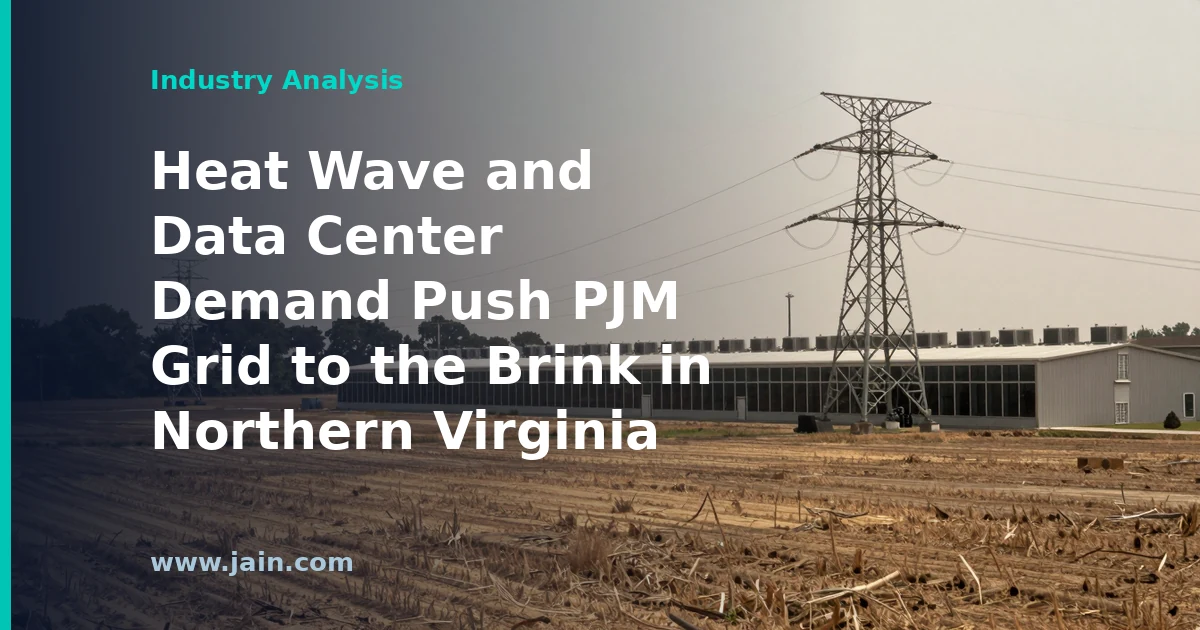
The Prince William Times reported on July 4, 2026 that a summer heat wave, layered on top of the enormous electricity appetite of the region’s data centers, pushed the regional power grid “to the brink.” The grid in question is operated by PJM Interconnection, the regional transmission organization that coordinates electricity across all or parts of 13 states and the District of Columbia — including Northern Virginia, home to the largest concentration of data centers in the world.
The report frames a collision that grid planners have warned about for years: weather-driven peak demand from air conditioning arriving at the same moment as a structural, around-the-clock load from data centers that has grown far faster than new generation and transmission have been built.
Executive Summary
According to the report, the stress event unfolded in Prince William County, Virginia and the surrounding region — the heart of “Data Center Alley,” where Prince William and neighboring Loudoun County host an unmatched density of hyperscale and colocation facilities. During a heat wave, residential and commercial air conditioning drives electricity demand to its annual peaks; data centers, unlike air conditioners, draw near-constant power day and night, so their load sits underneath the weather peak rather than replacing it.
Why it matters: grid operators plan for the single worst hour of the year. When a fast-growing baseload (data centers) raises the floor and a heat wave raises the ceiling, the margin between available supply and peak demand — the buffer that prevents emergency measures like conservation appeals or rolling outages — shrinks. A “to the brink” event is a concrete, dated data point in a debate that is often conducted in abstractions about future AI load forecasts.
A caveat on sourcing: this is a single local-newspaper account, and the headline-level material available does not specify which emergency procedures, if any, PJM invoked, what demand peaked at, or how close reserves actually came to exhaustion. Those specifics matter, and we flag them below.
The Peak Problem: Flat-Out Air Conditioning Meets Always-On Compute
Electric grids are sized for their worst hour, not their average one. In PJM territory that worst hour almost always occurs on a hot summer weekday afternoon, when tens of millions of air conditioners run simultaneously. Data centers change the arithmetic because they are effectively a new floor under demand: a large AI training or cloud facility draws a high, steady load 24 hours a day, in fair weather and foul. When a heat wave arrives, that steady draw does not politely step aside — it stacks. The result is that the same heat wave that a decade ago would have been routine can now push a region toward its limits, which is precisely the dynamic the Prince William Times describes.
For lay readers, “to the brink” typically means the grid operator is working through its escalation ladder — asking generators to defer maintenance, importing power from neighbors, calling on demand-response customers who are paid to curtail, and in the worst case shedding load (rolling blackouts). The available reporting does not tell us how far down that ladder PJM went in this event, and that distinction — between a tight day and a genuine emergency — is the difference between a warning sign and a crisis.
Northern Virginia Is the Stress Test the Rest of the Country Is Watching
Prince William County is not a random dateline. Northern Virginia is the world’s largest data center market, and the AI buildout has accelerated demand there just as it has become harder to site new transmission lines and generation. PJM’s own capacity auctions — the mechanism by which the operator procures commitments of future power supply — have cleared at sharply higher prices in recent cycles, a market signal that supply is not keeping pace with projected demand. A heat-wave near-miss in this region is therefore a preview: other fast-growing data center corridors in Texas, Georgia, Ohio, and Arizona face versions of the same squeeze.
The economics cut in several directions. Utilities and independent power producers benefit from higher capacity prices and large, creditworthy new customers. Data center operators face rising power costs and, increasingly, multi-year waits for grid connections — which is pushing some toward on-site generation, long-term nuclear and renewable contracts, and demand-flexibility commitments. Residential ratepayers, meanwhile, worry about absorbing the cost of grid upgrades driven by industrial customers, a tension that is now a live political issue in Virginia and across PJM’s footprint.
Who Bears the Risk — and Who Blinks First in the Next Heat Wave
Events like this sharpen a policy question that regulators have so far answered only partially: when supply gets tight, whose power is interruptible? Data centers have historically demanded — and paid for — extreme reliability, backed by on-site diesel or battery backup. That backup capacity is mostly idle during grid emergencies. Proposals to enroll data centers in demand-response programs, require flexible-load commitments as a condition of interconnection, or price peak consumption more aggressively all gain momentum every time a grid operator has a bad afternoon.
There is also a reputational dimension. The data center industry argues, with some justification, that it pays substantial sums into the grid and that load growth also comes from electrification of homes, vehicles, and factories. But headlines that pair “heat wave” with “data centers” and “brink” land hard with the public regardless of the precise load attribution. Operators that can document flexibility — shifting deferrable computing work away from peak hours, dispatching backup assets to support the grid — will have an easier time in siting battles than those that cannot.
Background
Northern Virginia became the world’s data center capital over two decades, thanks to early internet exchange points, cheap land, favorable tax treatment, and proximity to federal and enterprise customers. Loudoun County led the first wave; Prince William County became the frontier of the next one, with the AI boom driving proposals for ever-larger campuses. PJM Interconnection, formed from a power pool dating to 1927, operates the transmission grid across the Mid-Atlantic and parts of the Midwest and has repeatedly flagged accelerating load growth — led by data centers — as a central reliability challenge of the coming decade.
The tension surfaced well before this heat wave: PJM’s recent capacity auctions cleared at dramatically higher prices, utilities in Virginia have proposed new rate structures for large loads, and local land-use fights over data center siting in Prince William County have become some of the most contentious in the country. A dated, weather-driven stress event adds an operational exclamation point to what had largely been a forecasting debate.
Source: Heat wave, data centers’ huge demand push regional power grid to the brink — Prince William Times, July 4, 2026, reporting on grid strain in the PJM region amid a heat wave and data center load growth.