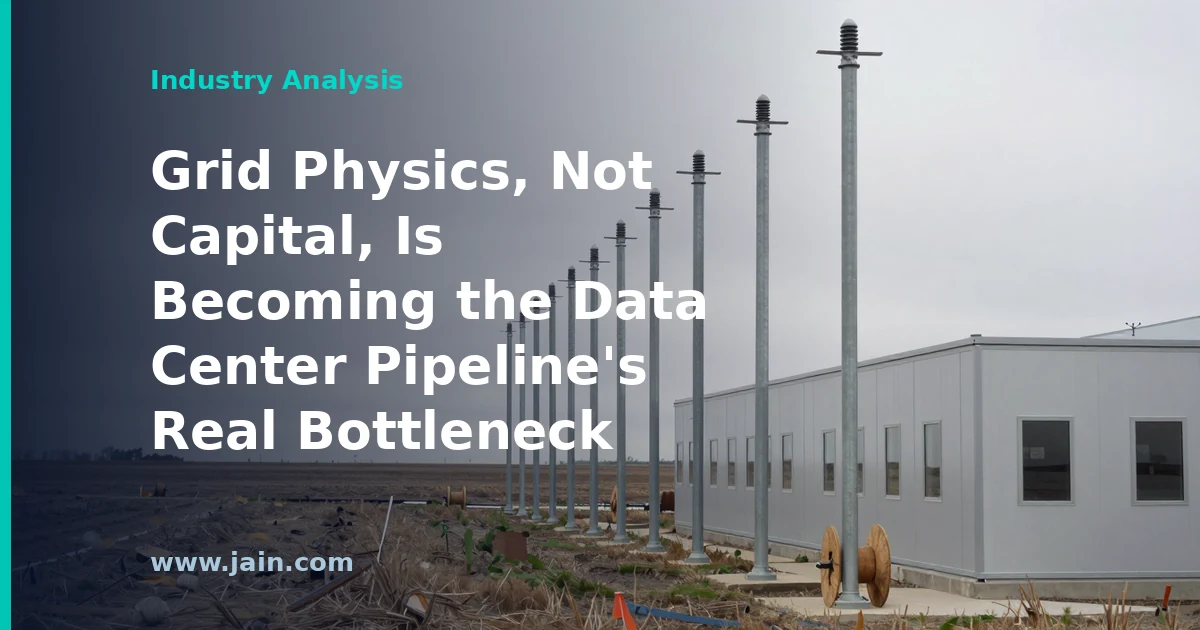
Latitude Media reports that the physical realities of the electric grid are “setting in” for the data center development pipeline. The April 26, 2026 piece frames a shift the industry has been circling for two years: the constraint on new AI-driven data center capacity is increasingly not capital, land, or chips, but whether the grid can physically deliver the power — and how long interconnection and transmission upgrades take.
Executive Summary
The report’s core observation is that the announced data center pipeline — the sum of projects developers have declared — is colliding with what the transmission system can actually serve. Interconnection (the formal process of connecting a large new load or generator to the grid) and transmission capacity (the physical ability of high-voltage lines to move power to a given location) operate on utility timescales measured in years, while hyperscale demand has been announced on timescales measured in quarters.
Why it matters: if grid physics is the binding constraint, then the familiar metrics of the buildout — megawatts announced, acres acquired, capital committed — stop predicting what actually gets energized and when. Siting strategy shifts from “where is land and fiber” to “where is deliverable power,” and the advantage moves to players who secured interconnection positions early or who can bring their own generation.
Announced Megawatts Are Not Energized Megawatts
A recurring pattern in this cycle is the gap between the announced pipeline and deliverable capacity. A developer can buy land, order equipment, and issue a press release in months; a utility must study the new load’s effect on the surrounding network, plan any needed substation and transmission upgrades, and build them — a sequence that routinely runs on multi-year timelines. The Latitude Media framing, that physical realities are “setting in,” suggests the market is starting to discount announcements accordingly. For readers of industry news, the practical takeaway is to treat energization dates, not announcement dates, as the real milestone.
Why Transmission Is the Hard Constraint
Transmission is unforgiving because it is physics plus process. Physically, a high-voltage line can carry only so much power before thermal and stability limits bind, and a concentrated gigawatt-scale load changes flows across an entire region, not just one feeder. Procedurally, upgrades require engineering studies, regulatory approvals, cost-allocation fights over who pays, and often new rights-of-way. None of these steps compresses easily with money. That is what distinguishes this bottleneck from earlier ones like GPU supply or land: you cannot pay a premium to make load-flow studies and line construction happen in a quarter.
Winners: Whoever Holds Deliverable Power
If interconnection position is the scarce asset, several groups benefit. Incumbent data center operators with existing utility relationships and already-energized capacity hold something new entrants cannot quickly replicate. Sites with surplus deliverable power — including brownfield industrial locations with legacy grid infrastructure — gain value relative to greenfield land. And “bring your own power” strategies, from on-site generation to co-location with existing plants, move from novelty to mainstream consideration, though they introduce their own permitting, fuel, and regulatory questions. Conversely, late-arriving developers whose projects sit deep in interconnection queues face the risk that their capacity arrives after the demand it was meant to serve has been placed elsewhere.
The Siting Map Is Being Redrawn
For two decades, data center geography followed fiber routes, tax incentives, and cheap land. A grid-constrained era redraws that map around electrical headroom: regions with spare transmission capacity, faster-moving utilities, or generation-rich locations become competitive even without a legacy data center cluster. This also raises a policy dimension — utilities and regulators must decide how much speculative load to plan for, and how to protect other ratepayers from paying for infrastructure serving projects that may not materialize. How that risk gets allocated will shape which regions court this demand and which slow-walk it.
Background
Data center development historically treated electricity as a routine input: sites were chosen for fiber connectivity, land cost, and tax treatment, and utilities absorbed the load growth without drama. The AI buildout that accelerated from 2023 onward broke that assumption, with individual campuses proposed at power levels comparable to heavy industry and developers announcing capacity far faster than grid infrastructure has historically been built.
By 2026 the conversation across the industry had shifted from chip supply and capital availability to power delivery — interconnection queues, transformer and equipment lead times, and transmission planning. The Latitude Media piece discussed here sits in that context: an energy-sector publication documenting the moment when the announced pipeline meets the grid’s physical and procedural limits.