
TL;DR · 30-second read
The Short Version
Google and Telstra, Australia’s leading phone and internet company, have agreed to use each other’s cables.
Google gets strands of fiber on Telstra’s new cross-country network, already more than 8,000 kilometers long, or roughly twice the drive from Sydney to Perth. Telstra gets space on three undersea cables that are part of Google’s Pacific programs, linking Australia to Japan, the Pacific Islands and the United States.
Why it matters: if one cable is cut, internet and artificial intelligence services can reroute instead of going dark. Neither company said what the deal is worth.
Google and Telstra announced a partnership on June 1, 2026, that connects the two companies’ networks on land and at sea. Google will secure inter-city dark fiber, which is unlit fiber that the buyer switches on with its own equipment, on Telstra’s new Aura Network backbone. In return, Telstra will use subsea fiber pairs on the Tabua, Proa and Bulikula cable systems through Google’s Pacific Connect and Australia Connect initiatives. Those cables link Australia with Japan, the Pacific Islands and the United States.
The deal was announced jointly by Bikash Koley, Google’s Vice President of Global Infrastructure, and Steven Worrall, CEO of Telstra Digital Infrastructure. Worrall said Aura has more than 8,000 kilometers of fiber already laid, and that its Melbourne-Canberra-Sydney coastal routes launched late last year. The companies did not disclose financial terms, capacity volumes or in-service dates.
Executive Summary
This is a reciprocal infrastructure arrangement, and it is not a conventional supply contract. Each company takes access to the half of the network the other one is building. Google is a major builder of subsea cable, and it gains terrestrial backbone across Australia’s key inter-city corridors. Telstra owns the country’s most extensive domestic network, and it gains fiber on three international systems that reach Japan, the Pacific Islands and the United States.
The stated goal is resilience. The companies say that joining their land and sea routes will let each of them ‘remove single points of network failure.’ The underlying argument is an operational one that often gets lost in AI-infrastructure coverage. Diverse ocean cables do not add much resilience if the traffic they carry funnels into the same stretch of fiber once it reaches shore.
For Australian enterprises, government agencies and cloud customers, the practical promise is more redundant paths in and out of the country and between its major cities. The companies have not yet said how much capacity is involved or when it becomes usable.
The Shoreline Is Where Diversity Is Won or Lost
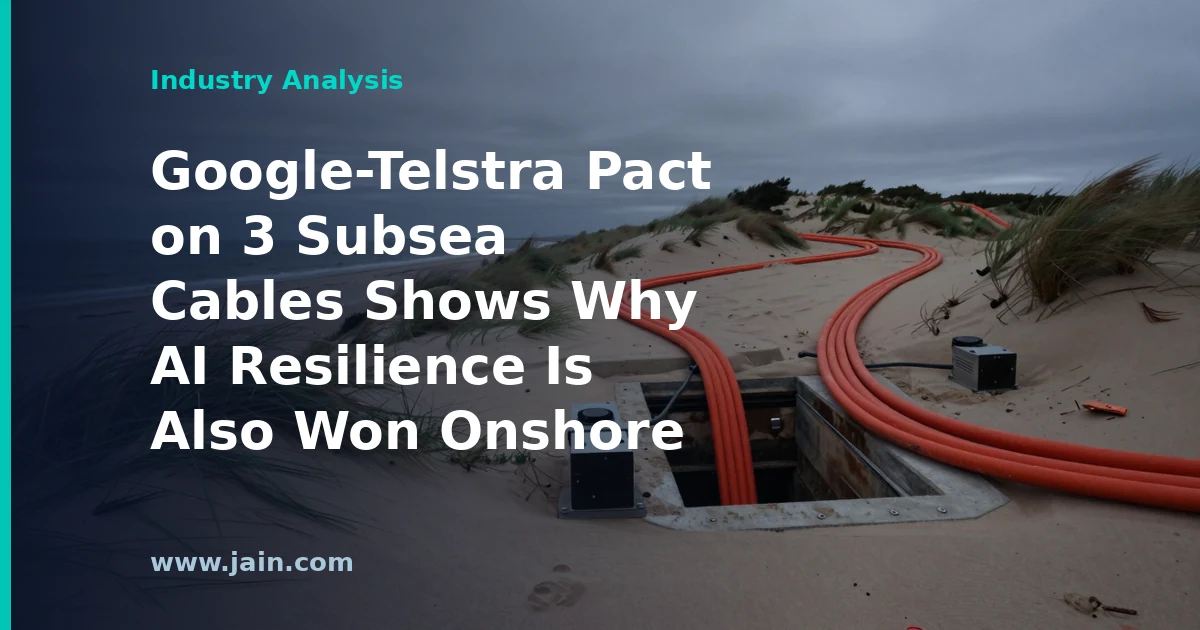
A subsea cable comes ashore at a landing station, and from there its traffic still has to travel overland, over terrestrial fiber, to data centers, exchanges and cities. Network engineers call the full path end-to-end diversity. If two separate ocean cables land in different places but their inland backhaul runs through the same conduit or corridor, a single construction accident can cut both. The ocean diversity bought at great cost is lost a few kilometers from the beach.
The Google-Telstra deal is built around that problem. Google already has subsea reach into the region through Tabua, Proa and Bulikula. What it lacked was inter-city capacity on land that it controls. It chose dark fiber, which means it lights the strands with its own optical equipment and sets capacity and upgrade timing itself, and it chose it on a new backbone that is physically separate from older routes. Telstra had the domestic network but wanted more international exits. The release states that integrating the two lets ‘Telstra and Google each remove single points of network failure.’ That is the substance behind the AI framing. As AI services depend more on moving data between Australian cities and overseas compute, a cable cut costs more, and the fix involves the land side as much as the sea side.
Several groups are affected. Google’s Australian users and cloud customers get more alternative routes if a path fails. Telstra’s enterprise and government customers get more options for international traffic. Other carriers and cloud providers face a competitor pair that now controls diversity at both ends of the path. This is one deal, so it is not proof of an industry trend. It is a clear example of how a hyperscaler, meaning one of the largest cloud operators, and a national carrier can split the build instead of each duplicating the other’s half.
A Two-Way Exchange of Scarce Assets
The structure is notable because each company offers something that is slow and expensive to replicate. Laying new inter-city fiber across Australia takes years of trenching, permits and landholder negotiations. Building a trans-Pacific cable takes consortium financing, marine surveys and cable-ship time. By exchanging access, each company avoids building the other’s specialty. Long-haul fiber and subsea capacity commonly change hands through long-term rights of use. The companies have not said whether cash, capacity or both are involved in this deal.
For Telstra’s Aura build, a hyperscaler taking dark fiber serves as an anchor tenant, a large customer whose commitment helps justify the network. Worrall tied the deal to Aura’s momentum and to ‘sustainable, disciplined growth.’ That suggests the company sees Google as validation for the backbone’s economics. How much of Aura’s capacity Google has taken, and on which routes, has not been said.
What Is Substantiated and What Is Aspiration
Some claims are concrete. These include the named cable systems and their destinations, the dark-fiber arrangement on Aura, Aura’s more than 8,000 kilometers laid, and the launch of the Melbourne-Canberra-Sydney coastal routes. The resilience mechanism is also sound network engineering.
Other claims are broader and harder to test. These include the partnership being ‘a significant step forward in securing Australia’s digital and AI future,’ Australia’s role as a ‘regional connectivity hub,’ and the link to ‘the next industrial revolution.’ The release does not quantify AI traffic growth, capacity added, or any change in latency or availability. These are reasonable ambitions for a well-connected market. Readers should weigh them as direction rather than as measured outcomes.
Background
Australia’s geography makes it heavily dependent on subsea cables for international traffic. Its population is concentrated in a few coastal cities linked by long terrestrial fiber routes. That combination makes route diversity, both at sea and on land, a recurring concern for carriers, cloud providers and government. Telstra is Australia’s largest telecommunications company. Its Telstra Digital Infrastructure unit is building Aura, a new inter-city fiber backbone.
Google, a subsidiary of Alphabet, has become one of the most active investors in subsea cables worldwide. It uses them to connect its data centers and to serve cloud and consumer products. Through its Pacific Connect and Australia Connect initiatives, it has backed new systems linking Australia with Japan, the Pacific Islands and the United States, including Tabua, Proa and Bulikula. Source: Google and Telstra Partner to Connect Australia and Bolster its Digital Future: Google Cloud Press Corner announcement of the Aura dark-fiber and Tabua, Proa and Bulikula subsea partnership.Sources