
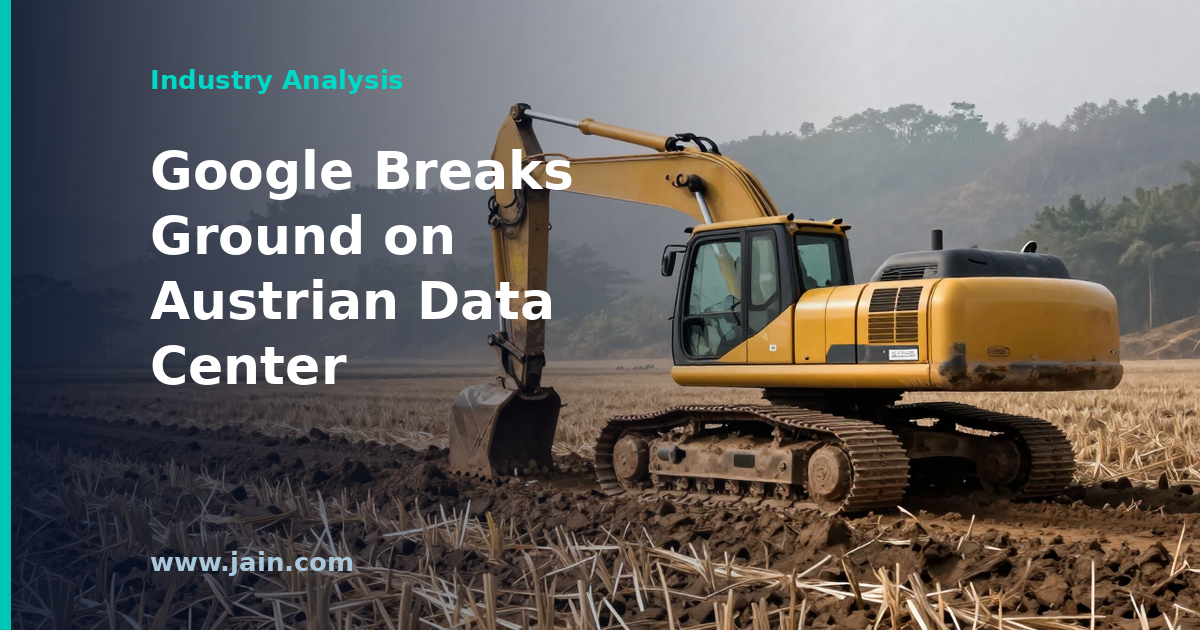
Google has begun construction on a data center in Kronstorf, a municipality in the Linz-Land district of Upper Austria, according to a groundbreaking announcement posted to the Google Cloud Press Corner and distributed on 23 April 2026. The item marks the start of physical work on the site.
The release as circulated is a headline announcement. It does not, in the version distributed through news syndication, state the campus size, planned power capacity, capital commitment, construction timeline, staffing, or whether the facility will underpin a new Google Cloud region for Austria.
Executive Summary
Groundbreaking is the point at which a data center stops being a land holding and becomes a construction project. For a hyperscaler — an operator running compute at global scale, such as Google, Amazon Web Services, Microsoft or Meta — it normally implies that land control, planning permission and, critically, a grid connection agreement are already settled. Those are the hard parts. Steel and concrete are comparatively easy.
The significance of Kronstorf is geographic more than technical. Europe’s data center industry has historically concentrated in five markets known as FLAP-D: Frankfurt, London, Amsterdam, Paris and Dublin. Those markets are now constrained less by demand than by electricity — grid connection queues, local moratoria and planning resistance have pushed new capacity outward into secondary markets with available power. Upper Austria, sitting on a hydro-heavy generation mix and on fiber routes between Munich, Vienna and northern Italy, fits that pattern.
What the announcement does not do is tell buyers anything actionable. Google has not, as far as the distributed release states, committed to a launch date or to an Austrian cloud region. Enterprises with Austrian data residency requirements should treat this as an encouraging signal about Google’s intentions, not as a procurement input.
Why Austria, and Why Now
The proximate driver of hyperscale expansion into new European markets is power availability, not proximity to customers. Latency between Kronstorf and Frankfurt is a rounding error for most workloads; the difference that matters is whether a transmission operator can deliver tens of megawatts on a schedule the builder can plan around. In several established hubs it cannot. Dublin’s grid operator has restricted new data center connections in the Greater Dublin area for years, and Amsterdam imposed a construction pause that reshaped Dutch development. Frankfurt and London face their own queue and land pressures.
Austria offers a different profile. Its electricity generation is unusually hydro-weighted by European standards, which is attractive both for carbon accounting and for price stability relative to gas-linked markets. Upper Austria is an industrial region with existing heavy-load infrastructure — the kind of grid that was built for manufacturing and can, in principle, be repurposed for compute. Kronstorf sits between Linz and Steyr, close to that industrial corridor.
None of this is stated in the release. It is the standard site-selection logic of the sector, and it is the most plausible reading of the decision. Readers should hold it as inference, not as a company claim.
What a Groundbreaking Actually Signals
Announcements of this kind are frequently over-read in both directions. A groundbreaking is a stronger signal than a land purchase or a memorandum of understanding: capital has been committed, contractors are mobilised, and the permitting and interconnection work that typically consumes years has largely concluded. Hyperscalers do not break ground on sites they intend to abandon, and the sunk cost from this point forward rises steeply.
It is a weaker signal than a service commitment. Large data center builds commonly run two to four years from groundbreaking to first customer traffic, and campuses are usually delivered in phases, with later buildings contingent on demand and on the operator’s capital plan at the time. A groundbreaking therefore says a facility is being built; it does not say when it will serve traffic, at what capacity, or which Google products will run on it.
The distinction matters most for the question of a Google Cloud region in Austria. A physical data center and a published cloud region are related but separate things — regions require multiple availability zones, a defined service catalogue and a launch commitment. The release, as distributed, does not make that commitment, and the absence should not be filled in by assumption.
Winners, Losers, and the Local Ledger
The clearest beneficiaries are Austrian enterprises and public-sector bodies with data residency obligations, who gain a credible prospect of in-country hyperscale capacity, and the regional construction and electrical trades, who capture the build phase — the largest and shortest-lived share of employment any data center generates. Local landowners and the municipal tax base typically benefit as well.
The competitive read is that Google is buying optionality in the DACH region rather than responding to a single anchor customer. Microsoft and AWS both hold established positions in German-language markets, and Vienna already hosts commercial colocation from international operators. Entering Austria with owned capacity changes Google’s cost structure and its sovereignty story simultaneously — owned facilities are cheaper at scale than leased ones and easier to make claims about.
The costs land locally and are worth stating plainly rather than defensively. Large sites consume grid capacity, land and, depending on the cooling design, water; operational employment is modest relative to capital deployed. Communities that raise these points are asking legitimate questions, and the honest answer is that this release provides no basis to evaluate them in either direction. When Google publishes capacity, cooling method and water sourcing, those figures should be tested — and so should any counter-claims made about them.
Reading a Thin Announcement Fairly
It would be unfair to characterise this release as evasive. Groundbreaking announcements are ceremonial by convention across the industry, and operators routinely withhold capacity figures for competitive and security reasons. Google’s more detailed European disclosures have historically followed at launch rather than at first excavation.
It would be equally unfair to present the announcement as more than it is. What is substantiated: construction has started at Kronstorf, and Google is the party announcing it. What is not substantiated by the release text: megawatts, euros, jobs, dates, cooling design, power procurement, and any regional service commitment. Coverage that supplies those numbers should be checked against a primary source.
For infrastructure buyers, the practical posture is patience. Treat Kronstorf as evidence of Google’s medium-term intent in Central Europe, factor it into three-to-five-year architecture planning, and revisit when the operator publishes a launch date or a region announcement.
Background
Google operates a global network of owned data centers supporting Search, YouTube, Workspace and Google Cloud, with a substantial European footprint including sites in Ireland, the Netherlands, Belgium, Finland and Denmark. Its cloud business competes with Amazon Web Services and Microsoft Azure, where physical proximity and in-country capacity increasingly matter for regulated customers subject to data residency rules.
Austria has hosted commercial colocation and enterprise data centers for years, largely concentrated around Vienna, but has not been a primary hyperscale construction market. The wider shift of European capacity toward secondary markets has been driven principally by electricity: as grid connections in Dublin, Amsterdam and Frankfurt became constrained, operators moved toward regions with spare transmission capacity and favourable generation mixes. Upper Austria, with its hydro-heavy power supply and existing industrial grid, sits squarely in that category.
Source: Google Breaks Ground on Data Center in Kronstorf, Austria – Google Cloud Press Corner — Google’s groundbreaking announcement for a data center site in Upper Austria, published 23 April 2026.