
TL;DR · 30-second read
The Short Version
Google is planning a $3 billion computer-server complex in rural southwest Virginia. A water deal signed last year allowed it to eventually draw up to 8 million gallons a day, roughly a dozen Olympic swimming pools, while the region faces drought.
After local pushback, Google says its first building will be cooled with air instead of water. But that covers only one of three buildings, and air cooling usually burns more electricity. Residents now want to know how much, and where that power comes from.
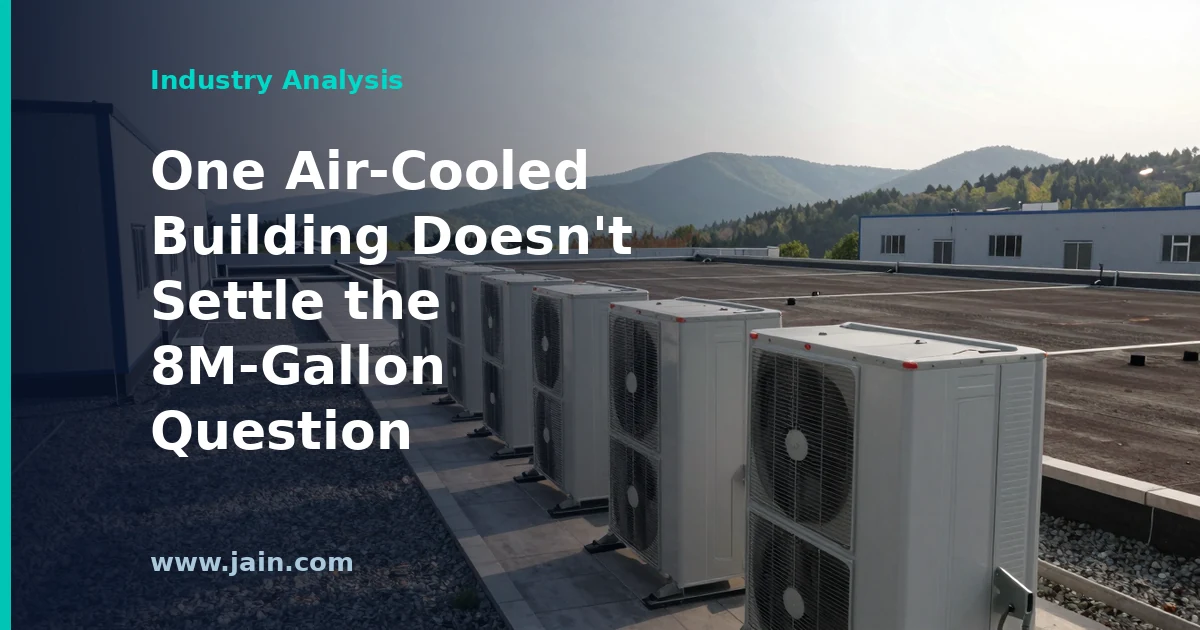
Google confirmed on Friday, July 24, 2026, that the first building of its proposed $3 billion data center campus at the Botetourt Center at Greenfield in Botetourt County, Virginia, will use air cooling rather than water to keep its equipment cool, Virginia Business reported. Cooling for the campus’s two other planned buildings “remains under active evaluation,” according to an update on botetourtcountydatacenter.com.
The decision follows community concern over Google’s October 2025 utility services funding agreement with the Western Virginia Water Authority, which anticipated up to 8 million gallons of water per day at full buildout and no more than 2 million gallons per day initially.
Executive Summary
Google has chosen air cooling for the first of three buildings on its Botetourt County campus. A Google spokesperson said the company “determined that air cooling was the appropriate solution based on the facility’s needs and our focus on operating efficiently and responsibly,” and the project website described the choice as “driven by business demand and infrastructure requirements.”
The announcement is a meaningful concession to local water concerns, arriving as the neighboring Roanoke drought region sits at emergency status. But it is scoped narrowly. It settles one building, not the campus, and Google has not published a revised water estimate or said whether the 8-million-gallon full-buildout figure in its water agreement still reflects its plans.
It also shifts the debate rather than ending it. Cooling a data center without water generally means spending more electricity, and a local group, the Southwest Virginia Data Center Transparency Alliance, is now asking how much power the facility will need and where it will come from.
One Building of Three Doesn’t Move the Ceiling
The number that alarmed residents was 8 million gallons a day, the full-buildout figure in Google’s October 2025 agreement with the Western Virginia Water Authority. That figure describes the whole campus. The July 24 decision covers only the first building, and the project website says the other two remain under evaluation. Nothing in Google’s statement revises the agreement’s terms or offers a new campus-wide estimate.
That matters because of how utility planning works. A water authority sizing pipes, treatment and supply commitments plans against the maximum a customer is entitled to draw, not the amount the first phase happens to use. As long as the agreement anticipates up to 8 million gallons at buildout, the authority, local officials and neighboring communities are still planning around that ceiling. The first building likely draws well under the agreement’s 2-million-gallon initial limit, but Google has not said by how much.
So the practical effect is a deferral. The first phase gets lighter on water; the larger question of what the finished campus will consume moves to the decision on buildings two and three, which has no announced timeline.
Water Saved Is Power Spent
Data centers turn nearly all the electricity they use into heat, and that heat has to go somewhere. Evaporative, or water-based, cooling removes it efficiently by evaporating water, much as sweat cools skin. Air-based systems avoid that water loss but generally rely more heavily on fans and mechanical chillers, which consume electricity. Operators track the two sides with separate yardsticks: water usage effectiveness (litres per unit of computing energy) and power usage effectiveness (total facility energy divided by what the servers use). Improving one often worsens the other.
That is the trade-off the Transparency Alliance flagged. Co-founder Julie Bivins asked how much power the facility will now use and whether it will come from fossil fuels, natural gas or nuclear. Those are fair questions, and they apply symmetrically: Google has not quantified the added energy draw, and the alliance has not quantified it either. Whether the swap is a net environmental gain depends on the local grid’s generation mix and on how water-stressed the region is, and neither side has put those numbers on the table.
The density of the hardware inside also shapes the choice. Air cooling suits lower-density server halls; the most power-hungry equipment, including the accelerators used for AI workloads, increasingly pushes operators toward liquid cooling. Google has not said what the Botetourt buildings will host, but the website’s reference to “business demand and infrastructure requirements” suggests the cooling decision for later buildings will turn on what they are built to run, not only on water.
A Cooling Decision Made in a Drought
The timing is hard to separate from the local climate. On July 15, Gov. Abigail Spanberger announced that the Roanoke Drought Evaluation Region, which includes Roanoke city and Roanoke County next to Botetourt, had reached emergency status, while most of Virginia sat under drought warnings or watches.
Local governance has been strained as well. Botetourt County said on July 3 that its planning commission lacks legal authority to independently convene public hearings, and The Roanoke Times described tense proceedings at the commission’s July 13 meeting, where members voted to recommend that the Board of Supervisors direct them to organize a meeting on water supply.
For developers elsewhere, the lesson is that cooling architecture is no longer purely an engineering decision made late in design. Water commitments negotiated early, and disclosed later through public-records requests, can become the defining public fact about a project. Publishing water and power estimates together, per building and at buildout, is the clearest way to show what a cooling trade-off actually saves.
Background
Google’s planned campus sits at the Botetourt Center at Greenfield, an industrial park in Botetourt County, just north of Roanoke in southwest Virginia. The company has proposed a $3 billion investment across three buildings, part of a broader push of large data center projects beyond Virginia’s established hub in the northern part of the state.
Data centers house the servers behind cloud services, search and AI, and they need continuous cooling. Many large facilities use evaporative systems that consume significant water; others use air-based or closed-loop designs that use less water but more electricity. That choice has become a central point of negotiation between developers and host communities, particularly in areas facing drought. Source: Google to use air-cooling tech for first Botetourt data center, reducing water use (Virginia Business): Google confirms air cooling for the first building of its Botetourt County campus as water and power concerns grow.Sources