
TL;DR · 30-second read
The Short Version
Google is studying a site west of Richmond, Virginia, for a campus of data centers that could use as much electricity as one large nuclear reactor produces. Data centers are the giant warehouses of computers behind search, video and artificial intelligence.
Another developer wants a campus almost as big nearby. Together they would need far more power than the area uses today.
The land is the easy part. Getting that much electricity to one spot usually means new high-voltage power lines, which take longer than buildings. Some residents worry about noise and lights. The county is hoping for tax money.
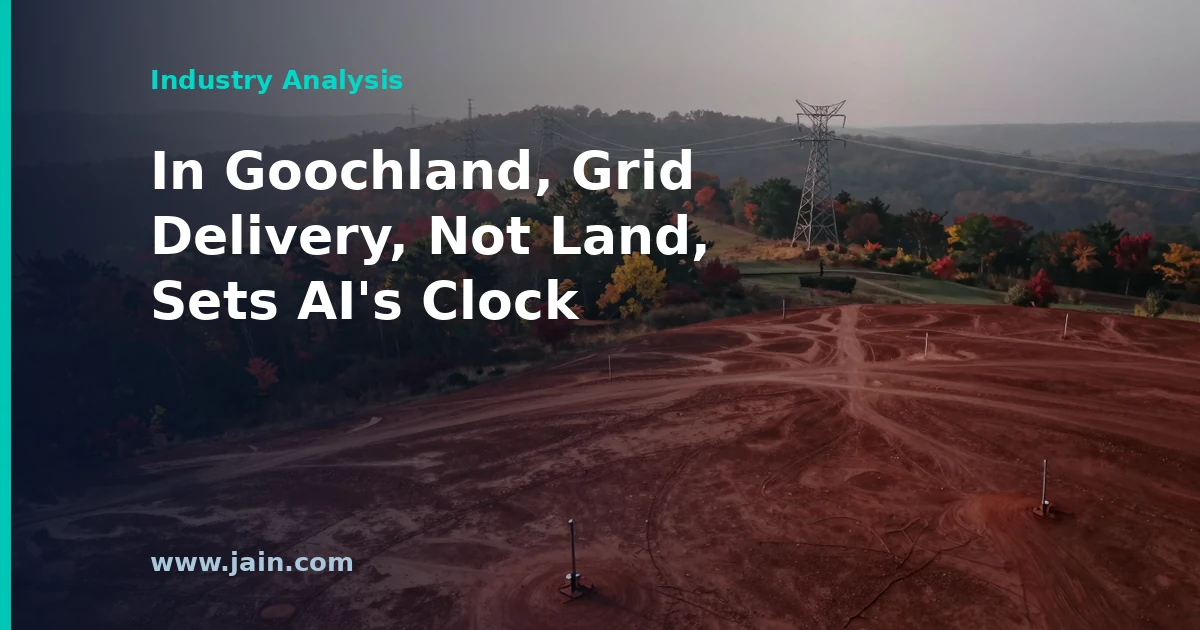
Google is evaluating a data center campus of up to 1.2 gigawatts (GW) on about 1,000 acres at the West Creek Business Park in Goochland County, Virginia, west of Richmond. The plan came to light through an unsealed non-disclosure agreement reported by WRIC. The site sits off Route 6 and Hockett Road. Google says it is still doing due diligence, the checks a buyer runs before committing, and has not finalized plans.
Developer Tract is separately proposing an 872-acre campus at the nearby Tuckahoe Technology Park, bounded to the west by Hockett Road. Site plans show up to 12 buildings and as much as 900 megawatts (MW) at full build-out, with more than $3 billion of potential investment.
Executive Summary
A gigawatt is a thousand megawatts. Running a campus at 1.2 GW continuously would draw roughly what one large nuclear reactor generates. Google has identified the land, and Goochland’s Board of Supervisors has already created a Technology Overlay District and Technology Zone to attract this kind of investment. Neither Google nor Tract has said how the electricity will reach these sites.
That gap is the story. Adding Google’s 1.2 GW to Tract’s 900 MW gives about 2.1 GW of proposed data center demand clustered around Hockett Road. Power on that scale has to come through high-voltage transmission lines and substations, which go through utility planning and state review. Those steps usually take longer than building the data halls. For Google, whose cloud revenue more than doubled last quarter on demand for AI infrastructure, the schedule for this site will likely depend on the grid rather than on construction.
Land Is the Easy Part; 2.1 GW of Delivery Is Not
Several of the usual early hurdles for a hyperscale campus (one built by a cloud giant at very large scale) have already moved. Google has a defined 1,000-acre parcel. The county has created a technology overlay and zone meant to draw investment and tax revenue. Google’s public affairs team has said the company is optimistic about the site. Land in a business park with friendly zoning can be secured in months.
Electricity is harder. Google’s proposed 1.2 GW and Tract’s 900 MW at full build-out total about 2.1 GW of possible new load within a few miles of Hockett Road. Data center load is close to constant, around the clock, so planners cannot count on it fading at night the way households or offices do. Serving demand like this usually requires new or upgraded transmission lines, new substations, and sometimes new generation. Each goes through the utility’s planning process and state regulators. Neither company has said which utility will serve the site, how much power has been requested, or when it might be delivered. Until those answers exist, the 1.2 GW figure is a ceiling for the site, not a schedule.
The people affected are clear. The utility’s long-range transmission planning west of Richmond becomes a dependency for both projects. Other large customers in the region may end up competing for the same upgrades. Ratepayers will have a stake in how the cost of new lines is shared, a question regulators settle and the companies have not addressed.
The Demand Pushing Capacity Outward
Northern Virginia, centered on Loudoun County, is the world’s largest data center market, and getting power to new sites there has been widely reported as a constraint. Large proposals around Richmond fit a broader pattern of developers looking for land and grid capacity farther from that core. Google has not said why it chose West Creek, so this is a reading of the pattern rather than a stated motive.
The demand behind that search is well documented. In its third-quarter results, furnished in an 8-K filed October 28, Alphabet reported Google Cloud revenue up 103% to $30.7 billion, driven by enterprise AI infrastructure and AI solutions, with TPU systems (Google’s in-house AI chips) a meaningful contributor. CEO Sundar Pichai said Google’s first-party model APIs now process nearly 32 billion tokens per minute, more than four times the level of a year earlier. Tokens are the small units of text AI models read and write. Usage growing that fast turns into demand for physical computing capacity, and that capacity needs power.
Alphabet Is Funding the Build at Scale
Alphabet’s earnings release shows the company raising large amounts of capital. In the third quarter it issued senior unsecured notes for net proceeds of $28.7 billion, designated for general corporate purposes. It also sold about $12.4 billion of Class A and Class C stock through its at-the-market program, which lets a company sell shares gradually into the market, and had $27.6 billion of capacity left in that program at September 30. Alphabet also pays dividends on mandatory convertible preferred stock, another financing tool on its balance sheet.
None of this money is tied to Goochland in the filings, and it would be wrong to assume it is. The point is narrower. Funding does not appear to be what limits a 1.2 GW campus for Alphabet. That leaves power delivery, permitting and local approval as the likelier sources of delay.
Tax Base Versus Quality of Life
The county’s case is straightforward: the technology overlay was created to raise investment and tax revenue, and large data centers pay significant property and equipment taxes while using relatively few public services. The county has not published revenue projections for either project, so the size of that benefit cannot yet be tested.
Residents’ concerns are specific. Goochland resident Cynthia Haas cited noise, pollution and lights at night, and argued the projects would dramatically change how the county looks. Google says it is committed to working transparently with residents and local leaders and points to more than 20 years of building data centers. That record is a general claim. Google has not yet said how it would address noise, lighting, backup generators or cooling water at this site. Both sides will make their case on details that have not been disclosed so far.
Background
Virginia has the largest concentration of data centers in the world, centered on Loudoun County in Northern Virginia, where the industry has grown for more than two decades. As AI has pushed demand for computing capacity sharply higher, developers have looked beyond that core for large parcels and available grid capacity. The Richmond region is one destination. Goochland County, west of Richmond and named after colonial governor Sir William Gooch, created a Technology Overlay District and Technology Zone to compete for that investment.
Google, a subsidiary of Alphabet, runs one of the largest data center fleets in the world to support Search, YouTube and Google Cloud. Alphabet’s third-quarter 2026 results showed consolidated revenue up 25% to $127.6 billion and Google Cloud revenue up 103% to $30.7 billion, much of it tied to AI infrastructure demand. Source: Google eyes 1,000 acres for 1.2GW data center in Goochland County, Virginia, Data Center Dynamics’ report on Google’s West Creek site evaluation and Tract’s nearby Tuckahoe Technology Park plans. Primary sources: Alphabet Inc. Form 10-Q for the quarter ended September 30, 2026 (filed October 29, 2026); Alphabet Inc. Form 8-K (filed October 28, 2026); Alphabet Announces Third Quarter 2026 Results (Exhibit 99.1 to Form 8-K, October 28, 2026).Sources