
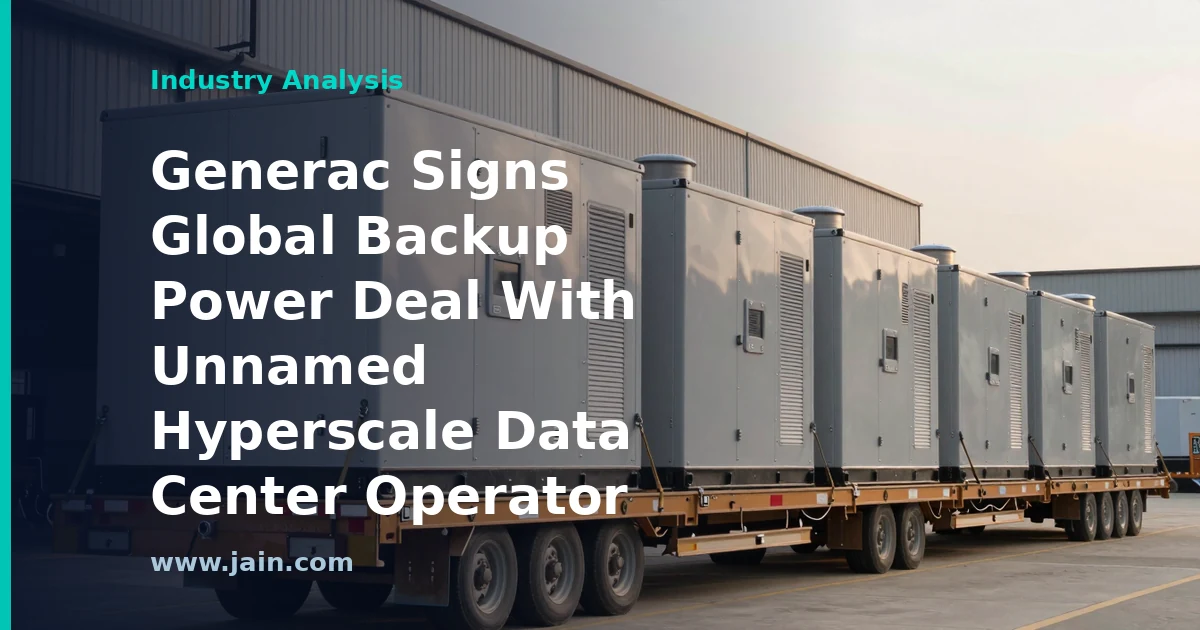
Generac Power Systems announced on June 1, 2026 that it has signed a global supply agreement to provide backup power equipment to a company it describes as a leading hyperscale data center operator. The customer was not named, and the announcement, distributed via PR Newswire, did not disclose financial terms, unit volumes, or a delivery timeline.
Executive Summary
The announcement matters less for its disclosed details — which are minimal — than for what it signals about both parties. For Generac, a company best known for residential standby generators, a global agreement with a hyperscaler is a credibility milestone in the large commercial and industrial power market, where data centers have become the most sought-after customer class. Hyperscalers — the handful of companies operating cloud and AI computing platforms at global scale — historically sourced backup generation from a small set of heavy-industrial incumbents.
For the data center industry, the deal is another data point in a broader pattern: operators locking in multi-year, multi-region supply of critical electrical equipment rather than procuring project by project. When a hyperscaler signs a global agreement for backup power, it suggests that generator capacity, like transformers and switchgear before it, is now scarce enough to justify strategic sourcing. That framing should be tempered by what the release does not say — no customer name, no dollar value, no megawatt figure — which limits how much weight the announcement can bear.
Backup Power Moves From Commodity to Constraint
Every serious data center pairs its utility feed with on-site backup generation — typically large diesel or natural gas generator sets that carry the facility through grid outages. For most of the industry’s history this was routine procurement: generators were a mature, readily available product bought near the end of a project’s design cycle. The AI-driven construction boom changed that. As operators race to bring gigawatts of new capacity online, long-lead electrical equipment — transformers, switchgear, and increasingly generator sets — has become a pacing item that can delay a facility as surely as a missing utility interconnection.
A global supply agreement is the procurement response to that scarcity. Instead of bidding each project separately, an operator reserves manufacturing capacity across regions and years, trading flexibility for certainty of delivery. The fact that a hyperscaler apparently judged this worthwhile for backup power is itself evidence of how tight the market has become, and it mirrors similar forward-buying behavior seen across the data center supply chain.
What the Deal Means for Generac
Generac built its business on home standby generators and mid-sized commercial units, while the largest data center generator orders have traditionally gone to heavy-industrial manufacturers such as Caterpillar, Cummins, and Rolls-Royce’s mtu brand. Generac has spent recent years pushing into larger industrial applications, and a hyperscale win — if it translates into sustained volume — would validate that strategy in the most demanding segment of the market. Hyperscale operators qualify suppliers rigorously, so passing that bar is meaningful even before any units ship.
The caution is that the release discloses no volumes or revenue. Supply agreements can range from firm multi-year commitments to framework arrangements that simply make a vendor eligible for future orders. Without disclosed terms, investors and industry observers cannot yet distinguish between the two, and the announcement should be read as a positive signal rather than a quantified backlog addition.
Why Hyperscalers Are Diversifying Their Supplier Base
From the buyer’s side, adding a supplier makes straightforward sense. When incumbent generator manufacturers carry extended backlogs, a hyperscaler that depends on a narrow vendor list risks having construction schedules dictated by someone else’s factory queue. Qualifying an additional manufacturer at global scale adds resilience, creates pricing competition, and expands total available manufacturing capacity — the same playbook hyperscalers have applied to chips, power equipment, and construction contractors.
The competitive implication for the wider market is worth watching: enterprise and colocation buyers, who lack hyperscale purchasing power, may find themselves further back in the queue as manufacturers allocate capacity to their largest strategic accounts. Backup power availability could quietly become another dimension on which the largest operators out-execute smaller ones.
Background
Generac Power Systems, founded in 1959 and headquartered in Waukesha, Wisconsin, became a household name in residential standby generators — the units that keep homes powered through grid outages. Over the past decade it has expanded into commercial and industrial generation, energy storage, and grid services, seeking growth beyond the housing-linked residential market. The largest tier of that industrial market is data center backup power, a segment long dominated by heavy-equipment incumbents.
The announcement lands amid an unprecedented data center construction cycle driven by cloud growth and AI computing demand. That boom has strained the supply chains for electrical infrastructure of every kind, prompting the biggest operators to lock in equipment supply years ahead — the context in which a global backup power agreement with a hyperscaler is best understood.
Source: Generac Signs Global Supply Agreement with Leading Hyperscale Data Center Operator to Supply Backup Power — PR Newswire release, June 1, 2026, announcing Generac’s backup power supply agreement with an unnamed hyperscale data center operator.