
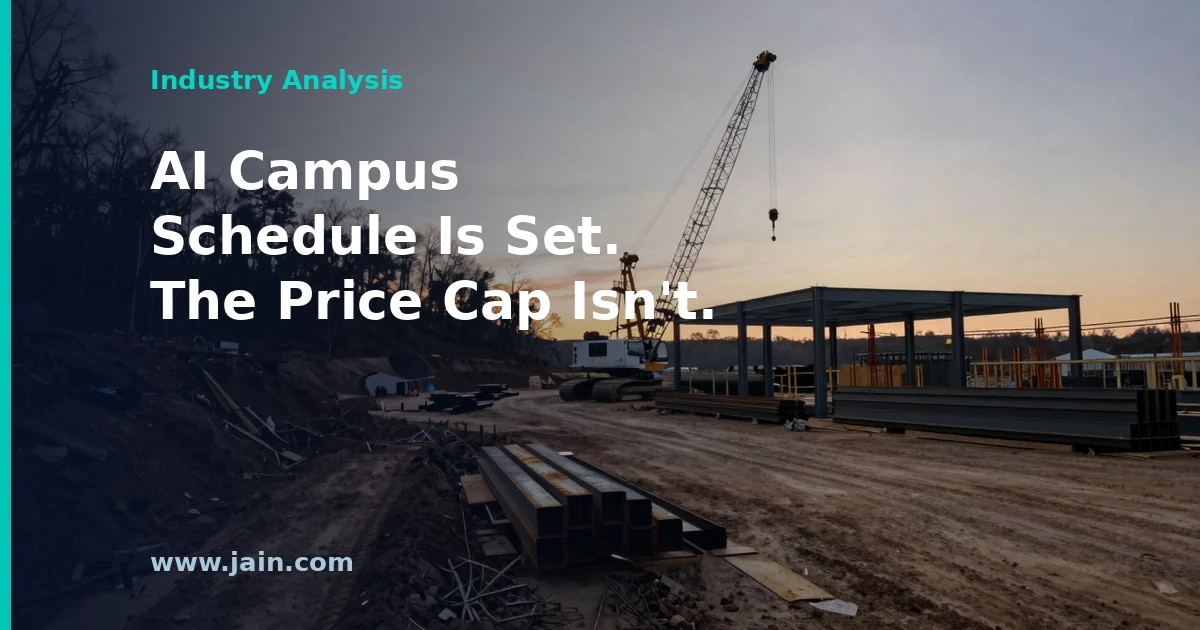
TL;DR · 30-second read
The Short Version
An artificial intelligence company, Anthropic, has agreed to rent a giant computing campus in Hawesville, Kentucky, for 20 years, in deals worth about $19 billion. Google has agreed to step in under certain conditions if the rent stops.
The campus owner, TeraWulf, has now signed a full building contract with construction firm Fluor. Handover starts in late 2027, and rent starts only as space is delivered, so delays push back the money.
The surprise: the most Fluor can charge is still being worked out. The income is largely agreed. The final building bill is not.
TeraWulf announced on November 4, 2026 that it has signed a definitive engineering, procurement and construction (EPC) agreement with Fluor Enterprises for three data center buildings at its Justified Data Campus in Hawesville, Kentucky. The contract is on a guaranteed maximum price basis, and phased ready-for-service completions are expected from late 2027 through the second quarter of 2028.
The same day, TeraWulf disclosed in an 8-K that Google agreed to backstop certain obligations of Anthropic, the campus tenant, under 20-year leases covering approximately 401 MW of critical IT load, the power available to run computing equipment. TeraWulf’s press release values the lease commitments at approximately $19 billion.
Executive Summary
The Fluor agreement expands the contractor’s role beyond the limited notice to proceed announced in March 2026, which covered early engineering and pre-construction. Its scope now runs through engineering, procurement, construction, testing and commissioning, with defined delivery milestones, open-book cost reporting, procurement oversight and contractual performance protections.
The most consequential detail is a single sentence in TeraWulf’s press release: guaranteed maximum pricing “is being established” as engineering and procurement progress. The delivery dates and the lease commitments have been stated, but the contractual ceiling on construction cost has not.
That matters because TeraWulf is arranging debt against this project and has made capital discipline central to its pitch. The Google agreement addresses whether the tenant’s rent is backed. The Fluor price cap will help answer what the asset costs to build, and therefore how much of that rent TeraWulf can keep.
The Schedule Is Stated. The Ceiling Is Not.
A guaranteed maximum price, or GMP, caps what an owner pays a contractor for a defined scope, with overruns above the cap generally falling to the contractor. TeraWulf describes the Fluor agreement as being on a GMP basis, while also saying the pricing is still being established as engineering and procurement progress. That sequence has a practical logic, because a contractor can price more reliably what has already been designed and bought. It also means that, for now, TeraWulf has announced a pricing framework without announcing a capped number.
The economics show why that gap deserves attention. Dividing approximately $19 billion by the 20-year lease term gives an average of about $950 million a year, although this is simple arithmetic and TeraWulf has not published the rent schedule. With the revenue side largely contracted, the cost to build becomes a main driver of project returns. A higher final cap would reduce the return on the same lease commitments, while a lower one would improve it.
The people most directly affected are TeraWulf shareholders, prospective lenders and Fluor itself. Lenders will want to know the cost to complete the project, shareholders will want to know the spread between that cost and the rent, and Fluor will carry more of the risk once a cap is in place. Open-book reporting, which gives the owner visibility into the contractor’s costs, improves oversight, but it does not set the limit. CEO Paul Prager’s promise of “disciplined cost management and clear schedule accountability” has a clear future test in the cap itself.
Why Fluor’s Milestones Now Carry the Lease
The 8-K says Anthropic’s obligation to pay rent begins upon delivery of each data hall. The leases cover three premises, CB-1, CB-2 and CB-3, and the Fluor contract covers three buildings on a matching timetable of late 2027 through the second quarter of 2028. The construction schedule therefore also serves as the starting schedule for rent.
Using the same straight-line average, a month of delay across the full campus would push back about $79 million of rent. That is an illustration rather than a forecast, since delivery is phased, actual rent may vary by year, and TeraWulf has not said how delays would affect the lease term. The mechanism still holds: a late data hall means later revenue while construction capital is already committed.
The credit support has a similar dependency. According to the 8-K, the Google backstop under each agreement becomes effective as of the commencement date for the final data hall under the corresponding lease. As described, it does not begin protecting that lease until construction delivery is complete, which makes Fluor’s execution relevant to lenders before Google’s credit comes into play.
What Google’s Backstop Solves and What It Does Not
The credit support is substantial. Alphabet’s senior unsecured debt, as TeraWulf notes, is rated AA+ by S&P and Aa2 by Moody’s. If Anthropic defaults on payment or becomes insolvent, Google has the option to pay current rent and assume the lease as tenant. Under certain circumstances, it can instead pay a termination fee and become entitled to acquire an equity interest in Raylan, the TeraWulf subsidiary that holds the leases. Google can also defer that choice for a specified period while paying the rent due.
That is meaningful protection, but it has limits. The termination fee amortizes, meaning it declines over a defined term, and the backstop can end if Anthropic or a guaranteeing affiliate achieves and maintains certain investment-grade ratings for at least three months. CFO Patrick Fleury says the support strengthens the company’s ability to pursue competitive long-term debt. That is a reasonable claim, but it remains prospective until TeraWulf reports actual financing terms.
The backstop also addresses a different risk from the Fluor contract. Google’s agreement concerns the tenant’s ability to pay, whereas the EPC agreement concerns whether the buildings arrive on time and at an acceptable cost. A strong credit behind the rent does not reduce the price of the buildings, so the two agreements complement each other without substituting for one another.
The Labor Claim Is Plausible but Not Yet Quantified
TeraWulf describes labor availability as an increasingly important constraint on large-scale data center development, and it presents Fluor’s subcontractor network and more than 100 years of experience as the answer. The strategic reasoning is clear. As Prager puts it, Fluor lets TeraWulf scale “without building a global engineering and construction organization internally.”
What TeraWulf has offered so far is capability rather than measurable commitment. It has not published workforce numbers, subcontractor commitments or procurement status for long-lead equipment. Those details would show how much of the delivery risk has been secured and how much still depends on future hiring and purchasing. The first ready-for-service date in late 2027 will provide the clearest evidence.
Background
TeraWulf, based in Easton, Maryland, develops, owns and operates large-scale, power-backed digital infrastructure in the United States. It operates the Lake Mariner Data Campus in New York, including existing bitcoin-mining infrastructure, and is developing or pursuing campuses in Kentucky, New York and Maryland. The company says it does not invest in AI compute hardware, instead supplying the underlying infrastructure under long-term leases.
The Justified campus in Hawesville is one of two Kentucky sites named in TeraWulf’s announcement. The other is the Muskie Data Campus in eastern Kentucky, where TeraWulf says contracted power capacity recently expanded to 1 GW. Fluor, the contractor on Justified, is described by TeraWulf as having more than 100 years of experience delivering complex infrastructure projects. Source: Fluor signs EPC contract with TeraWulf for Kentucky data centre campus, Data Centre Solutions’ report on the Fluor agreement for TeraWulf’s Kentucky campus. Primary sources: TeraWulf 8-K filed 2026-11-04; TeraWulf press release, Exhibit to 8-K filed 2026-11-04; Fluor Corporation 10-Q filed 2026-11-06.Sources