
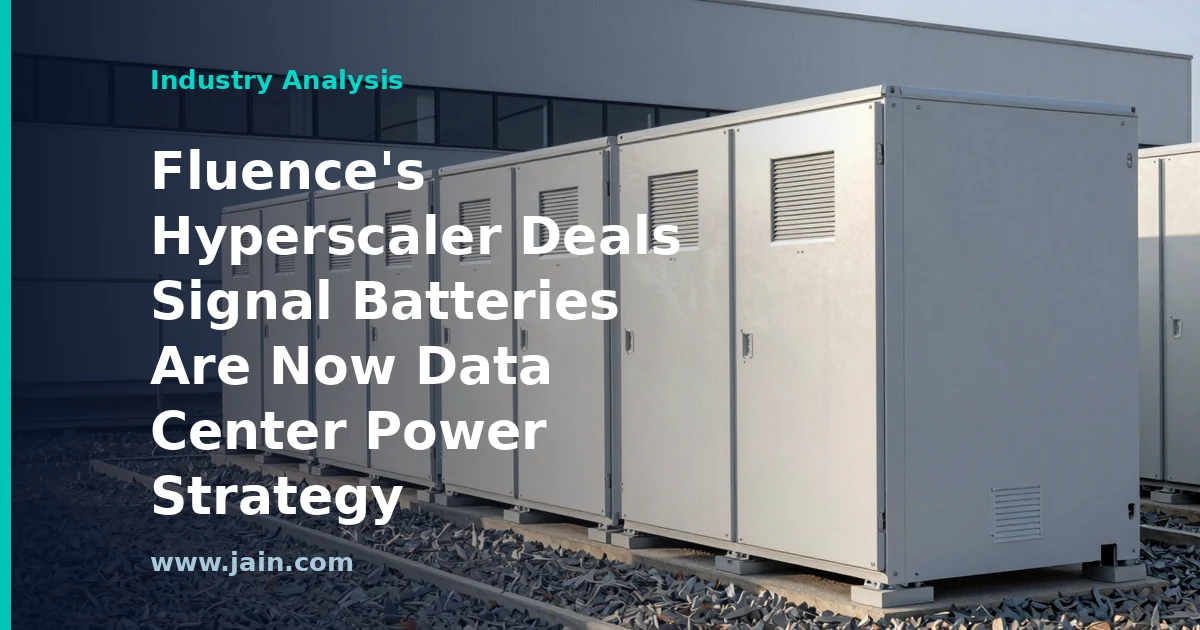
Energy storage company Fluence has signed agreements with two hyperscale data center operators, according to a report by Data Center Dynamics published May 18, 2026. The customers, deal values, and capacities were not disclosed in the source material, but the reported agreements mark a notable step: battery storage being procured directly in connection with hyperscale data center operations rather than solely by utilities and power producers.
Executive Summary
Fluence, one of the largest global suppliers of grid-scale battery energy storage systems, has reportedly landed two hyperscale data center customers — a category of buyer that historically purchased backup diesel generators and grid power, not utility-scale batteries. Hyperscale operators are the companies that run the world’s largest cloud and AI computing campuses, and their electricity demand has become one of the defining forces in power markets.
The significance is less about the (undisclosed) size of these specific deals and more about the buyer category. When hyperscalers begin contracting directly with storage integrators, batteries stop being purely a grid asset — something utilities install to balance supply and demand — and become part of the data center’s own power strategy: a tool for securing grid interconnection, riding through disturbances, and shaping when and how a facility draws power. If the pattern holds, it opens a substantial new demand channel for the storage industry and a new procurement lever for data center developers stuck in multi-year grid connection queues.
Why Hyperscalers Are Buying Batteries
The immediate driver is the collision between AI-era data center demand and a slow-moving grid. In many major markets, new large loads face interconnection waits measured in years, and utilities increasingly ask big customers to demonstrate they can soften their impact on the system. A battery energy storage system (BESS) — essentially a warehouse-scale bank of lithium-ion cells with power electronics — lets a data center reduce its peak draw, absorb power when it is cheap and plentiful, and present a more flexible, grid-friendly load. That flexibility can be the difference between an energization date in 2027 and one in 2030.
Batteries also address power quality. AI training clusters create fast, large swings in electricity demand that stress both on-site infrastructure and the surrounding grid; storage can buffer those swings. And for operators with public clean-energy commitments, batteries paired with wind and solar contracts help match consumption to carbon-free supply hour by hour, rather than only on an annual-average basis.
What Hyperscaler Customers Mean for Fluence
Fluence built its business selling storage systems and services to utilities, independent power producers, and renewable developers. Data centers represent diversification into a customer class with deep balance sheets, urgent timelines, and — critically — willingness to pay for speed and reliability rather than shopping purely on cost per megawatt-hour. For a storage integrator, that is an attractive shift in buyer mix, and landing two hyperscale names at once suggests deliberate strategy rather than a one-off win.
That said, the report gives no deal sizes, so the revenue significance cannot be assessed. Two agreements could range from pilot installations at single campuses to multi-site framework deals. The storage industry has seen announcements in both categories, and they carry very different weight. Until capacities and terms are disclosed, this is best read as a directional signal about the market, not a measurable change in Fluence’s book of business.
Batteries Versus Diesel — and Versus Gas Turbines
Data centers have long relied on diesel generators for backup: cheap to install, proven, but polluting, increasingly hard to permit, and useless for anything except emergencies. Batteries invert that profile. They are cleaner and can earn their keep daily — shaving peaks, providing grid services, arbitraging power prices — but standard four-hour lithium-ion systems cannot carry a facility through a multi-day outage. In practice, storage today complements rather than replaces backup generation, and the interesting design question is how large a battery a hyperscaler buys and what jobs it is asked to do.
The competitive backdrop matters too. Some data center developers are answering the power crunch with on-site gas turbines or fuel cells; others are betting on storage-plus-renewables or, further out, small modular reactors. Each path trades off speed, cost, carbon, and permitting risk differently. Hyperscalers signing with a storage integrator indicates that, at least for some sites, batteries have won a seat at that table — a meaningful endorsement in a market where Fluence competes with Tesla’s Megapack business, Sungrow, and a field of Chinese and Western integrators.
What Is Substantiated — and What Isn’t
It is worth being plain about the evidentiary base. The source is a single trade-press headline reporting that deals were signed; no capacities, locations, customer names, financial terms, or delivery dates accompany it. The trend it points to — storage converging with data center power strategy — is real and independently visible across the industry, but the specific commercial weight of these two agreements is unverified. Readers should treat the announcement as evidence of demand-side interest, not as proof of deployed megawatts.
Even so, thin announcements can be leading indicators. Hyperscalers rarely allow their names near a vendor’s deal news without internal conviction, and storage suppliers rarely publicize data center wins unless they expect the category to grow. The claims worth watching for next are concrete ones: megawatt-hours under contract, energization dates, and whether the systems sit behind the meter at the data center or in front of it on the grid.
Background
Fluence was created in 2018 as a joint venture between industrial group Siemens and global power company AES, combining their early battery storage businesses into a dedicated integrator. It listed on Nasdaq in 2021 and has since deployed grid-scale storage across the Americas, Europe, and Asia-Pacific, selling systems, services, and operational software primarily to utilities, independent power producers, and renewable developers.
The storage market it serves has grown rapidly as falling lithium-ion costs and rising renewable penetration made batteries a standard grid resource. What is newer is the demand side of this story: hyperscale data center operators, whose electricity needs have surged with AI computing, emerging as direct buyers of storage — a convergence of two of the fastest-growing segments in energy and digital infrastructure.
Source: Energy storage firm Fluence signs deals with two hyperscale data centers — Data Center Dynamics report, May 18, 2026, on Fluence’s storage agreements with two undisclosed hyperscale operators.